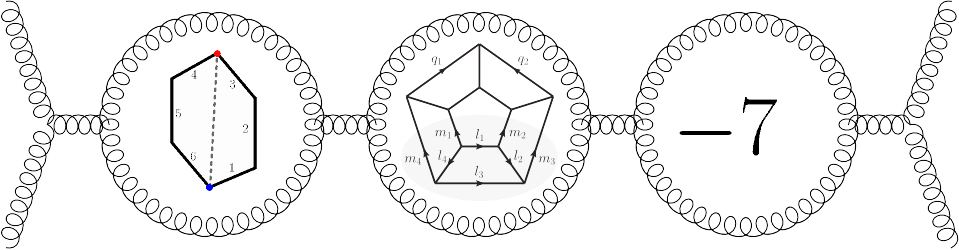
A while back, someone asked me what my subfield, amplitudeology, is really about. I wrote an answer to that here, a short-term and long-term perspective that line up with the stories we often tell about the field. I talked about how we try to figure out ways to calculate probabilities faster, first for understanding the output of particle colliders like the LHC, then more recently for gravitational wave telescopes. I talked about how the philosophy we use for that carries us farther, how focusing on the minimal information we need to make a prediction gives us hope that we can generalize and even propose totally new theories.
The world doesn’t follow stories, though, not quite so neatly. Try to define something as simple as the word “game” and you run into trouble. Some games have a winner and a loser, some games everyone is on one team, and some games don’t have winners or losers at all. Games can involve physical exercise, computers, boards and dice, or just people telling stories. They can be played for fun, or for money, silly or deadly serious. Most have rules, but some don’t even have that. Instead, games are linked by history: a series of resemblances, people saying that “this” is a game because it’s kind of like “that”.
A subfield isn’t just a word, it’s a group of people. So subfields aren’t defined just by resemblance. Instead, they’re defined by practicality.
To ask what amplitudeology is really about, think about why you might want to call yourself an amplitudeologist. It could be a question of goals, certainly: you might care a lot about making better predictions for the LHC, or you could have some other grand story in mind about how amplitudes will save the world. Instead, though, it could be a matter of training: you learned certain methods, certain mathematics, a certain perspective, and now you apply it to your research, even if it goes further afield from what was considered “amplitudeology” before. It could even be a matter of community, joining with others who you think do cool stuff, even if you don’t share exactly the same goals or the same methods.
Calling yourself an amplitudeologist means you go to their conferences and listen to their talks, means you look to them to collaborate and pay attention to their papers. Those kinds of things define a subfield: not some grand mission statement, but practical questions of interest, what people work on and know and where they’re going with that. Instead of one story, like every other word, amplitudeology has a practical meaning that shifts and changes with time. That’s the way subfields should be: useful to the people who practice them.
A reductionist would say that the behavior of the big is due to the behavior of the small. Big things are made up of small things, so anything the big things do must be explicable in terms of what the small things are doing. It may be very hard to explain things this way: you wouldn’t want to describe the economy in terms of motion of carbon atoms. But in principle, if you could calculate everything, you’d find the small things are enough: there are no fundamental “new rules” that only apply to big things.
A physicist reductionist would have to amend this story. Zoom in far enough, and it doesn’t really make sense to talk about “small things”, “big things”, or even “things” at all. The world is governed by interactions of quantum fields, ripples spreading and colliding and changing form. Some of these ripples (like the ones we call “protons”) are made up of smaller things…but ultimately most aren’t. They just are what they are.
Still, a physicist can rescue the idea of reductionism by thinking about renormalization. If you’ve heard of renormalization, you probably think of it as a trick physicists use to hide inconvenient infinite results in their calculations. But an arguably better way to think about it is as a kind of “zoom” dial for quantum field theories. Starting with a theory, we can use renormalization to “zoom out”, ignoring the smallest details and seeing what picture emerges. As we “zoom”, different forces will seem to get stronger or weaker: electromagnetism matters less when we zoom out, the strong nuclear force matters more.
(Why then, is electromagnetism so much more important in everyday life? The strong force gets so strong as we zoom out that we stop seeing individual particles, and only see them bound into protons and neutrons. Electromagnetism is like this too, binding electrons and protons into neutral atoms. In both cases, it can be better, once we’ve zoomed out, to use a new description: you don’t want to do chemistry keeping track of the quarks and gluons.)
A physicists reductionist then, would expect renormalization to always go “one way”. As we “zoom out”, we should find that our theories in a meaningful sense get simpler and simpler. Maybe they’re still hard to work with: it’s easier to think about gluons and quarks when zoomed in than the zoo of different nuclear particles we need to consider when zoomed out. But at each step, we’re ignoring some details. And if you’re a reductionist, you shouldn’t expect “zooming out” to show you anything truly fundamentally new.
Can you prove that, though?
Surprisingly, yes!
In 2011, Zohar Komargodski and Adam Schwimmer proved a result called the a-theorem. “The a-theorem” is probably the least google-able theorem in the universe, which has probably made it hard to popularize. It is named after a quantity, labeled “a”, that gives a particular way to add up energy in a quantum field theory. Komargodski and Schwimmer proved that, when you do the renormalization procedure and “zoom out”, then this quantity “a” will always get smaller.
Why does this say anything about reductionism?
Suppose you have a theory that violates reductionism. You zoom out, and see something genuinely new: a fact about big things that isn’t due to facts about small things. If you had a theory like that, then you could imagine “zooming in” again, and using your new fact about big things to predict something about the small things that you couldn’t before. You’d find that renormalization doesn’t just go “one way”: with new facts able to show up at every scale, zooming out isn’t necessarily ignoring more and zooming in isn’t necessarily ignoring less. It would depend on the situation which way the renormalization procedure would go.
The a-theorem puts a stop to this. It says that, when you “zoom out”, there is a number that always gets smaller. In some ways it doesn’t matter what that number is (as long as you’re not cheating and using the scale directly). In this case, it is a number that loosely counts “how much is going on” in a given space. And because it always decreases when you do renormalization, it means that renormalization can never “go backwards”. You can never renormalize back from your “zoomed out” theory to the “zoomed in” one.
The a-theorem, like every theorem, is based on assumptions. Here, the assumptions are mostly that quantum field theory works in the normal way, that the theory we’re dealing with is not a totally new type of theory instead. One assumption I find interesting is the assumption of locality, that no signals can travel faster than the speed of light. On a naive level, this makes a lot of sense to me. If you can send signals faster than light, then you can’t control your “zoom lens”. Physics in a small area might be changed by something happening very far away, so you can’t “zoom in” in a way that lets you keep including everything that could possibly be relevant. If you have signals that go faster than light, you could transmit information between different parts of big things without them having to “go through” small things first. You’d screw up reductionism, and have surprises show up on every scale.
Personally, I find it really cool that it’s possible to prove a theorem that says something about a seemingly philosophical topic like reductionism. Even with assumptions (and even with the above speculations about the speed of light), it’s quite interesting that one can say anything at all about this kind of thing from a physics perspective. I hope you find it interesting too!
Halloween is coming up, so let’s talk about the most prominent monster of the physics canon, the nightmare scenario.
Not to be confused with the D&D Nightmare, which once was a convenient source of infinite consumable items for mid-level characters.
Right now, thousands of physicists search for more information about particle physics beyond our current Standard Model. They look at data from the Large Hadron Collider to look for signs of new particles and unexpected behavior, they try to detect a wide range of possible dark matter particles, and they make very precise measurements to try to detect subtle deviations. And in the back of their minds, almost all of those physicists wonder if they’ll find anything at all.
It’s not that we think the Standard Model is right. We know it has problems, deep mathematical issues that make it give nonsense answers and an apparent big mismatch with what we observe about the motion of matter and light in the universe. (You’ve probably heard this mismatch called dark matter and dark energy.)
But none of those problems guarantee an answer soon. The Standard Model will eventually fail, but it may fail only for very difficult and expensive experiments, not a Large Hadron Collider but some sort of galactic-scale Large Earth Collider. It might be that none of the experiments or searches or theories those thousands of physicists are working on will tell them anything they didn’t already know. That’s the nightmare scenario.
I don’t know another field that has a nightmare scenario quite like this. In most fields, one experiment or another might fail, not just not giving the expected evidence but not teaching anything new. But most experiments teach us something new. We don’t have a theory, in almost any field, that has the potential to explain every observation up to the limits of our experiments, but which we still hope to disprove. Only the Standard Model is like that.
And while thousands of physicists are exposed to this nightmare scenario, the majority of physicists aren’t. Physics isn’t just the science of the reductionistic laws of the smallest constituents of matter. It’s also the study of physical systems, from the bubbling chaos of nuclear physics to the formation of planets and galaxies and black holes, to the properties of materials to the movement of bacteria on a petri dish and bees in a hive. It’s also the development of new methods, from better control of individual atoms and quantum states to powerful new tricks for calculation. For some, it can be the discovery, not of reductionistic laws of the smallest scales, but of general laws of the largest scales, of how systems with many different origins can show echoes of the same behavior.
Over time, more and more of those thousands of physicists break away from the nightmare scenario, “waking up” to new questions of these kinds. For some, motivated by puzzles and skill and the beauty of physics, the change is satisfying, a chance to work on ideas that are moving forward, connected with experiment or grounded in evolving mathematics. But if your motivation is really tied to those smallest scales, to that final reductionistic “why”, then such a shift won’t be satisfying, and this is a nightmare you won’t wake up from.
Me, I’m not sure. I’m a tool-builder, and I used to tell myself that tool-builders are always needed. But I find I do care, in the end, what my tools are used for. And as we approach the nightmare scenario, I’m not at all sure I know how to wake up.
You can think of cause and effect as the ultimate story. The world is filled with one damn thing happening after another, but to make sense of it we organize it into a narrative: this happened first, and it caused that, which caused that. We tie this to “what if” stories, stories about things that didn’t happen: if this hadn’t happened, then it wouldn’t have caused that, so that wouldn’t have happened.
We also tell stories about cause and effect. Physicists use cause and effect as a tool, a criterion to make sense of new theories: does this theory respect cause and effect, or not? And just like everything else in science, there is more than one story they tell about it.
As a physicist, how would you think about cause and effect?
The simplest, and most obvious requirement, is that effects should follow their causes. Cause and effect shouldn’t go backwards in time, the cause should come before the effect.
You’d think this makes a total mess of cause and effect, but actually everything remains fine, as long nothing goes faster than the speed of light. If someone could travel between two events slower than the speed of light, then everybody will agree on their order, and so everyone can agree on which one caused the other. Cause and effect only get screwed up if they can happen faster than light.
(If the two events are two different times you observed something, then cause and effect will always be fine, since you yourself can’t go faster than the speed of light. So nobody will contradict what you observe, they just might interpret it differently.)
So if you want to make sure that your theory respects cause and effect, you’d better be sure that nothing goes faster than light. It turns out, this is not automatic! In general relativity, an effect called Shapiro time delay makes light take longer to pass a heavy object than to go through empty space. If you modify general relativity, you can accidentally get a theory with a Shapiro time advance, where light arrives sooner than it would through empty space. In such a theory, at least some observers will see effects happen before their causes!
Once you know how to check this, as a physicist, there are two kinds of stories you can tell. I’ve heard different people in the field tell both.
On the other hand, there are a lot of stories about time travel. Time travel screws up cause and effect in a very direct way. When Harry Potter and Hermione travel back in time at the end of Harry Potter and the Prisoner of Azkaban, they cause the event that saves Harry’s life earlier in the book. Science fiction and fantasy are full of stories like this, and many of them are perfectly consistent. How can we be so sure that we don’t live in such a world?
The other type of story positions the physics of cause and effect as a search for evidence. We’re looking for physics that violates cause and effect, because if it exists, then on some small level it should be possible to travel back in time. By writing down the consequences of cause and effect, we get to describe what evidence we’d need to see it breaking down, and if we see it whole new possibilities open up.
These are both good stories! And like all other stories in science, they only capture part of what the scientists are up to. Some people stick to one or the other, some go between them, driven by the actual research, not the story itself. Like cause and effect itself, the story is just one way to describe the world around us.
I come up with tricks to make calculations in particle physics easier. That’s my one-sentence story, or my most common one. If I want to tell a longer story, I have more options.
Here’s one longer story:
I want to figure out what Nature is telling us. I want to take all the data we have access to that has anything to say about fundamental physics, every collider and gravitational wave telescope and ripple in the overall structure of the universe, and squeeze it as hard as I can until something comes out. I want to make sure we understand the implications of our current best theories as well as we can, to as high precision as we can, because I want to know whether they match what we see.
To do that, I am starting with a type of calculation I know how to do best. That’s both because I can make progress with it, and because it will be important for making these inferences, for testing our theories. I am following a hint in a theory that definitely does not describe the real world, one that is both simpler to work with and surprisingly complex, one that has a good track record, both for me and others, for advancing these calculations. And at the end of the day, I’ll make our ability to infer things from Nature that much better.
Here’s another:
Physicists, unknowing, proposed a kind of toy model, one often simpler to work with but not necessarily simpler to describe. Using this model, they pursued increasingly elaborate calculations, and time and time again, those calculations surprised them. The results were not random, not a disorderly mess of everything they could plausibly have gotten. Instead, they had structure, symmetries and patterns and mathematical properties that the physicists can’t seem to explain. If we can explain them, we will advance our knowledge of models and theories and ideas, geometry and combinatorics, learning more about the unexpected consequences of the rules we invent.
We can also help the physicists advance physics, of course. That’s a happy accident, but one that justifies the money and time, showing the rest of the world that understanding consequences of rules is still important and valuable.
These seem like very different stories, but they’re not so different. They change in order, physics then math or math then physics, backwards and forwards. By doing that, they change in emphasis, in where they’re putting glory and how they’re catching your attention. But at the end of the day, I’m investigating mathematical mysteries, and I’m advancing our ability to do precision physics.
(Maybe you think that my motivation must lie with one of these stories and not the other. One is “what I’m really doing”, the other is a lie made up for grant agencies. Increasingly, I don’t think people work like that. If we are at heart stories, we’re retroactive stories. Our motivation day to day doesn’t follow one neat story or another. We move forward, we maybe have deep values underneath, but our accounts of “why” can and will change depending on context. We’re human, and thus as messy as that word should entail.)
I can tell more than two stories if I want to. I won’t here. But this is largely what I’m working on at the moment. In applying for grants, I need to get the details right, to sprinkle the right references and the right scientific arguments, but the broad story is equally important. I keep shuffling that story, a pile of not-quite-literal index cards, finding different orders and seeing how they sound, imagining my audience and thinking about what stories would work for them.
Reading that, you might ask whether we can do better. What about a model-independent measurement of the age of the universe?
As intuitive as it might seem, we can’t actually do that. In fact, if we’re really strict about it, we can’t get a model-independent measurement of anything at all. Everything is based on a model.
Imagine stepping on your bathroom scale, getting a mass in kilograms. The number it gives you seems as objective as anything. But to get that number, you have to trust that a number of models are true. You have to model gravity, to assume that the scale’s measurement of your weight gives you the right mass based on the Earth’s surface gravity being approximately constant. You have to model the circuits and sensors in the scale, and be confident that you understand how they’re supposed to work. You have to model people: to assume that the company that made the scale tested it accurately, and that the people who sold it to you didn’t lie about where it came from. And finally, you have to model error: you know that the scale can’t possibly give you your exact weight, so you need a rough idea of just how far off it can reasonably be.
Everything we know is like this. Every measurement in science builds on past science, on our understanding of our measuring equipment and our trust in others. Everything in our daily lives comes through a network of assumptions about the world around us. Everything we perceive is filtered through instincts, our understanding of our own senses and knowledge of when they do and don’t trick us.
Ok, but when I say that the age of the universe is model-dependent, I don’t really mean it like that, right?
Everything we know is model-dependent, but only some model-dependence is worth worrying about. Your knowledge of your bathroom scale comes from centuries-old physics of gravity, widely-applied principles of electronics, and a trust in the function of basic products that serves you well in every other aspect of your life. The models that knowledge depends on aren’t really in question, especially not when you just want to measure your weight.
Some measurements we make in physics are like this too. When the experimental collaborations at the LHC measured the Higgs mass, they were doing something far from routine. But the models they based that measurement on, models of particle physics and particle detector electronics and their own computer code, are still so well-tested that it mostly doesn’t make sense to think of this as a model-dependent measurement. If we’re questioning the Higgs mass, it’s only because we’re questioning something much bigger.
The age of the universe, though, is trickier. Our most precise measurements are based on a specific model: we estimate what the universe is made of and how fast it’s expanding, plug it into our model of how the universe changes over time, and get an estimate for the age. You might suggest that we should just look out into the universe and find the oldest star, but that’s model-dependent too. Stars don’t have rings like trees. Instead, to estimate the age of a star we have to have some model for what kind of light it emits, and for how that light has changed over the history of the universe before it reached us.
These models are not quite as well-established as the models behind particle physics, let alone those behind your bathroom scale. Our models of stars are pretty good, applied to many types of stars in many different galaxies, but they do involve big, complicated systems involving many types of extreme and difficult to estimate physics. Star models get revised all the time, usually in minor ways but occasionally in more dramatic ones. Meanwhile, our model of the whole universe is powerful, but by its very nature much less-tested. We can test it on observations of the whole universe today, or on observations of the whole universe in the past (like the cosmic microwave background). And it works well for these, better than any other model. But it’s not inconceivable, not unrealistic, and above all not out of context, that another model could take its place. And if it did, many of the model-dependent measurements we’ve based on it will have to change.
So that’s why, while everything we know is model-dependent, some are model-dependent in a more important way. Some things, even if we feel they have solid backing, may well turn out to be wrong, in a way that we have reason to take seriously. The age of the universe is pretty well-established as these things go, but it still is one of those types of things, where there is enough doubt in our model that we can’t just take the measurement at face value.
If you know a bit about quantum physics, you might have heard that everything is made out of particles. Mass comes from Higgs particles, gravity from graviton particles, and light and electricity and magnetism from photon particles. The particles are the “quanta”, the smallest possible units of stuff.
This is not really how quantum physics works.
You might have heard (instead, or in addition), that light is both particle and wave. Maybe you’ve heard it said that it is both at the same time, or that it is one or the other, depending on how you look at it.
This is also not really how quantum physics works.
If you think that light is both a particle and a wave, you might get the impression there are only two options. This is better than thinking there is only one option, but still not really the truth. The truth is there are many options. It all depends on what you measure.
Suppose you have a particle collider, like the Large Hadron Collider at CERN. Sometimes, the particles you collide release photons. You surround the collision with particle detectors. When a photon hits them, these particle detectors amplify it, turning it into an electrical signal in a computer.
If you want to predict what those particle detectors see, you might put together a theory of photons. You’ll try to calculate the chance that you see some specific photon with some specific energy to some reasonable approximation…and you’ll get infinity.
You might think you’ve heard this story before. Maybe you’ve heard people talk about calculations in quantum field theory that give infinity, with buzzwords like divergences and renormalization. You may remember them saying that this is a sign that our theories are incomplete, that there are parameters we can’t predict or that the theory is just a low-energy approximation to a deeper theory.
This is not that story. That story is about “ultraviolet divergences”, infinities that come from high-energy particles. This story is about “infrared divergences” from low-energy particles. Infrared divergences don’t mean our theory is incomplete. Our theory is fine. We’re just using it wrong.
The problem is that I lied to you a little bit, earlier. I told you that your particle detectors can detect photons, so you might have imagined they can detect any photon you like. But that is impossible. A photon’s energy is determined by its wavelength: X-rays have more energy than UV light, which has more energy than IR light, which has more energy than microwaves. No matter how you build your particle detector, there will be some energy low enough that it cannot detect, a wavelength of photons that gives no response at all.
When you think you’re detecting just one photon, then, you’re not actually detecting just one photon. You’re detecting one photon, plus some huge number of undetectable photons that are too low-energy to see. We call these soft photons. You don’t know how many soft photons you generate, because you can’t detect them. Thus, as always in quantum mechanics, you have to add up every possibility.
That adding up is crucial, because it makes the infinite results go away. The different infinities pair up, negative and positive, at each order of approximation. Those pesky infrared divergences aren’t really a problem, provided you’re honest about what you’re actually detecting.
But while infrared divergences aren’t really a problem, they do say something about your model. You were modeling particles as single photons, and that made your calculations complicated, with a lot of un-physical infinite results. But you could, instead, have made another model. You could have modeled particles as dressed photons: one photon, plus a cloud of soft photons.
For a particle physicists, these dressed photons have advantages and disadvantages. They aren’t always the best tool, and can be complicated to use. But one thing they definitely do is avoid infinite results. You can interpret them a little more easily.
That ease, though, raises a question. You started out with a model in which each particle you detect was a photon. You could have imagined it as a model of reality, one in which every electromagnetic field was made up of photons.
But then you found another model, one which sometimes makes more sense. And in that model, instead, you model your particles as dressed photons. You could then once again imagine a model of reality, now with every electromagnetic field made up of dressed photons, not the ordinary ones.
So now it looks like you have three options. Are electromagnetic fields made out of waves, or particles…or dressed particles?
That’s a trick question. It was always a trick question, and will always be a trick question.
Ancient Greek philosophers argued about whether everything was made of water, or fire, or innumerable other things. Now, we teach children that science has found the answer: a world made of atoms, or protons, or quarks.
But scientists are actually answering a different, and much more important, question. “What is everything really made of?” is still a question for philosophers. We scientists want to know what we will observe. We want a model that makes predictions, that tells us what actions we can do and what results we should expect, that lets us develop technology and improve our lives.
And if we want to make those predictions, then our models can make different choices. We can arrange things in different ways, grouping the fluid possibilities of reality into different concrete “stuff”. We can choose what to measure, and how best to describe it. We don’t end up with one “what everything is made of”, but more than one, different stories for different contexts. As long as those models make the right predictions, we’ve done the only job we ever needed to do.
In physics, we sometimes say that an idea “breaks down”. What do we mean by that?
When a theory “breaks down”, we mean that it stops being accurate. Newton’s theory of gravity is excellent most of the time, but for objects under strong enough gravity or high enough speed its predictions stop matching reality and a new theory (relativity) is needed. This is the sense in which we say that Newtonian gravity breaks down for the orbit of mercury, or breaks down much more severely in the area around a black hole.
When a symmetry is “broken”, we mean that it stops holding true. Most of physics looks the same when you flip it in a mirror, a property called parity symmetry. Take a pile of electric and magnetic fields, currents and wires, and you’ll find their mirror reflection is also a perfectly reasonable pile of electric and magnetic fields, currents and wires. This isn’t true for all of physics, though: the weak nuclear force isn’t the same when you flip it in a mirror. We say that the weak force breaks parity symmetry.
What about when a more general “idea” breaks down? What about space-time?
In order for space-time to break down, there needs to be a good reason to abandon the idea. And depending on how stubborn you are about it, that reason can come at different times.
You might think of space-time as just Einstein’s theory of general relativity. In that case, you could say that space-time breaks down as soon as the world deviates from that theory. In that view, any modification to general relativity, no matter how small, corresponds to space-time breaking down. You can think of this as the “least stubborn” option, the one with barely any stubbornness at all, that will let space-time break down with a tiny nudge.
But if general relativity breaks down, a slightly more stubborn person could insist that space-time is still fine. You can still describe things as located at specific places and times, moving across curved space-time. They just obey extra forces, on top of those built into the space-time.
Such a person would be happy as long as general relativity was a good approximation of what was going on, but they might admit space-time has broken down when general relativity becomes a bad approximation. If there are only small corrections on top of the usual space-time picture, then space-time would be fine, but if those corrections got so big that they overwhelmed the original predictions of general relativity then that’s quite a different situation. In that situation, space-time may have stopped being a useful description, and it may be much better to describe the world in another way.
But we could imagine an even more stubborn person who still insists that space-time is fine. Ultimately, our predictions about the world are mathematical formulas. No matter how complicated they are, we can always subtract a piece off of those formulas corresponding to the predictions of general relativity, and call the rest an extra effect. That may be a totally useless thing to do that doesn’t help you calculate anything, but someone could still do it, and thus insist that space-time still hasn’t broken down.
To convince such a person, space-time would need to break down in a way that made some important concept behind it invalid. There are various ways this could happen, corresponding to different concepts. For example, one unusual proposal is that space-time is non-commutative. If that were true then, in addition to the usual Heisenberg uncertainty principle between position and momentum, there would be an uncertainty principle between different directions in space-time. That would mean that you can’t define the position of something in all directions at once, which many people would agree is an important part of having a space-time!
Ultimately, physics is concerned with practicality. We want our concepts not just to be definable, but to do useful work in helping us understand the world. Our stubbornness should depend on whether a concept, like space-time, is still useful. If it is, we keep it. But if the situation changes, and another concept is more useful, then we can confidently say that space-time has broken down.
I’ve never met someone who believed the Earth was flat. I’ve met a few who believed it was six thousand years old, but not many. Occasionally, I run into crackpots who rail against relativity or quantum mechanics, or more recent discoveries like quarks or the Higgs. But for one conclusion of modern physics, the doubters are common. For this one idea, the average person may not insist that the physicists are wrong, but they’ll usually roll their eyes a little bit, ask the occasional “really?”
That idea is dark matter.
For the average person, dark matter doesn’t sound like normal, responsible science. It sounds like cheating. Scientists try to explain the universe, using stars and planets and gravity, and eventually they notice the equations don’t work, so they just introduce some new matter nobody can detect. It’s as if a budget didn’t add up, so the accountant just introduced some “dark expenses” to hide the problem.
Part of what’s going on here is that fundamental physics, unlike other fields, doesn’t have to reduce to something else. An accountant has to explain the world in terms of transfers of money, a chemist in terms of atoms and molecules. A physicist has to explain the world in terms of math, with no more restrictions than that. Whatever the “base level” of another field is, physics can, and must, go deeper.
But that doesn’t explain everything. Physics may have to explain things in terms of math, but we shouldn’t just invent new math whenever we feel like it. Surely, we should prefer explanations in terms of things we know to explanations in terms of things we don’t know. The question then becomes, what justifies the preference? And when do we get to break it?
Imagine you’re camping in your backyard. You’ve brought a pack of jumbo marshmallows. You wake up to find a hole torn in the bag, a few marshmallows strewn on a trail into the bushes, the rest gone. You’re tempted to imagine a new species of ant, with enormous jaws capable of ripping open plastic and hauling the marshmallows away. Then you remember your brother likes marshmallows, and it’s probably his fault.
Now imagine instead you’re camping in the Amazon rainforest. Suddenly, the ant explanation makes sense. You may not have a particular species of ants in mind, but you know the rainforest is full of new species no-one has yet discovered. And you’re pretty sure your brother couldn’t have flown to your campsite in the middle of the night and stolen your marshmallows.
We do have a preference against introducing new types of “stuff”, like new species of ants or new particles. We have that preference because these new types of stuff are unlikely, based on our current knowledge. We don’t expect new species of ants in our backyards, because we think we have a pretty good idea of what kinds of ants exist, and we think a marshmallow-stealing brother is more likely. That preference gets dropped, however, based on the strength of the evidence. If it’s very unlikely our brother stole the marshmallows, and if we’re somewhere our knowledge of ants is weak, then the marshmallow-stealing ants are more likely.
Dark matter is a massive leap. It’s not a massive leap because we can’t see it, but simply because it involves new particles, particles not in our Standard Model of particle physics. (Or, for the MOND-ish fans, new fields not present in Einstein’s theory of general relativity.) It’s hard to justify physics beyond the Standard Model, and our standards for justifying it are in general very high: we need very precise experiments to conclude that the Standard Model is well and truly broken.
For dark matter, we keep those standards. The evidence for some kind of dark matter, that there is something that can’t be explained by just the Standard Model and Einstein’s gravity, is at this point very strong. Far from a vague force that appears everywhere, we can map dark matter’s location, systematically describe its effect on the motion of galaxies to clusters of galaxies to the early history of the universe. We’ve checked if there’s something we’ve left out, if black holes or unseen planets might cover it, and they can’t. It’s still possible we’ve missed something, just like it’s possible your brother flew to the Amazon to steal your marshmallows, but it’s less likely than the alternatives.
Also, much like ants in the rainforest, we don’t know every type of particle. We know there are things we’re missing: new types of neutrinos, or new particles to explain quantum gravity. These don’t have to have anything to do with dark matter, they might be totally unrelated. But they do show that we should expect, sometimes, to run into particles we don’t already know about. We shouldn’t expect that we already know all the particles.
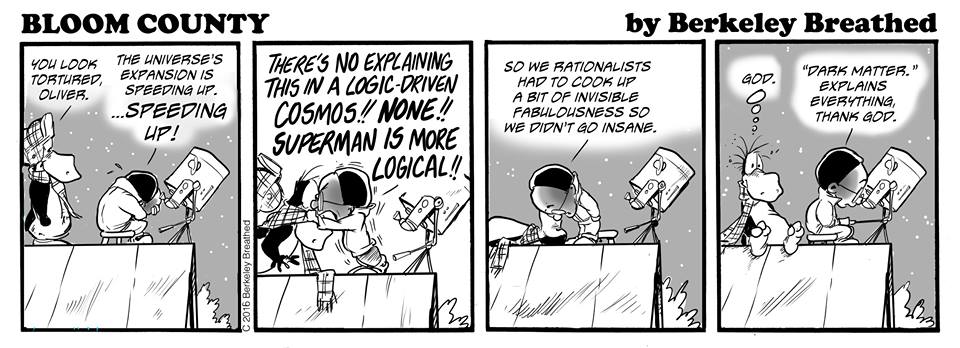
If physicists did what the cartoons suggest, it really would be cheating. If we proposed dark matter because our equations didn’t match up, and stopped checking, we’d be no better than an accountant adding “dark money” to a budget. But we didn’t do that. When we argue that dark matter exists, it’s because we’ve actually tried to put together the evidence, because we’ve weighed it against the preference to stick with the Standard Model and found the evidence tips the scales. The instinct to call it cheating is a good instinct, one you should cultivate. But here, it’s an instinct physicists have already taken into account.
There’s a saying in physics, attributed to the famous genius John von Neumann: “With four parameters I can fit an elephant, and with five I can make him wiggle his trunk.”
Say you want to model something, like some surprising data from a particle collider. You start with some free parameters: numbers in your model that aren’t decided yet. You then decide those numbers, “fixing” them based on the data you want to model. Your goal is for your model not only to match the data, but to predict something you haven’t yet measured. Then you can go out and check, and see if your model works.
The more free parameters you have in your model, the easier this can go wrong. More free parameters make it easier to fit your data, but that’s because they make it easier to fit any data. Your model ends up not just matching the physics, but matching the mistakes as well: the small errors that crop up in any experiment. A model like that may look like it’s a great fit to the data, but its predictions will almost all be wrong. It wasn’t just fit, it was overfit.
We have statistical tools that tell us when to worry about overfitting, when we should be impressed by a model and when it has too many parameters. We don’t actually use these tools correctly, but they still give us a hint of what we actually want to know, namely, whether our model will make the right predictions. In a sense, these tools form the mathematical basis for Occam’s Razor, the idea that the best explanation is often the simplest one, and Occam’s Razor is a critical part of how we do science.
So, did you know machine learning was just modeling data?
All of the much-hyped recent advances in artificial intelligence, GPT and Stable Diffusion and all those folks, at heart they’re all doing this kind of thing. They start out with a model (with a lot more than five parameters, arranged in complicated layers…), then use data to fix the free parameters. Unlike most of the models physicists use, they can’t perfectly fix these numbers: there are too many of them, so they have to approximate. They then test their model on new data, and hope it still works.
Increasingly, it does, and impressively well, so well that the average person probably doesn’t realize this is what it’s doing. When you ask one of these AIs to make an image for you, what you’re doing is asking what image the model predicts would show up captioned with your text. It’s the same sort of thing as asking an economist what their model predicts the unemployment rate will be when inflation goes up. The machine learning model is just way, way more complicated.
As a physicist, the first time I heard about this, I had von Neumann’s quote in the back of my head. Yes, these machines are dealing with a lot more data, from a much more complicated reality. They literally are trying to fit elephants, even elephants wiggling their trunks. Still, the sheer number of parameters seemed fishy here. And for a little bit things seemed even more fishy, when I learned about double descent.
Suppose you start increasing the number of parameters in your model. Initially, your model gets better and better. Your predictions have less and less error, your error descends. Eventually, though, the error increases again: you have too many parameters so you’re over-fitting, and your model is capturing accidents in your data, not reality.
In machine learning, weirdly, this is often not the end of the story. Sometimes, your prediction error rises, only to fall once more, in a double descent.
For a while, I found this deeply disturbing. The idea that you can fit your data, start overfitting, and then keep overfitting, and somehow end up safe in the end, was terrifying. The way some of the popular accounts described it, like you were just overfitting more and more and that was fine, was baffling, especially when they seemed to predict that you could keep adding parameters, keep fitting tinier and tinier fleas on the elephant’s trunk, and your predictions would never start going wrong. It would be the death of Occam’s Razor as we know it, more complicated explanations beating simpler ones off to infinity.
Luckily, that’s not what happens. And after talking to a bunch of people, I think I finally understand this enough to say something about it here.
The right way to think about double descent is as overfitting prematurely. You do still expect your error to eventually go up: your model won’t be perfect forever, at some point you will really overfit. It might take a long time, though: machine learning people are trying to model very complicated things, like human behavior, with giant piles of data, so very complicated models may often be entirely appropriate. In the meantime, due to a bad choice of model, you can accidentally overfit early. You will eventually overcome this, pushing past with more parameters into a model that works again, but for a little while you might convince yourself, wrongly, that you have nothing more to learn.
So Occam’s Razor still holds, but with a twist. The best model is simple enough, but no simpler. And if you’re not careful enough, you can convince yourself that a too-simple model is as complicated as you can get.
Image from Astral Codex Ten
I was reminded of all this recently by somearticles by Sabine Hossenfelder.
Hossenfelder is a critic of mainstream fundamental physics. The articles were her restating a point she’s made many times before, including in (at least) one of her books. She thinks the people who propose new particles and try to search for them are wasting time, and the experiments motivated by those particles are wasting money. She’s motivated by something like Occam’s Razor, the need to stick to the simplest possible model that fits the evidence. In her view, the simplest models are those in which we don’t detect any more new particles any time soon, so those are the models she thinks we should stick with.
I tend to disagree with Hossenfelder. Here, I was oddly conflicted. In some of her examples, it seemed like she had a legitimate point. Others seemed like she missed the mark entirely.
Talk to most astrophysicists, and they’ll tell you dark matter is settled science. Indeed, there is a huge amount of evidence that something exists out there in the universe that we can’t see. It distorts the way galaxies rotate, lenses light with its gravity, and wiggled the early universe in pretty much the way you’d expect matter to.
What isn’t settled is whether that “something” interacts with anything else. It has to interact with gravity, of course, but everything else is in some sense “optional”. Astroparticle physicists use satellites to search for clues that dark matter has some other interactions: perhaps it is unstable, sometimes releasing tiny signals of light. If it did, it might solve other problems as well.
Hossenfelder thinks this is bunk (in part because she thinks those other problems are bunk). I kind of do too, though perhaps for a more general reason: I don’t think nature owes us an easy explanation. Dark matter isn’t obligated to solve any of our other problems, it just has to be dark matter. That seems in some sense like the simplest explanation, the one demanded by Occam’s Razor.
At the same time, I disagree with her substantially more on collider physics. At the Large Hadron Collider so far, all of the data is reasonably compatible with the Standard Model, our roughly half-century old theory of particle physics. Collider physicists search that data for subtle deviations, one of which might point to a general discrepancy, a hint of something beyond the Standard Model.
While my intuitions say that the simplest dark matter is completely dark, they don’t say that the simplest particle physics is the Standard Model. Back when the Standard Model was proposed, people might have said it was exceptionally simple because it had a property called “renormalizability”, but these days we view that as less important. Physicists like Ken Wilson and Steven Weinberg taught us to view theories as a kind of series of corrections, like a Taylor series in calculus. Each correction encodes new, rarer ways that particles can interact. A renormalizable theory is just the first term in this series. The higher terms might be zero, but they might not. We even know that some terms cannot be zero, because gravity is not renormalizable.
The two cases on the surface don’t seem that different. Dark matter might have zero interactions besides gravity, but it might have other interactions. The Standard Model might have zero corrections, but it might have nonzero corrections. But for some reason, my intuition treats the two differently: I would find it completely reasonable for dark matter to have no extra interactions, but very strange for the Standard Model to have no corrections.
I think part of where my intuition comes from here is my experience with other theories.
One example is a toy model called sine-Gordon theory. In sine-Gordon theory, this Taylor series of corrections is a very familiar Taylor series: the sine function! If you go correction by correction, you’ll see new interactions and more new interactions. But if you actually add them all up, something surprising happens. Sine-Gordon turns out to be a special theory, one with “no particle production”: unlike in normal particle physics, in sine-Gordon particles can neither be created nor destroyed. You would never know this if you did not add up all of the corrections.
String theory itself is another example. In string theory, elementary particles are replaced by strings, but you can think of that stringy behavior as a series of corrections on top of ordinary particles. Once again, you can try adding these things up correction by correction, but once again the “magic” doesn’t happen until the end. Only in the full series does string theory “do its thing”, and fix some of the big problems of quantum gravity.
If the real world really is a theory like this, then I think we have to worry about something like double descent.
Remember, double descent happens when our models can prematurely get worse before getting better. This can happen if the real thing we’re trying to model is very different from the model we’re using, like the example in this explainer that tries to use straight lines to match a curve. If we think a model is simpler because it puts fewer corrections on top of the Standard Model, then we may end up rejecting a reality with infinite corrections, a Taylor series that happens to add up to something quite nice. Occam’s Razor stops helping us if we can’t tell which models are really the simple ones.
The problem here is that every notion of “simple” we can appeal to here is aesthetic, a choice based on what makes the math look nicer. Other sciences don’t have this problem. When a biologist or a chemist wants to look for the simplest model, they look for a model with fewer organisms, fewer reactions…in the end, fewer atoms and molecules, fewer of the building-blocks given to those fields by physics. Fundamental physics can’t do this: we build our theories up from mathematics, and mathematics only demands that we be consistent. We can call theories simpler because we can write them in a simple way (but we could write them in a different way too). Or we can call them simpler because they look more like toy models we’ve worked with before (but those toy models are just a tiny sample of all the theories that are possible). We don’t have a standard of simplicity that is actually reliable.
From the Wikipedia page for dark matter halos
There is one other way out of this pickle. A theory that is easier to write down is under no obligation to be true. But it is more likely to be useful. Even if the real world is ultimately described by some giant pile of mathematical parameters, if a simple theory is good enough for the engineers then it’s a better theory to aim for: a useful theory that makes peoples’ lives better.
I kind of get the feeling Hossenfelder would make this objection. I’ve seen her argue on twitter that scientists should always be able to say what their research is good for, and her Guardian article has this suggestive sentence: “However, we do not know that dark matter is indeed made of particles; and even if it is, to explain astrophysical observations one does not need to know details of the particles’ behaviour.”
Ok yes, to explain astrophysical observations one doesn’t need to know the details of dark matter particles’ behavior. But taking a step back, one doesn’t actually need to explain astrophysical observations at all.
Astrophysics and particle physics are not engineering problems. Nobody out there is trying to steer a spacecraft all the way across a galaxy, navigating the distribution of dark matter, or creating new universes and trying to make sure they go just right. Even if we might do these things some day, it will be so far in the future that our attempts to understand them won’t just be quaint: they will likely be actively damaging, confusing old research in dead languages that the field will be better off ignoring to start from scratch.
Because of that, usefulness is also not a meaningful guide. It cannot tell you which theories are more simple, which to favor with Occam’s Razor.
Hossenfelder’s highest-profile recent work falls afoul of one or the other of her principles. Her work on the foundations of quantum mechanics could genuinely be useful, but there’s no reason aside from claims of philosophical beauty to expect it to be true. Her work on modeling dark matter is at least directly motivated by data, but is guaranteed to not be useful.
I’m not pointing this out to call Hossenfelder a hypocrite, as some sort of ad hominem or tu quoque. I’m pointing this out because I don’t think it’s possible to do fundamental physics today without falling afoul of these principles. If you want to hold out hope that your work is useful, you don’t have a great reason besides a love of pretty math: otherwise, anything useful would have been discovered long ago. If you just try to model existing data as best you can, then you’re making a model for events far away or locked in high-energy particle colliders, a model no-one else besides other physicists will ever use.
I don’t know the way through this. I think if you need to take Occam’s Razor seriously, to build on the same foundations that work in every other scientific field…then you should stop doing fundamental physics. You won’t be able to make it work. If you still need to do it, if you can’t give up the sub-field, then you should justify it on building capabilities, on the kind of “practice” Hossenfelder also dismisses in her Guardian piece.
We don’t have a solid foundation, a reliable notion of what is simple and what isn’t. We have guesses and personal opinions. And until some experiment uncovers some blinding flash of new useful meaningful magic…I don’t think we can do any better than that.