Tag Archives: DoingScience

Jury-Rigging: The Many Uses of Dropbox

I’ll be behind the Great Firewall of China next week, so I’ve been thinking about various sites I won’t be able to access. Prominent among them is Dropbox, a service that hosts files online.

250px-dropbox_icon-svg

A helpful box to drop things in

What do physicists do with Dropbox? Quite a lot.

For us, Dropbox is a great way to keep collaborations on the same page. By sharing a Dropbox folder, we can share research programs, mathematical expressions, and paper drafts. It makes it a lot easier to keep one consistent version of a document between different people, and it’s a lot simpler than emailing files back and forth.

All that said, Dropbox has its drawbacks. You still need to be careful not to have two people editing the same thing at the same time, lest one overwrite the other’s work. You’ve got the choice between editing in place, making everyone else receive notifications whenever the files change, or editing in a separate folder, and having to be careful to keep it coordinated with the shared one.

Programmers will know there are cleaner solutions to these problems. GitHub is designed to share code, and you can work together on a paper with ShareLaTeX. So why do we use Dropbox?

Sometimes, it’s more important for a tool to be easy and universal, even if it doesn’t do everything you want. GitHub and ShareLaTeX might solve some of the problems we have with Dropbox, but they introduce extra work too. Because no one disadvantage of Dropbox takes up too much time, it’s simpler to stick with it than to introduce a variety of new services to fill the same role.

This is the source of a lot of jury-rigging in science. Our projects aren’t often big enough to justify more professional approaches: usually, something hacked together out of what’s available really is the best choice.

For one, it’s why I use wordpress. WordPress.com is not a great platform for professional blogging: it doesn’t give you a lot of control without charging, and surprise updates can make using it confusing. However, it takes a lot less effort than switching to something more professional, and for the moment at least I’m not really in a position that justifies the extra work.

The Parable of the Entanglers and the Bootstrappers

There’s been some buzz around a recent Quanta article by K. C. Cole, The Strange Second Life of String Theory. I found it a bit simplistic of a take on the topic, so I thought I’d offer a different one.

String theory has been called the particle physicist’s approach to quantum gravity. Other approaches use the discovery of general relativity as a model: they’re looking for a big conceptual break from older theories. String theory, in contrast, starts out with a technical problem (naive quantum gravity calculations that give infinity) proposes physical objects that could solve the problem (strings, branes), and figures out which theories of these objects are consistent with existing data (originally the five superstring theories, now all understood as parts of M theory).

That approach worked. It didn’t work all the way, because regardless of whether there are indirect tests that can shed light on quantum gravity, particle physics-style tests are far beyond our capabilities. But in some sense, it went as far as it can: we’ve got a potential solution to the problem, and (apart from some controversy about the cosmological constant) it looks consistent with observations. Until actual evidence surfaces, that’s the end of that particular story.

When people talk about the failure of string theory, they’re usually talking about its aspirations as a “theory of everything”. String theory requires the world to have eleven dimensions, with seven curled up small enough that we can’t observe them. Different arrangements of those dimensions lead to different four-dimensional particles. For a time, it was thought that there would be only a few possible arrangements: few enough that people could find the one that describes the world and use it to predict undiscovered particles.

That particular dream didn’t work out. Instead, it became apparent that there were a truly vast number of different arrangements of dimensions, with no unique prediction likely to surface.

By the time I took my first string theory course in grad school, all of this was well established. I was entering a field shaped by these two facts: string theory’s success as a particle-physics style solution to quantum gravity, and its failure as a uniquely predictive theory of everything.

The quirky thing about science: sociologically, success and failure look pretty similar. Either way, it’s time to find a new project.

A colleague of mine recently said that we’re all either entanglers or bootstrappers. It was a joke, based on two massive grants from the Simons Foundation. But it’s also a good way to summarize two different ways string theory has moved on, from its success and from its failure.

The entanglers start from string theory’s success and say, what’s next?

As it turns out, a particle-physics style understanding of quantum gravity doesn’t tell you everything you need to know. Some of the big conceptual questions the more general relativity-esque approaches were interested in are still worth asking. Luckily, string theory provides tools to answer them.

Many of those answers come from AdS/CFT, the discovery that string theory in a particular warped space-time is dual (secretly the same theory) to a more particle-physics style theory on the edge of that space-time. With that discovery, people could start understanding properties of gravity in terms of properties of particle-physics style theories. They could use concepts like information, complexity, and quantum entanglement (hence “entanglers”) to ask deeper questions about the structure of space-time and the nature of black holes.

The bootstrappers, meanwhile, start from string theory’s failure and ask, what can we do with it?

Twisting up the dimensions of string theory yields a vast number of different arrangements of particles. Rather than viewing this as a problem, why not draw on it as a resource?

“Bootstrappers” explore this space of particle-physics style theories, using ones with interesting properties to find powerful calculation tricks. The name comes from the conformal bootstrap, a technique that finds conformal theories (roughly: theories that are the same at every scale) by “pulling itself by its own boostraps”, using nothing but a kind of self-consistency.

Many accounts, including Cole’s, attribute people like the boostrappers to AdS/CFT as well, crediting it with inspiring string theorists to take a closer look at particle physics-style theories. That may be true in some cases, but I don’t think it’s the whole story: my subfield is bootstrappy, and while it has drawn on AdS/CFT that wasn’t what got it started. Overall, I think it’s more the case that the tools of string theory’s “particle physics-esque approach”, like conformal theories and supersymmetry, ended up (perhaps unsurprisingly) useful for understanding particle physics-style theories.

Not everyone is a “boostrapper” or an “entangler”, even in the broad sense I’m using the words. The two groups also sometimes overlap. Nevertheless, it’s a good way to think about what string theorists are doing these days. Both of these groups start out learning string theory: it’s the only way to learn about AdS/CFT, and it introduces the bootstrappers to a bunch of powerful particle physics tools all in one course. Where they go from there varies, and can be more or less “stringy”. But it’s research that wouldn’t have existed without string theory to get it started.


Hexagon Functions IV: Steinmann Harder

It’s paper season! I’ve got another paper out this week, this one a continuation of the hexagon function story.

The story so far:

My collaborators and I have been calculating “six-particle” (two particles collide, four come out, or three collide, three come out…) scattering amplitudes (probabilities that particles scatter) in N=4 super Yang-Mills. We calculate them starting with an ansatz (a guess, basically) made up of a type of functions called hexagon functions: “hexagon” because they’re the right functions for six-particle scattering. We then narrow down our guess by bringing in other information: for example, if two particles are close to lining up, our answer needs to match the one calculated with something called the POPE, so we can throw out guesses that don’t match that. In the end, only one guess survives, and we can check that it’s the right answer.

So what’s new this time?

More loops:

In quantum field theory, most of our calculations are approximate, and we measure the precision in something called loops. The more loops, the closer we are to the exact result, and the more complicated the calculation becomes.

This time, we’re at five loops of precision. To give you an idea of how complicated that is: I store these functions in text files. We’ve got a new, more efficient notation for them. With that, the two-loop functions fit into files around 20KB. Three loops, 500KB. Four, 15MB. And five? 300MB.

So if you want to imagine five loops, think about something that needs to be stored in a 300MB text file.

More insight:

We started out having noticed some weird new symmetries of our old results, so we brought in Simon Caron-Huot, expert on weird new symmetries. He couldn’t figure out that one…but he did notice an entirely different symmetry, one that turned out to have been first noticed in the 60’s, called the Steinmann relations.

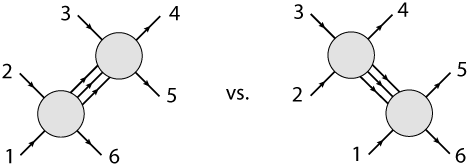
The core idea of the Steinmann relations goes back to the old method of calculating amplitudes, with Feynman diagrams. In Feynman diagrams, lines represent particles traveling from one part of the diagram to the other. In a simplified form, the Steinmann conditions are telling us that diagrams can’t take two mutually exclusive shapes at the same time. If three particles are going one way, they can’t also be going another way.

steinmann2

With the Steinmann relations, things suddenly became a whole lot easier. Calculations that we had taken months to do, Simon was now doing in a week. Finally we could narrow things down and get the full answer, and we could do it with clear, physics-based rules.

More bootstrap:

In physics, when we call something a “bootstrap” it’s in reference to the phrase “pull yourself up by your own boostraps”. That impossible task, lifting yourself  with no outside support, is essentially what we do when we “bootstrap”: we do a calculation with no external input, simply by applying general rules.

In the past, our hexagon function calculations always had some sort of external data. For the first time, with the Steinmann conditions, we don’t need that. Every constraint, everything we do to narrow down our guess, is either a general rule or comes out of our lower-loop results. We never need detailed information from anywhere else.

This is big, because it might allow us to avoid loops altogether. Normally, each loop is an approximation, narrowed down using similar approximations from others. If we don’t need the approximations from others, though, then we might not need any approximations at all. For this particular theory, for this toy model, we might be able to actually calculate scattering amplitudes exactly, for any strength of forces and any energy. Nobody’s been able to do that for this kind of theory before.

We’re already making progress. We’ve got some test cases, simpler quantities that we can understand with no approximations. We’re starting to understand the tools we need, the pieces of our bootstrap. We’ve got a real chance, now, of doing something really fundamentally new.

So keep watching this blog, keep your eyes on arXiv: big things are coming.

A Papal Resummation

I’ve got a new paper up this week. This one is a collaboration with Ho Tat Lam, who just finished a Master’s degree at Perimeter and will be at Princeton in the fall.

A while back, I mentioned that Perimeter’s Master’s program was holding a Winter School up in the wilderness of Ontario. In between skiing and ice skating, I worked with a group of students attempting to sum up something called the Pentagon Operator Product Expansion, or POPE.

SpacePope

The (Rapidity) Space Pope, for a joke only three people will get

While we didn’t finish the job there, we made a lot of progress, and Ho Tat and I kept working on it.

This is the first time I’ve been the senior member of a collaboration, and it was an interesting experience. There’s a lot that you feel like you know perfectly well until you sit down and try to teach it. Getting things out of my head and into someone else’s is a challenge, but it’s one I’m getting better at.

The POPE is an alternate way of calculating scattering amplitudes in N=4 super Yang-Mills. Rather than going loop by loop (and approximating the forces involved as small), it’s a sum of terms that approximate the energy as small. If all of those terms could be added up, we could calculate amplitudes in this theory for any energy and any strength of force.

We can’t do that in general (yet). What we can do is bring back the loop by loop approximation, but keep the sum in energy. If we add up that sum, we can check it against the known loop by loop results, and see if our calculation is faster. Along the way, we learn a bit about how these sums add up to give us polylogarithms.

Ho Tat and I have done the first loop. Going further isn’t just a bigger calculation, there are new challenges we’ll have to face. But I think we’ve got a shot at it.

Science Is a Collection of Projects, Not a Collection of Beliefs

Read a textbook, and you’ll be confronted by a set of beliefs about the world.

(If it’s a half-decent textbook, it will give justifications for those beliefs, and they will be true, putting you well on the way to knowledge.)

The same is true of most science popularization. In either case, you’ll be instructed that a certain set of statements about the world (or about math, or anything else) are true.

If most of your experience with science comes from popularizations and textbooks, you might think that all of science is like this. In particular, you might think of scientific controversies as matters of contrasting beliefs. Some scientists “believe in” supersymmetry, some don’t. Some “believe in” string theory, some don’t. Some “believe in” a multiverse, some don’t.

In practice, though, only settled science takes the form of beliefs. The rest, science as it is actually practiced, is better understood as a collection of projects.

Scientists spend most of their time working on projects. (Well, or procrastinating in my case.) Those projects, not our beliefs about the world, are how we influence other scientists, because projects build off each other. Any time we successfully do a calculation or make a measurement, we’re opening up new calculations and measurements for others to do. We all need to keep working and publishing, so anything that gives people something concrete to do is going to be influential.

The beliefs that matter come later. They come once projects have been so successful, and so widespread, that their success itself is evidence for beliefs. They’re the beliefs that serve as foundational assumptions for future projects. If you’re going to worry that some scientists are behaving unscientifically, these are the sorts of beliefs you want to worry about. Even then, things are often constrained by viable projects: in many fields, you can’t have a textbook without problem sets.

Far too many people seem to miss this distinction. I’ve seen philosophers focus on scientists’ public statements instead of their projects when trying to understand the implications of their science. I’ve seen bloggers and journalists who mostly describe conflicts of beliefs, what scientists expect and hope to be true rather than what they actually work on.

Do scientists have beliefs about controversial topics? Absolutely. Do those beliefs influence what they work on? Sure. But only so far as there’s actually something there to work on.

That’s why you see quite a few high-profile physicists endorsing some form of multiverse, but barely any actual journal articles about it. The belief in a multiverse may or may not be true, but regardless, there just isn’t much that one can do with the idea right now, and it’s what scientists are doing, not what they believe, that constitutes the health of science.

Different fields seem to understand this to different extents. I’m reminded of a story I heard in grad school, of two dueling psychologists. One of them believed that conversation was inherently cooperative, and showed that, unless unusually stressed or busy, people would put in the effort to understand the other person’s perspective. The other believed that conversation was inherently egocentric, and showed that, the more you stressed or busy people are, the more they assume that everyone else has the same perspective they do.

Strip off the “beliefs”, and these two worked on the exact same thing, with the same results. With their beliefs included, though, they were bitter rivals who bristled if their grad students so much as mentioned the other scientist.

We need to avoid this kind of mistake. The skills we have, the kind of work we do, these are important, these are part of science. The way we talk about it to reporters, the ideas we champion when we debate, those are sidelines. They have some influence, dragging people one way or another. But they’re not what science is, because on the front lines, science is about projects, not beliefs.

Still Traveling

I’m still traveling this week, so this will  be a short post.

Last year, when I went to Amplitudes I left Europe right after. This felt like a bit of a waste: an expensive, transcontinental flight, and I was only there for a week?

So this year, I resolved to visit a few more places. I was at the Niels Bohr Institute in Copenhagen earlier this week.

IMG_20160712_205034_hdr

Where the live LHC collisions represented as lights shining on the face of the building are rather spoiled by the lack of any actual darkness to see them by.

Now, I’m at Mainz, visiting Johannes Henn.

Oddly enough, I’ve got family connections to both places. My great-grandfather spent some time at the Niels Bohr Institute on his way out of Europe, and I have a relative who works at Mainz. So while the primary purpose of this trip was research, I’ve gotten to learn a little family history in the process.

Amplitudes 2016

I’m at Amplitudes this week, in Stockholm.

IMG_20160704_225049

The land of twilight at 11pm

Last year, I wrote a post giving a tour of the field. If I had to write it again this year most of the categories would be the same, but the achievements listed would advance in loops and legs, more complicated theories and more insight.

The ambitwistor string now goes to two loops, while my collaborators and I have pushed the polylogarithm program to five loops (dedicated post on that soon!) A decent number of techniques can now be applied to QCD, including a differential equation-based method that was used to find a four loop, three particle amplitude. Others tied together different approaches, found novel structures in string theory, or linked amplitudes techniques to physics from other disciplines. The talks have been going up on YouTube pretty quickly, due to diligent work by Nordita’s tech guy, so if you’re at all interested check it out!

Source Your Common Sense

When I wrote that post on crackpots, one of my inspirations was a particularly annoying Twitter conversation. The guy I was talking to had convinced himself that general relativity was a mistake. He was especially pissed off by the fact that, in GR, energy is not always conserved. Screw Einstein, energy conservation is just common sense! Right?

Think a little bit about why you believe in energy conservation. Is it because you run into a lot of energy in your day-to-day life, and it’s always been conserved? Did you grow up around something that was obviously energy? Or maybe someone had to explain it to you?

Teacher Pointing at Map of World

Maybe you learned about it…from a physics teacher?

A lot of the time, things that seem obvious only got that way because you were taught them. “Energy” isn’t an intuitive concept, however much it’s misused that way. It’s something defined by physicists because it solves a particular role, a consequence of symmetries in nature. When you learn about energy conservation in school, that’s because it’s one of the simpler ways to explain a much bigger concept, so you shouldn’t be surprised if there are some inaccuracies. If you know where your “common sense” is coming from, you can anticipate when and how it might go awry.

Similarly, if, like one of the commenters on my crackpot post, you’re uncomfortable with countable and uncountable infinities, remember that infinity isn’t “common sense” either. It’s something you learned about in a math class, from a math teacher. And just like energy conservation, it’s a simplification of a more precise concept, with epsilons and deltas and all that jazz.

It’s not possible to teach all the nuances of every topic, so naturally most people will hear a partial story. What’s important is to recognize that you heard a partial story, and not enshrine it as “common sense” when the real story comes knocking.

Don’t physicists use common sense, though? What about “physical intuition”?

Physical intuition has a lot of mystique behind it, and is often described as what separates us from the mathematicians. As such, different people mean different things by it…but under no circumstances should it be confused with pure “common sense”. Physical intuition uses analogy and experience. It involves seeing a system and anticipating the sorts of things you can do with it, like playing a game and assuming there’ll be a save button. In order for these sorts of analogies to work, they generally aren’t built around everyday objects or experiences. Instead, they use physical systems that are “similar” to the one under scrutiny in important ways, while being better understood in others. Crucially, physical intuition involves working in context. It’s not just uncritical acceptance of what one would naively expect.

So when your common sense is tingling, see if you can provide a source. Is that source relevant, experience with a similar situation? Or is it in fact a half-remembered class from high school?

I Don’t Get Crackpots

[Note: not an April fool’s post. Now I’m wishing I wrote one though.]

After the MHV@30 conference, I spent a few days visiting my sister. I hadn’t seen her in a while, and she noticed something new about me.

“You’re not sure about anything. It’s always ‘I get the impression’ or ‘I believe so’ or ‘that seems good’.”

On reflection, she’s right.

It’s a habit I’ve picked up from spending time around scientists. When you’re surrounded by people who are likely to know more than you do about something, it’s usually good to qualify your statements. A little intellectual humility keeps simple corrections from growing into pointless arguments, and makes it easier to learn from your mistakes.

With that kind of mindset, though, I really really don’t get crackpots.

open-uri20150422-20810-4a7nvg_87d49366

For example, why do they always wear funnels on their heads?

The thing about genuine crackpots (as opposed to just scientists with weird ideas) is that they tend to have almost none of the relevant background for a given field, but nevertheless have extremely strong opinions about it. That basic first step, of assuming that there are people who probably know a lot more about whatever you’re talking about? Typically, they don’t bother with that. The qualifiers, the “typically” and “as far as I know” just don’t show up. And I have a lot of trouble understanding how a person can work that way.

Is some of it the Dunning-Kruger effect? Sure. If you don’t know much about something, you don’t know the limits of your own knowledge, so you think you know more than you really do. But I don’t think it’s just that…there’s a baseline level of doubt, of humility in general, that just isn’t there for most crackpots.

I wonder if some fraction of crackpots are genuinely mentally ill, but if so I’m not sure what the illness would be. Mania is an ok fit some of the time, and the word salad and “everyone but me is crazy” attitude almost seem schizophrenic, but I doubt either is really what’s going on in most cases.

All of this adds up to me just being completely unable to relate to people who display a sufficient level of crackpottery.

The thing is, there are crackpots out there who I kind of wish I could talk to, because if I could maybe I could help them. There are crackpots who seem genuinely willing to be corrected, to be told what they’re doing wrong. But that core of implicit arrogance, the central assumption that it’s possible to make breakthroughs in a field while knowing almost nothing about it, that’s still there, and it makes it impossible for me to deal with them.

I kind of wish there was a website I could link, dedicated to walking crackpots through their mistakes. There used to be something like that for supernatural crackpots, in the form of the James Randi Educational Foundation‘s Million Dollar Prize, complete with forums where (basically) helpful people would patiently walk applicants through how to set up a test of their claims. There’s never been anything like that for science, as far as I’m aware, and it seems like it would take a lot more work. Still, it would be nice if there were people out there patient enough to do it.

In Defense of Lord Kelvin, Michelson, and the Physics of Decimals

William Thompson, Lord Kelvin, was a towering genius of 19th century physics. He is often quoted as saying,

There is nothing new to be discovered in physics now. All that remains is more and more precise measurement.

lord_kelvin_photograph

Certainly sounds like something I would say!

As it happens, he never actually said this. It’s a paraphrase of a quote from Albert Michelson, of the Michelson-Morley Experiment:

While it is never safe to affirm that the future of Physical Science has no marvels in store even more astonishing than those of the past, it seems probable that most of the grand underlying principles have been firmly established and that further advances are to be sought chiefly in the rigorous application of these principles to all the phenomena which come under our notice. It is here that the science of measurement shows its importance — where quantitative work is more to be desired than qualitative work. An eminent physicist remarked that the future truths of physical science are to be looked for in the sixth place of decimals.

albert_abraham_michelson2

Now that’s more like it!

In hindsight, this quote looks pretty silly. When Michelson said that “it seems probable that most of the grand underlying principles have been firmly established” he was leaving out special relativity, general relativity, and quantum mechanics. From our perspective, the grandest underlying principles had yet to be discovered!

And yet, I think we should give Michelson some slack.

Someone asked me on twitter recently what I would choose if given the opportunity to unravel one of the secrets of the universe. At the time, I went for the wishing-for-more-wishes answer: I’d ask for a procedure to discover all of the other secrets.

I was cheating, to some extent. But I do think that the biggest and most important mystery isn’t black holes or the big bang, isn’t asking what will replace space-time or what determines the constants in the Standard Model. The most critical, most important question in physics, rather, is to find the consequences of the principles we actually know!

We know our world is described fairly well by quantum field theory. We’ve tested it, not just to the sixth decimal place, but to the tenth. And while we suspect it’s not the full story, it should still describe the vast majority of our everyday world.

If we knew not just the underlying principles, but the full consequences of quantum field theory, we’d understand almost everything we care about. But we don’t. Instead, we’re forced to calculate with approximations. When those approximations break down, we fall back on experiment, trying to propose models that describe the data without precisely explaining it. This is true even for something as “simple” as the distribution of quarks inside a proton. Once you start trying to describe materials, or chemistry or biology, all bets are off.

This is what the vast majority of physics is about. Even more, it’s what the vast majority of science is about. And that’s true even back to Michelson’s day. Quantum mechanics and relativity were revelations…but there are still large corners of physics in which neither matters very much, and even larger parts of the more nebulous “physical science”.

New fundamental principles get a lot of press, but you shouldn’t discount the physics of “the sixth place of decimals”. Most of the big mysteries don’t ask us to challenge our fundamental paradigm: rather, they’re challenges to calculate or measure better, to get more precision out of rules we already know. If a genie gave me the solution to any of physics’ mysteries I’d choose to understand the full consequences of quantum field theory, or even of the physics of Michelson’s day, long before I’d look for the answer to a trendy question like quantum gravity.