Tag Archives: DoingScience

Hexagon Functions V: Seventh Heaven

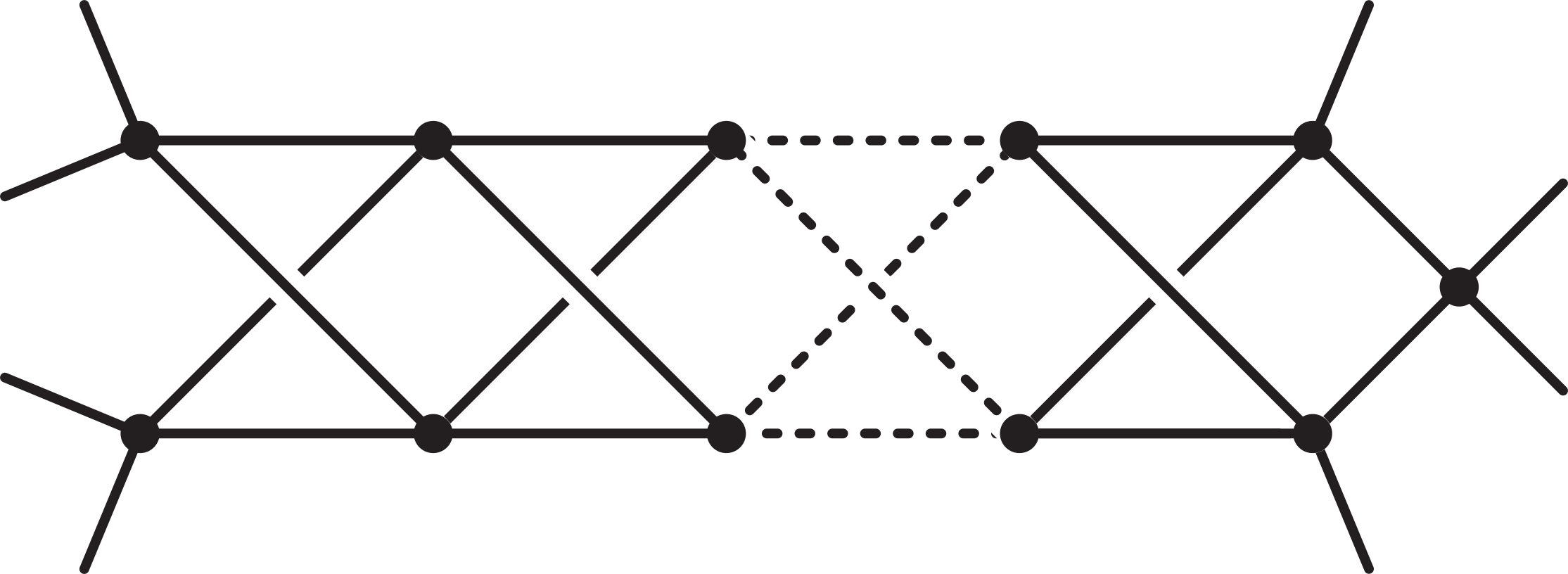
I’ve got a new paper out this week, a continuation of a story that has threaded through my career since grad school. With a growing collaboration (now Simon Caron-Huot, Lance Dixon, Falko Dulat, Andrew McLeod, and Georgios Papathanasiou) I’ve been calculating six-particle scattering amplitudes in my favorite theory-that-does-not-describe-the-real-world, N=4 super Yang-Mills. We’ve been pushing to more and more “loops”: tougher and tougher calculations that approximate the full answer better and better, using the “word jumble” trick I talked about in Scientific American. And each time, we learn something new.

Now we’re up to seven loops for some types of particles, and six loops for the rest. In older blog posts I talked in megabytes: half a megabyte for three loops, 15 MB for four loops, 300 MB for five loops. I don’t have a number like that for six and seven loops: we don’t store the result in that way anymore, it just got too cumbersome. We have to store it in a simplified form, and even that takes 80 MB.

Some of what we learned has to do with the types of mathematical functions that we need: our “guess” for the result at each loop. We’ve honed that guess down a lot, and discovered some new simplifications along the way. I won’t tell that story here (except to hint that it has to do with “cosmic Galois theory”) because we haven’t published it yet. It will be out in a companion paper soon.

This paper focused on the next step, going from our guess to the correct six- and seven-loop answers. Here too there were surprises. For the last several loops, we’d observed a surprisingly nice pattern: different configurations of particles with different numbers of loops were related, in a way we didn’t know how to explain. The pattern stuck around at five loops, so we assumed it was the real deal, and guessed the new answer would obey it too.

Yes, in our field this counts as surprisingly nice

Usually when scientists tell this kind of story, the pattern works, it’s a breakthrough, everyone gets a Nobel prize, etc. This time? Nope!

The pattern failed. And it failed in a way that was surprisingly difficult to detect.

The way we calculate these things, we start with a guess and then add what we know. If we know something about how the particles behave at high energies, or when they get close together, we use that to pare down our guess, getting rid of pieces that don’t fit. We kept adding these pieces of information, and each time the pattern seemed ok. It was only when we got far enough into one of these approximations that we noticed a piece that didn’t fit.

That piece was a surprisingly stealthy mathematical function, one that hid from almost every test we could perform. There aren’t any functions like that at lower loops, so we never had to worry about this before. But now, in the rarefied land of six-loop calculations, they finally start to show up.

We have another pattern, like the old one but that isn’t broken yet. But at this point we’re cautious: things get strange as calculations get more complicated, and sometimes the nice simplifications we notice are just accidents. It’s always important to check.

Deep physics or six-loop accident? You decide!

This result was a long time coming. Coordinating a large project with such a widely spread collaboration is difficult, and sometimes frustrating. People get distracted by other projects, they have disagreements about what the paper should say, even scheduling Skype around everyone’s time zones is a challenge. I’m more than a little exhausted, but happy that the paper is out, and that we’re close to finishing the companion paper as well. It’s good to have results that we’ve been hinting at in talks finally out where the community can see them. Maybe they’ll notice something new!


A Field That Doesn’t Read Its Journals

Last week, the University of California system ended negotiations with Elsevier, one of the top academic journal publishers. UC had been trying to get Elsevier to switch to a new type of contract, one in which instead of paying for access to journals they pay for their faculty to publish, then make all the results openly accessible to the public. In the end they couldn’t reach an agreement and thus didn’t renew their contract, cutting Elsevier off from millions of dollars and their faculty from reading certain (mostly recent) Elsevier journal articles. There’s a nice interview here with one of the librarians who was sent to negotiate the deal.

I’m optimistic about what UC was trying to do. Their proposal sounds like it addresses some of the concerns raised here with open-access systems. Currently, journals that offer open access often charge fees directly to the scientists publishing in them, fees that have to be scrounged up from somebody’s grant at the last minute. By setting up a deal for all their faculty together, UC would have avoided that. While the deal fell through, having an organization as big as the whole University of California system advocating open access (and putting the squeeze on Elsevier’s profits) seems like it can only lead to progress.

The whole situation feels a little surreal, though, when I compare it to my own field.

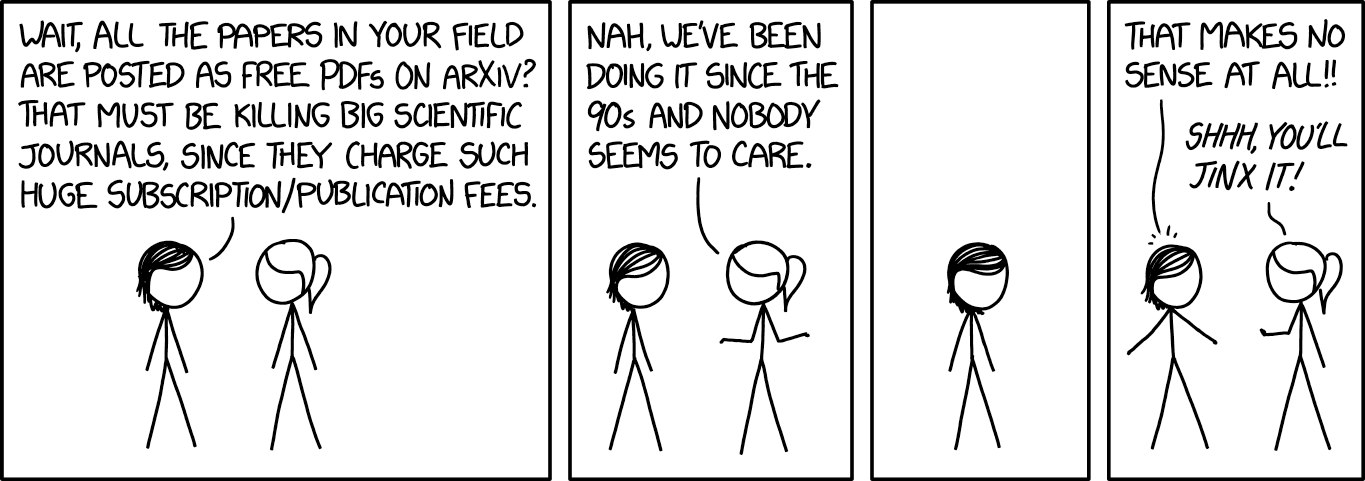
At the risk of jinxing it, my field’s relationship with journals is even weirder than xkcd says.

arXiv.org is a website that hosts what are called “preprints”, which originally meant papers that haven’t been published yet. They’re online, freely accessible to anyone who wants to read them, and will be for as long as arXiv exists to host them. Essentially everything anyone publishes in my field ends up on arXiv.

Journals don’t mind, in part, because many of them are open-access anyway. There’s an organization, SCOAP3, that runs what is in some sense a large-scale version of what UC was trying to set up: instead of paying for subscriptions, university libraries pay SCOAP3 and it covers the journals’ publication costs.

This means that there are two coexisting open-access systems, the journals themselves and arXiv. But in practice, arXiv is the one we actually use.

If I want to show a student a paper, I don’t send them to the library or the journal website, I tell them how to find it on arXiv. If I’m giving a talk, there usually isn’t room for a journal reference, so I’ll give the arXiv number instead. In a paper, we do give references to journals…but they’re most useful when they have arXiv links as well. I think the only times I’ve actually read an article in a journal were for articles so old that arXiv didn’t exist when they were published.

We still submit our papers to journals, though. Peer review still matters, we still want to determine whether our results are cool enough for the fancy journals or only good enough for the ordinary ones. We still put journal citations on our CVs so employers and grant agencies know not only what we’ve done, but which reviewers liked it.

But the actual copy-editing and formatting and publishing, that the journals still employ people to do? Mostly, it never gets read.

In my experience, that editing isn’t too impressive. Often, it’s about changing things to fit the journal’s preferences: its layout, its conventions, its inconvenient proprietary document formats. I haven’t seen them try to fix grammar, or improve phrasing. Maybe my papers have unusually good grammar, maybe they do more for other papers. And maybe they used to do more, when journals had a more central role. But now, they don’t change much.

Sometimes the journal version ends up on arXiv, if the authors put it there. Sometimes it doesn’t. And sometimes the result is in between. For my last paper about Calabi-Yau manifolds in Feynman diagrams, we got several helpful comments from the reviewers, but the journal also weighed in to get us to remove our more whimsical language, down to the word “bestiary”. For the final arXiv version, we updated for the reviewer comments, but kept the whimsical words. In practice, that version is the one people in our field will read.

This has some awkward effects. It means that sometimes important corrections don’t end up on arXiv, and people don’t see them. It means that technically, if someone wanted to insist on keeping an incorrect paper online, they could, even if a corrected version was published in a journal. And of course, it means that a large amount of effort is dedicated to publishing journal articles that very few people read.

I don’t know whether other fields could get away with this kind of system. Physics is small. It’s small enough that it’s not so hard to get corrections from authors when one needs to, small enough that social pressure can get wrong results corrected. It’s small enough that arXiv and SCOAP3 can exist, funded by universities and private foundations. A bigger field might not be able to do any of that.

For physicists, we should keep in mind that our system can and should still be improved. For other fields, it’s worth considering whether you can move in this direction, and what it would cost to do so. Academic publishing is in a pretty bizarre place right now, but hopefully we can get it to a better one.

Grant Roulette

Sometimes, it feels like applying for funding in science is a form of high-stakes gambling. You put in weeks of work assembling a grant application, making sure that it’s exciting and relevant and contains all the obnoxious buzzwords you’re supposed to use…and in the end, it gets approved or rejected for reasons that seem entirely out of your control.

What if, instead, you were actually gambling?

Put all my money on post-Newtonian corrections…

That’s the philosophy behind a 2016 proposal by Ferric Fang and Arturo Casadevall, recently summarized in an article on Vox by Kelsey Piper. The goal is to cut down on the time scientists waste applying for money from various government organizations (for them, the US’s National Institute of Health) by making part of the process random. Applications would be reviewed to make sure they met a minimum standard, but past that point every grant would have an equal chance of getting funded. That way scientists wouldn’t spend so much time perfecting grant applications, and could focus on the actual science.

It’s an idea that seems, on its face, a bit too cute. Yes, grant applications are exhausting, but surely you still want some way to prioritize better ideas over worse ones? For all its flaws, one would hope the grant review process at least does that.

Well, maybe not. The Vox piece argues that, at least in medicine, grants are almost random already. Each grant is usually reviewed by multiple experts. Several studies cited in the piece looked at the variability between these experts: do they usually agree, or disagree? Measuring this in a variety of ways, they came to the same conclusion: there is almost no consistency among ratings by different experts. In effect, the NIH appears to already be using a lottery, one in which grants are randomly accepted or rejected depending on who reviews them.

What encourages me about these studies is that there really is a concrete question to ask. You could argue that physics shouldn’t suffer from the same problems as medicine, that grant review is really doing good work in our field. If you want to argue that, you can test it! Look at old reviews by different people, or get researchers to do “mock reviews”, and test statistical measures like inter-rater reliability. If there really is no consistency between reviews then we have a real problem in need of fixing.

I genuinely don’t know what to expect from that kind of study in my field. But the way people talk about grants makes me suspicious. Everyone seems to feel like grant agencies are biased against their sub-field. Grant-writing advice is full of weird circumstantial tips. (“I heard so-and-so is reviewing this year, so don’t mention QCD!”) It could all be true…but it’s also the kind of superstition people come up with when they look for patterns in a random process. If all the grant-writing advice in the world boils down to “bet on red”, we might as well admit which game we’re playing.

What Science Would You Do If You Had the Time?

I know a lot of people who worry about the state of academia. They worry that the competition for grants and jobs has twisted scientists’ priorities, that the sort of dedicated research of the past, sitting down and thinking about a topic until you really understand it, just isn’t possible anymore. The timeline varies: there are people who think the last really important development was the Standard Model, or the top quark, or AdS/CFT. Even more optimistic people, who think physics is still just as great as it ever was, often complain that they don’t have enough time.

Sometimes I wonder what physics would be like if we did have the time. If we didn’t have to worry about careers and funding, what would we do? I can speculate, comparing to different communities, but here I’m interested in something more concrete: what, specifically, could we accomplish? I often hear people complain that the incentives of academia discourage deep work, but I don’t often hear examples of the kind of deep work that’s being discouraged.

So I’m going to try an experiment here. I know I have a decent number of readers who are scientists of one field or another. Imagine you didn’t have to worry about funding any more. You’ve got a permanent position, and what’s more, your favorite collaborators do too. You don’t have to care about whether your work is popular, whether it appeals to the university or the funding agencies or any of that. What would you work on? What projects would you personally do, that you don’t have the time for in the current system? What worthwhile ideas has modern academia left out?

Interdisciplinarity Is Good for the Soul

Interdisciplinary research is trendy these days. Grant agencies love it, for one. But talking to people in other fields isn’t just promoted by the authorities: like eating your vegetables, it’s good for you too.

If you talk only to people from your own field, you can lose track of what matters in the wider world. There’s a feedback effect where everyone in a field works on what everyone else in the field finds interesting, and the field spirals inward. “Interesting” starts meaning what everyone else is working on, without fulfilling any other criteria. Interdisciplinary contacts hold that back: not only can they call bullshit when you’re deep in your field’s arcane weirdness, they can also point out things that are more interesting than you expected, ideas that your field has seen so often they look boring but that are actually more surprising or useful than you realize.

Interdisciplinary research is good for self-esteem, too. As a young researcher, you can easily spend all your time talking to people who know more about your field than you do. Branching out reminds you of how much you’ve learned: all that specialized knowledge may be entry-level in your field, but it still puts you ahead of the rest of the world. Even as a grad student, you can be someone else’s guest expert if the right topic comes up.

Pan Narrans Scientificus

As scientists, we want to describe the world as objectively as possible. We try to focus on what we can establish conclusively, to leave out excessive speculation and stick to cold, hard facts.

Then we have to write application letters.

Stick to the raw, un-embellished facts, and an application letter would just be a list: these papers in these journals, these talks and awards. Though we may sometimes wish applications worked that way, we don’t live in that kind of world. To apply for a job or a grant, we can’t just stick to the most easily measured facts. We have to tell a story.

The author Terry Pratchett called humans Pan Narrans, the Storytelling Ape. Stories aren’t just for fun, they’re how we see the world, how we organize our perceptions and actions. Without a story, the world doesn’t make sense. And that applies even to scientists.

Applications work best when they tell a story: how did you get here, and where are you going? Scientific papers, similarly, require some sort of narrative: what did you do, and why did you do it? When teaching or writing about science, we almost never just present the facts. We try to fit it into a story, one that presents the facts but also makes sense, in that deliciously human way. A story, more than mere facts, lets us project to the future, anticipating what you’ll do with that grant money or how others will take your research in new directions.

It’s important to remember, though, that stories aren’t actually facts. You can’t get too attached to one story, you have to be willing to shift as new facts come in. Those facts can be scientific measurements, but they can also be steps in your career. You aren’t going to tell the same story when applying to grad school as when you’re trying for tenure, and that’s not just because you’ll have more to tell. The facts of your life will be organized in new ways, rearranging in importance as the story shifts.

Keep your stories in mind as you write or do science. Think about your narrative, the story you’re using to understand the world. Think about what it predicts, how the next step in the story should go. And be ready to start a new story when you need to.

My Other Brain (And My Other Other Brain)

What does a theoretical physicist do all day? We sit and think.

Most of us can’t do all that thinking in our heads, though. Maybe Steven Hawking could, but the rest of us need to visualize what we’re thinking. Our memories, too, are all-too finite, prone to forget what we’re doing midway through a calculation.

So rather than just use our imagination and memory, we use another imagination, another memory: a piece of paper. Writing is the simplest “other brain” we have access to, but even by itself it’s a big improvement, adding weeks of memory and the ability to “see” long calculations at work.

But even augmented by writing, our brains are limited. We can only calculate so fast. What’s more, we get bored: doing the same thing mechanically over and over is not something our brains like to do.

Luckily, in the modern era we have access to other brains: computers.

As I write, the “other brain” sitting on my desk works out a long calculation. Using programs like Mathematica or Maple, or more serious programming languages, I can tell my “other brain” to do something and it will do it, quickly and without getting bored.

My “other brain” is limited too. It has only so much memory, only so much speed, it can only do so many calculations at once. While it’s thinking, though, I can find yet another brain to think at the same time. Sometimes that’s just my desktop, sitting back in my office in Denmark. Sometimes I have access to clusters, blobs of synchronized brains to do my bidding.

While I’m writing this, my “brains” are doing five different calculations (not counting any my “real brain” might be doing). I’m sitting and thinking, as a theoretical physicist should.

Amplitudes in the LHC Era at GGI

I’m at the Galileo Galilei Institute in Florence this week, for a program on Amplitudes in the LHC Era.

IMG_20181102_091428198_HDR

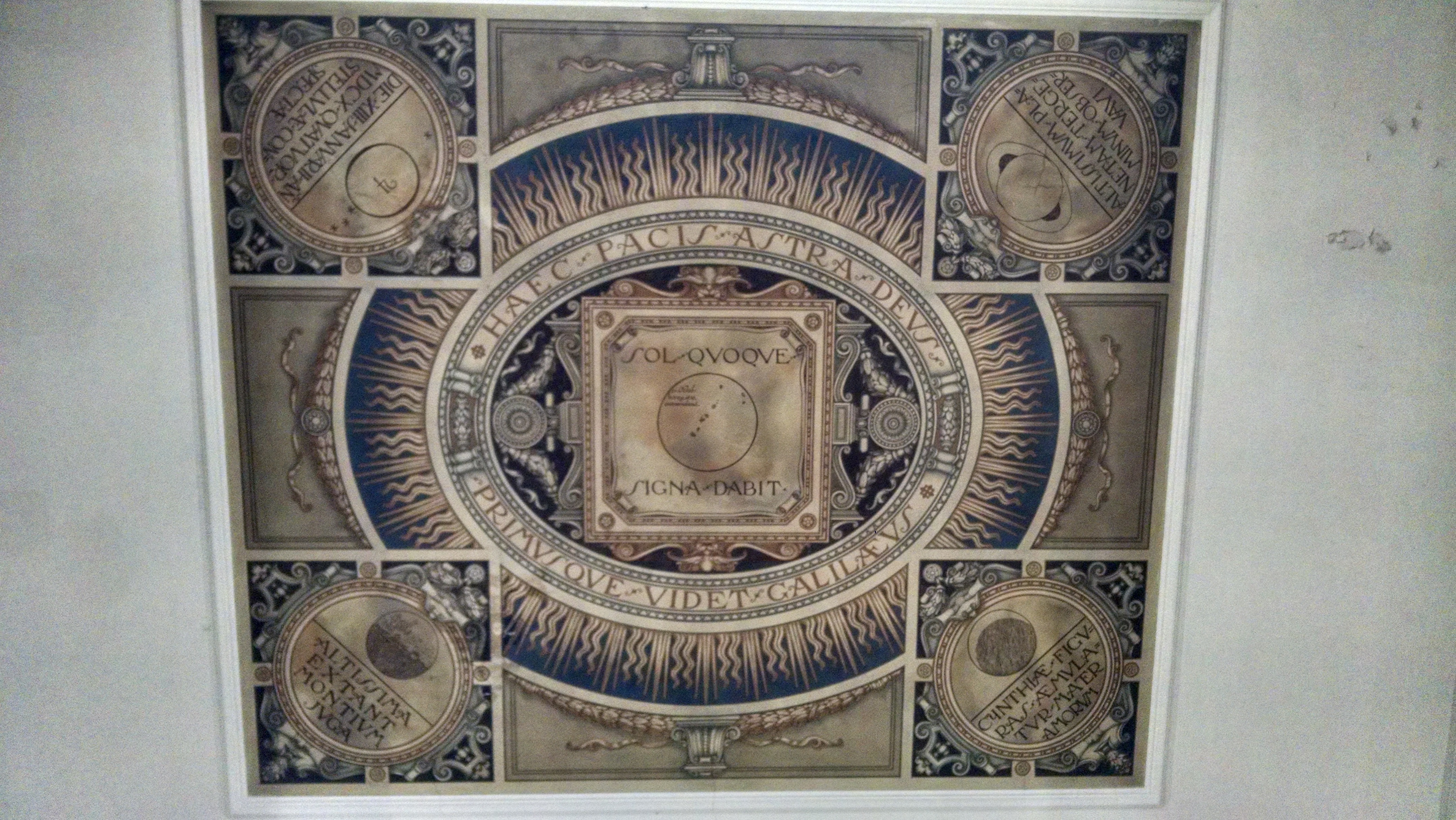
I didn’t notice this ceiling decoration last time I was here. These guys really love their Galileo stuff.

I’ll be here for three weeks of the full six-week program, hopefully plenty of time for some solid collaboration. This week was the “conference part”, with a flurry of talks over three days.

I missed the first day, which focused on the “actually useful” side of scattering amplitudes, practical techniques that can be applied to real Standard Model calculations. Luckily the slides are online, and at least some of the speakers are still around to answer questions. I’m particularly curious about Daniel Hulme’s talk, about an approximation strategy I hadn’t heard of before.

The topics of the next two days were more familiar, but the talks still gave me a better appreciation for the big picture behind them. From Johannes Henn’s thoughts about isolating a “conformal part” of general scattering amplitudes to Enrico Herrmann’s roadmap for finding an amplituhedron for supergravity, people seem to be aiming for bigger goals than just the next technical hurdle. It will be nice to settle in over the next couple weeks and get a feeling for what folks are working on next.

A Micrographia of Beastly Feynman Diagrams

Earlier this year, I had a paper about the weird multi-dimensional curves you get when you try to compute trickier and trickier Feynman diagrams. These curves were “Calabi-Yau”, a type of curve string theorists have studied as a way to curl up extra dimensions to preserve something called supersymmetry. At the time, string theorists asked me why Calabi-Yau curves showed up in these Feynman diagrams. Do they also have something to do with supersymmetry?

I still don’t know the general answer. I don’t know if all Feynman diagrams have Calabi-Yau curves hidden in them, or if only some do. But for a specific class of diagrams, I now know the reason. In this week’s paper, with Jacob Bourjaily, Andrew McLeod, and Matthias Wilhelm, we prove it.

We just needed to look at some more exotic beasts to figure it out.

tardigrade_eyeofscience_960

Like this guy!

Meet the tardigrade. In biology, they’re incredibly tenacious microscopic animals, able to withstand the most extreme of temperatures and the radiation of outer space. In physics, we’re using their name for a class of Feynman diagrams.

even_loop_tardigrades

A clear resemblance!

There is a long history of physicists using whimsical animal names for Feynman diagrams, from the penguin to the seagull (no relation). We chose to stick with microscopic organisms: in addition to the tardigrades, we have paramecia and amoebas, even a rogue coccolithophore.

The diagrams we look at have one thing in common, which is key to our proof: the number of lines on the inside of the diagram (“propagators”, which represent “virtual particles”) is related to the number of “loops” in the diagram, as well as the dimension. When these three numbers are related in the right way, it becomes relatively simple to show that any curves we find when computing the Feynman diagram have to be Calabi-Yau.

This includes the most well-known case of Calabi-Yaus showing up in Feynman diagrams, in so-called “banana” or “sunrise” graphs. It’s closely related to some of the cases examined by mathematicians, and our argument ended up pretty close to one made back in 2009 by the mathematician Francis Brown for a different class of diagrams. Oddly enough, neither argument works for the “traintrack” diagrams from our last paper. The tardigrades, paramecia, and amoebas are “more beastly” than those traintracks: their Calabi-Yau curves have more dimensions. In fact, we can show they have the most dimensions possible at each loop, provided all of our particles are massless. In some sense, tardigrades are “as beastly as you can get”.

We still don’t know whether all Feynman diagrams have Calabi-Yau curves, or just these. We’re not even sure how much it matters: it could be that the Calabi-Yau property is a red herring here, noticed because it’s interesting to string theorists but not so informative for us. We don’t understand Calabi-Yaus all that well yet ourselves, so we’ve been looking around at textbooks to try to figure out what people know. One of those textbooks was our inspiration for the “bestiary” in our title, an author whose whimsy we heartily approve of.

Like the classical bestiary, we hope that ours conveys a wholesome moral. There are much stranger beasts in the world of Feynman diagrams than anyone suspected.

Don’t Marry Your Arbitrary

This fall, I’m TAing a course on General Relativity. I haven’t taught in a while, so it’s been a good opportunity to reconnect with how students think.

This week, one problem left several students confused. The problem involved Christoffel symbols, the bane of many a physics grad student, but the trick that they had to use was in the end quite simple. It’s an example of a broader trick, a way of thinking about problems that comes up all across physics.

To see a simplified version of the problem, imagine you start with this sum:

g(j)=\Sigma_{i=0}^n ( f(i,j)-f(j,i) )

Now, imagine you want to sum the function g(j) over j. You can write:

\Sigma_{j=0}^n g(j) = \Sigma_{j=0}^n \Sigma_{i=0}^n ( f(i,j)-f(j,i) )

Let’s break this up into two terms, for later convenience:

\Sigma_{j=0}^n g(j) = \Sigma_{j=0}^n \Sigma_{i=0}^n f(i,j) - \Sigma_{j=0}^n \Sigma_{i=0}^n f(j,i)

Without telling you anything about f(i,j), what do you know about this sum?

Well, one thing you know is that i and j are arbitrary.

i and j are letters you happened to use. You could have used different letters, x and y, or \alpha and \beta. You could even use different letters in each term, if you wanted to. You could even just pick one term, and swap i and j.

\Sigma_{j=0}^n g(j) = \Sigma_{j=0}^n \Sigma_{i=0}^n f(i,j) - \Sigma_{i=0}^n \Sigma_{j=0}^n f(i,j) = 0

And now, without knowing anything about f(i,j), you know that \Sigma_{j=0}^n g(j) is zero.

In physics, it’s extremely important to keep track of what could be really physical, and what is merely your arbitrary choice. In general relativity, your choice of polar versus spherical coordinates shouldn’t affect your calculation. In quantum field theory, your choice of gauge shouldn’t matter, and neither should your scheme for regularizing divergences.

Ideally, you’d do your calculation without making any of those arbitrary choices: no coordinates, no choice of gauge, no regularization scheme. In practice, sometimes you can do this, sometimes you can’t. When you can’t, you need to keep that arbitrariness in the back of your mind, and not get stuck assuming your choice was the only one. If you’re careful with arbitrariness, it can be one of the most powerful tools in physics. If you’re not, you can stare at a mess of Christoffel symbols for hours, and nobody wants that.