Tag Archives: amplitudes

Where are the Amplitudeologists?

As I’ve mentioned a couple of times before, I’m part of a sub-field of theoretical physics called Amplitudeology.

Amplitudeology in its modern incarnation is relatively new, and concentrated in a few specific centers. I thought it might be interesting to visualize which universities have amplitudeologists, so I took a look at the attendee lists of two recent conferences and put their affiliations into google maps. In an attempt to balance things, one of the conferences is in North America and the other is in Europe. Here is the result:

The West Coast of the US has two major centers, Stanford/SLAC and UCLA, focused around Lance Dixon and Zvi Bern respectively. The Northeast has a fair assortment, including places that have essentially everything like the Perimeter Institute and the Institute for Advanced Study and places known especially for their amplitudes work like Brown.

Europe has quite a large number of places. There are many universities in Europe with a long history of technical research into quantum field theory. When amplitudes began to become more prominent as its own sub-field, many of these places slotted right in. In particular, there are many locations in Germany, a decent number in the UK, a few in the vicinity of CERN, and a variety of places of some importance elsewhere.

Outside of Europe and North America, there’s much less amplitudes research going on. Physics in general is a very international enterprise, and many sub-fields have a lot of participation from researchers in China, India, Japan, and Korea. Amplitudes, for the most part, hasn’t caught on in those places yet.

This map is just a result of looking at two conferences. More data would yield many places that were left out of this setup, including a longstanding community in Russia. Still, it gives you a rough idea of where to find amplitudeologists, should you have need of one.

The Amplituhedron and Other Excellently Silly Words

Nima Arkani-Hamed recently gave a talk at the Simons Center on the topic of what he and Jaroslav Trnka are calling the Amplituhedron.

There’s an article on it in Quanta Magazine. The article starts out a bit hype-y for my taste (too much language of importance, essentially), but it has several very solid descriptions of the history of the situation. I particularly like how the author concisely describes the Feynman diagram picture in the space of a single paragraph, and I would recommend reading that part even if you don’t have time to read the whole article. In general it’s worth it to get a picture of what’s going on.

That said, I obviously think I can clear a few things up, otherwise I wouldn’t be writing about it, so here I go!

“The” Amplituhedron

Nima’s new construction, the Amplituhedron, encodes amplitudes (building blocks of probabilities in particle physics) in N=4 super Yang-Mills as the “area” of a multi-dimensional analog of a polyhedron (hence, Amplitu-hedron).

Now, I’m a big supporter of silly-sounding words with amplitu- at the beginning (amplitudeologist, anyone?), and this is no exception. Anyway, the word Amplitu-hedron isn’t what’s confusing people. What’s confusing people is the word the.

When the Quanta article says that Nima has found “the” Amplituhedron, it makes it sound like he has discovered one central formula that somehow contains the whole universe. If you read the comments, many readers went away with that impression.

In case you needed me to say it, that’s not what is going on. The problem is in the use of the word “the”.

Suppose it was 1886, and I told you that a fellow named Carl Benz had invented “the Automobile”, a marvelous machine that can get everyone to work on time (as well as become the dominant form of life on Long Island).

My use of “the” might make you imagine that Benz invented some single, giant machine that would roam across the country, picking people up and somehow transporting everyone to work. You’d be skeptical of this, of course, expecting that long queues to use this gigantic, wondrous machine would swiftly ruin any speed advantage it might possess…

The Automobile, here to take you to work.

Or, you could view “the” in another light, as indicating a type of thing.

Much like “the Automobile” is a concept, manifested in many different cars and trucks across the country, “the Amplituhedron” is a concept, manifested in many different amplituhedra, each corresponding to a particular calculation that we might attempt.

Advantages…

Each amplituhedron has to do with an amplitude involving a specific number of particles, with a particular number of internal loops. (The Quanta article has a pretty good explanation of loops, here’s mine if you’d rather read that). Based on the problem you’re trying to solve, there are a set of rules that you use to construct the particular amplituhedron you need. The “area” of this amplituhedron (in quotation marks because I mean the area in an abstract, mathematical sense) is the amplitude for the process, which lets you calculate the probability that whatever particle physics situation you’re describing will happen.

Now, we already have many methods to calculate these probabilities. The amplituhedron’s advantage is that it makes these calculations much simpler. What was once quite a laborious and complicated four-loop calculation, Nima claims can be done by hand using amplituhedra. I didn’t get a chance to ask whether the same efficiency improvement holds true at six loops, but Nima’s description made it sound like it would at least speed things up.

[Edit: Some of my fellow amplitudeologists have reminded me of two things. First, that paper I linked above paved the way to more modern methods for calculating these things, which also let you do the four-loop calculation by hand. (You need only six or so diagrams). Second, even back then the calculation wasn’t exactly “laborious”, there were some pretty slick tricks that sped things up. With that in mind, I’m not sure Nima’s method is faster per se. But it is a fast method that has the other advantages described below.]

The amplituhedron has another, more sociological advantage. By describing the amplitude in terms of a geometrical object rather than in terms of our usual terminology, we phrase things in a way that mathematicians are more likely to understand. By making things more accessible to mathematicians (and the more math-headed physicists), we invite them to help us solve our problems, so that together we can come up with more powerful methods of calculation.

Nima and the Quanta article both make a big deal about how the amplituhedron gets rid of the principles of locality and unitarity, two foundational principles of quantum field theory. I’m a bit more impressed by this than Woit is. The fine distinction that needs to be made here is that the amplituhedron isn’t simply “throwing out” locality and unitarity. Rather, it’s written in such a way that it doesn’t need locality and unitarity to function. In the end, the formulas it computes still obey both principles. Nima’s hope is that, now that we are able to write amplitudes without needing locality and unitarity, if we end up having to throw out either of those principles to make a new theory we will be able to do so. That’s legitimately quite a handy advantage to have, it just doesn’t mean that locality and unitarity must be thrown out right now.

…and Disadvantages

It’s important to remember that this whole story is limited to N=4 super Yang-Mills. Nima doesn’t know how to apply it to other theories, and nobody else seems to have any good ideas either. In addition, this only applies to the planar part of the theory. I’m not going to explain what that term means here; for now just be aware that while there are tricks that let you “square” a calculation in super Yang-Mills to get a similar calculation in quantum gravity, those tricks rely on having non-planar data, or information beyond the planar part of the theory. So at this point, this doesn’t give us any new hints about quantum gravity. It’s conceivable that physicists will find ways around both of these limits, but for now this result, though impressive, is quite limited.

Nima hasn’t found some sort of singular “jewel at the heart of physics”. Rather, he’s found a very slick, very elegant, quite efficient way to make calculations within one particular theory. This is profound, because it expresses things in terms that mathematicians can address, and because it shows that we can write down formulas without relying on what are traditionally some of the most fundamental principles of quantum field theory. Only time will tell whether Nima or others can generalize this picture, taking it beyond planar N=4 super Yang-Mills and into the tougher theories that still await this sort of understanding.
Hexagon Functions – or, what is my new paper about?

I’ve got a new paper up on arXiv this week.

(For those of you unfamiliar with it, arXiv.org is a website where physicists, mathematicians, and researchers in related fields post their papers before submitting them to journals. It’s a cultural quirk of physics that probably requires a post in its own right at some point. Anyway…)

What’s it about? Well, the paper is titled Hexagon functions and the three-loop remainder function. Let’s go through that and figure out what it means.

When the paper refers to hexagon functions, it’s referring to functions used to describe situations with six particles involved. An important point to clarify here is that when counting the number of “particles involved”, we add together both the particles that go in and the particles that go out. So if three particles arrive somewhere, interact with each other in some complicated way, and then those three particles leave, that’s a six-particle process. Similarly, if two particles collide and four particles emerge, that’s also a six-particle process. (If you find the idea of more particles coming out than went in confusing, read this post.) Hexagon functions, then, can describe either of those processes.

What, specifically, are these functions being used for? Well, they’re being used to find the three-loop remainder function of N=4 super Yang-Mills.

N=4 super Yang-Mills is my favorite theory. If you haven’t read my posts on the subject, I encourage you to do so.

N=4 super Yang-Mills is so nice because it is so symmetric, and because it takes part in so many dualities. These two traits ended up being enough for Zvi Bern, Lance Dixon, and Vladimir Smirnov to propose an ansatz for all amplitudes in N=4 super Yang-Mills, called the BDS ansatz. (Amplitudes are how we calculate the probability of events occurring: for example, the probability of that “two particles going to four particles” situation I talked about earlier.)

Unfortunately, their formula was incomplete. While it was possible to prove that the formula was true for four-particle and five-particle processes, for six or more particles the formula failed. As it turned out though, it failed in a predictable way. All that was needed to fix it was to add something called the remainder function, the remaining part of the formula beyond the BDS ansatz.

The task, then, was to compute this remainder function.

I’ve talked before about how in quantum field theory, we calculate probabilities through increasingly complicated diagrams, keeping track of the complexity by counting the number of loops. The remainder function had already been computed up to two loops by working out these diagrams, but three looked to be considerably more difficult.

Luckily, we (myself, Lance Dixon, James Drummond, and Jeffrey Pennington) had a trick up our sleeves.

Formulas in N=4 super Yang-Mills have a property called maximal transcendentality. I’ve talked about transcendentality before:  essentially, it’s a way of counting how many powers of pi and logarithms are in your equations. Maximal transcendentality means that every part of the formula has a fixed, maximum number for its degree of transcendentality. In the case of the remainder function, this is two times the number of loops. Thus, the two-loop remainder function has degree of transcendentality four, so it can have pi to the fourth power in it, while the three-loop remainder function (the one that we calculated) has degree of transcendentality six, so it can have pi to the sixth power.

Of course, it can have lots of other expressions as well, which brings us back to the hexagon functions. By classifying the sort of functions that can appear in these formulas at each level of transcendentality, we find the basic building blocks that can show up in the remainder function. All we have to do then is ask what combinations of building blocks are allowed: which ones make good physics sense, for example, or which ones allow our formula to agree with the predictions of other researchers.

As it turns out, once you apply all the restrictions there is only one possible way to put the building blocks together that gives you a functioning formula. By process of elimination, this formula must be the correct three-loop six-point remainder function. Every extra constraint then serves as a check that nothing went wrong and that the formula is sound. Without calculating a single Feynman diagram, we’ve gotten our result!

Just to give you an idea of how complicated this result is, in order to write the formula out fully would take 800 pages. We’ve got shorter ways to summarize it, but perhaps it would be better to give a picture. The formula depends on three variables, called u, v, and w. To show how the formula behaves when all three variables change, here’s a plot of the formula in the variables u and v, for a series of different values of w.

wstacksheaves

Without our various shortcuts to generate this formula, it would have taken an extraordinarily long amount of time. Luckily, N=4 super Yang-Mills’s nice properties save the day, and allow us to achieve what I hope you won’t mind me calling a truly impressive result.

Achieving Transcendence: The Physicist Way

I wanted to shed some light on something I’ve been working on recently, but I realized that a little background was needed to explain some of the ideas. As such, this post is going to be a bit more math-y than usual, but I hope it’s educational!

Pi is special. Familiar to all through the area of a circle \pi r^2, pi is particularly interesting in that you cannot write an algebra equation made up of whole numbers whose solution is pi. While you can easily get fractions (3x=4 gives x=\frac{4}{3}) and even many irrational numbers (x^2=2 gives x=\sqrt{2}), pi is one of a set of numbers that it is impossible to get. These special numbers transcend other numbers, in that you cannot use more everyday numbers to get to them, and as such mathematicians call them transcendental numbers.

In addition to transcendental numbers, you can have transcendental functions. Transcendental functions are functions that can take in a normal number and produce a transcendental number. For example, you may be aware of the delightful equation below:

e^{i \pi}=-1

We can manipulate both sides of this equation by taking the natural logarithm, \ln, to find

i\pi=\ln(-1)

This tells us that the natural logarithm function can take a (negative) whole number (-1) and give us a transcendental number (pi). This means that the natural logarithm is a transcendental function.

There are many other transcendental functions. In addition to logarithms, there are a whole host of related functions called the polylogarithms, and even more generally the harmonic polylogarithms. All of these functions can take in whole numbers like -1 or 1 and give transcendental numbers.

Here physicists introduce a concept called degree of transcendentality, or transcendental weight, which we use to measure how transcendental a number or a function is. Pi (and functions that can give pi, like the natural logarithm) have transcendental weight one. Pi squared has transcendental weight two. Pi cubed (and another number called \zeta(3)) have transcendental weight three. And so on.

Note here that, according to mathematicians, there is no rigorous way that a number can be “more transcendental” than another number. In the case of some of these numbers, like \zeta(5), it hasn’t even been proven that the number is actually transcendental at all! However, physicists still use the concept of transcendental weight because it allows us to classify and manipulate a common and useful set of functions. This is an example of the differences in methods and standards between physicists and mathematicians, even when they are working on similar things.

In what way are these functions common and useful? Well it turns out that in N=4 super Yang-Mills many calculated results are not only made up of these polylogarithms, they have a particular (fixed) transcendental weight. In situations when we expect this to be true, we can use our knowledge to guess most, or even all, of the result without doing direct calculations. That’s immensely useful, and it’s a big part of what I’ve been doing recently.

Ansatz: Progress by Guesswork

I’ve talked before about how hard traditional Quantum Field Theory is. Building things up step by step is slow and inefficient. And like any slow and inefficient process, there is a quicker way. An easier way. A…riskier way.

You guess.

Guess is such an ugly word, though…so let’s call it an ansatz.

Ansatz is a word of German origin. In German, it is part of various idiomatic expressions, where it can refer to an approach, an attempt, or a starting point. When physicists and mathematicians use the term ansatz, they mean a combination of all of these.

An ansatz is an approach in that it is a way of finding a solution to a problem without using more general, inefficient methods. Rather than approaching problems starting from the question, an ansatz approaches problems by starting with an answer, or rather, an attempt at an answer.

An ansatz is an attempt in that it serves as researcher’s best first guess at what the answer is, based on what they know about it. This knowledge can come from several sources. Sometimes, the question constrains the answer, ruling out some possibilities or restricting the output to a particular form. Usually, though, the attempt of an ansatz goes beyond this, incorporating the scientist’s experience as to what sorts of answers similar questions have had in the past, even if it isn’t understood yet why those sorts of answers are common. With information from both of these sources, a scientist comes up with a preliminary guess, or ansatz, as to answer to the problem at hand.

What if the answer is wrong, though? The key here is that an ansatz is only a starting point. Rather than being a full answer with all the details filled in, an ansatz generally leaves some parameters free. These free parameters represent unknowns, and it is up to further tests to fix their values and complete the answer. These tests can be experimental, but they can also be mathematical: often there are restrictions on possible answers that are difficult to apply when creating a first guess, but easier to apply when one has only a few parameters to fix. In order to avoid the risk of finding an ansatz that only works by coincidence, many more tests are done than there are parameters. That way, if the guess behind the ansatz is wrong, then some of the tests will give contradictory rules for the values of the parameters, and you’ll know that it’s time to go back and find a better guess.

In the end, this approach, using your first attempt as a starting point, should end up with only a few parameters free, ideally none at all. One way or another, you have figured out a lot about your question just by guessing the answer!

The use of ansatzes is quite common in theoretical physics. Some of the most interesting problem either can’t be solved or are tedious to solve through traditional means. The only way to make progress, to go beyond what everyone else can already do, is to notice a pattern, make a guess, and hope you get lucky. Well, not just a guess: an ansatz.

N=4: Maximal Particles for Maximal Fun

Part Four of a Series on N=4 Super Yang-Mills Theory

This is the fourth in a series of articles that will explain N=4 super Yang-Mills theory. In this series I take that phrase apart bit by bit, explaining as I go. Because I’m perverse and out to confuse you, I started with the last bit here, and now I’ve reached the final part.

N=4 Super Yang-Mills Theory

Last time I explained supersymmetry as a relationship between two particles, one with spin X and the other with spin X-½. It’s actually a leeetle bit more complicated than that.

When a shape is symmetric, you can turn it around and it will look the same. When a theory is supersymmetric, you can “turn” it, moving from particles with spin X to particles of spin X-½, and the theory will look the same.

With a 2D shape, that’s the whole story. But if you have a symmetric 3D shape, you can turn it in two different directions, moving to different positions, and the shape will look the same either way. In supersymmetry, the number of different ways you can “turn” the theory and still have it look the same is called N.

N=1 symmetric shape

N=2 symmetric shape

Consider the example of super Yang-Mills. If we start out with a particle of spin 1 (a Yang-Mills field), N=1 supersymmetry says that there will also be a particle of spin ½, similar to the particles of everyday matter. But suppose that instead we had N=2 supersymmetry. You can move from the spin 1 particle to spin ½ in one direction, or in the other one, and just like regular symmetry moving in two different directions will get you to two different positions. That means you need two different spin ½ particles! Furthermore, you can also move in one direction, then in the other one: you go from spin 1 to spin ½, then down from spin ½ to spin 0. So our theory can’t just have spin 1 and spin ½, it has to have spin 0 particles as well!

You can keep increasing N, as long as you keep increasing the number and types of particles. Finally, at N=4, you’ve got the maximal set: one Yang-Mills field with spin 1, four different spin ½ particles, and six different spin 0 scalars. The diagram below shows how the particles are related: you start in the center with a Yang-Mills field, and then travel in one of four directions to the spin ½ particles. Picking two of those directions, you travel further, to a scalar in between two spin ½ particles. Applying more supersymmetry just takes you back down: first to spin ½, then all the way back to spin 1.

N=4 super Yang-Mills is where the magic happens. Its high degree of symmetry gives it conformal invariance and dual conformal invariance, it has been observed to have maximal transcendentality and it may even be integrable. Any one of those statements could easily take a full blog post to explain. For now, trust me when I tell you that while N=4 super Yang-Mills may seem complicated, its symmetry means that deep down it is one of the easiest theories to work with, and in fact it might be the simplest non-gravity quantum field theory possible. That makes it an immensely important stepping stone, the first link to take us to a full understanding of particle physics.

One final note: you’re probably wondering why we stopped at N=4. At N=4 we have enough symmetry to go out from spin 1 to spin 0, and then back in to spin 1 again. Any more symmetry, and we need more space, which in this case means higher spin, which means we need to start talking about gravity. Supergravity takes us all the way up to N=8, and has its own delightful properties…but that’s a topic for another day.

Who Am I?

I call myself a String Theorist, someone who describes the world in terms of subatomic lengths of string that move in ten dimensions (nine of space and one of time),

But in practice I’m more of a Particle Theorist, describing the world not in terms of short lengths of string but rather with particles that each occupy a single point in space,

More specifically, I’m an Amplitudeologist, part of a trendy new tribe including the likes of Zvi Bern, Lance Dixon, Nima Arkani-Hamed, John Joseph Carrasco (jjmc on twitter), and sometimes Sheldon Cooper,

In terms of my career, I’m a Graduate Student, less like a college student and more like an apprentice, learning not primarily through classes but rather through working to advance my advisor’s research,

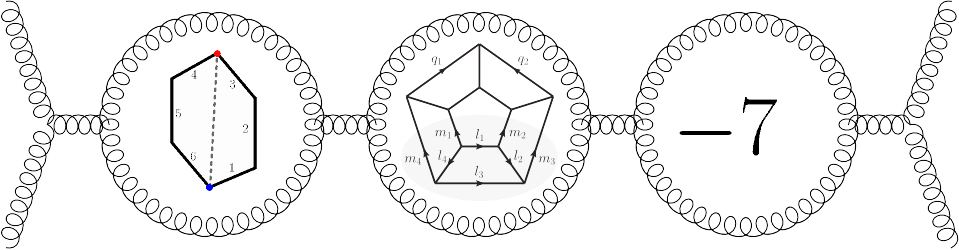
And what do I work on? Things like this.