Tag Archives: amplitudes

Hexagon Functions III: Now with More Symmetry

I’ve got a new paper up this week.

It’s a continuation of my previous work, understanding collisions involving six particles in my favorite theory, N=4 super Yang-Mills.

This time, we’re pushing up the complexity, going from three “loops” to four. In the past, I could have impressed you with the number of pages the formulas I’m calculating take up (eight hundred pages for the three-loop formula from that first Hexagon Functions paper). Now, though, I don’t have that number: putting my four-loop formula into a pdf-making program just crashes the program. Instead, I’ll have to impress you with file sizes: 2.6 MB for the three-loop formula, 96 MB for the four-loop one.

Calculating such a formula sounds like a pretty big task, and it was, the first time. But things got a lot simpler after a chat I had at Amplitudes.

We calculate these things using an ansatz, a guess for what the final answer should look like. The more vague our guess, the more parameters we need to fix, and the more work we have in general. If we can guess more precisely, we can start with fewer parameters and things are a lot easier.

Often, more precise guesses come from understanding the symmetries of the problem. If we can know that the final answer must be the same after making some change, we can rule out a lot of possibilities.

Sometimes, these symmetries are known features of the answer, things that someone proved had to be correct. Other times, though, they’re just observations, things that have been true in the past and might be true again.

We started out using an observation from three loops. That got us pretty far, but we still had a lot of work to do: 808 parameters, to be fixed by other means. Fixing them took months of work, and throughout we hoped that there was some deeper reason behind the symmetries we observed.

Finally, at Amplitudes, I ran into fellow amplitudeologist Simon Caron-Huot and asked him if he knew the source of our observed symmetry. In just a few days he was able to link it to supersymmetry, giving us justification for our jury rigged trick. However, we figured out that his explanation went further than any of us expected. In the end, rather than 808 parameters we only really needed to consider 34.

Thirty-four options to consider. Thirty-four possible contributions to a ~100 MB file. That might not sound like a big deal, but compared to eight hundred and eight it’s a huge deal. More symmetry means easier calculations, meaning we can go further. At this point going to the next step in complexity, to five loops rather than four, might be well within reach.

Scooped Is a Spectrum

I kind of got scooped recently.

I say kind of, because as I’ve been realizing being scooped isn’t quite the all-or-nothing thing you’d think it would be. Rather, being scooped is a spectrum.

Go ahead and scoop up a spectrum as you’re reading this.

By the way, I’m going to be a bit cagey about what exactly I got scooped on. As you’ll see, there are still a few things my collaborator and I need to figure out, and in the meantime I don’t want to put my foot in my mouth. Those of you who follow what’s going on in amplitudes might have some guesses. In case you’re worried, it has nothing to do with my work on Hexagon Functions.

When I heard about the paper that scooped us, my first reaction was to assume the project I’d been working on for a few weeks was now a dead end. When another group publishes the same thing you’ve been working on, and does it first, there doesn’t seem to be much you can do besides shake hands and move on.

As it turns out, though, things are a bit more complicated. The risk of publishing fast, after all, is making mistakes. In this case, it’s starting to look like a few of the obstructions that were holding us back weren’t solved by the other group, and in fact that they may have ignored those obstructions altogether in their rush to get something publishable.

This creates an interesting situation. It’s pretty clear the other group is beyond us in certain respects, they published first for a (good) reason. On the other hand, precisely because we’ve been slower, we’ve caught problems that it looks like the other group didn’t notice. Rather than rendering our work useless, this makes it that much more useful: complementing the other group’s work rather than competing with it.

Being scooped is a spectrum. If two groups are working on very similar things, then whoever publishes first usually wins. But if the work is different enough, then a whole range of roles opens up, from corrections and objections to extensions and completions. Being scooped doesn’t have to be the end of the world, in fact, it can be the beginning.

Want to Open up Your Work? Try a Data Mine!

Have you heard of the Open Science movement?

The general idea is to make scientists’ work openly accessible, both to the general public and to other scientists. This doesn’t just include published results, but the raw data as well. The goal is to make it possible for anyone, in principle, to check the validity of important results.

I’m of the opinion that this sort of thing isn’t always feasible, but when it is it’s usually a great thing to do. And in my field, the best way to do this sort of thing is to build a data mine.

I’m thinking in particular of Blümlein, Broadhurst, and Vermaseren’s Multiple Zeta Value Data Mine. Multiple zeta values are the result of generalizing the Riemann Zeta Function, and evaluating it at one. They’re transcendental numbers, and there are complicated relations between them. Finding all those relations, even for a restricted subset of them, can be a significant task. Usually, there aren’t published programs for this sort of thing, like most things in physics we have to jury-rig up our own code. What makes the folks behind the multiple zeta value data mine unique is that when they had to do this, they didn’t just keep the code to themselves. Instead, they polished it up and put it online.

That’s the general principle behind building a data mine. By putting your tools online, you make them available to others, so other researchers can use them as a jumping-off point for their own work. This can speed up the field, bringing everyone up to the same starting point, and has the side benefit of gathering heaps of citations from people who use your tools.

My collaborators already have a site with some of the data from our research into hexagon functions. Originally, it was just a place to house extra-large files that couldn’t be included with the original paper. For our next paper, we’re planning on expanding it into a true data mine, and including enough technology for someone else to build off of our results.

Historic Montreal

I’m at a conference in Montreal this week, so it’s going to be a short post. The University of Montreal’s Centre de Recherches Mathématiques has been holding a program on the various hidden symmetries of N=4 super Yang-Mills since the beginning of the summer. This week is the amplitudes-focused part of the program, so they’ve brought in a bunch of amplitudes-folks from around the world, myself included.

It’s been great hanging out with fellow members of my sub-field, as always, both at the conference and at dinner afterwards. Over possibly too much wine I heard stories of the heady days of 2007, when James Drummond and Johannes Henn first discovered one of the most powerful symmetries of N=4 super Yang-Mills (a duality called dual conformal invariance) and Andrew Hodges showed off the power of a set of funky variables called twistors. It’s amazing to me how fast the field moves, sometimes: by the time I started doing amplitudes work in 2011 these ideas were the bedrock of the field. History operates on different scales, and in amplitudes a few decades have played host to an enormous amount of progress.

History in the real world can move surprisingly fast too. After seeing cathedrals in Zurich that date back to the medieval era, I was surprised when the majestic basilica overlooking Montreal turned out to be less than a century old.

In retrospect the light-up cross should have made it obvious.

In retrospect the light-up cross should have made it obvious.

Amplitudes Megapost

If you met me on a plane and asked me what I do, I’d probably lead with something like this:

“I come up with mathematical tricks to make particle physics calculations easier.”

People like me, who research these tricks, are sometimes known as Amplitudeologists. We studying scattering amplitudes, mathematical formulas used to calculate the probabilities of different things happening when sub-atomic particles collide.

Why do we want to make calculations easier? Because particle physics is hard!

More specifically, calculations in particle physics can be hard for three broad reasons: lots of loops, lots of legs, or more complicated theories.

Loops measure precision. They’re called loops because more complicated Feynman diagrams contain “loops” of particles, while the simplest, with no loops at all, are called “trees”. The more loops you include, the more precise your calculation becomes, but it also becomes more complicated.

Legs are the number of particles involved. If two particles collide and bounce off each other, then there are a total of four legs: two from the incoming particles, two from the outgoing ones. Calculations with more legs are almost always more complicated than calculations with fewer.

Most of the time, our end-goal is to calculate things that are relevant to the real world. Usually, this means QCD, or Quantum Chromodynamics, the theory of quarks and gluons. QCD is very complicated, though. Often, we work to hone our techniques on simpler theories first. N=4 super Yang-Mills has been called the simplest quantum field theory, particularly the further simplified, planar version. If you want a basic overview of it, check out the Handy Handbooks tab at the top of my blog. Often, progress in amplitudeology involves adapting tricks from planar N=4 super Yang-Mills to more complicated, and more realistic, theories.

I should point out that our goal in amplitudeology isn’t always to do more complicated calculations. Sometimes, it’s about doing a calculation we already know how to do, but in a way that’s more insightful. This lets us learn more about the theories we’re studying, as well as gaining insights about larger problems like the nature of space and time.

So what sorts of tricks do we use to do all this? Well, there are a few broad categories…

Generalized Unitarity

The prizewinning idea that started it all, generalized unitarity came out of the collaboration of Zvi Bern, Lance Dixon, and David Kosower, starting in the 90’s. The core of the idea is difficult to describe in a quick sentence, but it essentially boils down to noticing that, rather than thinking about every single multi-loop Feynman diagram independently, you can think of loop diagrams as what you get when you sew trees together.

This is a very powerful idea. These days, pretty much everyone who studies amplitudeology learns it, and it’s proven pivotal for a wide array of applications.

In planar N=4 super Yang-Mills it’s one of the techniques that can go to exceptionally high loop order, to six or seven loops. If you drop the “planar” condition, it’s still quite powerful. If you do things right, as Zvi Bern, John Joseph Carrasco, and Henrik Johansson found, you can get results in N=8 supergravity “for free”. This raises what has ended up being one of the big questions of our sub-field: does N=8 supergravity behave like most attempts at theories of quantum gravity, with pesky infinite results that we don’t know how to deal with, or does it behave like N=4 super Yang-Mills, which has no pesky infinities at all? Answering this question requires a dizzying seven-loop calculation, the mystique of which got me in to the field in the first place. Unfortunately, despite diligent efforts from Bern and collaborators, they’ve been stuck at four loops for quite some time. In the meantime they’ve been extending things in all the other amplitudes-directions: more legs, more complicated theories (in this case, supergravity with less supersymmetry), and more insight. Recently, it looks like they may have found a way around this hurdle, so the mystery at seven loops may not be so far away after all.

Generalized Unitarity is also one of the most powerful amplitudes tricks for real-world theories, in particular QCD. In this case, it’s main virtue is in legs, not loops, going up to seven-particles at one loop for practical, LHC-relevant calculations. There’s also a major effort to push this to two loops, with some success.

BCFW Recursion

If generalized unitarity was the trick that got experimentalists to sit up and take notice, BCFW is the one that got the attention of the pure theorists. In the mid-2000s Ruth Britto, Freddy Cachazo, and Bo Feng (later joined by theoretical physics superstar Ed Witten) figured out a way to build up tree amplitudes to any number of legs recursively for any theory, starting with three particles and working their way up. Their method was both fairly efficient and extremely insightful, and it’s another trick that’s made its way into every amplitudeologist’s arsenal. Further developments led to a recursive procedure that could work up to any number of loops in planar N=4 super Yang-Mills, which while not especially efficient did lead to…

The Positive Grassmannian, and the Amplituhedron

The work of Nima Arkani-Hamed, Jacob Bourjaily, Freddy Cachazo, Alexander Goncharov, Alexander Postnikov, and Jaroslav Trnka on the Positive Grassmannian (and more recently the Amplituhedron) has pushed the “more insight” direction impressively far. The Amplituhedron in particular captured the public’s imagination, as well as that of mathematicians, by packaging the all-loop amplitude into a particularly clean, mathematically meaningful form. Now they’re working on pushing this deep understanding to non-planar N=4 super Yang-Mills.

Integration Tricks

Generalized unitarity and the Amplituhedron have one thing in common: neither gives the full result. Calculating scattering amplitudes traditionally is a two-step process: first, add up all possible Feynman diagrams, then add up (integrate) all possible momenta. Generalized unitarity and the Amplituhedron let you skip the diagrams, but in both cases you still need to integrate. There’s a whole lore of integration techniques, from breaking things up into a basis of known “master” integrals (an example paper on this theme here), to attacking the integrations numerically via a process known as sector decomposition (one of the better programs that does this here). Higher-loop integrations are typically quite tough, even with these techniques.

Polylogarithms

These integrals will usually result in a type of mathematical functions called polylogarithms, or transcendental functions. Understanding these functions has led to an enormous amount of progress (and I’m not just saying that because it’s what I work on 😉 ).

It all started when Alexander Goncharov, Mark Spradlin, Cristian Vergu, and Anastasia Volovich figured out how to write a laboriously calculated seventeen-page two-loop six-particle amplitude in just two lines. To do this, they used mathematical properties of polylogarithms that were previously largely unknown to physicists. Their success inspired Lance Dixon, James Drummond, and Johannes Henn to use these methods to guess the correct answer at three loops, work that was completed with my involvement.

Since then, both groups have made a lot of progress. In general, Spradlin, Volovich, and collaborators have been pushing things farther in terms of legs and insight, while Dixon and collaborators have made progress at higher loops. So far we’ve gotten to four loops (here, plus unpublished work), while the others have proposals for any number of particles at two loops and substantial progress for seven particles at three loops.

All of this is still for planar N=4 super Yang-Mills. Using these tricks for more complicated theories is trickier. However, while you usually can’t just guess the answer like you can for N=4, a good understanding of the properties of polylogarithms can still take you quite far.

Integrability

Why did the polylogarithm folks start with six particles? Wouldn’t four or five have been easier?

As it turns out, four and five particle amplitudes are indeed easier, so much so that for planar N=4 super Yang-Mills they’re known up to any loop order. And while a number of elements went in to that result, one that really filled in the details was integrability.

Integrability is tough to describe in a short sentence, but essentially it involves describing highly symmetric systems all in one go, without having to use the step-by-step approximations of perturbation theory. For our purposes, this means bypassing the loop-by-loop perspective altogether.

Integrability is a substantial field in its own right, probably bigger than amplitudeology. There’s a lot going on, and only some of it touches on amplitudes-related topics. When it does, though, it’s quite impressive, with the flagship example being the work of Benjamin Basso, Amit Sever, and Pedro Vieira. They are able to compute amplitudes in planar N=4 super Yang-Mills for any and all loops, instead making an approximation based on the particle momenta. These days, they’re working on making their method more complete and robust, while building up understanding of other structures that might eventually allow them to say something about the non-planar case.

CHY and the Ambitwistor String

Ed Witten’s involvement in BCFW didn’t come completely out of left field. He had shown interest in N=4 super Yang-Mills earlier, with the invention of the twistor string. The twistor string calculates tree amplitudes in N=4 super Yang-Mills as the result of a string-theory-like framework. The advantage to such a framework is that, while normal quantum field theory involves large numbers of different diagrams, string theory only has one diagram “shape” for each loop.

This advantage has been thrust back into the spotlight recently via the work of Freddy Cachazo, Song He, and Ellis Ye Yuan. Their CHY formula works not just for N=4 super Yang-Mills, but for a wide (and growing) variety of other theories, allowing them to examine those theories’ properties in a particularly powerful way. Meanwhile, Lionel Mason and David Skinner have given the CHY formula a more solid theoretical grounding in the form of their ambitwistor string, which they have recently been able to generalize to a loop-level proposal.

Amplitudeology is a large and growing field, and there are definitely important people I haven’t mentioned. Some, like Henriette Elvang and Yu-tin Huang, have been involved with many different things over the years, so there wasn’t a clear place to put them. Others are part of the European community, where there’s a lot of work on string theory amplitudes and on pushing the boundaries of polylogarithms. Still others were left out simply because I ran out of room. I’ve only covered a small part of the field here, but I hope that small part gives you an idea of the richness of the whole.

What Do You Get When You Put 136 Amplitudeologists into One Room? Amplitudes 2015!

I’m at Amplitudes this week, my subfield’s big yearly conference, located this year in sweltering but otherwise lovely Zurich.

A typical inhabitant of Zurich.

A typical inhabitant of Zurich.

I gave a talk on Tuesday. They’ve posted the slides online, and I think they’re going to post the talk itself at some point.

This is the first year I’ve been to Amplitudes, and it’s remarkable seeing the breadth of the field. We’ve got everything from people focused heavily on the needs of experimentalists, trying to perfect calculations that will reduce the error on measurements coming out of the LHC, to people primarily interested in some of the more esoteric aspects of string theory. Putting everyone into the same room definitely helps emphasize just how many different approaches there are under the amplitudes umbrella. It’s the first time I’ve really appreciated just how “big” the field is, how much it’s grown to encompass.

The Near and the Far: Motivations for Physics

When I introduce myself, I often describe my job like this:

“I develop mathematical tools to make calculations in particle physics easier and more efficient.”

However, I could equally well describe my job like this:

“I’m looking for a radical new way to reformulate particle physics in order to solve fundamental problems in space and time.”

These may sound very different, but they’re both correct. That’s because in theoretical physics, like in many branches of science, we have two types of goals: near-term and far-term.

In the near-term, I develop mathematical tools and tricks, which let me calculate things I (and others) couldn’t calculate before. Pushing the tricks to their limits gives me more proficiency, making the tools I develop more robust. In the future, I can imagine applying the tools to more types of calculations, and specifically to more “important” calculations.

All of that still involves relatively near-term goals, though. Develop a new trick, and you can already envision what it might be used for. The far-term goals are generally deeper.

End of the road, not just the next tree.

In the far term, the new techniques that I and others develop might lead to fundamentally new ways to understand particle physics. That’s because a central feature of most of the tricks we develop is that they rephrase the calculation in a way that leaves out something that used to be thought of as fundamental. They’re “revolutions”, overthrowing some basic principle of how we do things. The hope is that the right “revolution” will help us solve problems that our current understanding of physics seems incapable of solving.

Most scientists have both sorts of goals. Someone who studies quantum mechanics might talk about developing a quantum computer, but in the near-term be interested in perfecting some algorithm. A biologist might study how information is stored in a cell, but introduce themself as someone trying to cure cancer.

For some people, the far-term goals are a big component of how they view themselves. Nima Arkani-Hamed, for example, has joked that believing that “spacetime is doomed” is what allows him to get out of bed in the morning. (For a transcript of the relevant parts, see here.) There are plenty of others with similar perspectives, people who need a “big” goal to feel motivated.

Myself, I find it harder to identify with these kinds of goals, because the payoff is so uncertain. Rephrasing particle physics in a new way might be the solution to a fundamental problem…but it could also just be another way to say the same thing. There’s no guarantee that any one project will be that one magical solution. In contrast, for me, near term goals are something I can feel confident I’m making real progress on. I can envision each step along the way, and see the part my work plays in a larger picture, led along by the satisfaction of solving each puzzle as it comes.

Neither way is better than the other, and both are important parts of science. Some people do better with one, some do better with the other, and in the end, everyone can view themselves as accomplishing something they care about.

What’s an Amplitude? Just about everything.

I am an Amplitudeologist. In other words, I study scattering amplitudes. I’ve explained bits and pieces of what scattering amplitudes are in other posts, but I ought to give a short definition here so everyone’s on the same page:

A scattering amplitude is the formula used to calculate the probability that some collection of particles will “scatter”, emerging as some (possibly different) collection of particles.

Note that I’m using some weasel words here. The scattering amplitude is not a probability itself, but “the formula used to calculate the probability”. For those familiar with the mathematics of waves, the scattering amplitude gives the amplitude of a “probability wave” that must be squared to get the probability. (Those familiar with waves might also ask: “If this is the amplitude, what about the period?” The truth is that because scattering amplitudes are calculated using complex numbers, what we call the “amplitude” also contains information about the wave’s “period”. It may seem like an inconsistent way to name things from the perspective of a beginning student, but it is actually consistent with the terminology in a large chunk of physics.)

In some of the simplest scattering amplitudes particles literally “scatter”, with two particles “colliding” and emerging traveling in different directions.

A scattering amplitude can also describe a more complicated situation, though. At particle colliders like the Large Hadron Collider, two particles (a pair of protons for the LHC) are accelerated fast enough that when they collide they release a whole slew of new particles. Since it still fits the “some particles go in, some particles go out” template, this is still described by a scattering amplitude.

It goes even further than that, though, because “some particles” could also just be “one particle”. If you’re dealing with something unstable (the particle equivalent of radioactive, essentially) then one particle can decay into two or more particles. There’s a whole slew of questions that require that sort of calculation. For example, if unstable particles were produced in the early universe, how many of them would be left around today? If dark matter is unstable (and some possible candidates are), when it decays it might release particles we could detect. In general, this sort of scattering amplitude is often of interest to astrophysicists when they happen to get involved in particle physics.

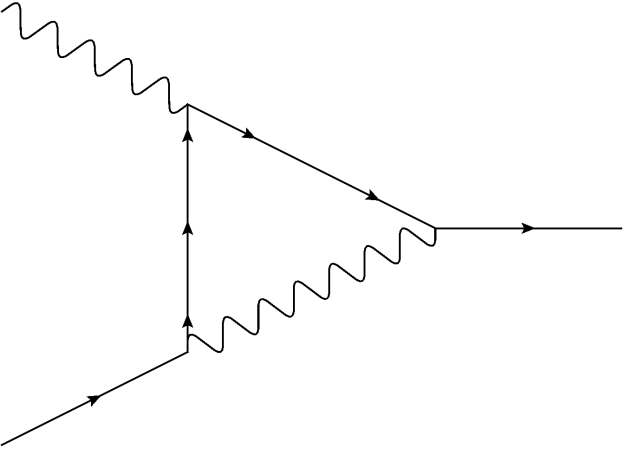
You can even use scattering amplitudes to describe situations that, at first glance, don’t sound like collisions of particles at all. If you want to find the effect of a magnetic field on an electron to high accuracy, the calculation also involves a scattering amplitude. A magnetic field can be thought of in terms of photons, particles of light, because light is a vibration in the electro-magnetic field. This means that the effect of a magnetic field on an electron can be calculated by “scattering” an electron and a photon.

4gravanom

If this looks familiar, check the handbook section.

In fact, doing the calculation in this way leads to what is possibly the most accurately predicted number in all of science.

Scattering amplitudes show up all over the place, from particle physics at the Large Hadron Collider to astrophysics to delicate experiments on electrons in magnetic fields. That said, there are plenty of things people calculate in theoretical physics that don’t use scattering amplitudes, either because they involve questions that are difficult to answer from the scattering amplitude point of view, or because they invoke different formulas altogether. Still, scattering amplitudes are central to the work of a large number of physicists. They really do cover just about everything.

Hexagon Functions II: Lost in (super)Space

My new paper went up last night.

It’s on a very similar topic to my last paper, actually. That paper dealt with a specific process involving six particles in my favorite theory, N=4 super Yang-Mills. Two particles collide, and after the metaphorical dust settles four particles emerge. That means six “total” particles, if you add the two in with the four out, for a “hexagon” of variables. To understand situations like that, my collaborators and I created “hexagon functions”, formulas that depended on the states of the six particles.

One thing I didn’t emphasize then was that that calculation only applied to one specific choice of particles, one in which all of the particles are Yang-Mills bosons, particles (like photons) created by the fundamental forces. There are lots of other particles in N=4 super Yang-Mills, though. What happens when they collide?

That question is answered by my new paper. Though it may sound surprising, all of the other particles can be taken into account with a single formula. In order to explain why, I have to tell you about something called superspace.

A while back I complained about a blog post by George Musser about the (2,0) theory. One of the things that irked me about that post was his attempt to explain superspace:

Supersymmetry is the idea that spacetime, in addition to its usual dimensions of space and time, has an entirely different type of dimension—a quantum dimension, whose coordinates are not ordinary real numbers but a whole new class of number that can be thought of as the square roots of zero.

This is actually a great way to think about superspace…if you’re already a physicist. If you’re not, it’s not very informative. Here’s a better way to think about it:

As I’ve talked about before, supersymmetry is a relationship between different types of particles. Two particles related by supersymmetry have the same mass, and the same charge. While they can be very different in other ways (specifically, having different spin), supersymmetric particles are described by many of the same equations as each-other. Rather than writing out those equations multiple times, it’s often nicer to write them all in a unified way, and that’s where superspace comes in.

At its simplest, superspace is just a trick used to write equations in a simpler way. Instead of writing down a different equation for each particle we write one equation with an extra variable, representing a “dimension” of supersymmetry. Traveling in that dimension takes you from particle to particle, in the same way that “turning” the theory (as I phrase it here) does, but it does it within the space of a single equation.

That, essentially, is the trick that we use. With four “superspace dimensions”, we can include the four supersymmetries of N=4 super Yang-Mills, showing how the formulas vary when you go beyond the equation from our first paper.

So far, you may be wondering why I’m calling superspace a “dimension”, when it probably sounds like more of a label. I’ve mentioned before that, just because something is a variable, doesn’t mean it counts as a real dimension.

The key difference is that superspace dimensions are related to regular dimensions in a precise way. In a sense, they’re the square roots of regular dimensions. (Though independently, as George Musser described, they’re the square roots of zero: go in the same direction twice in supersymmetry, and you get back where you’re started, going zero distance.) The coexistence of these two seemingly contradictory statements isn’t some sort of quantum mystery, it’s just a consequence of the fact that, mathematically, I’m saying two very different things. I just can’t think of a way to explain them differently without math.

Superspace isn’t a real place…but it can often be useful to think of it that way. In theories with supersymmetry, it can unify the world, putting disparate particles together into a single equation.

Gravity is Yang-Mills Squared

There’s a concept that I’ve wanted to present for quite some time. It’s one of the coolest accomplishments in my subfield, but I thought that explaining it would involve too much technical detail. However, the recent BICEP2 results have brought one aspect of it to the public eye, so I’ve decided that people are ready.

If you’ve been following the recent announcements by the BICEP2 telescope of their indirect observation of primordial gravitational waves, you’ve probably seen the phrases “E-mode polarization” and “B-mode polarization” thrown around. You may even have seen pictures, showing that light in the cosmic microwave background is polarized differently by quantum fluctuations in the inflaton field and by quantum fluctuations in gravity.

But why is there a difference? What’s unique about gravitational waves that makes them different from the other waves in nature?

As it turns out, the difference all boils down to one statement:

Gravity is Yang-Mills squared.

This is both a very simple claim and a very subtle one, and it comes up in many many places in physics.

Yang-Mills, for those who haven’t read my older posts, is a general category that contains most of the fundamental forces. Electromagnetism, the strong nuclear force, and the weak nuclear force are all variants of Yang-Mills forces.

Yang-Mills forces have “spin 1”. Another way to say this is that Yang-Mills forces are vector forces. If you remember vectors from math class, you might remember that a vector has a direction and a strength. This hopefully makes sense: forces point in a direction, and have a strength. You may also remember that vectors can also be described in terms of components. A vector in four space-time dimensions has four components: x, y, z, and time, like so:

\left( \begin{array}{c} x \\ y \\ z \\ t \end{array} \right)

Gravity has “spin 2”.

As I’ve talked about before, gravity bends space and time, which means that it modifies the way you calculate distances. In practice, that means it needs to be something that can couple two vectors together: a matrix, or more precisely, a tensor, like so:

\left( \begin{array}{cccc} xx & xy & xz & xt\\ yx & yy & yz & yt\\ zx & zy & zz & zt\\ tx & ty & tz & tt\end{array} \right)

So while a Yang-Mills force has four components, gravity has sixteen. Gravity is Yang-Mills squared.

(Technical note: gravity actually doesn’t use all sixteen components, because it’s traceless and symmetric. However, often when studying gravity’s quantum properties theorists often add on extra fields to “complete the square” and fill in the remaining components.)

There’s much more to the connection than that, though. For one, it appears in the kinds of waves the two types of forces can create.

In order to create an electromagnetic wave you need a dipole, a negative charge and a positive charge at opposite ends of a line, and you need that dipole to change over time.

Change over time, of course, is a property of Gifs.

Gravity doesn’t have negative and positive charges, it just has one type of charge. Thus, to create gravitational waves you need not a dipole, but a quadrupole: instead of a line between two opposite charges, you have four gravitational charges (masses) arranged in a square. This creates a “breathing” sort of motion, instead of the back-and-forth motion of electromagnetic waves.

This is your brain on gravitational waves.

This is why gravitational waves have a different shape than electromagnetic waves, and why they have a unique effect on the cosmic microwave background, allowing them to be spotted by BICEP2. Gravity, once again, is Yang-Mills squared.

But wait there’s more!

So far, I’ve shown you that gravity is the square of Yang-Mills, but not in a very literal way. Yes, there are lots of similarities, but it’s not like you can just square a calculation in Yang-Mills and get a calculation in gravity, right?

Well actually…

In quantum field theory, calculations are traditionally done using tools called Feynman diagrams, organized by how many loops the diagram contains. The simplest diagrams have no loops, and are called tree diagrams.

Fascinatingly, for tree diagrams the message of this post is as literal as it can be. Using something called the Kawai-Lewellen-Tye relations, the result of a tree diagram calculation in gravity can be found just by taking a similar calculation in Yang-Mills and squaring it.

(Interestingly enough, these relations were originally discovered using string theory, but they don’t require string theory to work. It’s yet another example of how string theory functions as a laboratory to make discoveries about quantum field theory.)

Does this hold beyond tree diagrams? As it turns out, the answer is again yes!
The calculation involved is a little more complicated, but as discovered by Zvi Bern, John Joseph Carrasco, and Henrik Johansson, if you can get your calculation in Yang-Mills into the right format then all you need to do is square the right thing at the right step to get gravity, even for diagrams with loops!

zvi-bern-350

carrasco

This trick, called BCJ duality after its discoverers, has allowed calculations in quantum gravity that far outpace what would be possible without it. In N=8 supergravity, the gravity analogue of N=4 super Yang-Mills, calculations have progressed up to four loops, and have revealed tantalizing hints that the uncontrolled infinities that usually plague gravity theories are absent in N=8 supergravity, even without adding in string theory. Results like these are why BCJ duality is viewed as one of the “foundational miracles” of the field for those of us who study scattering amplitudes.

Gravity is Yang-Mills squared, in more ways than one. And because gravity is Yang-Mills squared, gravity may just be tame-able after all.