Tag Archives: academia

The PhD Defense

Last Wednesday I completed the final stage of my PhD, the Defense. I booted up a projector and, in a room filled with esteemed physicists, eager grad students, and a three foot sub, I summarized the last two years of my work. A few questions later, people were shaking my hand and calling me “Doctor von Hippel”.

Now that I’m transitioning out of the grad student world, my blog will be transitioning too. I’ll be starting work as a Postdoctoral Fellow in the Fall at the Perimeter Institute for Theoretical Physics. Some time in between, probably in July, this blog will undergo a redesign, hopefully becoming easier to navigate. I’ll also be dropping the “and a grad student” from the title, switching to a new URL, 4gravitons.wordpress.com. Don’t worry, traffic from the old address will be forwarded, so infrequent readers won’t lose track. That said, if anyone with more experience has some advice about making the transition more seamless I’d love to hear it.

There are a lot of stereotypes about the PhD Defense, and mine broke almost all of them. My advisor hadn’t been directly involved in my work, my committee chair was one of the nicest, mellowest professors I’ve ever known, my experimentalist asked me a theoretical physics question, and my external member was NimafrigginArkani-Hamed.

That said, I’ve also seen several other PhD Defenses, and I have to say that the stereotypes are usually right on the money. And since I’m on a bit of a list-based comedy kick recently, let me introduce you to the four members of your PhD committee:

First, of course, is your advisor. If you two collaborate closely, you may find yourself presenting material that your advisor had a hand in. Naturally, the other committee members will ask questions about this material, and naturally you will answer them. Naturally, those answers will not be how your advisor would have explained it, so naturally your advisor will start explaining it themselves. (After all, it’s their work that’s being questioned!) Manage things well and the whole defense will be an argument between your advisor and the other committee members, and you won’t have to say anything at all!

Second is your committee chair. This is someone from your field, chosen for their general eminence and chair-ish-ness. They’ve done a lot of these before, and in their mind they’ve developed a special bond with the students, a bond forged by questions. See, if you have a typical committee chair, they will ask you the toughest, most nitpicky, most downright irrelevant lines of questions possible. The chair’s goal isn’t to keep things moving, it’s to make sure that you took their class and remember everything from it, no matter how much time that takes away from discussing your actual dissertation.

Third you must face your experimentalist. According to the ancient ideals of academia (ideals somehow unbreakably important for grad students and largely irrelevant for top-level university administrators), a dissertation must be judged not only by the yes-men of your own sub-field, but also by someone from the rest of your department. For a theoretical physicist, that means bringing in an experimental physicist. You may try to make things accessible to this person, but eventually you have to actually start talking about your work. This is healthy, as it will allow them much-needed sleep. Once they awake, they will bless you with a question that represents the most tenuous link they can draw between their own work and yours, generally asking after the mass of some subatomic particle. Once you have demonstrated your ignorance in some embarrassing fashion the experimentalist may return to sleep.

Finally, the defense brings in a special individual, the external member. Not only must you prove your worth to an experimentalist, but to someone from outside of your department altogether! For the lucky, this means someone who does similar work at a nearby university. For the terminally rural, this instead means finding the closest department and bringing in someone who will at least recognize some of the words in your talk. For us, this generally means a mathematician. Like the experimentalist, they will favor you with bewildered looks or snores, depending on temperament. Unlike the experimentalist, they are under no illusion that anything they do is relevant to anything you do, so their questions will be mercifully brief.

Grilled by these four, you then leave the room, allowing them to talk about the weather or their kids or something before they ask you back in to tell you that, of course, you’ve got your PhD. Because after all that, anything else would just be rude.

The Four Ways Physicists Name Things

If you’re a biologist and you discover a new animal, you’ve always got Latin to fall back on. If you’re an astronomer, you can describe what you see. But if you’re a physicist, your only option appears to involve falling back on one of a few terrible habits.

The most reasonable option is just to name it after a person. Yang-Mills and the Higgs Boson may sound silly at first, but once you know the stories of C. N. Yang, Robert Mills, Peter Higgs and Satyendra Nath Bose you start appreciating what the names mean. While this is usually the most elegant option, the increasingly collaborative nature of physics means that many things have to be named with a series of initials, like ABJM, BCJ and KKLT.

A bit worse is the tendency to just give it the laziest name possible. What do you call the particles that “glue” protons and neutrons together? Why gluons, of course, yuk yuk yuk!

This is particularly common when it comes to supersymmetry, where putting the word “super” in front of something almost always works. If that fails, it’s time to go for more specific conventions: to find the partner of an existing particle, if the new particle is a boson, just add “s-” for “super”“scalar” apparently to the name. This creates perfectly respectable names like stau, sneutrino, and selectron. If the new particle is a fermion, instead you add “-ino” to the end, getting something like a gluino if you start with a gluon. If you’ve heard of neutrinos, you may know that neutrino means “little neutral one”. You might perfectly rationally expect that gluino means “little gluon”, if you had any belief that physicists name things logically. We don’t. A gluino is called a gluino because it’s a fermion, and neutrinos are fermions, and the physicists who named it were too lazy to check what “neutrino” actually means.

Pictured: the superpartner of Nidoran?

Worse still are names that are obscure references and bad jokes. These are mercifully rare, and at least memorable when they occur. In quantum mechanics, you write down probabilities using brackets of two quantum states, \langle a | b\rangle. What if you need to separate the two states, \langle a| and |b\rangle? Then you’ve got a “bra” and a “ket”!

Or have you heard the story of how quarks were named? Quarks, for those of you unfamiliar with them, are found in protons and neutrons in groups of three. Murray Gell-Mann, one of the two people who first proposed the existence of quarks, got their name from Finnegan’s Wake, a novel by James Joyce, which at one point calls for “Three quarks for Muster Mark!” While this may at first sound like a heartwarming tale of respect for the literary classics, it should be kept in mind that a) Finnegan’s Wake is a novel composed almost entirely of gibberish, read almost exclusively by people who pretend to understand it to seem intelligent and b) this isn’t exactly the most important or memorable line in the book. So Gell-Mann wasn’t so much paying homage to a timeless work of literature as he was referencing the most mind-numbingly obscure piece of nerd trivia before the invention of Mara Jade. Luckily these days we have better ways to remember the name.

Albeit wrinklier ways.

The final, worst category, though, don’t even have good stories going for them. They are the names that tell you absolutely nothing about the thing they are naming.

Probably the worst examples of this from my experience are the a-theorem and the c-theorem. In both cases, a theory happened to have a parameter in it labeled by a letter. When a theorem was proven about that parameter, rather than giving it a name that told you anything at all about what it was, people just called it by the name of the parameter. Mathematics is full of names like this too. Without checking Wikipedia, what’s the difference between a set, a group, and a category? What the heck is a scheme?

If you ever have to name something, be safe and name it after a person. If you don’t, just try to avoid falling into these bad habits of physics naming.

The Royal We of Theoretical Physics

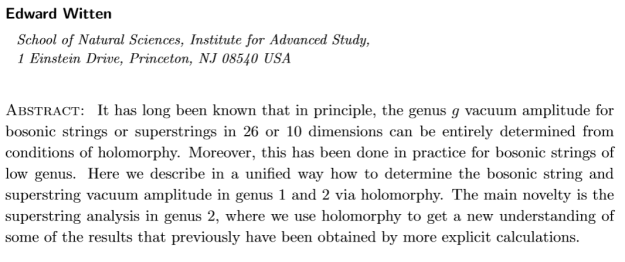
I’m about to show you an abstract from a theoretical physics paper. Don’t worry about what it says, just observe the grammar.

wittenabstract

Notice anything? Here, I’ll zoom in:

wittenwe

This paper has one author, Edward Witten. So who’s “we”?

As it turns out, it is actually quite common in theoretical physics for a paper to use the word “we”, even when it is written by a single author. While this tradition has been called stilted, pompous, and just plain bad writing, there is a legitimate reason behind it. “We” is convenient, because it represents several different important things.

While the paper I quoted was written by only one author, many papers are collaborative efforts. For a collaboration, depending on collaboration style, it is often hard to distinguish who did what in a consistent way. As such, “we” helps smooth over different collaboration styles in a consistent way.

What about single-authored papers, though? For a single author, and often even for multiple authors, “we” means the author plus the reader.

In principle, anyone reading a paper in theoretical physics should be able to follow along, doing the calculations on their own, and replicate the paper’s results. In practice this can often be difficult to impossible, but it’s still true that if you want to really retain what you read in theoretical physics, you need to follow along and do some of the calculation yourself. As a nod to this, it is conventional to write theoretical physics papers as if the reader was directly participating, leading them through the results point by point like exercises in a textbook. “We” do one calculation, then “we” use the result to derive the next point, and so on.

There are other meanings that “we” can occasionally serve, such as referring to everyone in a particular field, or a group in a hypothetical example.

While each of these meanings of “we” could potentially use a different word, that tends to make a paper feel cluttered, with jarring transitions between different subjects. Using “we” for everything gives the paper a consistent voice and feel, though it does come at the cost of obscuring some of the specific details of who did what. Especially for collaborations, the “we the collaborators” and “we the author plus reader” meanings can overlap and blur together. This usually isn’t a problem, but as I’ve been finding out recently it does make things tricky when writing for people who aren’t theoretical physicists, such as universities with guidelines that require a thesis to clearly specify who in a collaboration did what.

On an unrelated note, two papers went up this week pushing the hexagon function story to new and impressive heights. I wasn’t directly involved in either, I’ve been attacking a somewhat different part of the problem, and you can look forward to something on that in a few months.

What’s in a Thesis?

As I’ve mentioned before, I’m graduating this spring, which means I need to write that most foreboding of documents, the thesis. As I work on it, I’ve been thinking about how the nature of the thesis varies from field to field.

If you don’t have much experience with academics, you probably think of a thesis as a single, overarching achievement that structures a grad student’s career. A student enters grad school, designs an experiment, performs it, collects data, analyzes the data, draws some conclusion, then writes a thesis about it and graduates.

In some fields, the thesis really does work that way. In biology for example, the process of planning an experiment, setting it up, and analyzing and writing up the data can be just the right size so that, a reasonable percentage of the time, it really can all be done over the course of a PhD.

Other fields tend more towards smaller, faster-paced projects. In theoretical physics, mathematics, and computer science, most projects don’t have the same sort of large experimental overhead that psychologists or biologists have to deal with. The projects I’ve worked on are large-scale for theoretical physics, and I’ll still likely have worked on three distinct things before I graduate. Others, with smaller projects, will often have covered more.

In this situation, a thesis isn’t one overarching idea. Rather, it’s a compilation of work from past projects, sewed together with a pretense of an overall theme. It’s a bit messy, but because it’s the way things are expected to be done in these fields, no-one minds particularly much.

The other end of the spectrum is potentially much harder to deal with. For those who work on especially big experiments, the payoff might take longer to arrive than any reasonable degree. Big machines like colliders and particle detectors can take well over a decade before they start producing data, while longitudinal studies that follow a population as they grow and age take a long time no matter how fast you work.

In cases like this, the challenge is to chop off a small enough part of the project to make it feel like a thesis. A thesis could be written about designing one component for the eventual machine, or analyzing one part of the vast sea of data it produces. Preliminary data from a longitudinal study could be analyzed, even when the final results are many years down the line.

People in these fields have to be flexible and creative when it comes to creating a thesis, but usually the thesis committee is reasonable. In the end, a thesis is what you need to graduate, whatever that actually is for you.

Four Gravitons and a…Postdoc?

As a few of you already know, it’s looking increasingly certain that I will be receiving my Ph.D. in the spring. I’ll graduate, ceasing to be a grad student and becoming that most mysterious of academic entities, a postdoc.

When describing graduate school before, I compared it to an apprenticeship. (I expanded on that analogy more here.) Let’s keep pursuing that analogy. If a graduate student is like an apprentice, then a Postdoctoral Scholar, or Postdoc, is like a journeyman.

In Medieval Europe, once an apprenticeship was completed the apprentice was permitted to work independently, earning a wage for their own labors. However, they still would not have their own shop. Instead, they would work for a master craftsman. Such a person was called a journeyman, after the French work journée, meaning a day’s work.

Similarly, once a graduate student gets their Ph.D., they are able to do scientific research independently. However, most graduate students are not ready to be professors when fresh out of their Ph.D. Instead, they become postdocs, working in an established professor’s group. Like a journeyman, a postdoc is nominally independent, but in practice works under loose supervision from the more mature members of their field.

Another similarity between postdocs and journeymen is their tendency to travel. Historically, a journeyman would spend several years traveling, studying in the workshops of several masters. Similarly, a postdoc will often (especially in today’s interconnected world) travel far from where they began in order to broaden their capabilities.

A postdoctoral job generally lasts two or three years, one for particularly short positions. Most scientists will go through at least one postdoctoral position after achieving their Ph.D. In some fields (theoretical physics in particular), a scientist will have two or three such positions in different places before finding a job as a professor. Postdocs are paid significantly better than grad students, but generally significantly worse than professors. They don’t (typically) teach, but depending on the institution and field they may do some TA work.

Being still a grad student, my blog is titled “4 gravitons and a grad student”. That could change, though. Once I become a postdoc, I have three options:

  1. Keep the old title. Keeping the same title and domain name makes it easier for people to find the blog. It also maintains the alliteration, which I think is fun. On the other hand, it would be hard to justify, and I’d likely have to write something silly about taking a grad student perspective or the like.
  2. Change to “4 gravitons and a postdoc”. I’d lose the fun alliteration, but the title would accurately represent my current state. However, I might lose a few readers who don’t expect the change.
  3. Cut it down to “4 gravitons”. This matches the blog’s twitter handle (@4gravitons). It’s quick, it’s recognizable, and it keeps the memorable part of the old title without adding anything new to remember. However, it would be less unique in google searches.

What do you folks think? I’ve still got a while to decide, and I’d love to hear your opinions!

Amplitudes on Paperscape

Paperscape is a very cool tool developed by Damien George and Rob Knegjens. It analyzes papers from arXiv, the paper repository where almost all physics and math papers live these days. By putting papers that cite each other closer together and pushing papers that don’t cite each other further apart, Paperscape creates a map of all the papers on arXiv, arranged into “continents” based on the links between them. Papers with more citations are shown larger, newer papers are shown brighter, and subject categories are indicated by color-coding.

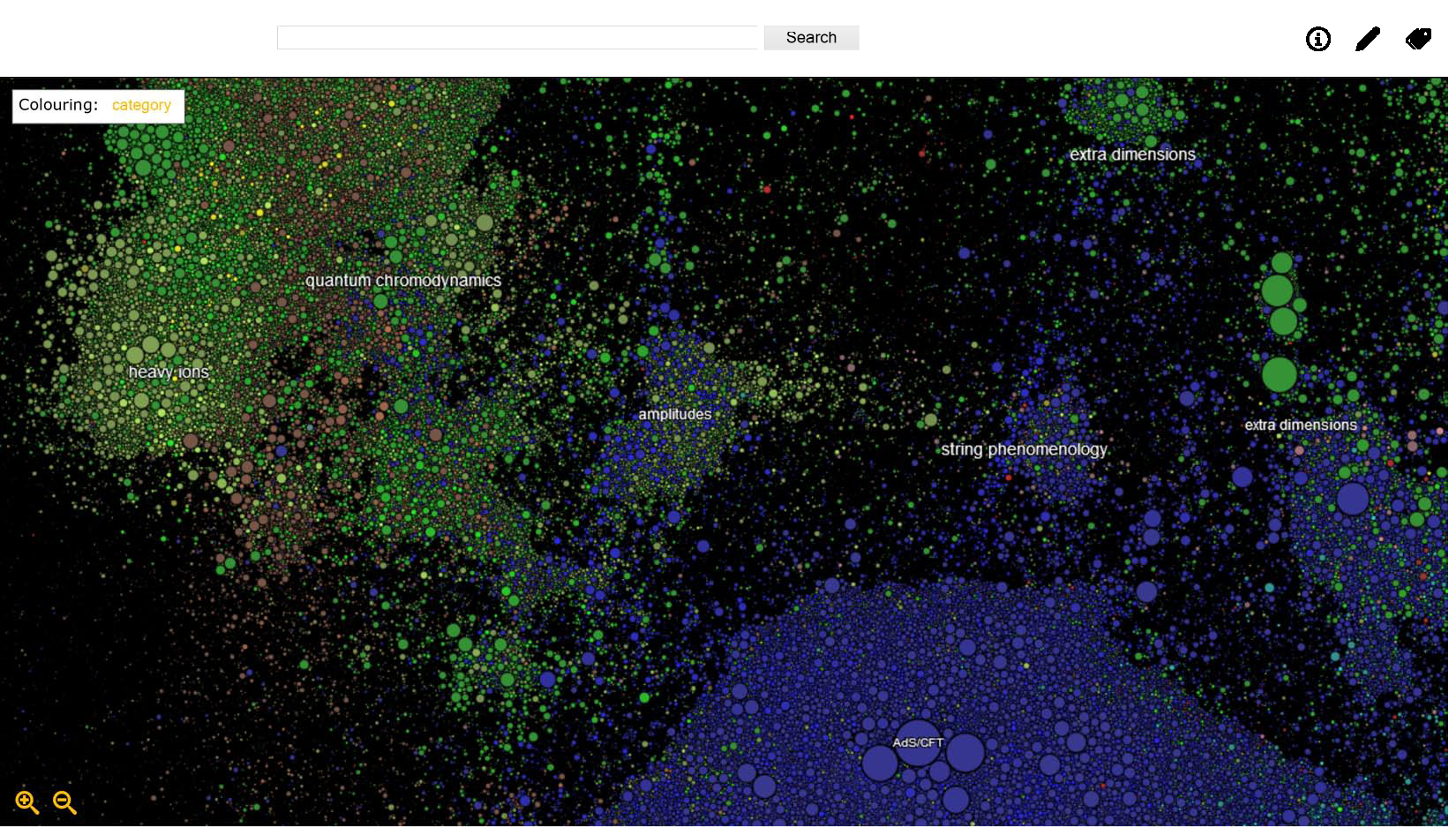
Here’s a zoomed-out view:

PaperscapeFullMap

Already you can see several distinct continents, corresponding to different arXiv categories like high energy theory and astrophysics.

If you want to find amplitudes on this map, just zoom in between the purple continent (high energy theory, much of which is string theory) and the green one (high energy lattice, nuclear experiment, high energy experiment, and high energy phenomenology, broadly speaking these are all particle physics).

PaperscapeAmplitudesMap

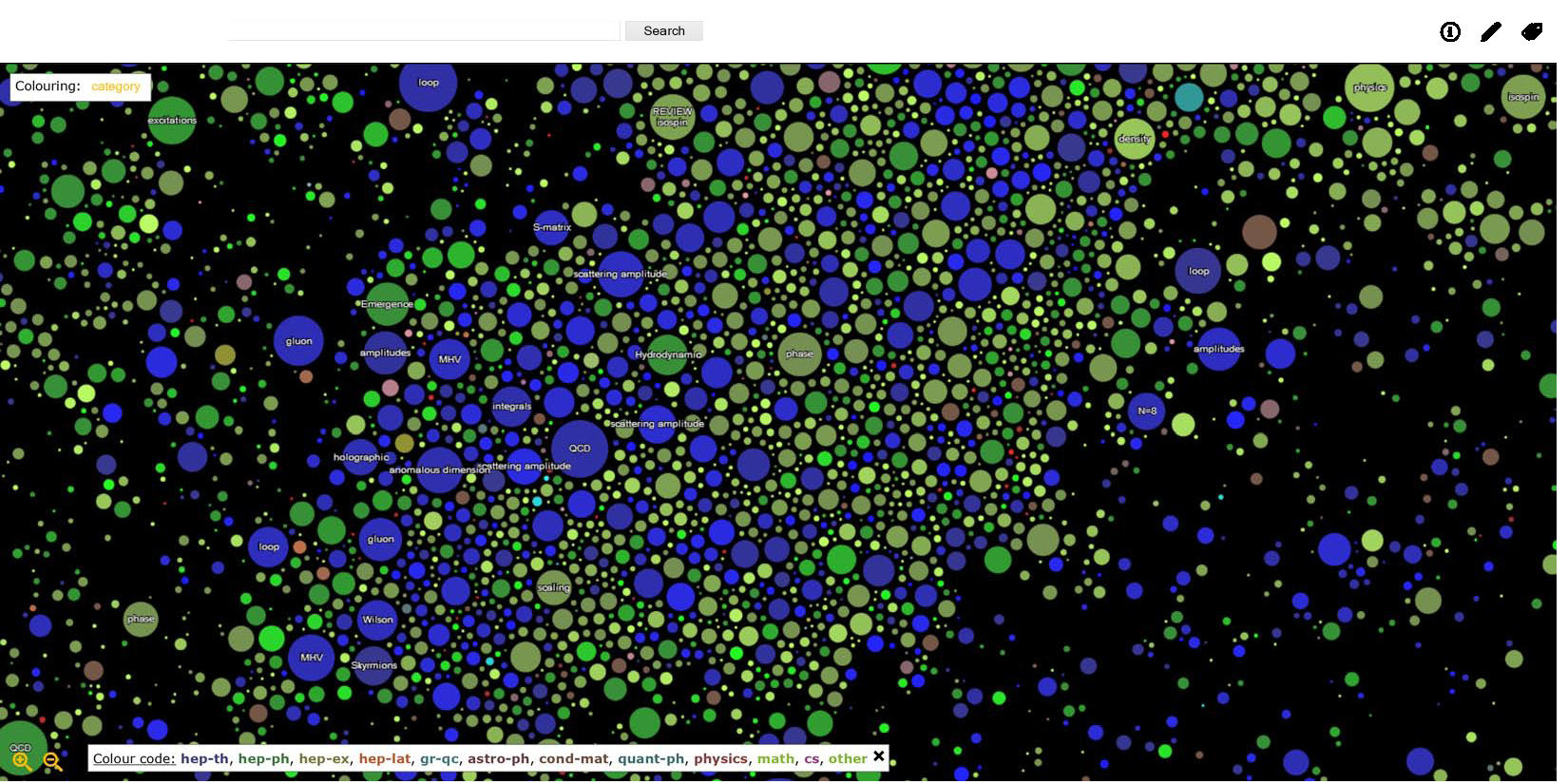
When you zoom in, Paperscape shows words that commonly appear in a given region of papers. Zoomed in this far, you can see amplitudes!

Amplitudeologists like me live on an island between particle physics and string theory. We’re connected on both sides by bridges of citations and shared terms, linking us to people who study quarks and gluons on one side to people who study strings and geometry on the other. Think of us like Manhattan, an island between two shores, densely networked in to the surroundings.

PaperscapeZoomedMap

Zoom in further, and you can see common keywords for individual papers. Exploring around here shows not only what is getting talked about, but what sort of subjects as well. You can see by the color-coding that many papers in amplitudes are published as hep-th, or high energy theory, but there’s a fair number of papers from hep-ph (phenomenology) and from nuclear physics as well.

There’s a lot of interesting things you can do with Paperscape. You can search for individuals, or look at individual papers, seeing who they cite and who cite them. Try it out!

Where are the Amplitudeologists?

As I’ve mentioned a couple of times before, I’m part of a sub-field of theoretical physics called Amplitudeology.

Amplitudeology in its modern incarnation is relatively new, and concentrated in a few specific centers. I thought it might be interesting to visualize which universities have amplitudeologists, so I took a look at the attendee lists of two recent conferences and put their affiliations into google maps. In an attempt to balance things, one of the conferences is in North America and the other is in Europe. Here is the result:

The West Coast of the US has two major centers, Stanford/SLAC and UCLA, focused around Lance Dixon and Zvi Bern respectively. The Northeast has a fair assortment, including places that have essentially everything like the Perimeter Institute and the Institute for Advanced Study and places known especially for their amplitudes work like Brown.

Europe has quite a large number of places. There are many universities in Europe with a long history of technical research into quantum field theory. When amplitudes began to become more prominent as its own sub-field, many of these places slotted right in. In particular, there are many locations in Germany, a decent number in the UK, a few in the vicinity of CERN, and a variety of places of some importance elsewhere.

Outside of Europe and North America, there’s much less amplitudes research going on. Physics in general is a very international enterprise, and many sub-fields have a lot of participation from researchers in China, India, Japan, and Korea. Amplitudes, for the most part, hasn’t caught on in those places yet.

This map is just a result of looking at two conferences. More data would yield many places that were left out of this setup, including a longstanding community in Russia. Still, it gives you a rough idea of where to find amplitudeologists, should you have need of one.

What’s up with arXiv?

First of all, I wanted to take a moment to say that this is the one-year anniversary of this blog. I’ve been posting every week, (almost always) on Friday, since I first was motivated to start blogging back in November 2012. It’s been a fun ride, through ups and downs, Ars Technica and Amplituhedra, and I hope it’s been fun for you, the reader, as well!

I’ve been giving links to arXiv since my very first post, but I haven’t gone into detail about what arXiv is. Since arXiv is a rather unique phenomenon, it could use a more full description.

arXivpic

The word arXiv is pronounced much like the normal word archive, just think of the capital X like a Greek letter Chi.

Much as the name would suggest, arXiv is an archive, specifically a preprint archive. A pre-print is in a sense a paper before it becomes a paper; more accurately, it is a scientific paper that has not yet been published in a journal. In the past, such preprints would be kept by individual universities, or passed between interested individuals. Now arXiv, for an increasing range of fields (first physics and mathematics, now also computer science, quantitative biology, quantitative finance, and statistics) puts all of the preprints in one easily accessible, free to access place.

Different fields have different conventions when it comes to using arXiv. As a theoretical physicist, I can only really speak to how we use the system.

When theoretical physicists write a paper, it is often not immediately clear which journal we should submit it to. Different journals have different standards, and a paper that will gather more interest can be published in a more prestigious journal. In order to gauge how much interest a paper will raise, most theoretical physicists will put their papers up on arXiv as preprints first, letting them sit there for a few months to drum up attention and get feedback before formally submitting the paper to a journal.

The arXiv isn’t just for preprints, though. Once a paper is published in a journal, a copy of the paper remains on arXiv. Often, the copy on arXiv will be updated when the paper is updated, changed to the journal’s preferred format and labeled with the correct journal reference. So arXiv, ultimately, contains almost all of the papers published in theoretical physics in the last decade or two, all free to read.

But it’s not just papers! The digital format of arXiv makes it much easier to post other files alongside a paper, so that many people upload not just their results, but the computer code they used to generate them, or their raw data in long files. You can also post papers too long or unwieldy to publish in a journal, making arXiv an excellent dropping-off point for information in whatever format you think is best.

We stand at the edge of a new age of freely accessible science. As more and more disciplines start to use arXiv and similar services, we’ll have more flexibility to get more information to more people, while still keeping the advantage of peer review for publication in actual journals. It’s going to be very interesting to see where things go from here.

Blackboards, Again

Recently I had the opportunity to give a blackboard talk. I’ve talked before about the value of blackboards, how they facilitate collaboration and can even be used to get work done. What I didn’t feel the need to explain was their advantages when giving a talk.

No, the blackboard behind me isn't my talk.

No, the blackboard behind me isn’t my talk.

When I mentioned I was giving a blackboard talk, some of my friends in other fields were incredulous.

“Why aren’t you using PowerPoint? Do you people hate technology?”

So why do theorists (and mathematicians) do blackboard talks, when many other fields don’t?

Typically, a chemist can’t bring chemicals to a talk. A biologist can’t bring a tank of fruit flies or zebrafish, and a psychologist probably shouldn’t bring in a passel of college student test subjects. As a theorist though, our test subjects are equations, and we can absolutely bring them into the room.

In the most ideal case, a talk by a theorist walks you through their calculation, reproducing it on the blackboard in enough detail that you can not only follow along, but potentially do the calculation yourself. While it’s possible to set up a calculation step by step in PowerPoint, you don’t have the same flexibility to erase and add to your equations, which becomes especially important if you need to clarify a point in response to a question.

Blackboards also often give you more space than a single slide. While your audience still only pays attention to a slide-sized area of the board at one time, you can put equations up in one area, move away, and then come back to them later. If you leave important equations up, people can remind themselves of them on their own time, without having to hold everybody up while you scroll back through the slides to the one they want to see.

Using a blackboard well is a fine art, and one I’m only beginning to learn. You have to know what to erase and what to leave up, when to pause to allow time to write or ask questions, and what to say while you’re erasing the board. You need to use all the quirks of the medium to your advantage, to show people not just what you did, but how and why you did it.

That’s why we use blackboards. And if you ask why we can’t do the same things with whiteboards, it’s because whiteboards are terrible. Everybody knows that.

Dammit Jim, I’m a Physicist not a Graphic Designer!

Over the last week I’ve been working with a few co-authors to get a paper ready for publication. For my part, this has mostly meant making plots of our data. (Yes, theorists have data! It’s the result of calculations, not observations, but it’s still data!)

As it turns out, making the actual plots is only the first and easiest step. We have a huge number of data points, which means the plots ended up being very large files. To fix this I had to smooth out the files so they don’t include every point, a process called rasterizing the images. I also needed to make sure that the labels of the plots matched the fonts in the paper, and that the images in the paper were of the right file type to be included, which in turn meant understanding the sort of information retained by each type of image file. I had to learn which image files include transparency and which don’t, which include fonts as text and which use images, and which fonts were included in each program I used. By the end, I learned more about graphic design than I ever intended to.

In a company, this sort of job would be given to a graphic designer on-staff, or a hired expert. In academia, however, we don’t have the resources for that sort of thing, so we have to become experts in the nitty-gritty details of how to get our work in publishable form.

As it turns out, this is part of a wider pattern in academia. Any given project doesn’t have a large staff of specialists or a budget for outside firms, so everyone involved has to become competent at tasks that a business would parcel out to experts. This is why a large part of work in physics isn’t really physics per se; rather, we theorists often spend much of our time programming, while experimentalists often have to build and repair their experimental apparatus. The end result is that much of what we do is jury-rigged together, with an amateur understanding of most of the side disciplines involved. Things work, but they aren’t as efficient or as slick as they could be if assembled by a real expert. On the other hand, it makes things much cheaper, and it’s a big contributor to the uncanny ability of physicists to know about other peoples’ disciplines.