
I’m about to show you an abstract from a theoretical physics paper. Don’t worry about what it says, just observe the grammar.
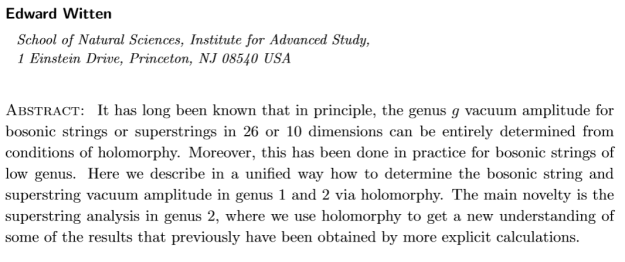
Notice anything? Here, I’ll zoom in:

This paper has one author, Edward Witten. So who’s “we”?
As it turns out, it is actually quite common in theoretical physics for a paper to use the word “we”, even when it is written by a single author. While this tradition has been called stilted, pompous, and just plain bad writing, there is a legitimate reason behind it. “We” is convenient, because it represents several different important things.
While the paper I quoted was written by only one author, many papers are collaborative efforts. For a collaboration, depending on collaboration style, it is often hard to distinguish who did what in a consistent way. As such, “we” helps smooth over different collaboration styles in a consistent way.
What about single-authored papers, though? For a single author, and often even for multiple authors, “we” means the author plus the reader.
In principle, anyone reading a paper in theoretical physics should be able to follow along, doing the calculations on their own, and replicate the paper’s results. In practice this can often be difficult to impossible, but it’s still true that if you want to really retain what you read in theoretical physics, you need to follow along and do some of the calculation yourself. As a nod to this, it is conventional to write theoretical physics papers as if the reader was directly participating, leading them through the results point by point like exercises in a textbook. “We” do one calculation, then “we” use the result to derive the next point, and so on.
There are other meanings that “we” can occasionally serve, such as referring to everyone in a particular field, or a group in a hypothetical example.
While each of these meanings of “we” could potentially use a different word, that tends to make a paper feel cluttered, with jarring transitions between different subjects. Using “we” for everything gives the paper a consistent voice and feel, though it does come at the cost of obscuring some of the specific details of who did what. Especially for collaborations, the “we the collaborators” and “we the author plus reader” meanings can overlap and blur together. This usually isn’t a problem, but as I’ve been finding out recently it does make things tricky when writing for people who aren’t theoretical physicists, such as universities with guidelines that require a thesis to clearly specify who in a collaboration did what.
On an unrelated note, two papers went up this week pushing the hexagon function story to new and impressive heights. I wasn’t directly involved in either, I’ve been attacking a somewhat different part of the problem, and you can look forward to something on that in a few months.



 4 gravitons