IGST 2018

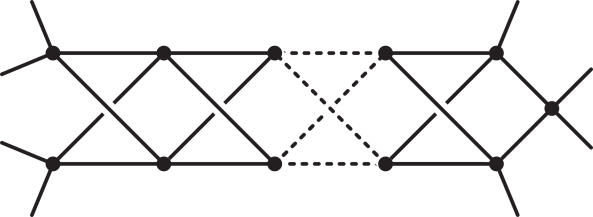
Conference season in Copenhagen continues this week, with Integrability in Gauge and String Theory 2018. Integrability here refers to integrable theories, theories where physicists can calculate things exactly, without the perturbative approximations we typically use. Integrable theories come up in a wide variety of situations, but this conference was focused on the “high-energy” side of the field, on gauge theories (roughly, theories of fundamental forces like Yang-Mills) and string theory.

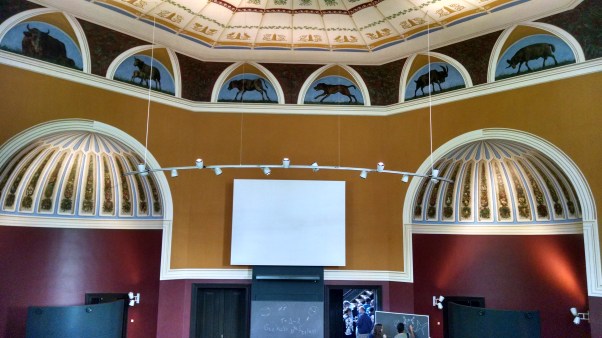
Integrability is one of the bigger sub-fields in my corner of physics, about the same size as amplitudes. It’s big enough that we can’t host the conference in the old Niels Bohr Institute auditorium.

IMG_20180820_162035401_HDR

Instead, they herded us into the old agriculture school

I don’t normally go to integrability conferences, but when the only cost is bus fare there’s not much to lose. Integrability is arguably amplitudes’s nearest neighbor. The two fields have a history of sharing ideas, and they have similar reputations in the wider community, seen as alternately deep and overly technical. Many of the talks still went over my head, but it was worth getting a chance to see how the neighbors are doing.

Current Themes 2018

I’m at Current Themes in High Energy Physics and Cosmology this week, the yearly conference of the Niels Bohr International Academy. (I talked about their trademark eclectic mix of topics last year.)

This year, the “current theme” was broadly gravitational (though with plenty of exceptions!).

IMG_20180815_180435532

For example, almost getting kicked out of the Botanical Garden

There were talks on phenomena we observe gravitationally, like dark matter. There were talks on calculating amplitudes in gravity theories, both classical and quantum. There were talks about black holes, and the overall shape of the universe. Subir Sarkar talked about his suspicion that the expansion of the universe isn’t actually accelerating, and while I still think the news coverage of it was overblown I sympathize a bit more with his point. He’s got a fairly specific worry, that we’re in a region that’s moving unusually with respect to the surrounding universe, that hasn’t really been investigated in much detail before. I don’t think he’s found anything definitive yet, but it will be interesting as more data accumulates to see what happens.

Of course, current themes can’t stick to just one theme, so there were non-gravitational talks as well. Nima Arkani-Hamed’s talk covered some results he’s talked about in the past, a geometric picture for constraining various theories, but with an interesting new development: while most of the constraints he found restrict things to be positive, one type of constraint he investigated allowed for a very small negative region, around thirty orders of magnitude smaller than the positive part. The extremely small size of the negative region was the most surprising part of the story, as it’s quite hard to get that kind of extremely small scale out of the math we typically invoke in physics (a similar sense of surprise motivates the idea of “naturalness” in particle physics).

There were other interesting talks, which I might talk about later. They should have slides up online soon in case any of you want to have a look.

Different Fields, Different Worlds

My grandfather is a molecular biologist. When we meet, we swap stories: the state of my field and his, different methods and focuses but often a surprising amount of common ground.

Recently he forwarded me an article by Raymond Goldstein, a biological physicist, arguing that biologists ought to be more comfortable with physical reasoning. The article is interesting in its own right, contrasting how physicists and biologists think about the relationship between models, predictions, and experiments. But what struck me most about the article wasn’t the content, but the context.

Goldstein’s article focuses on a question that seemed to me oddly myopic: should physical models be in the Results section, or the Discussion section?

As someone who has never written a paper with either a Results section or a Discussion section, I wondered why anyone would care. In my field, paper formats are fairly flexible. We usually have an Introduction and a Conclusion, yes, but in between we use however many sections we need to explain what we need to. In contrast, biology papers seem to have a very fixed structure: after the Introduction, there’s a Results section, a Discussion section, and a Materials and Methods section at the end.

At first blush, this seemed incredibly bizarre. Why describe your results before the methods you used to get them? How do you talk about your results without discussing them, but still take a full section to do it? And why do reviewers care how you divide things up in the first place?

It made a bit more sense once I thought about how biology differs from theoretical physics. In theoretical physics, the “methods” are most of the result: unsolved problems are usually unsolved because existing methods don’t solve them, and we need to develop new methods to make progress. Our “methods”, in turn, are often the part of the paper experts are most eager to read. In biology, in contrast, the methods are much more standardized. While papers will occasionally introduce new methods, there are so many unexplored biological phenomena that most of the time researchers don’t need to invent a new method: just asking a question no-one else has asked can be enough for a discovery. In that environment, the “results” matter a lot more: they’re the part that takes the most scrutiny, that needs to stand up on its own.

I can even understand the need for a fixed structure. Biology is a much bigger field than theoretical physics. My field is small enough that we all pretty much know each other. If a paper is hard to read, we’ll probably get a chance to ask the author what they meant. Biology, in contrast, is huge. An important result could come from anywhere, and anyone. Having a standardized format makes it a lot easier to scan through an unfamiliar paper and find what you need, especially when there might be hundreds of relevant papers.

The problem with a standardized system, as always, is the existence of exceptions. A more “physics-like” biology paper is more readable with “physics-like” conventions, even if the rest of the field needs to stay “biology-like”. Because of that, I have a lot of sympathy for Goldstein’s argument, but I can’t help but feel that he should be asking for more. If creating new mathematical models and refining them with observation is at the heart of what Goldstein is doing, then maybe he shouldn’t have to use Results/Discussion/Methods in the first place. Maybe he should be allowed to write biology papers that look more like physics papers.

Adversarial Collaborations for Physics

Sometimes physics debates get ugly. For the scientists reading this, imagine your worst opponents. Think of the people who always misinterpret your work while using shoddy arguments to prop up their own, where every question at a talk becomes a screaming match until you just stop going to the same conferences at all.

Now, imagine writing a paper with those people.

Adversarial collaborations, subject of a recent a contest on the blog Slate Star Codex, are a proposed method for resolving scientific debates. Two scientists on opposite sides of an argument commit to writing a paper together, describing the overall state of knowledge on the topic. For the paper to get published, both sides have to sign off on it: they both have to agree that everything in the paper is true. This prevents either side from cheating, or from coming back later with made-up objections: if a point in the paper is wrong, one side or the other is bound to catch it.

This won’t work for the most vicious debates, when one (or both) sides isn’t interested in common ground. But for some ongoing debates in physics, I think this approach could actually help.

One advantage of adversarial collaborations is in preventing accusations of bias. The debate between dark matter and MOND-like proposals is filled with these kinds of accusations: claims that one group or another is ignoring important data, being dishonest about the parameters they need to fit, or applying standards of proof they would never require of their own pet theory. Adversarial collaboration prevents these kinds of accusations: whatever comes out of an adversarial collaboration, both sides would make sure the other side didn’t bias it.

Another advantage of adversarial collaborations is that they make it much harder for one side to move the goalposts, or to accuse the other side of moving the goalposts. From the sidelines, one thing that frustrates me watching string theorists debate whether the theory can describe de Sitter space is that they rarely articulate what it would take to decisively show that a particular model gives rise to de Sitter. Any conclusion of an adversarial collaboration between de Sitter skeptics and optimists would at least guarantee that both parties agreed on the criteria. Similarly, I get the impression that many debates about interpretations of quantum mechanics are bogged down by one side claiming they’ve closed off a loophole with a new experiment, only for the other to claim it wasn’t the loophole they were actually using, something that could be avoided if both sides were involved in the experiment from the beginning.

It’s possible, even likely, that no-one will try adversarial collaboration for these debates. Even if they did, it’s quite possible the collaborations wouldn’t be able to agree on anything! Still, I have to hope that someone takes the plunge and tries writing a paper with their enemies. At minimum, it’ll be an interesting read!

Journalists Need to Adapt to Preprints, Not Ignore Them

Nature has an article making the rounds this week, decrying the dangers of preprints.

On the surface, this is a bit like an article by foxes decrying the dangers of henhouses. There’s a pretty big conflict of interest when a journal like Nature, that makes huge amounts of money out of research scientists would be happy to publish for free, gets snippy about scientists sharing their work elsewhere. I was expecting an article about how “important” the peer review process is, how we can’t just “let anyone” publish, and the like.

Instead, I was pleasantly surprised. The article is about a real challenge, the weakening of journalistic embargoes. While this is still a problem I think journalists can think their way around, it’s a bit subtler than the usual argument.

For the record, peer review is usually presented as much more important than it actually is. When a scientific article gets submitted to a journal, it gets sent to two or three experts in the field for comment. In the best cases, these experts read the paper carefully and send criticism back. They don’t replicate the experiments, they don’t even (except for a few heroic souls) reproduce the calculations. That kind of careful reading is important, but it’s hardly unique: it’s something scientists do on their own when they want to build off of someone else’s paper, and it’s what good journalists get when they send a paper to experts for comments before writing an article. If peer review in a journal is important, it’s to ensure that this careful reading happens at least once, a sort of minimal evidence that the paper is good enough to appear on a scientist’s CV.

The Nature article points out that peer review serves another purpose, specifically one of delay. While a journal is preparing to publish an article they can send it out to journalists, after making them sign an agreement (an embargo) that they won’t tell the public until the journal publishes. This gives the journalists a bit of lead time, so the more responsible ones can research and fact-check before publishing.

Open-access preprints cut out the lead time. If the paper just appears online with no warning and no embargoes, journalists can write about it immediately. The unethical journalists can skip fact-checking and publish first, and the ethical ones have to follow soon after, or risk publishing “old news”. Nobody gets the time to properly vet, or understand, a new paper.

There’s a simple solution I’ve seen from a few folks on Twitter: “Don’t be an unethical journalist!” That doesn’t actually solve the problem though. The question is, if you’re an ethical journalist, but other people are unethical journalists, what do you do?

Apparently, what some ethical journalists do is to carry on as if preprints didn’t exist. The Nature article describes journalists who, after a preprint has been covered extensively by others, wait until a journal publishes it and then cover it as if nothing had happened. The article frames this as virtuous, but doomed: journalists sticking to their ethics even if it means publishing “old news”.

To be 100% clear here, this is not virtuous. If you present a paper’s publication in a journal as news, when it was already released as a preprint, you are actively misleading the public. I can’t count the number of times I’ve gotten messages from readers, confused because they saw a scientific result covered again months later and thought it was new. It leads to a sort of mental “double-counting”, where the public assumes that the scientific result was found twice, and therefore that it’s more solid. Unless the publication itself is unexpected (something that wasn’t expected to pass peer review, or something controversial like Mochizuki’s proof of the ABC conjecture) mere publication in a journal of an already-public result is not news.

What science journalists need to do here is to step back, and think about how their colleagues cover stories. Current events these days don’t have embargoes, they aren’t fed through carefully managed press releases. There’s a flurry of initial coverage, and it gets things wrong and misses details and misleads people, because science isn’t the only field that’s complicated, real life is complicated. Journalists have adapted to this schedule, mostly, by specializing. Some journalists and news outlets cover breaking news as it happens, others cover it later with more in-depth analysis. Crucially, the latter journalists don’t present the topic as new. They write explicitly in the light of previous news, as a response to existing discussion. That way, the public isn’t misled, and their existing misunderstandings can be corrected.

The Nature article brings up public health, and other topics where misunderstandings can do lasting damage, as areas where embargoes are useful. While I agree, I would hope many of these areas would figure out embargoes on their own. My field certainly does: the big results of scientific collaborations aren’t just put online as preprints, they’re released only after the collaboration sets up its own journalistic embargoes, and prepares its own press releases. In a world of preprints, this sort of practice needs to happen for important controversial public health and environmental results as well. Unethical scientists might still release too fast, to keep journalists from fact-checking, but they could do that anyway, without preprints. You don’t need a preprint to call a journalist on the phone and claim you cured cancer.

As open-access preprints become the norm, journalists will have to adapt. I’m confident they will be able to, but only if they stop treating science journalism as unique, and start treating it as news. Science journalism isn’t teaching, you’re not just passing down facts someone else has vetted. You’re asking the same questions as any other journalist: who did what? And what really happened? If you can do that, preprints shouldn’t be scary.

The Physics Isn’t New, We Are

Last week, I mentioned the announcement from the IceCube, Fermi-LAT, and MAGIC collaborations of high-energy neutrinos and gamma rays detected from the same source, the blazar TXS 0506+056. Blazars are sources of gamma rays, thought to be enormous spinning black holes that act like particle colliders vastly more powerful than the LHC. This one, near Orion’s elbow, is “aimed” roughly at Earth, allowing us to detect the light and particles it emits. On September 22, a neutrino with energy around 300 TeV was detected by IceCube (a kilometer-wide block of Antarctic ice stuffed with detectors), coming from the direction of TXS 0506+056. Soon after, the satellite Fermi-LAT and ground-based telescope MAGIC were able to confirm that the blazar TXS 0506+056 was flaring at the time. The IceCube team then looked back, and found more neutrinos coming from the same source in earlier years. There are still lingering questions (Why didn’t they see this kind of behavior from other, closer blazars?) but it’s still a nice development in the emerging field of “multi-messenger” astronomy.

It also got me thinking about a conversation I had a while back, before one of Perimeter’s Public Lectures. An elderly fellow was worried about the LHC. He wondered if putting all of that energy in the same place, again and again, might do something unprecedented: weaken the fabric of space and time, perhaps, until it breaks? He acknowledged this didn’t make physical sense, but what if we’re wrong about the physics? Do we really want to take that risk?

At the time, I made the same point that gets made to counter fears of the LHC creating a black hole: that the energy of the LHC is less than the energy of cosmic rays, particles from space that collide with our atmosphere on a regular basis. If there was any danger, it would have already happened. Now, knowing about blazars, I can make a similar point: there are “galactic colliders” with energies so much higher than any machine we can build that there’s no chance we could screw things up on that kind of scale: if we could, they already would have.

This connects to a broader point, about how to frame particle physics. Each time we build an experiment, we’re replicating something that’s happened before. Our technology simply isn’t powerful enough to do something truly unprecedented in the universe: we’re not even close! Instead, the point of an experiment is to reproduce something where we can see it. It’s not the physics itself, but our involvement in it, our understanding of it, that’s genuinely new.

The IceCube experiment itself is a great example of this: throughout Antarctica, neutrinos collide with ice. The only difference is that in IceCube’s ice, we can see them do it. More broadly, I have to wonder how much this is behind the “unreasonable effectiveness of mathematics”: if mathematics is just the most precise way humans have to communicate with each other, then of course it will be effective in physics, since the goal of physics is to communicate the nature of the world to humans!

There may well come a day when we’re really able to do something truly unprecedented, that has never been done before in the history of the universe. Until then, we’re playing catch-up, taking laws the universe has tested extensively and making them legible, getting humanity that much closer to understanding physics that, somewhere out there, already exists.

Conferences Are Work! Who Knew?

I’ve been traveling for over a month now, from conference to conference, with a bit of vacation thrown in at the end.

(As such, I haven’t had time to read up on the recent announcement of the detection of neutrinos and high-energy photons from a blazar, Matt Strassler has a nice piece on it.)

One thing I didn’t expect was how exhausting going to three conferences in a row would be. I didn’t give any talks this time around, so I thought I was skipping the “work” part. But sitting in a room for talk after talk, listening and taking notes, turns out to still be work! There’s effort involved in paying attention, especially in a scientific talk where the details matter. You assess the talks in your head, turning concepts around and thinking about what you might do with them. It’s the kind of thing you don’t notice for a seminar or two, but at a conference, after a while, it really builds up. After three, let’s just say I’ve really needed this vacation. I’ll be back at work next week, and maybe I’ll have a longer blog post for you folks. Until then, I ought to get some rest!

Why a New Particle Matters

A while back, when the MiniBoone experiment announced evidence for a sterile neutrino, I was excited. It’s still not clear whether they really found something, here’s an article laying out the current status. If they did, it would be a new particle beyond those predicted by the Standard Model, something like the neutrinos but which doesn’t interact with any of the fundamental forces except gravity.

At the time, someone asked me why this was so exciting. Does it solve the mystery of dark matter, or any other long-standing problems?

The sterile neutrino MiniBoone is suggesting isn’t, as far as I’m aware, a plausible candidate for dark matter. It doesn’t solve any long-standing problems (for example, it doesn’t explain why the other neutrinos are so much lighter than other particles). It would even introduce new problems of its own!

It still matters, though. One reason, which I’ve talked about before, is that each new type of particle implies a new law of nature, a basic truth about the universe that we didn’t know before. But there’s another reason why a new particle matters.

There’s a malaise in particle physics. For most of the twentieth century, theory and experiment were tightly linked. Unexpected experimental results would demand new theory, which would in turn suggest new experiments, driving knowledge forward. That mostly stopped with the Standard Model. There are a few lingering anomalies, like the phenomena we attribute to dark matter, that show the Standard Model can’t be the full story. But as long as every other experiment fits the Standard Model, we have no useful hints about where to go next. We’re just speculating, and too much of that warps the field.

Critics of the physics mainstream pick up on this, but I’m not optimistic about what I’ve seen of their solutions. Peter Woit has suggested that physics should emulate the culture of mathematics, caring more about rigor and being more careful to confirm things before speaking. The title of Sabine Hossenfelder’s “Lost in Math” might suggest the opposite, but I get the impression she’s arguing for something similar: that particle physicists have been using sloppy arguments and should clean up their act, taking foundational problems seriously and talking to philosophers to help clarify their ideas.

Rigor and clarity are worthwhile, but the problems they’ll solve aren’t the ones causing the malaise. If there are problems we can expect to solve just by thinking better, they’re problems that we found by thinking in the first place: quantum gravity theories that stop making sense at very high energies, paradoxical thought experiments with black holes. There, rigor and clarity can matter: to some extent they’re already there, but I can appreciate the argument that it’s not yet nearly enough.

What rigor and clarity won’t do is make physics feel (and function) like it did in the twentieth century. For that, we need new evidence: experiments that disobey the Standard Model, and do it in a clear enough way that we can’t just chalk it up to predictable errors. We need a new particle, or something like it. Without that, our theories are most likely underdetermined by the data, and anything we propose is going to be subjective. Our subjective judgements may get better, we may get rid of the worst-justified biases, but at the end of the day we still won’t have enough information to actually make durable progress.

That’s not a popular message, in part, because it’s not something we can control. There’s a degree of helplessness in realizing that if nature doesn’t throw us a bone then we’ll probably just keep going in circles forever. It’s not the kind of thing that lends itself to a pithy blog post.

If there’s something we can do, it’s to keep our eyes as open as possible, to make sure we don’t miss nature’s next hint. It’s why people are getting excited about low-energy experiments, about precision calculations, about LIGO. Even this seemingly clickbaity proposal that dark matter killed the dinosaurs is motivated by the same sort of logic: if the only evidence for dark matter we have is gravitational, what can gravitational evidence tell us about what it’s made of? In each case, we’re trying to widen our net, to see new phenomena we might have missed.

I suspect that’s why this reviewer was disappointed that Hossenfelder’s book lacked a vision for the future. It’s not that the book lacked any proposals whatsoever. But it lacked this kind of proposal, of a new place to look, where new evidence, and maybe a new particle, might be found. Without that we can still improve things, we can still make progress on deep fundamental mathematical questions, we can kill off the stupidest of the stupid arguments. But the malaise won’t lift, we won’t get back to the health of twentieth century physics. For that, we need to see something new.

Strings 2018

I’m at Strings this week, in tropical Okinawa. Opening the conference, organizer Hirosi Ooguri joked that they had carefully scheduled things for a sunny time of year, and since the rainy season had just ended “who says that string theorists don’t make predictions?”

IMG_20180625_125441806

There was then a rainstorm during lunch, falsifying string theory

This is the first time I’ve been to Strings. There are almost 500 people here, which might seem small for folks in other fields, but for me this is the biggest conference I’ve attended. The size is noticeable in the little things: this is the first conference I’ve been to with a diaper changing room, the first managed by a tour company, the first with a dedicated “Cultural Evening” featuring classical music from the region. With this in mind, the conference were impressively well-organized, but there were some substantial gaps (tightly packed tours before the Cultural Evening that didn’t leave time for dinner, and a talk by Morrison cut short by missing slides that offset the schedule of the whole last day).

On the well-organized side, Strings has a particular structure for its talks, with Review Talks and Plenary Talks. The Review Talks each summarize a subject: mostly main focuses of the conference, but with a few (Ashoke Sen on String Field Theory, David Simmons-Duffin on the Conformal Bootstrap) that only covered the content of a few talks.

I’m not going to make another pie chart this year, if you want that kind of breakdown Daniel Harlow gave one during the “Golden Jubilee” at the end. If I did something like that this time, I’d divide it up not by sub-fields, but by goals. Talks here focused on a few big questions: “Can we classify all quantum field theories?” “What are the general principles behind quantum gravity?” “Can we make some of the murky aspects of string theory clearer?” “How can string theory give rise to sensible physics in four dimensions?”

Of those questions, classifying quantum field theories made up the bulk of the conference. I’ve heard people dismiss this work on the ground that much of it only works in supersymmetric theories. With that in mind, it was remarkable just how much of the conference was non-supersymmetric. Supersymmetry still played a role, but the assumption seemed to be that it was more of a sub-topic than something universal (to the extent that one of the Review Talks, Clay Cordova’s “What’s new with Q?”, was “the supersymmetry review talk”). Both supersymmetric and non-supersymmetric theories are increasingly understood as being part of a “landscape”, linked by duality and thinking at different scales. These links are sometimes understood in terms of string theory, but often not. So far it’s not clear if there is a real organizing principle here, especially for the non-supersymmetric cases, and people seem to be kept busy enough just proving the links they observe.

Finding general principles behind quantum gravity motivated a decent range of the talks, from Andrew Strominger to Jorge Santos. The topics that got the most focus, and two of the Review Talks, were by what I’ve referred to as “entanglers”, people investigating the structure of space and time via quantum entanglement and entropy. My main takeaway from these talks was perhaps a bit frivolous: between Maldacena’s talk (about an extremely small wormhole made from Standard Model-compatible building blocks) and Hartman’s discussion of the Average Null Energy Condition, it looks like a “useful sci-fi wormhole” (specifically, one that gets you there faster than going the normal way) has been conclusively ruled out in quantum field theory.

Only a minority of talks discussed using string theory to describe the real world, though I get the impression this was still more focus than in past years. In particular, there were several talks trying to discover properties of Calabi-Yaus, the geometries used to curl up string theory’s extra dimensions. Watching these talks I had a similar worry to Strominger’s question after Irene Valenzuela’s talk: it’s not clear that these investigations aren’t just examining a small range of possibilities, one that might become irrelevant if new dualities or types of compactification are found. Ironically, this objection seems to apply least to Valenzuela’s talk itself: characterizing the “swampland” of theories that don’t make sense as part of a theory of quantum gravity may start with examples from string compactifications, but its practitioners are looking for more general principles about quantum gravity and seem to manage at least reasonable arguments that don’t depend on string theory being true.

There wasn’t much from the amplitudes field at this conference, with just Yu-tin Huang’s talk carrying that particular flag. Despite that, amplitudes methods came up in several talks, with Silviu Pufu praising an amplitudes textbook and David Simmons-Duffin bringing up amplitudes several times (more than he did in his talk last week at Amplitudes).

The end of the conference featured a panel discussion in honor of String Theory’s 50th Anniversary, its “Golden Jubilee”. The panel was evenly split between founders of string theory, heroes of the string duality revolution, and the current crop of young theorists. The panelists started by each giving a short presentation. Michael Green joked that it felt like a “geriatric gong show”, and indeed a few of the presentations were gong show-esque. Still, some of the speeches were inspiring. I was particularly impressed by Juan Maldacena, Eva Silverstein, and Daniel Harlow, who each laid out a compelling direction for string theory’s future. The questions afterwards were collated by David Gross from audience submissions, and were largely what you would expect, with quite a lot of questions about whether string theory can ever connect with experiment. I was more than a little disappointed by the discussion of whether string theory can give rise to de Sitter space, which was rather botched: Maldacena was appointed as the defender of de Sitter, but (contra Gross’s summary) the quantum complexity-based derivation he proposed didn’t sound much like the flux compactifications that have inspired so much controversy, so everyone involved ended up talking past each other.

Edit: See Shamit’s comment below, I apparently misunderstood what Maldacena was referring to.

Amplitudes 2018

This week, I’m at Amplitudes, my field’s big yearly conference. The conference is at SLAC National Accelerator Laboratory this year, a familiar and lovely place.

IMG_20180620_183339441_HDR

Welcome to the Guest House California

It’s been a packed conference, with a lot of interesting talks. Recording and slides of most of them should be up at this point, for those following at home. I’ll comment on a few that caught my attention, I might do a more in-depth post later.

The first morning was dedicated to gravitational waves. At the QCD Meets Gravity conference last December I noted that amplitudes folks were very eager to do something relevant to LIGO, but that it was still a bit unclear how we could contribute (aside from Pierpaolo Mastrolia, who had already figured it out). The following six months appear to have cleared things up considerably, and Clifford Cheung and Donal O’Connel’s talks laid out quite concrete directions for this kind of research.

I’d seen Erik Panzer talk about the Hepp bound two weeks ago at Les Houches, but that was for a much more mathematically-inclined audience. It’s been interesting seeing people here start to see the implications: a simple method to classify and estimate (within 1%!) Feynman integrals could be a real game-changer.

Brenda Penante’s talk made me rethink a slogan I like to quote, that N=4 super Yang-Mills is the “most transcendental” part of QCD. While this is true in some cases, in many ways it’s actually least true for amplitudes, with quite a few counterexamples. For other quantities (like the form factors that were the subject of her talk) it’s true more often, and it’s still unclear when we should expect it to hold, or why.

Nima Arkani-Hamed has a reputation for talks that end up much longer than scheduled. Lately, it seems to be due to the sheer number of projects he’s working on. He had to rush at the end of his talk, which would have been about cosmological polytopes. I’ll have to ask his collaborator Paolo Benincasa for an update when I get back to Copenhagen.

Tuesday afternoon was a series of talks on the “NNLO frontier”, two-loop calculations that form the state of the art for realistic collider physics predictions. These talks brought home to me that the LHC really does need two-loop precision, and that the methods to get it are still pretty cumbersome. For those of us off in the airy land of six-loop N=4 super Yang-Mills, this is the challenge: can we make what these people do simpler?

Wednesday cleared up a few things for me, from what kinds of things you can write down in “fishnet theory” to how broad Ashoke Sen’s soft theorem is, to how fast John Joseph Carrasco could show his villanelle slide. It also gave me a clearer idea of just what simplifications are available for pushing to higher loops in supergravity.

Wednesday was also the poster session. It keeps being amazing how fast the field is growing, the sheer number of new faces was quite inspiring. One of those new faces pointed me to a paper I had missed, suggesting that elliptic integrals could end up trickier than most of us had thought.

Thursday featured two talks by people who work on the Conformal Bootstrap, one of our subfield’s closest relatives. (We’re both “bootstrappers” in some sense.) The talks were interesting, but there wasn’t a lot of engagement from the audience, so if the intent was to make a bridge between the subfields I’m not sure it panned out. Overall, I think we’re mostly just united by how we feel about Simon Caron-Huot, who David Simmons-Duffin described as “awesome and mysterious”. We also had an update on attempts to extend the Pentagon OPE to ABJM, a three-dimensional analogue of N=4 super Yang-Mills.

I’m looking forward to Friday’s talks, promising elliptic functions among other interesting problems.