Category Archives: Science Communication

No, Hawking didn’t say that a particle collider could destroy the universe

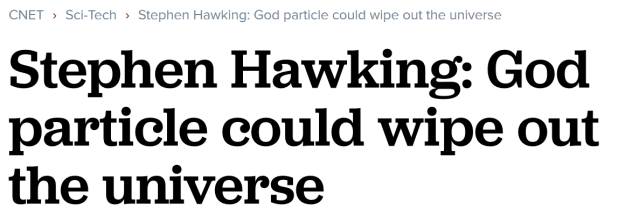
So apparently Hawking says that the Higgs could destroy the universe.
HawkingHiggs

I’ve covered this already, right? No need to say anything more?

Ok, fine, I’ll write a real blog post.

The Higgs is a scalar field: a number, sort of like temperature, that can vary across space and time. In the case of the Higgs this number determines the mass of almost every fundamental particle (the jury is still somewhat out on neutrinos). The Higgs doesn’t vary much at all, in fact it takes an enormous (Large Hadron Collider-sized) amount of energy to get it to wobble even a little bit. That is because the Higgs is in a very very stable state.

Hawking was pointing out that, given our current model of the Higgs, there’s actually another possible state for the Higgs to be in, one that’s even more stable (because it takes less energy, essentially). In that state, the number the Higgs corresponds to is much larger, so everything would be much more massive, with potentially catastrophic results. (Matt Strassler goes into some detail about the assumptions behind this.)

For those who have been following my blog for a while, you may find these “stable states” familiar. They’re vacua, different possible ways to set up “empty” space. In that post, I may have given the impression that there’s no way to change from one stable state, one “vacuum”, to another. In the case of the Higgs, the state it’s in is so stable that vast amounts of energy (again, a Large Hadron Collider-worth) only serve to create a small, unstable fluctuation, the Higgs boson, which vanishes in a fraction of a second.

And that would be the full story, were it not for a curious phenomenon called quantum tunneling.

If you’ve heard someone else describe quantum tunneling, you’ve probably heard that quantum particles placed on one side of a wall have a very small chance of being found later on the other side of the wall, as if they had tunneled there.

Using their incredibly tiny shovels.

However, quantum tunneling applies to much more than just walls. In general, a particle in an otherwise stable state (whether stable because there are walls keeping it in place, or for other reasons) can tunnel into another state, provided that the new state is “more stable” (has lower energy).

The chance of doing this is small, and it gets smaller the more “stable” the particle’s initial state is. Still, if you apply that logic to the Higgs, you realize there’s a very very very small chance that one day the Higgs could just “tunnel” away from its current stable state, destroying the universe as we know it in the process.

If that happened, everything we know would vanish at the speed of light, and we wouldn’t see it coming.

While that may sound scary, it’s also absurdly unlikely, to the extent that it probably won’t happen until the universe is many times older than it is now. It’s not the sort of thing anybody should worry about, at least on a personal level.

Is Hawking fear-mongering, then, by pointing this out? Hardly. He’s just explaining science. Pointing out the possibility that the Higgs could spontaneously change and end the universe is a great way to emphasize the sheer scale of physics, and it’s pretty common for science communicators to mention it. I seem to recall a section about it in Particle Fever, and Sean Carroll even argues that it’s a good thing, due to killing off spooky Boltzmann Brains.

What do particle colliders have to do with all this? Well, apart from quantum tunneling, just inputting enough energy in the right way can cause a transition from one stable state to another. Here “enough energy” means about a million times that produced by the Large Hadron Collider. As Hawking jokes, you’d need a particle collider the size of the Earth to get this effect. I don’t know whether he actually ran the numbers, but if anything I’d guess that a Large Earth Collider would actually be insufficient.

Either way, Hawking is just doing standard science popularization, which isn’t exactly newsworthy. Once again, “interpret something Hawking said in the most ridiculous way possible” seems to be the du jour replacement for good science writing.

“China” plans super collider

When I saw the headline, I was excited.

“China plans super collider” says Nature News.

There’s been a lot of worry about what may happen if the Large Hadron Collider finishes its run without discovering anything truly new. If that happens, finding new particles might require a much bigger machine…and since even that machine has no guarantee of finding anything at all, world governments may be understandably reluctant to fund it.

As such, several prominent people in the physics community have put their hopes on China. The country’s somewhat autocratic nature means that getting funding for a collider is a matter of convincing a few powerful people, not a whole fractious gaggle of legislators. It’s a cynical choice, but if it keeps the field alive so be it.

If China was planning a super collider, then, that would be great news!

Too bad it’s not.

Buried eight paragraphs in to Nature’s article we find the following:

The Chinese government is yet to agree on any funding, but growing economic confidence in the country has led its scientists to believe that the political climate is ripe, says Nick Walker, an accelerator physicist at DESY, Germany’s high-energy physics laboratory in Hamburg. Although some technical issues remain, such as keeping down the power demands of an energy-hungry ring, none are major, he adds.

The Chinese government is yet to agree on any funding. China, if by China you mean the Chinese government, is not planning a super collider.

So who is?

Someone must have drawn these diagrams, after all.

Reading the article, the most obvious answer is Beijing’s Institute of High Energy Physics (IHEP). While this is true, the article leaves out any mention of a more recently founded site, the Center for Future High Energy Physics (CFHEP).

This is a bit odd, given that CFHEP’s whole purpose is to compose a plan for the next generation of colliders, and persuade China’s government to implement it. They were founded, with heavy involvement from non-Chinese physicists including their director Nima Arkani-Hamed, with that express purpose in mind. And since several of the quotes in the article come from Yifang Wang, director of IHEP and member of the advisory board of CFHEP, it’s highly unlikely that this isn’t CFHEP’s plan.

So what’s going on here? On one level, it could be a problem on the journalists’ side. News editors love to rewrite headlines to be more misleading and click-bait-y, and claiming that China is definitely going to build a collider draws much more attention than pointing out the plans of a specialized think tank. I hope that it’s just something like that, and not the sort of casual racism that likes to think of China as a single united will. Similarly, I hope that the journalists involved just didn’t dig deep enough to hear about CFHEP, or left it out to simplify things, because there is a somewhat darker alternative.

CFHEP’s goal is to convince the Chinese government to build a collider, and what better way to do that than to present them with a fait accompli? If the public thinks that this is “China’s” plan, that wheels are already in motion, wouldn’t it benefit the Chinese government to play along? Throw in a few sweet words about the merits of international collaboration (a big part of the strategy of CFHEP is to bring international scientists to China to show the sort of community a collider could attract) and you’ve got a winning argument, or at least enough plausibility to get US and European funding agencies in a competitive mood.

This…is probably more cynical than what’s actually going on. For one, I don’t even know whether this sort of tactic would work.

Do these guys look like devious manipulators?

Indeed, it might just be a journalistic omission, part of a wider tendency of science journalists to focus on big projects and ignore the interesting part, the nitty-gritty things that people do to push them forward. It’s a shame, because people are what drive the news forward, and as long as science is viewed as something apart from real human beings people are going to continue to mistrust and misunderstand it.

Either way, one thing is clear. The public deserves to hear a lot more about CFHEP.

Look what I made!

In a few weeks, I’ll be giving a talk for Stony Brook’s Graduate Awards Colloquium, to an audience of social science grad students and their parents.

One of the most useful tools when talking to people in other fields is a shared image. You want something from your field that they’ve seen, that they’re used to, that they’ll recognize. Building off of that kind of thing can be a great way to communicate.

If there’s one particle physics image that lots and lots of people have seen, it’s the Standard Model. Generally, it’s organized into charts like this:

Standard_Model_of_Elementary_Particles

I thought that if people saw a chart like that, but for N=4 super Yang-Mills, it might make the theory seem a bit more familiar. N=4 super Yang-Mills has a particle much like the Standard Model’s gluon with spin 1, paired with four gluinos, particles that are sort of but not really like quarks with spin 1/2, and six scalars, particles whose closest analogue in the Standard Model is the Higgs with spin 0.

In N=4 super Yang-Mills, none of these particles have any mass, since if supersymmetry isn’t “broken” all particles have the same mass. So where mass is written in the Standard Model table, I can just put zero. The table I linked also gives the electric charge of each particle. That doesn’t really mean anything for N=4 super Yang-Mills. It isn’t a theory that tries to describe the real world, so there’s no direct equivalent to a real-world force like electromagnetism. Since everything in the theory has to have the same charge, again due to supersymmetry, I can just list all of their “electric charges” as zero.

Putting it all together, I get the diagram below. The theory has eleven particles in total, so it won’t fit into a nice neat square. Still, this should be more familiar than most of the ways I could present things.

N4SYMParticleContent

A Question of Audience

I’ve been thinking a bit about science communication recently.

One of the most important parts of communicating science (or indeed, communicating anything) is knowing your audience. Much of the time if a piece is flawed, it’s flawed because the author didn’t have a clear idea of who they’re talking to.

A persistent worry among people who communicate science to the public is that we’re really just talking to ourselves. If all the people praising you for your clear language are scientists, then maybe it’s time to take a step back and think about whether you’re actually being understood by anyone else.

This blog’s goal has always been to communicate science to the general public, and most of my posts are written with as little background assumed as possible. That said, I sometimes wonder whether that’s actually the audience I’m reaching.
Wordpress has a handy feature to let me track which links people click on to get to my blog, which gives me a rough way to gauge my audience.

When a new post goes up, I get around ten to twenty clicks from Facebook. Those are people I know, which for the most part these days means physicists. I get a couple clicks from Twitter, where my followers are a mix of young scientists, science journalists, and amateurs interested in science. On WordPress, my followers are also a mix of specialists and enthusiasts. Most interesting, to me at least, are the followers who get to my blog via Google searches. Naturally, they come in regardless of whether I have a new post or not, adding an extra twenty-five or so views every day. Judging by the sites (google.fr, google.ca) these people come from all over the world, and judging by their queries they run from physics PhD students to people with no physics knowledge whatsoever.

Overall then, I think I’m doing a pretty good job getting the word out. As my site’s Google rankings improve, more non-physicists will read what I have to say. It’s a diverse audience, but I think I’m up to the challenge.

Editors, Please Stop Misquoting Hawking

If you’ve been following science news recently, you’ve probably heard the apparently alarming news that Steven Hawking has turned his back on black holes, or that black holes can actually be escaped, or…how about I just show you some headlines:

FoxHawking

NatureHawking

YahooHawking

Now, Hawking didn’t actually say that black holes don’t exist, but while there are a few good pieces on the topic, in many cases the real message has gotten lost in the noise.

From Hawking’s paper:

ActualPaperHawking

What Hawking is proposing is that the “event horizon” around a black hole, rather than being an absolute permanent boundary from which nothing can escape, is a more temporary “apparent” horizon, the properties of which he goes on to describe in detail.

Why is he proposing this? It all has to do with the debate over black hole firewalls.

Starting with a paper by Polchinski and colleagues a year and a half ago, the black hole firewall paradox centers on contradictory predictions from general relativity and quantum mechanics. General relativity predicts that an astronaut falling past a black hole’s event horizon will notice nothing particularly odd about the surrounding space, but that once past the event horizon none of the “information” that specifies the astronaut’s properties can escape to the outside world. Quantum mechanics on the other hand predicts that information cannot be truly lost. The combination appears to suggest something radical, a “firewall” of high energy radiation around the event horizon carrying information from everything that fell into the black hole in the past, so powerful that it would burn our hypothetical astronaut to a crisp.

Since then, a wide variety of people have made one proposal or another, either attempting to avoid the seemingly preposterous firewall or to justify and further explain it. The reason the debate is so popular is because it touches on some of the fundamental principles of quantum mechanics.

Now, as I have pointed out before, I’m not a good person to ask about the fundamental principles of quantum mechanics. (Incidentally, I’d love it if some of the more quantum information or general relativity-focused bloggers would take a more substantial crack at this! Carroll, Preskill, anyone?) What I can talk about, though, is hype.

All of the headlines I listed take Hawking’s quote out of context, but not all of the articles do. The problem isn’t so much the journalists, as the editors.

One of an editor’s responsibilities is to take articles and give them titles that draw in readers. The editor wants a title that will get people excited, make them curious, and most importantly, get them to click. While a journalist won’t have any particular incentive to improve ad revenue, the same cannot be said for an editor. Thus, editors will often rephrase the title of an article in a way that makes the whole story seem more shocking.

Now that, in itself, isn’t a problem. I’ve used titles like that myself. The problem comes when the title isn’t just shocking, but misleading.

When I call astrophysics “impossible”, nobody is going to think I mean it literally. The title is petulant and ridiculous enough that no-one would take it at face value, but still odd enough to make people curious. By contrast, when you say that Hawking has “changed his mind” about black holes or said that “black holes do not exist”, there are people who will take that at face value as supporting their existing beliefs, as the Borowitz Report humorously points out. These people will go off thinking that Hawking really has given up on black holes. If the title confirms their beliefs enough, people might not even bother to read the article. Thus, by using an actively misleading title, you may actually be decreasing clicks!

It’s not that hard to write a title that’s both enough of a hook to draw people in and won’t mislead. Editors of the world, you’re well-trained writers, certainly much better than me. I’m sure you can manage it.

There really is some interesting news here, if people had bothered to look into it. The firewall debate has been going on for a year and a half, and while Hawking isn’t the universal genius the media occasionally depicts he’s still the world’s foremost expert on the quantum properties of black holes. Why did he take so long to weigh in? Is what he’s proposing even particularly new? I seem to remember people discussing eliminating the horizon in one way or another (even “naked” singularities) much earlier in the firewall debate…what makes Hawking’s proposal novel and different?

This is the sort of thing you can use to draw in interest, editors of the world. Don’t just write titles that cause ignorant people to roll their eyes and move on, instead, get people curious about what’s really going on in science! More ad revenue for you, more science awareness for us, sounds like a win-win!

Hype versus Miscommunication, or the Language of Importance

A fellow amplitudes-person was complaining to me recently about the hype surrounding the debate regarding whether black holes have “firewalls”. New York Times coverage seems somewhat excessive for what is, in the end, a fairly technical debate, and its enthusiasm was (rightly?) mocked in several places.

There’s an attitude I often run into among other physicists. The idea is that when hype like this happens, it’s because senior physicists are, at worst, cynically manipulating the press to further their positions or, at best, so naïve that they really see what they’re working on as so important that it deserves hype-y coverage. Occasionally, the blame will instead be put on the journalists, with largely the same ascribed motivations: cynical need for more page views, or naïve acceptance of whatever story they’re handed.

In my opinion, what’s going on there is a bit deeper, and not so easily traceable to any particular person.

In the articles on the (2, 0) theory I put up in the last few weeks, I made some disparaging comments about the tone of this Scientific American blog post. After exchanging a few tweets with the author, I think I have a better idea of what went down.

The problem here is that when you ask a scientist about something they’re excited about, they’re going to tell you why they’re excited about it. That’s what happened here when Nima Arkani-Hamed was interviewed for the above article: he was asked about the (2, 0) theory, and he seems to have tried to convey his enthusiasm with a metaphor that explained how the situation felt to him.

The reason this went wrong and led to a title as off-base and hype-sounding as “the Ultimate Ultimate Theory of Physics” was that we (scientists and science journalists) are taught to express enthusiasm in the language of importance.

There has been an enormous resurgence in science communication in recent years, but it has come with a very us-vs.-them mentality. The prevailing attitude is that the public will only pay attention to a scientific development if they are told that it is important. As such, both scientists and journalists try to make whatever they’re trying to communicate sound central, either to daily life or to our understanding of the universe. When both sides of the conversation are operating under this attitude, it creates an echo chamber where a concept’s importance is blown up many times greater than it really deserves, without either side doing anything other than communicating science in the only way they know.

We all have to step back and realize that most of the time, science isn’t interesting because of its absolute “importance”. Rather, a puzzle is often interesting simply because it is a puzzle. That’s what’s going on with the (2, 0) theory, or with firewalls: they’re hard to figure out, and that’s why we care.

Being honest about this is not going to lose us public backing, or funding. It’s not just scientists who value interesting things because they are challenging. People choose the path of their lives not based on some absolute relevance to the universe at large, but because things make sense in context. You don’t fall in love because the target of your affections is the most perfect person in the universe, you fall in love because they’re someone who can constantly surprise you.

Scientists are in love with what they do. We need to make sure that that, and not some abstract sense of importance, is what we’re communicating. If we do that, if we calm down and make a bit more effort to be understood, maybe we can win back some of the trust that we’ve lost by appearing to promote Ultimate Ultimate Theories of Everything.

Hawking vs. Witten: A Primer

Have you seen the episode of Star Trek where Data plays poker with Stephen Hawking? How about the times he appeared on Futurama or the Simpsons? Or the absurd number of times he has come up in one way or another on The Big Bang Theory?

Stephen Hawking is probably the most recognizable theoretical physicist to laymen. Wheelchair-bound and speaking through a voice synthesizer, Hawking presents a very distinct image, while his work on black holes and the big bang, along with his popular treatments of science in books like A Brief History of Time, has made him synonymous in the public’s mind with genius.

He is not, however, the most recognizable theoretical physicist when talking to physicists. If Sheldon from The Big Bang Theory were a real string theorist he wouldn’t be obsessed with Hawking. He might, however, be obsessed with Edward Witten.

Edward Witten is tall and has an awkwardly high voice (for a sample, listen to the clip here). He’s also smart, smart enough to dabble in basically every subfield of theoretical physics and manage to make important contributions while doing so. He has a knack for digging up ideas from old papers and dredging out the solution to current questions of interest.

And far more than Hawking, he represents a clear target for parody, at least when that parody is crafted by physicists and mathematicians. Abstruse Goose has a nice take on his role in theoretical physics, while his collaboration with another physicist named Seiberg on what came to be known as Seiberg-Witten theory gave rise to the cyber-Witten pun.

If you would look into the mouth of physics-parody madness, let this link be your guide…

So why hasn’t this guy appeared on Futurama? (After all, his dog does!)

Witten is famous among theorists, but he hasn’t done as much as Hawking to endear himself to the general public. He hasn’t written popular science books, and he almost never gives public talks. So when a well-researched show like The Big Bang Theory wants to mention a famous physicist, they go to Hawking, not to Witten, because people know about him. And unless Witten starts interfacing more with the public (or blog posts like this become more common), that’s not about to change.

Sound Bite Management; or the Merits of Shock and Awe

First off, for the small demographic who haven’t seen it already (and aren’t reading this because of it), I wrote an article for Ars Technica. Go read it.

After the article went up, a professor from my department told me that he and several others were concerned about the title.

Now before I go on, I’d like to clarify that this isn’t going to be a story about the department trying to “shut me down” or anything paranoid like that. The professor in question was expressing a valid concern in a friendly way, and it deserves some thought.

The concern was the following: isn’t a title like Earning a PhD by studying a theory that we know is wrong” bad publicity for the field? Regardless of whether the article rebuts the idea that “wrong” is a meaningful descriptor for this sort of theory, doesn’t a title like that give fuel to the fire, sharpening the cleavers of the field’s detractors as one commenter put it? In other words, even if it’s a good article, isn’t it a bad sound bite?

It’s worryingly easy for a catchy sound bite to eclipse everything else about a piece. As one commenter pointed out, that’s roughly what happened with Palin’s fruit fly comment itself. And with that in mind, the claim that people are earning PhDs based on “false” theories definitely sounds like the sort of sound bite that could get out of hand in a hurry if the wrong community picked it up.

There is, at least, one major difference between my sound bite and Palin’s. In the political climate of 2008 it was easy to believe that Sarah Palin didn’t understand the concept of fruit fly research. On the other hand, it’s quite a bit less plausible that Ars would air a piece calling most work in theoretical physics useless.

In operation here is the old, powerful technique of using a shocking, dissonant headline to lure people in. A sufficiently out-of-character statement won’t be taken at face value; rather, it will inspire readers to dig in to the full article to figure out what they’re missing. This is the principle behind provocateurs in many fields, and while there are always risks, often this is the only way to get people to think about complex issues (Peter Singer often seems to exemplify the risks and rewards of this tactic, just to give an example).

What’s the alternative here? In referring to the theory I study as “wrong”, I’m attempting to bring readers face to face with a common misconception: the idea that every theory in physics is designed to approximate some part of the real world. For the physicists in the audience, this is the public perception that everything in theoretical physics is phenomenology. If we don’t bring this perception to light and challenge it, then we’re sweeping a substantial amount of theoretical physics under the rug for the sake of a simpler message. And that’s risky, because if people don’t understand what physics really is then they’re likely to balk when they glimpse what they think is “illegitimate” physics.

In my view, shocking people by describing my type of physics as not “true” is the best way to teach people about what physicists actually do. But it is risky, and it could easily give people the wrong impression. Only time will tell.

Some thoughts about the current Flame Challenge

Ever tried to explain something to an eleven year old?

It’s not the same as talking to a six year old. There’s no need to talk down, or to oversimplify: eleven is smart enough to understand most of what you have to say. On the other hand, most eleven year olds haven’t had chemistry or physics, or algebra. They’re about as intelligent as they’re going to get, but with almost no knowledge base, which makes them a uniquely relevant challenge for communicating science.

That’s the concept behind Alan Alda’s Flame Challenge: eleven year olds around the country pick a question and scientists (via video, images, or text) attempt to answer it. Last year, the challenge question was “What is a flame?” a question from Alan Alda’s own youth. This year, the eleven year olds had their first opportunity to choose, and they chose a doozy: “What is time?”

This is…well, a difficult question. Not just hard to explain, it’s a question that could mean one of several different things. Alan Alda has embraced the ambiguity and assures contestants that they can pursue whichever interpretation they think best, but in the end the judges are eleven year olds around the country, and it will be their call whether an answer is sufficient.

(As an aside, I think this sort of ambiguous question isn’t a fluke: barring a new vetting procedure, we’re going to keep getting questions like this. If an eleven year old wants to understand something with a definite answer, he or she will just Google it. It’s only the ambiguous, tricky, arguably poorly-formed questions that can’t be answered by a quick search.)

I’ve been brainstorming a bit, and I’ve come up with a few meanings for the question “What is time?”

  • How should time travel work? In my own limited experience with kids asking about time, this is usually what they’re going for. Screw the big philosophical questions: can I go kill a dinosaur, and if I do, should I be worried that everyone will be speaking Chinese when I get back? In some ways this is the easiest question to answer because, barring Everett-style interpretations of quantum mechanics, there really is only one way for time travel to work consistent with current science, and that’s through wormholes. Wormholes aren’t an especially difficult concept: all they really require is some understanding of the idea that space can be curved. Flatland in particular proves ideal for teaching students to think of space as more than just three static directions, which is why I’m considering the (potentially wildly overambitious) idea of submitting an animated Flatland story dealing with wormholes and time travel for the Flame Challenge. By the way, any budding scientist-animators who are interested in collaborating on such a project are more than welcome! I’m not sure I can do this without help. By the way, one downside of this approach is that it is very well covered by movies and other media, so it is entirely possible that most eleven year olds know this already.
  • What makes time different from other dimensions? There is a flippant physicist answer to this question, and that is that time has a different sign in the Minkowski metric. What that means, in very vague terms, is that while rotations in space will always come back to where they started, if you rotate something in both space and time (it turns out all this means is gaining speed) you can keep going indefinitely, getting closer and closer to the speed of light without ever getting back to your previous speed. If you want to know why time is special like that, that’s harder to say, but occasionally papers bubble up on arXiv claiming that they understand why this should be the case. I’d love it if an author of one of those papers made a submission to the Flame Challenge.
  • Why does time have an arrow? Why does it only go forwards? This is not the same question as the previous one! This is much harder, and depending on who you talk to it relates somehow to entropy and thermodynamics or to quantum mechanics, or even to biology and psychology. It’s tricky to explain, but there have been many attempts, and I don’t doubt that a substantial number of the submissions will be in this vein.
  • How does Special Relativity (or General Relativity) work? How can time go faster or slower? This is a more specialized version of the question about why time is unique, and one that Alan Alda has made mention of in his interviews. Teaching Special Relativity or General Relativity to eleven year olds is a challenge, which is not to say it is impossible but rather the reverse: unlike the other questions, this is unambiguous enough that with enough work someone could do it, and possibly advance the field of science communication in doing so.
  • Is time real? Could time be an illusion? There are a number of variations of this, ranging from purely philosophical to directly scientific. Is it better to think of everything as happening at once, and our minds simply organizing it? Is time merely change, or could time exist in a changeless universe? There is a lot of ambiguity in answering this form of the question, and while we’ll see a few people trying to go in this vein I doubt there’s an answer that will satisfy the world’s eleven year olds.
  • Side topics. Someone could, of course, go on a completely different route. They could explain clocks, and timekeeping throughout the ages. They could talk about the definition of a second. They could talk about the beginning of time, and what that means, or discuss whether or not time had a beginning at all. They could talk about the relationship between energy and time, how one, via Noether’s Theorem, implies the other. There are many choices here, and the trick is to avoid straying too far from the main point. Eleven year olds are not forgiving folks, after all.

I am very much looking forward to seeing what people submit, and if all goes extraordinarily well, I may even have a submission too. It’s a very difficult topic this year, but we’re scientists! If anyone can do it, we can.

A Note on Blogging Style

So I’ve come to realize that my blog posts have a somewhat odd format for a science blog, in that I tend to use paragraphs of only one or two sentences, with important points in bold.

While I somehow had the impression that this was a common style in science blogging, I haven’t seen it elsewhere, and a few weeks ago I figured out where it comes from: it’s the same style I use when writing D&D optimization handbooks.

In that field (if I may call it a field), it’s a fairly common writing style. It works well for its target audience, with short paragraphs to appeal to short attention spans and bolding to isolate the elementary concepts behind rules and advice. Liberal application of links and references then allows the reader to check up on the topic, each time increasing their knowledge of the subject’s wider context.

All of these seem like perfectly good things to cultivate in a science blog too!

My style may evolve over time, but I definitely think this is a good place to start. If you don’t like it, though, feel free to comment! If I’m not communicating with my readers, I’m not accomplishing very much, now am I?