Author Archives: 4gravitons

What Does It Mean to Know the Answer?

My sub-field isn’t big on philosophical debates. We don’t tend to get hung up on how to measure an infinite universe, or in arguing about how to interpret quantum mechanics. Instead, we develop new calculation techniques, which tends to nicely sidestep all of that.

If there’s anything we do get philosophical about, though, any question with a little bit of ambiguity, it’s this: What counts as an analytic result?

“Analytic” here is in contrast to “numerical”. If all we need is a number and we don’t care if it’s slightly off, we can use numerical methods. We have a computer use some estimation trick, repeating steps over and over again until we have approximately the right answer.

“Analytic”, then, refers to everything else. When you want an analytic result, you want something exact. Most of the time, you don’t just want a single number: you want a function, one that can give you numbers for whichever situation you’re interested in.

It might sound like there’s no ambiguity there. If it’s a function, with sines and cosines and the like, then it’s clearly analytic. If you can only get numbers out through some approximation, it’s numerical. But as the following example shows, things can get a bit more complicated.

Suppose you’re trying to calculate something, and you find the answer is some messy integral. Still, you’ve simplified the integral enough that you can do numerical integration and get some approximate numbers out. What’s more, you can express the integral as an infinite series, so that any finite number of terms will get close to the correct result. Maybe you even know a few special cases, situations where you plug specific numbers in and you do get an exact answer.

It might sound like you only know the answer numerically. As it turns out, though, this is roughly how your computer handles sines and cosines.

When your computer tries to calculate a sine or a cosine, it doesn’t have access to the exact solution all of the time. It does have some special cases, but the rest of the time it’s using an infinite series, or some other numerical trick. Type in a random sine into your calculator and it will be just as approximate as if you did a numerical integration.

So what’s the real difference?

Rather than how we get numbers out, think about what else we know. We know how to take derivatives of sines, and how to integrate them. We know how to take limits, and series expansions. And we know their relations to other functions, including how to express them in terms of other things.

If you can do that with your integral, then you’ve probably got an analytic result. If you can’t, then you don’t.

What if you have only some of the requirements, but not the others? What if you can take derivatives, but don’t know all of the identities between your functions? What if you can do series expansions, but only in some limits? What if you can do all the above, but can’t get numbers out without a supercomputer?

That’s where the ambiguity sets in.

In the end, whether or not we have the full analytic answer is a matter of degree. The closer we can get to functions that mathematicians have studied and understood, the better grasp we have of our answer and the more “analytic” it is. In practice, we end up with a very pragmatic approach to knowledge: whether we know the answer depends entirely on what we can do with it.

Particles Aren’t Vibrations (at Least, Not the Ones You Think)

You’ve probably heard this story before, likely from Brian Greene.

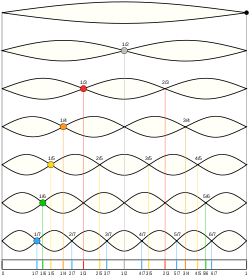
In string theory, the fundamental particles of nature are actually short lengths of string. These strings can vibrate, and like a string on a violin, that vibration is arranged into harmonics. The more energy in the string, the more complex the vibration. In string theory, each of these vibrations corresponds to a different particle, explaining how the zoo of particles we observe can come out of a single type of fundamental string.

250px-moodswingerscale-svg

Particles. Probably.

It’s a nice story. It’s even partly true. But it gives a completely wrong idea of where the particles we’re used to come from.

Making a string vibrate takes energy, and that energy is determined by the tension of the string. It’s a lot harder to wiggle a thick rubber band than a thin one, if you’re holding both tightly.

String theory’s strings are under a lot of tension, so it takes a lot of energy to make them vibrate. From our perspective, that energy looks like mass, so the more complicated harmonics on a string correspond to extremely massive particles, close to the Planck mass!

Those aren’t the particles you’re used to. They’re not electrons, they’re not dark matter. They’re particles we haven’t observed, and may never observe. They’re not how string theory explains the fundamental particles of nature.

So how does string theory go from one fundamental type of string to all of the particles in the universe, if not through these vibrations? As it turns out, there are several different ways it can happen, tricks that allow the lightest and simplest vibrations to give us all the particles we’ve observed.* I’ll describe a few.

The first and most important trick here is supersymmetry. Supersymmetry relates different types of particles to each other. In string theory, it means that along with vibrations that go higher and higher, there are also low-energy vibrations that behave like different sorts of particles. In a sense, string theory sticks a quantum field theory inside another quantum field theory, in a way that would make Xzibit proud.

Even with supersymmetry, string theory doesn’t give rise to all of the right sorts of particles. You need something else, like compactifications or branes.

The strings of string theory live in ten dimensions, it’s the only place they’re mathematically consistent. Since our world looks four-dimensional, something has to happen to the other six dimensions. They have to be curled up, in a process called compactification. There are lots and lots (and lots) of ways to do this compactification, and different ways of curling up the extra dimensions give different places for strings to move. These new options make the strings look different in our four-dimensional world: a string curled around a donut hole looks very different from one that moves freely. Each new way the string can move or vibrate can give rise to a new particle.

Another option to introduce diversity in particles is to use branes. Branes (short for membranes) are surfaces that strings can end on. If two strings end on the same brane, those ends can meet up and interact. If they end on different branes though, then they can’t. By cleverly arranging branes, then, you can have different sets of strings that interact with each other in different ways, reproducing the different interactions of the particles we’re familiar with.

In string theory, the particles we’re used to aren’t just higher harmonics, or vibrations with more and more energy. They come from supersymmetry, from compactifications and from branes. The higher harmonics are still important: there are theorems that you can’t fix quantum gravity with a finite number of extra particles, so the infinite tower of vibrations allows string theory to exploit a key loophole. They just don’t happen to be how string theory gets the particles of the Standard Model. The idea that every particle is just a higher vibration is a common misconception, and I hope I’ve given you a better idea of how string theory actually works.


*But aren’t these lightest vibrations still close to the Planck mass? Nope! See the discussion with TE in the comments for details.

Those Wacky 60’s Physicists

The 60’s were a weird time in academia. Psychologists were busy experimenting with LSD, seeing if they could convince people to electrocute each other, and otherwise doing the sorts of shenanigans that ended up saddling them with Institutional Review Boards so that nowadays they can’t even hand out surveys without a ten page form attesting that it won’t have adverse effects on pregnant women.

We don’t have IRBs in theoretical physics. We didn’t get quite as wacky as the psychologists did. But the 60’s were still a time of utopian dreams and experimentation, even in physics. We may not have done unethical experiments on people…but we did have the Analytic S-Matrix Program.

The Analytic S-Matrix Program was an attempt to rebuild quantum field theory from the ground up. The “S” in S-Matrix stands for “scattering”: the S-Matrix is an enormous matrix that tells you, for each set of incoming particles, the probability that they scatter into some new set of outgoing particles. Normally, this gets calculated piece by piece with what are called Feynman diagrams. The goal of the Analytic S-Matrix program was a loftier one: to derive the S-Matrix from first principles, without building it out of quantum field theory pieces. Without Feynman diagrams’ reliance on space and time, people like  Geoffrey Chew, Stanley Mandelstam, Tullio Regge, and Lev Landau hoped to reach a deeper understanding of fundamental physics.

If this sounds familiar, it should. Amplitudeologists like me view the physicists of the Analytic S-Matrix Program as our spiritual ancestors. Like us, they tried to skip the mess of Feynman diagrams, looking for mathematical tricks and unexpected symmetries to show them the way forward.

Unfortunately, they didn’t have the tools we do now. They didn’t understand the mathematical functions they needed, nor did they have novel ways of writing down their results like the amplituhedron. Instead, they had to work with what they knew, which in practice usually meant going back to Feynman diagrams.

Paradoxically then, much of the lasting impact of the Analytic S-Matrix Program has been on how we understand the results of Feynman diagram calculations. Just as psychologists learn about the Milgram experiment in school, we learn about Mandelstam variables and Regge trajectories. Recently, we’ve been digging up old concepts from those days and finding new applications, like the recent work on Landau singularities, or some as-yet unpublished work I’ve been doing.

Of course, this post wouldn’t be complete without mentioning the Analytic S-Matrix Program’s most illustrious child, String Theory. Some of the mathematics cooked up by the physicists of the 60’s, while dead ends for the problems they were trying to solve, ended up revealing a whole new world of potential.

The physicists of the 60’s were overly optimistic. Nevertheless, their work opened up questions that are still worth asking today. Much as psychologists can’t ignore what they got up to in the 60’s, it’s important for physicists to be aware of our history. You never know what you might dig up.

0521523362cvr.qxd (Page 1)

And as Levar Burton would say, you don’t have to take my word for it.

A Collider’s Eye View

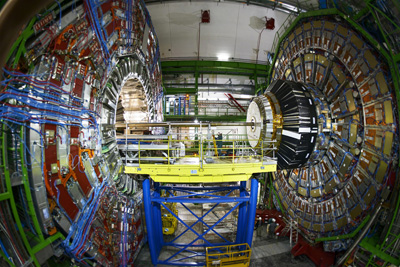
When it detected the Higgs, what did the LHC see, exactly?

cern-1304107-02-thumb

What do you see with your detector-eyes, CMS?

The first problem is that the Higgs, like most particles produced in particle colliders, is unstable. In a very short amount of time the Higgs transforms into two or more lighter particles. Often, these particles will decay in turn, possibly many more times.  So when the LHC sees a Higgs boson, it doesn’t really “see the Higgs”.

The second problem is that you can’t “see” the lighter particles either. They’re much too small for that. Instead, the LHC has to measure their properties.

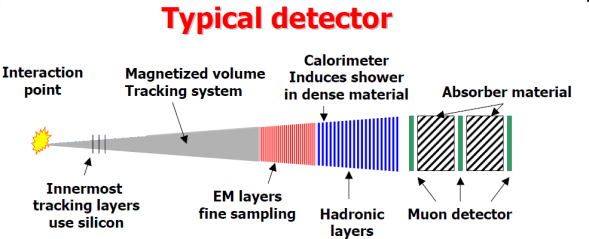
Does the particle have a charge? Then its path will curve in a magnetic field, and it will send electrical signals in silicon. So the LHC can “see” charge.

Can the particle be stopped, absorbed by some material? Getting absorbed releases energy, lighting up a detector. So the LHC can “see” energy, and what it takes for a particle to be absorbed.

vvvvv

Diagram of a collider’s “eye”

And that’s…pretty much it. When the LHC “sees” the Higgs, what it sees is a set of tracks in a magnetic field, indicating charge, and energy in its detectors, caused by absorption at different points. Everything else has to be inferred: what exactly the particles were, where they decayed, and from what. Some of it can be figured out in real-time, some is only understood later once we can add up everything and do statistics.

On the face of it, this sounds about as impossible as astrophysics. Like astrophysics, it works in part because what the colliders see is not the whole story. The strong force has to both be consistent with our observations of hadrons, and with nuclear physics. Neutrinos aren’t just mysterious missing energy that we can’t track, they’re an important part of cosmology. And so on.

So in the sense of that massive, interconnected web of ideas, the LHC sees the Higgs. It sees patterns of charges and energies, binned into histograms and analyzed with statistics and cross-checked, implicitly or explicitly, against all of the rest of physics at every scale we know. All of that, together, is the collider’s eye view of the universe.

Source Your Common Sense

When I wrote that post on crackpots, one of my inspirations was a particularly annoying Twitter conversation. The guy I was talking to had convinced himself that general relativity was a mistake. He was especially pissed off by the fact that, in GR, energy is not always conserved. Screw Einstein, energy conservation is just common sense! Right?

Think a little bit about why you believe in energy conservation. Is it because you run into a lot of energy in your day-to-day life, and it’s always been conserved? Did you grow up around something that was obviously energy? Or maybe someone had to explain it to you?

Teacher Pointing at Map of World

Maybe you learned about it…from a physics teacher?

A lot of the time, things that seem obvious only got that way because you were taught them. “Energy” isn’t an intuitive concept, however much it’s misused that way. It’s something defined by physicists because it solves a particular role, a consequence of symmetries in nature. When you learn about energy conservation in school, that’s because it’s one of the simpler ways to explain a much bigger concept, so you shouldn’t be surprised if there are some inaccuracies. If you know where your “common sense” is coming from, you can anticipate when and how it might go awry.

Similarly, if, like one of the commenters on my crackpot post, you’re uncomfortable with countable and uncountable infinities, remember that infinity isn’t “common sense” either. It’s something you learned about in a math class, from a math teacher. And just like energy conservation, it’s a simplification of a more precise concept, with epsilons and deltas and all that jazz.

It’s not possible to teach all the nuances of every topic, so naturally most people will hear a partial story. What’s important is to recognize that you heard a partial story, and not enshrine it as “common sense” when the real story comes knocking.

Don’t physicists use common sense, though? What about “physical intuition”?

Physical intuition has a lot of mystique behind it, and is often described as what separates us from the mathematicians. As such, different people mean different things by it…but under no circumstances should it be confused with pure “common sense”. Physical intuition uses analogy and experience. It involves seeing a system and anticipating the sorts of things you can do with it, like playing a game and assuming there’ll be a save button. In order for these sorts of analogies to work, they generally aren’t built around everyday objects or experiences. Instead, they use physical systems that are “similar” to the one under scrutiny in important ways, while being better understood in others. Crucially, physical intuition involves working in context. It’s not just uncritical acceptance of what one would naively expect.

So when your common sense is tingling, see if you can provide a source. Is that source relevant, experience with a similar situation? Or is it in fact a half-remembered class from high school?

Starshot: The Right Kind of Longshot

On Tuesday, Yuri Milner and Stephen Hawking announced Starshot, a $100 million dollar research initiative. The goal is to lay the groundwork for a very ambitious, but surprisingly plausible project: sending probes to the nearest star, Alpha Centauri. Their idea is to have hundreds of ultra-light probes, each with a reflective sail a few meters in diameter. By aiming an extremely powerful laser at these sails, it should be possible to accelerate the probes up to around a fifth of the speed of light, enough to make the trip in twenty years. Here’s the most complete article I’ve found on the topic.

I can’t comment on the engineering side of the project. The impression I get is that nothing they’re proposing is known to be impossible, but there are a lot of “ifs” along the way that might scupper things. What I can comment on is the story.

Milner and Hawking have both put quite a bit of effort recently into what essentially amounts to telling stories. Milner’s Breakthrough Prizes involve giving awards of $3 million to prominent theoretical physicists (and, more recently, mathematicians). Quite a few of my fellow theorists have criticized these prizes, arguing that the money would be better spent in a grant program like that of the Simons Foundation. While that would likely be better for science, the Breakthrough Prize isn’t really about that. Instead, it’s about telling a story: a story in which progress in theoretical physics is exalted in a public, Nobel-sized way.

Similarly, Hawking’s occasional pronouncements about aliens or AI aren’t science per se, and the media has a tendency to talk about his contributions to ongoing scientific debates out of proportion to their importance. Both of these things, though, contribute to the story of Hawking: a mascot for physics, someone to carry Einstein’s role of the most recognizable genius in the world. Hawking Inc. is about a role as much as it is about a man.

In calling Hawking and Milner’s activity “stories”, I’m not dismissing them. Stories can be important. And the story told by Starshot is a particularly important one.

Cosmology isn’t just a scientific subject, it contributes to how people see themselves. Here I don’t just mean cosmology the field, but cosmology in the broader sense of our understanding of the universe and our place in it.

A while back, I read a book called The View from the Center of the Universe. The book starts by describing the worldviews of the ancients, cosmologies in which they really did think of themselves as the center of the universe. It then suggests that this played an important role: that this kind of view of the world, in which humans have a place in the cosmos, is important to how we view ourselves. The rest of the book then attempts to construct this sort of mythological understanding out of the modern cosmological picture, with some success.

One thing the book doesn’t discuss very much, though, is the future. We care about our place in the universe not just because we want to know where we came from, but because we want to have some idea of where we’re going. We want to contribute to a greater goal, to see ourselves making progress towards something important and vast and different. That’s why so many religions have not just cosmologies, but eschatologies, why people envision armageddons and raptures.

Starshot places the future in our sight in a way that few other things do. Humanity’s spread among the stars seems like something so far distant that nothing we do now could matter to it. What Starshot does is give us something concrete, a conceptual stepping-stone that can link people in to the broader narrative. Right now, people can work on advanced laser technology and optics, work on making smaller chips and lighter materials, work that would be useful and worth funding regardless of whether it was going to lead to Alpha Centauri. But because of Starshot, we can view that work as the near-term embodiment of humanity’s interstellar destiny.

That combination, bridging the gap between the distant future and our concrete present, is the kind of story people need right now. And so for once, I think Milner’s storytelling is doing exactly what it should.

GUTs vs ToEs: What Are We Unifying Here?

“Grand Unified Theory” and “Theory of Everything” may sound like meaningless grandiose titles, but they mean very different things.

In particular, Grand Unified Theory, or GUT, is a technical term, referring to a specific way to unify three of the fundamental interactions: electromagnetism, the weak force, and the strong force.

blausen_0817_smallintestine_anatomy

In contrast, guts unify the two fundamental intestines.

Those three forces are called Yang-Mills forces, and they can all be described in the same basic way. In particular, each has a strength (the coupling constant) and a mathematical structure that determines how it interacts with itself, called a group.

The core idea of a GUT, then, is pretty simple: to unite the three Yang-Mills forces, they need to have the same strength (the same coupling constant) and be part of the same group.

But wait! (You say, still annoyed at the pun in the above caption.) These forces don’t have the same strength at all! One of them’s strong, one of them’s weak, and one of them is electromagnetic!

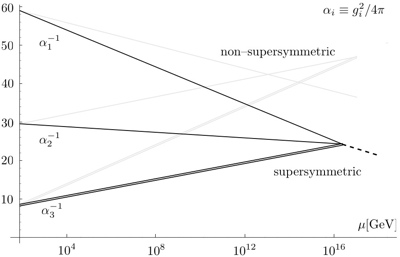
As it turns out, this isn’t as much of a problem as it seems. While the three Yang-Mills forces seem to have very different strengths on an everyday scale, that’s not true at very high energies. Let’s steal a plot from Sweden’s Royal Institute of Technology:

running

Why Sweden? Why not!

What’s going on in this plot?

Here, each \alpha represents the strength of a fundamental force. As the force gets stronger, \alpha gets bigger (and so \alpha^{-1} gets smaller). The variable on the x-axis is the energy scale. The grey lines represent a world without supersymmetry, while the black lines show the world in a supersymmetric model.

So based on this plot, it looks like the strengths of the fundamental forces change based on the energy scale. That’s true, but if you find that confusing there’s another, mathematically equivalent way to think about it.

You can think about each force as having some sort of ultimate strength, the strength it would have if the world weren’t quantum. Without quantum mechanics, each force would interact with particles in only the simplest of ways, corresponding to the simplest diagram here.

However, our world is quantum mechanical. Because of that, when we try to measure the strength of a force, we’re not really measuring its “ultimate strength”. Rather, we’re measuring it alongside a whole mess of other interactions, corresponding to the other diagrams in that post. These extra contributions mean that what looks like the strength of the force gets stronger or weaker depending on the energy of the particles involved.

(I’m sweeping several things under the rug here, including a few infinities and electroweak unification. But if you just want a general understanding of what’s going on, this should be a good starting point.)

If you look at the plot, you’ll see the forces meet up somewhere around 10^16 GeV. They miss each-other for the faint, non-supersymmetric lines, but they meet fairly cleanly for the supersymmetric ones.

So (at least if supersymmetry is true), making the Yang-Mills forces have the same strength is not so hard. Putting them in the same mathematical group is where things get trickier. This is because any group that contains the groups of the fundamental forces will be “bigger” than just the sum of those forces: it will contain “extra forces” that we haven’t observed yet, and these forces can do unexpected things.

In particular, the “extra forces” predicted by GUTs usually make protons unstable. As far as we can tell, protons are very long-lasting: if protons decayed too fast, we wouldn’t have stars. So if protons decay, they must do it only very rarely, detectable only with very precise experiments. These experiments are powerful enough to rule out most of the simplest GUTs. The more complicated GUTs still haven’t been ruled out, but it’s enough to make fewer people interested in GUTs as a research topic.

What about Theories of Everything, or ToEs?

While GUT is a technical term, ToE is very much not. Instead, it’s a phrase that journalists have latched onto because it sounds cool. As such, it doesn’t really have a clear definition. Usually it means uniting gravity with the other fundamental forces, but occasionally people use it to refer to a theory that also unifies the various Standard Model particles into some sort of “final theory”.

Gravity is very different from the other fundamental forces, different enough that it’s kind of silly to group them as “fundamental forces” in the first place. Thus, while GUT models are the kind of thing one can cook up and tinker with, any ToE has to be based on some novel insight, one that lets you express gravity and Yang-Mills forces as part of the same structure.

So far, string theory is the only such insight we have access to. This isn’t just me being arrogant: while there are other attempts at theories of quantum gravity, aside from some rather dubious claims none of them are even interested in unifying gravity with other forces.

This doesn’t mean that string theory is necessarily right. But it does mean that if you want a different “theory of everything”, telling physicists to go out and find a new one isn’t going to be very productive. “Find a theory of everything” is a hope, not a research program, especially if you want people to throw out the one structure we have that even looks like it can do the job.

I Don’t Get Crackpots

[Note: not an April fool’s post. Now I’m wishing I wrote one though.]

After the MHV@30 conference, I spent a few days visiting my sister. I hadn’t seen her in a while, and she noticed something new about me.

“You’re not sure about anything. It’s always ‘I get the impression’ or ‘I believe so’ or ‘that seems good’.”

On reflection, she’s right.

It’s a habit I’ve picked up from spending time around scientists. When you’re surrounded by people who are likely to know more than you do about something, it’s usually good to qualify your statements. A little intellectual humility keeps simple corrections from growing into pointless arguments, and makes it easier to learn from your mistakes.

With that kind of mindset, though, I really really don’t get crackpots.

open-uri20150422-20810-4a7nvg_87d49366

For example, why do they always wear funnels on their heads?

The thing about genuine crackpots (as opposed to just scientists with weird ideas) is that they tend to have almost none of the relevant background for a given field, but nevertheless have extremely strong opinions about it. That basic first step, of assuming that there are people who probably know a lot more about whatever you’re talking about? Typically, they don’t bother with that. The qualifiers, the “typically” and “as far as I know” just don’t show up. And I have a lot of trouble understanding how a person can work that way.

Is some of it the Dunning-Kruger effect? Sure. If you don’t know much about something, you don’t know the limits of your own knowledge, so you think you know more than you really do. But I don’t think it’s just that…there’s a baseline level of doubt, of humility in general, that just isn’t there for most crackpots.

I wonder if some fraction of crackpots are genuinely mentally ill, but if so I’m not sure what the illness would be. Mania is an ok fit some of the time, and the word salad and “everyone but me is crazy” attitude almost seem schizophrenic, but I doubt either is really what’s going on in most cases.

All of this adds up to me just being completely unable to relate to people who display a sufficient level of crackpottery.

The thing is, there are crackpots out there who I kind of wish I could talk to, because if I could maybe I could help them. There are crackpots who seem genuinely willing to be corrected, to be told what they’re doing wrong. But that core of implicit arrogance, the central assumption that it’s possible to make breakthroughs in a field while knowing almost nothing about it, that’s still there, and it makes it impossible for me to deal with them.

I kind of wish there was a website I could link, dedicated to walking crackpots through their mistakes. There used to be something like that for supernatural crackpots, in the form of the James Randi Educational Foundation‘s Million Dollar Prize, complete with forums where (basically) helpful people would patiently walk applicants through how to set up a test of their claims. There’s never been anything like that for science, as far as I’m aware, and it seems like it would take a lot more work. Still, it would be nice if there were people out there patient enough to do it.

Four Gravitons and Some Wildly Irresponsible Amplitudes Predictions

My post on the “physics of decimals” a couple of weeks back caught physics blogger Luboš Motl’s attention, with predictable results. Mostly, this led to a rather unproductive debate about semantics, but he did bring up one thing that I think deserves some further clarification.

In my post, I asked you to imagine asking a genie for the full consequences of quantum field theory. Short of genie-based magic, is this the sort of thing I think it’s at all possible to know?

robinwilliams_aladdin

A Candle of Invocation? Sure, why not.

In a word, no.

The world is messy, not the sort of thing that tends to be described by neat exact solutions. That’s why we use approximations, and it’s why physicists can’t just step in and solve biology or psychology by deriving everything from first principles.

That said, the nice thing about approximations is that there’s often room for improvement. Sometimes this is quantitative, literally pushing to the next order of decimals, while sometimes it’s qualitative, viewing problems from a new perspective and attacking them from a new approach.

I’d like to give you some idea of the sorts of improvements I think are possible. I’ll focus on scattering amplitudes, since they’re my field. In order to be precise, I’ll be using technical terms here without much explanation; if you’re curious about something specific go ahead and ask in the comments. Finally, there are no implied time-scales here: I’ll be rating things based on whether I think they’re likely to eventually be understood, not on how long it will take us to get there.

Let’s begin with the most likely category:

Probably going to happen:

Mathematicians characterize the set of n-point cluster polylogarithms whose collinear limits are well-defined (n-1)-point cluster polylogarithms.

The seven-loop N=8 supergravity integrand is found, and the coefficient of its potential divergence is evaluated.

The dual Amplituhedron is found.

A general procedure is described for re-summing the L-loop coefficient of the Pentagon OPE for any L into a polylogarithmic form, at least at six points.

We figure out what the heck is up with the MHV-NMHV relation we found here.

Likely to happen, but there may be unforeseen complications:

N=8 supergravity is found to be finite at seven loops.

A symbol bootstrap becomes workable for QCD amplitudes at two or three loops, perhaps involving Landau singularities.

Something like a symbol bootstrap becomes workable for elliptic integrals, though it may only pass a “physicist” level of rigor.

Analogues to all of the work up to the actual Amplituhedron itself are performed for non-planar N=4 super Yang-Mills.

Quite possible, but I’m likely overoptimistic:

The space of n-point cluster polylogarithms whose collinear limits are well-defined (n-1)-point cluster polylogarithms that also obey the first entry condition and some number of final entry conditions turns out to be well-constrained enough that some all-loop all-point statements can be made, at least for MHV.

The enhanced cancellations observed in supergravity theories are understood, and used to provide a strong argument that N=8 supergravity is perturbatively finite.

All-multiplicity analytic QCD results at two loops, for at least the simpler helicity configurations.

The volume of the dual Amplituhedron is characterized by mathematicians and the connection to cluster polylogarithms is fully explored.

A non-planar Amplituhedron is found.

Less likely, but if all of the above happens I would not be all that surprised:

A way is found to double-copy the non-planar Amplituhedron to get an N=8 supergravity Amplituhedron.

The enhanced cancellations in N=8 supergravity turn out to be something “deep”: perhaps they are derivable from string theory, or provide a novel constraint on quantum gravity theories.

Various all-loop statements about the polylogarithms present in N=4 are used to make more restricted all-loop statements about QCD.

The Pentagon OPE is re-summed for finite coupling, if not into known functions than into a form that admits good numerics and various analytic manipulations. Alternatively, the sorts of functions that the Pentagon OPE can sum to are characterized and a bootstrap procedure becomes viable for them.

Irresponsible speculations, suited to public talks or grant applications:

The N=8 Amplituhedron leads to some sort of reformulation of space-time in a way that solves various quantum gravity paradoxes.

The sorts of mathematical objects found in the finite-coupling resummation of the Pentagon OPE lead to a revival of the original analytic S-matrix program, now with an actual chance to succeed.

Extremely unlikely:

Analytic all-loop QCD results.

Magical genie land:

Analytic finite coupling QCD results.

It Was Thirty Years Ago Yesterday, Parke and Taylor Taught the Band to Play…

Just a short post this week. I’m at MHV@30, a conference at Fermilab in honor of Parke and Taylor’s landmark paper from March 17, 1986. I don’t have time to write up an explanation of their work’s importance, but luckily I already have.

It’s my first time visiting Fermilab. They took us on a tour of their neutrino detectors 100m underground. Since we theorists don’t visit experiments very often, it was an unusual experience.

IMG_20160317_135147031

In case you wanted to know what a neutrino beam looks like, look at the target.

The fun thing about these kinds of national labs is the sheer variety of research, from the most abstract theory to the most grounded experiments, that spring from the same core goals. Physics almost always involves a diversity of viewpoints and interests, and that’s nowhere more obvious than here.