
Monthly Archives: October 2020

Halloween Post: Superstimuli for Physicists

For Halloween, this blog has a tradition of covering “the spooky side” of physics. This year, I’m bringing in a concept from biology to ask a spooky physics “what if?”

In the 1950’s, biologists discovered that birds were susceptible to a worryingly effective trick. By giving them artificial eggs larger and brighter than their actual babies, they found that the birds focused on the new eggs to the exclusion of their own. They couldn’t help trying to hatch the fake eggs, even if they were so large that they would fall off when they tried to sit on them. The effect, since observed in other species, became known as a supernormal stimulus, or superstimulus.

Can this happen to humans? Some think so. They worry about junk food we crave more than actual nutrients, or social media that eclipses our real relationships. Naturally, this idea inspires horror writers, who write about haunting music you can’t stop listening to, or holes in a wall that “fit” so well you’re compelled to climb in.

(And yes, it shows up in porn as well.)

But this is a physics blog, not a biology blog. What kind of superstimulus would work on physicists?
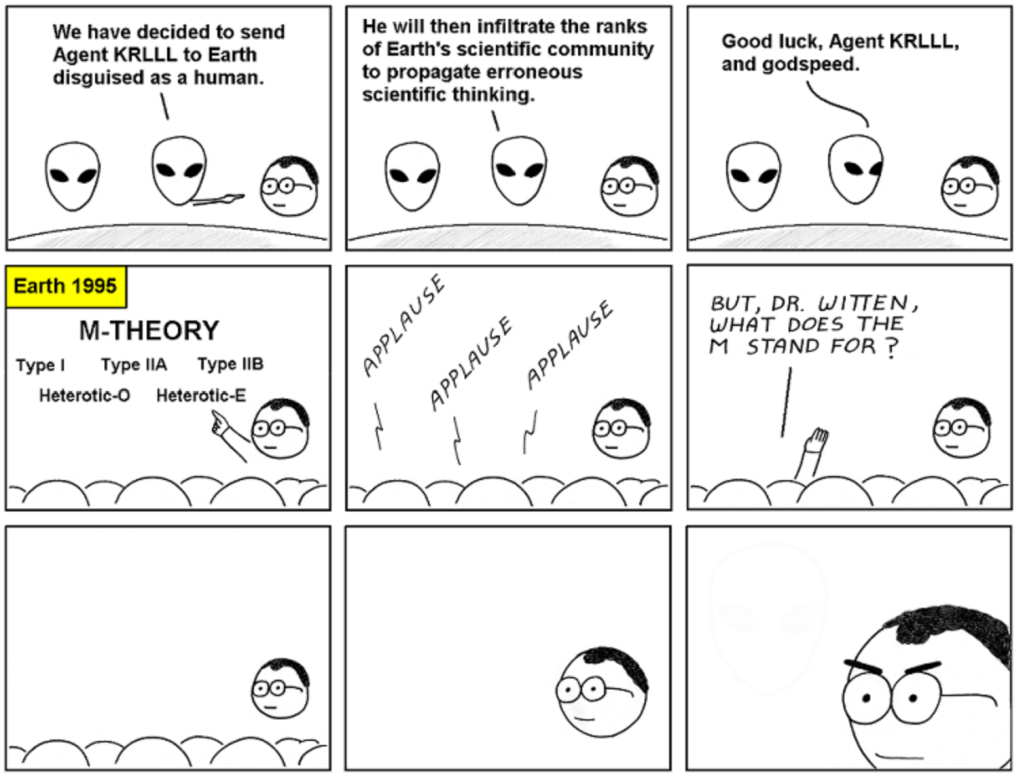
Abstruse goose knows what’s up

Well for one, this sounds a lot like some criticisms of string theory. Instead of a theory that just unifies some forces, why not unify all the forces? Instead of just learning some advanced mathematics, why not learn more, and more? And if you can’t be falsified by any experiment, well, all that would do is spoil the fun, right?

But it’s not just string theory you could apply this logic to. Astrophysicists study not just one world but many. Cosmologists study the birth and death of the entire universe. Particle physicists study the fundamental pieces that make up the fundamental pieces. We all partake in the euphoria of problem-solving, a perpetual rush where each solution leads to yet another question.

Do I actually think that string theory is a superstimulus, that astrophysics or particle physics is a superstimulus? In a word, no. Much as it might look that way from the news coverage, most physicists don’t work on these big, flashy questions. Far from being lured in by irresistible super-scale problems, most physicists work with tabletop experiments and useful materials. For those of us who do look up at the sky or down at the roots of the world, we do it not just because it’s compelling but because it has a good track record: physics wouldn’t exist if Newton hadn’t cared about the orbits of the planets. We study extremes because they advance our understanding of everything else, because they give us steam engines and transistors and change everyone’s lives for the better.

Then again, if I had fallen victim to a superstimulus, I’d say that anyway, right?

*cue spooky music*
What You Don’t Know, You Can Parametrize

In physics, what you don’t know can absolutely hurt you. If you ignore that planets have their own gravity, or that metals conduct electricity, you’re going to calculate a lot of nonsense. At the same time, as physicists we can’t possibly know everything. Our experiments are never perfect, our math never includes all the details, and even our famous Standard Model is almost certainly not the whole story. Luckily, we have another option: instead of ignoring what we don’t know, we can parametrize it, and estimate its effect.

Estimating the unknown is something we physicists have done since Newton. You might think Newton’s big discovery was the inverse-square law for gravity, but others at the time, like Robert Hooke, had also been thinking along those lines. Newton’s big discovery was that gravity was universal: that you need to know the effect of gravity, not just from the sun, but from all the other planets as well. The trouble was, Newton didn’t know how to calculate the motion of all of the planets at once (in hindsight, we know he couldn’t have). Instead, he estimated, using what he knew to guess how big the effect of what he didn’t would be. It was the accuracy of those guesses, not just the inverse square law by itself, that convinced the world that Newton was right.

If you’ve studied electricity and magnetism, you get to the point where you can do simple calculations with a few charges in your sleep. The world doesn’t have just a few charges, though: it has many charges, protons and electrons in every atom of every object. If you had to keep all of them in your calculations you’d never pass freshman physics, but luckily you can once again parametrize what you don’t know. Often you can hide those charges away, summarizing their effects with just a few numbers. Other times, you can treat materials as boundaries, and summarize everything beyond in terms of what happens on the edge. The equations of the theory let you do this, but this isn’t true for every theory: for the Navier-Stokes equation, which we use to describe fluids, it still isn’t known whether you can do this kind of trick.

Parametrizing what we don’t know isn’t just a trick for college physics, it’s key to the cutting edge as well. Right now we have a picture for how all of particle physics works, called the Standard Model, but we know that picture is incomplete. There are a million different theories you could write to go beyond the Standard Model, with a million different implications. Instead of having to use all those theories, physicists can summarize them all with what we call an effective theory: one that keeps track of the effect of all that new physics on the particles we already know. By summarizing those effects with a few parameters, we can see what they would have to be to be compatible with experimental results, ruling out some possibilities and suggesting others.

In a world where we never know everything, there’s always something that can hurt us. But if we’re careful and estimate what we don’t know, if we write down numbers and parameters and keep our options open, we can keep from getting burned. By focusing on what we do know, we can still manage to understand the world.

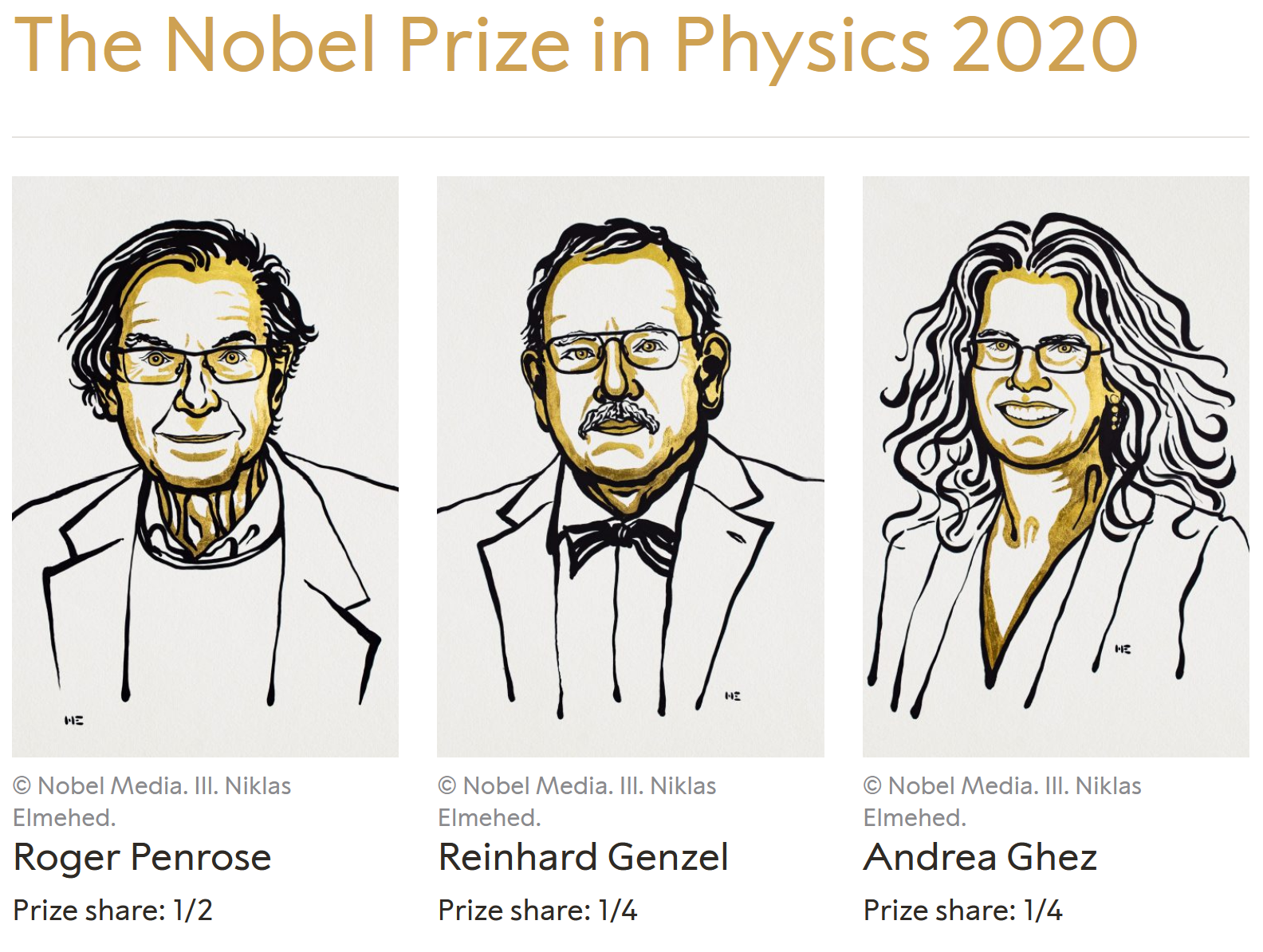
Congratulations to Roger Penrose, Reinhard Genzel, and Andrea Ghez!

The 2020 Physics Nobel Prize was announced last week, awarded to Roger Penrose for his theorems about black holes and Reinhard Genzel and Andrea Ghez for discovering the black hole at the center of our galaxy.

Of the three, I’m most familiar with Penrose’s work. People had studied black holes before Penrose, but only the simplest of situations, like an imaginary perfectly spherical star. Some wondered whether black holes in nature were limited in this way, if they could only exist under perfectly balanced conditions. Penrose showed that wasn’t true: he proved mathematically that black holes not only can form, they must form, in very general situations. He’s also worked on a wide variety of other things. He came up with “twistor space”, an idea intended for a new theory of quantum gravity that ended up as a useful tool for “amplitudeologists” like me to study particle physics. He discovered a set of four types of tiles such that if you tiled a floor with them the pattern would never repeat. And he has some controversial hypotheses about quantum gravity and consciousness.

I’m less familiar with Genzel and Ghez, but by now everyone should be familiar with what they found. Genzel and Ghez led two teams that peered into the center of our galaxy. By carefully measuring the way stars moved deep in the core, they figured out something we now teach children: that our beloved Milky Way has a dark and chewy center, an enormous black hole around which everything else revolves. These appear to be a common feature of galaxies, and many others have been shown to orbit black holes as well.

Like last year, I find it a bit odd that the Nobel committee decided to lump these two prizes together. Both discoveries concern black holes, so they’re more related than last year’s laureates, but the contexts are quite different: it’s not as if Penrose predicted the black hole in the center of our galaxy. Usually the Nobel committee avoids mathematical work like Penrose’s, except when it’s tied to a particular experimental discovery. It doesn’t look like anyone has gotten a Nobel prize for discovering that black holes exist, so maybe that’s the intent of this one…but Genzel and Ghez were not the first people to find evidence of a black hole. So overall I’m confused. I’d say that Penrose deserved a Nobel Prize, and that Genzel and Ghez did as well, but I’m not sure why they needed to split one with each other.

At “Antidifferentiation and the Calculation of Feynman Amplitudes”

I was at a conference this week, called Antidifferentiation and the Calculation of Feynman Amplitudes. The conference is a hybrid kind of affair: I attended via Zoom, but there were seven or so people actually there in the room (the room in question being at DESY Zeuthen, near Berlin).

The road to this conference was a bit of a roller-coaster. It was originally scheduled for early March. When the organizers told us they were postponing it, they seemed at the time a little overcautious…until the world proved me, and all of us, wrong. They rescheduled for October, and as more European countries got their infection rates down it looked like the conference could actually happen. We booked rooms at the DESY guest house, until it turned out they needed the space to keep the DESY staff socially distanced, and we quickly switched to booking at a nearby hotel.

Then Europe’s second wave hit. Cases in Denmark started to rise, so Germany imposed a quarantine on entry from Copenhagen and I switched to remote participation. Most of the rest of the participants did too, even several in Germany. For the few still there in person they have a variety of measures to stop infection, from fixed seats in the conference room to gloves for the coffee machine.

The content has been interesting. It’s an eclectic mix of review talks and talks on recent research, all focused on different ways to integrate (or, as one of the organizers emphasized, antidifferentiate) functions in quantum field theory. I’ve learned about the history of the field, and gotten a better feeling for the bottlenecks in some LHC-relevant calculations.

This week was also the announcement of the Physics Nobel Prize. I’ll do my traditional post on it next week, but for now, congratulations to Penrose, Genzel, and Ghez!

The Multiverse You Can Visit Is Not the True Multiverse

I don’t want to be the kind of science blogger who constantly complains about science fiction, but sometimes I can’t help myself.

When I blogged about zero-point energy a few weeks back, there was a particular book that set me off. Ian McDonald’s River of Gods depicts the interactions of human and AI agents in a fragmented 2047 India. One subplot deals with a power company pursuing zero-point energy, using an imagined completion of M theory called M* theory. This post contains spoilers for that subplot.

What frustrated me about River of Gods is that the physics in it almost makes sense. It isn’t just an excuse for magic, or a standard set of tropes. Even the name “M* theory” is extremely plausible, the sort of term that could get used for technical reasons in a few papers and get accidentally stuck as the name of our fundamental theory of nature. But because so much of the presentation makes sense, it’s actively frustrating when it doesn’t.

The problem is the role the landscape of M* theory plays in the story. The string theory (or M theory) landscape is the space of all consistent vacua, a list of every consistent “default” state the world could have. In the story, one of the AIs is trying to make a portal to somewhere else in the landscape, a world of pure code where AIs can live in peace without competing with humans.

The problem is that the landscape is not actually a real place in string theory. It’s a metaphorical mathematical space, a list organized by some handy coordinates. The other vacua, the other “default states”, aren’t places you can travel to, there just other ways the world could have been.

Ok, but what about the multiverse?

There are physicists out there who like to talk about multiple worlds. Some think they’re hypothetical, others argue they must exist. Sometimes they’ll talk about the string theory landscape. But to get a multiverse out of the string theory landscape, you need something else as well.

Two options for that “something else” exist. One is called eternal inflation, the other is the many-worlds interpretation of quantum mechanics. And neither lets you travel around the multiverse.

In eternal inflation, the universe is expanding faster and faster. It’s expanding so fast that, in most places, there isn’t enough time for anything complicated to form. Occasionally, though, due to quantum randomness, a small part of the universe expands a bit more slowly: slow enough for stars, planets, and maybe life. Each small part like that is its own little “Big Bang”, potentially with a different “default” state, a different vacuum from the string landscape. If eternal inflation is true then you can get multiple worlds, but they’re very far apart, and getting farther every second: not easy to visit.

The many-worlds interpretation is a way to think about quantum mechanics. One way to think about quantum mechanics is to say that quantum states are undetermined until you measure them: a particle could be spinning left or right, Schrödinger’s cat could be alive or dead, and only when measured is their state certain. The many-worlds interpretation offers a different way: by doing away with measurement, it instead keeps the universe in the initial “undetermined” state. The universe only looks determined to us because of our place in it: our states become entangled with those of particles and cats, so that our experiences only correspond to one determined outcome, the “cat alive branch” or the “cat dead branch”. Combine this with the string landscape, and our universe might have split into different “branches” for each possible stable state, each possible vacuum. But you can’t travel to those places, your experiences are still “just on one branch”. If they weren’t, many-worlds wouldn’t be an interpretation, it would just be obviously wrong.

In River of Gods, the AI manipulates a power company into using a particle accelerator to make a bubble of a different vacuum in the landscape. Surprisingly, that isn’t impossible. Making a bubble like that is a bit like what the Large Hadron Collider does, but on a much larger scale. When the Large Hadron Collider detected a Higgs boson, it had created a small ripple in the Higgs field, a small deviation from its default state. One could imagine a bigger ripple doing more: with vastly more energy, maybe you could force the Higgs all the way to a different default, a new vacuum in its landscape of possibilities.

Doing that doesn’t create a portal to another world, though. It destroys our world.

That bubble of a different vacuum isn’t another branch of quantum many-worlds, and it isn’t a far-off big bang from eternal inflation. It’s a part of our own universe, one with a different “default state” where the particles we’re made of can’t exist. And typically, a bubble like that spreads at the speed of light.

In the story, they have a way to stabilize the bubble, stop it from growing or shrinking. That’s at least vaguely believable. But it means that their “portal to another world” is just a little bubble in the middle of a big expensive device. Maybe the AI can live there happily…until the humans pull the plug.

Or maybe they can’t stabilize it, and the bubble spreads and spreads at the speed of light destroying everything. That would certainly be another way for the AI to live without human interference. It’s a bit less peaceful than advertised, though.