
Monthly Archives: March 2020

4gravitons, Spinning Up

I had a new paper out last week, with Michèle Levi and Andrew McLeod. But to explain it, I’ll need to clarify something about our last paper.

Two weeks ago, I told you that Andrew and Michèle and I had written a paper, predicting what gravitational wave telescopes like LIGO see when black holes collide. You may remember that LIGO doesn’t just see colliding black holes: it sees colliding neutron stars too. So why didn’t we predict what happens when neutron stars collide?

Actually, we did. Our calculation doesn’t just apply to black holes. It applies to neutron stars too. And not just neutron stars: it applies to anything of roughly the right size and shape. Black holes, neutron stars, very large grapefruits…
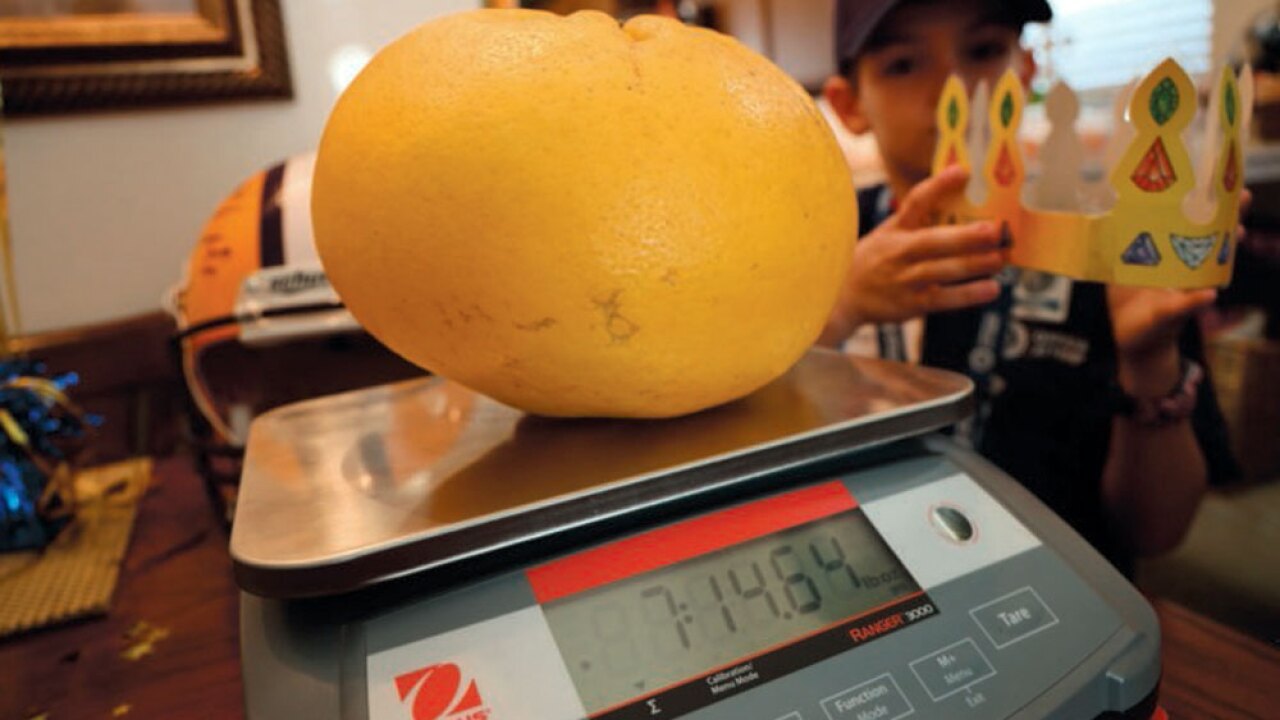
LIGO’s next big discovery

That’s the magic of Effective Field Theory, the “zoom lens” of particle physics. Zoom out far enough, and any big, round object starts looking like a particle. Black holes, neutron stars, grapefruits, we can describe them all using the same math.

Ok, so we can describe both black holes and neutron stars. Can we tell the difference between them?

In our last calculation, no. In this one, yes!

Effective Field Theory isn’t just a zoom lens, it’s a controlled approximation. That means that when we “zoom out” we don’t just throw out anything “too small to see”. Instead, we approximate it, estimating how big of an effect it can have. Depending on how precise we want to be, we can include more and more of these approximated effects. If our estimates are good, we’ll include everything that matters, and get a good approximation for what we’re trying to observe.

At the precision of our last calculation, a black hole and a neutron star still look exactly the same. Our new calculation aims for a bit higher precision though. (For the experts: we’re at a higher order in spin.) The higher precision means that we can actually see the difference: our result changes for two colliding black holes versus two colliding grapefruits.

So does that mean I can tell you what happens when two neutron stars collide, according to our calculation? Actually, no. That’s not because we screwed up the calculation: it’s because some of the properties of neutron stars are unknown.

The Effective Field Theory of neutron stars has what we call “free parameters”, unknown variables. People have tried to estimate some of these (called “Love numbers” after the mathematician A. E. H. Love), but they depend on the details of how neutron stars work: what stuff they contain, how that stuff is shaped, and how it can move. To find them out, we probably can’t just calculate: we’ll have to measure, observe an actual neutron star collision and see what the numbers actually are.

That’s one of the purposes of gravitational wave telescopes. It’s not (as far as I know) something LIGO can measure. But future telescopes, with more precision, should be able to. By watching two colliding neutron stars and comparing to a high-precision calculation, physicists will better understand what those neutron stars are made of. In order to do that, they will need someone to do that high-precision calculation. And that’s why people like me are involved.
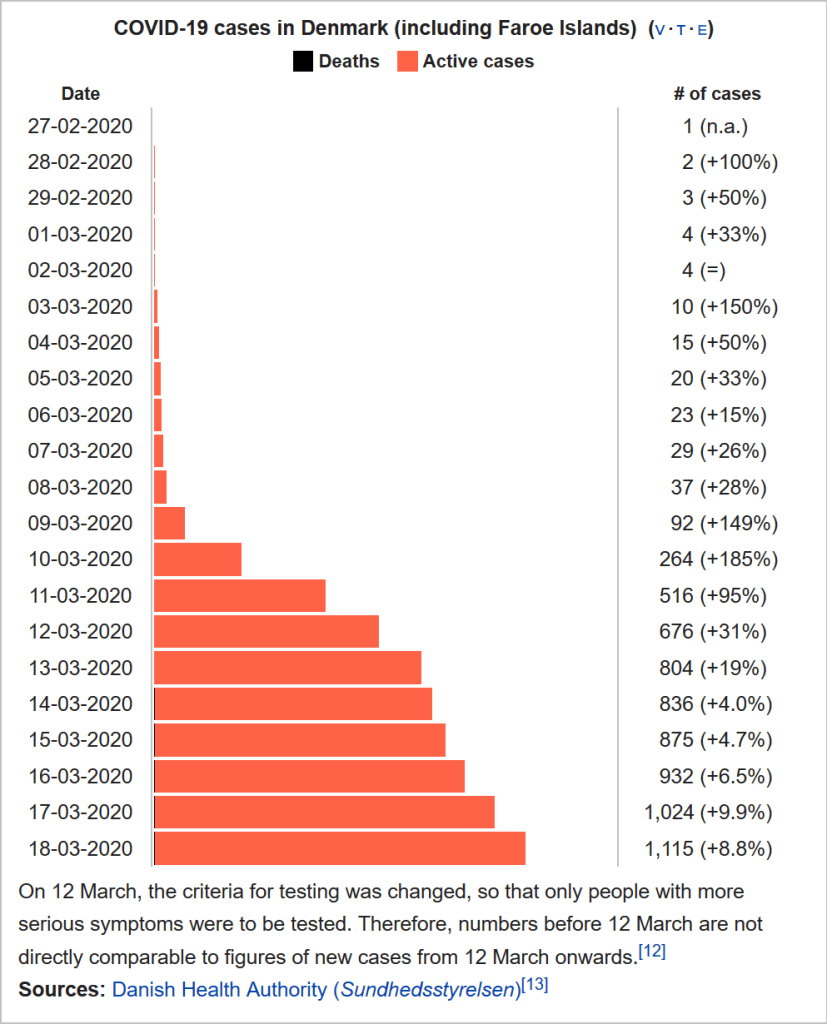
This Is What an Exponential Feels Like

Most people, when they picture exponential growth, think of speed. They think of something going faster and faster, more and more out of control. But in the beginning, exponential growth feels slow. A little bit leads to a little bit more, leads to a little bit more. It sneaks up on you.

When the first cases of COVID-19 were observed in China in December, I didn’t hear about it. If it was in the news, it wasn’t news I read.

I’d definitely heard about it by the end of January. A friend of mine had just gotten back from a trip to Singapore. At the time, Singapore had a few cases from China, but no local transmission. She decided to work from home for two weeks anyway, just to be safe. The rest of us chatted around tea at work, shocked at the measures China was taking to keep the virus under control.

Italy reached our awareness in February. My Italian friends griped and joked about the situation. Denmark’s first case was confirmed on February 27, a traveler returning from Italy. He was promptly quarantined.

I was scheduled to travel on March 8, to a conference in Hamburg. On March 2, six days before, they decided to postpone. I was surprised: Hamburg is on the opposite side of Germany from Italy.

That week, my friend who went to Singapore worked from home again. This time, she wasn’t worried she brought the virus from Singapore: she was worried she might pick it up in Denmark. I was surprised: with so few cases (23 by March 6) in a country with a track record of thorough quarantines, I didn’t think we had anything to worry about. She disagreed. She remembered what happened in Singapore.

That was Saturday, March 7. Monday evening, she messaged me again. The number of cases had risen to 90. Copenhagen University asked everyone who traveled to a “high-risk” region to stay home for fourteen days.

On Wednesday, the university announced new measures. They shut down social events, large meetings, and work-related travel. Classes continued, but students were asked to sit as far as possible from each other. The Niels Bohr Institute was more strict: employees were asked to work from home, and classes were asked to switch online. The canteen would stay open, but would only sell packaged food.

The new measures lasted a day. On Thursday, the government of Denmark announced a lockdown, starting Friday. Schools were closed for two weeks, and public sector employees were sent to work from home. On Saturday, they closed the borders. There were 836 confirmed cases.

Exponential growth is the essence of life…but not of daily life. It’s been eerie, seeing the world around me change little by little and then lots by lots. I’m not worried for my own health. I’m staying home regardless. I know now what an exponential feels like.

P.S.: This blog has a no-politics policy. Please don’t comment on what different countries or politicians should be doing, or who you think should be blamed. Viruses have enough effect on the world right now, let’s keep viral arguments out of the comment section.

4gravitons Exchanges a Graviton

I had a new paper up last Friday with Michèle Levi and Andrew McLeod, on a topic I hadn’t worked on before: colliding black holes.

I am an “amplitudeologist”. I work on particle physics calculations, computing “scattering amplitudes” to find the probability that fundamental particles bounce off each other. This sounds like the farthest thing possible from black holes. Nevertheless, the two are tightly linked, through the magic of something called Effective Field Theory.

Effective Field Theory is a kind of “zoom knob” for particle physics. You “zoom out” to some chosen scale, and write down a theory that describes physics at that scale. Your theory won’t be a complete description: you’re ignoring everything that’s “too small to see”. It will, however, be an effective description: one that, at the scale you’re interested in, is effectively true.

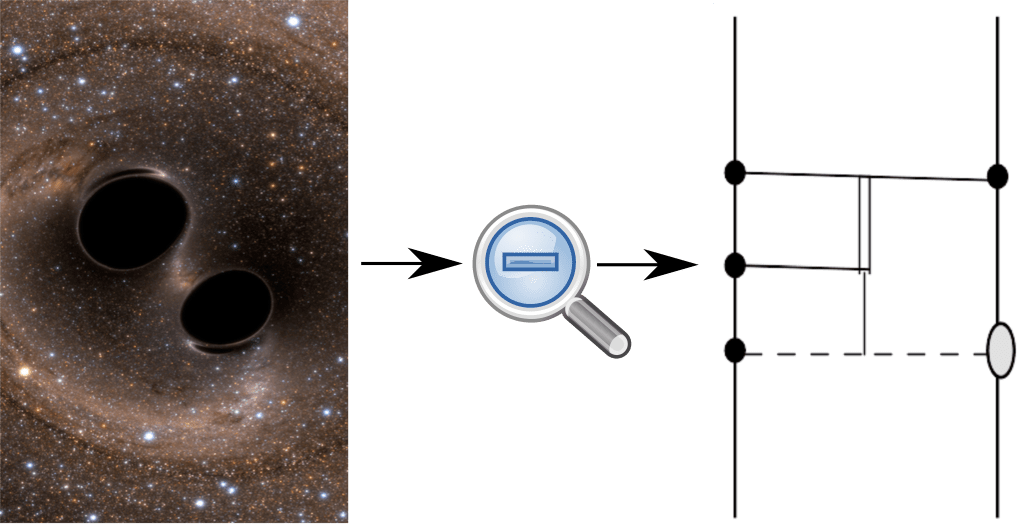
Particle physicists usually use Effective Field Theory to go between different theories of particle physics, to zoom out from strings to quarks to protons and neutrons. But you can zoom out even further, all the way out to astronomical distances. Zoom out far enough, and even something as massive as a black hole looks like just another particle.

Just click the “zoom X10” button fifteen times, and you’re there!

In this picture, the force of gravity between black holes looks like particles (specifically, gravitons) going back and forth. With this picture, physicists can calculate what happens when two black holes collide with each other, making predictions that can be checked with new gravitational wave telescopes like LIGO.

Researchers have pushed this technique quite far. As the calculations get more and more precise (more and more “loops”), they have gotten more and more challenging. This is particularly true when the black holes are spinning, an extra wrinkle in the calculation that adds a surprising amount of complexity.

That’s where I came in. I can’t compete with the experts on black holes, but I certainly know a thing or two about complicated particle physics calculations. Amplitudeologists, like Andrew McLeod and me, have a grab-bag of tricks that make these kinds of calculations a lot easier. With Michèle Levi’s expertise working with spinning black holes in Effective Field Theory, we were able to combine our knowledge to push beyond the state of the art, to a new level of precision.

This project has been quite exciting for me, for a number of reasons. For one, it’s my first time working with gravitons: despite this blog’s name, I’d never published a paper on gravity before. For another, as my brother quipped when he heard about it, this is by far the most “applied” paper I’ve ever written. I mostly work with a theory called N=4 super Yang-Mills, a toy model we use to develop new techniques. This paper isn’t a toy model: the calculation we did should describe black holes out there in the sky, in the real world. There’s a decent chance someone will use this calculation to compare with actual data, from LIGO or a future telescope. That, in particular, is an absurdly exciting prospect.

Because this was such an applied calculation, it was an opportunity to explore the more applied part of my own field. We ended up using well-known techniques from that corner, but I look forward to doing something more inventive in future.

What I Was Not Saying in My Last Post

Science communication is a gradual process. Anything we say is incomplete, prone to cause misunderstanding. Luckily, we can keep talking, give a new explanation that corrects those misunderstandings. This of course will lead to new misunderstandings. We then explain again, and so on. It sounds fruitless, but in practice our audience nevertheless gets closer and closer to the truth.

Last week, I tried to explain physicists’ notion of a fundamental particle. In particular, I wanted to explain what these particles aren’t: tiny, indestructible spheres, like Democritus imagined. Instead, I emphasized the idea of fields, interacting and exchanging energy, with particles as just the tip of the field iceberg.

I’ve given this kind of explanation before. And when I do, there are two things people often misunderstand. These correspond to two topics which use very similar language, but talk about different things. So this week, I thought I’d get ahead of the game and correct those misunderstandings.

The first misunderstanding: None of that post was quantum.

If you’ve heard physicists explain quantum mechanics, you’ve probably heard about wave-particle duality. Things we thought were waves, like light, also behave like particles, things we thought were particles, like electrons, also behave like waves.

If that’s on your mind, and you see me say particles don’t exist, maybe you think I mean waves exist instead. Maybe when I say “fields”, you think I’m talking about waves. Maybe you think I’m choosing one side of the duality, saying that waves exist and particles don’t.

To be 100% clear: I am not saying that.

Particles and waves, in quantum physics, are both manifestations of fields. Is your field just at one specific point? Then it’s a particle. Is it spread out, with a fixed wavelength and frequency? Then it’s a wave. These are the two concepts connected by wave-particle duality, where the same object can behave differently depending on what you measure. And both of them, to be clear, come from fields. Neither is the kind of thing Democritus imagined.

The second misunderstanding: This isn’t about on-shell vs. off-shell.

Some of you have seen some more “advanced” science popularization. In particular, you might have listened to Nima Arkani-Hamed, of amplituhedron fame, talk about his perspective on particle physics. Nima thinks we need to reformulate particle physics, as much as possible, “on-shell”. “On-shell” means that particles obey their equations of motion, normally quantum calculations involve “off-shell” particles that violate those equations.

To again be clear: I’m not arguing with Nima here.

Nima (and other people in our field) will sometimes talk about on-shell vs off-shell as if it was about particles vs. fields. Normal physicists will write down a general field, and let it be off-shell, we try to do calculations with particles that are on-shell. But once again, on-shell doesn’t mean Democritus-style. We still don’t know what a fully on-shell picture of physics will look like. Chances are it won’t look like the picture of sloshing, omnipresent fields we started with, at least not exactly. But it won’t bring back indivisible, unchangeable atoms. Those are gone, and we have no reason to bring them back.