Monthly Archives: October 2018

Cosmology, or Cosmic Horror?

Around Halloween, I have a tradition of posting about the “spooky” side of physics. This year, I’ll be comparing two no doubt often confused topics, Cosmic Horror and Cosmology.

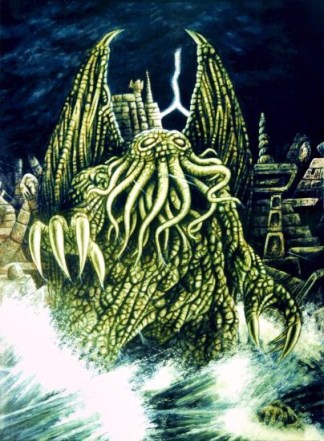
cthulhu_and_r27lyeh

Pro tip: if this guy shows up, it’s probably Cosmic Horror

Cosmic Horror

Cosmology

Started in the 1920’s with the work of Howard Phillips Lovecraft Started in the 1920’s with the work of Alexander Friedmann
Unimaginably ancient universe Precisely imagined ancient universe
In strange ages even death may die Strange ages, what redshift is that?
An expedition to Antarctica uncovers ruins of a terrifying alien civilization An expedition to Antarctica uncovers…actually, never mind, just dust
Alien beings may propagate in hidden dimensions Gravitons may propagate in hidden dimensions
Cultists compete to be last to be eaten by the Elder Gods Grad students compete to be last to realize there are no jobs
Oceanic “deep ones” breed with humans Have you seen daycare costs in a university town? No way.
Variety of inventive and bizarre creatures, inspiring libraries worth of copycat works Fritz Zwicky
Hollywood adaptations are increasingly popular, not very faithful to source material Actually this is exactly the same
Can waste hours on an ultimately fruitless game of Arkham Horror Can waste hours on an ultimately fruitless argument with Paul Steinhardt
No matter what we do, eventually Azathoth will kill us all No matter what we do, eventually vacuum decay will kill us all

A Micrographia of Beastly Feynman Diagrams

Earlier this year, I had a paper about the weird multi-dimensional curves you get when you try to compute trickier and trickier Feynman diagrams. These curves were “Calabi-Yau”, a type of curve string theorists have studied as a way to curl up extra dimensions to preserve something called supersymmetry. At the time, string theorists asked me why Calabi-Yau curves showed up in these Feynman diagrams. Do they also have something to do with supersymmetry?

I still don’t know the general answer. I don’t know if all Feynman diagrams have Calabi-Yau curves hidden in them, or if only some do. But for a specific class of diagrams, I now know the reason. In this week’s paper, with Jacob Bourjaily, Andrew McLeod, and Matthias Wilhelm, we prove it.

We just needed to look at some more exotic beasts to figure it out.
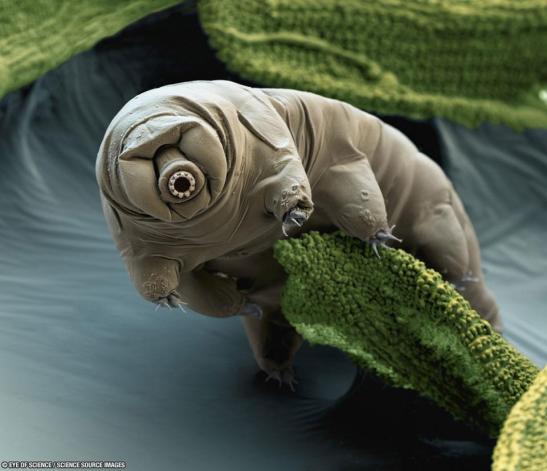
tardigrade_eyeofscience_960

Like this guy!

Meet the tardigrade. In biology, they’re incredibly tenacious microscopic animals, able to withstand the most extreme of temperatures and the radiation of outer space. In physics, we’re using their name for a class of Feynman diagrams.
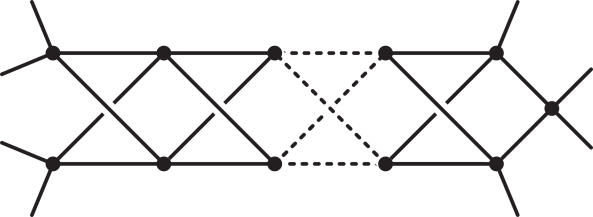
even_loop_tardigrades

A clear resemblance!

There is a long history of physicists using whimsical animal names for Feynman diagrams, from the penguin to the seagull (no relation). We chose to stick with microscopic organisms: in addition to the tardigrades, we have paramecia and amoebas, even a rogue coccolithophore.

The diagrams we look at have one thing in common, which is key to our proof: the number of lines on the inside of the diagram (“propagators”, which represent “virtual particles”) is related to the number of “loops” in the diagram, as well as the dimension. When these three numbers are related in the right way, it becomes relatively simple to show that any curves we find when computing the Feynman diagram have to be Calabi-Yau.

This includes the most well-known case of Calabi-Yaus showing up in Feynman diagrams, in so-called “banana” or “sunrise” graphs. It’s closely related to some of the cases examined by mathematicians, and our argument ended up pretty close to one made back in 2009 by the mathematician Francis Brown for a different class of diagrams. Oddly enough, neither argument works for the “traintrack” diagrams from our last paper. The tardigrades, paramecia, and amoebas are “more beastly” than those traintracks: their Calabi-Yau curves have more dimensions. In fact, we can show they have the most dimensions possible at each loop, provided all of our particles are massless. In some sense, tardigrades are “as beastly as you can get”.

We still don’t know whether all Feynman diagrams have Calabi-Yau curves, or just these. We’re not even sure how much it matters: it could be that the Calabi-Yau property is a red herring here, noticed because it’s interesting to string theorists but not so informative for us. We don’t understand Calabi-Yaus all that well yet ourselves, so we’ve been looking around at textbooks to try to figure out what people know. One of those textbooks was our inspiration for the “bestiary” in our title, an author whose whimsy we heartily approve of.

Like the classical bestiary, we hope that ours conveys a wholesome moral. There are much stranger beasts in the world of Feynman diagrams than anyone suspected.

The Amplitudes Assembly Line

In the amplitudes field, we calculate probabilities for particles to interact.

We’re trying to improve on the old-school way of doing this, a kind of standard assembly line. First, you define your theory, writing down something called a Lagrangian. Then you start drawing Feynman diagrams, starting with the simplest “tree” diagrams and moving on to more complicated “loops”. Using rules derived from your Lagrangian, you translate these Feynman diagrams into a set of integrals. Do the integrals, and finally you have your answer.

Our field is a big tent, with many different approaches. Despite that, a kind of standard picture has emerged. It’s not the best we can do, and it’s certainly not what everyone is doing. But it’s in the back of our minds, a default to compare against and improve on. It’s the amplitudes assembly line: an “industrial” process that takes raw assumptions and builds particle physics probabilities.

amplitudesassembly

  1. Start with some simple assumptions about your particles (what mass do they have? what is their spin?) and your theory (minimally, it should obey special relativity). Using that, find the simplest “trees”, involving only three particles: one particle splitting into two, or two particles merging into one.
  2. With the three-particle trees, you can now build up trees with any number of particles, using a technique called BCFW (named after its inventors, Ruth Britto, Freddy Cachazo, Bo Feng, and Edward Witten).
  3. Now that you’ve got trees with any number of particles, it’s time to get loops! As it turns out, you can stitch together your trees into loops, using a technique called generalized unitarity. To do this, you have to know what kinds of integrals are allowed to show up in your result, and a fair amount of effort in the field goes into figuring out a better “basis” of integrals.
  4. (Optional) Generalized unitarity will tell you which integrals you need to do, but those integrals may be related to each other. By understanding where these relations come from, you can reduce to a basis of fewer “master” integrals. You can also try to aim for integrals with particular special properties, quite a lot of effort goes in to improving this basis as well. The end goal is to make the final step as easy as possible:
  5. Do the integrals! If you just want to get a number out, you can use numerical methods. Otherwise, there’s a wide variety of choices available. Methods that use differential equations are probably the most popular right now, but I’m a fan of other options.

Some people work to improve one step in this process, making it as efficient as possible. Others skip one step, or all of them, replacing them with deeper ideas. Either way, the amplitudes assembly line is the background: our current industrial machine, churning out predictions.

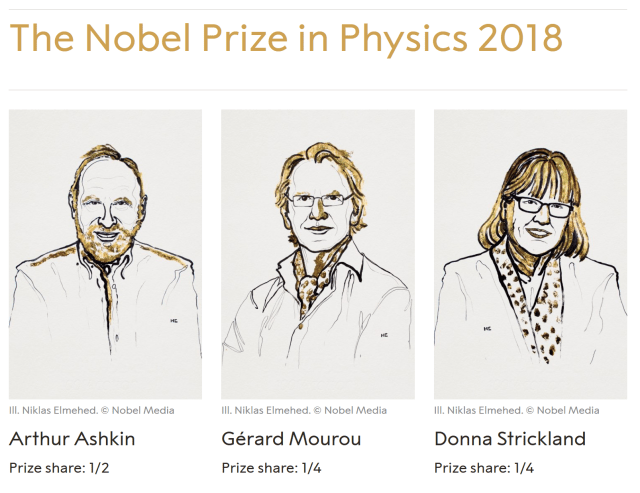
Congratulations to Arthur Ashkin, Gérard Mourou, and Donna Strickland!

The 2018 Physics Nobel Prize was announced this week, awarded to Arthur Ashkin, Gérard Mourou, and Donna Strickland for their work in laser physics.

nobel2018Some Nobel prizes recognize discoveries of the fundamental nature of reality. Others recognize the tools that make those discoveries possible.

Ashkin developed techniques that use lasers to hold small objects in place, culminating in “optical tweezers” that can pick up and move individual bacteria. Mourou and Strickland developed chirped pulse amplification, the current state of the art in extremely high-power lasers. Strickland is only the third woman to win the Nobel prize in physics, Ashkin at 96 is the oldest person to ever win the prize.

(As an aside, the phrase “optical tweezers” probably has you imagining two beams of laser light pinching a bacterium between them, like microscopic lightsabers. In fact, optical tweezers use a single beam, focused and bent so that if an object falls out of place it will gently roll back to the middle of the beam. Instead of tweezers, it’s really more like a tiny laser spoon.)

The Nobel announcement emphasizes practical applications, like eye surgery. It’s important to remember that these are research tools as well. I wouldn’t have recognized the names of Ashkin, Mourou, and Strickland, but I recognized atom trapping, optical tweezers, and ultrashort pulses. Hang around atomic physicists, or quantum computing experiments, and these words pop up again and again. These are essential tools that have given rise to whole subfields. LIGO won a Nobel based on the expectation that it would kick-start a vast new area of research. Ashkin, Mourou, and Strickland’s work already has.