Monthly Archives: June 2017

The Way You Think Everything Is Connected Isn’t the Way Everything Is Connected

I hear it from older people, mostly.

“Oh, I know about quantum physics, it’s about how everything is connected!”

“String theory: that’s the one that says everything is connected, right?”

“Carl Sagan said we are all stardust. So really, everything is connected.”

connect_four

It makes Connect Four a lot easier anyway

I always cringe a little when I hear this. There’s a misunderstanding here, but it’s not a nice clean one I can clear up in a few sentences. It’s a bunch of interconnected misunderstandings, mixing some real science with a lot of confusion.

To get it out of the way first, no, string theory is not about how “everything is connected”. String theory describes the world in terms of strings, yes, but don’t picture those strings as links connecting distant places: string theory’s proposed strings are very, very short, much smaller than the scales we can investigate with today’s experiments. The reason they’re thought to be strings isn’t because they connect distant things, it’s because it lets them wiggle (counteracting some troublesome wiggles in quantum gravity) and wind (curling up in six extra dimensions in a multitude of ways, giving us what looks like a lot of different particles).

(Also, for technical readers: yes, strings also connect branes, but that’s not the sort of connection these people are talking about.)

What about quantum mechanics?

Here’s where it gets trickier. In quantum mechanics, there’s a phenomenon called entanglement. Entanglement really does connect things in different places…for a very specific definition of “connect”. And there’s a real (but complicated) sense in which these connections end up connecting everything, which you can read about here. There’s even speculation that these sorts of “connections” in some sense give rise to space and time.

You really have to be careful here, though. These are connections of a very specific sort. Specifically, they’re the sort that you can’t do anything through.

Connect two cans with a length of string, and you can send messages between them. Connect two particles with entanglement, though, and you can’t send messages between them…at least not any faster than between two non-entangled particles. Even in a quantum world, physics still respects locality: the principle that you can only affect the world where you are, and that any changes you make can’t travel faster than the speed of light. Ansibles, science-fiction devices that communicate faster than light, can’t actually exist according to our current knowledge.

What kind of connection is entanglement, then? That’s a bit tricky to describe in a short post. One way to think about entanglement is as a connection of logic.

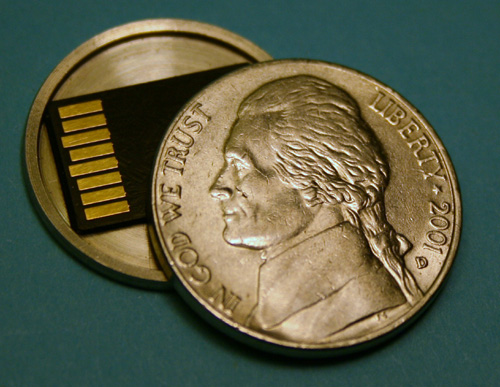
Imagine someone takes a coin and cuts it along the rim into a heads half and a tails half. They put the two halves in two envelopes, and randomly give you one. You don’t know whether you have heads or tails…but you know that if you open your envelope and it shows heads, the other envelope must have tails.
m_nickel

Unless they’re a spy. Then it could contain something else.

Entanglement starts out with connections like that. Instead of a coin, take a particle that isn’t spinning and “split” it into two particles spinning in different directions, “spin up” and “spin down”. Like the coin, the two particles are “logically connected”: you know if one of them is “spin up” the other is “spin down”.

What makes a quantum coin different from a classical coin is that there’s no way to figure out the result in advance. If you watch carefully, you can see which coin gets put in to which envelope, but no matter how carefully you look you can’t predict which particle will be spin up and which will be spin down. There’s no “hidden information” in the quantum case, nowhere nearby you can look to figure it out.

That makes the connection seem a lot weirder than a regular logical connection. It also has slightly different implications, weirdness in how it interacts with the rest of quantum mechanics, things you can exploit in various ways. But none of those ways, none of those connections, allow you to change the world faster than the speed of light. In a way, they’re connecting things in the same sense that “we are all stardust” is connecting things: tied together by logic and cause.

So as long as this is all you mean by “everything is connected” then sure, everything is connected. But often, people seem to mean something else.

Sometimes, they mean something explicitly mystical. They’re people who believe in dowsing rods and astrology, in sympathetic magic, rituals you can do in one place to affect another. There is no support for any of this in physics. Nothing in quantum mechanics, in string theory, or in big bang cosmology has any support for altering the world with the power of your mind alone, or the stars influencing your day to day life. That’s just not the sort of connection we’re talking about.

Sometimes, “everything is connected” means something a bit more loose, the idea that someone’s desires guide their fate, that you could “know” something happened to your kids the instant it happens from miles away. This has the same problem, though, in that it’s imagining connections that let you act faster than light, where people play a special role. And once again, these just aren’t that sort of connection.

Sometimes, finally, it’s entirely poetic. “Everything is connected” might just mean a sense of awe at the deep physics in mundane matter, or a feeling that everyone in the world should get along. That’s fine: if you find inspiration in physics then I’m glad it brings you happiness. But poetry is personal, so don’t expect others to find the same inspiration. Your “everyone is connected” might not be someone else’s.
Where Grants Go on the Ground

I’ve seen several recent debates about grant funding, arguments about whether this or that scientist’s work is “useless” and shouldn’t get funded. Wading into the specifics is a bit more political than I want to get on this blog right now, and if you’re looking for a general defense of basic science there are plenty to choose from. I’d like to focus on a different part, one where I think the sort of people who want to de-fund “useless” research are wildly overoptimistic.

People who call out “useless” research act as if government science funding works in a simple, straightforward way: scientists say what they want to work on, the government chooses which projects it thinks are worth funding, and the scientists the government chooses get paid.

This may be a (rough) picture of how grants are assigned. For big experiments and grants with very specific purposes, it’s reasonably accurate. But for the bulk of grants distributed among individual scientists, it ignores what happens to the money on the ground, after the scientists get it.

The simple fact of the matter is that what a grant is “for” doesn’t have all that much influence on what it gets spent on. In most cases, scientists work on what they want to, and find ways to pay for it.

Sometimes, this means getting grants for applied work, doing some of that, but also fitting in more abstract theoretical projects during downtime. Sometimes this means sharing grant money, if someone has a promising grad student they can’t fund at the moment and needs the extra help. (When I first got research funding as a grad student, I had to talk to the particle physics group’s secretary, and I’m still not 100% sure why.) Sometimes this means being funded to look into something specific and finding a promising spinoff that takes you in an entirely different direction. Sometimes you can get quite far by telling a good story, like a mathematician I know who gets defense funding to study big abstract mathematical systems because some related systems happen to have practical uses.

Is this unethical? Some of it, maybe. But from what I’ve seen of grant applications, it’s understandable.

The problem is that if scientists are too loose with what they spend grant money on, grant agency asks tend to be far too specific. I’ve heard of grants that ask you to give a timeline, over the next five years, of each discovery you’re planning to make. That sort of thing just isn’t possible in science: we can lay out a rough direction to go, but we don’t know what we’ll find.

The end result is a bit like complaints about job interviews, where everyone is expected to say they love the company even though no-one actually does. It creates an environment where everyone has to twist the truth just to keep up with everyone else.

The other thing to keep in mind is that there really isn’t any practical way to enforce any of this. Sure, you can require receipts for equipment and the like, but once you’re paying for scientists’ time you don’t have a good way to monitor how they spend it. The best you can do is have experts around to evaluate the scientists’ output…but if those experts understand enough to do that, they’re going to be part of the scientific community, like grant committees usually already are. They’ll have the same expectations as the scientists, and give similar leeway.

So if you want to kill off some “useless” area of research, you can’t do it by picking and choosing who gets grants for what. There are advocates of more drastic actions of course, trying to kill whole agencies or fields, and that’s beyond the scope of this post. But if you want science funding to keep working the way it does, and just have strong opinions about what scientists should do with it, then calling out “useless” research doesn’t do very much: if the scientists in question think it’s useful, they’ll find a way to keep working on it. You’ve slowed them down, but you’ll still end up paying for research you don’t like.

Final note: The rule against political discussion in the comments is still in effect. For this post, that means no specific accusations of one field or another as being useless, or one politician/political party/ideology or another of being the problem here. Abstract discussions and discussions of how the grant system works should be fine.

Movie Review: The Truth is in the Stars

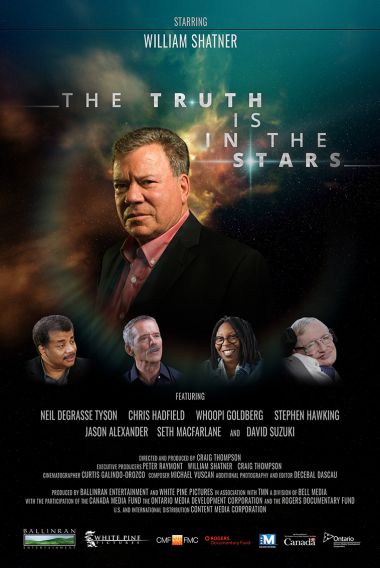
Recently, Perimeter aired a showing of The Truth is in the Stars, a documentary about the influence of Star Trek on science and culture, with a panel discussion afterwards. The documentary follows William Shatner as he wanders around the world interviewing scientists and film industry people about how Star Trek inspired them. Along the way he learns a bit about physics, and collects questions to ask Steven Hawking at the end.

5834308d05e48__po__ipho__380_568

I’ll start with the good: the piece is cute. They managed to capture some fun interactions with the interviewees, there are good (if occasionally silly) visuals, and the whole thing seems fairly well edited. If you’re looking for an hour of Star Trek nostalgia and platitudes about physics, this is the documentary for you.

That said, it doesn’t go much beyond cute, and it dances between topics in a way that felt unsatisfying.

The piece has a heavy focus on Shatner, especially early on, beginning with a clumsily shoehorned-in visit to his ranch to hear his thoughts on horses. For a while, the interviews are all about him: his jokes, his awkward questions, his worries about getting old. He has a habit of asking the scientists he talks to whether “everything is connected”, which to the scientists’ credit is usually met by a deft change of subject. All of this fades somewhat as the movie progresses, though: whether by a trick of editing, or because after talking to so many scientists he begins to pick up some humility.

(Incidentally, I really ought to have a blog post debunking the whole “everything is connected” thing. The tricky part is that it involves so many different misunderstandings, from confusion around entanglement to the role of strings to “we are all star-stuff” that it’s hard to be comprehensive.)

Most of the scientific discussions are quite superficial, to the point that they’re more likely to confuse inexperienced viewers than to tell them something new (especially the people who hinted at dark energy-based technology…no, just no). While I don’t expect a documentary like this to cover the science in-depth, trying to touch on so many topics in this short a time mostly just fuels the “everything is connected” misunderstanding. One surprising element of the science coverage was the choice to have both Michio Kaku giving a passionate description of string theory and Neil Turok bluntly calling string theory “a mess”. While giving the public “both sides” like that isn’t unusual in other contexts, for some reason most science documentaries I’ve seen take one side or the other.

Of course, the point of the documentary isn’t really to teach science, it’s to show how Star Trek influenced science. Here too, though, the piece was disappointing. Most of the scientists interviewed could tell their usual story about the power of science fiction in their childhood, but didn’t have much to say about Star Trek specifically. It was the actors and producers who had the most to say about Star Trek, from Ben Stiller showing off his Gorn mask to Seth MacFarlane admiring the design of the Enterprise. The best of these was probably Whoopi Goldberg’s story of being inspired by Uhura, which has been covered better elsewhere (and might have been better as Mae Jemison’s similar story, which would at least have involved an astronaut rather than another actor). I did enjoy Neil deGrasse Tyson’s explanation of how as a kid he thought everything on Star Trek was plausible…except for the automatic doors.

Shatner’s meeting with Hawking is the finale, and is the documentary’s strongest section. Shatner is humbled, even devout, in Hawking’s presence, while Hawking seems to show genuine joy swapping jokes with Captain Kirk.

Overall, the piece felt more than a little disjointed. It’s not really about the science, but it didn’t have enough content to be really about Star Trek either. If it was “about” anything, it was Shatner’s journey: an aging actor getting to hang out and chat with interesting people around the world. If that sounds fun, you should watch it: but don’t expect much deeper than that.

You Can’t Smooth the Big Bang

As a kid, I was fascinated by cosmology. I wanted to know how the universe began, possibly disproving gods along the way, and I gobbled up anything that hinted at the answer.

At the time, I had to be content with vague slogans. As I learned more, I could match the slogans to the physics, to see what phrases like “the Big Bang” actually meant. A large part of why I went into string theory was to figure out what all those documentaries are actually about.

In the end, I didn’t end up working on cosmology due my ignorance of a few key facts while in college (mostly, who Vilenkin was). Thus, while I could match some of the old popularization stories to the science, there were a few I never really understood. In particular, there were two claims I never quite saw fleshed out: “The universe emerged from nothing via quantum tunneling” and “According to Hawking, the big bang was not a singularity, but a smooth change with no true beginning.”

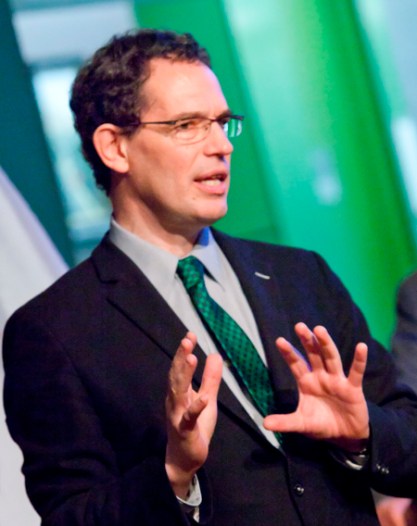
As a result, I’m delighted that I’ve recently learned the physics behind these claims, in the context of a spirited take-down of both by Perimeter’s Director Neil Turok.

neil20turok_cropped_photo20credit20jens20langen

My boss

Neil held a surprise string group meeting this week to discuss the paper I linked above, “No smooth beginning for spacetime” with Job Feldbrugge and Jean-Luc Lehners, as well as earlier work with Steffen Gielen. In it, he talked about problems in the two proposals I mentioned: Hawking’s suggestion that the big bang was smooth with no true beginning (really, the Hartle-Hawking no boundary proposal) and the idea that the universe emerged from nothing via quantum tunneling (really, Vilenkin’s tunneling from nothing proposal).

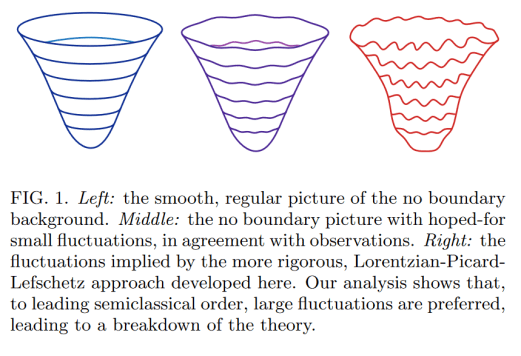
In popularization-speak, these two proposals sound completely different. In reality, though, they’re quite similar (and as Neil argues, they end up amounting to the same thing). I’ll steal a picture from his paper to illustrate:

neilpaperpic

The picture on the left depicts the universe under the Hartle-Hawking proposal, with time increasing upwards on the page. As the universe gets older, it looks like the expanding (de Sitter) universe we live in. At the beginning, though, there’s a cap, one on which time ends up being treated not in the usual way (Lorentzian space) but on the same footing as the other dimensions (Euclidean space). This lets space be smooth, rather than bunching up in a big bang singularity. After treating time in this way the result is reinterpreted (via a quantum field theory trick called Wick rotation) as part of normal space-time.

What’s the connection to Vilenkin’s tunneling picture? Well, when we talk about quantum tunneling, we also end up describing it with Euclidean space. Saying that the universe tunneled from nothing and saying it has a Euclidean “cap” then end up being closely related claims.

Before Neil’s work these two proposals weren’t thought of as the same because they were thought to give different results. What Neil is arguing is that this is due to a fundamental mistake on Hartle and Hawking’s part. Specifically, Neil is arguing that the Wick rotation trick that Hartle and Hawking used doesn’t work in this context, when you’re trying to calculate small quantum corrections for gravity. In normal quantum field theory, it’s often easier to go to Euclidean space and use Wick rotation, but for quantum gravity Neil is arguing that this technique stops being rigorous. Instead, you should stay in Lorentzian space, and use a more powerful mathematical technique called Picard-Lefschetz theory.

Using this technique, Neil found that Hartle and Hawking’s nicely behaved result was mistaken, and the real result of what Hartle and Hawking were proposing looks more like Vilenkin’s tunneling proposal.

Neil then tried to see what happens when there’s some small perturbation from a perfect de Sitter universe. In general in physics if you want to trust a result it ought to be stable: small changes should stay small. Otherwise, you’re not really starting from the right point, and you should instead be looking at wherever the changes end up taking you. What Neil found was that the Hartle-Hawking and Vilenkin proposals weren’t stable. If you start with a small wiggle in your no-boundary universe you get, not the purple middle drawing with small wiggles, but the red one with wiggles that rapidly grow unstable. The implication is that the Hartle-Hawking and Vilenkin proposals aren’t just secretly the same, they also both can’t be the stable state of the universe.

Neil argues that this problem is quite general, and happens under the following conditions:

  1. A universe that begins smoothly and semi-classically (where quantum corrections are small) with no sharp boundary,
  2. with a positive cosmological constant (the de Sitter universe mentioned earlier),
  3. under which the universe expands many times, allowing the small fluctuations to grow large.

If the universe avoids one of those conditions (maybe the cosmological constant changes in the future and the universe stops expanding, for example) then you might be able to avoid Neil’s argument. But if not, you can’t have a smooth semi-classical beginning and still have a stable universe.

Now, no debate in physics ends just like that. Hartle (and collaborators) don’t disagree with Neil’s insistence on Picard-Lefschetz theory, but they argue there’s still a way to make their proposal work. Neil mentioned at the group meeting that he thinks even the new version of Hartle’s proposal doesn’t solve the problem, he’s been working out the calculation with his collaborators to make sure.

Often, one hears about an idea from science popularization and then it never gets mentioned again. The public hears about a zoo of proposals without ever knowing which ones worked out. I think child-me would appreciate hearing what happened to Hawking’s proposal for a universe with no boundary, and to Vilenkin’s proposal for a universe emerging from nothing. Adult-me certainly does. I hope you do too.

An Amplitudes Flurry

Now that we’re finally done with flurries of snow here in Canada, in the last week arXiv has been hit with a flurry of amplitudes papers.

kitchener-construction

We’re also seeing a flurry of construction, but that’s less welcome.

Andrea Guerrieri, Yu-tin Huang, Zhizhong Li, and Congkao Wen have a paper on what are known as soft theorems. Most famously studied by Weinberg, soft theorems are proofs about what happens when a particle in an amplitude becomes “soft”, or when its momentum becomes very small. Recently, these theorems have gained renewed interest, as new amplitudes techniques have allowed researchers to go beyond Weinberg’s initial results (to “sub-leading” order) in a variety of theories.

Guerrieri, Huang, Li, and Wen’s contribution to the topic looks like it clarifies things quite a bit. Previously, most of the papers I’d seen about this had been isolated examples. This paper ties the various cases together in a very clean way, and does important work in making some older observations more rigorous.


Vittorio Del Duca, Claude Duhr, Robin Marzucca, and Bram Verbeek wrote about transcendental weight in something known as the multi-Regge limit. I’ve talked about transcendental weight before: loosely, it’s counting the power of pi that shows up in formulas. The multi-Regge limit concerns amplitudes with very high energies, in which we have a much better understanding of how the amplitudes should behave. I’ve used this limit before, to calculate amplitudes in N=4 super Yang-Mills.

One slogan I love to repeat is that N=4 super Yang-Mills isn’t just a toy model, it’s the most transcendental part of QCD. I’m usually fairly vague about this, because it’s not always true: while often a calculation in N=4 super Yang-Mills will give the part of the same calculation in QCD with the highest power of pi, this isn’t always the case, and it’s hard to propose a systematic principle for when it should happen. Del Duca, Duhr, Marzucca, and Verbeek’s work is a big step in that direction. While some descriptions of the multi-Regge limit obey this property, others don’t, and in looking at the ones that don’t the authors gain a better understanding of what sorts of theories only have a “maximally transcendental part”. What they find is that even when such theories aren’t restricted to N=4 super Yang-Mills, they have shared properties, like supersymmetry and conformal symmetry. Somehow these properties are tied to the transcendentality of functions in the amplitude, in a way that’s still not fully understood.


My colleagues at Perimeter released two papers over the last week: one, by Freddy Cachazo and Alfredo Guevara, uses amplitudes techniques to look at classical gravity, while the other, by Sebastian Mizera and Guojun Zhang, looks at one of the “pieces” inside string theory amplitudes.

I worked with Freddy and Alfredo on an early version of their result, back at the PSI Winter School. While I was off lazing about in Santa Barbara, they were hard at work trying to understand how the quantum-looking “loops” one can use to make predictions for potential energy in classical gravity are secretly classical. What they ended up finding was a trick to figure out whether a given amplitude was going to have a classical part or be purely quantum. So far, the trick works for amplitudes with one loop, and a few special cases at higher loops. It’s still not clear if it works for the general case, and there’s a lot of work still to do to understand what it means, but it definitely seems like an idea with potential. (Pun mostly not intended.)

I’ve talked before about “Z theory”, the weird thing you get when you isolate the “stringy” part of string theory amplitudes. What Sebastian and Guojun have carved out isn’t quite the same piece, but it’s related. I’m still not sure of the significance of cutting string amplitudes up in this way, I’ll have to read the paper more thoroughly (or chat with the authors) to find out.