Tag Archives: theoretical physics

What are Vacua? (A Point about the String Landscape)

A couple weeks back, there was a bit of a scuffle between Matt Strassler and Peter Woit on the subject of predictions in string theory (or more properly, the question of whether any predictions can be made at all). As a result, Strassler has begun a series on the subject of quantum field theory, string theory, and predictions.

Strassler hasn’t gotten to the topic of string vacua yet, but he’s probably going to cover the subject in a future post. While his take on the subject is likely to be more expansive and precise than mine, I think my perspective on the problem might still be of interest.

Let’s start with the basics: one of the problems often cited with string theory is the landscape problem, the idea that string theory has a metaphorical landscape of around 10^500 vacua.

What are vacua?

Vacua is the plural of vacuum.

Ok, and?

A vacuum is empty space.

That’s what you thought, right? That’s the normal meaning of vacuum. But if a vacuum is empty, how can there be more than one of them, let alone 10^500?

“Empty” is subjective.

Now we’re getting somewhere. The problem with defining a concept like “empty space” in string theory or field theory is that it’s unclear what precisely it should be empty of. Naively, such a space should be empty of “stuff”, or “matter”, but our naive notions of “matter” don’t apply to field theory or string theory. In fact, there is plenty of “stuff” that can be present in “empty” space.

Think about two pieces of construction paper. One is white, the other is yellow. Which is empty? Neither has anything drawn on it, so while one has a color and the other does not, both are empty.

“Empty space” doesn’t come in multiple colors like construction paper, but there are equivalent parameters that can vary. In quantum field theory, one option is for scalar fields to take different values. In string theory, different dimensions can be curled up in different ways (as an aside, when string theory leads to a quantum field theory often these different curling-up shapes correspond to different values for scalar fields, so the two ideas are related).

So if space can have “stuff” in it and still count as empty, are there any limits on what can be in it?

As it turns out, there is a quite straightforward limit. But to explain it, I need to talk a bit about why physicists care about vacua in the first place.

Why do physicists care about vacua?

In physics, there is a standard modus operandi for solving problems. If you’ve taken even a high school physics course, you’ve probably encountered it in some form. It’s not the only way to solve problems, but it’s one of the easiest. The idea, broadly, is the following:

First get the initial conditions, and then use the laws of physics to see what happens next.

In high school physics, this is how almost every problem works: your teacher tells you what the situation is, and you use what you know to figure out what happens next.

In quantum field theory, things are a bit more subtle, but there is a strong resemblance. You start with a default state, and then find the perturbations, or small changes, around that state.

In high school, your teacher told you what the initial conditions were. In quantum field theory, you need another source for the “default state”. Sometimes, you get that from observations of the real world. Sometimes, though, you want to make a prediction that goes beyond what your observations tell you. In that case, one trick often proves useful:

To find the default state, find which state is stable.

If your system starts out in a state that is unstable, it will change. It will keep changing until eventually it changes into a stable state, where it will stop changing. So if you’re looking for a default state, that state should be one in which the system is stable, where it won’t change.

(I’m oversimplifying things a bit here to make them easier to understand. In particular, I’m making it sound like these things change over time, which is a bit of a tricky subject when talking about different “default” states for the whole of space and time. There’s also a cool story connected to this about why tachyons don’t exist, which I’d love to go into for another post.)

Since we know that the “default” state has to be stable, if there is only one stable state, we’ve found the default!

Because of this, we can lay down a somewhat better definition:

A vacuum is a stable state.

There’s more to the definition than this, but this should be enough to give you the feel for what’s going on. If we want to know the “default” state of the world, the state which everything else is just a small perturbation on top of, we need to find a vacuum. If there is only one plausible vacuum, then our work is done.

When there are many plausible vacua, though, we have a problem. When there are 10^500 vacua, we have a huge problem.

That, in essence, is why many people despair of string theory ever making any testable predictions. String theory has around 10^500 plausible vacua (for a given, technical, meaning of plausible).

It’s important to remember a few things here.

First, the reason we care about vacuum states is because we want a “default” to make predictions around. That is, in a sense, a technical problem, in that it is an artifact of our method. It’s a result of the fact that we are choosing a default state and perturbing around it, rather than proving things that don’t depend on our choice of default state. That said, this isn’t as useful an insight as it might appear, and as it turns out there is generally very little that can be predicted without choosing a vacuum.

Second, the reason that the large number of vacua is a problem is that if there was only one vacuum, we would know which state was the default state for our world. Instead, we need some other method to pick, out of the many possible vacua, which one to use to make predictions. That is, in a sense, a philosophical problem, in that it asks what seems ostensibly to be a philosophical question: what is the basic, default state of the universe?

This happens to be a slightly more useful insight than the first one, and it leads to a number of different approaches. The most intuitive solution is to just shrug and say that we will see which vacuum we’re in by observing the world around us. That’s a little glib, since many different vacua could lead to very similar observations. A better tactic might be to try to make predictions on general grounds by trying to see what the world we can already observe implies about which vacua are possible, but this is also quite controversial. And there are some people who try another approach, attempting to pick a vacuum not based on observations, but rather on statistics, choosing a vacuum that appears to be “typical” in some sense, or that satisfies anthropic constraints. All of these, again, are controversial, and I make no commentary here about which approaches are viable and which aren’t. It’s a complicated situation and there are a fair number of people working on it. Perhaps, in the end, string theory will be ruled un-testable. Perhaps the relevant solution is right under peoples’ noses. We just don’t know.
Brown, Blue, and Birds

I gave a talk at Brown this week, so this post may be shorter than usual. On the topic of Brown I don’t have much original to say: the people were friendly, the buildings were brownish-colored, and bringing a car there was definitely a bad idea. Don’t park at Brown. Not even then.

There’s a quote from Werner Heisenberg that has been making the rounds of the internet. It comes out of a 1976 article by Felix Bloch where he describes taking a walk with Heisenberg, when the discussion turned to the subject of space and time:

I had just read Weyl’s book Space, Time and Matter, and under its influence was proud to declare that space was simply the field of linear operations.

“Nonsense,” said Heisenberg, “space is blue and birds fly through it.”

Heisenberg’s point is that sometimes in physics you need to ask what your abstractions are really describing. You need to make sure that you haven’t stretched your definitions too badly away from their original inspiration.

When people first hear that string theory requires eleven dimensions, many wonder if this point applies. In mathematics, it’s well known that a problem can be described in many dimensions more than the physical dimensions of space. There’s a lovely example in the book Flatterland (a sequel to Flatland, a book which any math-y person should read at least once) of the dimensions of a bike. The bike’s motion through space gives three dimensions: up/down, backward/forward, and left/right. However, the bike can move in other ways: its gears can each be in a different position, as can its handlebars, as can the wheels…in the end, a bike can be envisioned as having many more “dimensions” than our normal three-dimensional space, each corresponding to some internal position.

Is string theory like this? No.

The first hint of the answer comes from something called F theory. String theory is part of something larger called M theory, and since M theory has eleven dimensions this is usually the number of dimensions given. But F theory contains string theory in a certain sense as well, only F theory contains twelve dimensions.

So why don’t string theorists say that the world has twelve dimensions?

As it turns out, the extra dimension added by F theory isn’t “really” a dimension. It’s much more like the mathematical dimensions of a bike’s gears and wheels than it is like the other eleven dimensions of M theory.

What’s the difference? What, according to a string theorist, is the definition of a dimension of space?

It’s simple: Space is “blue” (or colorless, I suppose). Birds (and particles, and strings, and membranes) fly in it.

We’re using the same age-old distinction that Heisenberg was, in a way. What is space? Space is just a place where things can move, in the same way they move in our usual three dimensions. Space is where you have momentum, where that momentum can change your position. Space is where forces act, the set of directions in which something can be pulled or pushed in a symmetric way. Space can’t be reduced, at least not without a lot of tricks: a bird flying isn’t just another description of a lizard crawling, not in the way a bicycle’s gears moving can be thought of as turning through our normal three dimensions without any extra ones. And while F theory doesn’t fit this criterion, M theory really does. The membranes of M theory fly around in eleven dimensional space-time, just like a bird moves through three space and one time dimensions.

Space for a string theorist isn’t any crazier or more abstract than it is for you. It’s just a place where things can move.

Planar vs. Non-Planar: A Colorful Story

Last week, I used two terms, planar theory and non-planar theory, without defining them. This week, I’m going to explain what they mean, and why they’re important.

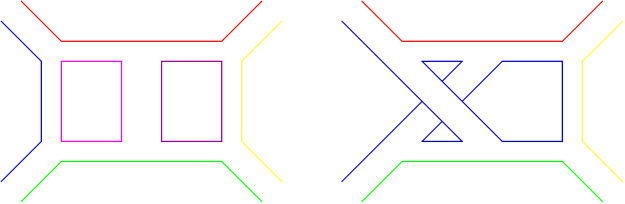
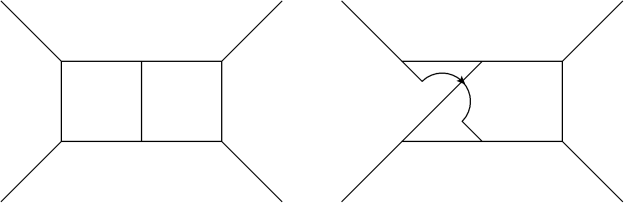
Suppose you’re working with a Yang-Mills theory (not necessarily N=4 super Yang-Mills. To show you the difference between planar and non-planar, I’ll draw some two-loop Feynman diagrams for a process where two particles go in and two particles come out:

planarity1

The diagram on your left is planar, while the diagram on your right is non-planar. The diagram on the left can be written entirely on a flat page (or screen), with no tricks. By contrast, with the diagram on the right I have to cheat and make one of the particle lines jump over another one (that’s what the arrow is meant to show). Try as you might, you can’t twist that diagram so that it lies flat on a plane (at least not while keeping the same particles going in and out). That’s the difference between planar and non-planar.

Now, what does it mean for a theory to be planar or non-planar?

Let’s review some facts about Yang-Mills theories. (For a more detailed explanation, see here). In Yang-Mills there are a certain number of colors, where each one works a bit like a different kind of electric charge. The strong force, the force that holds protons and neutrons together, has three colors, usually referred to as red, blue, and green (this is of course just jargon, not the literal color of the particles).

Forces give rise to particles. In the case of the strong force, those particles are called gluons. Each gluon has a color and an anti-color, where you can think of the color like a positive charge and the anti-color like a negative charge. A given gluon might be red-antiblue, or green-antired, or even red-antired.

While the strong force has three colors, for this article it will be convenient to pretend that there are four: red, green, blue, and yellow.

An important principle of Yang-Mills theories is that color must be conserved. Since anti-colors are like negative colors, they can cancel normal colors out. So if you’ve got a red-antiblue gluon that collides with a blue-antigreen gluon, the blue and antiblue can cancel each other out, and you can end up with, for example, red-antiyellow and yellow-antigreen instead.

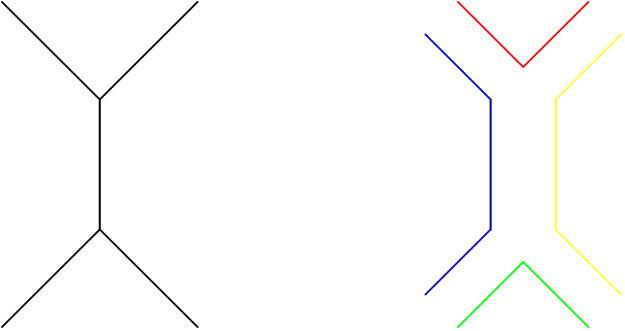
Let’s consider that process in particular. There are lots of Feynman diagrams you can draw for it, let’s draw one of the simplest ones first:

planarity2

The diagram on the left just shows the process in terms of the particles involved: two gluons go in, two come out.

The other diagram takes into account conservation of colors. The red from the red-antiblue gluon becomes the red in the red-antiyellow gluon on the other side. The antiblue instead goes down and meets the blue from the blue-antigreen gluon, and both vanish in the middle, cancelling each other out. It’s as if the blue color entered the diagram, then turned around backwards and left it again. (If you’ve ever heard someone make the crazy-sounding claim that antimatter is normal matter going backwards in time, this is roughly what they mean.)

From this diagram, we can start observing a general principle: to make sure that color is conserved, each line must have only one color.

Now let’s try to apply this principle to the two-loop diagrams from the beginning of the article. If you draw double lines like we did in the last example, fill in the colors, and work things out, this is what you get:

planarity3

What’s going on here?

In the diagram on the left, you see the same lines as the earlier diagram on the outside. On the inside, though, I’ve drawn two loops of color, purple and pink.

I drew the lines that way because, just based on the external lines, you don’t know what color they should be. They could be red, or yellow, or green, or blue. Nothing tells you which one is right, so all of them are possible.

Remember that for Feynman diagrams, we need to add up every diagram we can draw to get the final result. That means that there are actually four times four or sixteen copies of this diagram, each one with different colors in the loops.

Now let’s look at the other diagram. Like the first one, it’s a diagram with two loops. However, in this case, the inside of both loops is blue. If you like, you can try to trace out the lines in the loops. You’ll find that they’re all connected together. Because this diagram is non-planar, color conservation fixes the color in the loops.

So while there are sixteen copies of the first diagram, there is only one possible version of the second one. Since you add all the diagrams together, that means that the first diagram is sixteen times more important than the second diagram.

Now suppose we had more than four colors. Lots more.

More than that…

With ten colors, the planar diagrams are a hundred times more important. With a hundred colors, they are ten thousand times more important. Keep increasing the number of colors, and it gets to the point where you can honestly say that the non-planar diagrams don’t matter at all.

What, then, is a “planar theory”?

A planar theory is a theory with a very large (infinite) number of colors.

In a planar theory, you can ignore the non-planar diagrams and focus only on the planar ones.

Nima Arkani-Hamed’s Amplituhedron method applies to the planar version of N=4 super Yang-Mills. There is a lot of progress on the planar version of the theory, and it is because the restriction to planar diagrams makes things simpler.

However, sometimes you need to go beyond planar diagrams. There are relationships between planar and non-planar diagrams, based on the ways that you can pair different colors together in the theory. Fully understanding this relationship is powerful for understanding Yang-Mills theory, but, as it turns out, it’s also the key to relating Yang-Mills theory to gravity! But that’s a story for another post.

The Amplituhedron and Other Excellently Silly Words

Nima Arkani-Hamed recently gave a talk at the Simons Center on the topic of what he and Jaroslav Trnka are calling the Amplituhedron.

There’s an article on it in Quanta Magazine. The article starts out a bit hype-y for my taste (too much language of importance, essentially), but it has several very solid descriptions of the history of the situation. I particularly like how the author concisely describes the Feynman diagram picture in the space of a single paragraph, and I would recommend reading that part even if you don’t have time to read the whole article. In general it’s worth it to get a picture of what’s going on.

That said, I obviously think I can clear a few things up, otherwise I wouldn’t be writing about it, so here I go!

“The” Amplituhedron

Nima’s new construction, the Amplituhedron, encodes amplitudes (building blocks of probabilities in particle physics) in N=4 super Yang-Mills as the “area” of a multi-dimensional analog of a polyhedron (hence, Amplitu-hedron).

Now, I’m a big supporter of silly-sounding words with amplitu- at the beginning (amplitudeologist, anyone?), and this is no exception. Anyway, the word Amplitu-hedron isn’t what’s confusing people. What’s confusing people is the word the.

When the Quanta article says that Nima has found “the” Amplituhedron, it makes it sound like he has discovered one central formula that somehow contains the whole universe. If you read the comments, many readers went away with that impression.

In case you needed me to say it, that’s not what is going on. The problem is in the use of the word “the”.

Suppose it was 1886, and I told you that a fellow named Carl Benz had invented “the Automobile”, a marvelous machine that can get everyone to work on time (as well as become the dominant form of life on Long Island).

My use of “the” might make you imagine that Benz invented some single, giant machine that would roam across the country, picking people up and somehow transporting everyone to work. You’d be skeptical of this, of course, expecting that long queues to use this gigantic, wondrous machine would swiftly ruin any speed advantage it might possess…

The Automobile, here to take you to work.

Or, you could view “the” in another light, as indicating a type of thing.

Much like “the Automobile” is a concept, manifested in many different cars and trucks across the country, “the Amplituhedron” is a concept, manifested in many different amplituhedra, each corresponding to a particular calculation that we might attempt.

Advantages…

Each amplituhedron has to do with an amplitude involving a specific number of particles, with a particular number of internal loops. (The Quanta article has a pretty good explanation of loops, here’s mine if you’d rather read that). Based on the problem you’re trying to solve, there are a set of rules that you use to construct the particular amplituhedron you need. The “area” of this amplituhedron (in quotation marks because I mean the area in an abstract, mathematical sense) is the amplitude for the process, which lets you calculate the probability that whatever particle physics situation you’re describing will happen.

Now, we already have many methods to calculate these probabilities. The amplituhedron’s advantage is that it makes these calculations much simpler. What was once quite a laborious and complicated four-loop calculation, Nima claims can be done by hand using amplituhedra. I didn’t get a chance to ask whether the same efficiency improvement holds true at six loops, but Nima’s description made it sound like it would at least speed things up.

[Edit: Some of my fellow amplitudeologists have reminded me of two things. First, that paper I linked above paved the way to more modern methods for calculating these things, which also let you do the four-loop calculation by hand. (You need only six or so diagrams). Second, even back then the calculation wasn’t exactly “laborious”, there were some pretty slick tricks that sped things up. With that in mind, I’m not sure Nima’s method is faster per se. But it is a fast method that has the other advantages described below.]

The amplituhedron has another, more sociological advantage. By describing the amplitude in terms of a geometrical object rather than in terms of our usual terminology, we phrase things in a way that mathematicians are more likely to understand. By making things more accessible to mathematicians (and the more math-headed physicists), we invite them to help us solve our problems, so that together we can come up with more powerful methods of calculation.

Nima and the Quanta article both make a big deal about how the amplituhedron gets rid of the principles of locality and unitarity, two foundational principles of quantum field theory. I’m a bit more impressed by this than Woit is. The fine distinction that needs to be made here is that the amplituhedron isn’t simply “throwing out” locality and unitarity. Rather, it’s written in such a way that it doesn’t need locality and unitarity to function. In the end, the formulas it computes still obey both principles. Nima’s hope is that, now that we are able to write amplitudes without needing locality and unitarity, if we end up having to throw out either of those principles to make a new theory we will be able to do so. That’s legitimately quite a handy advantage to have, it just doesn’t mean that locality and unitarity must be thrown out right now.

…and Disadvantages

It’s important to remember that this whole story is limited to N=4 super Yang-Mills. Nima doesn’t know how to apply it to other theories, and nobody else seems to have any good ideas either. In addition, this only applies to the planar part of the theory. I’m not going to explain what that term means here; for now just be aware that while there are tricks that let you “square” a calculation in super Yang-Mills to get a similar calculation in quantum gravity, those tricks rely on having non-planar data, or information beyond the planar part of the theory. So at this point, this doesn’t give us any new hints about quantum gravity. It’s conceivable that physicists will find ways around both of these limits, but for now this result, though impressive, is quite limited.

Nima hasn’t found some sort of singular “jewel at the heart of physics”. Rather, he’s found a very slick, very elegant, quite efficient way to make calculations within one particular theory. This is profound, because it expresses things in terms that mathematicians can address, and because it shows that we can write down formulas without relying on what are traditionally some of the most fundamental principles of quantum field theory. Only time will tell whether Nima or others can generalize this picture, taking it beyond planar N=4 super Yang-Mills and into the tougher theories that still await this sort of understanding.

The (2, 0) Theory: What is it, though?

Part Three of a Series on the (2, 0) Theory

If you’ve been following this series, you know that the (2, 0) theory describes what it’s like to live on a five dimensional membrane in M theory. You know it’s got five scalar fields, and four chiral fermions (and hopefully you have a rough idea of what those things are). And if you’ve been reading for longer, you’ve probably heard me mention that a theory is essentially a list of quantum fields. So if I’m going to define the (2, 0) theory for you, I ought to, at the very least, list its quantum fields.

This is where things get tricky, and where unfortunately I will have to get a big vague. Some of the quantum fields in the (2, 0) theory are things I’ve talked about before: the five scalars and the four fermions. The remaining field, though, is different, and it’s the reason why the (2, 0) theory is so mysterious.

I’ll start by throwing around some terminology. Normally, I’d go back and explain it, but in this case there’s simply too much. My aim here is to give the specialists reading this enough to understand what I’m talking about. Then I’ll take a few paragraphs to talk about what the implications of all this jargon are for a general understanding.

The remaining field in the (2, 0) theory is a two-form, or an antisymmetric, two-index tensor, with a self-dual field strength. It comes from the gauge orientation zero modes of the M5-brane. It is not a Yang-Mills field. However, it is non-abelian, that is, it “interacts with itself” in a similar way to how a Yang-Mills field does.

While I can give examples of familiar Yang-Mills fields, fermions, and now with the Higgs even scalars, I can’t give you a similar example of a fundamental two-form field. That’s because in our four dimensional world, such a field doesn’t make sense. It only makes sense in six or more dimensions.

The problem with understanding this isn’t just a matter of not having examples in the real world, though. We can invent a wide variety of unobserved fields, and in general have no problem calculating their hypothetical properties. The problem is that, in the case of the two-form field of the (2, 0) theory, we don’t know how to properly do calculations about it.

There are a couple different ways to frame the issue. One is that, while we know roughly which fields should interact with which other fields, there isn’t a mathematically consistent way to write down how they do so. Any attempt results in a formula with some critical flaw that keeps it from being useful.

The other way to frame the problem is to point out that every Yang-Mills force has a number that determines how powerful it is, called the coupling constant. As I discuss here, it is the small size of the coupling constant that allows us to calculate only the simplest Feynman diagrams and still get somewhat accurate results.

The (2, 0) theory has no coupling constant. There is no parameter that, if it was small, would allow you to only look at some diagrams and not others. In the (2, 0) theory, every diagram is equally important.

When people say that the (2, 0) theory is “irreducibly quantum”, this is what they’re referring to: we can’t separate out the less-quantum (lower loops) bits from the more quantum (higher loops) bits. The theory simply is quantum, inherently and uniformly so.

This is what makes it so hard to understand, what makes it sexy and mysterious and Mara Jade-like. If we could understand it, the payoffs would be substantial: M theory has a similar problem, so a full understanding of the (2, 0) theory might pave the way to a full understanding of M theory, which, unlike the (2, 0) theory, really is supposed to be a theory of everything.

And there is progress…somewhat, anyway. Twisting one of the six dimensions of the (2, 0) theory around in a circle gives you N=4 super Yang-Mills in five dimensions, while another circle brings it down to four dimensions. Because super Yang-Mills is so well-understood, this gives us a tantalizing in-road to understanding the (2, 0) theory. I’ve worked a bit on this myself.

Perhaps a good way to summarize the situation would be to say that, while N=4 super Yang-Mills is interesting because of how much we know about it, the (2, 0) theory is interesting because, contrary to expectations, we can do something with it at all. Every time someone comes up with a novel method for understanding quantum field theories, you can rest assured that they will end up trying to apply it to the (2, 0) theory. One of them might even work.

The (2, 0) Theory: What does it mean?

Part Two of a Series on the (2, 0) Theory

Apologies in advance. This is going to be a long one.

So now that you know that the (2, 0) theory is the world-volume theory of an M5-brane, you might be asking what the hell (2, 0) means. Why is this theory labeled with an arcane bunch of numbers rather than words like any sensible theory?

To explain that, we have to talk a bit about how we count supersymmetries. As I talked about with N=4 super Yang-Mills, supersymmetry is a relationship between particles of different spins, and since one particle can be related in this way to more than one other particle, we indicated the number of different related particles by the number N. (I’d recommend reading those posts to understand this one. If you need a quick summary, spin is a way of categorizing particles, with spin 1 corresponding to forces of nature like electromagnetism and the Yang-Mills forces in general, while spin ½ corresponds to the types of particles that make up much of everyday matter, like electrons and quarks.)

As it turns out, we count the number of supersymmetries N differently in different dimensions. The reasons are fairly technical, and are related to the fact that spin ½ particles are more complicated in higher dimensions. The end result is that while super Yang-Mills has N=4 in four dimensions (three space one time), in six dimensions it only has N=2 (in case you’re curious, it goes all the way down to N=1 in ten dimensions).

The “2” in the (2, 0) theory means the same thing as that N=2. However, the (2, 0) theory is very different from super Yang-Mills, and that’s where the other number in the pair comes in. To explain this, I have to talk a bit about something called chirality.

Chirality is a word for handedness. If you’re given a right-handed glove, no matter what you do you can’t rotate it to turn it into a left-handed glove. The only way you could change a right-handed glove into a left-handed glove would be to flip it through a mirror, like Alice through the looking glass.

Particles often behave similarly. While they don’t have fingers to flip, they do have spin.

I told you earlier to think of spin as just a way to classify particles. That’s still the best way for you to think about it, but in order to explain chirality I have to mention that spin isn’t just an arbitrary classification scheme, it’s a number that corresponds to how fast a particle is “spinning”.

Here I have to caution that the particle isn’t necessarily literally spinning. Rather, it acts as if it were spinning, interacting with other objects as if it were spinning with a particular speed. If you’ve ever played with a gyroscope, you know that a spinning object behaves differently from a non-spinning one: the faster it spins, the harder it is to change the direction in which it is spinning.

Suppose that a particle is flying at you head-on. If you measured the particle’s spin, it would appear to be spinning either clockwise or counterclockwise, to the left or to the right. This choice, left or right, is the particle’s chirality.

L for left, R for right, V and p show which way the particle is going.

The weird thing is that there are some particles that only spin one way. For example, every neutrino that has been discovered has left-handed chirality. In general when a fermion only spins one way we call it a chiral fermion.

What does this have to do with the (2, 0) theory?

Supersymmetry relates particles of spin X to particles of spin X-½.  As such, you can look at supersymmetry as taking the original particle, and “subtracting” a particle of spin ½. These aren’t really particles, but they share some properties, and those properties can include chirality. You can have left-supersymmetry, and right-supersymmetry.

So what does (2, 0) mean? It means that not only is the (2, 0) theory an N=2 theory in six dimensions, but those two supersymmetries are chiral. They are only left-handed (or, if you prefer, only right-handed). By contrast, super Yang-Mills in six dimensions is a (1, 1) theory. It has one left-handed supersymmetry, and one right-handed supersymmetry.

We can now learn a bit more about the sorts of particles in the (2, 0) theory.

As I said when discussing N=4 super Yang-Mills, N=4 is the most supersymmetry you can have in Yang-Mills in four dimensions. Any more, and you need to include gravity.  Recall that the (2, 0) theory comes from the behavior of M5-branes in M theory. M theory includes gravity, which means that it can go higher than N=4.

How high? As it turns out, the maximum including gravity (which I will explain a bit more when I do a series on supergravity) is N=8. That’s in four dimensions, however. In M theory’s native eleven dimensions, this is just N=1. In six dimensions, where the (2, 0) theory lives, this becomes N=4. More specifically, including information about chirality, its supersymmetry is (2, 2).

So if M theory in six dimensions has (2, 2) symmetry, how to we get to (2, 0)? What happens to the other ( ,2)?

As I talked about in the last post, the varying position of the M5-brane in the other five dimensions gives rise to five scalar fields. In a way, we have broken the symmetry between the eleven dimensions of M theory, treating five of them differently from the other six.

It turns out that supersymmetry is closely connected to the symmetry of space and time. What this means in practice is that when you break the symmetry of space-time, you can also break supersymmetry, reducing the number N of symmetries. Here, the M5-brane breaks supersymmetry from (2, 2) to (2, 0), so two of the supersymmetries are broken.

Just like the position of the M5-brane can vary, so too can the specific supersymmetries broken. What this means is that just like the numbers for the positions become scalar fields, the choices of supersymmetry to be broken become new fermion fields. Because supersymmetry is broken in a chiral way, these new fermion fields are chiral, which for technical reasons ends up meanings that because of the two broken supersymmetries, there are four new chiral fermions.

So far, we know that the (2, 0) theory has five scalar fields, and four chiral fermions. But scalar fields and chiral fermions are pretty ordinary, surely not as mysterious as the Emperor, or even Mara Jade. What makes the (2, 0) theory so mysterious, so difficult to deal with? What makes it, in a word, sexy? Tune in next week to find out!

The (2, 0) Theory: Where does it come from?

Part One of a Series on the (2, 0) Theory

By semi-popular demand, I’m doing a guide on the (2, 0) theory. Over the course of this guide I’ll try to explain where the (2, 0) theory comes from, what its name means, and, more elusively, what it’s actually about.

The (2, 0) theory doesn’t get much press coverage, and when it does, it’s a bit silly. The article I just linked compares it to Star Wars’ Emperor Palpatine, in analogy with what George Musser and perhaps others call the Darth Vader theory, or N=4 super Yang-Mills.

The metaphor, as far as I can parse it, is the following: while N=4 super Yang-Mills is solid, powerful, and important (like Darth Vader), the (2, 0) theory is mysterious and yet somehow even more central (like the Emperor).

The thing is, while the (2, 0) theory is indeed sexy and mysterious, it isn’t especially central. Laymen haven’t heard of it for good reason: it’s really only specialists in the field who have a reason to be interested in it. So really, it’s more like the Mara Jade theory.

If you don’t know who this is, that’s my point

The (2, 0) theory is very much a theory, in the same sense as N=4 super Yang-Mills. It isn’t a “theory of everything”, and it isn’t supposed to describe the real world. With that in mind, let’s talk about the sort of world it does describe.

There are two ways to “define” the (2, 0) theory. One of them is to take a particular type of string theory (type IIB) with ten dimensions (nine space dimensions and one dimension for time), and twist four of those dimensions into a particular shape (called a K3 surface). There are six dimensions left (five space, one time), and in those six dimensions the world obeys the (2, 0) theory.

That definition may not seem particularly illuminating, and it really isn’t. You can get almost any theory in physics by taking some type of string theory and twisting up some of the dimensions in a particular way, so unless you’re familiar with that particular type of string theory or the particular shape of the dimensions, you don’t learn anything from that definition.

The second definition, though, is more appealing. The (2, 0) theory can be defined as the world-volume theory of a five-dimensional object called an M5-brane.

A world-volume theory is a theory that describes what it is like to live inside of the volume of some object, so that the object is your whole world. To understand what that means, think about Flatland.

Think upward, not northward

In Edwin A. Abbott’s Flatland, the characters are two-dimensional shapes living in a two-dimensional world. Because their whole world is two-dimensional, they cannot imagine a third dimension. Despite that, there is a third dimension, as demonstrated by a sphere who floats through the world one day and upsets the main character’s life. The theory of physics in Flatland, then, is the world-volume theory of a two-dimensional plane in three-dimensional space.

Imagine that the two-dimensional plane of Flatland was flexible, that is, more like a two-dimensional membrane. Such a membrane could move back and forth in the third dimension, rippling up and down.

Now remember that, in Flatland, nobody can imagine a third dimension. So if you are within Flatland, and the world around you is bouncing up and down, can you notice?

The answer is a counter-intuitive yes. It’s easy if there is gravity in the third dimension: when the world curves up, it would get harder to climb up, while if the world curves down, it would be easier. Even if there isn’t gravity, though, you can still notice the changes in energy. It takes energy to set the world vibrating, and that energy has to come from somewhere. That energy can come from movement within your dimension. What a Flatlander would observe, then, would be processes that seem to violate conservation of energy, by losing more energy than they put in: instead, that energy would go to making the world wiggle.

What a Flatland scientist would observe, then, would be a world in which there is some number that can change from place to place, and that can oscillate, carrying energy as it does so. Those of you who remember my older posts might recognize what’s going on here: this is precisely the way in which you discover the existence of a scalar field!

An M5-brane is a five-dimensional membrane that lives in M theory, a theory with eleven dimensions (ten space and one time). The world-volume theory of an M5-brane, then, is the theory of what it is like to have your whole world inside the five dimensions of the M5-brane, just like a person in Flatland has their whole world within the two dimensions of Flatland. And just like the two-dimensional Flatland would have one scalar field corresponding to its ability to vibrate in the third dimension, the five space dimensions of the (2, 0) theory have five scalar fields, corresponding to the five other directions (ten minus five) in which the M5-brane can move.

So the (2, 0) theory is the theory of what it’s like to live on a five-dimensional membrane in a ten-dimensional space, and because of that, the theory contains five scalar fields. But if it was just five scalar fields, it would hardly be mysterious. What else does the theory contain? And what does “(2, 0)” mean anyway? Tune in next week to find out!

Edit: I am informed by George Musser (@gmusser on twitter) that the Darth Vader thing was apparently all Nima Arkani-Hamed’s idea. So don’t blame him for the somewhat misleading metaphor!

Hexagon Functions – or, what is my new paper about?

I’ve got a new paper up on arXiv this week.

(For those of you unfamiliar with it, arXiv.org is a website where physicists, mathematicians, and researchers in related fields post their papers before submitting them to journals. It’s a cultural quirk of physics that probably requires a post in its own right at some point. Anyway…)

What’s it about? Well, the paper is titled Hexagon functions and the three-loop remainder function. Let’s go through that and figure out what it means.

When the paper refers to hexagon functions, it’s referring to functions used to describe situations with six particles involved. An important point to clarify here is that when counting the number of “particles involved”, we add together both the particles that go in and the particles that go out. So if three particles arrive somewhere, interact with each other in some complicated way, and then those three particles leave, that’s a six-particle process. Similarly, if two particles collide and four particles emerge, that’s also a six-particle process. (If you find the idea of more particles coming out than went in confusing, read this post.) Hexagon functions, then, can describe either of those processes.

What, specifically, are these functions being used for? Well, they’re being used to find the three-loop remainder function of N=4 super Yang-Mills.

N=4 super Yang-Mills is my favorite theory. If you haven’t read my posts on the subject, I encourage you to do so.

N=4 super Yang-Mills is so nice because it is so symmetric, and because it takes part in so many dualities. These two traits ended up being enough for Zvi Bern, Lance Dixon, and Vladimir Smirnov to propose an ansatz for all amplitudes in N=4 super Yang-Mills, called the BDS ansatz. (Amplitudes are how we calculate the probability of events occurring: for example, the probability of that “two particles going to four particles” situation I talked about earlier.)

Unfortunately, their formula was incomplete. While it was possible to prove that the formula was true for four-particle and five-particle processes, for six or more particles the formula failed. As it turned out though, it failed in a predictable way. All that was needed to fix it was to add something called the remainder function, the remaining part of the formula beyond the BDS ansatz.

The task, then, was to compute this remainder function.

I’ve talked before about how in quantum field theory, we calculate probabilities through increasingly complicated diagrams, keeping track of the complexity by counting the number of loops. The remainder function had already been computed up to two loops by working out these diagrams, but three looked to be considerably more difficult.

Luckily, we (myself, Lance Dixon, James Drummond, and Jeffrey Pennington) had a trick up our sleeves.

Formulas in N=4 super Yang-Mills have a property called maximal transcendentality. I’ve talked about transcendentality before:  essentially, it’s a way of counting how many powers of pi and logarithms are in your equations. Maximal transcendentality means that every part of the formula has a fixed, maximum number for its degree of transcendentality. In the case of the remainder function, this is two times the number of loops. Thus, the two-loop remainder function has degree of transcendentality four, so it can have pi to the fourth power in it, while the three-loop remainder function (the one that we calculated) has degree of transcendentality six, so it can have pi to the sixth power.

Of course, it can have lots of other expressions as well, which brings us back to the hexagon functions. By classifying the sort of functions that can appear in these formulas at each level of transcendentality, we find the basic building blocks that can show up in the remainder function. All we have to do then is ask what combinations of building blocks are allowed: which ones make good physics sense, for example, or which ones allow our formula to agree with the predictions of other researchers.

As it turns out, once you apply all the restrictions there is only one possible way to put the building blocks together that gives you a functioning formula. By process of elimination, this formula must be the correct three-loop six-point remainder function. Every extra constraint then serves as a check that nothing went wrong and that the formula is sound. Without calculating a single Feynman diagram, we’ve gotten our result!

Just to give you an idea of how complicated this result is, in order to write the formula out fully would take 800 pages. We’ve got shorter ways to summarize it, but perhaps it would be better to give a picture. The formula depends on three variables, called u, v, and w. To show how the formula behaves when all three variables change, here’s a plot of the formula in the variables u and v, for a series of different values of w.

wstacksheaves

Without our various shortcuts to generate this formula, it would have taken an extraordinarily long amount of time. Luckily, N=4 super Yang-Mills’s nice properties save the day, and allow us to achieve what I hope you won’t mind me calling a truly impressive result.

Talks, and what they’re good for

It’s an ill-kept secret that basically everyone in academia is a specialist. Nobody is just a “physicist”, or just a “high energy theorist”, or even just a “string theorist”. Even when I describe myself as something as specific as an “amplitudeologist”, I’m still over-generalizing: there’s a lot of amplitudes work out there that I would be hard-pressed to understand, and even harder-pressed to reproduce.

In the end, each of us is only going to understand a small subset of the vastness of our subject. This is problematic when it comes to attending talks.

Rarely, we get to attend talks about something we completely understand. Generally, we’re the ones giving those talks. The rest of the time, even at conferences for people of our particular specialty, we’re going to miss some fraction of the content, either because we don’t understand it or because we don’t find it interesting.

The question then becomes, why attend the talk in the first place? Why spend an hour of your time when you’re not getting an hour’s worth of content?

There are a couple reasons, of varying levels of plausibility.

One is that it’s always nice to know what other subfields are doing. It lets one feel connected to one’s compatriots, and it helps one navigate one’s career. That said, it’s unclear whether going to talks is really the best way of doing this. If you just want to know what other people are doing, you can always just watch to see what they publish. That doesn’t take an hour, unless you’re really dedicated to wasting time.

A more important benefit is increasing levels of familiarity. These days, I can productively pay attention to the first quarter of a talk, half if it’s particularly good. When I first got to grad school, I’d probably tune out after the first five minutes. The more talks you see on a subject, the more of the talk makes sense, and the more you get out of it. That’s part of why even fairly specialized people who are further along in their careers can talk on a wide range of subjects: often, they’ve intentionally kept themselves aware of what’s going on in other subfields, going to talks, reading papers, and engaging in conversation. This is a valuable end goal, since there is some truth to the hype about the benefits of interdisciplinarity in providing unconventional solutions to problems. That said, this is a gradual process. The benefit of one individual talk is tiny, and it doesn’t seem worth an hour of time. Much like exercise, it’s the habit that provides the benefit, not any individual session.

So in the end, talks are almost always unsatisfying. But we keep going to them, because they make us better scientists.

Duality: Find out what it means to me

There’s a cute site out there called Why String Theory. Started by Oxford and the Royal Society, Why String Theory contains lots of concise and well-illustrated explanations of string theory, and it even wades into some of the more complex topics like AdS/CFT and string dualities in general. Their explanation of dualities is a nice introduction to why dualities matter in string theory, but I don’t think it does a very good job of explaining what a duality actually is or how one works. As your fearless host, I’m confident that I can do better.

Why String Theory defines dualities as when “different mathematical theories describe the same physics.” How does that work, though? In what sense are the theories different, if they describe the same thing? And if they describe the same thing, why do we need both of them?

1563px-face_or_vase_ata_01.svg_

You’ve probably seen the above image before, or one much like it. Look at it one way, and you see a goblet. Another, and you see two faces.

Now imagine that instead of a flat image, these are 3D objects, models you have in your house. You’ve got a goblet, and a pair of clay faces. You’re still pretty sure they fit together like they do in the image, though. Maybe they said they fit together on the packaging, maybe you stuck them together and it didn’t look like there were any gaps. Whatever the reason, you’re confident enough about this that you’re willing to assume it’s true.

Now suppose you want to figure out how long the noses on the faces are. In case you’ve never measured a human nose, I can let you know that it’s tricky. You could put a ruler along the nose, but it would be diagonal rather than straight, so you wouldn’t get an accurate measurement. Even putting the ruler beneath the nose doesn’t work for rounded noses like these.

That said, measuring the goblet is easy. You can run measuring tape around the neck of the goblet to find the circumference, and then calculate the diameter. And if you measure the goblet in this way, you also know how long the faces’ noses are.

You could go further, and build up a list of things you can measure on one object that tell you about the other one. The necks match up to the base of the goblet, the foreheads to the mouth, etc. It would be like a dictionary, translating between two languages: the language of measurements of the faces, and the language of measurements of the goblet.

That sort of “dictionary” is the essence of duality. When two theories have a duality (are dual to each other), you can make a “dictionary” to translate measurements in one theory to measurements in the other. That doesn’t mean, however, that the theories are clearly connected: like 3D models of the faces and the goblet, it may be that without looking at the particular “silhouette” defined by duality the two views are radically different. Rather than physical objects, the theories compare mathematical “objects”, so rather than physical obstructions like the solidity of noses we have to deal with mathematical ones, situations where one quantity or another is easier or harder to calculate depending on how the math is set up. For example, many dualities relate things that require calculations at very high loops to things that can be calculated with fewer loops (for an explanation of loops, check out this post).

As Why String Theory points out, one of the most prominent dualities is called AdS/CFT, and it relates N=4 super Yang-Mills (a Conformal Field Theory, or CFT) to string theory in something called Anti-de Sitter (AdS) space (tricky to describe, but essentially a world in which space is warped like a hyperbola). Another duality relates N=4 super Yang-Mills Feynman diagrams with n particles coming in from outside to diagrams with an n-sided shape and particles randomly coming in from the edges of the shape (these latter diagrams are called Wilson loops). In general N=4 super Yang-Mills is involved in many, many dualities, which is a big part of why it’s so dang cool.