Tag Archives: supercomputers

Some Dumb AI Ideas

Sometimes, when I write a post about AI, I’ve been sitting on an idea for a long time. I’ve talked to experts, I’ve tried to understand the math, I’ve honed my points and cleared away clutter.

This is not one of those times. The ideas in this post almost certainly have something deeply wrong with them. But hopefully they’re interesting food for thought.

My first dumb idea: instruction tuning was a mistake.

I’m drawing the seeds of this one from a tumblr post by nostalgebraist, someone known for making a popular bot trained on his tumblr posts in the early days before GPT became ChatGPT.

AIs like ChatGPT are based on Large Language Models, insanely complicated mathematical formulas that predict, given part of a text, what the rest of that text is likely to look like. In the early days, this was largely how they were used. Loosely described nostalgebraist’s bot, called nostalgebraist-autoresponder, began with a list of tumblr posts and asks and determines what additional posts would best fit in.

If you think about it, though, ChatGPT doesn’t really work like that. ChatGPT has conversations: you send it messages, it sends you responses. The text it creates is a dialogue, with you supplying half the input. But most texts aren’t dialogues, and ChatGPT draws on a lot of non-dialogue texts to make its dialogue-like responses.

The reason it does this is something called instruction tuning. ChatGPT has been intentionally biased, not to give the most likely completion to a task in general, but to give completions that fit this dialogue genre. What I didn’t know until I read nostalgebraist’s post was that this genre was defined artificially: AI researchers made up fake dialogues with AI, cheesy sci-fi conversations imagining how an AI might respond to instructions from a user, and then biased the Large Language Model so that rather than giving the most likely text in general, it gives a text that is more likely to look like these cheesy sci-fi conversations. It’s why ChatGPT sounds kind of like a fictional robot: not because sci-fi writers accurately predicted what AI would sound like, but because AI was created based on sci-fi texts.

For nostalgebraist, this leads into an interesting reflection of how a sci-fi AI should behave, how being warped around a made-up genre without history or depth creates characters which act according to simple narratives and express surprising anxiety.

For myself, though, I can’t help but wonder if the goal of dialogue itself is the problem. Dialogue is clearly important commercially: people use ChatGPT because they can chat with it. But Large Language Models aren’t inherently chatbots: they produce plausible texts, of any sort you could imagine. People seem to want a machine that can, for example, answer scientific questions as part of a conversation. But most competent answers to scientific questions aren’t conversations, they’re papers. If people stuck with the “raw” model, producing excerpts of nonexistent papers rather than imitating a dialogue with a non-existent expert, wouldn’t you expect the answers to be more accurate, with the model no longer biased by an irrelevant goal? Is the need to make a sell-able chatbot making these AIs worse at everything else people are trying to use them for?

I’m imagining a world where, instead of a chatbot, OpenAI built an “alternate universe simulator”. You give it some context, some texts or parts of texts from a universe you made up, and it completes them in a plausible way. By imagining different universes, you can use it to answer different questions. Such a gimmick would get fewer customers, and fewer investors, it would probably do worse. But I have to wonder if the actual technology might have been more useful.

My second idea is dumber, to the point where I mostly know why it doesn’t work. But thinking about it might help clarify how things work for people unused to AI.

I saw someone point out that, unlike something like Wikipedia, AI doesn’t give you context. You shouldn’t trust Wikipedia, or a source you find on Google, blindly. If you want to, you can look through the edit history on Wikipedia, or figure out who wrote a page you found on Google and how. If ChatGPT tells you something, by default you don’t know where that knowledge came from. You can tell it to search, and then you’ll get links, but that’s because it’s using Google or the like behind the scenes anyway. You don’t know where the model is getting its ideas.

Why couldn’t we get that context, though?

Every text produced by a Large Language Model is causally dependent on its training data. Different data, different model, different text. That doesn’t mean that each text draws from one source, or just a few sources: ChatGPT isn’t copying the training data, at least not so literally.

But it does mean that, if ChatGPT says something is true, you should in principle be able to ask which data was most important in making it say that. If you leave a piece of data out of the training, and get similar answers, you can infer that the response you got doesn’t have much to do with that piece of data. But if you leave out a text in training, and now ChatGPT gives totally different responses to the same question…then there’s a pretty meaningful sense that it got the information from that source.

If this were the type of non-AI statistical model people use in physics, this would be straightforward. Researchers do this all the time: take one experiment out of the data, see how their analysis changes, and thereby figure out which experiments are most important to check. One can even sometimes calculate, given a model, where you should look.

Unfortunately, you can’t do this with ChatGPT. The model is just too big. You can’t calculate anything explicitly about it, the giant mathematical formulas behind it are so complicated that the most you can do is get probabilities out case by case, you can’t “unwind” them and see where the numbers come from. And you can’t just take out sources one by one, and train the model again: not when training takes months of expensive computer time.

So unlike with the previous idea, I understand even on a technical level why you can’t do this. But it helped me to be able to think about what I would like to do, if it were possible. Maybe it helps you too!

Microdosing Vibe Physics

Have you heard of “vibe physics”?

The phrase “vibe coding” came first. People have been using large language models like ChatGPT to write computer code (and not the way I did last year). They chat with the model, describing what they want to do and asking the model to code it up. You can guess the arguments around this, from people who are convinced AI is already better than a human programmer to people sure the code will be riddled with errors and vulnerabilities.

Now, there are people claiming not only to do vibe coding, but vibe physics: doing theoretical physics by chatting with an AI.

I think we can all agree that’s a lot less plausible. Some of the people who do vibe coding actually know how to code, but I haven’t seen anyone claiming to do vibe physics who actually understands physics. They’re tech entrepreneurs in the most prominent cases, random people on the internet otherwise. And while a lot of computer code is a minor tweak on something someone has already done, theoretical physics doesn’t work that way: if someone has already come up with your idea, you’re an educator, not a physicist.

Still, I think there is something to keep in mind about the idea of “vibe physics”, related to where physics comes from.

Here’s a question to start with: go back a bit before the current chat-bot boom. There were a ton of other computational and mathematical tools. Theorem-proving software could encode almost arbitrary mathematical statements in computer code and guarantee their accuracy. Statistical concepts like Bayes’ rule described how to reason from evidence to conclusions, not flawlessly but as well as anyone reliably can. We had computer simulations for a wealth of physical phenomena, and approximation schemes for many others.

With all those tools, why did we still have human physicists?

That is, go back before ChatGPT, before large language models. Why not just code up a program that starts with the evidence and checks which mathematical model fits it best?

In principle, I think you really could have done that. But you could never run that program. It would take too long.

Doing science 100% correctly and reliably is agonizingly slow, and prohibitively expensive. You cannot check every possible model, nor can you check those models against all the available data. You must simplify your problem, somehow, even if it makes your work less reliable, and sometimes incorrect.

And for most of history, humans have provided that simplification.

A physicist isn’t going to consider every possible model. They’re going to consider models that are similar to models they studied, or similar to models others propose. They aren’t going to consider all the evidence. They’ll look at some of the evidence, the evidence other physicists are talking about and puzzled by. They won’t simulate the consequences of their hypotheses in exhaustive detail. Instead, they’ll guess, based on their own experience, a calculation that captures what they expect to be relevant.

Human physicists provided the unreliable part of physics, the heuristics. The “vibe physics”, if you will.

AI is also unreliable, also heuristic. But humans still do this better than AI.

Part of the difference is specificity. These AIs are trained on all of human language, and then perhaps fine-tuned on a general class of problems. A human expert has spent their life fine-tuning on one specific type of problem, and their intuitions, their heuristics, their lazy associations and vibes, all will be especially well-suited to problems of that type.

Another part of the difference, though, is scale.

When you talk to ChatGPT, it follows its vibes into paragraphs of text. If you turn on reasoning features, you make it check its work in the background, but it still is generating words upon words inside, evaluating those words, then generating more.

I suspect, for a physicist, the “control loop” is much tighter. Many potential ideas get ruled out a few words in. Many aren’t even expressed in words at all, just concepts. A human physicist is ultimately driven by vibes, but they check and verify those vibes, based on their experience, at a much higher frequency than any current AI system can achieve.

(I know almost nothing about neuroscience. I’m just basing this on what it can feel like, to grope through a sentence and have it assemble itself as it goes into something correct, rather than having to go back and edit it.)

As companies get access to bigger datacenters, I suspect they’ll try to make this loop tighter, to get AI to do something closer to what (I suspect, it appears) humans do. And then maybe AI will be able to do vibe physics.

Even then, though, you should not do vibe physics with the AI.

If you look at the way people describe doing vibe physics, they’re not using the AI for the vibes. They’re providing the vibes, and the AI is supposed to check things.

And that, I can confidently say, is completely ass-backwards. The AI is a vibe machine, it is great at vibes. Substituting your vibes will just make it worse. On the other hand, the AI is awful at checking things. It can find published papers sometimes, which can help you check something. But it is not set up to do the math, at least not unless the math can be phrased as a simple Python script or an IMO problem. In order to do anything like that, it has to call another type of software to verify. And you could have just used that software.

Theoretical physics is still not something everyone can do. Proposing a crackpot theory based on a few papers you found on Google and a couple YouTube videos may make you feel less confident than proposing a crackpot theory based on praise from ChatGPT and a list of papers it claims have something to do with your idea, which makes it more tempting. But it’s still proposing a crackpot theory. If you want to get involved, there’s still no substitute for actually learning how physics works.

Why Solving the Muon Puzzle Doesn’t Solve the Puzzle

You may have heard that the muon g-2 problem has been solved.

Muons are electrons’ heavier cousins. As spinning charged particles, they are magnetic, the strength of that magnetism characterized by a number denoted “g”. If you were to guess this number from classical physics alone, you’d conclude it should be 2, but quantum mechanics tweaks it. The leftover part, “g-2”, can be measured, and predicted, with extraordinary precision, which ought to make it an ideal test: if our current understanding of the particle physics, called the Standard Model, is subtly wrong, the difference might be noticeable there.

And for a while, it looked like such a difference was indeed noticeable. Extremely precise experiments over the last thirty years have consistently found a number slightly different from the extremely precise calculations, different enough that it seemed quite unlikely to be due to chance.

Now, the headlines are singing a different tune.

What changed?

That headline might make you think the change was an experimental result, a new measurement that changed the story. It wasn’t, though. There is a new, more precise measurement, but it agrees with the old measurements.

So the change has to be in the calculations, right? They did a new calculation, corrected a mistake or just pushed up their precision, and found that the Standard Model matches the experiment after all?

…sort of, but again, not really. The group of theoretical physicists associated with the experiment did release new, more accurate calculations. But it wasn’t the new calculations, by themselves, that made a difference. Instead, it was a shift in what kind of calculations they used…or even more specifically, what kind of calculations they trusted.

Parts of the calculation of g-2 can be done with Feynman diagrams, those photogenic squiggles you see on physicists’ blackboards. That part is very precise, and not especially controversial. However, Feynman diagrams only work well when forces between particles are comparatively weak. They’re great for electromagnetism, even better for the weak nuclear force. But for the strong nuclear force, the one that holds protons and neutrons together, you often need a different method.

For g-2, that used to be done via a “data-driven” method. Physicists measured different things, particles affected by the strong nuclear force in different ways, and used that to infer how the strong force would affect g-2. By getting a consistent picture from different experiments, they were reasonably confident that they had the right numbers.

Back in 2020, though, a challenger came to the scene, with another method. Called lattice QCD, this method involves building gigantic computer simulations of the effect of the strong force. People have been doing lattice QCD since the 1970’s, and the simulations have been getting better and better, until in 2020, a group managed to calculate the piece of the g-2 calculation that had until then been done by the data-driven method.

The lattice group found a very different result than what had been found previously. Instead of a wild disagreement with experiment, their calculation agreed. According to them, everything was fine, the muon g-2 was behaving exactly as the Standard Model predicted.

For some of us, that’s where the mystery ended. Clearly, something must be wrong with the data-driven method, not with the Standard Model. No more muon puzzle.

But the data-driven method wasn’t just a guess, it was being used for a reason. A significant group of physicists found the arguments behind it convincing. Now, there was a new puzzle: figuring out why the data-driven method and lattice QCD disagree.

Five years later, has that mystery been solved? Is that, finally, what the headlines are about?

Again, not really, no.

The theorists associated with the experiment have decided to trust lattice QCD, not the data-driven method. But they don’t know what went wrong, exactly.

Instead, they’ve highlighted cracks in the data-driven method. The way the data-driven method works, it brings together different experiments to try to get a shared picture. But that shared picture has started to fall apart. A new measurement by a different experiment doesn’t fit into the system: the data-driven method now “has tensions”, as physicists say. It’s no longer possible to combine all experiments into a shared picture they way they used to. Meanwhile, lattice QCD has gotten even better, reaching even higher precision. From the perspective of the theorists associated with the muon g-2 experiment, switching methods is now clearly the right call.

But does that mean they solved the puzzle?

If you were confident that lattice QCD is the right approach, then the puzzle was already solved in 2020. All that changed was the official collaboration finally acknowledging that.

And if you were confident that the data-driven method was the right approach, then the puzzle is even worse. Now, there are tensions within the method itself…but still no explanation of what went wrong! If you had good reasons to think the method should work, you still have those good reasons. Now you’re just…more puzzled.

I am reminded of another mystery, a few years back, when an old experiment announced a dramatically different measurement for the mass of the W boson. Then, I argued the big mystery was not how the W boson’s mass had changed (it hadn’t), but how they came to be so confident in a result so different from what others, also confidently, had found. In physics, our confidence is encoded in numbers, estimated and measured and tested and computed. If we’re not estimating that confidence correctly…then that’s the real mystery, the real puzzle. One much more important to solve.


Also, I had two more pieces out this week! In Quanta I have a short explainer about bosons and fermions, while at Ars Technica I have a piece about machine learning at the LHC. I may have a “bonus info” post on the latter at some point, I have to think about whether I have enough material for it.

Integration by Parts, Evolved

I posted what may be my last academic paper today, about a project I’ve been working on with Matthias Wilhelm for most of the last year. The paper is now online here. For me, the project has been a chance to broaden my horizons, learn new skills, and start to step out of my academic comfort zone. For Matthias, I hope it was grant money well spent.

I wanted to work on something related to machine learning, for the usual trendy employability reasons. Matthias was already working with machine learning, but was interested in pursuing a different question.

When is machine learning worthwhile? Machine learning methods are heuristics, unreliable methods that sometimes work well. You don’t use a heuristic if you have a reliable method that runs fast enough. But if all you have are heuristics to begin with, then machine learning can give you a better heuristic.

Matthias noticed a heuristic embedded deep in how we do particle physics, and guessed that we could do better. In particle physics, we use pictures called Feynman diagrams to predict the probabilities for different outcomes of collisions, comparing those predictions to observation to look for evidence of new physics. Each Feynman diagram corresponds to an integral, and for each calculation there are hundreds, thousands, or even millions of those integrals to do.

Luckily, physicists don’t actually have to do all those integrals. It turns out that most of them are related, by a slightly more advanced version of that calculus class mainstay, integration by parts. Using integration by parts you can solve a list of equations, finding out how to write your integrals in terms of a much smaller list.

How big a list of equations do you need, and which ones? Twenty-five years ago, Stefano Laporta proposed a “golden rule” to choose, based on his own experience, and people have been using it (more or less, with their own tweaks) since then.

Laporta’s rule is a heuristic, with no proof that it is the best option, or even that it will always work. So we probably shouldn’t have been surprised when someone came up with a better heuristic. Watching talks at a December 2023 conference, Matthias saw a presentation by Johann Usovitsch on a curious new rule. The rule was surprisingly simple, just one extra condition on top of Laporta’s. But it was enough to reduce the number of equations by a factor of twenty.

That’s great progress, but it’s also a bit frustrating. Over almost twenty-five years, no-one had guessed this one simple change?

Maybe, thought Matthias and I, we need to get better at guessing.

We started out thinking we’d try reinforcement learning, a technique where a machine is trained by playing a game again and again, changing its strategy when that strategy brings it a reward. We thought we could have the machine learn to cut away extra equations, getting rewarded if it could cut more while still getting the right answer. We didn’t end up pursuing this very far before realizing another strategy would be a better fit.

What is a rule, but a program? Laporta’s golden rule and Johann’s new rule could both be expressed as simple programs. So we decided to use a method that could guess programs.

One method stood out for sheer trendiness and audacity: FunSearch. FunSearch is a type of algorithm called a genetic algorithm, which tries to mimic evolution. It makes a population of different programs, “breeds” them with each other to create new programs, and periodically selects out the ones that perform best. That’s not the trendy or audacious part, though, people have been doing that sort of genetic programming for a long time.

The trendy, audacious part is that FunSearch generates these programs with a Large Language Model, or LLM (the type of technology behind ChatGPT). Using an LLM trained to complete code, FunSearch presents the model with two programs labeled v0 and v1 and asks it to complete v2. In general, program v2 will have some traits from v0 and v1, but also a lot of variation due to the unpredictable output of LLMs. The inventors of FunSearch used this to contribute the variation needed for evolution, using it to evolve programs to find better solutions to math problems.

We decided to try FunSearch on our problem, modifying it a bit to fit the case. We asked it to find a shorter list of equations, giving a better score for a shorter list but a penalty if the list wasn’t able to solve the problem fully.

Some tinkering and headaches later, it worked! After a few days and thousands of program guesses, FunSearch was able to find a program that reproduced the new rule Johann had presented. A few hours more, and it even found a rule that was slightly better!

But then we started wondering: do we actually need days of GPU time to do this?

An expert on heuristics we knew had insisted, at the beginning, that we try something simpler. The approach we tried then didn’t work. But after running into some people using genetic programming at a conference last year, we decided to try again, using a Python package they used in their work. This time, it worked like a charm, taking hours rather than days to find good rules.

This was all pretty cool, a great opportunity for me to cut my teeth on Python programming and its various attendant skills. And it’s been inspiring, with Matthias drawing together more people interested in seeing just how much these kinds of heuristic methods can do there. I should be clear though, that so far I don’t think our result is useful. We did better than the state of the art on an example, but only slightly, and in a way that I’d guess doesn’t generalize. And we needed quite a bit of overhead to do it. Ultimately, while I suspect there’s something useful to find in this direction, it’s going to require more collaboration, both with people using the existing methods who know better what the bottlenecks are, and with experts in these, and other, kinds of heuristics.

So I’m curious to see what the future holds. And for the moment, happy that I got to try this out!

Toy Models

In academia, scientists don’t always work with what they actually care about. A lot of the time, they use what academics call toy models. A toy model can be a theory with simpler mathematics than the theories that describe the real world, but it can also be something that is itself real, just simpler or easier to work with, like nematodes, fruit flies, or college students.

Some people in industry seem to think this is all academics do. I’ve seen a few job ads that emphasize experience dealing with “real-world data”, and a few people skeptical that someone used to academia would be able to deal with the messy challenges of the business world.

There’s a grain of truth to this, but I don’t think industry has a monopoly on mess. To see why, let’s think about how academics write computer code.

There are a lot of things that one is in-principle supposed to do to code well, and most academics do none of them. Good code has test suites, so that if you change something you can check whether it still works by testing it on all the things that could go wrong. Good code is modular, with functions doing specific things and re-used whenever appropriate. Good code follows shared conventions, so that others can pick up your code and understand how you did it.

Some academics do these things, for example those who build numerical simulations on supercomputers. But for most academics, coding best-practices range from impractical to outright counterproductive. Testing is perhaps the clearest example. To design a test suite, you have to have some idea what kinds of things your code will run into, what kind of input you expect what the output is supposed to be. Many academic projects, though, are the first of their kind. Academics code up something to do a calculation nobody has done before, not knowing the result, or they make code to analyze a dataset nobody has worked with before. By the time they understand the problem well enough to write a test suite, they’ve already solved the problem, and they’re on to the next project, which may need something totally different.

From the perspective of these academics, if you have a problem well-defined enough that you can build a test suite, well enough that you can have stable conventions and reusable functions…then you have a toy model, not a real problem from the real world.

…and of course, that’s not quite fair either, right?

The truth is, academics and businesspeople want to work with toy models. Toy models are well-behaved, and easy, and you can do a lot with them. The real world isn’t a toy model…but it can be, if you make it one.

This means planning your experiments, whether in business or in science. It means making sure the data you gather is labeled and organized before you begin. It means coming up with processes, and procedures, and making as much of the work as possible a standardized, replicable thing. That’s desirable regardless, whether you’re making a consistent product instead of artisanal one-offs or a well-documented scientific study that another team can replicate.

Academia and industry both must handle mess. They handle different kinds of mess in different circumstances, and manage it in different ways, and this can be a real challenge for someone trying to go from one world to another. But neither world is intrinsically messier or cleaner. Nobody has a monopoly on toy models.

Bottlenecks, Known and Unknown

Scientists want to know everything, and we’ve been trying to get there since the dawn of science. So why aren’t we there yet? Why are there things we still don’t know?

Sometimes, the reason is obvious: we can’t do the experiments yet. Victorian London had neither the technology nor the wealth to build a machine like Fermilab, so they couldn’t discover the top quark. Even if Newton had the idea for General Relativity, the telescopes of the era wouldn’t have let astronomers see its effect on the motion of Mercury. As we grow (in technology, in resources, in knowledge, in raw number of human beings), we can test more things and learn more about the world.

But I’m a theoretical physicist, not an experimental physicist. I still want to understand the world, but what I contribute aren’t new experiments, but new ideas and new calculations. This brings back the question in a new form: why are there calculations we haven’t done yet? Why are there ideas we haven’t had yet?

Sometimes, we can track the reason down to bottlenecks. A bottleneck is a step in a calculation that, for some reason, is harder than the rest. As you try to push a calculation to new heights, the bottleneck is the first thing that slows you down, like the way liquid bubbles through the neck of a literal bottle. If you can clear the bottleneck, you can speed up your calculation and accomplish more.

In the clearest cases, we can see how these bottlenecks could be solved with more technology. As computers get faster and more powerful, calculations become possible that weren’t possible before, in the same way new experiments become possible with new equipment. This is essentially what has happened recently with machine learning, where relatively old ideas are finally feasible to apply on a massive scale.

In physics, a subtlety is that we rarely have access to the most powerful computers available. Some types of physics are done on genuine supercomputers, but for more speculative or lower-priority research we have to use small computer clusters, or even our laptops. Something can be a bottleneck not because it can’t be done on any computer, but because it can’t be done on the computers we can afford.

Most of the time, bottlenecks aren’t quite so obvious. That’s because in theoretical physics, often, we don’t know what we want to calculate. If we want to know why something happens, and not merely that it happens, then we need a calculation that we can interpret, that “makes sense” and that thus, hopefully, we can generalize. We might have some ideas for how that calculation could work: some property a mathematical theory might have that we already know how to understand. Some of those ideas are easy to check, so we check, and make progress. Others are harder, and we have to decide: is the calculation worth it, if we don’t know if it will give us the explanation we need?

Those decisions provide new bottlenecks, often hidden ones. As we get better at calculation, the threshold for an “easy” check gets easier and easier to meet. We put aside fewer possibilities, so we notice more things, which inspire yet more ideas. We make more progress, not because the old calculations were impossible, but because they weren’t easy enough, and now they are. Progress fuels progress, a virtuous cycle that gets us closer and closer to understanding everything we want to understand (which is everything).

When Your Research Is a Cool Toy

Merry Newtonmas, everyone!

In the US, PhD students start without an advisor. As they finish their courses, different research groups make their pitch, trying to get them to join. Some promise interesting puzzles and engaging mysteries, others talk about the importance of their work, how it can help society or understand the universe.

Thinking back to my PhD, there is one pitch I remember to this day. The pitch was from the computational astrophysics group, and the message was a simple one: “we blow up stars”.

Obviously, these guys didn’t literally blow up stars: they simulated supernovas. They weren’t trying to make some weird metaphysical argument, they didn’t believe their simulation was somehow the real thing. The point they were making, instead, was emotional: blowing up stars feels cool.

Scientists can be motivated by curiosity, fame, or altruism, and these are familiar things. But an equally important motivation is a sense of play. If your job is to build tiny cars for rats, some of your motivation has to be the sheer joy of building tiny cars for rats. If you simulate supernovas, then part of your motivation can be the same as my nephew hurling stuffed animals down the stairs: that joyful moment when you yell “kaboom!”

Probably, your motivation shouldn’t just be to play with a cool toy. You need some of those “serious” scientific motivations as well. But for those of you blessed with a job where you get to say “kaboom”, you have that extra powerful reason to get up in the morning. And for those of you just starting a scientific career, may you have some cool toys under your Newtonmas tree!

This Week at Quanta Magazine

I’ve got an article in Quanta Magazine this week, about a program called FORM.

Quanta has come up a number of times on this blog, they’re a science news outlet set up by the Simons Foundation. Their goal is to enhance the public understanding of science and mathematics. They cover topics other outlets might find too challenging, and they cover the topics others cover with more depth. Most people I know who’ve worked with them have been impressed by their thoroughness: they take fact-checking to a level I haven’t seen with other science journalists. If you’re doing a certain kind of mathematical work, then you hope that Quanta decides to cover it.

A while back, as I was chatting with one of their journalists, I had a startling realization: if I want Quanta to cover something, I can send them a tip, and if they’re interested they’ll write about it. That realization resulted in the article I talked about here. Chatting with the journalist interviewing me for that article, though, I learned something if anything even more startling: if I want Quanta to cover something, and I want to write about it, I can pitch the article to Quanta, and if they’re interested they’ll pay me to write about it.

Around the same time, I happened to talk to a few people in my field, who had a problem they thought Quanta should cover. A software, called FORM, was used in all the most serious collider physics calculations. Despite that, the software wasn’t being supported: its future was unclear. You can read the article to learn more.

One thing I didn’t mention in that article: I hadn’t used FORM before I started writing it. I don’t do those “most serious collider physics calculations”, so I’d never bothered to learn FORM. I mostly use Mathematica, a common choice among physicists who want something easy to learn, even if it’s not the strongest option for many things.

(By the way, it was surprisingly hard to find quotes about FORM that didn’t compare it specifically to Mathematica. In the end I think I included one, but believe me, there could have been a lot more.)

Now, I wonder if I should have been using FORM all along. Many times I’ve pushed to the limits of what Mathematica could comfortable handle, the limits of what my computer’s memory could hold, equations long enough that just expanding them out took complicated work-arounds. If I had learned FORM, maybe I would have breezed through those calculations, and pushed even further.

I’d love it if this article gets FORM more attention, and more support. But also, I’d love it if it gives a window on the nuts and bolts of hard-core particle physics: the things people have to do to turn those T-shirt equations into predictions for actual colliders. It’s a world in between physics and computer science and mathematics, a big part of the infrastructure of how we know what we know that, precisely because it’s infrastructure, often ends up falling through the cracks.

Edit: For researchers interested in learning more about FORM, the workshop I mentioned at the end of the article is now online, with registrations open.

At Amplitudes 2022 in Prague

It’s that time of year again! I’m at the big yearly conference of my subfield, Amplitudes, this year in Prague.

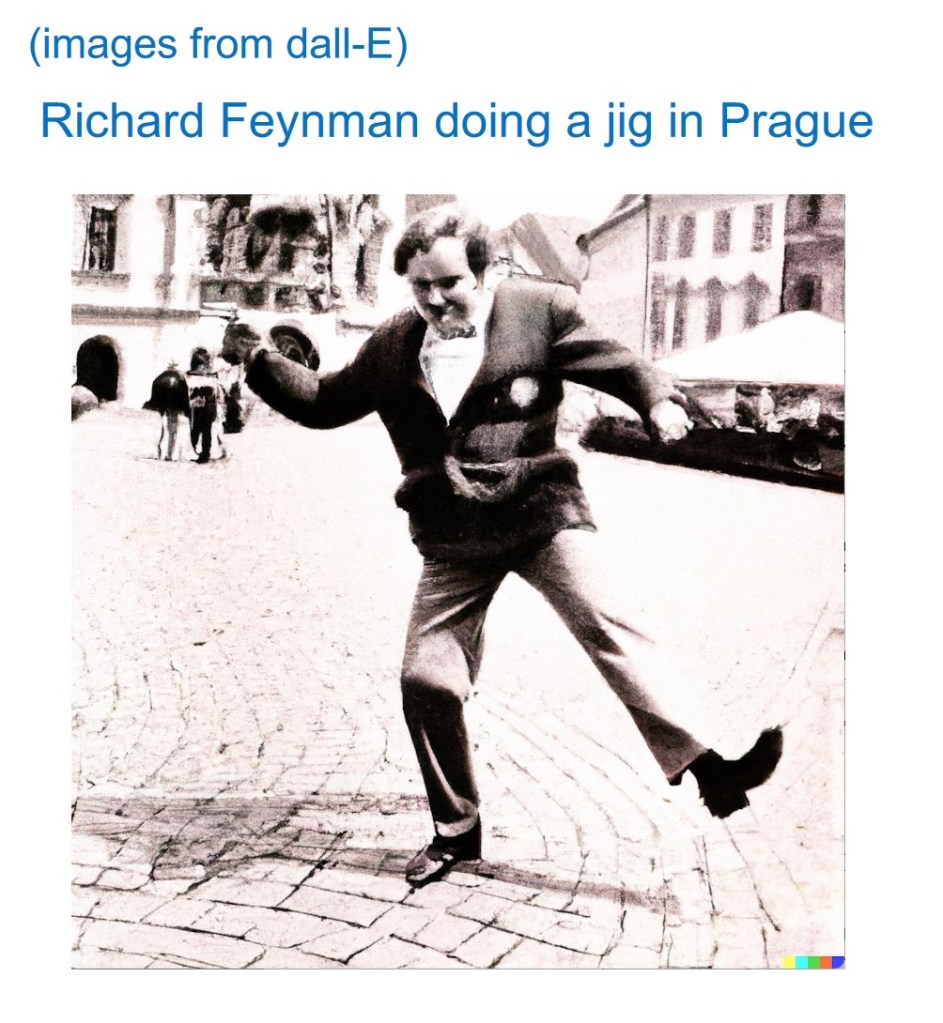
The conference poster included a picture of Prague’s famous clock, which is admittedly cool. But I think this computer-generated anachronism from Matt Schwartz’s machine learning talk is much more fun.

Amplitudes has grown, and keeps growing. The last time we met in person, there were 175 of us. This year, many people are skipping: some avoiding travel due to COVID, others just exhausted from a summer filled with long-postponed conferences. Nonetheless, we have more people here than then: 222 registered participants!

The large number of people means a large number of talks. Almost all were quite short, 25+5 minutes. Some speakers took advantage of the short length to deliver very accessible talks. Others seemed to think of the time limit as an excuse to cut short the introduction and dive right into technical details. We had just a few 40+5 minute talks, each a review from an adjacent field.

It’s been fun seeing people in person again. I think half of my conversations started with “It’s been a long time!” It’s easy for motivation to wane when you don’t have regular contact with the wider field, getting enthusiastic about shared goals and brainstorming big questions.

I’ll probably give a longer retrospective later: the packed schedule means I don’t have much time to write! But I can say that I’ve largely enjoyed this, the organizers were organized and the presenters presented and things felt a bit more like they ought to in the world.

Einstein-Years

Scott Aaronson recently published an interesting exchange on his blog Shtetl Optimized, between him and cognitive psychologist Steven Pinker. The conversation was about AI: Aaronson is optimistic (though not insanely so) Pinker is pessimistic (again, not insanely though). While fun reading, the whole thing would normally be a bit too off-topic for this blog, except that Aaronson’s argument ended up invoking something I do know a bit about: how we make progress in theoretical physics.

Aaronson was trying to respond to an argument of Pinker’s, that super-intelligence is too vague and broad to be something we could expect an AI to have. Aaronson asks us to imagine an AI that is nothing more or less than a simulation of Einstein’s brain. Such a thing isn’t possible today, and might not even be efficient, but it has the advantage of being something concrete we can all imagine. Aarsonson then suggests imagining that AI sped up a thousandfold, so that in one year it covers a thousand years of Einstein’s thought. Such an AI couldn’t solve every problem, of course. But in theoretical physics, surely such an AI could be safely described as super-intelligent: an amazing power that would change the shape of physics as we know it.

I’m not as sure of this as Aaronson is. We don’t have a machine that generates a thousand Einstein-years to test, but we do have one piece of evidence: the 76 Einstein-years the man actually lived.

Einstein is rightly famous as a genius in theoretical physics. His annus mirabilis resulted in five papers that revolutionized the field, and the next decade saw his theory of general relativity transform our understanding of space and time. Later, he explored what general relativity was capable of and framed challenges that deepened our understanding of quantum mechanics.

After that, though…not so much. For Einstein-decades, he tried to work towards a new unified theory of physics, and as far as I’m aware made no useful progress at all. I’ve never seen someone cite work from that period of Einstein’s life.

Aarsonson mentions simulating Einstein “at his peak”, and it would be tempting to assume that the unified theory came “after his peak”, when age had weakened his mind. But while that kind of thing can sometimes be an issue for older scientists, I think it’s overstated. I don’t think careers peak early because of “youthful brains”, and with the exception of genuine dementia I don’t think older physicists are that much worse-off cognitively than younger ones. The reason so many prominent older physicists go down unproductive rabbit-holes isn’t because they’re old. It’s because genius isn’t universal.

Einstein made the progress he did because he was the right person to make that progress. He had the right background, the right temperament, and the right interests to take others’ mathematics and take them seriously as physics. As he aged, he built on what he found, and that background in turn enabled him to do more great things. But eventually, the path he walked down simply wasn’t useful anymore. His story ended, driven to a theory that simply wasn’t going to work, because given his experience up to that point that was the work that interested him most.

I think genius in physics is in general like that. It can feel very broad because a good genius picks up new tricks along the way, and grows their capabilities. But throughout, you can see the links: the tools mastered at one age that turn out to be just right for a new pattern. For the greatest geniuses in my field, you can see the “signatures” in their work, hints at why they were just the right genius for one problem or another. Give one a thousand years, and I suspect the well would eventually run dry: the state of knowledge would no longer be suitable for even their breadth.

…of course, none of that really matters for Aaronson’s point.

A century of Einstein-years wouldn’t have found the Standard Model or String Theory, but a century of physicist-years absolutely did. If instead of a simulation of Einstein, your AI was a simulation of a population of scientists, generating new geniuses as the years go by, then the argument works again. Sure, such an AI would be much more expensive, much more difficult to build, but the first one might have been as well. The point of the argument is simply to show such a thing is possible.

The core of Aaronson’s point rests on two key traits of technology. Technology is replicable: once we know how to build something, we can build more of it. Technology is scalable: if we know how to build something, we can try to build a bigger one with more resources. Evolution can tap into both of these, but not reliably: just because it’s possible to build a mind a thousand times better at some task doesn’t mean it will.

That is why the possibility of AI leads to the possibility of super-intelligence. If we can make a computer that can do something, we can make it do that something faster. That something doesn’t have to be “general”, you can have programs that excel at one task or another. For each such task, with more resources you can scale things up: so anything a machine can do now, a later machine can probably do better. Your starting-point doesn’t necessarily even have to be efficient, or a good algorithm: bad algorithms will take longer to scale, but could eventually get there too.

The only question at that point is “how fast?” I don’t have the impression that’s settled. The achievements that got Pinker and Aarsonson talking, GPT-3 and DALL-E and so forth, impressed people by their speed, by how soon they got to capabilities we didn’t expect them to have. That doesn’t mean that something we might really call super-intelligence is close: that has to do with the details, with what your target is and how fast you can actually scale. And it certainly doesn’t mean that another approach might not be faster! (As a total outsider, I can’t help but wonder if current ML is in some sense trying to fit a cubic with straight lines.)

It does mean, though, that super-intelligence isn’t inconceivable, or incoherent. It’s just the recognition that technology is a master of brute force, and brute force eventually triumphs. If you want to think about what happens in that “eventually”, that’s a very important thing to keep in mind.