Tag Archives: quantum gravity

The “Lies to Children” Model of Science Communication, and The “Amplitudes Are Weird” Model of Amplitudes

Let me tell you a secret.

Scattering amplitudes in N=4 super Yang-Mills don’t actually make sense.

Scattering amplitudes calculate the probability that particles “scatter”: coming in from far away, interacting in some fashion, and producing new particles that travel far away in turn. N=4 super Yang-Mills is my favorite theory to work with: a highly symmetric version of the theory that describes the strong nuclear force. In particular, N=4 super Yang-Mills has conformal symmetry: if you re-scale everything larger or smaller, you should end up with the same predictions.

You might already see the contradiction here: scattering amplitudes talk about particles coming in from very far away…but due to conformal symmetry, “far away” doesn’t mean anything, since we can always re-scale it until it’s not far away anymore!

So when I say that I study scattering amplitudes in N=4 super Yang-Mills, am I lying?

Well…yes. But it’s a useful type of lie.

There’s a concept in science writing called “lies to children”, first popularized in a fantasy novel.
the-science-of-discworld-1

This one.

When you explain science to the public, it’s almost always impossible to explain everything accurately. So much background is needed to really understand most of modern science that conveying even a fraction of it would bore the average audience to tears. Instead, you need to simplify, to skip steps, and even (to be honest) to lie.

The important thing to realize here is that “lies to children” aren’t meant to mislead. Rather, they’re chosen in such a way that they give roughly the right impression, even as they leave important details out. When they told you in school that energy is always conserved, that was a lie: energy is a consequence of symmetry in time, and when that symmetry is broken energy doesn’t have to be conserved. But “energy is conserved” is a useful enough rule that lets you understand most of everyday life.

In this case, the “lie” that we’re calculating scattering amplitudes is fairly close to the truth. We’re using the same methods that people use to calculate scattering amplitudes in theories where they do make sense, like QCD. For a while, people thought these scattering amplitudes would have to be zero, since anything else “wouldn’t make sense”…but in practice, we found they were remarkably similar to scattering amplitudes in other theories. Now, we have more rigorous definitions for what we’re calculating that avoid this problem, involving objects called polygonal Wilson loops.

This illustrates another principle, one that hasn’t (yet) been popularized by a fantasy novel. I’d like to call it the “amplitudes are weird” principle. Time and again we amplitudes-folks will do a calculation that doesn’t really make sense, find unexpected structure, and go back to figure out what that structure actually means. It’s been one of the defining traits of the field, and we’ve got a pretty good track record with it.

A couple of weeks back, Lance Dixon gave an interview for the SLAC website, talking about his work on quantum gravity. This was immediately jumped on by Peter Woit and Lubos Motl as ammo for the long-simmering string wars. To one extent or another, both tried to read scientific arguments into the piece. This is in general a mistake: it is in the nature of a popularization piece to contain some volume of lies-to-children, and reading a piece aimed at a lower audience can be just as confusing as reading one aimed at a higher audience.

In the remainder of this post, I’ll try to explain what Lance was talking about in a slightly higher-level way. There will still be lies-to-children involved, this is a popularization blog after all. But I should be able to clear up a few misunderstandings. Lubos probably still won’t agree with the resulting argument, but it isn’t the self-evidently wrong one he seems to think it is.

Lance Dixon has done a lot of work on quantum gravity. Those of you who’ve read my old posts might remember that quantum gravity is not so difficult in principle: general relativity naturally leads you to particles called gravitons, which can be treated just like other particles. The catch is that the theory that you get by doing this fails to be predictive: one reason why is that you get an infinite number of erroneous infinite results, which have to be papered over with an infinite number of arbitrary constants.

Working with these non-predictive theories, however, can still yield interesting results. In the article, Lance mentions the work of Bern, Carrasco, and Johansson. BCJ (as they are abbreviated) have found that calculating a gravity amplitude often just amounts to calculating a (much easier to find) Yang-Mills amplitude, and then squaring the right parts. This was originally found in the context of string theory by another three-letter group, Kawai, Lewellen, and Tye (or KLT). In string theory, it’s particularly easy to see how this works, as it’s a basic feature of how string theory represents gravity. However, the string theory relations don’t tell the whole story: in particular, they only show that this squaring procedure makes sense on a classical level. Once quantum corrections come in, there’s no known reason why this squaring trick should continue to work in non-string theories, and yet so far it has. It would be great if we had a good argument why this trick should continue to work, a proof based on string theory or otherwise: for one, it would allow us to be much more confident that our hard work trying to apply this trick will pay off! But at the moment, this falls solidly under the “amplitudes are weird” principle.

Using this trick, BCJ and collaborators (frequently including Lance Dixon) have been calculating amplitudes in N=8 supergravity, a highly symmetric version of those naive, non-predictive gravity theories. For this particular, theory, the theory you “square” for the above trick is N=4 super Yang-Mills. N=4 super Yang-Mills is special for a number of reasons, but one is that the sorts of infinite results that lose you predictive power in most other quantum field theories never come up. Remarkably, the same appears to be true of N=8 supergravity. We’re still not sure, the relevant calculation is still a bit beyond what we’re capable of. But in example after example, N=8 supergravity seems to be behaving similarly to N=4 super Yang-Mills, and not like people would have predicted from its gravitational nature. Once again, amplitudes are weird, in a way that string theory helped us discover but by no means conclusively predicted.

If N=8 supergravity doesn’t lose predictive power in this way, does that mean it could describe our world?

In a word, no. I’m not claiming that, and Lance isn’t claiming that. N=8 supergravity simply doesn’t have the right sorts of freedom to give you something like the real world, no matter how you twist it. You need a broader toolset (string theory generally) to get something realistic. The reason why we’re interested in N=8 supergravity is not because it’s a candidate for a real-world theory of quantum gravity. Rather, it’s because it tells us something about where the sorts of dangerous infinities that appear in quantum gravity theories really come from.

That’s what’s going on in the more recent paper that Lance mentioned. There, they’re not working with a supersymmetric theory, but with the naive theory you’d get from just trying to do quantum gravity based on Einstein’s equations. What they found was that the infinity you get is in a certain sense arbitrary. You can’t get rid of it, but you can shift it around (infinity times some adjustable constant 😉 ) by changing the theory in ways that aren’t physically meaningful. What this suggests is that, in a sense that hadn’t been previously appreciated, the infinite results naive gravity theories give you are arbitrary.

The inevitable question, though, is why would anyone muck around with this sort of thing when they could just use string theory? String theory never has any of these extra infinities, that’s one of its most important selling points. If we already have a perfectly good theory of quantum gravity, why mess with wrong ones?

Here, Lance’s answer dips into lies-to-children territory. In particular, Lance brings up the landscape problem: the fact that there are 10^500 configurations of string theory that might loosely resemble our world, and no clear way to sift through them to make predictions about the one we actually live in.

This is a real problem, but I wouldn’t think of it as the primary motivation here. Rather, it gets at a story people have heard before while giving the feeling of a broader issue: that string theory feels excessive.

princess_diana_wedding_dress

Why does this have a Wikipedia article?

Think of string theory like an enormous piece of fabric, and quantum gravity like a dress. You can definitely wrap that fabric around, pin it in the right places, and get a dress. You can in fact get any number of dresses, elaborate trains and frilly togas and all sorts of things. You have to do something with the extra material, though, find some tricky but not impossible stitching that keeps it out of the way, and you have a fair number of choices of how to do this.

From this perspective, naive quantum gravity theories are things that don’t qualify as dresses at all, scarves and socks and so forth. You can try stretching them, but it’s going to be pretty obvious you’re not really wearing a dress.

What we amplitudes-folks are looking for is more like a pencil skirt. We’re trying to figure out the minimal theory that covers the divergences, the minimal dress that preserves modesty. It would be a dress that fits the form underneath it, so we need to understand that form: the infinities that quantum gravity “wants” to give rise to, and what it takes to cancel them out. A pencil skirt is still inconvenient, it’s hard to sit down for example, something that can be solved by adding extra material that allows it to bend more. Similarly, fixing these infinities is unlikely to be the full story, there are things called non-perturbative effects that probably won’t be cured. But finding the minimal pencil skirt is still going to tell us something that just pinning a vast stretch of fabric wouldn’t.

This is where “amplitudes are weird” comes in in full force. We’ve observed, repeatedly, that amplitudes in gravity theories have unexpected properties, traits that still aren’t straightforwardly explicable from the perspective of string theory. In our line of work, that’s usually a sign that we’re on the right track. If you’re a fan of the amplituhedron, the project here is along very similar lines: both are taking the results of plodding, not especially deep loop-by-loop calculations, observing novel simplifications, and asking the inevitable question: what does this mean?

That far-term perspective, looking off into the distance at possible insights about space and time, isn’t my style. (It isn’t usually Lance’s either.) But for the times that you want to tell that kind of story…well, this isn’t that outlandish of a story to tell. And unless your primary concern is whether a piece gives succor to the Woits of the world, it shouldn’t be an objectionable one.

When to Look under the Bed

Last week, blogged about a rather interesting experiment, designed to test the quantum properties of gravity. Normally, quantum gravity is essentially unobservable: quantum effects are typically only relevant for very small systems, where gravity is extremely weak. However, there has been a lot of progress in putting larger and larger systems into interesting quantum states, and a team of experimentalists has recently proposed a setup. The experiment wouldn’t have enough detail to, for example, distinguish between rival models of quantum gravity, but it would provide evidence as to whether or not gravity is quantum at all.

Lubos Motl, meanwhile, argues that such an experiment is utterly pointless, because there is no possible way that gravity could not be quantum. I won’t blame you if you don’t read his argument since it’s written in his trademark…aggressive…style, but the gist is that it’s really hard to make sense of the idea that there are non-quantum things in an otherwise quantum world. It causes all sorts of issues with pretty much every interpretation of quantum mechanics, and throws the differences between those interpretations into particularly harsh and obvious light. From this perspective, checking to see if gravity might not actually be quantum (an idea called semi-classical gravity) is a bit like checking for a monster under the bed.

You might find semi-classical gravity!

In general, I share Motl’s reservations about semi-classical gravity. As I mentioned back when journalists were touting the BICEP2 results as evidence of quantum gravity, the idea that gravity could not be quantum doesn’t really make much sense. (Incidentally, Hossenfelder makes a similar point in her post.)

All that said, sometimes in science it’s absolutely worth looking under the bed.

Take another unlikely possibility, that of cell phone radiation causing cancer. Things that cause cancer do it by messing with the molecular bonds in DNA. In order to mess with molecular bonds, you need high-frequency light. That’s how UV light from the sun can cause skin cancer. Cell phones emit microwaves, which are very low-frequency light. It’s what allows them to be useful inside of buildings, where normal light wouldn’t reach. It also means it’s impossible for them to cause cancer.

Nevertheless, if nobody had ever studied whether cell phones cause cancer, it would probably be worth at least one study. If that study came back positive, it would say something interesting, either about the study’s design or about other possible causes of cancer. If negative, the topic could be put to bed more convincingly. As it happens, those studies have been done, and overall confirm the expectations we have from basic science.

Another important point here is that experimentalists and theorists have different priorities, due to their different specializations. Theorists are interested in confirmation for particular theories: they want not just an unknown particle, but a gluino, and not just a gluino, but the gluino predicted by their particular model of supersymmetry. By contrast, experimentalists typically aren’t very interested in proving or disproving one theory or another. Rather, they look for general signals that indicate broad classes of new physics. For example, experimentalists might use the LHC to look for a leptoquark, a particle that allows quarks and leptons to interact, without caring what theory might produce them. Experimentalists are also very interested in improving their techniques. Much like theorists, a lot of interesting work in the field involves pushing the current state-of-the-art as far as it will go.

So, when should we look under the bed?

Well, if nobody has ever looked under this particular bed before, and if seeing something strange under this bed would at least be informative, and if looking under the bed serves as a proving ground for the latest in bed-spelunking technology, then yes, we should absolutely look under this bed.

Just don’t expect to see any monsters.

Don’t Watch the Star, Watch the Crowd

I didn’t comment last week on Hawking’s proposed solution of the black hole firewall problem. The media buzz around it was a bit less rabid than the last time he weighed in on this topic, but there was still a lot more heat than light.

The impression I get from the experts is that Hawking’s proposal (this time made in collaboration with Andrew Strominger and Malcom Perry, the former of whom is famous for, among other things, figuring out how string theory can explain the entropy of black holes) resembles some earlier suggestions, with enough new elements to make it potentially interesting but potentially just confusing. It’s a development worth paying attention to for specialists, but it’s probably not the sort of long-awaited answer the media seems to be presenting it as.

This raises a question: how, as a non-specialist, are you supposed to tell the difference? Sure, you can just read blogs like mine, but I can’t report on everything.

I may have a pretty solid grounding in physics, but I know almost nothing about music. I definitely can’t tell what makes a song good. About the best I can do is see if I can dance to it, but that doesn’t seem to be a reliable indicator of quality music. Instead, my best bet is usually to watch the crowd.

Lasers may make this difficult.

Ask the star of a show if they’re doing good work, and they’re unlikely to be modest. Ask the average music fan, though, and you get a better idea. Watch music fans as a group, and you get even more information.

When a song starts playing everywhere you go, when people start pulling it out at parties and making their own imitations of it, then maybe it’s important. That might not mean it’s good, but it does mean it’s worth knowing about.

When Hawking or Strominger or Witten or anyone whose name you’ve heard of says they’ve solved the puzzle of the century, be cautious. If it really is worth your attention, chances are it won’t be the last you’ll hear about it. Other physicists will build off of it, discuss it, even spin off a new sub-field around it. If it’s worth it, you won’t have to trust what the stars of the physics world say: you’ll be able to listen to the crowd.

Romeo and Juliet, through a Wormhole

Perimeter is hosting this year’s Mathematica Summer School on Theoretical Physics. The school is a mix of lectures on a topic in physics (this year, the phenomenon of quantum entanglement) and tips and tricks for using the symbolic calculation program Mathematica.

Juan Maldacena is one of the lecturers, which gave me a chance to hear his Romeo and Juliet-based explanation of the properties of wormholes. While I’ve criticized some of Maldacena’s science popularization work in the past, this one is pretty solid, so I thought I’d share it with you guys.

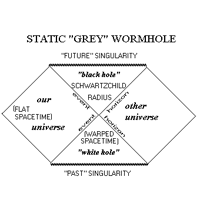
You probably think of wormholes as “shortcuts” to travel between two widely separated places. As it turns out, this isn’t really accurate: while “normal” wormholes do connect distant locations, they don’t do it in a way that allows astronauts to travel between them, Interstellar-style. This can be illustrated with something called a Penrose diagram:

Static

Static “Greyish Black” Diagram

In the traditional Penrose diagram, time goes upward, while space goes from side to side. In order to measure both in the same units, we use the speed of light, so one year on the time axis corresponds to one light-year on the space axis. This means that if you’re traveling at a 45 degree line on the diagram, you’re going at the speed of light. Any lower angle is impossible, while any higher angle means you’re going slower.

If we start in “our universe” in the diagram, can we get to the “other universe”?

Pretty clearly, the answer is no. As long as we go slower than the speed of light, when we pass the event horizon of the wormhole we will end up, not in the “other universe”, but at the part of the diagram labeled Future Singularity, the singularity at the center of the black hole. Even going at the speed of light only keeps us orbiting the event horizon for all eternity, at best.

What use could such a wormhole be? Well, imagine you’re Romeo or Juliet.

Romeo has been banished from Verona, but he took one end of a wormhole with him, while the other end was left with Juliet. He can’t go through and visit her, she can’t go through and visit him. But if they’re already considering taking poison, there’s an easier way. If they both jump in to the wormhole, they’ll fall in to the singularity. Crucially, though, it’s the same singularity, so once they’re past the event horizon they can meet inside the black hole, spending some time together before the end.

Depicted here for more typical quantum protagonists, Alice and Bob.

This explains what wormholes really are: two black holes that share a center.

Why was Maldacena talking about this at a school on entanglement? Maldacena has recently conjectured that quantum entanglement and wormholes are two sides of the same phenomenon, that pairs of entangled particles are actually connected by wormholes. Crucially, these wormholes need to have the properties described above: you can’t use a pair of entangled particles to communicate information faster than light, and you can’t use a wormhole to travel faster than light. However, it is the “shared” singularity that ends up particularly useful, as it suggests a solution to the problem of black hole firewalls.

Firewalls were originally proposed as a way of getting around a particular paradox relating three states connected by quantum entanglement: a particle inside a black hole, radiation just outside the black hole, and radiation far away from the black hole. The way the paradox is set up, it appears that these three states must all be connected. As it turns out, though, this is prohibited by quantum mechanics, which only allows two states to be entangled at a time. The original solution proposed for this was a “firewall”, a situation in which anyone trying to observe all three states would “burn up” when crossing the event horizon, thus avoiding any observed contradiction. Maldacena’s conjecture suggests another way: if someone interacts with the far-away radiation, they have an effect on the black hole’s interior, because the two are connected by a wormhole! This ends up getting rid of the contradiction, allowing the observer to view the black hole and distant radiation as two different descriptions of the same state, and it depends crucially on the fact that a wormhole involves a shared singularity.

There’s still a lot of detail to be worked out, part of the reason why Maldacena presented this research here was to inspire more investigation from students. But it does seem encouraging that Romeo and Juliet might not have to face a wall of fire before being reunited.

Sorry Science Fiction, Quantum Gravity Doesn’t Do What You Think It Does

I saw Interstellar this week. There’s been a lot of buzz among physicists about it, owing in part to the involvement of black hole expert Kip Thorne in the film’s development. I’d just like to comment on one aspect of the film that bugged me, a problem that shows up pretty frequently in science fiction.

In the film, Michael Caine plays a theoretical physicist working for NASA. His dream is to save humanity from an Earth plagued by a blight that is killing off the world’s food supply. To do this, he plans to build giant anti-gravity spaceships capable of taking as many people as possible away from the dying Earth to find a new planet capable of supporting human life. And in order to do that, apparently, he needs a theory of quantum gravity.

The thing is, quantum gravity has nothing to do with making giant anti-gravity spaceships.

Michael Caine lied to us?

This mistake isn’t unique to Interstellar. Lots of science fiction works assume that once we understand quantum gravity then everything else will follow: faster than light travel, wormholes, anti-gravity…pretty much every sci-fi staple.

It’s not just present in science fiction, either. Plenty of science popularizers like to mention all of the marvelous technology that’s going to come out of quantum gravity, including people who really should know better. A good example comes from a recent piece by quantum gravity researcher Sabine Hossenfelder:

But especially in high energy physics and quantum gravity, progress has basically stalled since the development of the standard model in the mid 70s. […] it is a frustrating situation and this makes you wonder if not there are other reasons for lack of progress, reasons that we can do something about. Especially in a time when we really need a game changer, some breakthrough technology, clean energy, that warp drive, a transporter!

None of these are things we’re likely to get from quantum gravity, and the reason is rather basic. It boils down to one central issue: if we can’t control the classical physics, we can’t control the quantum physics.

When science fiction authors speculate about the benefits of quantum gravity, they’re thinking about the benefits of quantum mechanics. Understanding the quantum world has allowed some of the greatest breakthroughs of the 20th century, from miniaturizing circuits to developing novel materials.

The assumption writers make is that the same will be true for quantum gravity: understand it, and gravity technology will flow. But this assumption forgets that quantum mechanics was so successful because it let us understand things we were already working with.

In order to miniaturize circuits, you have to know how to build a circuit in the first place. Only then, when you try to make the circuit smaller and don’t understand why it stops working, does quantum mechanics step in to tell you what you’re missing. Quantum mechanics helps us develop new materials because it helps us understand how existing materials work.

We don’t have any gravity circuits to shrink down, or gravity materials to understand. When gravity limits our current technology, it does so on a macro level (such as the effect of the Earth’s gravity on GPS satellites) not on a quantum level. If there isn’t a way to build anti-gravity technology using classical physics, there probably isn’t a way using quantum physics.

Scientists and popularizers generally argue that we can’t know what the future will bring. This is true, up to a point. When Maxwell wrote down equations to unify electricity and magnetism he could not have imagined the wealth of technology we have today. And often, technologies come from unexpected places. The spinoff technologies of the space race are the most popular example, another is that CERN (the facility that houses the Large Hadron Collider) was instrumental in developing the world wide web.

While it’s great to emphasize the open-ended promise of scientific advances (especially on grant applications!), in this context it’s misleading because it erases the very real progress people are making on these issues without quantum gravity.

Want to invest in clean energy? There are a huge number of scientists working on it, with projects ranging from creating materials that can split water using solar energy to nuclear fusion. Quantum gravity is just about the last science likely to give us clean energy, and I’m including the social sciences in that assessment.

How about a warp drive?

Indeed, how about one?

That’s not obviously related to quantum gravity either. There has actually been some research into warp drives, but they’re based on a solution to Einstein’s equations without quantum mechanics. It’s not clear whether quantum gravity has something meaningful to say about them…while there are points to be made, from what I’ve been able to gather they’re more related to talking about how other quantum systems interact with gravity than the quantum properties of gravity itself. The same seems to apply to the difficulties involved in wormholes, another sci-fi concept that comes straight out of Einstein’s theory.

As for teleportation, that’s an entirely different field, and it probably doesn’t work how you think it does.

So what is quantum gravity actually good for?

Quantum gravity becomes relevant when gravity becomes very strong, places where Einstein’s theory would predict infinitely dense singularities. That means the inside of black holes, and the Big Bang. Quantum gravity smooths out these singularities, which means it can tell you about the universe’s beginnings (by smoothing out the big bang and showing what could cause it), or its long-term future (for example, problems with the long-term evolution of black holes).

These are important questions! They tell us about where we come from and where we’re going: in short, about our ultimate place in the universe. Almost every religion in history has tried to answer these questions. They’re very important to us as a species, even if they don’t directly impact our daily lives.

What they are not, however, is a source of technology.

So please, science fiction, use some other field for your plot-technology. There are plenty of scientific advances to choose from, people who are really working on cutting-edge futuristic stuff. They don’t need to wait on a theory of quantum gravity to get their work done. Neither do you.

The Three Things Everyone Gets Wrong about the Big Bang

Ah, the Big Bang, our most science-y of creation myths. Everyone knows the story of how the universe and all its physical laws emerged from nothing in a massive explosion, growing from a singularity to the size of a breadbox until, over billions of years, it became the size it is today.

bigbang

A hot dense state, if you know what I mean.

…actually, almost nothing in that paragraph is true. There are a lot of myths about the Big Bang, born from physicists giving sloppy explanations. Here are three things most people get wrong about the Big Bang:

1. A Massive Explosion:

When you picture the big bang, don’t you imagine that something went, well, bang?

In movies and TV shows, a time traveler visiting the big bang sees only an empty void. Suddenly, an explosion lights up the darkness, shooting out stars and galaxies until it has created the entire universe.

Astute readers might find this suspicious: if the entire universe was created by the big bang, then where does the “darkness” come from? What does the universe explode into?

The problem here is that, despite the name, the big bang was not actually an explosion.

In picturing the universe as an explosion, you’re imagining the universe as having finite size. But it’s quite likely that the universe is infinite. Even if it is finite, it’s finite like the surface of the Earth: as Columbus (and others) experienced, you can’t get to the “edge” of the Earth no matter how far you go: eventually, you’ll just end up where you started. If the universe is truly finite, the same is true of it.

Rather than an explosion in one place, the big bang was an explosion everywhere at once. Every point in space was “exploding” at the same time. Each point was moving farther apart from every other point, and the whole universe was, as the song goes, hot and dense.

So what do physicists mean when they say that the universe at some specific time was the size of a breadbox, or a grapefruit?

It’s just sloppy language. When these physicists say “the universe”, what they mean is just the part of the universe we can see today, the Hubble Volume. It is that (enormously vast) space that, once upon a time, was merely the size of a grapefruit. But it was still adjacent to infinitely many other grapefruits of space, each one also experiencing the big bang.

2. It began with a Singularity:

This one isn’t so much definitely wrong as probably wrong.

If the universe obeys Einstein’s Theory of General Relativity perfectly, then we can make an educated guess about how it began. By tracking back the expansion of the universe to its earliest stages, we can infer that the universe was once as small as it can get: a single, zero-dimensional point, or a singularity. The laws of general relativity work the same backwards and forwards in time, so just as we could see a star collapsing and know that it is destined to form a black hole, we can see the universe’s expansion and know that if we traced it back it must have come from a single point.

This is all well and good, but there’s a problem with how it begins: “If the universe obeys Einstein’s Theory of General Relativity perfectly”.

In this situation, general relativity predicts an infinitely small, infinitely dense point. As I’ve talked about before, in physics an infinite result is almost never correct. When we encounter infinity, almost always it means we’re ignoring something about the nature of the universe.

In this case, we’re ignoring Quantum Mechanics. Quantum Mechanics naturally makes physics somewhat “fuzzy”: the Uncertainty Principle means that a quantum state can never be exactly in one specific place.

Combining quantum mechanics and general relativity is famously tricky, and the difficulty boils down to getting rid of pesky infinite results. However, several approaches exist to solving this problem, the most prominent of them being String Theory.

If you ask someone to list string theory’s successes, one thing you’ll always hear mentioned is string theory’s ability to understand black holes. In general relativity, black holes are singularities: infinitely small, and infinitely dense. In string theory, black holes are made up of combinations of fundamental objects: strings and membranes, curled up tight, but crucially not infinitely small. String theory smooths out singularities and tamps down infinities, and the same story applies to the infinity of the big bang.

String theory isn’t alone in this, though. Less popular approaches to quantum gravity, like Loop Quantum Gravity, also tend to “fuzz” out singularities. Whichever approach you favor, it’s pretty clear at this point that the big bang didn’t really begin with a true singularity, just a very compressed universe.

3. It created the laws of physics:

Physicists will occasionally say that the big bang determined the laws of physics. Fans of Anthropic Reasoning in particular will talk about different big bangs in different places in a vast multi-verse, each producing different physical laws.

I’ve met several people who were very confused by this. If the big bang created the laws of physics, then what laws governed the big bang? Don’t you need physics to get a big bang in the first place?

The problem here is that “laws of physics” doesn’t have a precise definition. Physicists use it to mean different things.

In one (important) sense, each fundamental particle is its own law of physics. Each one represents something that is true across all of space and time, a fact about the universe that we can test and confirm.

However, these aren’t the most fundamental laws possible. In string theory, the particles that exist in our four dimensions (three space dimensions, and one of time) change depending on how six “extra” dimensions are curled up. Even in ordinary particle physics, the value of the Higgs field determines the mass of the particles in our universe, including things that might feel “fundamental” like the difference between electromagnetism and the weak nuclear force. If the Higgs field had a different value (as it may have early in the life of the universe), these laws of physics would have been different. These sorts of laws can be truly said to have been created by the big bang.

The real fundamental laws, though, don’t change. Relativity is here to stay, no matter what particles exist in the universe. So is quantum mechanics. The big bang didn’t create those laws, it was a natural consequence of them. Rather than springing physics into existence from nothing, the big bang came out of the most fundamental laws of physics, then proceeded to fix the more contingent ones.

In fact, the big bang might not have even been the beginning of time! As I mentioned earlier in this article, most approaches to quantum gravity make singularities “fuzzy”. One thing these “fuzzy” singularities can do is “bounce”, going from a collapsing universe to an expanding universe. In Cyclic Models of the universe, the big bang was just the latest in a cycle of collapses and expansions, extending back into the distant past. Other approaches, like Eternal Inflation, instead think of the big bang as just a local event: our part of the universe happened to be dense enough to form a big bang, while other regions were expanding even more rapidly.

So if you picture the big bang, don’t just imagine an explosion. Imagine the entire universe expanding at once, changing and settling and cooling until it became the universe as we know it today, starting from a world of tangled strings or possibly an entirely different previous universe.

Sounds a bit more interesting to visit in your TARDIS, no?

N=8: That’s a Whole Lot of Symmetry

In two weeks, I’m planning an extensive overhaul of the blog. I’ll be switching from 4gravitons.wordpress.com to just 4gravitons.wordpress.com, since I’m no longer a grad student. Don’t worry, I’ll be forwarding traffic from the old address, so if you miss the changeover you’ll have plenty of time to readjust. I’ll also be changing the blog’s look a bit, and adding some new tools and sections, including my current project, a series on the theory N=8 supergravity. This is post will be the last in the N=8 supergravity series.

I’ve told you about how gravity can be thought of as interactions with spin 2 particles, called gravitons. I’ve talked about how adding supersymmetry gives you a whole new type of particle, a gravitino, one different from all of the other particles we’ve seen in nature. Add supersymmetry to gravity, and you get a type of theory called supergravity.

In this post I want to discuss a particularly interesting form of supergravity. It’s called N=8 supergravity, and it’s closely related to N=4 super Yang-Mills.

In my articles about N=4 super Yang-Mills, I talked about supersymmetry. Supersymmetry is a relationship between particles of spin X and particles of spin X-½, but it gets more complicated when N (the number of “directions” of supersymmetry) is greater than one.

I’d encourage you to read at least the two links in the above paragraph. The gist is that just like a symmetrical object can be turned in different directions and still remain the same, a supersymmetrical theory can be “turned” so that a particle with spin X becomes a particle of spin X-½ (a different type of particle), and the theory will remain the same. The higher the number N, the more different directions the theory can be “turned”.

N=4 was something I could depict in a picture. We started with a particle of spin 1, then could “turn” it in four different directions, each resulting in a different particle of spin ½. By combining two different “turns” we ended up with six distinct particles of spin 0. Miraculously, I could fit this all into one image.

N=8 is tougher. This time, we start with 1 particle of spin 2: the graviton, the particle that corresponds to the force of gravity. From there we can “turn” the theory in eight different directions, leading to 8 different gravitino particles with spin 3/2.

After that, things get more complicated. You can “turn” the theory twice to reach spin 1. Spin 1 particles correspond to Yang-Mills forces, the fundamental forces of nature (besides gravity). Photons are the spin 1 particles that correspond to Electromagnetism. The spin 1 particles here, connected as they are to gravity by supersymmetry, are typically called graviphotons. There are 28 distinct graviphotons in N=8 supergravity.

From the graviphotons, we can keep turning, getting to spin ½, where we find 56 new particles of the same “type” as electrons and quarks. On our fourth turn, we get to spin 0, the scalars, with 70 new particles. Turning further takes us back: from spin 0 to spin ½, spin ½ to spin 1, spin 1 to spin 3/2, and spin 3/2 to spin 2, back where we started after eight “turns”.

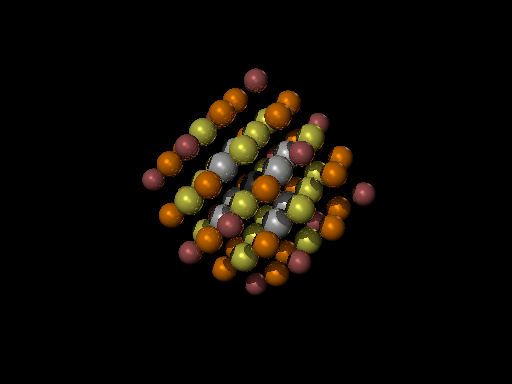
I’ve tried to depict this in the same way as N=4 super Yang-Mills, but there’s just no way to fit everything in. The best I can do is to take a slice through the space, letting certain particles overlap to give at best a general impression of what’s going on.

Graviton in black, gravitinos in grey, graviphotons in yellow, fermions in orange, scalars in red, and comprehensibility omitted entirely.

Graviton in black, gravitinos in grey, graviphotons in yellow, fermions in orange, scalars in red, making a firework of incomprehensible graphics. Incidentally, happy 4th of July to my American readers.

That picture doesn’t give you any intuition about the numbers. It doesn’t show you why there are 28 graviphotons, or 70 scalars. To explain that, it’s best to turn to another, hopefully more familiar picture, Pascal’s triangle.

Getting math class flashbacks yet?

Pascal’s triangle is a way of writing down how many distinct combinations you can make out of a list, and that’s really all that’s going on here. If you have four directions to “turn” and you pick one, you have four options, while picking two gives you six distinct choices. That’s just the 1-4-6-4-1 line on the triangle. If you go down to the eighth, you’ll spot the numbers from N=8 supergravity: 1 graviton, 8 gravitinos, 28 graviphotons, 56 fermions, and 70 scalars.

That’s a lot of particles. With that many particles, you might wonder if you could somehow fit the real world in there.

Actually, that isn’t such a naive thought. When N=8 supergravity was first discovered, people tried to fit the existing particles of nature inside it, hoping that it could explain them. Over the years though, it was realized that N=8 supergravity simply doesn’t provide enough tools to fully capture the particles of the standard model. Something more diverse, like string theory, would be needed.

That means that N=8 supergravity, like many of the things theorists call theories, does not describe the real world. Instead, it’s interesting for a different reason.

You’ve probably heard that gravity and quantum mechanics are incompatible. That’s not exactly true: you can write down a quantum theory of gravity about as easily as you can write down a quantum theory of anything else. The problem is that most such theories have divergences, infinite results that shouldn’t be infinite. Dealing with those results involves a process called renormalization, which papers over the infinities but reduces our ability to make predictions. For gravity theories, this process has to be performed an infinite number of times, resulting in an infinite loss of predictability. So while you can certainly write down a theory of quantum gravity, you can’t predict anything with it.

String theory is different. It doesn’t have the same sorts of infinite results, doesn’t require renormalization. That, really, is it’s purpose, it’s biggest virtue: everything else is a side benefit.

N=4 super Yang-Mills isn’t a theory of gravity at all, but it does have that same neat trait: you never get this sort of infinite results, so you never need to give up predictive power.

What’s so cool about N=8 supergravity is that it just might be in the same category. By all rights, it shouldn’t be…but loop after loop its divergences seem to be behaving much like N=4 super Yang-Mills. (For those new to this blog, loops are a measure of how complex a calculation is in particle physics. Most practical calculations only involve one or two loops, while four loops represents possibly the most precise test ever performed by science.)

Now, two predictions are at the fore. One suggests that this magic behavior will be broken at the terrifyingly complex level of seven loops. The other proposes that the magic will continue, and N=8 supergravity will never see a divergence. The only way for certain is to do the calculation, look at four gravitons at seven loops and see what happens.

If N=8 supergravity really doesn’t diverge, then the biggest “point” of string theory isn’t unique anymore. If you don’t need all the bells and whistles of string theory to get an acceptable quantum theory of gravity, then maybe there’s a better way to think about the problem of quantum gravity in general. Even if N=8 supergravity doesn’t describe the real world, there may be other ways forward, other ways to handle the problem of divergences. If someone can manage that calculation (not as impossible as it sounds nowadays, but still very very hard) then we might see something really truly new.

(Super)gravity: Meet the Gravitino

I’m putting together a series of posts about N=8 supergravity, with the goal of creating a guide much like I have for N=4 super Yang-Mills and the (2,0) theory.

N=8 supergravity is what happens when you add the maximum amount of supersymmetry to a theory of gravity. I’m going to strongly recommend that you read both of those posts before reading this one, as there are a number of important concepts there: the idea that different types of particles are categorized by a number called spin, the idea that supersymmetry is a relationship between particles with spin X and particles with spin X-½, and the idea that gravity can be thought of equally as a bending of space and time or as a particle with spin 2, called a graviton.

Knowing all that, if you add supersymmetry to gravity, you’d relate a spin 2 particle (the graviton) to a spin 3/2 particle (for 2-½).

What is a spin 3/2 particle?

Spin 0 particles correspond to a single number, like a temperature, that can vary over space. The Higgs boson is the one example of a spin 0 particle that we know of in the real world. Spin ½ covers electrons, protons, and almost all of the particles that make up ordinary matter, while spin 1 covers Yang-Mills forces. That covers the entire Standard Model, all of the particles scientists have seen in the real world. So what could a spin 3/2 particle possibly be?

We can at least guess at what it would be called. Whatever this spin 3/2 particle is, it’s the supersymmetric partner of the graviton. For somewhat stupid reasons, that means its name is determined by taking “graviton” and adding “-ino” to the end, to get gravitino.

But that still doesn’t answer the question: What is a gravitino?

Here’s the quick answer: A gravitino is a spin 1 particle combined with a spin ½ particle.

What sort of combination am I talking about? Not the one you might think. A gravitino is a fundamental particle, it is not made up of other particles.


NOT like this.

So in what sense is it a combination?

A handy way for physicists to think about particles is as manifestations of an underlying field. The field is stronger or weaker in different places, and when the field is “on”, a particle is present. For example, the electron field covers all of space, but only where that electron field is greater than zero do actual electrons show up.

I’ve said that a scalar field is simple to understand because it’s just a number, like a temperature, that takes different values in different places. The other types of fields are like this too, but instead of one number there’s generally a more complicated set of numbers needed to define them. Yang-Mills fields, with spin 1, are forces, with a direction and a strength. This is why they’re often called vector fields. Spin ½ particles have a set of numbers that characterizes them as well. It’s called a spinor, and unfortunately it’s not something I can give you an intuitive definition for. Just be aware that, like vectors, it involves a series of numbers that specify how the field behaves at each point.

It’s a bit like a computer game. The world is full of objects, and different objects have different stats. A weapon might have damage and speed, while a quest-giver would have information about what quests they give. Since everything is just code, though, you can combine the two, and all you have to do is put both types of stats on the same object.

Like this.

For quantum fields, the “stats” are the numbers I mentioned earlier: a single number for scalars, direction and strength for vectors, and the spinor information for spinors. So if you want to combine two of them, say spin 1 and spin ½, you just need a field that has both sets of “stats”.

That’s the gravitino. The gravitino has vector “stats” from the spin 1 part, and spinor “stats” from the spin ½ part. It’s a combination of two types of fundamental particles, to create one that nobody has seen before.

That doesn’t mean nobody will ever see one, though. Gravitinos could well exist in our world, they’re actually a potential (if problematic) candidate for dark matter.

But much like supersymmetry in general, while gravitinos may exist, N=8 of them certainly don’t. N=8 is a whole lot of supersymmetry…but that’s a topic for another post. Stay tuned for the next post in the series!

Gravity is Yang-Mills Squared

There’s a concept that I’ve wanted to present for quite some time. It’s one of the coolest accomplishments in my subfield, but I thought that explaining it would involve too much technical detail. However, the recent BICEP2 results have brought one aspect of it to the public eye, so I’ve decided that people are ready.

If you’ve been following the recent announcements by the BICEP2 telescope of their indirect observation of primordial gravitational waves, you’ve probably seen the phrases “E-mode polarization” and “B-mode polarization” thrown around. You may even have seen pictures, showing that light in the cosmic microwave background is polarized differently by quantum fluctuations in the inflaton field and by quantum fluctuations in gravity.

But why is there a difference? What’s unique about gravitational waves that makes them different from the other waves in nature?

As it turns out, the difference all boils down to one statement:

Gravity is Yang-Mills squared.

This is both a very simple claim and a very subtle one, and it comes up in many many places in physics.

Yang-Mills, for those who haven’t read my older posts, is a general category that contains most of the fundamental forces. Electromagnetism, the strong nuclear force, and the weak nuclear force are all variants of Yang-Mills forces.

Yang-Mills forces have “spin 1”. Another way to say this is that Yang-Mills forces are vector forces. If you remember vectors from math class, you might remember that a vector has a direction and a strength. This hopefully makes sense: forces point in a direction, and have a strength. You may also remember that vectors can also be described in terms of components. A vector in four space-time dimensions has four components: x, y, z, and time, like so:

\left( \begin{array}{c} x \\ y \\ z \\ t \end{array} \right)

Gravity has “spin 2”.

As I’ve talked about before, gravity bends space and time, which means that it modifies the way you calculate distances. In practice, that means it needs to be something that can couple two vectors together: a matrix, or more precisely, a tensor, like so:

\left( \begin{array}{cccc} xx & xy & xz & xt\\ yx & yy & yz & yt\\ zx & zy & zz & zt\\ tx & ty & tz & tt\end{array} \right)

So while a Yang-Mills force has four components, gravity has sixteen. Gravity is Yang-Mills squared.

(Technical note: gravity actually doesn’t use all sixteen components, because it’s traceless and symmetric. However, often when studying gravity’s quantum properties theorists often add on extra fields to “complete the square” and fill in the remaining components.)

There’s much more to the connection than that, though. For one, it appears in the kinds of waves the two types of forces can create.

In order to create an electromagnetic wave you need a dipole, a negative charge and a positive charge at opposite ends of a line, and you need that dipole to change over time.

Change over time, of course, is a property of Gifs.

Gravity doesn’t have negative and positive charges, it just has one type of charge. Thus, to create gravitational waves you need not a dipole, but a quadrupole: instead of a line between two opposite charges, you have four gravitational charges (masses) arranged in a square. This creates a “breathing” sort of motion, instead of the back-and-forth motion of electromagnetic waves.

This is your brain on gravitational waves.

This is why gravitational waves have a different shape than electromagnetic waves, and why they have a unique effect on the cosmic microwave background, allowing them to be spotted by BICEP2. Gravity, once again, is Yang-Mills squared.

But wait there’s more!

So far, I’ve shown you that gravity is the square of Yang-Mills, but not in a very literal way. Yes, there are lots of similarities, but it’s not like you can just square a calculation in Yang-Mills and get a calculation in gravity, right?

Well actually…

In quantum field theory, calculations are traditionally done using tools called Feynman diagrams, organized by how many loops the diagram contains. The simplest diagrams have no loops, and are called tree diagrams.

Fascinatingly, for tree diagrams the message of this post is as literal as it can be. Using something called the Kawai-Lewellen-Tye relations, the result of a tree diagram calculation in gravity can be found just by taking a similar calculation in Yang-Mills and squaring it.

(Interestingly enough, these relations were originally discovered using string theory, but they don’t require string theory to work. It’s yet another example of how string theory functions as a laboratory to make discoveries about quantum field theory.)

Does this hold beyond tree diagrams? As it turns out, the answer is again yes!
The calculation involved is a little more complicated, but as discovered by Zvi Bern, John Joseph Carrasco, and Henrik Johansson, if you can get your calculation in Yang-Mills into the right format then all you need to do is square the right thing at the right step to get gravity, even for diagrams with loops!

zvi-bern-350

carrasco

This trick, called BCJ duality after its discoverers, has allowed calculations in quantum gravity that far outpace what would be possible without it. In N=8 supergravity, the gravity analogue of N=4 super Yang-Mills, calculations have progressed up to four loops, and have revealed tantalizing hints that the uncontrolled infinities that usually plague gravity theories are absent in N=8 supergravity, even without adding in string theory. Results like these are why BCJ duality is viewed as one of the “foundational miracles” of the field for those of us who study scattering amplitudes.

Gravity is Yang-Mills squared, in more ways than one. And because gravity is Yang-Mills squared, gravity may just be tame-able after all.

Flexing the BICEP2 Results

The physicsverse has been abuzz this week with news of the BICEP2 experiment’s observations of B-mode polarization in the Cosmic Microwave Background.

There are lots of good sources on this, and it’s not really my field, so I’m just going to give a quick summary before talking about a few aspects I find interesting.

BICEP2 is a telescope in Antarctica that observes the Cosmic Microwave Background, light left over from the first time that the universe was clear enough for light to travel. (If you’re interested in a background on what we know about how the universe began, Of Particular Significance has an article here that should be fairly detailed, and I have a take on some more speculative aspects here.) Earlier experiments that observed the Cosmic Microwave Background discovered a surprising amount of uniformity. This led to the proposal of a concept called inflation: the idea that at some point the early universe expanded exponentially, smearing any non-uniformities across the sky and smoothing everything out. Since the rate the universe expands is a number, if that number is to vary it naturally should be a scalar field, which in this case is called the inflaton.

During inflation, distances themselves get stretched out. Think about inflation like enlarging an image. As you’ve probably noticed (maybe even in early posts on this blog), enlarging an image doesn’t always work out well. The resulting image is often pixelated or distorted. Some of the distortion comes from glitches in the program that enlarges the image, while some of it is just what happens when the pixels of the original image get enlarged to the point that you can see them.

Enlarging the Cosmic Microwave Background

Quantum fluctuations in the inflaton field itself are the glitches in the program, enlarging some areas more than others. The pattern they create in the Cosmic Microwave Background is called E-mode polarization, and several other experiments have been able to detect it.

Much weaker are the effect of the “pixels” of the original image. Since the original image is spacetime itself, the pixels are the quantum fluctuations of spacetime: quantum gravity waves. Inflation enlarged them to the point that they were visible on a large-distance scale, fundamental non-uniformity in the world blown up big enough to affect the distribution of light. The effect this had on light is detectably different: it’s called B-mode polarization, and this is the first experiment to detect it on the right scale for it to be caused by gravity waves.

Measuring this polarization, in particular how strong it is, tells us a lot about how inflation occurred. It’s enough to rule out several models, and lend support to several others. If the results are corroborated this will be real, useful evidence, the sort physicists love to get, and folks are happily crunching numbers on it all over the world.

All that said, this site is called four gravitons and a grad student, and I’m betting that some of you want to ask this grad student: is this evidence for gravitons, or for gravity waves?

Sort of.

We already had good indirect evidence for gravity waves: pairs of neutron stars release gravity waves as they orbit each other, which causes them to slow down. Since we’ve observed them slowing down at the right rates, we were already confident gravity waves exist. And if you’ve got gravity waves, gravitons follow as a natural consequence of quantum mechanics.

The data from BICEP2 is also indirect. The gravity waves “observed” by BICEP2 were present in the early universe. It is their effect on the light that would become the Cosmic Microwave Background that is being observed, not the gravity waves directly. We still have yet to directly detect gravity waves, with a gravity telescope like LIGO.

On the other hand, a “gravity telescope” isn’t exactly direct either. In order to detect gravity waves, LIGO and other gravity telescopes attempt to measure their effect on the distances between objects. How do they do that? By looking at interference patterns of light.

In both cases, we’re looking at light, present in the environment of a gravity wave, and examining its properties. Of course, in a gravity telescope the light is from a nearby environment under tight control, while the Cosmic Microwave Background is light from as far away and long ago as anything within the reach of science today. In both cases, though, it’s not nearly as simple as “observing” an effect. “Seeing” anything in high energy physics or astrophysics is always a matter of interpreting data based on science we already know.

Alright, that’s evidence for gravity waves. Does that mean evidence for gravitons?

I’ve seen a few people describe BICEP2’s results as evidence for quantum gravity/quantum gravity effects. I felt a little uncomfortable with that claim, so I asked Matt Strassler what he thought. I think his perspective on this is the right one. Quantum gravity is just what happens when gravity exists in a quantum world. As I’ve said on this site before, quantum gravity is easy. The hard part is making a theory of quantum gravity that has real predictive power, and that’s something these results don’t shed any light on at all.

That said, I’m a bit conflicted. They really are seeing a quantum effect in gravity, and as far as I’m aware this really is the first time such an effect has been observed. Gravity is so weak, and quantum gravity effects so small, that it takes inflation blowing them up across the sky for them to be visible. Now, I don’t think there was anyone out there who thought gravity didn’t have quantum fluctuations (or at least, anyone with a serious scientific case). But seeing into a new regime, even if it doesn’t tell us much…that’s important, isn’t it? (After writing this, I read Matt Strassler’s more recent post, where he has a paragraph professing similar sentiments).

On yet another hand, I’ve heard it asserted in another context that loop quantum gravity researchers don’t know how to get gravitons. I know nothing about the technical details of loop quantum gravity, so I don’t know if that actually has any relevance here…but it does amuse me.