Tag Archives: quantum field theory

The State of Four Gravitons

This blog is named for a question: does the four-graviton amplitude in N=8 supergravity diverge?

Over the years, Zvi Bern and a growing cast of collaborators have been trying to answer that question. They worked their way up, loop by loop, until they stalled at five loops. Last year, they finally broke the stall, and last week, they published the result of the five-loop calculation. They find that N=8 supergravity does not diverge at five loops in four dimensions, but does diverge in 24/5 dimensions. I thought I’d write a brief FAQ about the status so far.

Q: Wait a minute, 24/5 dimensions? What does that mean? Are you talking about fractals, or…

Nothing so exotic. The number 24/5 comes from a regularization trick. When we’re calculating an amplitude that might be divergent, one way to deal with it is to treat the dimension like a free variable. You can then see what happens as you vary the dimension, and see when the amplitude starts diverging. If the dimension is an integer, then this ends up matching a more physics-based picture, where you start with a theory in eleven dimensions and curl up the extra ones until you get to the dimension you’re looking for. For fractional dimensions, it’s not clear that there’s any physical picture like this: it’s just a way to talk about how close something is to diverging.

Q: I’m really confused. What’s a graviton? What is supergravity? What’s a divergence?

I don’t have enough space to explain these things here, but that’s why I write handbooks. Here are explanations of gravitons, supersymmetry, and (N=8) supergravity, loops, and divergences. Please let me know if anything in those explanations is unclear, or if you have any more questions.

Q: Why do people think that N=8 supergravity will diverge at seven loops?

There’s a useful rule of thumb in quantum field theory: anything that can happen, will happen. In this case, that means if there’s a way for a theory to diverge that’s consistent with the symmetries of the theory, then it almost always does diverge. In the past, that meant that people expected N=8 supergravity to diverge at five loops. However, researchers found a previously unknown symmetry that looked like it would forbid the five-loop divergence, and only allow a divergence at seven loops (in four dimensions). Zvi and co.’s calculation confirms that the five-loop divergence doesn’t show up.

More generally, string theory not only avoids divergences but clears up other phenomena, like black holes. These two things seem tied together: string theory cleans up problems in quantum gravity in a consistent, unified way. There isn’t a clear way for N=8 supergravity on its own to clean up these kinds of problems, which makes some people skeptical that it can match string theory’s advantages. Either way N=8 supergravity, unlike string theory, isn’t a candidate theory of nature by itself: it would need to be modified in order to describe our world, and no-one has suggested a way to do that.

Q: Why do people think that N=8 supergravity won’t diverge at seven loops?

There’s a useful rule of thumb in amplitudes: amplitudes are weird. In studying amplitudes we often notice unexpected simplifications, patterns that uncover new principles that weren’t obvious before.

Gravity in general seems to have a lot of these kinds of simplifications. Even without any loops, its behavior is surprisingly tame: it’s a theory that we can build up piece by piece from the three-particle interaction, even though naively we shouldn’t be able to (for the experts: I’m talking about large-z behavior in BCFW). This behavior seems to have an effect on one-loop amplitudes as well. There are other ways in which gravity seems better-behaved than expected, overall this suggests that we still have a fair ways to go before we understand all of the symmetries of gravity theories.

Supersymmetric gravity in particular also seems unusually well-behaved. N=5 supergravity was expected to diverge at four loops, but doesn’t. N=4 supergravity does diverge at four loops, but that seems to be due to an effect that is specific to that case (for the experts: an anomaly).

For N=8 specifically, a suggestive hint came from varying the dimension. If you checked the dimension in which the theory diverged at each loop, you’d find it matched the divergences of another theory, N=4 super Yang-Mills. At l loops, N=4 super Yang-Mills diverges in dimension 4+6/l. From that formula, you can see that no matter how much you increase l, you’ll never get to four dimensions: in four dimensions, N=4 super Yang-Mills doesn’t diverge.

At five loops, N=4 super Yang-Mills diverges in 26/5 dimensions. Zvi Bern made a bet with supergravity expert Kelly Stelle that the dimension would be the same for N=8 supergravity: a bottle of California wine from Bern versus English wine from Stelle. Now that they’ve found a divergence in 24/5 dimensions instead, Stelle will likely be getting his wine soon.

Q: It sounds like the calculation was pretty tough. Can they still make it to seven loops?

I think so, yes. Doing the five-loop calculation they noticed simplifications, clever tricks uncovered by even more clever grad students. The end result is that if they just want to find out whether the theory diverges then they don’t have to do the “whole calculation”, just part of it. This simplifies things a lot. They’ll probably have to find a few more simplifications to make seven loops viable, but I’m optimistic that they’ll find them, and in the meantime the new tricks should have some applications in other theories.

Q: What do you think? Will the theory diverge?

I’m not sure.

To be honest, I’m a bit less optimistic than I used to be. The agreement of divergence dimensions between N=8 supergravity and N=4 super Yang-Mills wasn’t the strongest argument (there’s a reason why, though Stelle accepted the bet on five loops, string theorist Michael Green is waiting on seven loops for his bet). Fractional dimensions don’t obviously mean anything physically, and many of the simplifications in gravity seem specific to four dimensions. Still, it was suggestive, the kind of “motivation” that gets a conjecture started.

Without that motivation, none of the remaining arguments are specific to N=8. I still think unexpected simplifications are likely, that gravity overall behaves better than we yet appreciate. I still would bet on seven loops being finite. But I’m less confident about what it would mean for the theory overall. That’s going to take more serious analysis, digging in to the anomaly in N=4 supergravity and seeing what generalizes. It does at least seem like Zvi and co. are prepared to undertake that analysis.

Regardless, it’s still worth pushing for seven loops. Having that kind of heavy-duty calculation in our sub-field forces us to improve our mathematical technology, in the same way that space programs and particle colliders drive technology in the wider world. If you think your new amplitudes method is more efficient than the alternatives, the push to seven loops is the ideal stress test. Jacob Bourjaily likes to tell me how his prescriptive unitarity technique is better than what Zvi and co. are doing, this is our chance to find out!

Overall, I still stand by what I say in my blog’s sidebar. I’m interested in N=8 supergravity, I’d love to find out whether the four-graviton amplitude diverges…and now that the calculation is once again making progress, I expect that I will.

Path Integrals and Loop Integrals: Different Things!

When talking science, we need to be careful with our words. It’s easy for people to see a familiar word and assume something totally different from what we intend. And if we use the same word twice, for two different things…

I’ve noticed this problem with the word “integral”. When physicists talk about particle physics, there are two kinds of integrals we mention: path integrals, and loop integrals. I’ve seen plenty of people get confused, and assume that these two are the same thing. They’re not, and it’s worth spending some time explaining the difference.

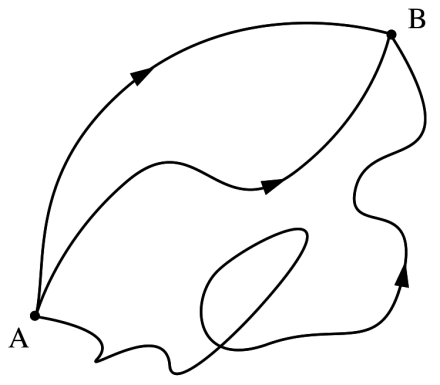
Let’s start with path integrals (also referred to as functional integrals, or Feynman integrals). Feynman promoted a picture of quantum mechanics in which a particle travels along many different paths, from point A to point B.

three_paths_from_a_to_b

You’ve probably seen a picture like this. Classically, a particle would just take one path, the shortest path, from A to B. In quantum mechanics, you have to add up all possible paths. Most longer paths cancel, so on average the short, classical path is the most important one, but the others do contribute, and have observable, quantum effects. The sum over all paths is what we call a path integral.

It’s easy enough to draw this picture for a single particle. When we do particle physics, though, we aren’t usually interested in just one particle: we want to look at a bunch of different quantum fields, and figure out how they will interact.

We still use a path integral to do that, but it doesn’t look like a bunch of lines from point A to B, and there isn’t a convenient image I can steal from Wikipedia for it. The quantum field theory path integral adds up, not all the paths a particle can travel, but all the ways a set of quantum fields can interact.

How do we actually calculate that?

One way is with Feynman diagrams, and (often, but not always) loop integrals.

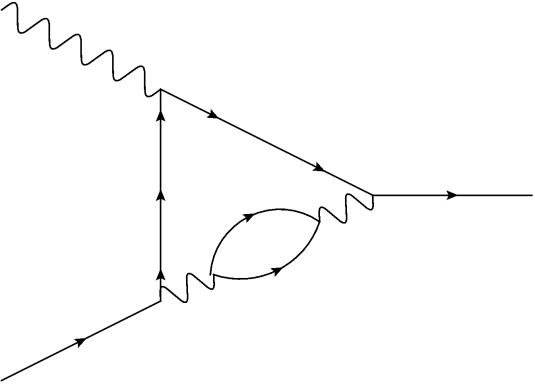
4grav2loop

I’ve talked about Feynman diagrams before. Each one is a picture of one possible way that particles can travel, or that quantum fields can interact. In some (loose) sense, each one is a single path in the path integral.

Each diagram serves as instructions for a calculation. We take information about the particles, their momenta and energy, and end up with a number. To calculate a path integral exactly, we’d have to add up all the diagrams we could possibly draw, to get a sum over all possible paths.

(There are ways to avoid this in special cases, which I’m not going to go into here.)

Sometimes, getting a number out of a diagram is fairly simple. If the diagram has no closed loops in it (if it’s what we call a tree diagram) then knowing the properties of the in-coming and out-going particles is enough to know the rest. If there are loops, though, there’s uncertainty: you have to add up every possible momentum of the particles in the loops. You do that with a different integral, and that’s the one that we sometimes refer to as a loop integral. (Perhaps confusingly, these are also often called Feynman integrals: Feynman did a lot of stuff!)

\frac{i^{a+l(1-d/2)}\pi^{ld/2}}{\prod_i \Gamma(a_i)}\int_0^\infty...\int_0^\infty \prod_i\alpha_i^{a_i-1}U^{-d/2}e^{iF/U-i\sum m_i^2\alpha_i}d\alpha_1...d\alpha_n

Loop integrals can be pretty complicated, but at heart they’re the same sort of thing you might have seen in a calculus class. Mathematicians are pretty comfortable with them, and they give rise to numbers that mathematicians find very interesting.

Path integrals are very different. In some sense, they’re an “integral over integrals”, adding up every loop integral you could write down. Mathematicians can define path integrals in special cases, but it’s still not clear that the general case, the overall path integral picture we use, actually makes rigorous mathematical sense.

So if you see physicists talking about integrals, it’s worth taking a moment to figure out which one we mean. Path integrals and loop integrals are both important, but they’re very, very different things.

The Rippling Pond Universe

[Background: Someone told me they couldn’t imagine popularizing Quantum Field Theory in the same flashy way people popularize String Theory. Naturally I took this as a challenge. Please don’t take any statements about what “really exists” here too seriously, this isn’t intended as metaphysics, just metaphor.]


You probably learned about atoms in school.

Your teacher would have explained that these aren’t the same atoms the ancient Greeks imagined. Democritus thought of atoms as indivisible, unchanging spheres, the fundamental constituents of matter. We know, though, that atoms aren’t indivisible. They’re clouds of electrons, buzzing in their orbits around a nucleus of protons and neutrons. Chemists can divide the electrons from the rest, nuclear physicists can break the nucleus. The atom is not indivisible.

And perhaps your teacher remarked on how amazing it is, that the nucleus is such a tiny part of the atom, that the atom, and thus all solid matter, is mostly empty space.


You might have learned that protons and neutrons, too, are not indivisible. That each proton, and each neutron, is composed of three particles called quarks, particles which can be briefly freed by powerful particle colliders.

And you might have wondered, then, even if you didn’t think to ask: are quarks atoms? The real atoms, the Greek atoms, solid indestructible balls of fundamental matter?


They aren’t, by the way.


You might have gotten an inkling of this, learning about beta decay. In beta decay, a neutron transforms, becoming a proton, an electron, and a neutrino. Look for an electron inside a neutron, and you won’t find one. Even if you look at the quarks, you see the same transformation: a down quark becomes an up quark, plus an electron, plus a neutrino. If quarks were atoms, indivisible and unchanging, this couldn’t happen. There’s nowhere for the electron to hide.


In fact, there are no atoms, not the way the Greeks imagined. Just ripples.

Water Drop

Picture the universe as a pond. This isn’t a still pond: something has disturbed it, setting ripples and whirlpools in motion. These ripples and whirlpools skim along the surface of the pond, eddying together and scattering apart.

Our universe is not a simple pond, and so these are not simple ripples. They shine and shimmer, each with their own bright hue, colors beyond our ordinary experience that mix in unfamiliar ways. The different-colored ripples interact, merge and split, and the pond glows with their light.

Stand back far enough, and you notice patterns. See that red ripple, that stays together and keeps its shape, that meets other ripples and interacts in predictable ways. You might imagine the red ripple is an atom, truly indivisible…until it splits, transforms, into ripples of new colors. The quark has changed, down to up, an electron and a neutrino rippling away.

All of our world is encoded in the colors of these ripples, each kind of charge its own kind of hue. With a wink (like your teacher’s, telling you of empty atoms), I can tell you that distance itself is just a kind of ripple, one that links other ripples together. The pond’s very nature as a place is defined by the ripples on it.


This is Quantum Field Theory, the universe of ripples. Democritus said that in truth there are only atoms and the void, but he was wrong. There are no atoms. There is only the void. It ripples and shimmers, and each of us lives as a collection of whirlpools, skimming the surface, seeming concrete and real and vital…until the ripples dissolve, and a new pattern comes.

At the GGI Lectures on the Theory of Fundamental Interactions

I’m at the Galileo Galilei Institute for Theoretical Physics in Florence at their winter school, the GGI Lectures on the Theory of Fundamental Interactions. Next week I’ll be helping Lance Dixon teach Amplitudeology, this week, I’m catching the tail end of Ira Rothstein’s lectures.

IMG_20180112_082716844

The Galileo Galilei Institute, at the end of a long, winding road filled with small, speedy cars and motorcycles, in classic Italian fashion

Rothstein has been heavily involved in doing gravitational wave calculations using tools from quantum field theory, something that has recently captured a lot of interest from amplitudes people. Specifically, he uses Effective Field Theory, theories that are “effectively” true at some scale but hide away higher-energy physics. In the case of gravitational waves, these theories are a powerful way to calculate the waves that LIGO and VIRGO can observe without using the full machinery of general relativity.

After seeing Rothstein’s lectures, I’m reminded of something he pointed out at the QCD Meets Gravity conference in December. He emphasized then that even if amplitudes people get very good at drawing diagrams for classical general relativity, that won’t be the whole story: there’s a series of corrections needed to “match” between the quantities LIGO is able to see and the ones we’re able to calculate. Different methods incorporate these corrections in different ways, and the most intuitive approach for us amplitudes folks may still end up cumbersome once all the corrections are included. In typical amplitudes fashion, this just makes me wonder if there’s a shortcut: some way to compute, not just a piece that gets plugged in to an Effective Field Theory story, but the waves LIGO sees in one fell swoop (or at least, the part where gravity is weak enough that our methods are still useful). That’s probably a bit naive of me, though.

4gravitons Meets QCD Meets Gravity

I’m at UCLA this week, for the workshop QCD Meets Gravity. I haven’t worked on QCD or gravity yet, so I’m mostly here as an interested observer, and as an excuse to enjoy Los Angeles in December.

IMG_20171213_082840263_HDR

I think there’s a song about this…

QCD Meets Gravity is a conference centered around the various ways that “gravity is Yang-Mills squared”. There are a number of tricks that let you “square” calculations in Yang-Mills theories (a type of theory that includes QCD) to get calculations in gravity, and this conference showcased most of them.

At Amplitudes this summer, I was disappointed there were so few surprises. QCD Meets Gravity was different, with several talks on new or preliminary results, including one by Julio Parra-Martinez where the paper went up in the last few minutes of the talk! Yu-tin Huang talked about his (still-unpublished) work with Nima Arkani-Hamed on “UV/IR Polytopes”. The story there is a bit like the conformal bootstrap, with constraints (in this case based on positivity) marking off a space of “allowed” theories. String theory, interestingly, is quite close to the boundary of what is allowed. Enrico Herrmann is working on a way to figure out which gravity integrands are going to diverge without actually integrating them, while Simon Caron-Huot, in his characteristic out-of-the-box style, is wondering whether supersymmetric black holes precess. We also heard a bit more about a few recent papers. Oliver Schlotterer’s talk cleared up one thing: apparently the GEF functions he defines in his paper on one-loop “Z theory” are pronounced “Jeff”. I kept waiting for him to announce “Jeff theory”, but unfortunately no such luck. Sebastian Mizera’s talk was a very clear explanation of intersection theory, the subject of his recent paper. As it turns out, intersection theory is the study of mathematical objects like the Beta function (which shows up extensively in string theory), taking them apart in a way very reminiscent of the “squaring” story of Yang-Mills and gravity.

The heart of the workshop this year was gravitational waves. Since LIGO started running, amplitudes researchers (including, briefly, me) have been looking for ways to get involved. This conference’s goal was to bring together amplitudes people and the gravitational wave community, to get a clearer idea of what we can contribute. Between talks and discussions, I feel like we all understand the problem better. Some things that the amplitudes community thought were required, like breaking the symmetries of special relativity, turn out to be accidents of how the gravitational wave community calculates things: approximations that made things easier for them, but make things harder for us. There are areas in which we can make progress quite soon, even areas in which amplitudes people have already made progress. The detectors for which the new predictions matter might still be in the future (LIGO can measure two or three “loops”, LISA will see up to four), but they will eventually be measured. Amplitudes and gravitational wave physics could turn out to be a very fruitful partnership.


Interesting Work at the IAS

I’m visiting the Institute for Advanced Study this week, on the outskirts of Princeton’s impressively Gothic campus.

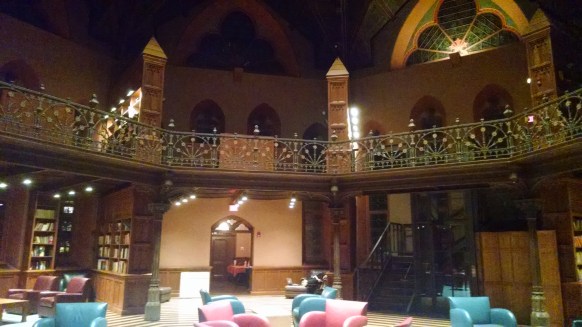
IMG_20171127_192657307

A typical Princeton reading room

The IAS was designed as a place for researchers to work with minimal distraction, and we’re taking full advantage of it. (Though I wouldn’t mind a few more basic distractions…dinner closer than thirty minutes away for example.)

The amplitudes community seems to be busily working as well, with several interesting papers going up on the arXiv this week, four with some connection to the IAS.

Carlos Mafra and Oliver Schlotterer’s paper about one-loop string amplitudes mentions visiting the IAS in the acknowledgements. Mafra and Schlotterer have found a “double-copy” structure in the one-loop open string. Loosely, “double-copy” refers to situations in which one theory can be described as two theories “multiplied together”, like how “gravity is Yang-Mills squared”. Normally, open strings would be the “Yang-Mills” in that equation, with their “squares”, closed strings, giving gravity. Here though, open strings themselves are described as a “product” of two different pieces, a Yang-Mills part and one that takes care of the “stringiness”. You may remember me talking about something like this and calling it “Z theory”. That was at “tree level”, for the simplest string diagrams. This paper updates the technology to one-loop, where the part taking care of the “stringiness” has a more sophisticated mathematical structure. It’s pretty nontrivial for this kind of structure to survive at one loop, and it suggests something deeper is going on.

Yvonne Geyer (IAS) and Ricardo Monteiro (non-IAS) work on the ambitwistor string, a string theory-like setup for calculating particle physics amplitudes. Their paper shows how this setup can be used for one-loop amplitudes in a wide range of theories, in particular theories without supersymmetry. This makes some patterns that were observed before quite a bit clearer, and leads to a fairly concise way of writing the amplitudes.

Nima-watchers will be excited about a paper by Nima Arkani-Hamed and his student Yuntao Bai (IAS) and Song He and his student Gongwang Yan (non-IAS). This paper is one that has been promised for quite some time, Nima talked about it at Amplitudes last summer. Nima is famous for the amplituhedron, an abstract geometrical object that encodes amplitudes in one specific theory, N=4 super Yang-Mills. Song He is known for the Cachazo-He-Yuan (or CHY) string, a string-theory like picture of particle scattering in a very general class of theories that is closely related to the ambitwistor string. Collaborating, they’ve managed to link the two pictures together, and in doing so take the first step to generalizing the amplituhedron to other theories. In order to do this they had to think about the amplituhedron not in terms of some abstract space, but in terms of the actual momenta of the particles they’re colliding. This is important because the amplituhedron’s abstract space is very specific to N=4 super Yang-Mills, with supersymmetry in some sense built in, while momenta can be written down for any particles. Once they had mastered this trick, they could encode other things in this space of momenta: colors of quarks, for example. Using this, they’ve managed to find amplituhedron-like structure in the CHY string, and in a few particular theories. They still can’t do everything the amplituhedron can, in particular the amplituhedron can go to any number of loops while the structures they’re finding are tree-level. But the core trick they’re using looks very powerful. I’ve been hearing hints about the trick from Nima for so long that I had forgotten they hadn’t published it yet, now that they have I’m excited to see what the amplitudes community manages to do with it.

Finally, last night a paper by Igor Prlina, Marcus Spradlin, James Stankowicz, Stefan Stanojevic, and Anastasia Volovich went up while three of the authors were visiting the IAS. The paper deals with Landau equations, a method to classify and predict the singularities of amplitudes. By combining this method with the amplituhedron they’ve already made substantial progress, and this paper serves as a fairly thorough proof of principle, using the method to comprehensively catalog the singularities of one-loop amplitudes. In this case I’ve been assured that they have papers at higher loops in the works, so it will be interesting to see how powerful this method ends up being.

Amplitudes Papers I Haven’t Had Time to Read

Interesting amplitudes papers seem to come in groups. Several interesting papers went up this week, and I’ve been too busy to read any of them!

Well, that’s not quite true, I did manage to read this paper, by James Drummond, Jack Foster, and Omer Gurdogan. At six pages long, it wasn’t hard to fit in, and the result could be quite useful. The way my collaborators and I calculate amplitudes involves building up a mathematical object called a symbol, described in terms of a string of “letters”. What James and collaborators have found is a restriction on which “letters” can appear next to each other, based on the properties of a mathematical object called a cluster algebra. Oddly, the restriction seems to have the same effect as a more physics-based condition we’d been using earlier. This suggests that the abstract mathematical restriction and the physics-based restriction are somehow connected, but we don’t yet understand how. It also could be useful for letting us calculate amplitudes with more particles: previously we thought the number of “letters” we’d have to consider there was going to be infinite, but with James’s restriction we’d only need to consider a finite number.

I didn’t get a chance to read David Dunbar, John Godwin, Guy Jehu, and Warren Perkins’s paper. They’re computing amplitudes in QCD (which unlike N=4 super Yang-Mills actually describes the real world!) and doing so for fairly complicated arrangements of particles. They claim to get remarkably simple expressions: since that sort of claim was what jump-started our investigations into N=4, I should probably read this if only to see if there’s something there in the real world amenable to our technique.

I also haven’t read Rutger Boels and Hui Lui’s paper yet. From the abstract, I’m still not clear which parts of what they’re describing is new, or how much it improves on existing methods. It will probably take a more thorough reading to find out.

I really ought to read Burkhard Eden, Yunfeng Jiang, Dennis le Plat, and Alessandro Sfondrini’s paper. They’re working on a method referred to as the Hexagon Operator Product Expansion, or HOPE. It’s related to an older method, the Pentagon Operator Product Expansion (POPE), but applicable to trickier cases. I’ve been keeping an eye on the HOPE in part because my collaborators have found the POPE very useful, and the HOPE might enable something similar. It will be interesting to find out how Eden et al.’s paper modifies the HOPE story.

Finally, I’ll probably find the time to read my former colleague Sebastian Mizera’s paper. He’s found a connection between the string-theory-like CHY picture of scattering amplitudes and some unusual mathematical structures. I’m not sure what to make of it until I get a better idea of what those structures are.

When It Rains It Amplitudes

The last few weeks have seen a rain of amplitudes papers on arXiv, including quite a few interesting ones.

rainydays

As well as a fair amount of actual rain in Copenhagen

Over the last year Nima Arkani-Hamed has been talking up four or five really interesting results, and not actually publishing any of them. This has understandably frustrated pretty much everybody. In the last week he published two of them, Cosmological Polytopes and the Wavefunction of the Universe with Paolo Benincasa and Alexander Postnikov and Scattering Amplitudes For All Masses and Spins with Tzu-Chen Huang and Yu-tin Huang. So while I’ll have to wait on the others (I’m particularly looking forward to seeing what he’s been working on with Ellis Yuan) this can at least tide me over.

Cosmological Polytopes and the Wavefunction of the Universe is Nima & co.’s attempt to get a geometrical picture for cosmological correlators, analogous to the Ampituhedron. Cosmological correlators ask questions about the overall behavior of the visible universe: how likely is one clump of matter to be some distance from another? What sorts of patterns might we see in the Cosmic Microwave Background? This is the sort of thing that can be used for “cosmological collider physics”, an idea I mention briefly here.

Paolo Benincasa was visiting Perimeter near the end of my time there, so I got a few chances to chat with him about this. One thing he mentioned, but that didn’t register fully at the time, was Postnikov’s involvement. I had expected that even if Nima and Paolo found something interesting that it wouldn’t lead to particularly deep mathematics. Unlike the N=4 super Yang-Mills theory that generates the Amplituhedron, the theories involved in these cosmological correlators aren’t particularly unique, they’re just a particular class of models cosmologists use that happen to work well with Nima’s methods. Given that, it’s really surprising that they found something mathematically interesting enough to interest Postnikov, a mathematician who was involved in the early days of the Amplituhedron’s predecessor, the Positive Grassmannian. If there’s something that mathematically worthwhile in such a seemingly arbitrary theory then perhaps some of the beauty of the Amplithedron are much more general than I had thought.

Scattering Amplitudes For All Masses and Spins is on some level a byproduct of Nima and Yu-tin’s investigations of whether string theory is unique. Still, it’s a useful byproduct. Many of the tricks we use in scattering amplitudes are at their best for theories with massless particles. Once the particles have masses our notation gets a lot messier, and we often have to rely on older methods. What Nima, Yu-tin, and Tzu-Chen have done here is to build a notation similar to what we use for massless particle, but for massive ones.

The advantage of doing this isn’t just clean-looking papers: using this notation makes it a lot easier to see what kinds of theories make sense. There are a variety of old theorems that restrict what sorts of theories you can write down: photons can’t interact directly with each other, there can only be one “gravitational force”, particles with spins greater than two shouldn’t be massless, etc. The original theorems were often fairly involved, but for massless particles there were usually nice ways to prove them in modern amplitudes notation. Yu-tin in particular has a lot of experience finding these kinds of proofs. What the new notation does is make these nice simple proofs possible for massive particles as well. For example, you can try to use the new notation to write down an interaction between a massive particle with spin greater than two and gravity, and what you find is that any expression you write breaks down: it works fine at low energies, but once you’re looking at particles with energies much higher than their mass you start predicting probabilities greater than one. This suggests that particles with higher spins shouldn’t be “fundamental”, they should be explained in terms of other particles at higher energies. The only way around this turns out to be an infinite series of particles to cancel problems from the previous ones, the sort of structure that higher vibrations have in string theory. I often don’t appreciate papers that others claim are a pleasure to read, but this one really was a pleasure to read: there’s something viscerally satisfying about seeing so many important constraints manifest so cleanly.

I’ve talked before about the difference between planar and non-planar theories. Planar theories end up being simpler, and in the case of N=4 super Yang-Mills this results in powerful symmetries that let us do much more complicated calculations. Non-planar theories are more complicated, but necessary for understanding gravity. Dual Conformal Symmetry, Integration-by-Parts Reduction, Differential Equations and the Nonplanar Sector, a new paper by Zvi Bern, Michael Enciso, Harald Ita, and Mao Zeng, works on bridging the gap between these two worlds.

Most of the paper is concerned with using some of the symmetries of N=4 super Yang-Mills in other, more realistic (but still planar) theories. The idea is that even if those symmetries don’t hold one can still use techniques that respect those symmetries, and those techniques can often be a lot cleaner than techniques that don’t. This is probably the most practically useful part of the paper, but the part I was most curious about is in the last few sections, where they discuss non-planar theories. For a while now I’ve been interested in ways to treat a non-planar theory as if it were planar, to try to leverage the powerful symmetries we have in planar N=4 super Yang-Mills elsewhere. Their trick is surprisingly simple: they just cut the diagram open! Oddly enough, they really do end up with similar symmetries using this method. I still need to read this in more detail to understand its limitations, since deep down it feels like something this simple couldn’t possibly work. Still, if anything like the symmetries of planar N=4 holds in the non-planar case there’s a lot we could do with it.

There are a bunch of other interesting recent papers that I haven’t had time to read. Some look like they might relate to weird properties of N=4 super Yang-Mills, others say interesting things about the interconnected web of theories tied together by their behavior when a particle becomes “soft”. Another presents a method for dealing with elliptic functions, one of the main obstructions to applying my hexagon function technique to more situations. And of course I shouldn’t fail to mention a paper by my colleague Carlos Cardona, applying amplitudes techniques to AdS/CFT. Overall, a lot of interesting stuff in a short span of time. I should probably get back to reading it!

Topic Conferences, Place Conferences

I spent this week at Current Themes in High Energy Physics and Cosmology, a conference at the Niels Bohr Institute.

Most conferences focus on a particular topic. Usually the broader the topic, the bigger the conference. A workshop on flux tubes is smaller than Amplitudes, which is smaller than Strings, which is smaller than the March Meeting of the American Physical Society.

“Current Themes in High Energy Physics and Cosmology” sounds like a very broad topic, but it was a small conference. The reason why is that it wasn’t a “topic conference”, it was a “place conference”.

Most conferences focus on a topic, but some are built around a place. These conferences are hosted by a particular institute year after year. Sometimes each year has a loose theme (for example, the Simons Summer Workshop this year focused on theories without supersymmetry) but sometimes no attempt is made to tie the talks together (“current themes”).

Instead of a theme, the people who go to these conferences are united by their connections to the institute. Some of them have collaborators there, or worked there in the past. Others have been coming for many years. Some just happened to be in the area.

While they may seem eclectic, “place” conferences have a valuable role: they help to keep our interests broad. In physics, there’s a natural tendency to specialize. Left alone, we end up reading papers and going to talks only when they’re directly relevant for what we’re working on. By doing this we lose track of the wider field, losing access to the insights that come from different perspectives and methods.

“Place” conferences, like seminars, help pull things in the other direction. When you’re hearing talks from “everyone connected to the Simons Center” or “everyone connected to the Niels Bohr Institute”, you’re exposed to a much broader range of topics than a conference for just your sub-field. You get a broad overview of what’s going on in the field, but unlike a big conference like Strings there are few enough people that you can actually talk to everyone.

Physicists’ attachment to places is counter-intuitive. We’re studying mathematical truths and laws of nature, surely it shouldn’t matter where we work. In practice, though, we’re still human. Out of the vast span of physics we still pick our interests based on the people around us. That’s why places, why institutes with a wide range of excellent people, are so important: they put our social instincts to work studying the universe.

More Travel

I’m visiting the Niels Bohr Institute this week, on my way back from Amplitudes.

IMG_20170719_152906

You might recognize the place from old conference photos.

Amplitudes itself was nice. There weren’t any surprising new developments, but a lot of little “aha” moments when one of the speakers explained something I’d heard vague rumors about. I figured I’d mention a few of the things that stood out. Be warned, this is going to be long and comparatively jargon-heavy.

The conference organizers were rather daring in scheduling Nima Arkani-Hamed for the first talk, as Nima has a tendency to arrive at the last minute and talk for twice as long as you ask him to. Miraculously, though, things worked out, if only barely: Nima arrived at the wrong campus and ran most of the way back, showing up within five minutes of the start of the conference. He also stuck to his allotted time, possibly out of courtesy to his student, Yuntao Bai, who was speaking next.

Between the two of them, Nima and Yuntao covered an interesting development, tying the Amplituhedron together with the string theory-esque picture of scattering amplitudes pioneered by Freddy Cachazo, Song He, and Ellis Ye Yuan (or CHY). There’s a simpler (and older) Amplituhedron-like object called the associahedron that can be thought of as what the Amplituhedron looks like on the surface of a string, and CHY’s setup can be thought of as a sophisticated map that takes this object and turns it into the Amplituhedron. It was nice to hear from both Nima and his student on this topic, because Nima’s talks are often high on motivation but low on detail, so it was great that Yuntao was up next to fill in the blanks.

Anastasia Volovich talked about Landau singularities, a topic I’ve mentioned before. What I hadn’t appreciated was how much they can do with them at this point. Originally, Juan Maldacena had suggested that these singularities, mathematical points that determine the behavior of amplitudes first investigated by Landau in the 60’s, might explain some of the simplicity we’ve observed in N=4 super Yang-Mills. They ended up not being enough by themselves, but what Volovich and collaborators are discovering is that with a bit of help from the Amplithedron they explain quite a lot. In particular, if they start with the Amplituhedron and do a procedure similar to Landau’s, they can find the simpler set of singularities allowed by N=4 super Yang-Mills, at least for the examples they’ve calculated. It’s still a bit unclear how this links to their previous investigations of these things in terms of cluster algebras, but it sounds like they’re making progress.

Dmitry Chicherin gave me one of those minor “aha” moments. One big useful fact about scattering amplitudes in N=4 super Yang-Mills is that they’re “dual” to different mathematical objects called Wilson loops, a fact which allows us to compare to the “POPE” approach of Basso, Sever, and Vieira. Chicherin asks the question: “What if you’re not calculating a scattering amplitude or a Wilson loop, but something halfway in between?” Interestingly, this has an answer, with the “halfway between” objects having a similar duality among themselves.

Yorgos Papathansiou talked about work I’ve been involved with. I’ll probably cover it in detail in another post, so now I’ll just mention that we’re up to six loops!

Andy Strominger talked about soft theorems. It’s always interesting seeing people who don’t traditionally work on amplitudes giving talks at Amplitudes. There’s a range of responses, from integrability people (who are basically welcomed like family) to work on fairly unrelated areas that have some “amplitudes” connection (met with yawns except from the few people interested in the connection). The response to Strominger was neither welcome nor boredom, but lively debate. He’s clearly doing something interesting, but many specialists worried he was ignorant of important no-go results in the field that could hamstring some of his bolder conjectures.

The second day focused on methods for more practical calculations, and had the overall effect of making me really want to clean up my code. Tiziano Peraro’s finite field methods in particular look like they could be quite useful. There were two competing bases of integrals on display, Von Manteuffel’s finite integrals and Rutger Boels’s uniform transcendental integrals later in the conference. Both seem to have their own virtues, and I ended up asking Rob Schabinger if it was possible to combine the two, with the result that he’s apparently now looking into it.

The more practical talks that day had a clear focus on calculations with two loops, which are becoming increasingly viable for LHC-relevant calculations. From talking to people who work on this, I get the impression that the goal of these calculations isn’t so much to find new physics as to confirm and investigate new physics found via other methods. Things are complicated enough at two loops that for the moment it isn’t feasible to describe what all the possible new particles might do at that order, and instead the goal is to understand the standard model well enough that if new physics is noticed (likely based on one-loop calculations) then the details can be pinned down by two-loop data. But this picture could conceivably change as methods improve.

Wednesday was math-focused. We had a talk by Francis Brown on his conjecture of a cosmic Galois group. This is a topic I knew a bit about already, since it’s involved in something I’ve been working on. Brown’s talk cleared up some things, but also shed light on the vagueness of the proposal. As with Yorgos’s talk, I’ll probably cover more about this in a future post, so I’ll skip the details for now.

There was also a talk by Samuel Abreu on a much more physical picture of the “symbols” we calculate with. This is something I’ve seen presented before by Ruth Britto, and it’s a setup I haven’t looked into as much as I ought to. It does seem at the moment that they’re limited to one loop, which is a definite downside. Other talks discussed elliptic integrals, the bogeyman that we still can’t deal with by our favored means but that people are at least understanding better.

The last talk on Wednesday before the hike was by David Broadhurst, who’s quite a character in his own right. Broadhurst sat in the front row and asked a question after nearly every talk, usually bringing up papers at least fifty years old, if not one hundred and fifty. At the conference dinner he was exactly the right person to read the Address to the Haggis, resurrecting a thick Scottish accent from his youth. Broadhurst’s techniques for handling high-loop elliptic integrals are quite impressively powerful, leaving me wondering if the approach can be generalized.

Thursday focused on gravity. Radu Roiban gave a better idea of where he and his collaborators are on the road to seven-loop supergravity and what the next bottlenecks are along the way. Oliver Schlotterer’s talk was another one of those “aha” moments, helping me understand a key difference between two senses in which gravity is Yang-Mills squared ( the Kawai-Lewellen-Tye relations and BCJ). In particular, the latter is much more dependent on specifics of how you write the scattering amplitude, so to the extent that you can prove something more like the former at higher loops (the original was only for trees, unlike BCJ) it’s quite valuable. Schlotterer has managed to do this at one loop, using the “Q-cut” method I’ve (briefly) mentioned before. The next day’s talk by Emil Bjerrum-Bohr focused more heavily on these Q-cuts, including a more detailed example at two loops than I’d seen that group present before.

There was also a talk by Walter Goldberger about using amplitudes methods for classical gravity, a subject I’ve looked into before. It was nice to see a more thorough presentation of those ideas, including a more honest appraisal of which amplitudes techniques are really helpful there.

There were other interesting topics, but I’m already way over my usual post length, so I’ll sign off for now. Videos from all but a few of the talks are now online, so if you’re interested you should watch them on the conference page.