Tag Archives: particle physics

The Particle Physics Curse of Knowledge

There’s a debate raging right now in particle physics, about whether and how to build the next big collider. CERN’s Future Circular Collider group has been studying different options, some more expensive and some less (Peter Woit has a nice summary of these here). This year, the European particle physics community will debate these proposals, deciding whether to include them in an updated European Strategy for Particle Physics. After that, it will be up to the various countries that are members of CERN to decide whether to fund the proposal. With the costs of the more expensive options hovering around $20 billion, this has led to substantial controversy.

I’m not going to offer an opinion here one way or another. Weighing this kind of thing requires knowing the alternatives: what else the European particle physics community might lobby for in the next few years, and once they decide, what other budget priorities each individual country has. I know almost nothing about either.

Instead of an opinion, I have an observation:

Imagine that primatologists had proposed a $20 billion primate center, able to observe gorillas in greater detail than ever before. The proposal might be criticized in any number of ways: there could be much cheaper ways to accomplish the same thing, the project might fail, it might be that we simply don’t care enough about primate behavior to spend $20 billion on it.

What you wouldn’t expect is the claim that a $20 billion primate center would teach us nothing new.

It probably wouldn’t teach us “$20 billion worth of science”, whatever that means. But a center like that would be guaranteed to discover something. That’s because we don’t expect primatologists’ theories to be exact. Even if gorillas behaved roughly as primatologists expected, the center would still see new behaviors, just as a consequence of looking at a new level of detail.

To pick a physics example, consider the gravitational wave telescope LIGO. Before their 2016 observation of two black holes merging, LIGO faced substantial criticism. After their initial experiments didn’t detect anything, many physicists thought that the project was doomed to fail: that it would never be sensitive enough to detect the faint signals of gravitational waves past the messy vibrations of everyday life on Earth.

When it finally worked, though, LIGO did teach us something new. Not the existence of gravitational waves, we already knew about them. Rather, LIGO taught us new things about the kinds of black holes that exist. LIGO observed much bigger black holes than astronomers expected, a surprise big enough that it left some people skeptical. Even if it hadn’t, though, we still would almost certainly observe something new: there’s no reason to expect astronomers to perfectly predict the size of the universe’s black holes.

Particle physics is different.

I don’t want to dismiss the work that goes in to collider physics (far too many people have dismissed it recently). Much, perhaps most, of the work on the LHC is dedicated not to detecting new particles, but to confirming and measuring the Standard Model. A new collider would bring heroic scientific effort. We’d learn revolutionary new things about how to build colliders, how to analyze data from colliders, and how to use the Standard Model to make predictions for colliders.

In the end, though, we expect those predictions to work. And not just to work reasonably well, but to work perfectly. While we might see something beyond the Standard Model, the default expectation is that we won’t, that after doing the experiments and analyzing the data and comparing to predictions we’ll get results that are statistically indistinguishable from an equation we can fit on a T-shirt. We’ll fix the constants on that T-shirt to an unprecedented level of precision, yes, but the form of the equation may well stay completely the same.

I don’t think there’s another field where that’s even an option. Nowhere else in all of science could we observe the world in unprecedented detail, capturing phenomena that had never been seen before…and end up perfectly matching our existing theory. There’s no other science where anyone would even expect that to happen.

That makes the argument here different from any argument we’ve faced before. It forces people to consider their deep priorities, to think not just about the best way to carry out this test or that but about what science is supposed to be for. I don’t think there are any easy answers. We’re in what may well be a genuinely new situation, and we have to figure out how to navigate it together.

Postscript: I still don’t want to give an opinion, but given that I didn’t have room for this above let me give a fragment of an opinion: Higgs triple couplings!!!

Made of Quarks Versus Made of Strings

When you learn physics in school, you learn it in terms of building blocks.

First, you learn about atoms. Indivisible elements, as the Greeks foretold…until you learn that they aren’t indivisible. You learn that atoms are made of electrons, protons, and neutrons. Then you learn that protons and neutrons aren’t indivisible either, they’re made of quarks. They’re what physicists call composite particles, particles made of other particles stuck together.

Hearing this story, you notice a pattern. Each time physicists find a more fundamental theory, they find that what they thought were indivisible particles are actually composite. So when you hear physicists talking about the next, more fundamental theory, you might guess it has to work the same way. If quarks are made of, for example, strings, then each quark is made of many strings, right?

Nope! As it turns out, there are two different things physicists can mean when they say a particle is “made of” a more fundamental particle. Sometimes they mean the particle is composite, like the proton is made of quarks. But sometimes, like when they say particles are “made of strings”, they mean something different.

To understand what this “something different” is, let’s go back to quarks for a moment. You might have heard there are six types, or flavors, of quarks: up and down, strange and charm, top and bottom. The different types have different mass and electric charge. You might have also heard that quarks come in different colors, red green and blue. You might wonder then, aren’t there really eighteen types of quark? Red up quarks, green top quarks, and so forth?

Physicists don’t think about it that way. Unlike the different flavors, the different colors of quark have a more unified mathematical description. Changing the color of a quark doesn’t change its mass or electric charge. All it changes is how the quark interacts with other particles via the strong nuclear force. Know how one color works, and you know how the other colors work. Different colors can also “mix” together, similarly to how different situations can mix together in quantum mechanics: just as Schrodinger’s cat can be both alive and dead, a quark can be both red and green.

This same kind of thing is involved in another example, electroweak unification. You might have heard that electromagnetism and the weak nuclear force are secretly the same thing. Each force has corresponding particles: the familiar photon for electromagnetism, and W and Z bosons for the weak nuclear force. Unlike the different colors of quarks, photons and W and Z bosons have different masses from each other. It turns out, though, that they still come from a unified mathematical description: they’re “mixtures” (in the same Schrodinger’s cat-esque sense) of the particles from two more fundamental forces (sometimes called “weak isospin” and “weak hypercharge”). The reason they have different masses isn’t their own fault, but the fault of the Higgs: the Higgs field we have in our universe interacts with different parts of this unified force differently, so the corresponding particles end up with different masses.

A physicist might say that electromagnetism and the weak force are “made of” weak isospin and weak hypercharge. And it’s that kind of thing that physicists mean when they say that quarks might be made of strings, or the like: not that quarks are composite, but that quarks and other particles might have a unified mathematical description, and look different only because they’re interacting differently with something else.

This isn’t to say that quarks and electrons can’t be composite as well. They might be, we don’t know for sure. If they are, the forces binding them together must be very strong, strong enough that our most powerful colliders can’t make them wiggle even a little out of shape. The tricky part is that composite particles get mass from the energy holding them together. A particle held together by very powerful forces would normally be very massive, if you want it to end up lighter you have to construct your theory carefully to do that. So while occasionally people will suggest theories where quarks or electrons are composite, these theories aren’t common. Most of the time, if a physicist says that quarks or electrons are “made of ” something else, they mean something more like “particles are made of strings” than like “protons are made of quarks”.

Assumptions for Naturalness

Why did physicists expect to see something new at the LHC, more than just the Higgs boson? Mostly, because of something called naturalness.

Naturalness, broadly speaking, is the idea that there shouldn’t be coincidences in physics. If two numbers that appear in your theory cancel out almost perfectly, there should be a reason that they cancel. Put another way, if your theory has a dimensionless constant in it, that constant should be close to one.

(To see why these two concepts are the same, think about a theory where two large numbers miraculously almost cancel, leaving just a small difference. Take the ratio of one of those large numbers to the difference, and you get a very large dimensionless number.)

You might have heard it said that the mass of the Higgs boson is “unnatural”. There are many different physical processes that affect what we measure as the mass of the Higgs. We don’t know exactly how big these effects are, but we do know that they grow with the scale of “new physics” (aka the mass of any new particles we might have discovered), and that they have to cancel to give the Higgs mass we observe. If we don’t see any new particles, the Higgs mass starts looking more and more unnatural, driving some physicists to the idea of a “multiverse”.

If you find parts of this argument hokey, you’re not alone. Critics of naturalness point out that we don’t really have a good reason to favor “numbers close to one”, nor do we have any way to quantify how “bad” a number far from one is (we don’t know the probability distribution, in other words). They critique theories that do preserve naturalness, like supersymmetry, for being increasingly complicated and unwieldy, violating Occam’s razor. And in some cases they act baffled by the assumption that there should be any “new physics” at all.

Some of these criticisms are reasonable, but some are distracting and off the mark. The problem is that the popular argument for naturalness leaves out some important assumptions. These assumptions are usually kept in mind by the people arguing for naturalness (at least the more careful people), but aren’t often made explicit. I’d like to state some of these assumptions. I’ll be framing the naturalness argument in a bit of an unusual (if not unprecedented) way. My goal is to show that some criticisms of naturalness don’t really work, while others still make sense.

I’d like to state the naturalness argument as follows:

  1. The universe should be ultimately described by a theory with no free dimensionless parameters at all. (For the experts: the theory should also be UV-finite.)
  2. We are reasonably familiar with theories of the sort described in 1., we know roughly what they can look like.
  3. If we look at such a theory at low energies, it will appear to have dimensionless parameters again, based on the energy where we “cut off” our description. We understand this process well enough to know what kinds of values these parameters can take, starting from 2.
  4. Point 3. can only be consistent with the observed mass of the Higgs if there is some “new physics” at around the scales the LHC can measure. That is, there is no known way to start with a theory like those of 2. and get the observed Higgs mass without new particles.

Point 1. is often not explicitly stated. It’s an assumption, one that sits in the back of a lot of physicists’ minds and guides their reasoning. I’m really not sure if I can fully justify it, it seems like it should be a consequence of what a final theory is.

(For the experts: you’re probably wondering why I’m insisting on a theory with no free parameters, when usually this argument just demands UV-finiteness. I demand this here because I think this is the core reason why we worry about coincidences: free parameters of any intermediate theory must eventually be explained in a theory where those parameters are fixed, and “unnatural” coincidences are those we don’t expect to be able to fix in this way.)

Point 2. may sound like a stretch, but it’s less of one than you might think. We do know of a number of theories that have few or no dimensionless parameters (and that are UV-finite), they just don’t describe the real world. Treating these theories as toy models, we can hopefully get some idea of how theories like this should look. We also have a candidate theory of this kind that could potentially describe the real world, M theory, but it’s not fleshed out enough to answer these kinds of questions definitively at this point. At best it’s another source of toy models.

Point 3. is where most of the technical arguments show up. If someone talking about naturalness starts talking about effective field theory and the renormalization group, they’re probably hashing out the details of point 3. Parts of this point are quite solid, but once again there are some assumptions that go into it, and I don’t think we can say that this point is entirely certain.

Once you’ve accepted the arguments behind points 1.-3., point 4. follows. The Higgs is unnatural, and you end up expecting new physics.

Framed in this way, arguments about the probability distribution of parameters are missing the point, as are arguments from Occam’s razor.

The point is not that the Standard Model has unlikely parameters, or that some in-between theory has unlikely parameters. The point is that there is no known way to start with the kind of theory that could be an ultimate description of the universe and end up with something like the observed Higgs and no detectable new physics. Such a theory isn’t merely unlikely, if you take this argument seriously it’s impossible. If your theory gets around this argument, it can be as cumbersome and Occam’s razor-violating as it wants, it’s still a better shot than no possible theory at all.

In general, the smarter critics of naturalness are aware of this kind of argument, and don’t just talk probabilities. Instead, they reject some combination of point 2. and point 3.

This is more reasonable, because point 2. and point 3. are, on some level, arguments from ignorance. We don’t know of a theory with no dimensionless parameters that can give something like the Higgs with no detectable new physics, but maybe we’re just not trying hard enough. Given how murky our understanding of M theory is, maybe we just don’t know enough to make this kind of argument yet, and the whole thing is premature. This is where probability can sneak back in, not as some sort of probability distribution on the parameters of physics but just as an estimate of our own ability to come up with new theories. We have to guess what kinds of theories can make sense, and we may well just not know enough to make that guess.

One thing I’d like to know is how many critics of naturalness reject point 1. Because point 1. isn’t usually stated explicitly, it isn’t often responded to explicitly either. The way some critics of naturalness talk makes me suspect that they reject point 1., that they honestly believe that the final theory might simply have some unexplained dimensionless numbers in it that we can only fix through measurement. I’m curious whether they actually think this, or whether I’m misreading them.

There’s a general point to be made here about framing. Suppose that tomorrow someone figures out a way to start with a theory with no dimensionless parameters and plausibly end up with a theory that describes our world, matching all existing experiments. (People have certainly been trying.) Does this mean naturalness was never a problem after all? Or does that mean that this person solved the naturalness problem?

Those sound like very different statements, but it should be clear at this point that they’re not. In principle, nothing distinguishes them. In practice, people will probably frame the result one way or another based on how interesting the solution is.

If it turns out we were missing something obvious, or if we were extremely premature in our argument, then in some sense naturalness was never a real problem. But if we were missing something subtle, something deep that teaches us something important about the world, then it should be fair to describe it as a real solution to a real problem, to cite “solving naturalness” as one of the advantages of the new theory.

If you ask for my opinion? You probably shouldn’t, I’m quite far from an expert in this corner of physics, not being a phenomenologist. But if you insist on asking anyway, I suspect there probably is something wrong with the naturalness argument. That said, I expect that whatever we’re missing, it will be something subtle and interesting, that naturalness is a real problem that needs to really be solved.

Book Review: We Have No Idea

I have no idea how I’m going to review this book.

Ok fine, I have some idea.

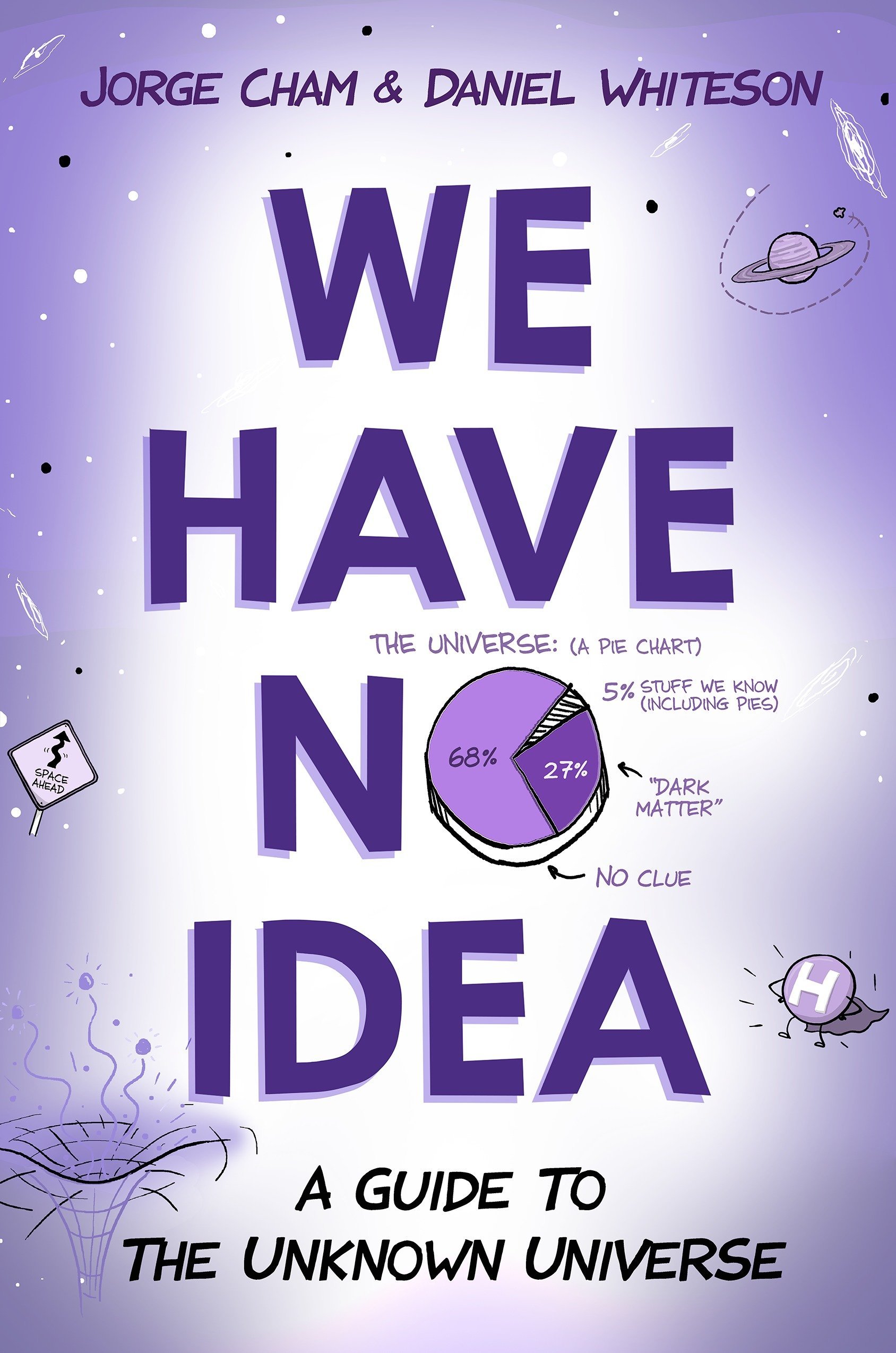
Jorge Cham writes Piled Higher and Deeper, a webcomic with possibly the most accurate depiction of grad school available. Daniel Whiteson is a professor at the University of California, Irvine, and a member of the ATLAS collaboration (one of the two big groups that make measurements at the Large Hadron Collider). Together, they’ve written a popular science book covering everything we don’t know about fundamental physics.

Writing a book about what we don’t know is an unusual choice, and there was a real risk it would end up as just a superficial gimmick. The pie chart on the cover presents the most famous “things physicists don’t know”, dark matter and dark energy. If they had just stuck to those this would have been a pretty ordinary popular physics book.

Refreshingly, they don’t do that. After blazing through dark matter and dark energy in the first three chapters, the rest of the book focuses on a variety of other scientific mysteries.

The book contains a mix of problems that get serious research attention (matter-antimatter asymmetry, high-energy cosmic rays) and more blue-sky “what if” questions (does matter have to be made out of particles?). As a theorist, I’m not sure that all of these questions are actually mysterious (we do have some explanation of the weird “1/3” charges of quarks, and I’d like to think we understand why mass includes binding energy), but even in these cases what we really know is that they follow from “sensible assumptions”, and one could just as easily ask “what if” about those assumptions instead. Overall, these “what if” questions make the book unique, and it would be a much weaker book without them.

“We Have No Idea” is strongest when the authors actually have some idea, i.e. when Whiteson is discussing experimental particle physics. It gets weaker on other topics, where the authors seem to rely more on others’ popular treatments (their discussion of “pixels of space-time” motivated me to write this post). Still, they at least seem to have asked the right people, and their accounts are on the more accurate end of typical pop science. (Closer to Quanta than IFLScience.)

The book’s humor really ties it together, often in surprisingly subtle ways. Each chapter has its own running joke, initially a throwaway line that grows into metaphors for everything the chapter discusses. It’s a great way to help the audience visualize without introducing too many new concepts at once. If there’s one thing cartoonists can teach science communicators, it’s the value of repetition.

I liked “We Have No Idea”. It could have been more daring, or more thorough, but it was still charming and honest and fun. If you’re looking for a Christmas present to explain physics to your relatives, you won’t go wrong with this book.

Why the Coupling Constants Aren’t Constant: Epistemology and Pragmatism

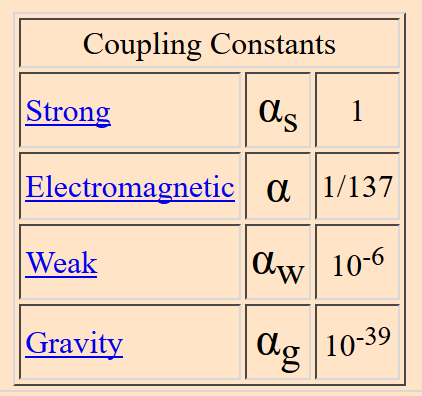
If you’ve heard a bit about physics, you might have heard that each of the fundamental forces (electromagnetism, the weak nuclear force, the strong nuclear force, and gravity) has a coupling constant, a number, handed down from nature itself, that determines how strong of a force it is. Maybe you’ve seen them in a table, like this:

tablefromhyperphysics

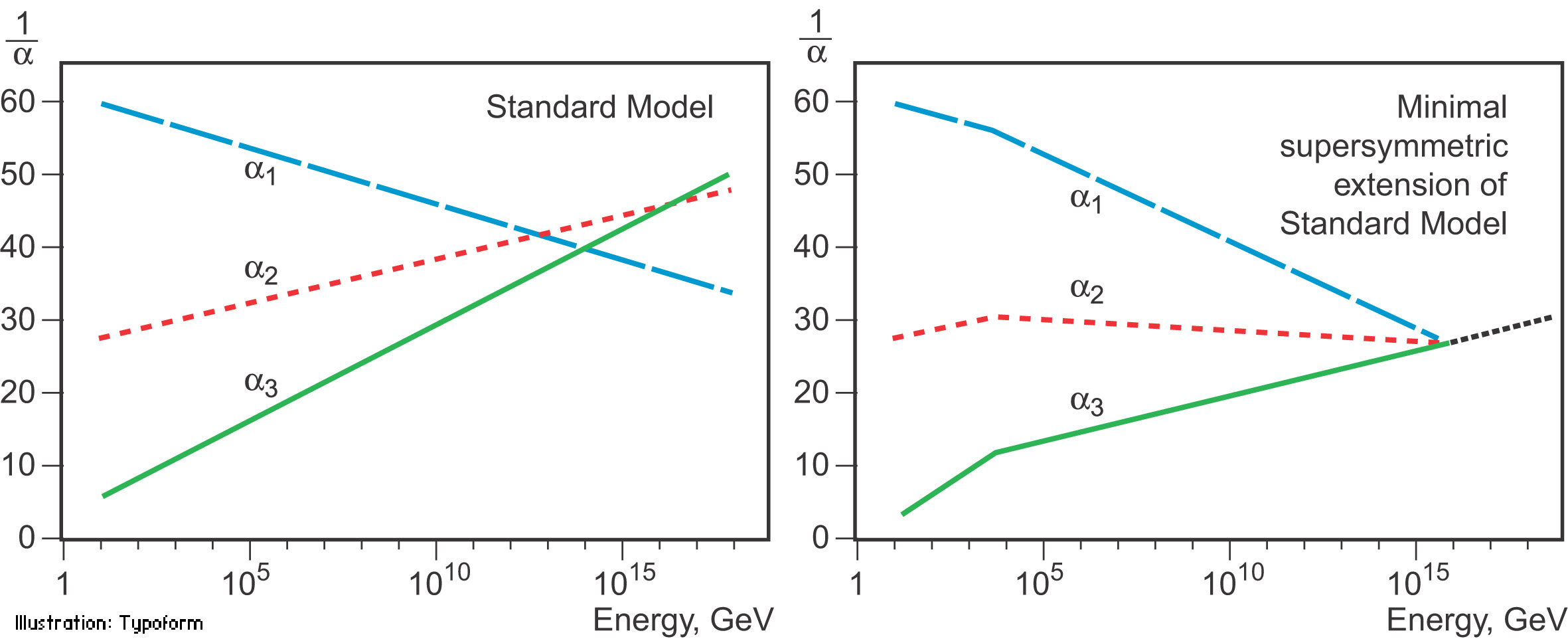
If you’ve heard a bit more about physics, though, you’ll have heard that those coupling constants aren’t actually constant! Instead, they vary with energy. Maybe you’ve seen them plotted like this:

phypub4highen

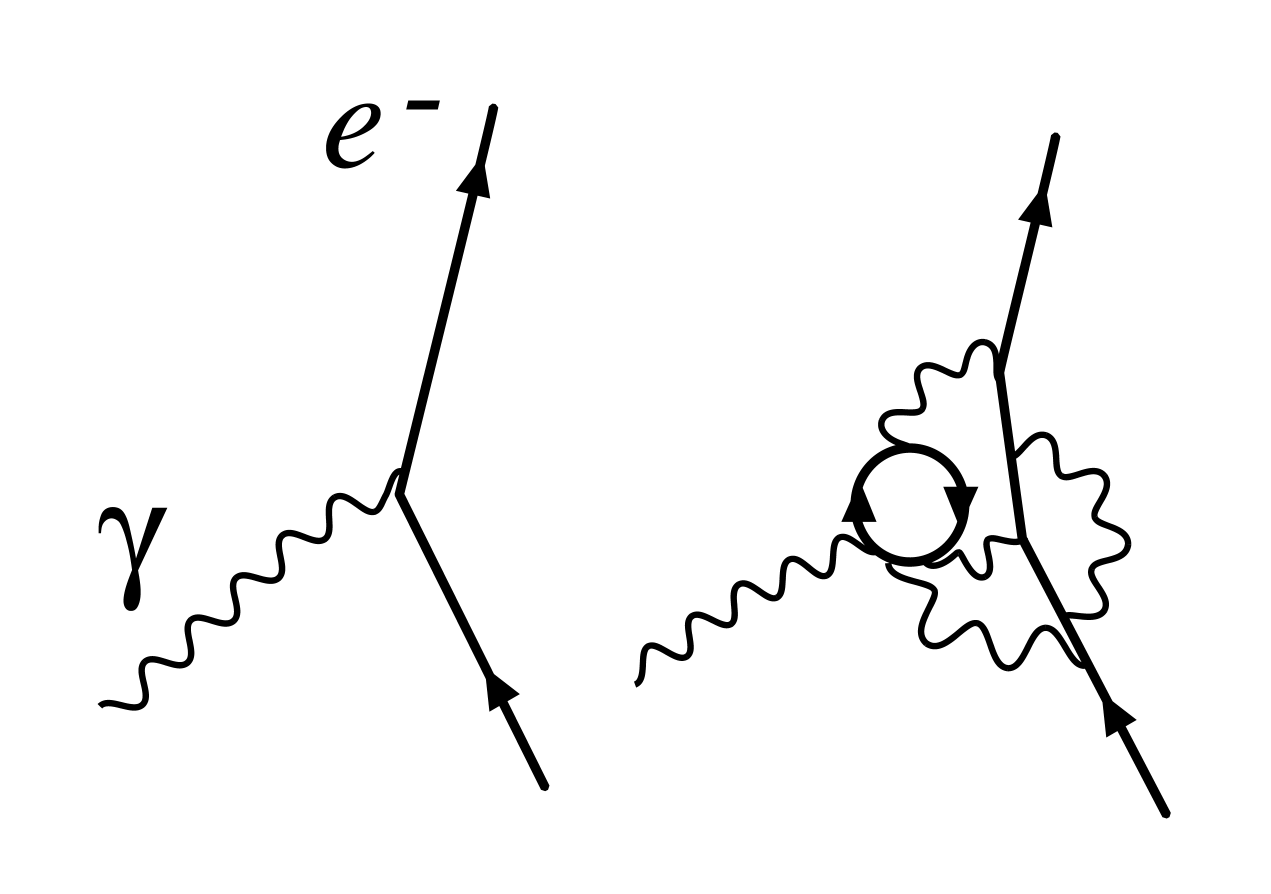
The usual way physicists explain this is in terms of quantum effects. We talk about “virtual particles”, and explain that any time particles and forces interact, these virtual particles can pop up, adding corrections that change with the energy of the interacting particles. The coupling constant includes all of these corrections, so it can’t be constant, it has to vary with energy.

renormalized-vertex

Maybe you’re happy with this explanation. But maybe you object:

“Isn’t there still a constant, though? If you ignore all the virtual particles, and drop all the corrections, isn’t there some constant number you’re correcting? Some sort of `bare coupling constant’ you could put into a nice table for me?”

There are two reasons I can’t do that. One is an epistemological reason, that comes from what we can and cannot know. The other is practical: even if I knew the bare coupling, most of the time I wouldn’t want to use it.

Let’s start with the epistemology:

The first thing to understand is that we can’t measure the bare coupling directly. When we measure the strength of forces, we’re always measuring the result of quantum corrections. We can’t “turn off” the virtual particles.

You could imagine measuring it indirectly, though. You’d measure the end result of all the corrections, then go back and calculate. That calculation would tell you how big the corrections were supposed to be, and you could subtract them off, solve the equation, and find the bare coupling.

And this would be a totally reasonable thing to do, except that when you go and try to calculate the quantum corrections, instead of something sensible, you get infinity.

We think that “infinity” is due to our ignorance: we know some of the quantum corrections, but not all of them, because we don’t have a final theory of nature. In order to calculate anything we need to hedge around that ignorance, with a trick called renormalization. I talk about that more in an older post. The key message to take away there is that in order to calculate anything we need to give up the hope of measuring certain bare constants, even “indirectly”. Once we fix a few constants that way, the rest of the theory gives reliable predictions.

So we can’t measure bare constants, and we can’t reason our way to them. We have to find the full coupling, with all the quantum corrections, and use that as our coupling constant.

Still, you might wonder, why does the coupling constant have to vary? Can’t I just pick one measurement, at one energy, and call that the constant?

This is where pragmatism comes in. You could fix your constant at some arbitrary energy, sure. But you’ll regret it.

In particle physics, we usually calculate in something called perturbation theory. Instead of calculating something exactly, we have to use approximations. We add up the approximations, order by order, expecting that each time the corrections will get smaller and smaller, so we get closer and closer to the truth.

And this works reasonably well if your coupling constant is small enough, provided it’s at the right energy.

If your coupling constant is at the wrong energy, then your quantum corrections will notice the difference. They won’t just be small numbers anymore. Instead, they end up containing logarithms of the ratio of energies. The more difference between your arbitrary energy scale and the correct one, the bigger these logarithms get.

This doesn’t make your calculation wrong, exactly. It makes your error estimate wrong. It means that your assumption that the next order is “small enough” isn’t actually true. You’d need to go to higher and higher orders to get a “good enough” answer, if you can get there at all.

Because of that, you don’t want to think about the coupling constants as actually constant. If we knew the final theory then maybe we’d know the true numbers, the ultimate bare coupling constants. But we still would want to use coupling constants that vary with energy for practical calculations. We’d still prefer the plot, and not just the table.

The Physics Isn’t New, We Are

Last week, I mentioned the announcement from the IceCube, Fermi-LAT, and MAGIC collaborations of high-energy neutrinos and gamma rays detected from the same source, the blazar TXS 0506+056. Blazars are sources of gamma rays, thought to be enormous spinning black holes that act like particle colliders vastly more powerful than the LHC. This one, near Orion’s elbow, is “aimed” roughly at Earth, allowing us to detect the light and particles it emits. On September 22, a neutrino with energy around 300 TeV was detected by IceCube (a kilometer-wide block of Antarctic ice stuffed with detectors), coming from the direction of TXS 0506+056. Soon after, the satellite Fermi-LAT and ground-based telescope MAGIC were able to confirm that the blazar TXS 0506+056 was flaring at the time. The IceCube team then looked back, and found more neutrinos coming from the same source in earlier years. There are still lingering questions (Why didn’t they see this kind of behavior from other, closer blazars?) but it’s still a nice development in the emerging field of “multi-messenger” astronomy.

It also got me thinking about a conversation I had a while back, before one of Perimeter’s Public Lectures. An elderly fellow was worried about the LHC. He wondered if putting all of that energy in the same place, again and again, might do something unprecedented: weaken the fabric of space and time, perhaps, until it breaks? He acknowledged this didn’t make physical sense, but what if we’re wrong about the physics? Do we really want to take that risk?

At the time, I made the same point that gets made to counter fears of the LHC creating a black hole: that the energy of the LHC is less than the energy of cosmic rays, particles from space that collide with our atmosphere on a regular basis. If there was any danger, it would have already happened. Now, knowing about blazars, I can make a similar point: there are “galactic colliders” with energies so much higher than any machine we can build that there’s no chance we could screw things up on that kind of scale: if we could, they already would have.

This connects to a broader point, about how to frame particle physics. Each time we build an experiment, we’re replicating something that’s happened before. Our technology simply isn’t powerful enough to do something truly unprecedented in the universe: we’re not even close! Instead, the point of an experiment is to reproduce something where we can see it. It’s not the physics itself, but our involvement in it, our understanding of it, that’s genuinely new.

The IceCube experiment itself is a great example of this: throughout Antarctica, neutrinos collide with ice. The only difference is that in IceCube’s ice, we can see them do it. More broadly, I have to wonder how much this is behind the “unreasonable effectiveness of mathematics”: if mathematics is just the most precise way humans have to communicate with each other, then of course it will be effective in physics, since the goal of physics is to communicate the nature of the world to humans!

There may well come a day when we’re really able to do something truly unprecedented, that has never been done before in the history of the universe. Until then, we’re playing catch-up, taking laws the universe has tested extensively and making them legible, getting humanity that much closer to understanding physics that, somewhere out there, already exists.

Why a New Particle Matters

A while back, when the MiniBoone experiment announced evidence for a sterile neutrino, I was excited. It’s still not clear whether they really found something, here’s an article laying out the current status. If they did, it would be a new particle beyond those predicted by the Standard Model, something like the neutrinos but which doesn’t interact with any of the fundamental forces except gravity.

At the time, someone asked me why this was so exciting. Does it solve the mystery of dark matter, or any other long-standing problems?

The sterile neutrino MiniBoone is suggesting isn’t, as far as I’m aware, a plausible candidate for dark matter. It doesn’t solve any long-standing problems (for example, it doesn’t explain why the other neutrinos are so much lighter than other particles). It would even introduce new problems of its own!

It still matters, though. One reason, which I’ve talked about before, is that each new type of particle implies a new law of nature, a basic truth about the universe that we didn’t know before. But there’s another reason why a new particle matters.

There’s a malaise in particle physics. For most of the twentieth century, theory and experiment were tightly linked. Unexpected experimental results would demand new theory, which would in turn suggest new experiments, driving knowledge forward. That mostly stopped with the Standard Model. There are a few lingering anomalies, like the phenomena we attribute to dark matter, that show the Standard Model can’t be the full story. But as long as every other experiment fits the Standard Model, we have no useful hints about where to go next. We’re just speculating, and too much of that warps the field.

Critics of the physics mainstream pick up on this, but I’m not optimistic about what I’ve seen of their solutions. Peter Woit has suggested that physics should emulate the culture of mathematics, caring more about rigor and being more careful to confirm things before speaking. The title of Sabine Hossenfelder’s “Lost in Math” might suggest the opposite, but I get the impression she’s arguing for something similar: that particle physicists have been using sloppy arguments and should clean up their act, taking foundational problems seriously and talking to philosophers to help clarify their ideas.

Rigor and clarity are worthwhile, but the problems they’ll solve aren’t the ones causing the malaise. If there are problems we can expect to solve just by thinking better, they’re problems that we found by thinking in the first place: quantum gravity theories that stop making sense at very high energies, paradoxical thought experiments with black holes. There, rigor and clarity can matter: to some extent they’re already there, but I can appreciate the argument that it’s not yet nearly enough.

What rigor and clarity won’t do is make physics feel (and function) like it did in the twentieth century. For that, we need new evidence: experiments that disobey the Standard Model, and do it in a clear enough way that we can’t just chalk it up to predictable errors. We need a new particle, or something like it. Without that, our theories are most likely underdetermined by the data, and anything we propose is going to be subjective. Our subjective judgements may get better, we may get rid of the worst-justified biases, but at the end of the day we still won’t have enough information to actually make durable progress.

That’s not a popular message, in part, because it’s not something we can control. There’s a degree of helplessness in realizing that if nature doesn’t throw us a bone then we’ll probably just keep going in circles forever. It’s not the kind of thing that lends itself to a pithy blog post.

If there’s something we can do, it’s to keep our eyes as open as possible, to make sure we don’t miss nature’s next hint. It’s why people are getting excited about low-energy experiments, about precision calculations, about LIGO. Even this seemingly clickbaity proposal that dark matter killed the dinosaurs is motivated by the same sort of logic: if the only evidence for dark matter we have is gravitational, what can gravitational evidence tell us about what it’s made of? In each case, we’re trying to widen our net, to see new phenomena we might have missed.

I suspect that’s why this reviewer was disappointed that Hossenfelder’s book lacked a vision for the future. It’s not that the book lacked any proposals whatsoever. But it lacked this kind of proposal, of a new place to look, where new evidence, and maybe a new particle, might be found. Without that we can still improve things, we can still make progress on deep fundamental mathematical questions, we can kill off the stupidest of the stupid arguments. But the malaise won’t lift, we won’t get back to the health of twentieth century physics. For that, we need to see something new.

Amplitudes 2018

This week, I’m at Amplitudes, my field’s big yearly conference. The conference is at SLAC National Accelerator Laboratory this year, a familiar and lovely place.

IMG_20180620_183339441_HDR

Welcome to the Guest House California

It’s been a packed conference, with a lot of interesting talks. Recording and slides of most of them should be up at this point, for those following at home. I’ll comment on a few that caught my attention, I might do a more in-depth post later.

The first morning was dedicated to gravitational waves. At the QCD Meets Gravity conference last December I noted that amplitudes folks were very eager to do something relevant to LIGO, but that it was still a bit unclear how we could contribute (aside from Pierpaolo Mastrolia, who had already figured it out). The following six months appear to have cleared things up considerably, and Clifford Cheung and Donal O’Connel’s talks laid out quite concrete directions for this kind of research.

I’d seen Erik Panzer talk about the Hepp bound two weeks ago at Les Houches, but that was for a much more mathematically-inclined audience. It’s been interesting seeing people here start to see the implications: a simple method to classify and estimate (within 1%!) Feynman integrals could be a real game-changer.

Brenda Penante’s talk made me rethink a slogan I like to quote, that N=4 super Yang-Mills is the “most transcendental” part of QCD. While this is true in some cases, in many ways it’s actually least true for amplitudes, with quite a few counterexamples. For other quantities (like the form factors that were the subject of her talk) it’s true more often, and it’s still unclear when we should expect it to hold, or why.

Nima Arkani-Hamed has a reputation for talks that end up much longer than scheduled. Lately, it seems to be due to the sheer number of projects he’s working on. He had to rush at the end of his talk, which would have been about cosmological polytopes. I’ll have to ask his collaborator Paolo Benincasa for an update when I get back to Copenhagen.

Tuesday afternoon was a series of talks on the “NNLO frontier”, two-loop calculations that form the state of the art for realistic collider physics predictions. These talks brought home to me that the LHC really does need two-loop precision, and that the methods to get it are still pretty cumbersome. For those of us off in the airy land of six-loop N=4 super Yang-Mills, this is the challenge: can we make what these people do simpler?

Wednesday cleared up a few things for me, from what kinds of things you can write down in “fishnet theory” to how broad Ashoke Sen’s soft theorem is, to how fast John Joseph Carrasco could show his villanelle slide. It also gave me a clearer idea of just what simplifications are available for pushing to higher loops in supergravity.

Wednesday was also the poster session. It keeps being amazing how fast the field is growing, the sheer number of new faces was quite inspiring. One of those new faces pointed me to a paper I had missed, suggesting that elliptic integrals could end up trickier than most of us had thought.

Thursday featured two talks by people who work on the Conformal Bootstrap, one of our subfield’s closest relatives. (We’re both “bootstrappers” in some sense.) The talks were interesting, but there wasn’t a lot of engagement from the audience, so if the intent was to make a bridge between the subfields I’m not sure it panned out. Overall, I think we’re mostly just united by how we feel about Simon Caron-Huot, who David Simmons-Duffin described as “awesome and mysterious”. We also had an update on attempts to extend the Pentagon OPE to ABJM, a three-dimensional analogue of N=4 super Yang-Mills.

I’m looking forward to Friday’s talks, promising elliptic functions among other interesting problems.

A Paper About Ranking Papers

If you’ve ever heard someone list problems in academia, citation-counting is usually near the top. Hiring and tenure committees want easy numbers to judge applicants with: number of papers, number of citations, or related statistics like the h-index. Unfortunately, these metrics can be gamed, leading to a host of bad practices that get blamed for pretty much everything that goes wrong in science. In physics, it’s not even clear that these statistics tell us anything: papers in our field have been including more citations over time, and for thousand-person experimental collaborations the number of citations and papers don’t really reflect any one person’s contribution.

It’s pretty easy to find people complaining about this. It’s much rarer to find a proposed solution.

That’s why I quite enjoyed Alessandro Strumia and Riccardo Torre’s paper last week, on Biblioranking fundamental physics.

Some of their suggestions are quite straightforward. With the number of citations per paper increasing, it makes sense to divide each paper by the number of citations it contains: it means more to get cited by a paper with ten citations than by a paper with one hundred. Similarly, you could divide credit for a paper among its authors, rather than giving each author full credit.

Some are more elaborate. They suggest using a variant of Google’s PageRank algorithm to rank papers and authors. Essentially, the algorithm imagines someone wandering from paper to paper and tries to figure out which papers are more central to the network. This is apparently an old idea, but by combining it with their normalization by number of citations they eke a bit more mileage from it. (I also found their treatment a bit clearer than the older papers they cite. There are a few more elaborate setups in the literature as well, but they seem to have a lot of free parameters so Strumia and Torre’s setup looks preferable on that front.)

One final problem they consider is that of self-citations, and citation cliques. In principle, you could boost your citation count by citing yourself. While that’s easy to correct for, you could also be one of a small number of authors who cite each other a lot. To keep the system from being gamed in this way, they propose a notion of a “CitationCoin” that counts (normalized) citations received minus (normalized) citations given. The idea is that, just as you can’t make anyone richer just by passing money between your friends without doing anything with it, so a small community can’t earn “CitationCoins” without getting the wider field interested.

There are still likely problems with these ideas. Dividing each paper by its number of authors seems like overkill: a thousand-person paper is not typically going to get a thousand times as many citations. I also don’t know whether there are ways to game this system: since the metrics are based in part on citations given, not just citations received, I worry there are situations where it would be to someone’s advantage to cite others less. I think they manage to avoid this by normalizing by number of citations given, and they emphasize that PageRank itself is estimating something we directly care about: how often people read a paper. Still, it would be good to see more rigorous work probing the system for weaknesses.

In addition to the proposed metrics, Strumia and Torre’s paper is full of interesting statistics about the arXiv and InSpire databases, both using more traditional metrics and their new ones. Whether or not the methods they propose work out, the paper is definitely worth a look.

Path Integrals and Loop Integrals: Different Things!

When talking science, we need to be careful with our words. It’s easy for people to see a familiar word and assume something totally different from what we intend. And if we use the same word twice, for two different things…

I’ve noticed this problem with the word “integral”. When physicists talk about particle physics, there are two kinds of integrals we mention: path integrals, and loop integrals. I’ve seen plenty of people get confused, and assume that these two are the same thing. They’re not, and it’s worth spending some time explaining the difference.

Let’s start with path integrals (also referred to as functional integrals, or Feynman integrals). Feynman promoted a picture of quantum mechanics in which a particle travels along many different paths, from point A to point B.

three_paths_from_a_to_b

You’ve probably seen a picture like this. Classically, a particle would just take one path, the shortest path, from A to B. In quantum mechanics, you have to add up all possible paths. Most longer paths cancel, so on average the short, classical path is the most important one, but the others do contribute, and have observable, quantum effects. The sum over all paths is what we call a path integral.

It’s easy enough to draw this picture for a single particle. When we do particle physics, though, we aren’t usually interested in just one particle: we want to look at a bunch of different quantum fields, and figure out how they will interact.

We still use a path integral to do that, but it doesn’t look like a bunch of lines from point A to B, and there isn’t a convenient image I can steal from Wikipedia for it. The quantum field theory path integral adds up, not all the paths a particle can travel, but all the ways a set of quantum fields can interact.

How do we actually calculate that?

One way is with Feynman diagrams, and (often, but not always) loop integrals.

4grav2loop

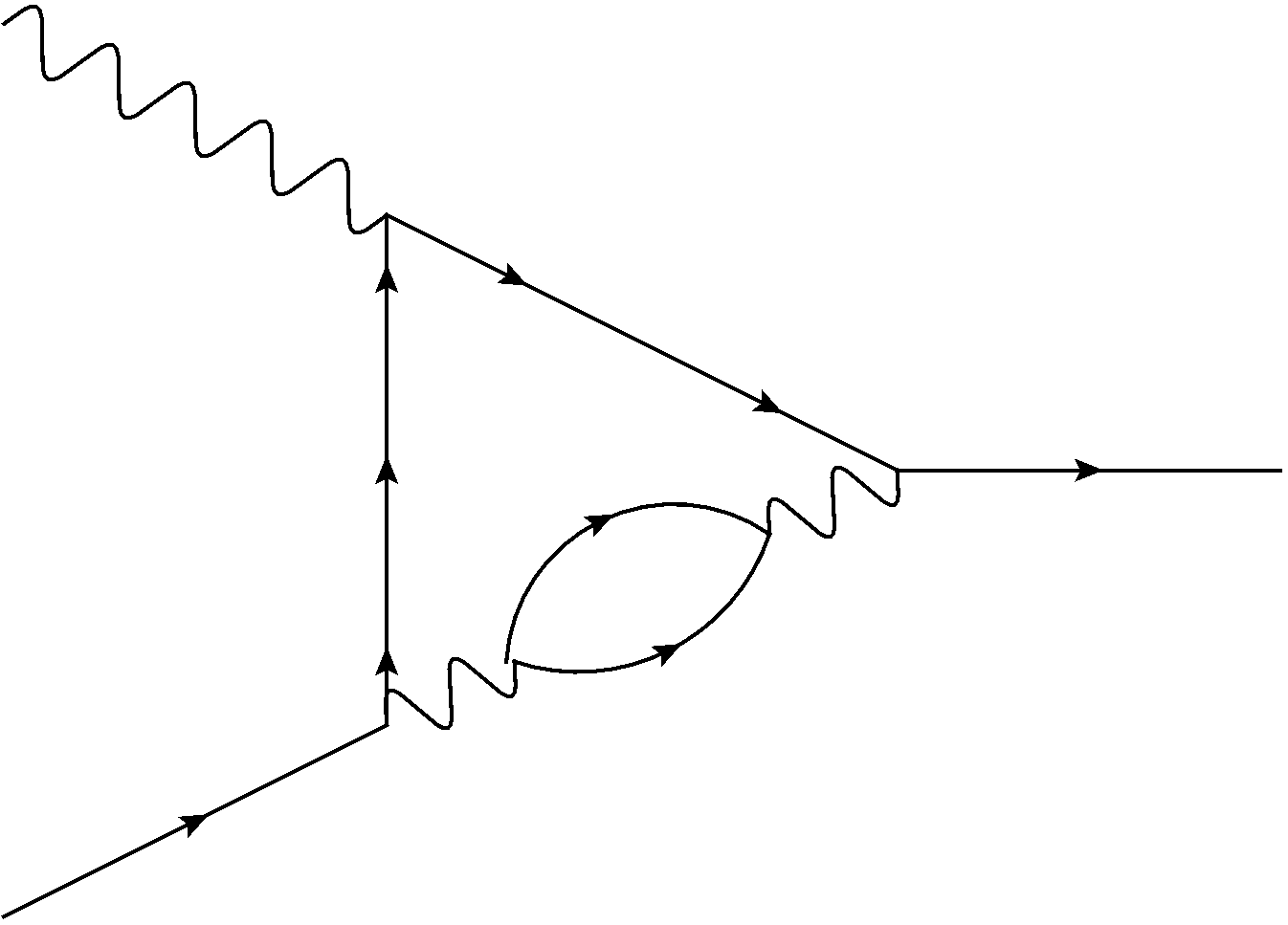
I’ve talked about Feynman diagrams before. Each one is a picture of one possible way that particles can travel, or that quantum fields can interact. In some (loose) sense, each one is a single path in the path integral.

Each diagram serves as instructions for a calculation. We take information about the particles, their momenta and energy, and end up with a number. To calculate a path integral exactly, we’d have to add up all the diagrams we could possibly draw, to get a sum over all possible paths.

(There are ways to avoid this in special cases, which I’m not going to go into here.)

Sometimes, getting a number out of a diagram is fairly simple. If the diagram has no closed loops in it (if it’s what we call a tree diagram) then knowing the properties of the in-coming and out-going particles is enough to know the rest. If there are loops, though, there’s uncertainty: you have to add up every possible momentum of the particles in the loops. You do that with a different integral, and that’s the one that we sometimes refer to as a loop integral. (Perhaps confusingly, these are also often called Feynman integrals: Feynman did a lot of stuff!)

\frac{i^{a+l(1-d/2)}\pi^{ld/2}}{\prod_i \Gamma(a_i)}\int_0^\infty...\int_0^\infty \prod_i\alpha_i^{a_i-1}U^{-d/2}e^{iF/U-i\sum m_i^2\alpha_i}d\alpha_1...d\alpha_n

Loop integrals can be pretty complicated, but at heart they’re the same sort of thing you might have seen in a calculus class. Mathematicians are pretty comfortable with them, and they give rise to numbers that mathematicians find very interesting.

Path integrals are very different. In some sense, they’re an “integral over integrals”, adding up every loop integral you could write down. Mathematicians can define path integrals in special cases, but it’s still not clear that the general case, the overall path integral picture we use, actually makes rigorous mathematical sense.

So if you see physicists talking about integrals, it’s worth taking a moment to figure out which one we mean. Path integrals and loop integrals are both important, but they’re very, very different things.