Tag Archives: Higgs

Want to Make Something New? Just Turn on the Lights.

Isn’t it weird that you can collide two protons, and get something else?

It wouldn’t be so weird if you collided two protons, and out popped a quark. After all, protons are made of quarks. But how, if you collide two protons together, do you get a tau, or the Higgs boson: things that not only aren’t “part of” protons, but are more massive than a proton by themselves?

It seems weird…but in a way, it’s not. When a particle releases another particle that wasn’t inside it to begin with, it’s actually not doing anything more special than an everyday light bulb.

Eureka!

How does a light bulb work?

You probably know the basics: when an electrical current enters the bulb, the electrons in the filament start to move. They heat the filament up, releasing light.

That probably seems perfectly ordinary. But ask yourself for a moment: where did the light come from?

Light is made up of photons, elementary particles in their own right. When you flip a light switch, where do the photons come from? Were they stored in the light bulb?

Silly question, right? You don’t need to “store” light in a light bulb: light bulbs transform one type of energy (electrical, or the movement of electrons) into another type of energy (light, or photons).

Here’s the thing, though: mass is just another type of energy.

I like to describe mass as “energy we haven’t met yet”. Einstein’s equation, E=mc^2, relates a particle’s mass to its “rest energy”, the energy it would have if it stopped moving around and sit still. Even when a particle seems to be sitting still from the outside, there’s still a lot going on, though. “Composite” particles like protons have powerful forces between their internal quarks, while particles like electrons interact with the Higgs field. These processes give the particle energy, even when it’s not moving, so from our perspective on the outside they’re giving the particle mass.

What does that mean for the protons at the LHC?

The protons at the LHC have a lot of kinetic energy: they’re going 99.9999991% of the speed of light! When they collide, all that energy has to go somewhere. Just like in a light bulb, the fast-moving particles will release their energy in another form. And while that some of that energy will add to the speed of the fragments, much of it will go into the mass and energy of new particles. Some of these particles will be photons, some will be tau leptons, or Higgs bosons…pretty much anything that the protons have enough energy to create.

So if you want to understand how to create new particles, you don’t need a deep understanding of the mysteries of quantum field theory. Just turn on the lights.

What Counts as a Fundamental Force?

I’m giving a presentation next Wednesday for Learning Unlimited, an organization that presents educational talks to seniors in Woodstock, Ontario. The talk introduces the fundamental forces and talks about Yang and Mills before moving on to introduce my work.

While practicing the talk today, someone from Perimeter’s outreach department pointed out a rather surprising missing element: I never mention gravity!

Most people know that there are four fundamental forces of nature. There’s Electromagnetism, there’s Gravity, there’s the Weak Nuclear Force, and there’s the Strong Nuclear Force.

Listed here by their most significant uses.

What ties these things together, though? What makes them all “fundamental forces”?

Mathematically, gravity is the odd one out here. Electromagnetism, the Weak Force, and the Strong Force all share a common description: they’re Yang-Mills forces. Gravity isn’t. While you can sort of think of it as a Yang-Mills force “squared”, it’s quite a bit more complicated than the Yang-Mills forces.

You might be objecting that the common trait of the fundamental forces is obvious: they’re forces! And indeed, you can write down a force law for gravity, and a force law for E&M, and umm…

[Mumble Mumble]

Ok, it’s not quite as bad as xkcd would have us believe. You can actually write down a force law for the weak force, if you really want to, and it’s at least sort of possible to talk about the force exerted by the strong interaction.

All that said, though, why are we thinking about this in terms of forces? Forces are a concept from classical mechanics. For a beginning physics student, they come up again and again, in free-body diagram after free-body diagram. But by the time a student learns quantum mechanics, and quantum field theory, they’ve already learned other ways of framing things where forces aren’t mentioned at all. So while forces are kind of familiar to people starting out, they don’t really match onto anything that most quantum field theorists work with, and it’s a bit weird to classify things that only really appear in quantum field theory (the Weak Nuclear Force, the Strong Nuclear Force) based on whether or not they’re forces.

Isn’t there some connection, though? After all, gravity, electromagnetism, the strong force, and the weak force may be different mathematically, but at least they all involve bosons.

Well, yes. And so does the Higgs.

The Higgs is usually left out of listings of the fundamental forces, because it’s not really a “force”. It doesn’t have a direction, instead it works equally at every point in space. But if you include spin 2 gravity and spin 1 Yang-Mills forces, why not also include the spin 0 Higgs?

Well, if you’re doing that, why not include fermions as well? People often think of fermions as “matter” and bosons as “energy”, but in fact both have energy, and neither is made of it. Electrons and quarks are just as fundamental as photons and gluons and gravitons, just as central a part of how the universe works.

I’m still trying to decide whether my presentation about Yang-Mills forces should also include gravity. On the one hand, it would make everything more familiar. On the other…pretty much this entire post.

How to Predict the Mass of the Higgs

Did Homer Simpson predict the mass of the Higgs boson?

No, of course not.

Apart from the usual reasons, he’s off by more than a factor of six.

If you play with the numbers, it looks like Simon Singh (the popular science writer who reported the “discovery” Homer made as a throwaway joke in a 1998 Simpsons episode) made the classic physics mistake of losing track of a factor of 2\pi. In particular, it looks like he mistakenly thought that the Planck constant, h, was equal to the reduced Planck constant, \hbar, divided by 2\pi, when actually it’s \hbar times 2\pi. So while Singh read Homer’s prediction as 123 GeV, surprisingly close to the actual Higgs mass of 125 GeV found in 2012, in fact Homer predicted the somewhat more embarrassing value of 775 GeV.

D’Oh!

That was boring. Let’s ask a more interesting question.

Did Gordon Kane predict the mass of the Higgs boson?

I’ve talked before about how it seems impossible that string theory will ever make any testable predictions. The issue boils down to one of too many possibilities: string theory predicts different consequences for different ways that its six (or seven for M theory) extra dimensions can be curled up. Since there is an absurdly vast number of ways this can be done, anything you might want to predict (say, the mass of the electron) has an absurd number of possible values.

Gordon Kane and collaborators get around this problem by tackling a different one. Instead of trying to use string theory to predict things we already know, like the mass of the electron, they assume these things are already true. That is, they assume we live in a world with electrons that have the mass they really have, and quarks that have the mass they really have, and so on. They assume that we live in a world that obeys all of the discoveries we’ve already made, and a few we hope to make. And, they assume that this world is a consequence of string (or rather M) theory.

From that combination of assumptions, they then figure out the consequences for things that aren’t yet known. And in a 2011 paper, they predicted the Higgs mass would be between 105 and 129 GeV.

I have a lot of sympathy for this approach, because it’s essentially the same thing that non-string-theorists do. When a particle physicist wants to predict what will come out of the LHC, they don’t try to get it from first principles: they assume the world works as we have discovered, make a few mild extra assumptions, and see what new consequences come out that we haven’t observed yet. If those particle physicists can be said to make predictions from supersymmetry, or (shudder) technicolor, then Gordon Kane is certainly making predictions from string theory.

So why haven’t you heard of him? Even if you have, why, if this guy successfully predicted the mass of the Higgs boson, are people still saying that you can’t make predictions with string theory?

Trouble is, making predictions is tricky.

Part of the problem is timing. Gordon Kane’s paper went online in December of 2011. The Higgs mass was announced in July 2012, so you might think Kane got a six month head-start. But when something is announced isn’t the same as when it’s discovered. For a big experiment like the Large Hadron Collider, there’s a long road between the first time something gets noticed and the point where everyone is certain enough that they’re ready to announce it to the world. Rumors fly, and it’s not clear that Kane and his co-authors wouldn’t have heard them.

Assumptions are the other issue. Remember when I said, a couple paragraphs up, that Kane’s group assumed “that we live in a world that obeys all of the discoveries we’ve already made, and a few we hope to make“? That last part is what makes things tricky. There were a few extra assumptions Kane made, beyond those needed to reproduce the world we know. For many people, some of these extra assumptions are suspicious. They worry that the assumptions might have been chosen, not just because they made sense, but because they happened to give the right (rumored) mass of the Higgs.

If you want to predict something in physics, it’s not just a matter of getting in ahead of the announcement with the right number. For a clear prediction, you need to be early enough that the experiments haven’t yet even seen hints of what you’re looking for. Even then, you need your theory to be suitably generic, so that it’s clear that your prediction is really the result of the math and not of your choices. You can trade off aspects of this: more accuracy for a less generic theory, better timing for looser predictions. Get the formula right, and the world will laud you for your prediction. Wrong, and you’re Homer Simpson. Somewhere in between, though, and you end up in that tricky, tricky grey area.

Like Gordon Kane.

The Three Things Everyone Gets Wrong about the Big Bang

Ah, the Big Bang, our most science-y of creation myths. Everyone knows the story of how the universe and all its physical laws emerged from nothing in a massive explosion, growing from a singularity to the size of a breadbox until, over billions of years, it became the size it is today.

bigbang

A hot dense state, if you know what I mean.

…actually, almost nothing in that paragraph is true. There are a lot of myths about the Big Bang, born from physicists giving sloppy explanations. Here are three things most people get wrong about the Big Bang:

1. A Massive Explosion:

When you picture the big bang, don’t you imagine that something went, well, bang?

In movies and TV shows, a time traveler visiting the big bang sees only an empty void. Suddenly, an explosion lights up the darkness, shooting out stars and galaxies until it has created the entire universe.

Astute readers might find this suspicious: if the entire universe was created by the big bang, then where does the “darkness” come from? What does the universe explode into?

The problem here is that, despite the name, the big bang was not actually an explosion.

In picturing the universe as an explosion, you’re imagining the universe as having finite size. But it’s quite likely that the universe is infinite. Even if it is finite, it’s finite like the surface of the Earth: as Columbus (and others) experienced, you can’t get to the “edge” of the Earth no matter how far you go: eventually, you’ll just end up where you started. If the universe is truly finite, the same is true of it.

Rather than an explosion in one place, the big bang was an explosion everywhere at once. Every point in space was “exploding” at the same time. Each point was moving farther apart from every other point, and the whole universe was, as the song goes, hot and dense.

So what do physicists mean when they say that the universe at some specific time was the size of a breadbox, or a grapefruit?

It’s just sloppy language. When these physicists say “the universe”, what they mean is just the part of the universe we can see today, the Hubble Volume. It is that (enormously vast) space that, once upon a time, was merely the size of a grapefruit. But it was still adjacent to infinitely many other grapefruits of space, each one also experiencing the big bang.

2. It began with a Singularity:

This one isn’t so much definitely wrong as probably wrong.

If the universe obeys Einstein’s Theory of General Relativity perfectly, then we can make an educated guess about how it began. By tracking back the expansion of the universe to its earliest stages, we can infer that the universe was once as small as it can get: a single, zero-dimensional point, or a singularity. The laws of general relativity work the same backwards and forwards in time, so just as we could see a star collapsing and know that it is destined to form a black hole, we can see the universe’s expansion and know that if we traced it back it must have come from a single point.

This is all well and good, but there’s a problem with how it begins: “If the universe obeys Einstein’s Theory of General Relativity perfectly”.

In this situation, general relativity predicts an infinitely small, infinitely dense point. As I’ve talked about before, in physics an infinite result is almost never correct. When we encounter infinity, almost always it means we’re ignoring something about the nature of the universe.

In this case, we’re ignoring Quantum Mechanics. Quantum Mechanics naturally makes physics somewhat “fuzzy”: the Uncertainty Principle means that a quantum state can never be exactly in one specific place.

Combining quantum mechanics and general relativity is famously tricky, and the difficulty boils down to getting rid of pesky infinite results. However, several approaches exist to solving this problem, the most prominent of them being String Theory.

If you ask someone to list string theory’s successes, one thing you’ll always hear mentioned is string theory’s ability to understand black holes. In general relativity, black holes are singularities: infinitely small, and infinitely dense. In string theory, black holes are made up of combinations of fundamental objects: strings and membranes, curled up tight, but crucially not infinitely small. String theory smooths out singularities and tamps down infinities, and the same story applies to the infinity of the big bang.

String theory isn’t alone in this, though. Less popular approaches to quantum gravity, like Loop Quantum Gravity, also tend to “fuzz” out singularities. Whichever approach you favor, it’s pretty clear at this point that the big bang didn’t really begin with a true singularity, just a very compressed universe.

3. It created the laws of physics:

Physicists will occasionally say that the big bang determined the laws of physics. Fans of Anthropic Reasoning in particular will talk about different big bangs in different places in a vast multi-verse, each producing different physical laws.

I’ve met several people who were very confused by this. If the big bang created the laws of physics, then what laws governed the big bang? Don’t you need physics to get a big bang in the first place?

The problem here is that “laws of physics” doesn’t have a precise definition. Physicists use it to mean different things.

In one (important) sense, each fundamental particle is its own law of physics. Each one represents something that is true across all of space and time, a fact about the universe that we can test and confirm.

However, these aren’t the most fundamental laws possible. In string theory, the particles that exist in our four dimensions (three space dimensions, and one of time) change depending on how six “extra” dimensions are curled up. Even in ordinary particle physics, the value of the Higgs field determines the mass of the particles in our universe, including things that might feel “fundamental” like the difference between electromagnetism and the weak nuclear force. If the Higgs field had a different value (as it may have early in the life of the universe), these laws of physics would have been different. These sorts of laws can be truly said to have been created by the big bang.

The real fundamental laws, though, don’t change. Relativity is here to stay, no matter what particles exist in the universe. So is quantum mechanics. The big bang didn’t create those laws, it was a natural consequence of them. Rather than springing physics into existence from nothing, the big bang came out of the most fundamental laws of physics, then proceeded to fix the more contingent ones.

In fact, the big bang might not have even been the beginning of time! As I mentioned earlier in this article, most approaches to quantum gravity make singularities “fuzzy”. One thing these “fuzzy” singularities can do is “bounce”, going from a collapsing universe to an expanding universe. In Cyclic Models of the universe, the big bang was just the latest in a cycle of collapses and expansions, extending back into the distant past. Other approaches, like Eternal Inflation, instead think of the big bang as just a local event: our part of the universe happened to be dense enough to form a big bang, while other regions were expanding even more rapidly.

So if you picture the big bang, don’t just imagine an explosion. Imagine the entire universe expanding at once, changing and settling and cooling until it became the universe as we know it today, starting from a world of tangled strings or possibly an entirely different previous universe.

Sounds a bit more interesting to visit in your TARDIS, no?

Misleading Headlines and Tacky Physics, Oh My!

It’s been making the rounds on the blogosphere (despite having come out three months ago). It’s probably showed up on your Facebook feed. It’s the news that (apparently) one of the biggest discoveries of recent years may have been premature. It’s….

The Huffington Post writing a misleading headline to drum up clicks!

The article linked above is titled “Scientists Raise Doubts About Higgs Boson Discovery, Say It Could Be Another Particle”. And while that is indeed technically all true, it’s more than a little misleading.

When the various teams at the Large Hadron Collider announced their discovery of the Higgs, they didn’t say it was exactly the Higgs predicted by the Standard Model. In fact, it probably shouldn’t be: most of the options for extending the Standard Model, like supersymmetry, predict a Higgs boson with slightly different properties. Until the Higgs is measured more precisely, these slightly different versions won’t be ruled out.

Of course, “not ruled out” is not exactly newsworthy, which is the main problem with this article. The Huffington Post quotes a paper that argues, not that there is new evidence for an alternative to the Higgs, but simply that one particular alternative that the authors like hasn’t been ruled out yet.

Also, it’s probably the tackiest alternative out there.

The theory in question is called Technicolor, and if you’re imagining a certain coat then you may have an idea of how tacky we’re talking.

Any Higgs will do…

To describe technicolor, let’s take a brief aside and talk about the colors of quarks.

Rather than having one type of charge going from plus to minus like Electromagnetism, the Strong Nuclear Force has three types of charge, called red, green, and blue. Quarks are charged under the strong force, and can be red, green, or blue, while the antimatter partners of quarks have the equivalent of negative charges, anti-red, anti-green, and anti-blue. The strong force binds quarks together into protons and neutrons. The strong force is also charged under itself, which means that not only does it bind quarks together, it also binds itself together, so that it only acts at very very short range.

In combination, these two facts have one rather surprising consequence. A proton contains three quarks, but a proton’s mass is over a hundred times the total mass of three quarks. The same is true of neutrons.

The reason why is that most of the mass isn’t coming from the quarks, it’s coming from the strength of the strong force. Mass, contrary to what you might think, isn’t fundamental “stuff”. It’s just a handy way of talking about energy that isn’t due to something we can easily see. Particles have energy because they move, but they also have energy due to internal interactions, as well as interactions with other fields like the Higgs field. While a lone quark’s mass is due to its interaction with the Higgs field, the quarks inside a proton are also interacting with each other, gaining enormous amounts of energy from the strong force trapped within. That energy, largely invisible from an outside view, contributes most of what we see as the mass of the proton.

Technicolor asks the following: what if it’s not just protons and neutrons? What if the mass of everything, quarks and electrons and the W and Z bosons, was due not truly to the Higgs, but to another force, like the strong force but even stronger? The Higgs we think we saw at the LHC would not be fundamental, but merely a composite, made up of  two “techni-quarks” with “technicolor” charges. [Edited to remove confusion with Preon Theory]

It’s…an idea. But it’s never been a very popular one.

Part of the problem is that the simpler versions of technicolor have been ruled out, so theorists are having to invoke increasingly baroque models to try to make it work. But that, to some extent, is also true of supersymmetry.

A bigger problem is that technicolor is just kind of…tacky.

Technicolor doesn’t say anything deep about the way the universe works. It doesn’t propose new [types of] symmetries, and it doesn’t say anything about what happens at the very highest energies. It’s not really tied in to any of the other lines of speculation in physics, it doesn’t lead to a lot of discussion between researchers. It doesn’t require an end, a fundamental lowest level with truly fundamental particles. You could potentially keep adding new levels of technicolor, new things made up of other things made up of other things, ad infinitum.

And the fleas that bite ’em, presumably.

[Note: to clarify, technicolor theories don’t actually keep going like this, their extra particles don’t require another layer of technicolor to gain their masses. That would be an actual problem with the concept itself, not a reason it’s tacky. It’s tacky because, in a world where most physicists feel like we’ve really gotten down to the fundamental particles, adding new composite objects seems baroque and unnecessary, like adding epicycles. Fleas upon fleas as it were.]

In a word, it’s not sexy.

Does that mean it’s wrong? No, of course not. As the paper linked by Huffington Post points out, technicolor hasn’t been ruled out yet.

Does that mean I think people shouldn’t study it? Again, no. If you really find technicolor meaningful and interesting, go for it! Maybe you’ll be the kick it needs to prove itself!

But good grief, until you manage that, please don’t spread your tacky, un-sexy theory all over Facebook. A theory like technicolor should get press when it’s got a good reason, and “we haven’t been ruled out yet” is never, ever, a good reason.


[Edit: Esben on Facebook is more well-informed about technicolor than I am, and pointed out some issues with this post. Some of them are due to me conflating technicolor with another old and tacky theory, while some were places where my description was misleading. Corrections in bold.]

Why I Can’t Explain Ghosts: Or, a Review of a Popular Physics Piece

Since today is Halloween, I really wanted to write a post talking about the spookiest particles in physics, ghosts.

And their superpartners, ghost riders.

The problem is, in order to explain ghosts I’d have to explain something called gauge symmetry. And gauge symmetry is quite possibly the hardest topic in modern physics to explain to a general audience.

Deep down, gauge symmetry is the idea that irrelevant extra parts of how we represent things in physics should stay irrelevant. While that sounds obvious, it’s far from obvious how you can go from that to predicting new particles like the Higgs boson.

Explaining this is tough! Tough enough that I haven’t thought of a good way to do it yet.

Which is why I was fairly stoked when a fellow postdoc pointed out a recent popular physics article by Juan Maldacena, explaining gauge symmetry.

Juan Maldacena is a Big Deal. He’s the guy who figured out the AdS/CFT correspondence, showing that string theory (in a particular hyperbola-shaped space called AdS) and everybody’s favorite N=4 super Yang-Mills theory are secretly the same, a discovery which led to a Big Blue Dot on Paperscape. So naturally, I was excited to see what he had to say.

Big Blue Dot pictured here.

Big Blue Dot pictured here.

The core analogy he makes is with currencies in different countries. Just like gauge symmetry, currencies aren’t measuring anything “real”: they’re arbitrary conventions put in place because we don’t have a good way of just buying things based on pure “value”. However, also like gauge symmetry, then can have real-life consequences, as different currency exchange rates can lead to currency speculation, letting some people make money and others lose money. In Maldacena’s analogy the Higgs field works like a precious metal, making differences in exchange rates manifest as different prices of precious metals in different countries.

It’s a solid analogy, and one that is quite close to the real mathematics of the problem (as the paper’s Appendix goes into detail to show). However, I have some reservations, both about the paper as a whole and about the core analogy.

In general, Maldacena doesn’t do a very good job of writing something publicly accessible. There’s a lot of stilted, academic language, and a lot of use of “we” to do things other than lead the reader through a thought experiment. There’s also a sprinkling of terms that I don’t think the average person will understand; for example, I doubt the average college student knows flux as anything other than a zany card game.

Regarding the analogy itself, I think Maldacena has fallen into the common physicist trap of making an analogy that explains things really well…if you already know the math.

This is a problem I see pretty frequently. I keep picking on this article, and I apologize for doing so, but it’s got a great example of this when it describes supersymmetry as involving “a whole new class of number that can be thought of as the square roots of zero”. That’s a really great analogy…if you’re a student learning about the math behind supersymmetry. If you’re not, it doesn’t tell you anything about what supersymmetry does, or how it works, or why anyone might study it. It relates something unfamiliar to something unfamiliar.

I’m worried that Maldacena is doing that in this paper. His setup is mathematically rigorous, but doesn’t say much about the why of things: why do physicists use something like this economic model to understand these forces? How does this lead to what we observe around us in the real world? What’s actually going on, physically? What do particles have to do with dimensionless constants? (If you’re curious about that last one, I like to think I have a good explanation here.)

It’s not that Maldacena ignores these questions, he definitely puts effort into answering them. The problem is that his analogy itself doesn’t really address them. They’re the trickiest part, the part that people need help picturing and framing, the part that would benefit the most from a good analogy. Instead, the core imagery of the piece is wasted on details that don’t really do much for a non-expert.

Maybe I’m wrong about this, and I welcome comments from non-physicists. Do you feel like Maldacena’s account gives you a satisfying idea of what gauge symmetry is?

Love It or Hate It, Don’t Fear the Multiverse

“In an infinite universe, anything is possible.”

A nice maxim for science fiction, perhaps. But it probably doesn’t sound like productive science.

A growing number of high profile scientists and science popularizers have come out in favor of the idea that there may exist a “multiverse” of multiple universes, and that this might explain some of the unusual properties of our universe. If there are multiple universes, each with different physical laws, then we must exist in one of the universes with laws capable of supporting us, no matter how rare or unlikely such a universe is. This sort of argument is called anthropic reasoning.

(If you’re picky about definitions and don’t like the idea of more than one universe, think instead of a large universe with many different regions, each one separated from the others. There are some decent physics-based reasons to suppose we live in such a universe.)

Not to mention continuity reasons.

Why is anyone in favor of this idea? It all goes back to the Higgs.

The Higgs field interacts with other particles, giving them mass. What most people don’t mention is that the effect, in some sense, goes both ways. Because the Higgs interacts with other particles, the mass of the Higgs is also altered. This alteration is large, much larger than the observed mass of the Higgs. (In fact, in a sense it’s infinite!)

In order for the Higgs to have the mass we observe, then, something has to cancel out these large corrections. That cancellation can either be a coincidence, or there can be a reason for it.

The trouble is, we’re running out of good reasons. One of the best was supersymmetry, the idea that each particle has a partner with tightly related properties. But if supersymmetry was going to save the day, we probably would have detected some of those partners at the Large Hadron Collider by now. More generally, it can be argued that almost all possible “good reasons” require some new particle to be found at the LHC.

If there are no good reasons, then we’re stuck with a coincidence. (This is often referred to as the Naturalness Problem in particle physics.) And it’s this uncomfortable coincidence that has driven prominent physicists to the arms of the multiverse.

There’s a substantial backlash, though. Many people view the multiverse as a cop-out. Some believe it to be even more toxic than that: if there’s a near-infinite number of possible universes then in principle any unusual feature of our universe could be explained by anthropic reasoning, which sounds like it could lead to the end of physics as we know it.

You can disdain the multiverse as a cop-out, but, as I’ll argue here, you shouldn’t fear it. Those who think the multiverse will destroy physics are fundamentally misunderstanding the way physics research works.

The key thing to keep in mind is that almost nobody out there prefers the multiverse. When a prominent physicist supports the multiverse, that doesn’t mean they’re putting aside productive work on other solutions to the problem. In general, it means they don’t have other solutions to the problem. Supporting the multiverse isn’t going to stop them from having ideas they wouldn’t have had to begin with.

And indeed, many of these people are quite supportive of alternatives to the multiverse. I’ve seen Nima Arkani-Hamed talk about the multiverse, and he generally lists a number of other approaches (some quite esoteric!) that he has worked (and failed to make progress) on, and encourages the audience to look into them.

Physics isn’t a zero-sum game, nor is it ruled by a few prominent people. If a young person has a good idea about how to explain something without the multiverse, they’re going to have all the support and recognition that such an idea deserves.

What the multiverse adds is another track, another potentially worthwhile line of research. Surprising as it may seem, the multiverse doesn’t automatically answer every question. It might not even answer the question of the mass of the Higgs! All that the existence of a multiverse tells us is that we should exist somewhere where intelligent life could exist…but if intelligent life is more likely to exist in a universe very different from ours, then we’re back to square one. There’s a lot of research involved in figuring out just what the multiverse implies, research by people who wouldn’t have been working on this sort of problem if the idea of the multiverse hadn’t been proposed.

That’s the key take-away message here. The multiverse may be wrong, but just considering it isn’t going to destroy physics. Rather, it’s opened up new avenues of research, widening the community of those trying to solve the Naturalness Problem. It may well be a cop-out for individuals, but science as a whole doesn’t have cop-outs: there’s always room for someone with a good idea to sweep away the cobwebs and move things forward.

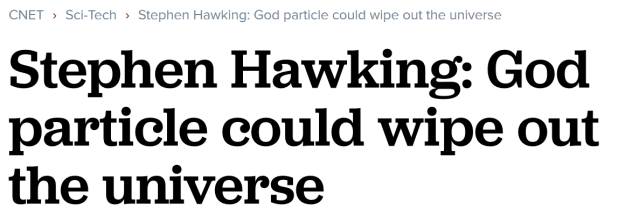
No, Hawking didn’t say that a particle collider could destroy the universe

So apparently Hawking says that the Higgs could destroy the universe.

HawkingHiggs

I’ve covered this already, right? No need to say anything more?

Ok, fine, I’ll write a real blog post.

The Higgs is a scalar field: a number, sort of like temperature, that can vary across space and time. In the case of the Higgs this number determines the mass of almost every fundamental particle (the jury is still somewhat out on neutrinos). The Higgs doesn’t vary much at all, in fact it takes an enormous (Large Hadron Collider-sized) amount of energy to get it to wobble even a little bit. That is because the Higgs is in a very very stable state.

Hawking was pointing out that, given our current model of the Higgs, there’s actually another possible state for the Higgs to be in, one that’s even more stable (because it takes less energy, essentially). In that state, the number the Higgs corresponds to is much larger, so everything would be much more massive, with potentially catastrophic results. (Matt Strassler goes into some detail about the assumptions behind this.)

For those who have been following my blog for a while, you may find these “stable states” familiar. They’re vacua, different possible ways to set up “empty” space. In that post, I may have given the impression that there’s no way to change from one stable state, one “vacuum”, to another. In the case of the Higgs, the state it’s in is so stable that vast amounts of energy (again, a Large Hadron Collider-worth) only serve to create a small, unstable fluctuation, the Higgs boson, which vanishes in a fraction of a second.

And that would be the full story, were it not for a curious phenomenon called quantum tunneling.

If you’ve heard someone else describe quantum tunneling, you’ve probably heard that quantum particles placed on one side of a wall have a very small chance of being found later on the other side of the wall, as if they had tunneled there.

Using their incredibly tiny shovels.

However, quantum tunneling applies to much more than just walls. In general, a particle in an otherwise stable state (whether stable because there are walls keeping it in place, or for other reasons) can tunnel into another state, provided that the new state is “more stable” (has lower energy).

The chance of doing this is small, and it gets smaller the more “stable” the particle’s initial state is. Still, if you apply that logic to the Higgs, you realize there’s a very very very small chance that one day the Higgs could just “tunnel” away from its current stable state, destroying the universe as we know it in the process.

If that happened, everything we know would vanish at the speed of light, and we wouldn’t see it coming.

While that may sound scary, it’s also absurdly unlikely, to the extent that it probably won’t happen until the universe is many times older than it is now. It’s not the sort of thing anybody should worry about, at least on a personal level.

Is Hawking fear-mongering, then, by pointing this out? Hardly. He’s just explaining science. Pointing out the possibility that the Higgs could spontaneously change and end the universe is a great way to emphasize the sheer scale of physics, and it’s pretty common for science communicators to mention it. I seem to recall a section about it in Particle Fever, and Sean Carroll even argues that it’s a good thing, due to killing off spooky Boltzmann Brains.

What do particle colliders have to do with all this? Well, apart from quantum tunneling, just inputting enough energy in the right way can cause a transition from one stable state to another. Here “enough energy” means about a million times that produced by the Large Hadron Collider. As Hawking jokes, you’d need a particle collider the size of the Earth to get this effect. I don’t know whether he actually ran the numbers, but if anything I’d guess that a Large Earth Collider would actually be insufficient.

Either way, Hawking is just doing standard science popularization, which isn’t exactly newsworthy. Once again, “interpret something Hawking said in the most ridiculous way possible” seems to be the du jour replacement for good science writing.

“China” plans super collider

When I saw the headline, I was excited.

“China plans super collider” says Nature News.

There’s been a lot of worry about what may happen if the Large Hadron Collider finishes its run without discovering anything truly new. If that happens, finding new particles might require a much bigger machine…and since even that machine has no guarantee of finding anything at all, world governments may be understandably reluctant to fund it.

As such, several prominent people in the physics community have put their hopes on China. The country’s somewhat autocratic nature means that getting funding for a collider is a matter of convincing a few powerful people, not a whole fractious gaggle of legislators. It’s a cynical choice, but if it keeps the field alive so be it.

If China was planning a super collider, then, that would be great news!

Too bad it’s not.

Buried eight paragraphs in to Nature’s article we find the following:

The Chinese government is yet to agree on any funding, but growing economic confidence in the country has led its scientists to believe that the political climate is ripe, says Nick Walker, an accelerator physicist at DESY, Germany’s high-energy physics laboratory in Hamburg. Although some technical issues remain, such as keeping down the power demands of an energy-hungry ring, none are major, he adds.

The Chinese government is yet to agree on any funding. China, if by China you mean the Chinese government, is not planning a super collider.

So who is?

Someone must have drawn these diagrams, after all.

Reading the article, the most obvious answer is Beijing’s Institute of High Energy Physics (IHEP). While this is true, the article leaves out any mention of a more recently founded site, the Center for Future High Energy Physics (CFHEP).

This is a bit odd, given that CFHEP’s whole purpose is to compose a plan for the next generation of colliders, and persuade China’s government to implement it. They were founded, with heavy involvement from non-Chinese physicists including their director Nima Arkani-Hamed, with that express purpose in mind. And since several of the quotes in the article come from Yifang Wang, director of IHEP and member of the advisory board of CFHEP, it’s highly unlikely that this isn’t CFHEP’s plan.

So what’s going on here? On one level, it could be a problem on the journalists’ side. News editors love to rewrite headlines to be more misleading and click-bait-y, and claiming that China is definitely going to build a collider draws much more attention than pointing out the plans of a specialized think tank. I hope that it’s just something like that, and not the sort of casual racism that likes to think of China as a single united will. Similarly, I hope that the journalists involved just didn’t dig deep enough to hear about CFHEP, or left it out to simplify things, because there is a somewhat darker alternative.

CFHEP’s goal is to convince the Chinese government to build a collider, and what better way to do that than to present them with a fait accompli? If the public thinks that this is “China’s” plan, that wheels are already in motion, wouldn’t it benefit the Chinese government to play along? Throw in a few sweet words about the merits of international collaboration (a big part of the strategy of CFHEP is to bring international scientists to China to show the sort of community a collider could attract) and you’ve got a winning argument, or at least enough plausibility to get US and European funding agencies in a competitive mood.

This…is probably more cynical than what’s actually going on. For one, I don’t even know whether this sort of tactic would work.

Do these guys look like devious manipulators?

Indeed, it might just be a journalistic omission, part of a wider tendency of science journalists to focus on big projects and ignore the interesting part, the nitty-gritty things that people do to push them forward. It’s a shame, because people are what drive the news forward, and as long as science is viewed as something apart from real human beings people are going to continue to mistrust and misunderstand it.

Either way, one thing is clear. The public deserves to hear a lot more about CFHEP.

What if there’s nothing new?

In the weeks after the folks at the Large Hadron Collider announced that they had found the Higgs, people I met would ask if I was excited. After all, the Higgs was what particle physicists were searching for, right?

 As usual in this blog, the answer is “Not really.”

We were all pretty sure the Higgs had to exist; we just didn’t know what its mass would be. And while many people had predictions for what properties the Higgs might have (including some string theorists), fundamentally they were interested for other reasons.

Those reasons, for the most part, are supersymmetry. If the Higgs had different properties than we expected, it could be evidence for one or another proposed form of supersymmetry. Supersymmetry is still probably the best explanation for dark matter, and it’s necessary in some form or another for string theory. It also helps with other goals of particle physics, like unifying the fundamental forces and getting rid of fine-tuned parameters.

Fundamentally, though, the Higgs isn’t likely to answer these questions. To get enough useful information we’ll need to discover an actual superpartner particle. And so far…we haven’t.

That’s why we’re not all that excited about the Higgs anymore. And that’s why, increasingly, particle physics is falling into doom and gloom.

Sure, when physicists talk about the situation, they’re quick to claim that they’re just as hopeful as ever. We still may well see supersymmetry in later runs of the LHC, as it still has yet to reach its highest energies. But people are starting, quietly and behind closed doors, to ask: what if we don’t?

What happens if we don’t see any new particles in the LHC?

There are good mathematical reasons to think that some form of supersymmetry holds. Even if we don’t see supersymmetric particles in the LHC, they may still exist. We just won’t know anything new about them.

That’s a problem.

We’ve been spinning our wheels for too long, and it’s becoming more and more obvious. With no new information from experiments, it’s not clear what we can do anymore.

And while, yes, many theorists are studying theories that aren’t true, sometimes without even an inkling of a connection to the real world, we’re all part of the same zeitgeist. We may not be studying reality itself, but at least we’re studying parts of reality, rearranged in novel ways. Without the support of experiment the rest of the field starts to decay. And one by one, those who can are starting to leave.

Despite how it may seem, most of physics doesn’t depend on supersymmetry. If you’re investigating novel materials, or the coolest temperatures ever achieved, or doing other awesome things with lasers, then the LHC’s failure to find supersymmetry will mean absolutely nothing to you. It’s only a rather small area of physics that will progressively fall into self-doubt until the only people left are the insane or the desperate.

But those of us in that area? If there really is nothing new? Yeah, we’re screwed.