Tag Archives: cosmology

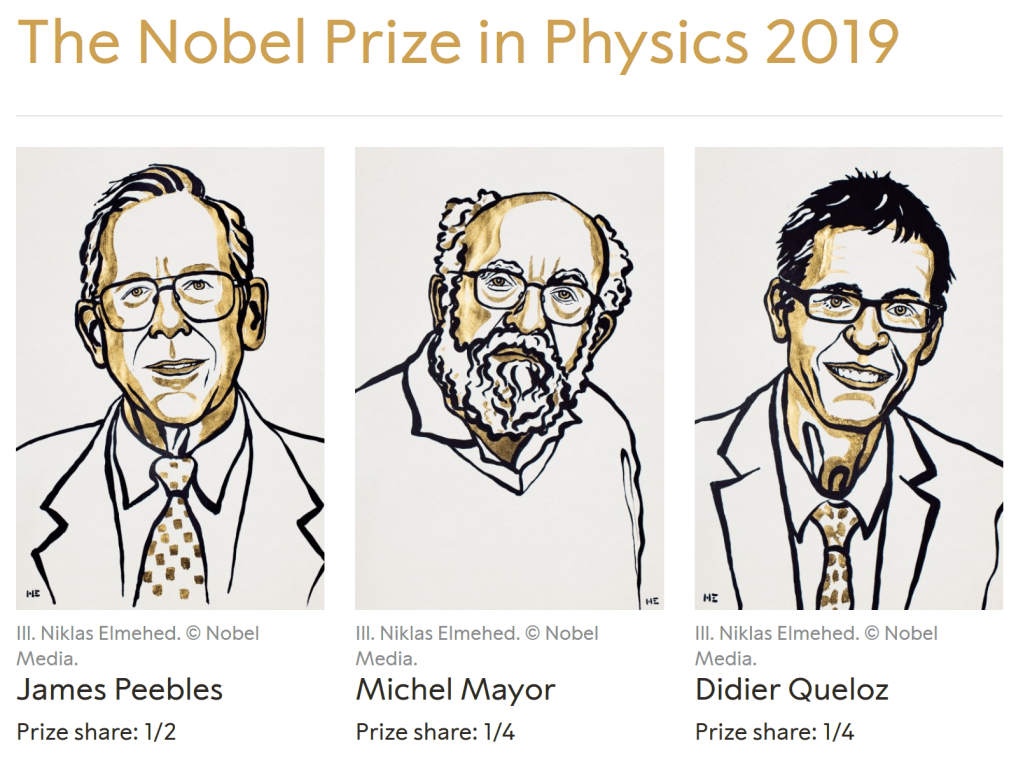
Congratulations to James Peebles, Michel Mayor, and Didier Queloz!

The 2019 Physics Nobel Prize was announced this week, awarded to James Peebles for work in cosmology and to Michel Mayor and Didier Queloz for the first observation of an exoplanet.

Peebles introduced quantitative methods to cosmology. He figured out how to use the Cosmic Microwave Background (light left over from the Big Bang) to understand how matter is distributed in our universe, including the presence of still-mysterious dark matter and dark energy. Mayor and Queloz were the first team to observe a planet outside of our solar system (an “exoplanet”), in 1995. By careful measurement of the spectrum of light coming from a star they were able to find a slight wobble, caused by a Jupiter-esque planet in orbit around it. Their discovery opened the floodgates of observation. Astronomers found many more planets than expected, showing that, far from a rare occurrence, exoplanets are quite common.

It’s a bit strange that this Nobel was awarded to two very different types of research. This isn’t the first time the prize was divided between two different discoveries, but all of the cases I can remember involve discoveries in closely related topics. This one didn’t, and I’m curious about the Nobel committee’s logic. It might have been that neither discovery “merited a Nobel” on its own, but I don’t think we’re supposed to think of shared Nobels as “lesser” than non-shared ones. It would make sense if the Nobel committee thought they had a lot of important results to “get through” and grouped them together to get through them faster, but if anything I have the impression it’s the opposite: that at least in physics, it’s getting harder and harder to find genuinely important discoveries that haven’t been acknowledged. Overall, this seems like a very weird pairing, and the Nobel committee’s citation “for contributions to our understanding of the evolution of the universe and Earth’s place in the cosmos” is a pretty loose justification.

Amplitudes 2019

It’s that time of year again, and I’m at Amplitudes, my field’s big yearly conference. This year we’re in Dublin, hosted by Trinity.

Which also hosts the Book of Kells, and the occasional conference reception just down the hall from the Book of Kells

Increasingly, the organizers of Amplitudes have been setting aside a few slots for talks from people in other fields. This year the “closest” such speaker was Kirill Melnikov, who pointed out some of the hurdles that make it difficult to have useful calculations to compare to the LHC. Many of these hurdles aren’t things that amplitudes-people have traditionally worked on, but are still things that might benefit from our particular expertise. Another such speaker, Maxwell Hansen, is from a field called Lattice QCD. While amplitudeologists typically compute with approximations, order by order in more and more complicated diagrams, Lattice QCD instead simulates particle physics on supercomputers, chopping up their calculations on a grid. This allows them to study much stronger forces, including the messy interactions of quarks inside protons, but they have a harder time with the situations we’re best at, where two particles collide from far away. Apparently, though, they are making progress on that kind of calculation, with some clever tricks to connect it to calculations they know how to do. While I was a bit worried that this would let them fire all the amplitudeologists and replace us with supercomputers, they’re not quite there yet, nonetheless they are doing better than I would have expected. Other speakers from other fields included Leron Borsten, who has been applying the amplitudes concept of the “double copy” to M theory and Andrew Tolley, who uses the kind of “positivity” properties that amplitudeologists find interesting to restrict the kinds of theories used in cosmology.

The biggest set of “non-traditional-amplitudes” talks focused on using amplitudes techniques to calculate the behavior not of particles but of black holes, to predict the gravitational wave patterns detected by LIGO. This year featured a record six talks on the topic, a sixth of the conference. Last year I commented that the research ideas from amplitudeologists on gravitational waves had gotten more robust, with clearer proposals for how to move forward. This year things have developed even further, with several initial results. Even more encouragingly, while there are several groups doing different things they appear to be genuinely listening to each other: there were plenty of references in the talks both to other amplitudes groups and to work by more traditional gravitational physicists. There’s definitely still plenty of lingering confusion that needs to be cleared up, but it looks like the community is robust enough to work through it.

I’m still busy with the conference, but I’ll say more when I’m back next week. Stay tuned for square roots, clusters, and Nima’s travel schedule. And if you’re a regular reader, please fill out last week’s poll if you haven’t already!

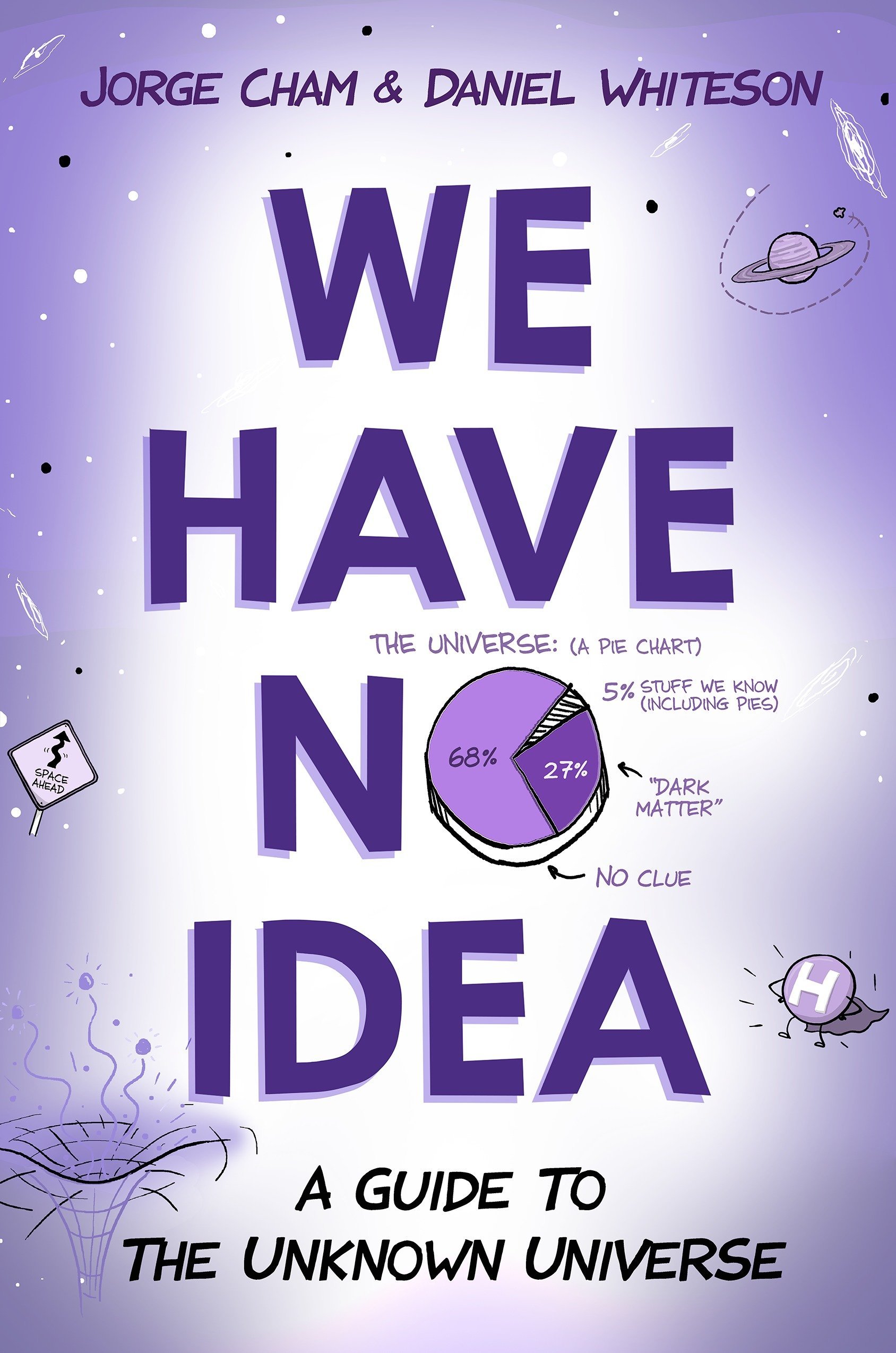
Book Review: We Have No Idea

I have no idea how I’m going to review this book.

Ok fine, I have some idea.

Jorge Cham writes Piled Higher and Deeper, a webcomic with possibly the most accurate depiction of grad school available. Daniel Whiteson is a professor at the University of California, Irvine, and a member of the ATLAS collaboration (one of the two big groups that make measurements at the Large Hadron Collider). Together, they’ve written a popular science book covering everything we don’t know about fundamental physics.

Writing a book about what we don’t know is an unusual choice, and there was a real risk it would end up as just a superficial gimmick. The pie chart on the cover presents the most famous “things physicists don’t know”, dark matter and dark energy. If they had just stuck to those this would have been a pretty ordinary popular physics book.

Refreshingly, they don’t do that. After blazing through dark matter and dark energy in the first three chapters, the rest of the book focuses on a variety of other scientific mysteries.

The book contains a mix of problems that get serious research attention (matter-antimatter asymmetry, high-energy cosmic rays) and more blue-sky “what if” questions (does matter have to be made out of particles?). As a theorist, I’m not sure that all of these questions are actually mysterious (we do have some explanation of the weird “1/3” charges of quarks, and I’d like to think we understand why mass includes binding energy), but even in these cases what we really know is that they follow from “sensible assumptions”, and one could just as easily ask “what if” about those assumptions instead. Overall, these “what if” questions make the book unique, and it would be a much weaker book without them.

“We Have No Idea” is strongest when the authors actually have some idea, i.e. when Whiteson is discussing experimental particle physics. It gets weaker on other topics, where the authors seem to rely more on others’ popular treatments (their discussion of “pixels of space-time” motivated me to write this post). Still, they at least seem to have asked the right people, and their accounts are on the more accurate end of typical pop science. (Closer to Quanta than IFLScience.)

The book’s humor really ties it together, often in surprisingly subtle ways. Each chapter has its own running joke, initially a throwaway line that grows into metaphors for everything the chapter discusses. It’s a great way to help the audience visualize without introducing too many new concepts at once. If there’s one thing cartoonists can teach science communicators, it’s the value of repetition.

I liked “We Have No Idea”. It could have been more daring, or more thorough, but it was still charming and honest and fun. If you’re looking for a Christmas present to explain physics to your relatives, you won’t go wrong with this book.

Cosmology, or Cosmic Horror?

Around Halloween, I have a tradition of posting about the “spooky” side of physics. This year, I’ll be comparing two no doubt often confused topics, Cosmic Horror and Cosmology.

cthulhu_and_r27lyeh

Pro tip: if this guy shows up, it’s probably Cosmic Horror

Cosmic Horror

Cosmology

Started in the 1920’s with the work of Howard Phillips Lovecraft Started in the 1920’s with the work of Alexander Friedmann
Unimaginably ancient universe Precisely imagined ancient universe
In strange ages even death may die Strange ages, what redshift is that?
An expedition to Antarctica uncovers ruins of a terrifying alien civilization An expedition to Antarctica uncovers…actually, never mind, just dust
Alien beings may propagate in hidden dimensions Gravitons may propagate in hidden dimensions
Cultists compete to be last to be eaten by the Elder Gods Grad students compete to be last to realize there are no jobs
Oceanic “deep ones” breed with humans Have you seen daycare costs in a university town? No way.
Variety of inventive and bizarre creatures, inspiring libraries worth of copycat works Fritz Zwicky
Hollywood adaptations are increasingly popular, not very faithful to source material Actually this is exactly the same
Can waste hours on an ultimately fruitless game of Arkham Horror Can waste hours on an ultimately fruitless argument with Paul Steinhardt
No matter what we do, eventually Azathoth will kill us all No matter what we do, eventually vacuum decay will kill us all

Current Themes 2018

I’m at Current Themes in High Energy Physics and Cosmology this week, the yearly conference of the Niels Bohr International Academy. (I talked about their trademark eclectic mix of topics last year.)

This year, the “current theme” was broadly gravitational (though with plenty of exceptions!).

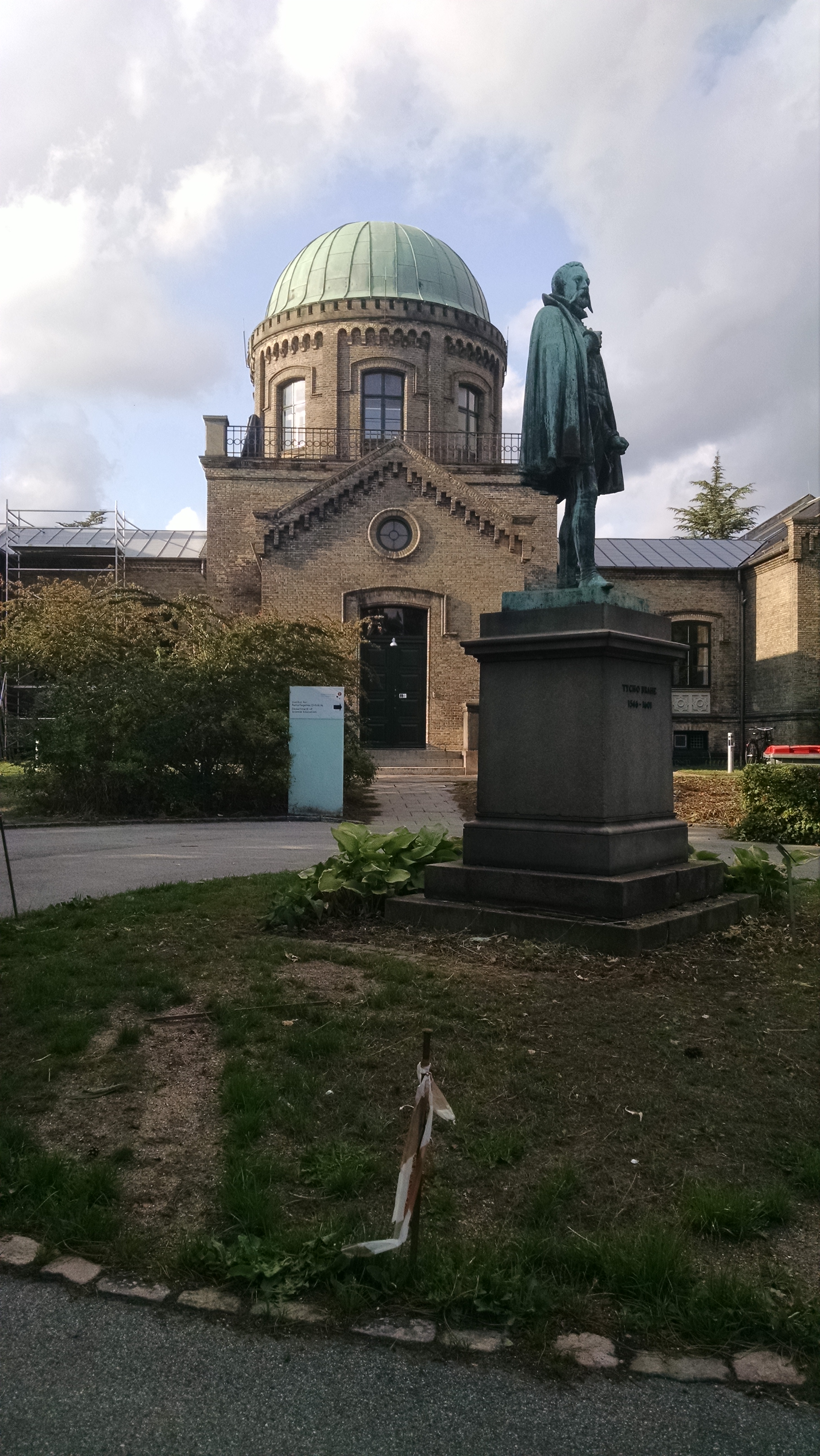
IMG_20180815_180435532

For example, almost getting kicked out of the Botanical Garden

There were talks on phenomena we observe gravitationally, like dark matter. There were talks on calculating amplitudes in gravity theories, both classical and quantum. There were talks about black holes, and the overall shape of the universe. Subir Sarkar talked about his suspicion that the expansion of the universe isn’t actually accelerating, and while I still think the news coverage of it was overblown I sympathize a bit more with his point. He’s got a fairly specific worry, that we’re in a region that’s moving unusually with respect to the surrounding universe, that hasn’t really been investigated in much detail before. I don’t think he’s found anything definitive yet, but it will be interesting as more data accumulates to see what happens.

Of course, current themes can’t stick to just one theme, so there were non-gravitational talks as well. Nima Arkani-Hamed’s talk covered some results he’s talked about in the past, a geometric picture for constraining various theories, but with an interesting new development: while most of the constraints he found restrict things to be positive, one type of constraint he investigated allowed for a very small negative region, around thirty orders of magnitude smaller than the positive part. The extremely small size of the negative region was the most surprising part of the story, as it’s quite hard to get that kind of extremely small scale out of the math we typically invoke in physics (a similar sense of surprise motivates the idea of “naturalness” in particle physics).

There were other interesting talks, which I might talk about later. They should have slides up online soon in case any of you want to have a look.

Adversarial Collaborations for Physics

Sometimes physics debates get ugly. For the scientists reading this, imagine your worst opponents. Think of the people who always misinterpret your work while using shoddy arguments to prop up their own, where every question at a talk becomes a screaming match until you just stop going to the same conferences at all.

Now, imagine writing a paper with those people.

Adversarial collaborations, subject of a recent a contest on the blog Slate Star Codex, are a proposed method for resolving scientific debates. Two scientists on opposite sides of an argument commit to writing a paper together, describing the overall state of knowledge on the topic. For the paper to get published, both sides have to sign off on it: they both have to agree that everything in the paper is true. This prevents either side from cheating, or from coming back later with made-up objections: if a point in the paper is wrong, one side or the other is bound to catch it.

This won’t work for the most vicious debates, when one (or both) sides isn’t interested in common ground. But for some ongoing debates in physics, I think this approach could actually help.

One advantage of adversarial collaborations is in preventing accusations of bias. The debate between dark matter and MOND-like proposals is filled with these kinds of accusations: claims that one group or another is ignoring important data, being dishonest about the parameters they need to fit, or applying standards of proof they would never require of their own pet theory. Adversarial collaboration prevents these kinds of accusations: whatever comes out of an adversarial collaboration, both sides would make sure the other side didn’t bias it.

Another advantage of adversarial collaborations is that they make it much harder for one side to move the goalposts, or to accuse the other side of moving the goalposts. From the sidelines, one thing that frustrates me watching string theorists debate whether the theory can describe de Sitter space is that they rarely articulate what it would take to decisively show that a particular model gives rise to de Sitter. Any conclusion of an adversarial collaboration between de Sitter skeptics and optimists would at least guarantee that both parties agreed on the criteria. Similarly, I get the impression that many debates about interpretations of quantum mechanics are bogged down by one side claiming they’ve closed off a loophole with a new experiment, only for the other to claim it wasn’t the loophole they were actually using, something that could be avoided if both sides were involved in the experiment from the beginning.

It’s possible, even likely, that no-one will try adversarial collaboration for these debates. Even if they did, it’s quite possible the collaborations wouldn’t be able to agree on anything! Still, I have to hope that someone takes the plunge and tries writing a paper with their enemies. At minimum, it’ll be an interesting read!

Bubbles of Nothing

I recently learned about a very cool concept, called a bubble of nothing.

Read about physics long enough, and you’ll hear all sorts of cosmic disaster scenarios. If the Higgs vacuum decays, and the Higgs field switches to a different value, then the masses of most fundamental particles would change. It would be the end of physics, and life, as we know it.

A bubble of nothing is even more extreme. In a bubble of nothing, space itself ceases to exist.

The idea was first explored by Witten in 1982. Witten started with a simple model, a world with our four familiar dimensions of space and time, plus one curled-up extra dimension. What he found was that this simple world is unstable: quantum mechanics (and, as was later found, thermodynamics) lets it “tunnel” to another world, one that contains a small “bubble”, a sphere in which nothing at all exists.

giphy

Except perhaps the Nowhere Man

A bubble of nothing might sound like a black hole, but it’s quite different. Throw a particle into a black hole and it will fall in, never to return. Throw it into a bubble of nothing, though, and something more interesting happens. As you get closer, the extra dimension of space gets smaller and smaller. Eventually, it stops, smoothly closing off. The particle you threw in will just bounce back, smoothly, off the outside of the bubble. Essentially, it reached the edge of the universe.

The bubble starts out small, comparable to the size of the curled-up dimension. But it doesn’t stay that way. In Witten’s setup, the bubble grows, faster and faster, until it’s moving at the speed of light, erasing the rest of the universe from existence.

You probably shouldn’t worry about this happening to us. As far as I’m aware, nobody has written down a realistic model that can transform into a bubble of nothing.

Still, it’s an evocative concept, and one I’m surprised isn’t used more often in science fiction. I could see writers using a bubble of nothing as a risk from an experimental FTL drive, or using a stable (or slowly growing) bubble as the relic of some catastrophic alien war. The idea of a bubble of literal nothing is haunting enough that it ought to be put to good use.

Why Your Idea Is Bad

By A. Physicist


Your idea is bad…


…because it disagrees with precision electroweak measurements

…………………………………..with bounds from ATLAS and CMS

…………………………………..with the power spectrum of the CMB

…………………………………..with Eötvös experiments

…because it isn’t gauge invariant

………………………….Lorentz invariant

………………………….diffeomorphism invariant

………………………….background-independent, whatever that means

…because it violates unitarity

…………………………………locality

…………………………………causality

…………………………………observer-independence

…………………………………technical naturalness

…………………………………international treaties

…………………………………cosmic censorship

…because you screwed up the calculation

…because you didn’t actually do the calculation

…because I don’t understand the calculation

…because you predict too many magnetic monopoles

……………………………………too many proton decays

……………………………………too many primordial black holes

…………………………………..remnants, at all

…because it’s fine-tuned

…because it’s suspiciously finely-tuned

…because it’s finely tuned to be always outside of experimental bounds

…because you’re misunderstanding quantum mechanics

…………………………………………………………..black holes

………………………………………………………….effective field theory

…………………………………………………………..thermodynamics

…………………………………………………………..the scientific method

…because Condensed Matter would contribute more to Chinese GDP

…because the approximation you’re making is unjustified

…………………………………………………………………………is not valid

…………………………………………………………………………is wildly overoptimistic

………………………………………………………………………….is just kind of lazy

…because there isn’t a plausible UV completion

…because you care too much about the UV

…because it only works in polynomial time

…………………………………………..exponential time

…………………………………………..factorial time

…because even if it’s fast it requires more memory than any computer on Earth

…because it requires more bits of memory than atoms in the visible universe

…because it has no meaningful advantages over current methods

…because it has meaningful advantages over my own methods

…because it can’t just be that easy

…because it’s not the kind of idea that usually works

…because it’s not the kind of idea that usually works in my field

…because it isn’t canonical

…because it’s ugly

…because it’s baroque

…because it ain’t baroque, and thus shouldn’t be fixed

…because only a few people work on it

…because far too many people work on it

…because clearly it will only work for the first case

……………………………………………………………….the first two cases

……………………………………………………………….the first seven cases

……………………………………………………………….the cases you’ve published and no more

…because I know you’re wrong

…because I strongly suspect you’re wrong

…because I strongly suspect you’re wrong, but saying I know you’re wrong looks better on a grant application

…….in a blog post

…because I’m just really pessimistic about something like that ever actually working

…because I’d rather work on my own thing, that I’m much more optimistic about

…because if I’m clear about my reasons

……and what I know

…….and what I don’t

……….then I’ll convince you you’re wrong.


……….or maybe you’ll convince me?


The Quantum Kids

I gave a pair of public talks at the Niels Bohr International Academy this week on “The Quest for Quantum Gravity” as part of their “News from the NBIA” lecture series. The content should be familiar to long-time readers of this blog: I talked about renormalization, and gravitons, and the whole story leading up to them.

(I wanted to title the talk “How I Learned to Stop Worrying and Love Quantum Gravity”, like my blog post, but was told Danes might not get the Doctor Strangelove reference.)

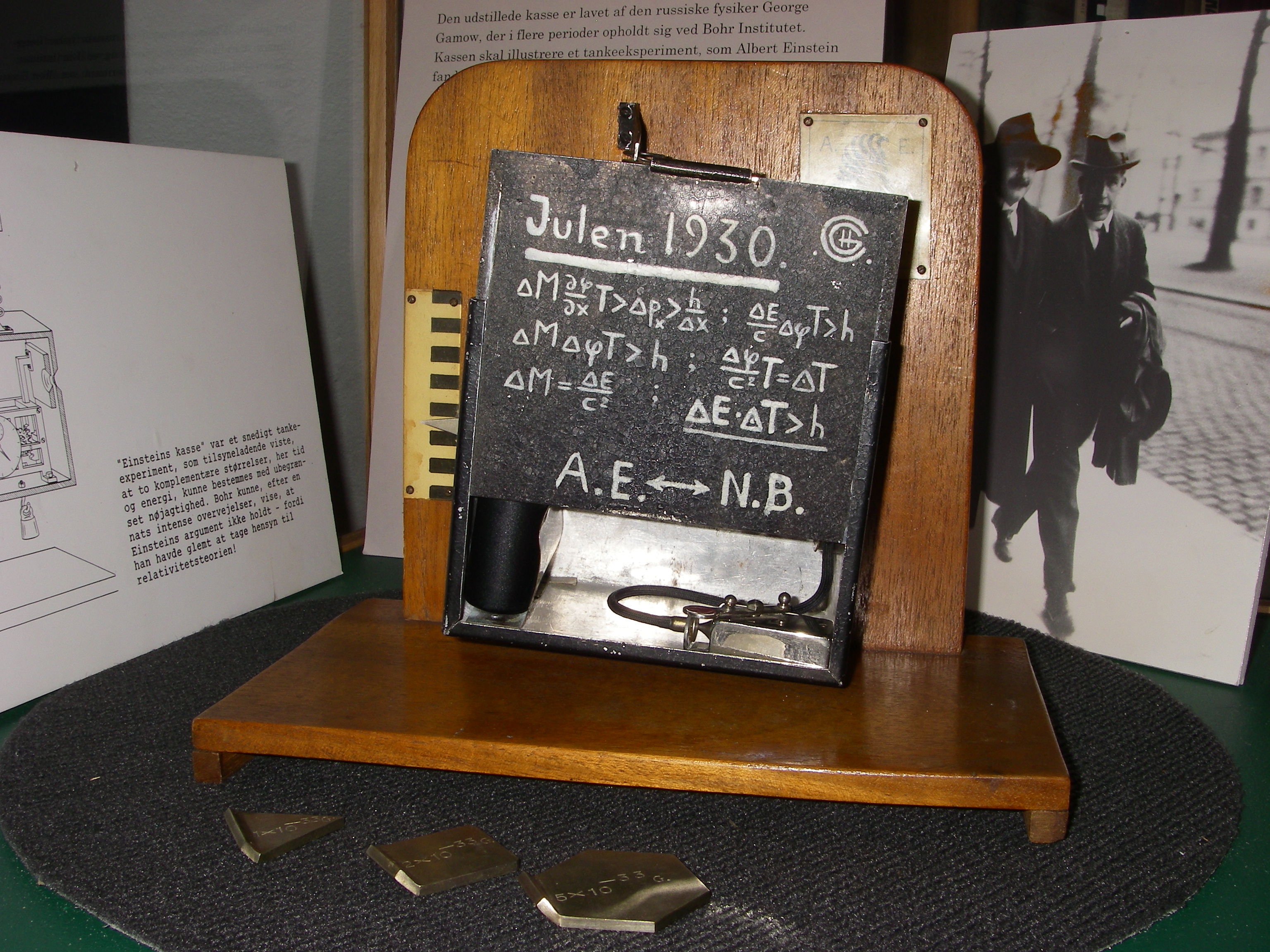
I also managed to work in some history, which made its way into the talk after Poul Damgaard, the director of the NBIA, told me I should ask the Niels Bohr Archive about Gamow’s Thought Experiment Device.

“What’s a Thought Experiment Device?”

einsteinbox

This, apparently

If you’ve heard of George Gamow, you’ve probably heard of the Alpher-Bethe-Gamow paper, his work with grad student Ralph Alpher on the origin of atomic elements in the Big Bang, where he added Hans Bethe to the paper purely for an alpha-beta-gamma pun.

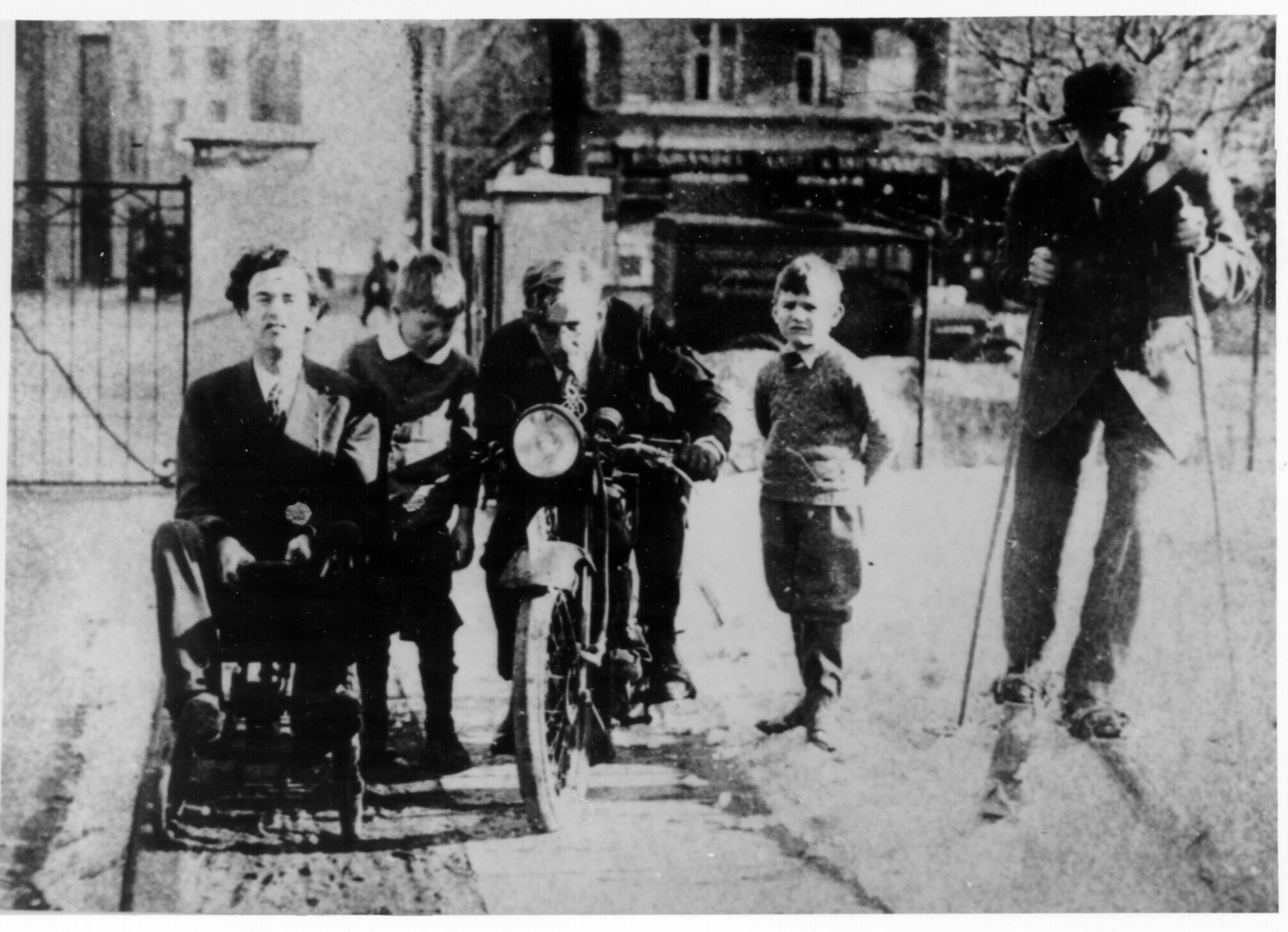
As I would learn, Gamow’s sense of humor was prominent quite early on. As a research fellow at the Niels Bohr Institute (essentially a postdoc) he played with Bohr’s kids, drew physics cartoons…and made Thought Experiment Devices. These devices were essentially toy experiments, apparatuses that couldn’t actually work but that symbolized some physical argument. The one I used in my talk, pictured above, commemorated Bohr’s triumph over one of Einstein’s objections to quantum theory.

Learning more about the history of the institute, I kept noticing the young researchers, the postdocs and grad students.

h155

Lev Landau, George Gamow, Edward Teller. The kids are Aage and Ernest Bohr. Picture from the Niels Bohr Archive.

We don’t usually think about historical physicists as grad students. The only exception I can think of is Feynman, with his stories about picking locks at the Manhattan project. But in some sense, Feynman was always a grad student.

This was different. This was Lev Landau, patriarch of Russian physics, crowning name in a dozen fields and author of a series of textbooks of legendary rigor…goofing off with Gamow. This was Edward Teller, father of the Hydrogen Bomb, skiing on the institute lawn.

These were the children of the quantum era. They came of age when the laws of physics were being rewritten, when everything was new. Starting there, they could do anything, from Gamow’s cosmology to Landau’s superconductivity, spinning off whole fields in the new reality.

On one level, I envy them. It’s possible they were the last generation to be on the ground floor of a change quite that vast, a shift that touched all of physics, the opportunity to each become gods of their own academic realms.

I’m glad to know about them too, though, to see them as rambunctious grad students. It’s all too easy to feel like there’s an unbridgeable gap between postdocs and professors, to worry that the only people who make it through seem to have always been professors at heart. Seeing Gamow and Landau and Teller as “quantum kids” dispels that: these are all-too-familiar grad students and postdocs, joking around in all-too-familiar ways, who somehow matured into some of the greatest physicists of their era.

Our Bargain

Sabine Hossenfelder has a blog post this week chastising particle physicists and cosmologists for following “upside-down Popper”, or assuming a theory is worth working on merely because it’s falsifiable. She describes her colleagues churning out one hypothesis after another, each tweaking an old idea just enough to make it falsifiable in the next experiment, without caring whether the hypothesis is actually likely to be true.

Sabine is much more of an expert in this area of physics (phenomenology) than I am, and I don’t presume to tell her she’s wrong about that community. But the problem she’s describing is part of something bigger, something that affects my part of physics as well.

There’s a core question we’d all like to answer: what should physicists work on? What criteria should guide us?

Falsifiability isn’t the whole story. The next obvious criterion is a sense of simplicity, of Occam’s Razor or mathematical elegance. Sabine has argued against the latter, which prompted a friend of mine to comment that between rejecting falsifiability and elegance, Sabine must want us to stop doing high-energy physics at all!

That’s more than a little unfair, though. I think Sabine has a reasonably clear criterion in mind. It’s the same criterion that most critics of the physics mainstream care about. It’s even the same criterion being used by the “other side”, the sort of people who criticize anything that’s not string/SUSY/inflation.

The criterion is quite a simple one: physics research should be productive. Anything we publish, anything we work on, should bring us closer to understanding the real world.

And before you object that this criterion is obvious, that it’s subjective, that it ignores the very real disagreements between the Sabines and the Luboses of the world…before any of that, please let me finish.

We can’t achieve this criterion. And we shouldn’t.

We can’t demand that all physics be productive without breaking a fundamental bargain, one we made when we accepted that science could be a career.
1200px-13_portrait_of_robert_hooke

The Hunchback of Notre Science

It wasn’t always this way. Up until the nineteenth century, “scientist” was a hobby, not a job.

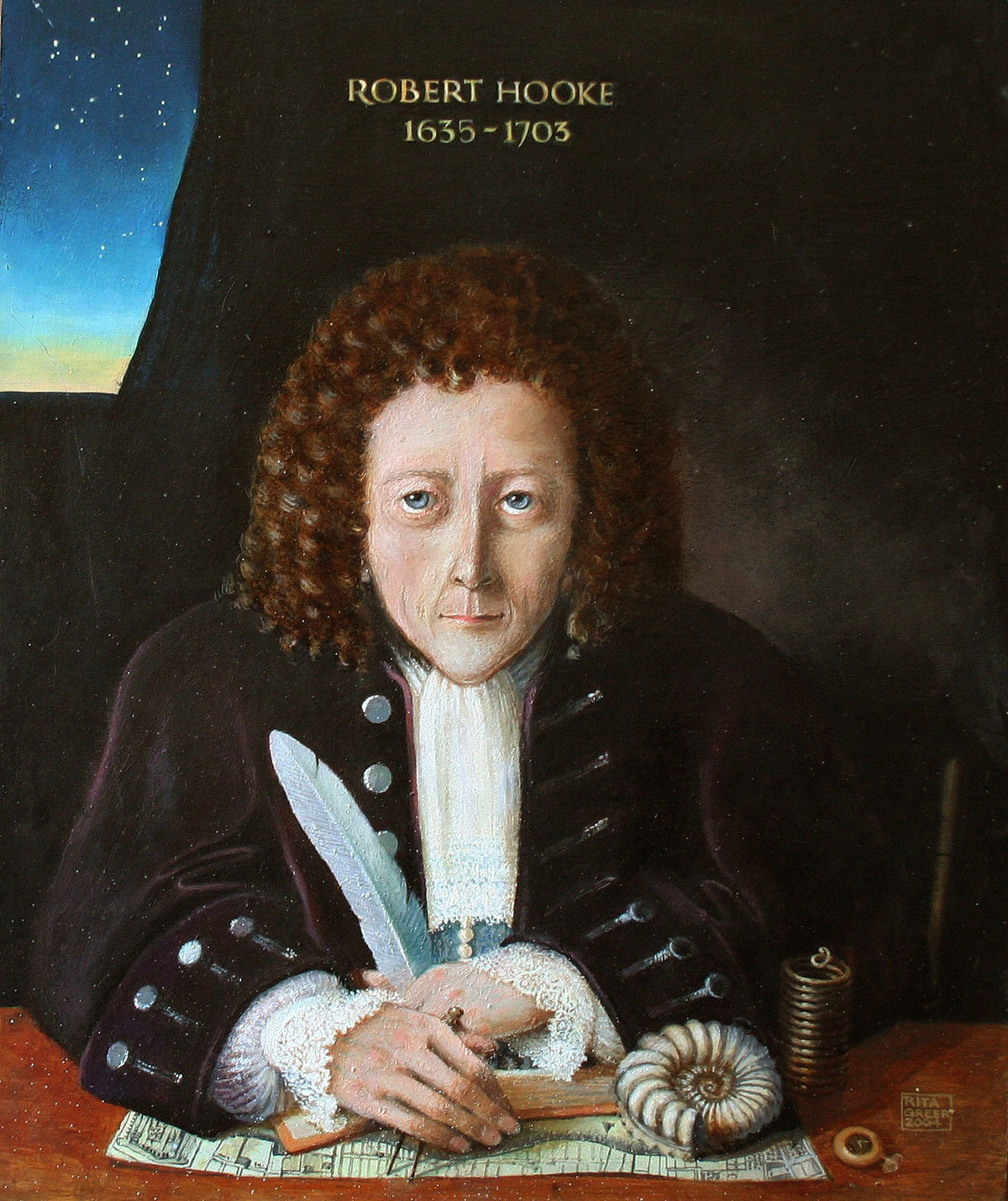
After Newton published his theory of gravity, he was famously accused by Robert Hooke of stealing the idea. There’s some controversy about this, but historians agree on a few points: that Hooke did write a letter to Newton suggesting a 1/r^2 force law, and that Hooke, unlike Newton, never really worked out the law’s full consequences.

Why not? In part, because Hooke, unlike Newton, had a job.

Hooke was arguably the first person for whom science was a full-time source of income. As curator of experiments for the Royal Society, it was his responsibility to set up demonstrations for each Royal Society meeting. Later, he also handled correspondence for the Royal Society Journal. These responsibilities took up much of his time, and as a result, even if he was capable of following up on the consequences of 1/r^2 he wouldn’t have had time to focus on it. That kind of calculation wasn’t what he was being paid for.

We’re better off than Hooke today. We still have our responsibilities, to journals and teaching and the like, at various stages of our careers. But in the centuries since Hooke expectations have changed, and real original research is no longer something we have to fit in our spare time. It’s now a central expectation of the job.

When scientific research became a career, we accepted a kind of bargain. On the positive side, you no longer have to be independently wealthy to contribute to science. More than that, the existence of professional scientists is the bedrock of technological civilization. With enough scientists around, we get modern medicine and the internet and space programs and the LHC, things that wouldn’t be possible in a world of rare wealthy geniuses.

We pay a price for that bargain, though. If science is a steady job, then it has to provide steady work. A scientist has to be able to go in, every day, and do science.

And the problem is, science doesn’t always work like that. There isn’t always something productive to work on. Even when there is, there isn’t always something productive for you to work on.

Sabine blames “upside-down Popper” on the current publish-or-perish environment in physics. If physics careers weren’t so cut-throat and the metrics they are judged by weren’t so flawed, then maybe people would have time to do slow, careful work on deeper topics rather than pumping out minimally falsifiable papers as fast as possible.

There’s a lot of truth to this, but I think at its core it’s a bit too optimistic. Each of us only has a certain amount of expertise, and sometimes that expertise just isn’t likely to be productive at the moment. Because science is a job, a person in that position can’t just go work at the Royal Mint like Newton did. (The modern-day equivalent would be working for Wall Street, but physicists rarely come back from that.) Instead, they keep doing what they know how to do, slowly branching out, until they’ve either learned something productive or their old topic becomes useful once more. You can think of it as a form of practice, where scientists keep their skills honed until they’re needed.

So if we slow down the rate of publication, if we create metrics for universities that let them hire based on the depth and importance of work and not just number of papers and citations, if we manage all of that then yes we will improve science a great deal. But Lisa Randall still won’t work on Haag’s theorem.

In the end, we’ll still have physicists working on topics that aren’t actually productive.
img_0622

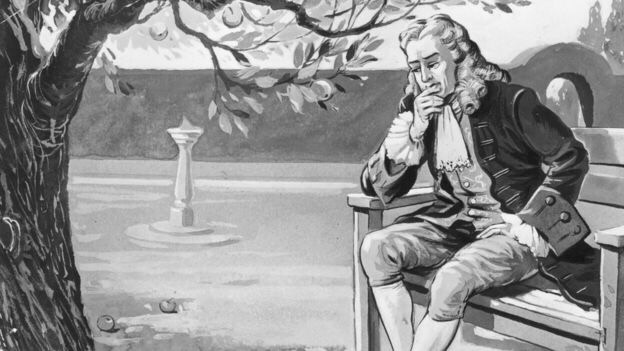
A physicist lazing about unproductively under an apple tree

So do we have to pay physicists to work on whatever they want, no matter how ridiculous?

No, I’m not saying that. We can’t expect everyone to do productive work all the time, but we can absolutely establish standards to make the work more likely to be productive.

Strange as it may sound, I think our standards for this are already quite good, or at least better than many other fields.

First, there’s falsifiability itself, or specifically our attitude towards it.

Physics’s obsession with falsifiability has one important benefit: it means that when someone proposes a new model of dark matter or inflation that they tweaked to be just beyond the current experiments, they don’t claim to know it’s true. They just claim it hasn’t been falsified yet.

This is quite different from what happens in biology and the social sciences. There, if someone tweaks their study to be just within statistical significance, people typically assume the study demonstrated something real. Doctors base treatments on it, and politicians base policy on it. Upside-down Popper has its flaws, but at least it’s never going to kill anybody, or put anyone in prison.

Admittedly, that’s a pretty low bar. Let’s try to set a higher one.

Moving past falsifiability, what about originality? We have very strong norms against publishing work that someone else has already done.

Ok, you (and probably Sabine) would object, isn’t that easy to get around? Aren’t all these Popper-flippers pretending to be original but really just following the same recipe each time, modifying their theory just enough to stay falsifiable?

To some extent. But if they were really following a recipe, you could beat them easily: just write the recipe down.

Physics progresses best when we can generalize, when we skip from case-by-case to understanding whole swaths of cases at once. Over time, there have been plenty of cases in which people have done that, where a number of fiddly hand-made models have been summarized in one parameter space. Once that happens, the rule of originality kicks in: now, no-one can propose another fiddly model like that again. It’s already covered.

As long as the recipe really is just a recipe, you can do this. You can write up what these people are doing in computer code, release the code, and then that’s that, they have to do something else. The problem is, most of the time it’s not really a recipe. It’s close enough to one that they can rely on it, close enough to one that they can get paper after paper when they need to…but it still requires just enough human involvement, just enough genuine originality, to be worth a paper.

The good news is that the range of “recipes” we can code up increases with time. Some spaces of theories we might never be able to describe in full generality (I’m glad there are people trying to do statistics on the string landscape, but good grief it looks quixotic). Some of the time though, we have a real chance of putting a neat little bow on a subject, labeled “no need to talk about this again”.

This emphasis on originality keeps the field moving. It means that despite our bargain, despite having to tolerate “practice” work as part of full-time physics jobs, we can still nudge people back towards productivity.


One final point: it’s possible you’re completely ok with the idea of physicists spending most of their time “practicing”, but just wish they wouldn’t make such a big deal about it. Maybe you can appreciate that “can I cook up a model where dark matter kills the dinosaurs” is an interesting intellectual exercise, but you don’t think it should be paraded in front of journalists as if it were actually solving a real problem.

In that case, I agree with you, at least up to a point. It is absolutely true that physics has a dysfunctional relationship with the media. We’re too used to describing whatever we’re working on as the most important thing in the universe, and journalists are convinced that’s the only way to get the public to pay attention. This is something we can and should make progress on. An increasing number of journalists are breaking from the trend and focusing not on covering the “next big thing”, but in telling stories about people. We should do all we can to promote those journalists, to spread their work over the hype, to encourage the kind of stories that treat “practice” as interesting puzzles pursued by interesting people, not the solution to the great mysteries of physics. I know that if I ever do anything newsworthy, there are some journalists I’d give the story to before any others.

At the same time, it’s important to understand that some of the dysfunction here isn’t unique to physics, or even to science. Deep down the reason nobody can admit that their physics is “practice” work is the same reason people at job interviews claim to love the company, the same reason college applicants have to tell stirring stories of hardship and couples spend tens of thousands on weddings. We live in a culture in which nothing can ever just be “ok”, in which admitting things are anything other than exceptional is akin to calling them worthless. It’s an arms-race of exaggeration, and it goes far beyond physics.

(I should note that this “culture” may not be as universal as I think it is. If so, it’s possible its presence in physics is due to you guys letting too many of us Americans into the field.)


We made a bargain when we turned science into a career. We bought modernity, but the price we pay is subsidizing some amount of unproductive “practice” work. We can negotiate the terms of our bargain, and we should, tilting the field with incentives to get it closer to the truth. But we’ll never get rid of it entirely, because science is still done by people. And sometimes, despite what we’re willing to admit, people are just “ok”.