The Theorist Exclusion Principle

There are a lot of people who think theoretical physics has gone off-track, though very few of them agree on exactly how. Some think that string theory as a whole is a waste of time, others that the field just needs to pay more attention to their preferred idea. Some think we aren’t paying enough attention to the big questions, or that we’re too focused on “safe” ideas like supersymmetry, even when they aren’t working out. Some think the field needs less focus on mathematics, while others think it needs even more.

Usually, people act on these opinions by writing strongly worded articles and blog posts. Sometimes, they have more power, and act with money, creating grants and prizes that only go to their preferred areas of research.

Let’s put the question of whether the field actually needs to change aside for the moment. Even if it does, I’m skeptical that this sort of thing will have any real effect. While grants and blogs may be very good at swaying experimentalists, theorists are likely to be harder to shift, due to what I’m going to call the Theorist Exclusion Principle.

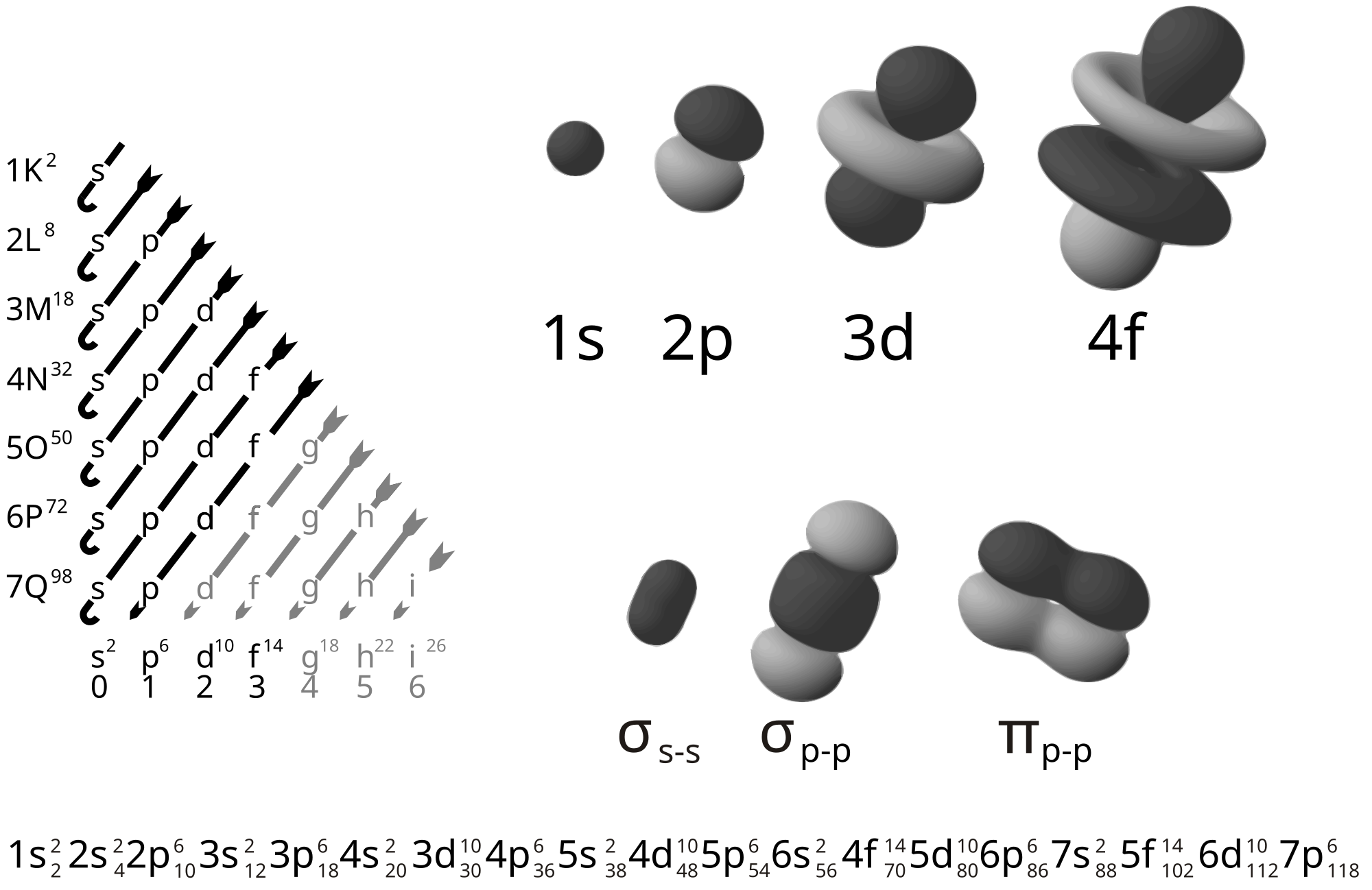
The Pauli Exclusion Principle is a rule from quantum mechanics that states that two fermions (particles with half-integer spin) can’t occupy the same state. Fermions include electrons, quarks, protons…essentially, all the particles that make up matter. Many people learn about the Pauli Exclusion Principle first in a chemistry class, where it explains why electrons fall into different energy levels in atoms: once one energy level “fills up”, no more electrons can occupy the same state, and any additional electrons are “excluded” and must occupy a different energy level.

Those 1s electrons are such a clique!

In contrast, bosons (like photons, or the Higgs) can all occupy the same state. It’s what allows for things like lasers, and it’s why all the matter we’re used to is made out of fermions: because fermions can’t occupy the same state as each other, as you add more fermions the structures they form have to become more and more complicated.

Experimentalists are a little like bosons. While you can’t stuff two experimentalists into the same quantum state, you can get them working on very similar projects. They can form large collaborations, with each additional researcher making the experiment that much easier. They can replicate eachother’s work, making sure it was accurate. They can take some physical phenomenon and subject it to a battery of tests, so that someone is bound to learn something.

Theorists, on the other hand, are much more like fermions. In theory, there’s very little reason to work on something that someone else is already doing. Replication doesn’t mean very much: the purest theory involves mathematical proofs, where replication is essentially pointless. Theorists do form collaborations, but they don’t have the same need for armies of technicians and grad students that experimentalists do. With no physical objects to work on, there’s a limit to how much can be done pursuing one particular problem, and if there really are a lot of options they can be pursued by one person with a cluster.

Like fermions, then, theorists expand to fill the projects available. If an idea is viable, someone will probably work on it, and once they do, there isn’t much reason for someone else to do the same thing.

This makes theory a lot harder to influence than experiment. You can write the most beautiful thinkpiece possible to persuade theorists to study the deep questions of the universe, but if there aren’t any real calculations available nothing will change. Contrary to public perception, theoretical physicists aren’t paid to just sit around thinking all day: we calculate, compute, and publish, and if a topic doesn’t lend itself to that then we won’t get much mileage out of it. And no matter what you try to preferentially fund with grants, mostly you’ll just get people re-branding what they’re already doing, shifting a few superficial details to qualify.

Theorists won’t occupy the same states, so if you want to influence theorists you need to make sure there are open states where you’re trying to get them to go. Historically, theorists have shifted when new states have opened up: new data from experiment that needed a novel explanation, new mathematical concepts that opened up new types of calculations. You want there to be fewer string theorists, or more focus on the deep questions? Give us something concrete to do, and I guarantee you’ll get theorists flooding in.

Want to Open up Your Work? Try a Data Mine!

Have you heard of the Open Science movement?

The general idea is to make scientists’ work openly accessible, both to the general public and to other scientists. This doesn’t just include published results, but the raw data as well. The goal is to make it possible for anyone, in principle, to check the validity of important results.

I’m of the opinion that this sort of thing isn’t always feasible, but when it is it’s usually a great thing to do. And in my field, the best way to do this sort of thing is to build a data mine.

I’m thinking in particular of Blümlein, Broadhurst, and Vermaseren’s Multiple Zeta Value Data Mine. Multiple zeta values are the result of generalizing the Riemann Zeta Function, and evaluating it at one. They’re transcendental numbers, and there are complicated relations between them. Finding all those relations, even for a restricted subset of them, can be a significant task. Usually, there aren’t published programs for this sort of thing, like most things in physics we have to jury-rig up our own code. What makes the folks behind the multiple zeta value data mine unique is that when they had to do this, they didn’t just keep the code to themselves. Instead, they polished it up and put it online.

That’s the general principle behind building a data mine. By putting your tools online, you make them available to others, so other researchers can use them as a jumping-off point for their own work. This can speed up the field, bringing everyone up to the same starting point, and has the side benefit of gathering heaps of citations from people who use your tools.

My collaborators already have a site with some of the data from our research into hexagon functions. Originally, it was just a place to house extra-large files that couldn’t be included with the original paper. For our next paper, we’re planning on expanding it into a true data mine, and including enough technology for someone else to build off of our results.

Historic Montreal

I’m at a conference in Montreal this week, so it’s going to be a short post. The University of Montreal’s Centre de Recherches Mathématiques has been holding a program on the various hidden symmetries of N=4 super Yang-Mills since the beginning of the summer. This week is the amplitudes-focused part of the program, so they’ve brought in a bunch of amplitudes-folks from around the world, myself included.

It’s been great hanging out with fellow members of my sub-field, as always, both at the conference and at dinner afterwards. Over possibly too much wine I heard stories of the heady days of 2007, when James Drummond and Johannes Henn first discovered one of the most powerful symmetries of N=4 super Yang-Mills (a duality called dual conformal invariance) and Andrew Hodges showed off the power of a set of funky variables called twistors. It’s amazing to me how fast the field moves, sometimes: by the time I started doing amplitudes work in 2011 these ideas were the bedrock of the field. History operates on different scales, and in amplitudes a few decades have played host to an enormous amount of progress.

History in the real world can move surprisingly fast too. After seeing cathedrals in Zurich that date back to the medieval era, I was surprised when the majestic basilica overlooking Montreal turned out to be less than a century old.

In retrospect the light-up cross should have made it obvious.

In retrospect the light-up cross should have made it obvious.

Amplitudes Megapost

If you met me on a plane and asked me what I do, I’d probably lead with something like this:

“I come up with mathematical tricks to make particle physics calculations easier.”

People like me, who research these tricks, are sometimes known as Amplitudeologists. We studying scattering amplitudes, mathematical formulas used to calculate the probabilities of different things happening when sub-atomic particles collide.

Why do we want to make calculations easier? Because particle physics is hard!

More specifically, calculations in particle physics can be hard for three broad reasons: lots of loops, lots of legs, or more complicated theories.

Loops measure precision. They’re called loops because more complicated Feynman diagrams contain “loops” of particles, while the simplest, with no loops at all, are called “trees”. The more loops you include, the more precise your calculation becomes, but it also becomes more complicated.

Legs are the number of particles involved. If two particles collide and bounce off each other, then there are a total of four legs: two from the incoming particles, two from the outgoing ones. Calculations with more legs are almost always more complicated than calculations with fewer.

Most of the time, our end-goal is to calculate things that are relevant to the real world. Usually, this means QCD, or Quantum Chromodynamics, the theory of quarks and gluons. QCD is very complicated, though. Often, we work to hone our techniques on simpler theories first. N=4 super Yang-Mills has been called the simplest quantum field theory, particularly the further simplified, planar version. If you want a basic overview of it, check out the Handy Handbooks tab at the top of my blog. Often, progress in amplitudeology involves adapting tricks from planar N=4 super Yang-Mills to more complicated, and more realistic, theories.

I should point out that our goal in amplitudeology isn’t always to do more complicated calculations. Sometimes, it’s about doing a calculation we already know how to do, but in a way that’s more insightful. This lets us learn more about the theories we’re studying, as well as gaining insights about larger problems like the nature of space and time.

So what sorts of tricks do we use to do all this? Well, there are a few broad categories…

Generalized Unitarity

The prizewinning idea that started it all, generalized unitarity came out of the collaboration of Zvi Bern, Lance Dixon, and David Kosower, starting in the 90’s. The core of the idea is difficult to describe in a quick sentence, but it essentially boils down to noticing that, rather than thinking about every single multi-loop Feynman diagram independently, you can think of loop diagrams as what you get when you sew trees together.

This is a very powerful idea. These days, pretty much everyone who studies amplitudeology learns it, and it’s proven pivotal for a wide array of applications.

In planar N=4 super Yang-Mills it’s one of the techniques that can go to exceptionally high loop order, to six or seven loops. If you drop the “planar” condition, it’s still quite powerful. If you do things right, as Zvi Bern, John Joseph Carrasco, and Henrik Johansson found, you can get results in N=8 supergravity “for free”. This raises what has ended up being one of the big questions of our sub-field: does N=8 supergravity behave like most attempts at theories of quantum gravity, with pesky infinite results that we don’t know how to deal with, or does it behave like N=4 super Yang-Mills, which has no pesky infinities at all? Answering this question requires a dizzying seven-loop calculation, the mystique of which got me in to the field in the first place. Unfortunately, despite diligent efforts from Bern and collaborators, they’ve been stuck at four loops for quite some time. In the meantime they’ve been extending things in all the other amplitudes-directions: more legs, more complicated theories (in this case, supergravity with less supersymmetry), and more insight. Recently, it looks like they may have found a way around this hurdle, so the mystery at seven loops may not be so far away after all.

Generalized Unitarity is also one of the most powerful amplitudes tricks for real-world theories, in particular QCD. In this case, it’s main virtue is in legs, not loops, going up to seven-particles at one loop for practical, LHC-relevant calculations. There’s also a major effort to push this to two loops, with some success.

BCFW Recursion

If generalized unitarity was the trick that got experimentalists to sit up and take notice, BCFW is the one that got the attention of the pure theorists. In the mid-2000s Ruth Britto, Freddy Cachazo, and Bo Feng (later joined by theoretical physics superstar Ed Witten) figured out a way to build up tree amplitudes to any number of legs recursively for any theory, starting with three particles and working their way up. Their method was both fairly efficient and extremely insightful, and it’s another trick that’s made its way into every amplitudeologist’s arsenal. Further developments led to a recursive procedure that could work up to any number of loops in planar N=4 super Yang-Mills, which while not especially efficient did lead to…

The Positive Grassmannian, and the Amplituhedron

The work of Nima Arkani-Hamed, Jacob Bourjaily, Freddy Cachazo, Alexander Goncharov, Alexander Postnikov, and Jaroslav Trnka on the Positive Grassmannian (and more recently the Amplituhedron) has pushed the “more insight” direction impressively far. The Amplituhedron in particular captured the public’s imagination, as well as that of mathematicians, by packaging the all-loop amplitude into a particularly clean, mathematically meaningful form. Now they’re working on pushing this deep understanding to non-planar N=4 super Yang-Mills.

Integration Tricks

Generalized unitarity and the Amplituhedron have one thing in common: neither gives the full result. Calculating scattering amplitudes traditionally is a two-step process: first, add up all possible Feynman diagrams, then add up (integrate) all possible momenta. Generalized unitarity and the Amplituhedron let you skip the diagrams, but in both cases you still need to integrate. There’s a whole lore of integration techniques, from breaking things up into a basis of known “master” integrals (an example paper on this theme here), to attacking the integrations numerically via a process known as sector decomposition (one of the better programs that does this here). Higher-loop integrations are typically quite tough, even with these techniques.

Polylogarithms

These integrals will usually result in a type of mathematical functions called polylogarithms, or transcendental functions. Understanding these functions has led to an enormous amount of progress (and I’m not just saying that because it’s what I work on 😉 ).

It all started when Alexander Goncharov, Mark Spradlin, Cristian Vergu, and Anastasia Volovich figured out how to write a laboriously calculated seventeen-page two-loop six-particle amplitude in just two lines. To do this, they used mathematical properties of polylogarithms that were previously largely unknown to physicists. Their success inspired Lance Dixon, James Drummond, and Johannes Henn to use these methods to guess the correct answer at three loops, work that was completed with my involvement.

Since then, both groups have made a lot of progress. In general, Spradlin, Volovich, and collaborators have been pushing things farther in terms of legs and insight, while Dixon and collaborators have made progress at higher loops. So far we’ve gotten to four loops (here, plus unpublished work), while the others have proposals for any number of particles at two loops and substantial progress for seven particles at three loops.

All of this is still for planar N=4 super Yang-Mills. Using these tricks for more complicated theories is trickier. However, while you usually can’t just guess the answer like you can for N=4, a good understanding of the properties of polylogarithms can still take you quite far.

Integrability

Why did the polylogarithm folks start with six particles? Wouldn’t four or five have been easier?

As it turns out, four and five particle amplitudes are indeed easier, so much so that for planar N=4 super Yang-Mills they’re known up to any loop order. And while a number of elements went in to that result, one that really filled in the details was integrability.

Integrability is tough to describe in a short sentence, but essentially it involves describing highly symmetric systems all in one go, without having to use the step-by-step approximations of perturbation theory. For our purposes, this means bypassing the loop-by-loop perspective altogether.

Integrability is a substantial field in its own right, probably bigger than amplitudeology. There’s a lot going on, and only some of it touches on amplitudes-related topics. When it does, though, it’s quite impressive, with the flagship example being the work of Benjamin Basso, Amit Sever, and Pedro Vieira. They are able to compute amplitudes in planar N=4 super Yang-Mills for any and all loops, instead making an approximation based on the particle momenta. These days, they’re working on making their method more complete and robust, while building up understanding of other structures that might eventually allow them to say something about the non-planar case.

CHY and the Ambitwistor String

Ed Witten’s involvement in BCFW didn’t come completely out of left field. He had shown interest in N=4 super Yang-Mills earlier, with the invention of the twistor string. The twistor string calculates tree amplitudes in N=4 super Yang-Mills as the result of a string-theory-like framework. The advantage to such a framework is that, while normal quantum field theory involves large numbers of different diagrams, string theory only has one diagram “shape” for each loop.

This advantage has been thrust back into the spotlight recently via the work of Freddy Cachazo, Song He, and Ellis Ye Yuan. Their CHY formula works not just for N=4 super Yang-Mills, but for a wide (and growing) variety of other theories, allowing them to examine those theories’ properties in a particularly powerful way. Meanwhile, Lionel Mason and David Skinner have given the CHY formula a more solid theoretical grounding in the form of their ambitwistor string, which they have recently been able to generalize to a loop-level proposal.

Amplitudeology is a large and growing field, and there are definitely important people I haven’t mentioned. Some, like Henriette Elvang and Yu-tin Huang, have been involved with many different things over the years, so there wasn’t a clear place to put them. Others are part of the European community, where there’s a lot of work on string theory amplitudes and on pushing the boundaries of polylogarithms. Still others were left out simply because I ran out of room. I’ve only covered a small part of the field here, but I hope that small part gives you an idea of the richness of the whole.

Journalists Are Terrible at Quasiparticles

TerribleQuasiparticleHeadlineNo, they haven’t, and no, that’s not what they found, and no, that doesn’t make sense.

Quantum field theory is how we understand particle physics. Each fundamental particle comes from a quantum field, a law of nature in its own right extending across space and time. That’s why it’s so momentous when we detect a fundamental particle, like the Higgs, for the first time, why it’s not just like discovering a new species of plant.

That’s not the only thing quantum field theory is used for, though. Quantum field theory is also enormously important in condensed matter and solid state physics, the study of properties of materials.

When studying materials, you generally don’t want to start with fundamental particles. Instead, you usually want to think about overall properties, ways the whole material can move and change overall. If you want to understand the quantum properties of these changes, you end up describing them the same way particle physicists talk about fundamental fields: you use quantum field theory.

In particle physics, particles come from vibrations in fields. In condensed matter, your fields are general properties of the material, but they can also vibrate, and these vibrations give rise to quasiparticles.

Probably the simplest examples of quasiparticles are the “holes” in semiconductors. Semiconductors are materials used to make transistors. They can be “doped” with extra slots for electrons. Electrons in the semiconductor will move around from slot to slot. When an electron moves, though, you can just as easily think about it as a “hole”, an empty slot, that “moved” backwards. As it turns out, thinking about electrons and holes independently makes understanding semiconductors a lot easier, and the same applies to other types of quasiparticles in other materials.

Unfortunately, the article I linked above is pretty impressively terrible, and communicates precisely none of that.

The problem starts in the headline:

Scientists have finally discovered massless particles, and they could revolutionise electronics

Scientists have finally discovered massless particles, eh? So we haven’t seen any massless particles before? You can’t think of even one?

After 85 years of searching, researchers have confirmed the existence of a massless particle called the Weyl fermion for the first time ever. With the unique ability to behave as both matter and anti-matter inside a crystal, this strange particle can create electrons that have no mass.

Ah, so it’s a massless fermion, I see. Well indeed, there are no known fundamental massless fermions, not since we discovered neutrinos have mass anyway. The statement that these things “create electrons” of any sort is utter nonsense, however, let alone that they create electrons that themselves have no mass.

Electrons are the backbone of today’s electronics, and while they carry charge pretty well, they also have the tendency to bounce into each other and scatter, losing energy and producing heat. But back in 1929, a German physicist called Hermann Weyl theorised that a massless fermion must exist, that could carry charge far more efficiently than regular electrons.

Ok, no. Just no.

The problem here is that this particular journalist doesn’t understand the difference between pure theory and phenomenology. Weyl didn’t theorize that a massless fermion “must exist”, nor did he say anything about their ability to carry charge. Weyl described, mathematically, how a massless fermion could behave. Weyl fermions aren’t some proposed new fundamental particle, like the Higgs boson: they’re a general type of particle. For a while, people thought that neutrinos were Weyl fermions, before it was discovered that they had mass. What we’re seeing here isn’t some ultimate experimental vindication of Weyl, it’s just an old mathematical structure that’s been duplicated in a new material.

What’s particularly cool about the discovery is that the researchers found the Weyl fermion in a synthetic crystal in the lab, unlike most other particle discoveries, such as the famous Higgs boson, which are only observed in the aftermath of particle collisions. This means that the research is easily reproducible, and scientists will be able to immediately begin figuring out how to use the Weyl fermion in electronics.

Arrgh!

Fundamental particles from particle physics, like the Higgs boson, and quasiparticles, like this particular Weyl fermion, are completely different things! Comparing them like this, as if this is some new efficient trick that could have been used to discover the Higgs, just needlessly confuses people.

Weyl fermions are what’s known as quasiparticles, which means they can only exist in a solid such as a crystal, and not as standalone particles. But further research will help scientists work out just how useful they could be. “The physics of the Weyl fermion are so strange, there could be many things that arise from this particle that we’re just not capable of imagining now,” said Hasan.

In the very last paragraph, the author finally mentions quasiparticles. There’s no mention of the fact that they’re more like waves in the material than like fundamental particles, though. From this description, it makes it sound like they’re just particles that happen to chill inside crystals, like they’re agoraphobic or something.

What the scientists involved here actually discovered is probably quite interesting. They’ve discovered a new sort of ripple in the material they studied. The ripple can carry charge, and because it can behave like a massless particle it can carry charge much faster than electrons can. (To get a basic idea as to how this works, think about waves in the ocean. You can have a wave that goes much faster than the ocean’s current. As the wave travels, no actual water molecules travel from one side to the other. Instead, it is the motion that travels, the energy pushing the wave up and down being transferred along.)

There’s no reason to compare this to particle physics, to make it sound like another Higgs boson. This sort of thing dilutes the excitement of actual particle discoveries, perpetuating the misconception of particles as just more species to find and catalog. Furthermore, it’s just completely unnecessary: condensed matter is a very exciting field, one that the majority of physicists work on. It doesn’t need to ride on the coat-tails of particle physics rhetoric in order to capture peoples’ attention. I’ve seen journalists do this kind of thing before, comparing new quasiparticles and composite particles with fundamental particles like the Higgs, and every time I cringe. Don’t you have any respect for the subject you’re writing about?

Pentaquarks!

Earlier this week, the LHCb experiment at the Large Hadron Collider announced that, after painstakingly analyzing the data from earlier runs, they have decisive evidence of a previously unobserved particle: the pentaquark.

What’s a pentaquark? In simple terms, it’s five quarks stuck together. Stick two up quarks and a down quark together, and you get a proton. Stick two quarks together, you get a meson of some sort. Five, you get a pentaquark.

(In this case, if you’re curious: two up quarks, one down quark, one charm quark and one anti-charm quark.)

Artist’s Conception

Crucially, this means pentaquarks are not fundamental particles. Fundamental particles aren’t like species, but composite particles like pentaquarks are: they’re examples of a dizzying variety of combinations of an already-known set of basic building blocks.

So why is this discovery exciting? If we already knew that quarks existed, and we already knew the forces between them, shouldn’t we already know all about pentaquarks?

Well, not really. People definitely expected pentaquarks to exist, they were predicted fifty years ago. But their exact properties, or how likely they were to show up? Largely unknown.

Quantum field theory is hard, and this is especially true of QCD, the theory of quarks and gluons. We know the basic rules, but calculating their large-scale consequences, which composite particles we’re going to detect and which we won’t, is still largely out of our reach. We have to supplement first-principles calculations with experimental data, to take bits and pieces and approximations until we get something reasonably sensible.

This is an important point in general, not just for pentaquarks. Often, people get very excited about the idea of a “theory of everything”. At best, such a theory would tell us the fundamental rules that govern the universe. The thing is, we already know many of these rules, even if we don’t yet know all of them. What we can’t do, in general, is predict their full consequences. Most of physics, most of science in general, is about investigating these consequences, coming up with models for things we can’t dream of calculating from first principles, and it really does start as early as “what composite particles can you make out of quarks?”

Pentaquarks have been a long time coming, long enough that someone occasionally proposed a model that explained that they didn’t exist. There are still other exotic states of quarks and gluons out there, like glueballs, that have been predicted but not yet observed. It’s going to take time, effort, and data before we fully understand composite particles, even though we know the rules of QCD.

What Do You Get When You Put 136 Amplitudeologists into One Room? Amplitudes 2015!

I’m at Amplitudes this week, my subfield’s big yearly conference, located this year in sweltering but otherwise lovely Zurich.

A typical inhabitant of Zurich.

A typical inhabitant of Zurich.

I gave a talk on Tuesday. They’ve posted the slides online, and I think they’re going to post the talk itself at some point.

This is the first year I’ve been to Amplitudes, and it’s remarkable seeing the breadth of the field. We’ve got everything from people focused heavily on the needs of experimentalists, trying to perfect calculations that will reduce the error on measurements coming out of the LHC, to people primarily interested in some of the more esoteric aspects of string theory. Putting everyone into the same room definitely helps emphasize just how many different approaches there are under the amplitudes umbrella. It’s the first time I’ve really appreciated just how “big” the field is, how much it’s grown to encompass.

Where Do the Experts Go When They Need an Expert?

If your game crashes, or Windows keeps spitting out bizarre error messages, you google the problem. Chances are, you find someone on a help forum who had the same problem, and hopefully someone else posted the answer.

(If your preferred strategy is to ask a younger relative, then I’m sorry, but nine times out of ten they’re just doing that.)

What do scientists do, though? We’re at the cutting-edge of knowledge. When we have a problem, who do we turn to?

Typically, Stack Exchange.

The thing is, when we’re really confused about something, most of the time it’s not really a physics problem. We get mystified by the intricacies of Mathematica, or we need some quality trick from numerical methods. And while I haven’t done much with them yet, there are communities dedicated to answering actual physics questions, like Physics Overflow.

The idea I was working on last week? That came from a poster on the Mathematica Stack Exchange, who mentioned a handy little function called Association that I hadn’t heard of before. (It worked, by the way.)

Science is a collaborative process. Sometimes that means actual collaborators, but sometimes we need a little help from folks online, just like everyone else.

Why I Spent Convergence Working

Convergence is basically Perimeter Institute Christmas.

This week, the building was dressed up in festive posters and elaborate chalk art, and filled with Perimeter’s many distant relations. Convergence is like a hybrid of an alumni reunion and a conference, where Perimeter’s former students and close collaborators come to hear talks about the glory of Perimeter and the marvels of its research.

Sponsored by the Bank of Montreal

And I attended none of those talks.

I led a discussion session on the first day of Convergence (which was actually pretty fun!), and I helped out in the online chat for the public lecture on Emmy Noether. But I didn’t register for the conference, and I didn’t take the time to just sit down and listen to a talk.

Before you ask, this isn’t because the talks are going to be viewable online. (Though they are, and I’d recommend watching a few if you’re in the mood for a fun physics talk.)

It’s partly to do with how general these talks are. Convergence is very broad: rather than being focused on a single topic, its goal is to bring people from very different sub-fields together, hopefully to spark new ideas. The result, though, are talks that are about as broad as you can get while still being directed at theoretical physicists. Most physics departments have talks like these once a week, they’re called colloquia. Perimeter has colloquia too: they’re typically in the room that the Convergence talks happened in. Some of the Convergence talks have already been given as colloquia! So part of my reluctance is the feeling that, if I haven’t seen these talks before, I probably will before too long.

The main reason, though, is work. I’ve been working on a fairly big project, since shortly after I got to Perimeter. It’s an extension of my previous work, dealing with the next, more complicated step in the same calculation. And it’s kind of driving me nuts.

The thing is, we had almost all of what we needed around January. We’ve accomplished our main goal, we’ve got the result that we were looking for. We just need to plot it, to get actual numbers out. And for some reason, that’s taken six months.

This week, I thought I had an idea that would make the calculation work. Rationally, I know I could have just taken the week to attend Convergence, and worked on the problem afterwards. We’ve waited six months, we can wait another week.

But that’s not why I do science. I do science to solve problems. And right here, in front of me, I had a problem that maybe I could solve. And I knew I wasn’t going to be able to focus on a bunch of colloquium talks with that sitting in the back of my mind.

So I skipped Convergence, and sat watching the calculation run again and again, each time trying to streamline it until it’s fast enough to work properly. It hasn’t worked yet, but I’m so close. So I’m hoping.

Lewis Carroll, Anti-String Theorist?

You all know the real meaning of Alice in Wonderland, right?

No, I’m not talking about drugs, or darker things. I’m talking about math!

The 19th century was a time of great changes in mathematics, and Charles Dodgson, pen name Lewis Carroll, was opposed to almost all of it. A very traditional mathematician, Dodgson thought of Euclid’s Elements as the pinnacle of mathematical reasoning. Non-Euclidean geometry, symbolic algebra, complex numbers, all of these were viewed by Dodgson as nonsense, perverting students away from the study of Euclidean geometry and arithmetic, subjects that actually described the real world.

Scholars of Dodgson/Carroll’s writing have posited that the craziness of Wonderland was intended to parody the craziness Dodgson saw in mathematics. When Alice encounters the Caterpillar, she grows and shrinks non-uniformly as the Caterpillar advises her to “keep her temper”. “Temper” here refers not to anger, but to ratios between different parts: something preserved in Euclidean geometry but potentially violated by symbolic algebra. Similarly, the frantic rotations around the table by the Mad Hatter and his tea party are thought to represent imaginary numbers and quaternions, concepts used to understand rotation which had to postulate extra dimensions to do so.

Dodgson was on the wrong side of history, and today mathematics deals with even more abstract concepts. What amuses me, though, is how well Dodgson’s parodies match certain criticisms of string theory.

String theorists often study theories with two properties not found in the real world: conformal symmetry and supersymmetry.

In a theory with conformal symmetry, distances aren’t fixed. Different parts of objects can grow and shrink different amounts, and the theory will still predict the same physical behavior. The only restriction is that angles need to be preserved: two lines that meet at a given angle must meet at the same angle after transformation. In other words, keep your temper.

Alice, undergoing a conformal transformation.

I’ve talked about supersymmetry before. A supersymmetric theory can be “turned” in certain ways, related to exchanging different types of particles. If you “turn” the theory twice in the same “direction”, you get back to where you started, sort of like how if you square the imaginary number i you get back to the real number -1. Supersymmetry sees a group of particles and declares that “it’s time to change places!”

I thought the string theory skeptics among my readers might find the parallels here amusing. With parody, if not always with science, the best work was often done long, long ago.