I’ve found that when it comes to reading papers, there are two distinct things I look for.
Sometimes, I read a paper looking for an answer. Typically, this is a “how to” kind of answer: I’m trying to do something, and the paper I’m reading is supposed to explain how. More rarely, I’m directly using a result: the paper proved a theorem or compute a formula, and I just take it as written and use it to calculate something else. Either way, I’m seeking out the paper with a specific goal in mind, which typically means I’m reading it long after it came out.
Other times, I read a paper looking for a question. Specifically, I look for the questions the author couldn’t answer. Sometimes these are things they point out, limitations of their result or opportunities for further study. Sometimes, these are things they don’t notice, holes or patterns in their results that make me wonder “what if?” Either can be the seed of a new line of research, a problem I can solve with a new project. If I read a paper in this way, typically it just came out, and this is the first time I’ve read it. When that isn’t the case, it’s because I start out with another reason to read it: often I’m looking for an answer, only to realize the answer I need isn’t there. The missing answer then becomes my new question.
I’m curious about the balance of these two behaviors in different fields. My guess is that some fields read papers more for their answers, while others read them more for their questions. If you’re working in another field, let me know what you do in the comments!
A reader pointed me to Stephen Wolfram’s one-year update of his proposal for a unified theory of physics. I was pretty squeamish about it one year ago, and now I’m even less interested in wading in to the topic. But I thought it would be worth saying something, and rather than say something specific, I realized I could say something general. I thought I’d talk a bit about how we judge good and bad research in theoretical physics.
In science, there are two things we want out of a new result: we want it to be true, and we want it to be surprising. The first condition should be obvious, but the second is also important. There’s no reason to do an experiment or calculation if it will just tell us something we already know. We do science in the hope of learning something new, and that means that the best results are the ones we didn’t expect.
(What about replications? We’ll get there.)
If you’re judging an experiment, you can measure both of these things with statistics. Statistics lets you estimate how likely an experiment’s conclusion is to be true: was there a large enough sample? Strong enough evidence? It also lets you judge how surprising the experiment is, by estimating how likely it would be to happen given what was known beforehand. Did existing theories and earlier experiments make the result seem likely, or unlikely? While you might not have considered replications surprising, from this perspective they can be: if a prior experiment seems unreliable, successfully replicating it can itself be a surprising result.
If instead you’re judging a theoretical result, these measures get more subtle. There aren’t always good statistical tools to test them. Nonetheless, you don’t have to rely on vague intuitions either. You can be fairly precise, both about how true a result is and how surprising it is.
We get our results in theoretical physics through mathematical methods. Sometimes, this is an actual mathematical proof: guaranteed to be true, no statistics needed. Sometimes, it resembles a proof, but falls short: vague definitions and unstated assumptions mar the argument, making it less likely to be true. Sometimes, the result uses an approximation. In those cases we do get to use some statistics, estimating how good the approximation may be. Finally, a result can’t be true if it contradicts something we already know. This could be a logical contradiction in the result itself, but if the result is meant to describe reality (note: not always the case), it might contradict the results of a prior experiment.
What makes a theoretical result surprising? And how precise can we be about that surprise?
Theoretical results can be surprising in the light of earlier theory. Sometimes, this gets made precise by a no-go theorem, a proof that some kind of theoretical result is impossible to obtain. If a result finds a loophole in a no-go theorem, that can be quite surprising. Other times, a result is surprising because it’s something no-one else was able to do. To be precise about that kind of surprise, you need to show that the result is something others wanted to do, but couldn’t. Maybe someone else made a conjecture, and only you were able to prove it. Maybe others did approximate calculations, and now you can do them more precisely. Maybe a question was controversial, with different people arguing for different sides, and you have a more conclusive argument. This is one of the better reasons to include a long list of references in a paper: not to pad your friends’ citation counts, but to show that your accomplishment is surprising: that others might have wanted to achieve it, but had to settle for something lesser.
In general, this means that showing whether a theoretical result is good: not merely true, but surprising and new, links you up to the rest of the theoretical community. You can put in all the work you like on a theory of everything, and make it as rigorous as possible, but if all you did was reproduce a sub-case of someone else’s theory then you haven’t accomplished all that much. If you put your work in context, compare and contrast to what others have done before, then we can start getting precise about how much we should be surprised, and get an idea of what your result is really worth.
When you look into your mirror in the morning, the face looking back at you isn’t exactly your own. Your mirror image is flipped: left-handed if you’re right-handed, and right-handed if you’re left-handed. Your body is not symmetric in the mirror: we say it does not respect parity symmetry. Zoom in, and many of the molecules in your body also have a “handedness” to them: biology is not the same when flipped in a mirror.
What about physics? At first, you might expect the laws of physics themselves to respect parity symmetry. Newton’s laws are the same when reflected in a mirror, and so are Maxwell’s. But one part of physics breaks this rule: the weak nuclear force, the force that causes nuclear beta decay. The weak nuclear force interacts differently with “right-handed” and “left-handed” particles (shorthand for particles that spin counterclockwise or clockwise with respect to their motion). This came as a surprise to most physicists, but it was predicted by Tsung-Dao Lee and Chen-Ning Yang and demonstrated in 1956 by Chien-Shiung Wu, known in her day as the “Queen of Nuclear Research”. The world really does look different when flipped in a mirror.
I gave a lecture on the weak force for the pedagogy course I took a few weeks back. One piece of feedback I got was that the topic wasn’t very relatable. People wanted to know why they should care about the handedness of the weak force, they wanted to hear about “real-life” applications. Once scientists learned that the weak force didn’t respect parity, what did that let us do?
Thinking about this, I realized this is actually a pretty tricky story to tell. With enough time and background, I could explain that the “handedness” of the Standard Model is a major constraint on attempts to unify physics, ruling out a lot of the simpler options. That’s hard to fit in a short lecture though, and it still isn’t especially close to “real life”.
Then I realized I don’t need to talk about “real life” to give a “real-life example”. People explaining relativity get away with science fiction scenarios, spaceships on voyages to black holes. The key isn’t to be familiar, just relatable. If I can tell a story (with people in it), then maybe I can make this work.
All I need, then, is a person who cares a lot about the world behind a mirror.
In order to make this story work, we have to get Alice to care about the weak nuclear force. The most familiar thing the weak force does is cause beta decay. And the most familiar thing that undergoes beta decay is a banana. Bananas contain radioactive potassium, which can transform to calcium by emitting an electron and an anti-electron-neutrino.
The radioactive potassium from a banana doesn’t stay in the body very long, only a few hours at most. But if Alice was especially paranoid about radioactivity, maybe she would want to avoid eating bananas. (We shouldn’t tell her that other foods contain potassium too.) If so, she might view the looking glass as a golden opportunity, a chance to eat as many bananas as she likes without worrying about radiation.
Does this work?
A first problem: can Alice even eat mirror-reversed bananas? I told you many biological molecules have handedness, which led Alan Moore’s version of Alice to starve. If we assume, unlike Moore, that Alice comes back in her original configuration and survives, we should still ask if she gets any benefit out of the bananas in the looking glass.
Researching this, I found that the main thing that makes bananas taste “banana-ish”, isoamyl acetate, does not have handedness: mirror bananas will still taste like bananas. Fructose, a sugar in bananas, does have handedness however: it isn’t the same when flipped in a mirror. Chatting with a chemist, the impression I got was that this isn’t a total loss: often, flipping a sugar results in another, different sugar. A mirror banana might still taste sweet, but less so. Overall, it may still be worth eating.
The next problem is a tougher one: flipping a potassium atom doesn’t actually make it immune to the weak force. The weak force only interacts with left-handed particles and right-handed antiparticles: in beta decay, it transforms a left-handed down quark to a left-handed up quark, producing a left-handed electron and a right-handed anti-neutrino.
Alice would have been fine if all of the quarks in potassium were left-handed, but they aren’t: an equal amount are right-handed, so the mirror weak force will still act on them, and they will still undergo beta decay. Actually, it’s worse than that: quarks, and massive particles in general, don’t actually have a definite handedness. If you speed up enough to catch up to a quark and pass it, then from your perspective it’s now going in the opposite direction, and its handedness is flipped. The only particles with definite handedness are massless particles: those go at the speed of light, so you can never catch up to them. Another way to think about this is that quarks get their mass from the Higgs field, and this happens because the Higgs lets left- and right-handed quarks interact. What we call the quark’s mass is in some sense just left- and right-handed quarks constantly mixing back and forth.
Alice does have the opportunity to do something interesting here, if she can somehow capture the anti-neutrinos from those bananas. Our world appears to only have left-handed neutrinos and right-handed anti-neutrinos. This seemed reasonable when we thought neutrinos were massless, but now we know neutrinos have a (very small) mass. As a result, the hunt is on for right-handed neutrinos or left-handed anti-neutrinos: if we can measure them, we could fix one of the lingering mysteries of the Standard Model. With this in mind, Alice has the potential to really confuse some particle physicists, giving them some left-handed anti-neutrinos from beyond the looking-glass.
It turns out there’s a problem with even this scheme, though. The problem is a much wider one: the whole story is physically inconsistent.
I’d been acting like Alice can pass back and forth through the mirror, carrying all her particles with her. But what are “her particles”? If she carries a banana through the mirror, you might imagine the quarks in the potassium atoms carry over. But those quarks are constantly exchanging other quarks and gluons, as part of the strong force holding them together. They’re also exchanging photons with electrons via the electromagnetic force, and they’re also exchanging W bosons via beta decay. In quantum field theory, all of this is in some sense happening at once, an infinite sum over all possible exchanges. It doesn’t make sense to just carve out one set of particles and plug them in to different fields somewhere else.
If we actually wanted to describe a mirror like Alice’s looking glass in physics, we’d want to do it consistently. This is similar to how physicists think of time travel: you can’t go back in time and murder your grandparents because your whole path in space-time has to stay consistent. You can only go back and do things you “already did”. We treat space in a similar way to time. A mirror like Alice’s imposes a condition, that fields on one side are equal to their mirror image on the other side. Conditions like these get used in string theory on occasion, and they have broad implications for physics on the whole of space-time, not just near the boundary. The upshot is that a world with a mirror like Alice’s in it would be totally different from a world without the looking glass: the weak force as we know it would not exist.
So unfortunately, I still don’t have a good “real life” story for a class about parity symmetry. It’s fun trying to follow Alice through a parity transformation, but there are a few too many problems for the tale to make any real sense. Feel free to suggest improvements!
Pedagogy courses have a mixed reputation among physicists, and for once I don’t just mean “mixed” as a euphemism for “bad”. I’ve met people who found them very helpful, and I’ve been told that attending a Scandinavian pedagogy course looks really good on a CV. On the other hand, I’ve heard plenty of horror stories of classes that push a jumble of dogmatic requirements and faddish gimmicks, all based on research that if anything has more of a replication crisis going than psychology does.
With that reputation in mind, I went into the pedagogy course last week hopeful, but skeptical. In part, I wasn’t sure whether pedagogy was the kind of thing that could be taught. Each class is different, and so much of what makes a bad or good teacher seems to be due to experience, which one can’t get much of in a one-week course. I couldn’t imagine what facts a pedagogy course could tell me that would actually improve my teaching, and wouldn’t just be ill-justified dogma.
The answer, it turned out, would be precisely the message of the course. A pedagogy course that drills you in “pedagogy facts” would indeed be annoying. But one of those “pedagogy facts” is that teaching isn’t just drilling students in facts. And because this course practiced what it preached, it ended up much less annoying than I worried it would be.
There were hints of that dogmatic approach in the course materials, but only hints. An early slide had a stark quote calling pure lecturing irresponsible. The teacher immediately and awkwardly distanced himself from it, almost literally saying “well that is a thing someone could say”. Instead, most of the class was made up of example lessons and student discussions. We’d be assembled into groups to discuss something, then watch a lesson intended to show off a particular technique. Only then would we get a brief lecture about the technique, giving a name and some justification, before being thrown into yet more discussion about it.
In the terminology we were taught, this made the course dialogical rather than authoritative, and inductive rather than deductive. We learned by reflecting on examples rather than deriving general truths, and discussed various perspectives rather than learning one canonical one.
Did we learn anything from that, besides the terms?
One criticism of both dialogical and inductive approaches to teaching is that students can only get out what they put in. If you learn by discussing and solving examples by yourself, you’d expect the only things you’ll learn are things you already know.
We weren’t given the evidence to refute this criticism in general, and honestly I wouldn’t have trusted it if we had (see above: replication crisis). But in this context, that criticism does miss something. Yes, pretty much every method I learned in this course was something I could come up with on my own in the right situation. But I wouldn’t be thinking of the methods systematically. I’d notice a good idea for one lesson or another, but miss others because I wouldn’t be thinking of the ideas as part of a larger pattern. With the patterns in mind, with terms to “hook” the methods on to, I can be more aware of when opportunities come up. I don’t have to think of dialogical as better than authoritative, or inductive as better than deductive, in general. All I have to do is keep an eye out for when a dialogical or inductive approach might prove useful. And that’s something I feel genuinely better at after taking this course.
Beyond that core, we got some extremely topical tips about online teaching and way too many readings (I think the teachers overestimated how easy it is to read papers from a different discipline…and a “theory paper” in education is about as far from a “theory paper” in physics as you can get). At times the dialogue aspect felt a little too open, we heard “do what works for you” often enough that it felt like the teachers were apologizing for their own field. But overall, the course worked, and I expect to teach better going forward because of it.
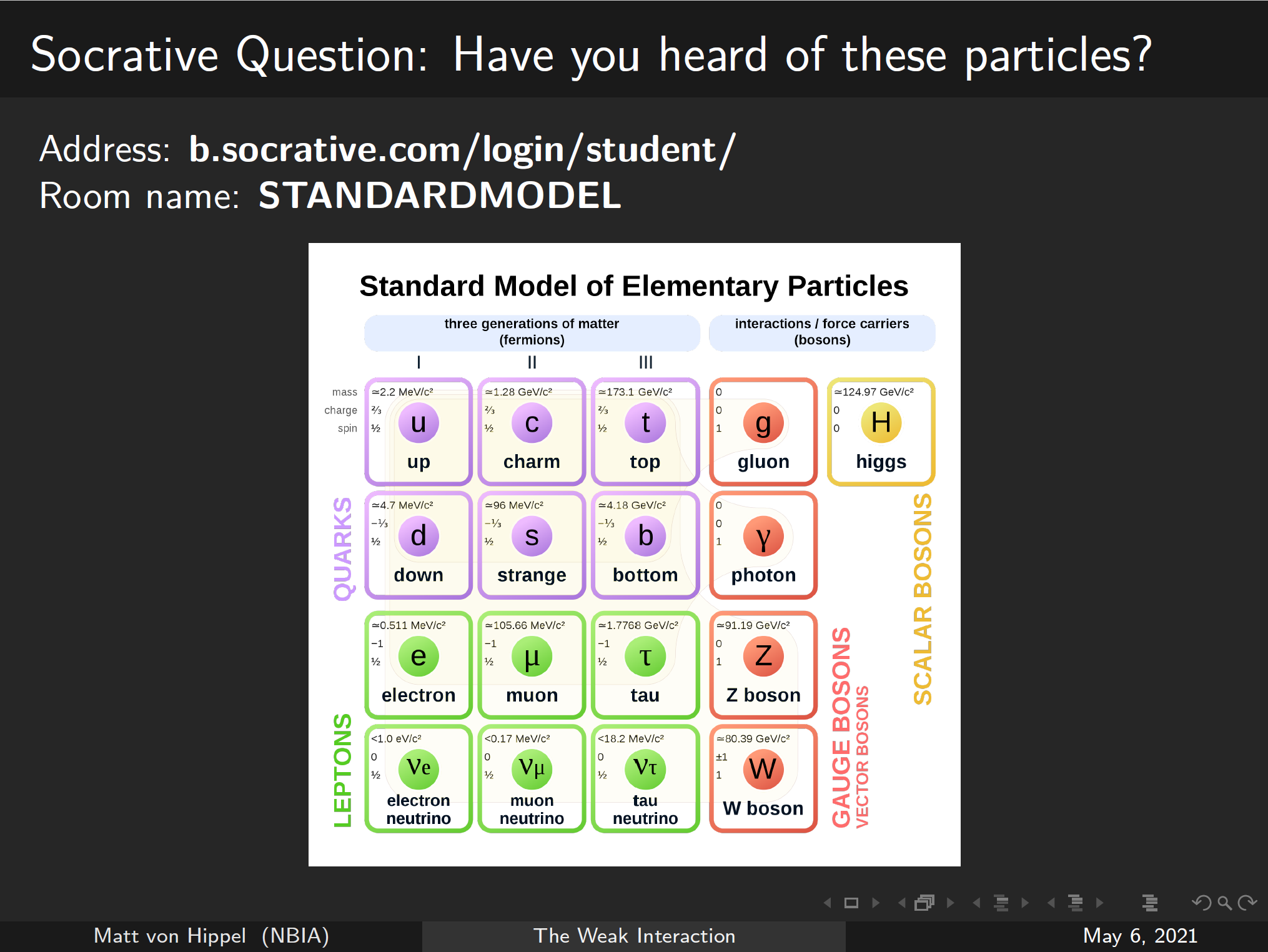
I’m at a pedagogy course this week. It’s the first time I’ve taken a course like this, and it has been really interesting learning about different approaches to teaching (which, as I keep being reminded, is very different from outreach!). It’s also really time-consuming: seven hours of class a day, with readings and lecture prep in the evening. As such, I haven’t had time to do a full blog post. Next week I’ll likely post some reflections about the course. Until then, here’s a slide from the practice lecture I gave:
For a long time, physicists only knew about two fundamental forces: electromagnetism, and gravity. Physics students follow the same path, studying Newtonian gravity, then E&M, and only later learning about the other fundamental forces. If you’ve just recently heard about the weak nuclear force and the strong nuclear force, it can be tempting to think of them as just slight tweaks on electromagnetism. But while that can be a helpful way to start, in a way it’s precisely backwards. Electromagnetism is simpler than the other forces, that’s true. But because of that simplicity, it’s actually pretty weird as a force.
The weirdness of electromagnetism boils down to one key reason: the electromagnetic field has no charge.
Maybe that sounds weird to you: if you’ve done anything with electromagnetism, you’ve certainly seen charges. But while you’ve calculated the field produced by a charge, the field itself has no charge. You can specify the positions of some electrons and not have to worry that the electric field will introduce new charges you didn’t plan. Mathematically, this means your equations are linear in the field, and thus not all that hard to solve.
The other forces are different. The strong nuclear force has three types of charge, dubbed red, green, and blue. Not just quarks, but the field itself has charges under this system, making the equations that describe it non-linear.
A depiction of a singlet state
Those properties mean that you can’t just think of the strong force as a push or pull between charges, like you could with electromagnetism. The strong force doesn’t just move quarks around, it can change their color, exchanging charge between the quark and the field. That’s one reason why when we’re more careful we refer to it as not the strong force, but the strong interaction.
The weak force also makes more sense when thought of as an interaction. It can change even more properties of particles, turning different flavors of quarks and leptons into each other, resulting in among other phenomena nuclear beta decay. It would be even more like the strong force, but the Higgs field screws that up, stirring together two more fundamental forces and spitting out the weak force and electromagnetism. The result ties them together in weird ways: for example, it means that the weak field can actually have an electric charge.
Interactions like the strong and weak forces are much more “normal” for particle physicists: if you ask us to picture a random fundamental force, chances are it will look like them. It won’t typically look like electromagnetism, the weird “degenerate” case with a field that doesn’t even have a charge. So despite how familiar electromagnetism may be to you, don’t take it as your model of what a fundamental force should look like: of all the forces, it’s the simplest and weirdest.
There are theoretical physicists who can do everything they do with a pencil and a piece of paper. I’m not one of them. The calculations I do are long, complicated, or tedious enough that they’re often best done with a computer. For a calculation like that, I can’t just use existing software “out of the box”: I need to program special-purpose tools to do the kind of calculation I need. This means each project has its own kind of learning curve. If I already have the right code, or almost the right code, things go very smoothly: with a few tweaks I can do a lot of interesting calculations. If I don’t have the right code yet, things go much more slowly: I have to build up my technology, figuring out what I need piece by piece until I’m back up to my usual speed.
I don’t always need to use computers to do my calculations. Sometimes my work hinges on something more conceptual: understanding a mathematical proof, or the arguments from another physicist’s paper. While this seems different on the surface, I’ve found that it has the same kinds of learning curves. If I know the right papers and mathematical methods, I can go pretty quickly. If I don’t, I have to “build up my technology”, reading and practicing, a slow build-up to my goal.
The times when I have to “build my technology” are always a bit frustrating. I don’t work as fast as I’d like, and I get tripped up by dumb mistakes. I keep having to go back, almost to the beginning, realizing that some aspect of how I set things up needs to be changed to make the rest work. As I go, though, the work gets more and more satisfying. I find pieces (of the code, of my understanding) that become solid, that I can rely on. I build my technology, and I can do more and more, and feel better about myself in the bargain. Eventually, I get back up to my full abilities, my technology set up, and a wide variety of calculations become possible.
Technically, we don’t know yet. The ALPHA-g experiment would have been the first to check this, making anti-hydrogen by trapping anti-protons and positrons in a long tube and seeing which way it falls. While they got most of their setup working, the LHC complex shut down before they could finish. It starts up again next month, so we should have our answer soon.
That said, for most theorists’ purposes, we absolutely do know: antimatter falls down. Antimatter is one of the cleanest examples of a prediction from pure theory that was confirmed by experiment. When Paul Dirac first tried to write down an equation that described electrons, he found the math forced him to add another particle with the opposite charge. With no such particle in sight, he speculated it could be the proton (this doesn’t work, they need the same mass), before Carl D. Anderson discovered the positron in 1932.
The same math that forced Dirac to add antimatter also tells us which way it falls. There’s a bit more involved, in the form of general relativity, but the recipe is pretty simple: we know how to take an equation like Dirac’s and add gravity to it, and we have enough practice doing it in different situations that we’re pretty sure it’s the right way to go. Pretty sure doesn’t mean 100% sure: talk to the right theorists, and you’ll probably find a proposal or two in which antimatter falls up instead of down. But they tend to be pretty weird proposals, from pretty weird theorists.
Ok, but if those theorists are that “weird”, that outside the mainstream, why does an experiment like ALPHA-g exist? Why does it happen at CERN, one of the flagship facilities for all of mainstream particle physics?
This gets at a misconception I occasionally hear from critics of the physics mainstream. They worry about groupthink among mainstream theorists, the physics community dismissing good ideas just because they’re not trendy (you may think I did that just now, for antigravity antimatter!) They expect this to result in a self-fulfilling prophecy where nobody tests ideas outside the mainstream, so they find no evidence for them, so they keep dismissing them.
The mistake of these critics is in assuming that what gets tested has anything to do with what theorists think is reasonable.
Theorists talk to experimentalists, sure. We motivate them, give them ideas and justification. But ultimately, people do experiments because they can do experiments. I watched a talk about the ALPHA experiment recently, and one thing that struck me was how so many different techniques play into it. They make antiprotons using a proton beam from the accelerator, slow them down with magnetic fields, and cool them with lasers. They trap their antihydrogen in an extremely precise vacuum, and confirm it’s there with particle detectors. The whole setup is a blend of cutting-edge accelerator physics and cutting-edge tricks for manipulating atoms. At its heart, ALPHA-g feels like its primary goal is to stress-test all of those tricks: to push the state of the art in a dozen experimental techniques in order to accomplish something remarkable.
And so even if the mainstream theorists don’t care, ALPHA will keep going. It will keep getting funding, it will keep getting visited by celebrities and inspiring pop fiction. Because enough people recognize that doing something difficult can be its own reward.
In my experience, this motivation applies to theorists too. Plenty of us will dismiss this or that proposal as unlikely or impossible. But give us a concrete calculation, something that lets us use one of our flashy theoretical techniques, and the tune changes. If we’re getting the chance to develop our tools, and get a paper out of it in the process, then sure, we’ll check your wacky claim. Why not?
I suspect critics of the mainstream would have a lot more success with this kind of pitch-based approach. If you can find a theorist who already has the right method, who’s developing and extending it and looking for interesting applications, then make your pitch: tell them how they can answer your question just by doing what they do best. They’ll think of it as a chance to disprove you, and you should let them, that’s the right attitude to take as a scientist anyway. It’ll work a lot better than accusing them of hogging the grant money.
Yesterday, Fermilab’s Muon g-2 experiment announced a new measurement of the magnetic moment of the muon, a number which describes how muons interact with magnetic fields. For what might seem like a small technical detail, physicists have been very excited about this measurement because it’s a small technical detail that the Standard Model seems to get wrong, making it a potential hint of new undiscovered particles. Quanta magazine has a great piece on the announcement, which explains more than I will here, but the upshot is that there are two different calculations on the market that attempt to predict the magnetic moment of the muon. One of them, using older methods, disagrees with the experiment. The other, with a new approach, agrees. The question then becomes, which calculation was wrong? And why?
What does it mean for a prediction to match an experimental result? The simple, wrong, answer is that the numbers must be equal: if you predict “3”, the experiment has to measure “3”. The reason why this is wrong is that in practice, every experiment and every prediction has some uncertainty. If you’ve taken a college physics class, you’ve run into this kind of uncertainty in one of its simplest forms, measurement uncertainty. Measure with a ruler, and you can only confidently measure down to the smallest divisions on the ruler. If you measure 3cm, but your ruler has ticks only down to a millimeter, then what you’re measuring might be as large as 3.1cm or as small as 2.9 cm. You just don’t know.
This uncertainty doesn’t mean you throw up your hands and give up. Instead, you estimate the effect it can have. You report, not a measurement of 3cm, but of 3cm plus or minus 1mm. If the prediction was 2.9cm, then you’re fine: it falls within your measurement uncertainty.
Measurements aren’t the only thing that can be uncertain. Predictions have uncertainty too, theoretical uncertainty. Sometimes, this comes from uncertainty on a previous measurement: if you make a prediction based on that experiment that measured 3cm plus or minus 1mm, you have to take that plus or minus into account and estimate its effect (we call this propagation of errors). Sometimes, the uncertainty comes instead from an approximation you’re making. In particle physics, we sometimes approximate interactions between different particles with diagrams, beginning with the simplest diagrams and adding on more complicated ones as we go. To estimate the uncertainty there, we estimate the size of the diagrams we left out, the more complicated ones we haven’t calculated yet. Other times, that approximation doesn’t work, and we need to use a different approximation, treating space and time as a finite grid where we can do computer simulations. In that case, you can estimate your uncertainty based on how small you made your grid. The new approach to predicting the muon magnetic moment uses that kind of approximation.
There’s a common thread in all of these uncertainty estimates: you don’t expect to be too far off on average. Your measurements won’t be perfect, but they won’t all be screwed up in the same way either: chances are, they will randomly be a little below or a little above the truth. Your calculations are similar: whether you’re ignoring complicated particle physics diagrams or the spacing in a simulated grid, you can treat the difference as something small and random. That randomness means you can use statistics to talk about your errors: you have statistical uncertainty. When you have statistical uncertainty, you can estimate, not just how far off you might get, but how likely it is you ended up that far off. In particle physics, we have very strict standards for this kind of thing: to call something new a discovery, we demand that it is so unlikely that it would only show up randomly under the old theory roughly one in a million times. The muon magnetic moment isn’t quite up to our standards for a discovery yet, but the new measurement brought it closer.
The two dueling predictions for the muon’s magnetic moment both estimate some amount of statistical uncertainty. It’s possible that the two calculations just disagree due to chance, and that better measurements or a tighter simulation grid would make them agree. Given their estimates, though, that’s unlikely. That takes us from the realm of theoretical uncertainty, and into uncertainty about the theoretical. The two calculations use very different approaches. The new calculation tries to compute things from first principles, using the Standard Model directly. The risk is that such a calculation needs to make assumptions, ignoring some effects that are too difficult to calculate, and one of those assumptions may be wrong. The older calculation is based more on experimental results, using different experiments to estimate effects that are hard to calculate but that should be similar between different situations. The risk is that the situations may be less similar than expected, their assumptions breaking down in a way that the bottom-up calculation could catch.
None of these risks are easy to estimate. They’re “unknown unknowns”, or rather, “uncertain uncertainties”. And until some of them are resolved, it won’t be clear whether Fermilab’s new measurement is a sign of undiscovered particles, or just a (challenging!) confirmation of the Standard Model.
Betteridge’s law applies here: the answer is “no”. It’s a subtle “no”, though.
As a scientist, you will always need to be able to communicate your work. Most of the time you can get away with papers and talks aimed at your peers. But the longer you mean to stick around, the more often you will have to justify yourself to others: to departments, to universities, and to grant agencies. A scientist cannot survive on scientific ability alone: to get jobs, to get funding, to survive, you need to be able to promote yourself, at least a little.
Self-promotion isn’t outreach, though. Talking to the public, or to journalists, is a different skill from talking to other academics or writing grants. And it’s entirely possible to go through an entire scientific career without exercising that skill.
That’s a reassuring message for some. I’ve met people for whom science is a refuge from the mess of human interaction, people horrified by the thought of fame or even being mentioned in a newspaper. When I meet these people, they sometimes seem to worry that I’m silently judging them, thinking that they’re ignoring their responsibilities by avoiding outreach. They think this in part because the field seems to be going in that direction. Grants that used to focus just on science have added outreach as a requirement, demanding that each application come with a plan for some outreach project.
I can’t guarantee that more grants won’t add outreach requirements. But I can say at least that I’m on your side here: I don’t think you should have to do outreach if you don’t want to. I don’t think you have to, just yet. And I think if grant agencies are sensible, they’ll find a way to encourage outreach without making it mandatory.
I think that overall, collectively, we have a responsibility to do outreach. Beyond the old arguments about justifying ourselves to taxpayers, we also just ought to be open about what we do. In a world where people are actively curious about us, we ought to encourage and nurture that curiosity. I don’t think this is unique to science, I think it’s something every industry, every hobby, and every community should foster. But in each case, I think that communication should be done by people who want to do it, not forced on every member.
I also think that, potentially, anyone can do outreach. Outreach can take different forms for different people, anything from speaking to high school students to talking to journalists to writing answers for Stack Exchange. I don’t think anyone should feel afraid of outreach because they think they won’t be good enough. Chances are, you know something other people don’t: I guarantee if you want to, you will have something worth saying.