
I hear it from older people, mostly.
“Oh, I know about quantum physics, it’s about how everything is connected!”
“String theory: that’s the one that says everything is connected, right?”
“Carl Sagan said we are all stardust. So really, everything is connected.”

It makes Connect Four a lot easier anyway
I always cringe a little when I hear this. There’s a misunderstanding here, but it’s not a nice clean one I can clear up in a few sentences. It’s a bunch of interconnected misunderstandings, mixing some real science with a lot of confusion.
To get it out of the way first, no, string theory is not about how “everything is connected”. String theory describes the world in terms of strings, yes, but don’t picture those strings as links connecting distant places: string theory’s proposed strings are very, very short, much smaller than the scales we can investigate with today’s experiments. The reason they’re thought to be strings isn’t because they connect distant things, it’s because it lets them wiggle (counteracting some troublesome wiggles in quantum gravity) and wind (curling up in six extra dimensions in a multitude of ways, giving us what looks like a lot of different particles).
(Also, for technical readers: yes, strings also connect branes, but that’s not the sort of connection these people are talking about.)
What about quantum mechanics?
Here’s where it gets trickier. In quantum mechanics, there’s a phenomenon called entanglement. Entanglement really does connect things in different places…for a very specific definition of “connect”. And there’s a real (but complicated) sense in which these connections end up connecting everything, which you can read about here. There’s even speculation that these sorts of “connections” in some sense give rise to space and time.
You really have to be careful here, though. These are connections of a very specific sort. Specifically, they’re the sort that you can’t do anything through.
Connect two cans with a length of string, and you can send messages between them. Connect two particles with entanglement, though, and you can’t send messages between them…at least not any faster than between two non-entangled particles. Even in a quantum world, physics still respects locality: the principle that you can only affect the world where you are, and that any changes you make can’t travel faster than the speed of light. Ansibles, science-fiction devices that communicate faster than light, can’t actually exist according to our current knowledge.
What kind of connection is entanglement, then? That’s a bit tricky to describe in a short post. One way to think about entanglement is as a connection of logic.
Imagine someone takes a coin and cuts it along the rim into a heads half and a tails half. They put the two halves in two envelopes, and randomly give you one. You don’t know whether you have heads or tails…but you know that if you open your envelope and it shows heads, the other envelope must have tails.

Unless they’re a spy. Then it could contain something else.
Entanglement starts out with connections like that. Instead of a coin, take a particle that isn’t spinning and “split” it into two particles spinning in different directions, “spin up” and “spin down”. Like the coin, the two particles are “logically connected”: you know if one of them is “spin up” the other is “spin down”.
What makes a quantum coin different from a classical coin is that there’s no way to figure out the result in advance. If you watch carefully, you can see which coin gets put in to which envelope, but no matter how carefully you look you can’t predict which particle will be spin up and which will be spin down. There’s no “hidden information” in the quantum case, nowhere nearby you can look to figure it out.
That makes the connection seem a lot weirder than a regular logical connection. It also has slightly different implications, weirdness in how it interacts with the rest of quantum mechanics, things you can exploit in various ways. But none of those ways, none of those connections, allow you to change the world faster than the speed of light. In a way, they’re connecting things in the same sense that “we are all stardust” is connecting things: tied together by logic and cause.
So as long as this is all you mean by “everything is connected” then sure, everything is connected. But often, people seem to mean something else.
Sometimes, they mean something explicitly mystical. They’re people who believe in dowsing rods and astrology, in sympathetic magic, rituals you can do in one place to affect another. There is no support for any of this in physics. Nothing in quantum mechanics, in string theory, or in big bang cosmology has any support for altering the world with the power of your mind alone, or the stars influencing your day to day life. That’s just not the sort of connection we’re talking about.
Sometimes, “everything is connected” means something a bit more loose, the idea that someone’s desires guide their fate, that you could “know” something happened to your kids the instant it happens from miles away. This has the same problem, though, in that it’s imagining connections that let you act faster than light, where people play a special role. And once again, these just aren’t that sort of connection.
Sometimes, finally, it’s entirely poetic. “Everything is connected” might just mean a sense of awe at the deep physics in mundane matter, or a feeling that everyone in the world should get along. That’s fine: if you find inspiration in physics then I’m glad it brings you happiness. But poetry is personal, so don’t expect others to find the same inspiration. Your “everyone is connected” might not be someone else’s.

 ,
,  .
. , then a particle is moving at the speed of light.


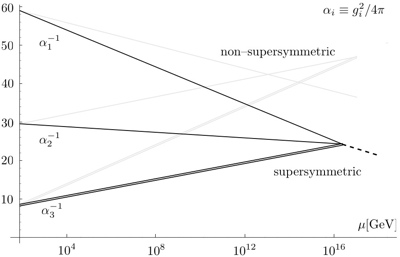
 represents the strength of a fundamental force. As the force gets stronger,
  gets smaller). The variable on the x-axis is the energy scale. The grey lines represent a world without supersymmetry, while the black lines show


 4 gravitons