There’s a big, AI-shaped conversation going on right now about why people do science and mathematics. Is mathematics just about proving things, or about building new ideas, or about helping humans to understand them? What about physics?
Each researcher has their own perspective, their own reasons for research. And I’ve realized there’s a surprisingly nice way to sum them up. It’s an old idea, but not one most academics know.
That’s because it’s an idea from the trading-card game Magic the Gathering.
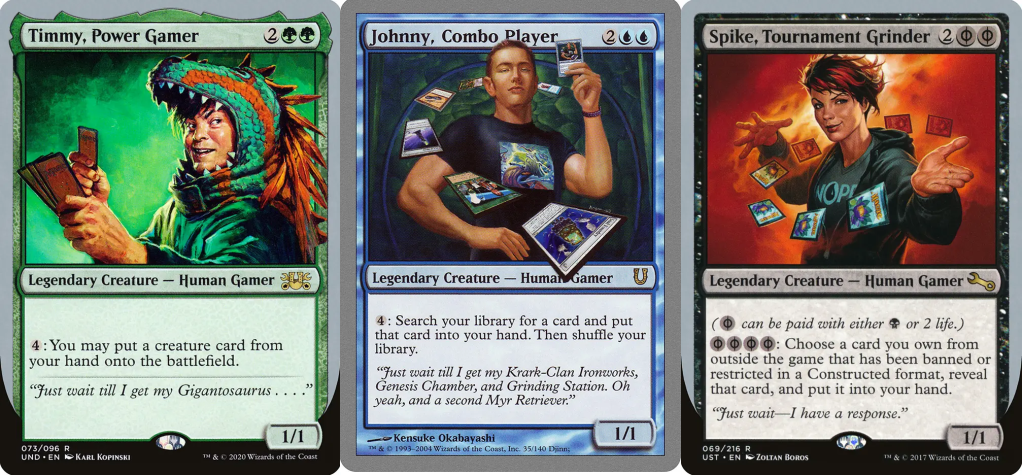
Meet Timmy, Johnny, and Spike. When Magic the Gathering’s designers print new cards, they use these three characters to think about what players want. Each represents a different motivation, a different reason to play the game. It turns out, they’re a pretty good match for researchers’ motivations, too.
Let’s start with Timmy. Timmy wants to experience something. Stereotypically, a Timmy is a new player excited by cards that represent big, flashy monsters, like dragons or dinosaurs. Timmy wants to take part in something cool, to do things that aren’t possible in everyday life. Timmy is motivated by something fundamentally emotional, by how playing the game feels.
In the research world, Timmy is the supernova modeller who told me to join his group because “we blow up stars”. Timmy is the raccoon researcher who thinks they’re the most adorable animals in the world. A researcher who’s a Timmy doesn’t necessarily need to be the best in the field, as long as they get to participate in something that makes them smile.
AI can give Timmy crazy experiences, the chance to feel a part of bigger and bigger things. That can be great, but it can also lead to pathology. If the Magic the Gathering designers did what the Timmy players wanted, they’d keep making bigger and bigger monsters, until the games end so fast that even Timmy wouldn’t have fun anymore. Similarly, researchers might find themselves in a world where there are no more cool open problems to tackle.
Next, there’s Johnny. Johnny wants to express something. In a game where you choose which cards to put in your deck, Johnny’s choices are personal and particular. Johnny enjoys putting together a deck that does something specific, something they figured out on their own. Stereotypically, Johnny likes to find combos, combinations of cards that do something powerful and unexpected.
In research, Johnny works to build new concepts and express ideas. The mathematician Grothendieck was a Johnny, with a picture for how he wanted mathematics to look. A quantum researcher promoting their own interpretation, a biologist with their perspective on the interaction between genes and ecosystems, a scattering amplitudes researcher who’d rather find a cool new way to write the amplitude than a more efficient but boring way to calculate it, all of these are versions of Johnny.
AI doesn’t do what Johnny does yet, or at least it doesn’t seem to. The mathematicians who object when AI jumps ahead to a proof often have a Johnny motivation, because for them, the proof was supposed to be a motivation to build new concepts and research directions. So most Johnny researchers are either annoyed by AI, or dismissive of it. But some use it: some people have something they want to express, but can’t bring together the expertise to get it through. They use AI to fill the gaps, realizing their vision instead of looking for a different vision.
Finally, there’s Spike. Spike has been described in different ways over the years, as someone who wants to improve, or to prove something. But I like the oldest definition here. Spike wants to win. Spike doesn’t care if the cards are cool giant monsters or embarrassing references to Teenage Mutant Ninja Turtles, Spike doesn’t care if the deck is something they figured out themselves or a list they copied from the internet. Spike just wants to win.
In research, Spikes have a goal, and do what they need to to achieve it. When Watson moved to the UK and switched fields to position himself to discover the structure of DNA, he was being a Spike. When Brian Keating was so desperate for a Nobel that he scraped Planck collaboration slides rather than wait for the data to be released, he was being a Spike. Spikes don’t care about whether they solve things in an elegant, cool, or personally meaningful way. Clunky jury-rig solutions are fine, as long as they do the job.
For some Spikes in mathematics, AI is triggering an existential crisis. For people focused on improving themselves, proving themselves, and being the best, the idea that they can be beaten at long-standing goals by a machine is soul-crushing. Other Spikes are AI’s most enthusiastic adopters. If you’re willing to do anything you can to win, and you don’t care about style, why not use every tool you can, no matter how alien the output?
In practice, everyone has a bit of each motivation. No-one is pure Timmy, pure Johnny, or pure Spike. But the balance is different in each person. So I’ve found it helpful to ask, as I read what researchers write (about AI and otherwise): is this a Timmy? A Johnny? Or a Spike?


To render “Spike” as a woman is sexist and demeaning. Spike is a man with a dog collar on.
LikeLike