Monthly Archives: October 2026

An AI Apocalypse, but Just for You

For Halloween, I like to talk about spooky scenarios. And these days, the most trendy one is an AI apocalypse.

You can run into a wild range of ideas for how AI could go wrong, of varying plausibility. They go from hacks shutting down key infrastructure or engineered viruses, to taking over nuclear arsenals and sending out armies of killer robots, all the way to nanotech that devours the world and flawlessly manipulative plans that end up filling space with computers simulating hell at the speed of light.

And of course, on the other end, the possibility that banks suddenly become convinced that the investments underpinning AI companies’ trillion dollar evaluations aren’t going to pay, collapsing the economy.

So, lots of things to be scared of this year!

But in all of those scenarios, at least we suffer together. If civilization cracks like an egg, everyone who survives has to adapt and figure out a new path forward. And if everyone’s dead, well, everyone’s dead. There’s something oddly comforting about that.

That’s not guaranteed, though.

I occasionally see quotes from “100+ reactions to 100+ solutions”, a compilation of thoughts by mathematicians about OpenAI’s recent claim to have solved hundreds of difficult open problems in mathematics. For the most part, these people aren’t writing about an AI apocalypse that sweeps civilization into a new form. They’re writing about what AI seems to be capable of in mathematics, right now, and wondering how they personally will withstand it.

Picture a world where you’ve defined yourself around something. Maybe you’re competitive, someone who wants to be the best in the world. Maybe you just want something of your own, accomplishments that came from you, not anyone else. Either way, it’s something you love, something you chose a strange and difficult path to pursue.

Then, that identity falls apart. For the competitive, you’re not the best anymore, not at the kind of thing you were doing, you’ll never be the best at that again. For the rest, your sense of ownership is less secure. Someone could hear about that problem you’re tinkering with, decide to tackle it on a whim, and jump so far ahead that you’d never be able to catch up on your own merits.

And if there isn’t a wider collapse, you’re facing this on your own. You might have to find a new job, though in a world where universities still need math classes that seems unlikely. But you will have to find a new purpose. You’d have to become a different kind of mathematician, at minimum, one more dedicated to something the AI can’t do and less dedicated to the things that happened to define your style of mathematics. Your friends in other fields will never quite understand. Your friends outside of academia will understand even less.

If we thread the needle between the apocalypses of powerful AI and an economic bubble that pops so hard that companies can’t host the models anymore, we end up with a series of quieter, more personal AI apocalypses, people who feel like their own world is ending, and have to figure out how to go on. For now, that’s the possibility many mathematicians are considering. We’ll see how many others consider it in the years to come.
The Weird Incentives of Word Count

Many freelancers get paid per hour, or per day. Some have standard rates for typical tasks.

Journalism is rarely typical. And usually, we’re paid per word.

I’ve had many friends whose first thought is how easy that must be to exploit. Often they remember a story about a writer like Charles Dickens or Victor Hugo padding their books with digressions to up their pay. Those stories probably didn’t happen, and these days, that method is even less likely to work. When I pitch a piece, the editor and I agree beforehand on a target word count. The only way I get paid more than expected is if the editor agrees that it makes sense.

That said, there definitely are ways to exploit being paid by the word, if you wanted to. They’re just more subtle.

The source of any such exploit is to notice that writing is not actually the hard part of journalism. Research is time-consuming: the more people you talk to, the longer it takes. Writing, once you’re used to it, can go quite quickly. So the length of a piece itself doesn’t determine how much work it takes to write: research does.

In principle, longer pieces are supposed to take more research. Editors will have rough expectations for the number of sources you’ll interview, so this isn’t something you can skimp on, per se. And publications known for their high standards for research usually pay larger rates per-word.

But no matter how much you’re paid, research can go out of hand in the other direction. Journalism is about finding out the truth, and sometimes the truth is more complicated than expected. Sometimes you need more information, and need to fit in one more interview, then another, or run around chasing after missing info. Then you need to figure out how to fit it all into the same word count you started with.

So suppose you’re a freelancer who aspires to consistently pay their bills. You want to earn a certain amount per hour worked, but some projects can take much more work than others. So what do you do?

You look for the simple. You try to find stories that are unlikely to be complicated, that won’t have clashes of opinion that need to be represented or experts with different sides of the story. If you don’t find such a story, you simplify: you write a piece that makes the story sound cohesive, that papers over doubt, even if you’ve run into doubts yourself while writing it. If you’re consistent about it, you can do what your friends with salaries do, and earn a stable living.

Not the kind of exploit you had in mind, I suspect. And not, despite the sound of it, something you can do reliably. I find I’m always tempted by complexity, always drawn to investigate a story that’s a bit too big for the wordcount it’s supposed to fit.

But it is an ever-present incentive, one I suspect people with a larger roster of leads start to feel. If you’re paid by the word, then the best story tends to be a tidy one.

Showing Me Your Amateur Breakthrough Is Evidence That It’s Wrong

Ok, people who read my post on the Anthropic science blog: we need to talk.

It’s understandable. You saw me write about AI being used to tackle a serious, publishable physics problem. Naturally, some of you want to share that you accomplished something even more impressive with AI, something the scientific journals and arXiv moderators won’t acknowledge. Maybe you’re hoping I’ll write about it, maybe you want me to check your math. Maybe you just think it’s neat.

But here’s the thing: most of the time, I’m not the right person to send those ideas to. And the fact that you didn’t figure that out is a bad sign.

Outside of the movies, scientists are specialists. Not just “physics” or “particle physics” or “theoretical particle physics”, but so specific that they often focus on particular methods, or are geared around particular goals. For any idea you propose, if it’s good, there will be a small list of people who will be excited to see it and able to evaluate it. They’ll be people who are trying to accomplish the same thing, or people who used the methods you’re using for other things. Those people aren’t hard to find, if your idea is in a field you’re actually interested in: they’re the people who write papers on the subject. If you find the topic interesting, you’ll have read their papers, and know who to reach out to.

So even back when I was active as a physicist, there was only a small list of ideas where I’d be the right person to talk to. Now, though, as I mentioned in the Anthropic post, I’m not a scientist anymore. I haven’t been following the field in enough detail to actually verify anything in detail, even on topics I used to research. Part of the punchline of the post was that I don’t have a clear idea of what’s possible in the field right now. So even if you’ve figured out something in scattering amplitudes, you should reach out to someone who’s still researching the subject, a few of whom were even mentioned in the post!

Now, it might be you’re not interested in someone checking your work, and instead you’re writing to me in my capacity as a science journalist, because you feel like you did something newsworthy. But as a science journalist, I’m not supposed to evaluate your work by myself. I’m supposed to reach out to an independent expert, and if I can’t find any who will speak positively about your result, then the editors won’t publish it. So if you think you did something big enough to merit news coverage, the first thing to do is once again, reach out to a scientist who actually has the expertise to evaluate your work, and get them excited about it. Then you two can contact me together!

If you don’t know who to contact, that’s a sign you don’t read papers in the field. It makes it more likely you managed to convince yourself of something nonsensical, because you don’t have the expertise to evaluate it. It’s a pretty clear sign that I shouldn’t trust you or your AI methods about the result.

It’s also just plain bad for you. If you produce a paper without ever wanting to read any, it suggests your priorities are in a dangerous place: that you’re trying to do something that sounds cool and important over doing something you actually care about.

I’m coming from personal experience here.

As an academic, I spent years telling myself that not enjoying reading papers or going to talks was just part of the job. Then it really cost me something, and I realized the job wasn’t worth my superficial desire to be a physicist. So I left.

Then, I spent a year trying to get a job in industry, and was told the same thing. They wanted to hire people who cared about the job. The finance guys wanted to hire people who read books about finance. The data scientists wanted to hire people who did projects in data science. They wanted, if not passion, then at least grace. Someone who could take to the job easily, and naturally.

Now, what I do for a living is something I was doing once a week, for no more incentive than a vague sense of personal obligation, for over a decade. And I’m doing a lot better.

You want to do something impressive with AI? You think you’re a whiz with Claude Code, that your custom workflow is immune to AI hallucinations?

Then use it for something else. Pick something you actually enjoy reading about, not just the pop news, but the real technical literature. Something you don’t need the AI to explain to you. Something that matters to you, in a way that actually counts.

At the very least, it’ll work out better than writing to me.

Congratulations to Francis Halzen!

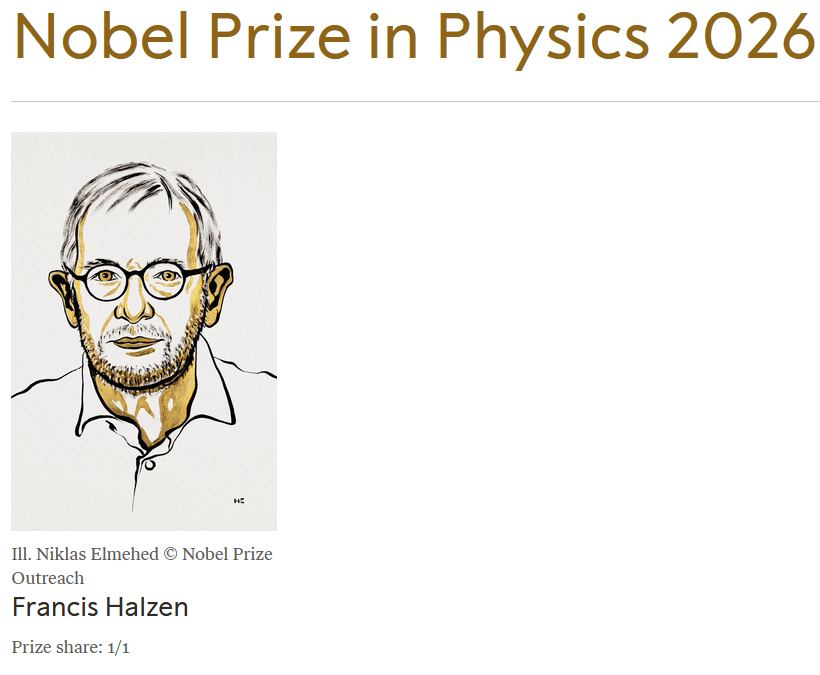
The 2026 Physics Nobel Prize was awarded this week, going to Francis Halzen for the work that led to the IceCube Neutrino Observatory.

Does that image look weird, like something is missing? It should. This is the first time in over thirty years that the physics Nobel was awarded to just a single person. Most years, it goes to three people, even if they have to awkwardly jam loosely related achievements together to make it work. Some years, it goes to two. The last time one person received the whole prize was 1992.

So why didn’t Halzen have to share the prize like Penrose did in 2020 and Parisi did in 2021? As the saying goes, your guess is as good as mine.

I can say that I was pleasantly surprised to read the announcement and see a name I recognized. I probably couldn’t name the main figures behind most big experiments. If the prize had gone to another founding figure, I’d be out of luck. But I’d heard of Halzen. And specifically, I’d heard about him in the context of the long road it took to get IceCube working.

The IceCube Neutrino Observatory is on the face of it a crazy idea. Neutrinos are almost undetectable, particles that can whiz through a light-year of lead without noticing a thing. To detect them, other experiments had build massive underground tanks of heavy water, shielded from outside interference and covered in cameras, so that on the extremely rare occasions when a neutrino happens to nudge a water molecule, it can be recorded and measured.

IceCube does this on another level, in wild surroundings, by sinking a grid of cameras into a kilometer of Antarctic ice.

So when I saw someone else propose a wild particle detection idea, I talked to my contacts at IceCube, to get an idea of how those wild ideas get fleshed out. And they told me about Halzen.

What they told me, what resonated again and again in Halzen’s writing, and what keeps coming up in quotes from him today, is that it took both luck and persistence. Nature needed to cooperate, there was no guarantee that IceCube would work. But also, the experiment couldn’t have existed without predecessors. He built off plans to put detectors on the bottom of the ocean, and tried out smaller experiments in Greenland.

Those experiments intrigue me, because they filled two roles. On the one hand, they were in a sense mere prototypes, and theorists had strong arguments that they wouldn’t be able to detect anything of interest. On the other hand, those arguments could have been wrong, and the experiments wouldn’t have been made if they could only be justified as prototypes: they were made because there was a chance they could actually see interesting neutrinos.

That combination strikes me as fundamental. We never know, in science, if an experiment will work. So every experiment, deep down, serves this combined purpose. It has to have a chance, even if low and poorly understood, of seeing something new and interesting. And it has to serve as a prototype, to teach us how to make the next experiment. Experiments are almost never one or the other, they are almost always both.

And eventually, as for Halzen, we get lucky, and nature cooperates.

Beginnings Don’t Matter as Much as You’d Think

I’ve met people who think they’re uncomfortable with evolution, but when you actually talk to them, they’re worried about something very different. They ask, “How could something come from nothing? How could life come from non-life?”

Biologists aren’t sure of the origin of life. They’re working on it, there’s a whole research field on what the experts call abiogenesis. But it’s hard going, because there’s so little direct evidence.

There is a lot more evidence for evolution. Evolution isn’t a theory of where life comes from, it was never meant to be one. It’s a theory that explains the copious evidence we have from the history of life, from the fossil record to genetic comparisons to leftover features in related animals. It’s a theory that tells you what to expect when you already have some life, and wait a few generations.

Evolution and abiogenesis are different ideas, with different domains. You can have one without the other. And when you already have life, and want to understand it, evolution is quite a bit more useful than abiogenesis.

There’s a similar story with the big bang.

Some people get mystified at the idea that the big bang made something out of nothing. But that’s not really how the big bang works.

It’s not just that the big bang wasn’t the explosion you imagine, a single point expanding in an empty space. Rather, it was a time when the entire universe, everywhere that anything could be, was in a hot dense state, not empty but brim-full.

It’s that the most important part of the big bang is what happened next. As the universe cooled, things spread away from each other, like the residents of Hilbert’s Hotel all moving one room apart. Clumps formed, electrons slowing down and getting caught by protons to make atoms, dust pulling on dust until it collapsed into stars.

The patterns of a universe that cooled this way are distributed over the sky. They tell us the kinds of atoms we expect to see in spectra of stars, the distribution of galaxies, the ripples in the afterglow of the first light to avoid getting absorbed by hot plasma. Those patterns are the core of physical cosmology, the bulk of the field’s research and its strongest argument.

In contrast, the question of where that hot dense state came from is murkier. There are a variety of pictures, different attempts to approximate a context where gravity’s quantum properties should be especially relevant by people who still don’t have a clear idea of how to think about quantum gravity.

But while the question is murky, it’s also just not very useful. Wherever that state came from, knowing it exists is usually enough to chart the rest of the universe’s history. In fact, it may even be impossible for us to know what happened before a certain time: we have only one sky’s worth of evidence, and eventually that evidence runs out.

People are used to created things: food, clothes, cars. Created things don’t change in complicated ways over time, for the most part, just break down. To understand a created thing, understanding its origin matters.

But science is full of stranger things, things with a life, or dynamics, of their own. Natural phenomena change, swiftly becoming something other than what they began as. Understanding them means understanding those changes, much more than it does understanding how they began.