
The 2026 Physics Nobel Prize was awarded this week, going to Francis Halzen for the work that led to the IceCube Neutrino Observatory.
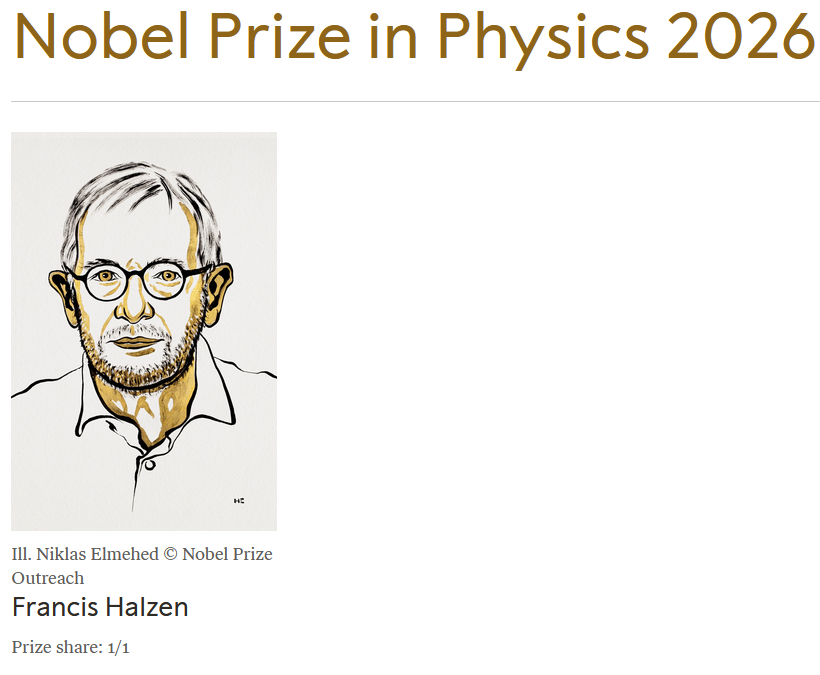
Does that image look weird, like something is missing? It should. This is the first time in over thirty years that the physics Nobel was awarded to just a single person. Most years, it goes to three people, even if they have to awkwardly jam loosely related achievements together to make it work. Some years, it goes to two. The last time one person received the whole prize was 1992.
So why didn’t Halzen have to share the prize like Penrose did in 2020 and Parisi did in 2021? As the saying goes, your guess is as good as mine.
I can say that I was pleasantly surprised to read the announcement and see a name I recognized. I probably couldn’t name the main figures behind most big experiments. If the prize had gone to another founding figure, I’d be out of luck. But I’d heard of Halzen. And specifically, I’d heard about him in the context of the long road it took to get IceCube working.
The IceCube Neutrino Observatory is on the face of it a crazy idea. Neutrinos are almost undetectable, particles that can whiz through a light-year of lead without noticing a thing. To detect them, other experiments had build massive underground tanks of heavy water, shielded from outside interference and covered in cameras, so that on the extremely rare occasions when a neutrino happens to nudge a water molecule, it can be recorded and measured.
IceCube does this on another level, in wild surroundings, by sinking a grid of cameras into a kilometer of Antarctic ice.
So when I saw someone else propose a wild particle detection idea, I talked to my contacts at IceCube, to get an idea of how those wild ideas get fleshed out. And they told me about Halzen.
What they told me, what resonated again and again in Halzen’s writing, and what keeps coming up in quotes from him today, is that it took both luck and persistence. Nature needed to cooperate, there was no guarantee that IceCube would work. But also, the experiment couldn’t have existed without predecessors. He built off plans to put detectors on the bottom of the ocean, and tried out smaller experiments in Greenland.
Those experiments intrigue me, because they filled two roles. On the one hand, they were in a sense mere prototypes, and theorists had strong arguments that they wouldn’t be able to detect anything of interest. On the other hand, those arguments could have been wrong, and the experiments wouldn’t have been made if they could only be justified as prototypes: they were made because there was a chance they could actually see interesting neutrinos.
That combination strikes me as fundamental. We never know, in science, if an experiment will work. So every experiment, deep down, serves this combined purpose. It has to have a chance, even if low and poorly understood, of seeing something new and interesting. And it has to serve as a prototype, to teach us how to make the next experiment. Experiments are almost never one or the other, they are almost always both.
And eventually, as for Halzen, we get lucky, and nature cooperates.

