Monthly Archives: October 2023

Physics’ Unique Nightmare

Halloween is coming up, so let’s talk about the most prominent monster of the physics canon, the nightmare scenario.

Not to be confused with the D&D Nightmare, which once was a convenient source of infinite consumable items for mid-level characters.

Right now, thousands of physicists search for more information about particle physics beyond our current Standard Model. They look at data from the Large Hadron Collider to look for signs of new particles and unexpected behavior, they try to detect a wide range of possible dark matter particles, and they make very precise measurements to try to detect subtle deviations. And in the back of their minds, almost all of those physicists wonder if they’ll find anything at all.

It’s not that we think the Standard Model is right. We know it has problems, deep mathematical issues that make it give nonsense answers and an apparent big mismatch with what we observe about the motion of matter and light in the universe. (You’ve probably heard this mismatch called dark matter and dark energy.)

But none of those problems guarantee an answer soon. The Standard Model will eventually fail, but it may fail only for very difficult and expensive experiments, not a Large Hadron Collider but some sort of galactic-scale Large Earth Collider. It might be that none of the experiments or searches or theories those thousands of physicists are working on will tell them anything they didn’t already know. That’s the nightmare scenario.

I don’t know another field that has a nightmare scenario quite like this. In most fields, one experiment or another might fail, not just not giving the expected evidence but not teaching anything new. But most experiments teach us something new. We don’t have a theory, in almost any field, that has the potential to explain every observation up to the limits of our experiments, but which we still hope to disprove. Only the Standard Model is like that.

And while thousands of physicists are exposed to this nightmare scenario, the majority of physicists aren’t. Physics isn’t just the science of the reductionistic laws of the smallest constituents of matter. It’s also the study of physical systems, from the bubbling chaos of nuclear physics to the formation of planets and galaxies and black holes, to the properties of materials to the movement of bacteria on a petri dish and bees in a hive. It’s also the development of new methods, from better control of individual atoms and quantum states to powerful new tricks for calculation. For some, it can be the discovery, not of reductionistic laws of the smallest scales, but of general laws of the largest scales, of how systems with many different origins can show echoes of the same behavior.

Over time, more and more of those thousands of physicists break away from the nightmare scenario, “waking up” to new questions of these kinds. For some, motivated by puzzles and skill and the beauty of physics, the change is satisfying, a chance to work on ideas that are moving forward, connected with experiment or grounded in evolving mathematics. But if your motivation is really tied to those smallest scales, to that final reductionistic “why”, then such a shift won’t be satisfying, and this is a nightmare you won’t wake up from.

Me, I’m not sure. I’m a tool-builder, and I used to tell myself that tool-builders are always needed. But I find I do care, in the end, what my tools are used for. And as we approach the nightmare scenario, I’m not at all sure I know how to wake up.

Neutrinos and Guarantees

The Higgs boson, or something like it, was pretty much guaranteed.

When physicists turned on the Large Hadron Collider, we didn’t know exactly what they would find. Instead of the Higgs boson, there might have been many strange new particles with different properties. But we knew they had to find something, because without the Higgs boson or a good substitute, the Standard Model is inconsistent. Try to calculate what would happen at the LHC using the Standard Model without the Higgs boson, and you get literal nonsense: chances of particles scattering that are greater than one, a mathematical impossibility. Without the Higgs boson, the Standard Model had to be wrong, and had to go wrong specifically when that machine was turned on. In effect, the LHC was guaranteed to give a Nobel prize.

The LHC also searches for other things, like supersymmetric partner particles. It, and a whole zoo of other experiments, also search for dark matter, narrowing down the possibilities. But unlike the Higgs, none of these searches for dark matter or supersymmetric partners is guaranteed to find something new.

We’re pretty certain that something like dark matter exists, and that it is in some sense “matter”. Galaxies rotate, and masses bend light, in a way that seems only consistent with something new in the universe we didn’t predict. Observations of the whole universe, like the cosmic microwave background, let us estimate the properties of this something new, finding it to behave much more like matter than like radio waves or X-rays. So we call it dark matter.

But none of that guarantees that any of these experiments will find dark matter. The dark matter particles could have many different masses. They might interact faintly with ordinary matter, or with themselves, or almost not at all. They might not technically be particles at all. Each experiment makes some assumption, but no experiment yet can cover the most pessimistic possibility, that dark matter simply doesn’t interact in any usefully detectable way aside from by gravity.

Neutrinos also hide something new. The Standard Model predicts that neutrinos shouldn’t have mass, since it would screw up the way they mess with the mirror symmetry of the universe. But they do, in fact, have mass. We know because they oscillate, because they change when traveling, from one type to another, and that means those types must be mixes of different masses.

It’s not hard to edit the Standard Model to give neutrinos masses. But there’s more than one way to do it. Every way adds new particles we haven’t yet seen. And none of them tell us what neutrino masses should be. So there are a number of experiments, another zoo, trying to find out. (Maybe this one’s an aquarium?)

Are those experiments guaranteed to work?

Not so much as the LHC was to find the Higgs, but more than the dark matter experiments.

We particle physicists have a kind of holy book, called the Particle Data Book. It summarizes everything we know about every particle, and explains why we know it. It has many pages with many sections, but if you turn to page 10 of this section, you’ll find a small table about neutrinos. The table gives a limit: the neutrino mass is less than 0.8 eV (a mysterious unit called an electron-volt, about ten-to-the-minus-sixteen grams). That limit comes from careful experiments, using E=mc^2 to find what the missing mass could be when an electron-neutrino shoots out in radioactive beta decay. The limit is an inequality, “less than” rather than “equal to”, because the experiments haven’t detected any missing mass yet. So far, they only can tell us what they haven’t seen.

As these experiments get more precise, you could imagine them getting close enough to see some missing mass, and find the mass of a neutrino. And this would be great, and a guaranteed discovery, except that the neutrino they’re measuring isn’t guaranteed to have a mass at all.

We know the neutrino types have different masses, because they oscillate as they travel between the types. But one of the types might have zero mass, and it could well be the electron-neutrino. If it does, then careful experiments on electron-neutrinos may never give us a mass.

Still, there’s a better guarantee than for dark matter. That’s because we can do other experiments, to test the other types of neutrino. These experiments are harder to do, and the bounds they get are less precise. But if the electron neutrino really is massless, then we could imagine getting better and better at these different experiments, until one of them measures something, detecting some missing mass.

(Cosmology helps too. Wiggles in the shape of the universe gives us an estimate of the total, the mass of all the neutrinos averaged together. Currently, it gives another upper bound, but it could give a lower bound as well, which could be used along with weaker versions of the other experiments to find the answer.)

So neutrinos aren’t quite the guarantee the Higgs was, but they’re close. As the experiments get better, key questions will start to be answerable. And another piece of beyond-the-standard-model physics will be understood.

Academic Hiring: My Field vs. Bret’s

Bret Deveraux is a historian and history-blogger who’s had a rough time on the academic job market. He recently had a post about how academic hiring works, at least in his corner of academia. Since we probably have some overlap in audience (and should have more, if you’re at all interested in ancient history he’s got some great posts), I figured I’d make a post of my own pointing out how my field, and fields nearby, do things differently.

First, there’s a big difference in context. The way Bret describes things, it sounds like he’s applying only to jobs in the US (maybe also Canada?). In my field, you can do that (the US is one of a few countries big enough to do that), but in practice most searches are at least somewhat international. If you look at the Rumor Mill, you’ll see a fair bit of overlap between US searches and UK searches, for example.

Which brings up another difference: rumor mills! It can be hard for applicants to get a clear picture of what’s going on. Universities sometimes forget to let applicants know they weren’t shortlisted, or even that someone else was hired. Rumor mills are an informal way to counteract this. They’re websites where people post which jobs are advertised in a given year, who got shortlisted, and who eventually got offered the job. There’s a rumor mill for the US market (including some UK jobs anyway), a UK rumor mill, a German/Nordic rumor mill (which also has a bunch of Italian jobs on it, to the seeming annoyance of the organizers), and various ones that I haven’t used but are linked on the US one’s page.

Bret describes a seasonal market with two stages: a first stage aimed at permanent positions, and a second stage for temporary adjunct teaching positions. My field doesn’t typically do adjuncts, so we just have the first stage. This is usually, like Bret’s field, something that happens in the Fall through Winter, but in Europe institutional funding decisions can get made later in the year, so I’ve seen new permanent positions get advertised even into the early Spring.

(Our temporary positions are research-focused, and advertised at basically the same time of year as the faculty positions, with the caveat that there is a special rule for postdocs. Due to a widely signed agreement, we in high-energy theory have agreed to not require postdocs to make a decision about whether they will accept a position until Feb 15 at the earliest. This stopped what used to be an arms race, with positions requiring postdocs to decide earlier and earlier in order to snatch the good ones before other places could make offers. The deadline was recently pushed a bit later yet, to lower administrative load during the Christmas break.)

Bret also describes two stages of interviews, a long-list interviewed on Zoom (that used to be interviewed at an important conference) and a short-list interviewed on campus. We just have the latter: while there are sometimes long-lists, they’re usually an internal affair, and I can’t think of a conference you could expect everyone to go to for interviews anyway. Our short-lists are also longer than his: I was among eight candidates when I interviewed for my position, which is a little high but not unheard of, five is quite typical.

His description of the actual campus visit matches my experience pretty well. There’s a dedicated talk, and something that resembles a “normal job interview”, but the rest, conversations from the drive in to the dinners if they organize them, are all interviews on some level too.

(I would add though, that while everyone there is trying to sort out if you’d be a good fit for them, you should also try to sort out if they’d be a good fit for you. I’ll write more about this another time, but I’m increasingly convinced that a key element in my landing a permanent position was the realization that, rather than just trying for every position I where I plausibly had a chance, I should focus on positions where I would actually be excited to collaborate with folks there.)

Bret’s field, as mentioned, has a “second round” of interviews for temporary positions, including adjuncts and postdocs. We don’t have adjuncts, but we do have postdocs, and they mostly interview at the same time the faculty do. For Bret, this wouldn’t make any sense, because anyone applying for postdocs is also applying for faculty positions, but in my field there’s less overlap. For one, very few people apply for faculty positions right out of their PhD: almost everyone, except those viewed as exceptional superstars, does at least one postdoc first. After that, you can certainly have collisions, with someone taking a postdoc and then getting a faculty job. The few times I’ve broached this possibility with people, they were flexible: most people have no hard feelings if a postdoc accepts a position and then changes their mind when they get a faculty job, and many faculty jobs let people defer a year, so they can do their postdoc and then start their faculty job afterwards.

(It helps that my field never seems to have all that much pressure to fill teaching roles. I’m not sure why (giant lecture courses using fewer profs? more research funding meaning we don’t have to justify ourselves with more undergrad majors?), but it’s probably part of why we don’t seem to hire adjuncts very often.)

Much like in Bret’s field, we usually need to submit a cover letter, CV, research statement, and letters of recommendation. Usually we submit a teaching statement, not a portfolio: some countries (Denmark) have been introducing portfolios but for now they’re not common. Diversity statements are broadly speaking a US and Canada thing: you will almost always need to submit one for a job in those places (one memorable job I looked at asserted that Italian-American counted as diversity), and sometimes in the UK, but much more rarely elsewhere in Europe (I can think of only one example). You never need to submit transcripts except if you’re applying to some unusually bureaucracy-obsessed country. “Writing samples” sometimes take the form of requests for a few important published papers: most places don’t ask for this, though. Our cover letters are less fixed (I’ve never heard a two-page limit, and various jobs actually asked for quite different things). While most jobs require three letters of recommendation, I was surprised to learn (several years in to applying…) that one sometimes can submit more, with three just being a minimum.

Just like Bret’s field, these statements all need to be tailored to the job to some extent (something I once again appreciated more a few years in). That does mean a lot of work, because much like Bret’s field there are often only a few reasonable permanent jobs one can apply for worldwide each year (maybe more than 6-12, but that depends on what you’re looking for), and they essentially all have hundreds of applicants. I won’t comment as much on how hiring decisions get made, except to say that my field seems a little less dysfunctional than Bret’s with “just out of PhD” hires quite rare and most people doing a few postdocs before finding a position. Still, there is a noticeable bias towards comparatively fresh PhDs, and this is reinforced by the European grant system: the ERC Starting Grant is a huge sum of money compared to many other national grants, and you can only apply for it within seven years from your PhD. The ERC Consolidator Grant can be applied for later (twelve years from PhD), but has higher standards (I’m working on an application for it this year). If you aren’t able to apply for either of those, then a lot of European institutions won’t consider you.


Congratulations to Pierre Agostini, Ferenc Krausz and Anne L’Huillier!

The 2023 Physics Nobel Prize was announced this week, awarded to Pierre Agostini, Ferenc Krausz and Anne L’Huillier for figuring out how to generate extremely fast (hundreds of attoseconds) pulses of light.

Some physicists try to figure out the laws of physics themselves, or the behavior of big photogenic physical systems like stars and galaxies. Those people tend to get a lot of press, but most physicists don’t do that kind of work. Instead, most physicists try to accomplish new things with old physical laws: taking light, electrons, and atoms and doing things nobody thought possible. While that may sound like engineering, the work these physicists do lies beyond the bounds of what engineers are comfortable with: there’s too much uncertainty, too little precedent, and the applications are still far away. The work is done with the goal of pushing our capabilities as far as we can, accomplishing new things and worrying later about what they’re good for.

(Somehow, they still tend to be good for something, often valuable things. Knowing things pays off!)

Anne L’Huillier began the story in 1987, shining infrared lasers through noble gases and seeing the gas emit unexpected new frequencies. As physicists built on that discovery, it went from an academic observation to a more and more useful tool, until in 2001 Pierre Agostini and Ferenc Krausz, with different techniques both based on the same knowledge, managed to produce pulses of light only a few hundred attoseconds long.

(“Atto” is one of the SI prefixes. They go milli, micro, nano, pico, femto, atto. Notice that “nano” is in the middle there: an attosecond is as much smaller than a nanosecond as a nanosecond is from an ordinary second.)

This is cool just from the point of view of “humans doing difficult things”, but it’s also useful. Electrons move on attosecond time-scales. If you can send pulses of light at attosecond speed, you’ve got a camera fast enough to capture how electrons move in real time. You can figure out how they traverse electronics, or how they slosh back and forth in biological molecules.

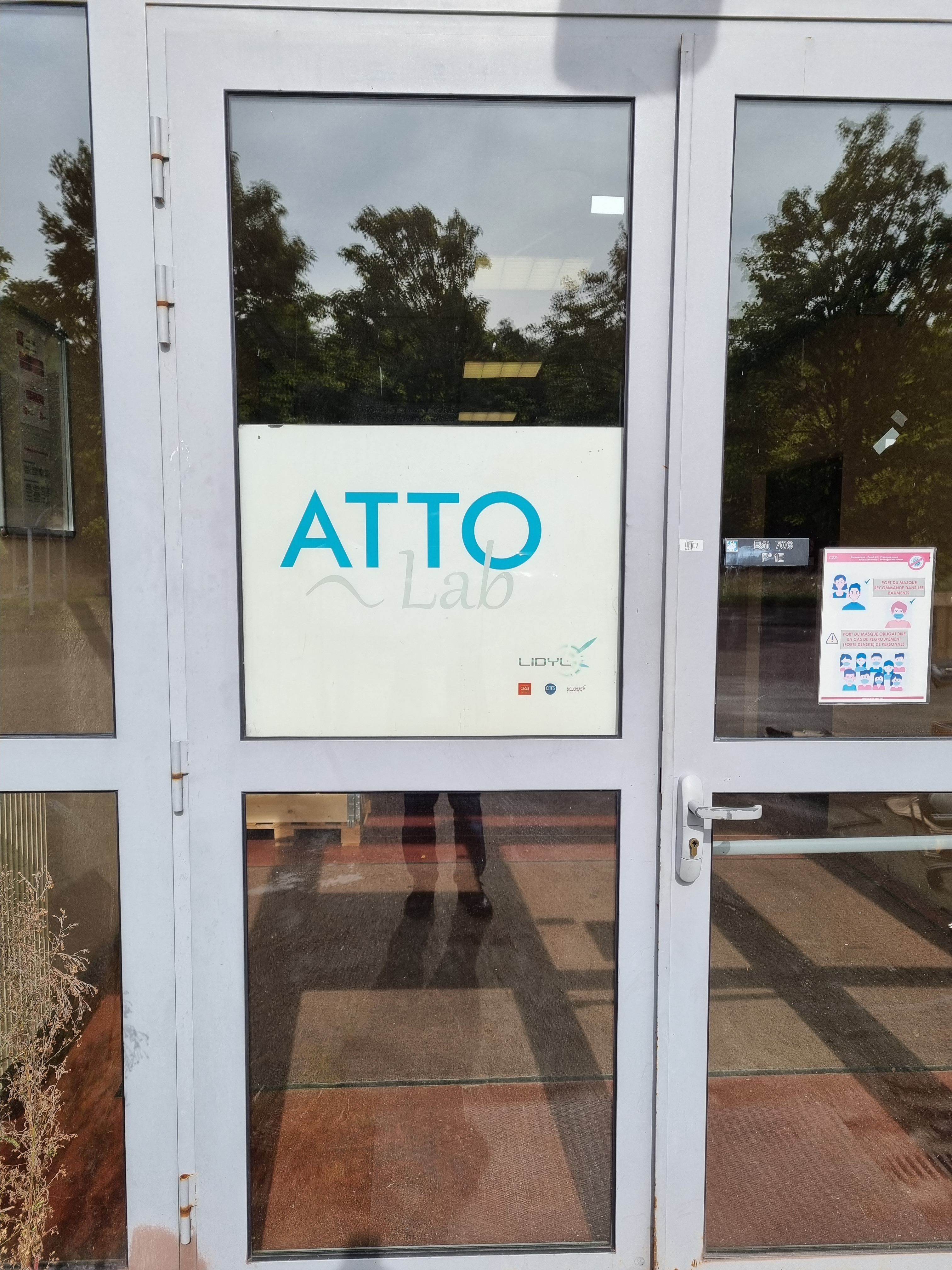
This year’s prize has an extra point of interest for me, as both Anne L’Huillier and Pierre Agostini did their prize-winning work at CEA Paris-Saclay, where I just started work last month. Their groups would eventually evolve into something called Attolab, I walk by their building every day on the way to lunch.