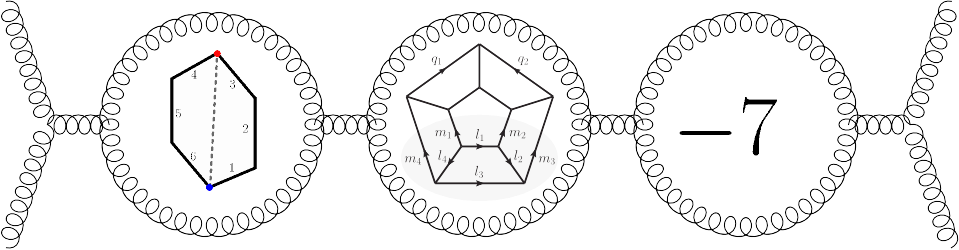
I’ve tried to convince you that you are a particle detector. You choose your experiment, what actions you take, and then observe the outcome. If you focus on that view of yourself, data out and data in, you start to wonder if the world outside really has any meaning. Maybe you’re just trapped in the Matrix.

From a physics perspective, you actually are trapped in a sort of a Matrix. We call it the S Matrix.
“S” stands for scattering. The S Matrix is a formula we use, a mathematical tool that tells us what happens when fundamental particles scatter: when they fly towards each other, colliding or bouncing off. For each action we could take, the S Matrix gives the probability of each outcome: for each pair of particles we collide, the chance we detect different particles at the end. You can imagine putting every possible action in a giant vector, and every possible observation in another giant vector. Arrange the probabilities for each action-observation pair in a big square grid, and that’s a matrix.
Actually, I lied a little bit. This is particle physics, and particle physics uses quantum mechanics. Because of that, the entries of the S Matrix aren’t probabilities: they’re complex numbers called probability amplitudes. You have to multiply them by their complex conjugate to get probability out.
Ok, that probably seemed like a lot of detail. Why am I telling you all this?
What happens when you multiply the whole S Matrix by its complex conjugate? (Using matrix multiplication, naturally.) You can still pick your action, but now you’re adding up every possible outcome. You’re asking “suppose I take an action. What’s the chance that anything happens at all?”
The answer to that question is 1. There is a 100% chance that something happens, no matter what you do. That’s just how probability works.
We call this property unitarity, the property of giving “unity”, or one. And while it may seem obvious, it isn’t always so easy. That’s because we don’t actually know the S Matrix formula most of the time. We have to approximate it, a partial formula that only works for some situations. And unitarity can tell us how much we can trust that formula.
Imagine doing an experiment trying to detect neutrinos, like the IceCube Neutrino Observatory. For you to detect the neutrinos, they must scatter off of electrons, kicking them off of their atoms or transforming them into another charged particle. You can then notice what happens as the energy of the neutrinos increases. If you do that, you’ll notice the probability also start to increase: it gets more and more likely that the neutrino can scatter an electron. You might propose a formula for this, one that grows with energy. [EDIT: Example changed after a commenter pointed out an issue with it.]
If you keep increasing the energy, though, you run into a problem. Those probabilities you predict are going to keep increasing. Eventually, you’ll predict a probability greater than one.
That tells you that your theory might have been fine before, but doesn’t work for every situation. There’s something you don’t know about, which will change your formula when the energy gets high. You’ve violated unitarity, and you need to fix your theory.
In this case, the fix is already known. Neutrinos and electrons interact due to another particle, called the W boson. If you include that particle, then you fix the problem: your probabilities stop going up and up, instead, they start slowing down, and stay below one.
For other theories, we don’t yet know the fix. Try to write down an S Matrix for colliding gravitational waves (or really, gravitons), and you meet the same kind of problem, a probability that just keeps growing. Currently, we don’t know how that problem should be solved: string theory is one answer, but may not be the only one.
So even if you’re trapped in an S Matrix, sending data out and data in, you can still use logic. You can still demand that probability makes sense, that your matrix never gives a chance greater than 100%. And you can learn something about physics when you do!


 4 gravitons