
Phew!
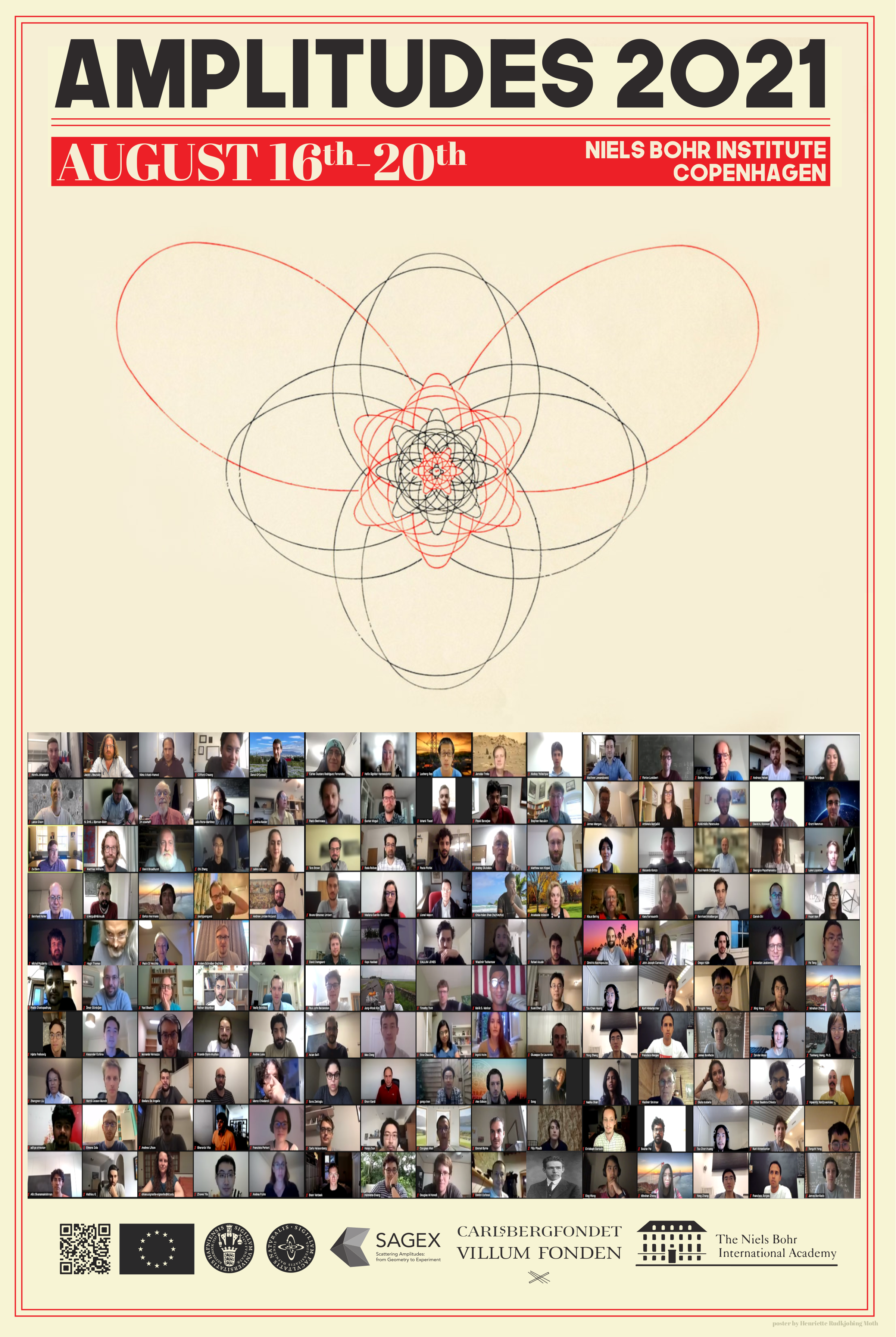
Now that I’ve rested up after this year’s Amplitudes, I’ll give a few of my impressions.
Overall, I think the conference went pretty well. People seemed amused by the digital Niels Bohr, even if he looked a bit like a puppet (Lance compared him to Yoda in his final speech, which was…apt). We used Gather.town, originally just for the poster session and a “virtual reception”, but later we also encouraged people to meet up in it during breaks. That in particular was a big hit: I think people really liked the ability to just move around and chat in impromptu groups, and while nobody seemed to use the “virtual bar”, the “virtual beach” had a lively crowd. Time zones were inevitably rough, but I think we ended up with a good compromise where everyone could still see a meaningful chunk of the conference.
A few things didn’t work as well. For those planning conferences, I would strongly suggest not making a brand new gmail account to send out conference announcements: for a lot of people the emails went straight to spam. Zulip was a bust: I’m not sure if people found it more confusing than last year’s Slack or didn’t notice it due to the spam issue, but almost no-one posted in it. YouTube was complicated: the stream went down a few times and I could never figure out exactly why, it may have just been internet issues here at the Niels Bohr Institute (we did have a power outage one night and had to scramble to get internet access back the next morning). As far as I could tell YouTube wouldn’t let me re-open the previous stream so each time I had to post a new link, which probably was frustrating for those following along there.
That said, this was less of a problem than it might have been, because attendance/”viewership” as a whole was lower than expected. Zoomplitudes last year had massive numbers of people join in both on Zoom and via YouTube. We had a lot fewer: out of over 500 registered participants, we had fewer than 200 on Zoom at any one time, and at most 30 or so on YouTube. Confusion around the conference email might have played a role here, but I suspect part of the difference is simple fatigue: after over a year of this pandemic, online conferences no longer feel like an exciting new experience.
The actual content of the conference ranged pretty widely. Some people reviewed earlier work, others presented recent papers or even work-in-progress. As in recent years, a meaningful chunk of the conference focused on applications of amplitudes techniques to gravitational wave physics. This included a talk by Thibault Damour, who has by now mostly made his peace with the field after his early doubts were sorted out. He still suspected that the mismatch of scales (weak coupling on the one hand, classical scattering on the other) would cause problems in future, but after his work with Laporta and Mastrolia even he had to acknowledge that amplitudes techniques were useful.
In the past I would have put the double-copy and gravitational wave researchers under the same heading, but this year they were quite distinct. While a few of the gravitational wave talks mentioned the double-copy, most of those who brought it up were doing something quite a bit more abstract than gravitational wave physics. Indeed, several people were pushing the boundaries of what it means to double-copy. There were modified KLT kernels, different versions of color-kinematics duality, and explorations of what kinds of massive particles can and (arguably more interestingly) cannot be compatible with a double-copy framework. The sheer range of different generalizations had me briefly wondering whether the double-copy could be “too flexible to be meaningful”, whether the right definitions would let you double-copy anything out of anything. I was reassured by the points where each talk argued that certain things didn’t work: it suggests that wherever this mysterious structure comes from, its powers are limited enough to make it meaningful.
A fair number of talks dealt with what has always been our main application, collider physics. There the context shifted, but the message stayed consistent: for a “clean” enough process two or three-loop calculations can make a big difference, taking a prediction that would be completely off from experiment and bringing it into line. These are more useful the more that can be varied about the calculation: functions are more useful than numbers, for example. I was gratified to hear confirmation that a particular kind of process, where two massless particles like quarks become three massive particles like W or Z bosons, is one of these “clean enough” examples: it means someone will need to compute my “tardigrade” diagram eventually.
If collider physics is our main application, N=4 super Yang-Mills has always been our main toy model. Jaroslav Trnka gave us the details behind Nima’s exciting talk from last year, and Nima had a whole new exciting talk this year with promised connections to category theory (connections he didn’t quite reach after speaking for two and a half hours). Anastasia Volovich presented two distinct methods for predicting square-root symbol letters, while my colleague Chi Zhang showed some exciting progress with the elliptic double-box, realizing the several-year dream of representing it in a useful basis of integrals and showcasing several interesting properties. Anne Spiering came over from the integrability side to show us just how special the “planar” version of the theory really is: by increasing the number of colors of gluons, she showed that one could smoothly go between an “integrability-esque” spectrum and a “chaotic” spectrum. Finally, Lance Dixon mentioned his progress with form-factors in his talk at the end of the conference, showing off some statistics of coefficients of different functions and speculating that machine learning might be able to predict them.
On the more mathematical side, Francis Brown showed us a new way to get numbers out of graphs, one distinct but related to our usual interpretation in terms of Feynman diagrams. I’m still unsure what it will be used for, but the fact that it maps every graph to something finite probably has some interesting implications. Albrecht Klemm and Claude Duhr talked about two sides of the same story, their recent work on integrals involving Calabi-Yau manifolds. They focused on a particular nice set of integrals, and time will tell whether the methods work more broadly, but there are some exciting suggestions that at least parts will.
There’s been a resurgence of the old dream of the S-matrix community, constraining amplitudes via “general constraints” alone, and several talks dealt with those ideas. Sebastian Mizera went the other direction, and tried to test one of those “general constraints”, seeing under which circumstances he could prove that you can swap a particle going in with an antiparticle going out. Others went out to infinity, trying to understand amplitudes from the perspective of the so-called “celestial sphere” where they appear to be governed by conformal field theories of some sort. A few talks dealt with amplitudes in string theory itself: Yvonne Geyer built them out of field-theory amplitudes, while Ashoke Sen explained how to include D-instantons in them.
We also had three “special talks” in the evenings. I’ve mentioned Nima’s already. Zvi Bern gave a retrospective talk that I somewhat cheesily describe as “good for the soul”: a look to the early days of the field that reminded us of why we are who we are. Lance Dixon closed the conference with a light-hearted summary and a look to the future. That future includes next year’s Amplitudes, which after a hasty discussion during this year’s conference has now localized to Prague. Let’s hope it’s in person!



 4 gravitons