
Monthly Archives: December 2018

A Newtonmas Present of Internet Content

I’m lazy this Newtonmas, so instead of writing a post of my own I’m going to recommend a few other people who do excellent work.

Quantum Frontiers is a shared blog updated by researchers connected to Caltech’s Institute for Quantum Information and Matter. While the whole blog is good, I’m going to be more specific and recommend the posts by Nicole Yunger Halpern. Nicole is really a great writer, and her posts are full of vivid imagery and fun analogies. If she’s not as well-known, it’s only because she lacks the attention-grabbing habit of getting into stupid arguments with other bloggers. Definitely worth a follow.

Recommending Slate Star Codex feels a bit strange, because it seems like everyone I’ve met who would enjoy the blog already reads it. It’s not a physics blog by any stretch, so it’s also an unusual recommendation to give here. Slate Star Codex writes about a wide variety of topics, and while the author isn’t an expert in most of them he does a lot more research than you or I would. If you’re interested in up-to-date meta-analyses on psychology, social science, and policy, pored over by someone with scrupulous intellectual honesty and an inexplicably large amount of time to indulge it, then Slate Star Codex is the blog for you.

I mentioned Piled Higher and Deeper a few weeks back, when I reviewed the author’s popular science book We Have No Idea. Piled Higher and Deeper is a webcomic about life in grad school. Humor is all about exaggeration, and it’s true that Piled Higher and Deeper exaggerates just how miserable and dysfunctional grad school can be…but not by as much as you’d think. I recommend that anyone considering grad school read Piled Higher and Deeper, and take it seriously. Grad school can really be like that, and if you don’t think you can deal with spending five or six years in the world of that comic you should take that into account.
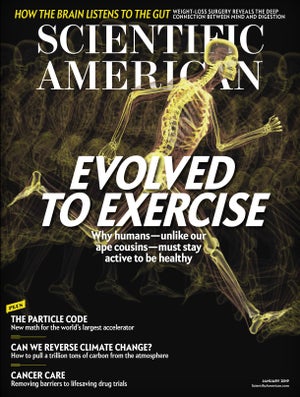
This Week, at Scientific American

I’ve written an article for Scientific American! It went up online this week, the print versions go out on the 25th. The online version is titled “Loopy Particle Math”, the print one is “The Particle Code”, but they’re the same article.

For those who don’t subscribe to Scientific American, sorry about the paywall!

“The Particle Code” covers what will be familiar material to regulars on this blog. I introduce Feynman diagrams, and talk about the “amplitudeologists” who try to find ways around them. I focus on my corner of the amplitudes field, how the work of Goncharov, Spradlin, Vergu, and Volovich introduced us to “symbology”, a set of tricks for taking apart more complicated integrals (or “periods”) into simple logarithmic building blocks. I talk about how my collaborators and I use symbology, using these building blocks to compute amplitudes that would have been impossible with other techniques. Finally, I talk about the frontier of the field, the still-mysterious “elliptic polylogarithms” that are becoming increasingly well-understood.

(I don’t talk about the even more mysterious “Calabi-Yau polylogarithms“…another time for those!)

Working with Scientific American was a fun experience. I got to see how the professionals do things. They got me to clarify and explain, pointing out terms I needed to define and places I should pause to summarize. They took my rough gel-pen drawings and turned them into polished graphics. While I’m still a little miffed about them removing all the contractions, overall I learned a lot, and I think they did a great job of bringing the article to the printed page.

Interdisciplinarity Is Good for the Soul

Interdisciplinary research is trendy these days. Grant agencies love it, for one. But talking to people in other fields isn’t just promoted by the authorities: like eating your vegetables, it’s good for you too.

If you talk only to people from your own field, you can lose track of what matters in the wider world. There’s a feedback effect where everyone in a field works on what everyone else in the field finds interesting, and the field spirals inward. “Interesting” starts meaning what everyone else is working on, without fulfilling any other criteria. Interdisciplinary contacts hold that back: not only can they call bullshit when you’re deep in your field’s arcane weirdness, they can also point out things that are more interesting than you expected, ideas that your field has seen so often they look boring but that are actually more surprising or useful than you realize.

Interdisciplinary research is good for self-esteem, too. As a young researcher, you can easily spend all your time talking to people who know more about your field than you do. Branching out reminds you of how much you’ve learned: all that specialized knowledge may be entry-level in your field, but it still puts you ahead of the rest of the world. Even as a grad student, you can be someone else’s guest expert if the right topic comes up.

Book Review: We Have No Idea

I have no idea how I’m going to review this book.

Ok fine, I have some idea.

Jorge Cham writes Piled Higher and Deeper, a webcomic with possibly the most accurate depiction of grad school available. Daniel Whiteson is a professor at the University of California, Irvine, and a member of the ATLAS collaboration (one of the two big groups that make measurements at the Large Hadron Collider). Together, they’ve written a popular science book covering everything we don’t know about fundamental physics.

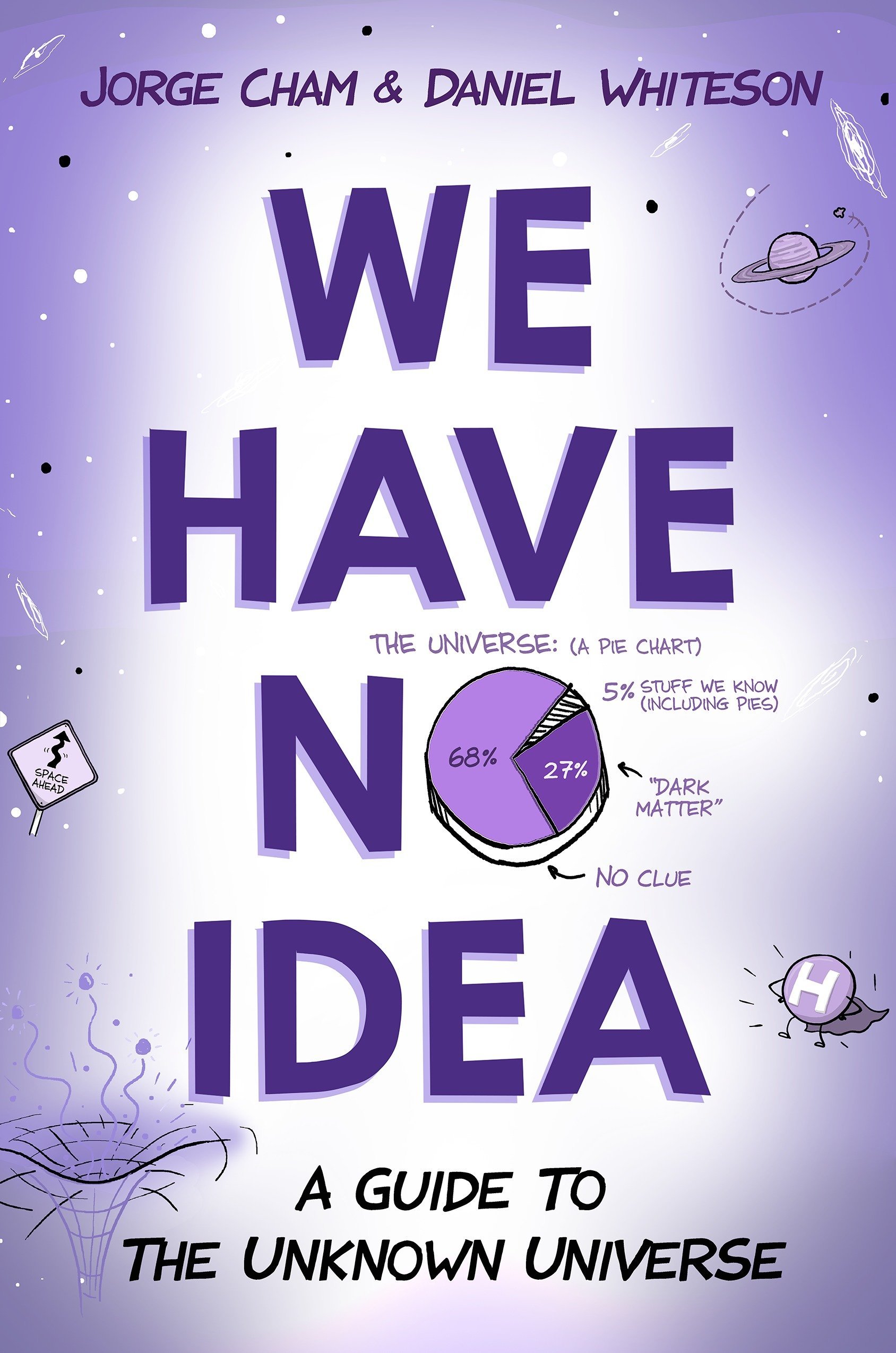
Writing a book about what we don’t know is an unusual choice, and there was a real risk it would end up as just a superficial gimmick. The pie chart on the cover presents the most famous “things physicists don’t know”, dark matter and dark energy. If they had just stuck to those this would have been a pretty ordinary popular physics book.

Refreshingly, they don’t do that. After blazing through dark matter and dark energy in the first three chapters, the rest of the book focuses on a variety of other scientific mysteries.

The book contains a mix of problems that get serious research attention (matter-antimatter asymmetry, high-energy cosmic rays) and more blue-sky “what if” questions (does matter have to be made out of particles?). As a theorist, I’m not sure that all of these questions are actually mysterious (we do have some explanation of the weird “1/3” charges of quarks, and I’d like to think we understand why mass includes binding energy), but even in these cases what we really know is that they follow from “sensible assumptions”, and one could just as easily ask “what if” about those assumptions instead. Overall, these “what if” questions make the book unique, and it would be a much weaker book without them.

“We Have No Idea” is strongest when the authors actually have some idea, i.e. when Whiteson is discussing experimental particle physics. It gets weaker on other topics, where the authors seem to rely more on others’ popular treatments (their discussion of “pixels of space-time” motivated me to write this post). Still, they at least seem to have asked the right people, and their accounts are on the more accurate end of typical pop science. (Closer to Quanta than IFLScience.)

The book’s humor really ties it together, often in surprisingly subtle ways. Each chapter has its own running joke, initially a throwaway line that grows into metaphors for everything the chapter discusses. It’s a great way to help the audience visualize without introducing too many new concepts at once. If there’s one thing cartoonists can teach science communicators, it’s the value of repetition.

I liked “We Have No Idea”. It could have been more daring, or more thorough, but it was still charming and honest and fun. If you’re looking for a Christmas present to explain physics to your relatives, you won’t go wrong with this book.