Monthly Archives: October 2016

“Maybe” Isn’t News

It’s been published several places, but you’ve probably seen this headline:

expansionheadlineIf you’ve been following me for a while, you know where this is going:

No, these physicists haven’t actually shown that the Universe isn’t expanding at an accelerated rate.

What they did show is that the original type of data used to discover that the universe was accelerating back in the 90’s, measurements of supernovae, doesn’t live up to the rigorous standards that we physicists use to evaluate discoveries. We typically only call something a discovery if the evidence is good enough that, in a world where the discovery wasn’t actually true, we’d only have a one in 3.5 million chance of getting the same evidence (“five sigma” evidence). In their paper, Nielsen, Guffanti, and Sarkar argue that looking at a bigger collection of supernovae leads to a hazier picture: the chance that we could get the same evidence in a universe that isn’t accelerating is closer to one in a thousand, giving “three sigma” evidence.

This might sound like statistical quibbling: one in a thousand is still pretty unlikely, after all. But a one in a thousand chance still happens once in a thousand times, and there’s a long history of three sigma evidence turning out to just be random noise. If the discovery of the accelerating universe was new, this would be an important objection, a reason to hold back and wait for more data before announcing a discovery.

The trouble is, the discovery isn’t new. In the twenty years since it was discovered that the universe was accelerating, people have built that discovery into the standard model of cosmology. They’ve used that model to make other predictions, explaining a wide range of other observations. People have built on the discovery, and their success in doing so is its own kind of evidence.

So the objection, that one source of evidence isn’t as strong as people thought, doesn’t kill cosmic acceleration. What it is is a “maybe”, showing that there is at least room in some of the data for a non-accelerating universe.

People publish “maybes” all the time, nothing bad about that. There’s a real debate to be had about how strong the evidence is, and how much it really establishes. (And there are already voices on the other side of that debate.)

But a “maybe” isn’t news. It just isn’t.

Science journalists (and university press offices) have a habit of trying to turn “maybes” into stories. I’ve lost track of the times I’ve seen ideas that were proposed a long time ago (technicolor, MOND, SUSY) get new headlines not for new evidence or new ideas, but just because they haven’t been ruled out yet. “SUSY hasn’t been ruled out yet” is an opinion piece, perhaps a worthwhile one, but it’s no news article.

The thing is, I can understand why journalists do this. So much of science is building on these kinds of “maybes”, working towards the tipping point where a “maybe” becomes a “yes” (or a “no”). And journalists (and university press offices, and to some extent the scientists themselves) can’t just take time off and wait for something legitimately newsworthy. They’ve got pages to fill and careers to advance, they need to say something.

I post once a week. As a consequence, a meaningful fraction of my posts are garbage. I’m sure that if I posted every day, most of my posts would be garbage.

Many science news sites post multiple times a day. They’ve got multiple writers, sure, and wider coverage…but they still don’t have the luxury of skipping a “maybe” when someone hands it to them.

I don’t know if there’s a way out of this. Maybe we need a new model for science journalism, something that doesn’t try to ape the pace of the rest of the news cycle. For the moment, though, it’s publish or perish, and that means lots and lots of “maybes”.

EDIT: More arguments against the paper in question, pointing out that they made some fairly dodgy assumptions.

EDIT: The paper’s authors respond here.

Four Gravitons in China

I’m in China this week, at the School and Workshop on Amplitudes in Beijing 2016.

img_20161018_085714

It’s a little chilly this time of year, so the dragons have accessorized

A few years back, I mentioned that there didn’t seem to be many amplitudeologists in Asia. That’s changed quite a lot over just the last few years. Song He and Yu-tin Huang went from postdocs in the west to faculty positions in China and Taiwan, respectively, while Bo Feng’s group in China has expanded. As a consequence, there’s now a substantial community here. This is the third “Amplitudes in Asia” conference, with past years meeting in Hong Kong and Taipei.

The “school” part of the conference was last week. I wasn’t here, but the students here seem to have enjoyed it a lot. This week is the “workshop” part, and there have been talks on a variety of parts of amplitudes. Nima showed up on Wednesday and managed to talk for his usual impressively long amount of time, finishing with a public lecture about the future of physics. The talk was ostensibly about why China should build the next big collider, but for the most part it ended up as a more general talk about exciting open questions in high energy physics. The talks were recorded, so they should be online at some point.

Jury-Rigging: The Many Uses of Dropbox

I’ll be behind the Great Firewall of China next week, so I’ve been thinking about various sites I won’t be able to access. Prominent among them is Dropbox, a service that hosts files online.

250px-dropbox_icon-svg

A helpful box to drop things in

What do physicists do with Dropbox? Quite a lot.

For us, Dropbox is a great way to keep collaborations on the same page. By sharing a Dropbox folder, we can share research programs, mathematical expressions, and paper drafts. It makes it a lot easier to keep one consistent version of a document between different people, and it’s a lot simpler than emailing files back and forth.

All that said, Dropbox has its drawbacks. You still need to be careful not to have two people editing the same thing at the same time, lest one overwrite the other’s work. You’ve got the choice between editing in place, making everyone else receive notifications whenever the files change, or editing in a separate folder, and having to be careful to keep it coordinated with the shared one.

Programmers will know there are cleaner solutions to these problems. GitHub is designed to share code, and you can work together on a paper with ShareLaTeX. So why do we use Dropbox?

Sometimes, it’s more important for a tool to be easy and universal, even if it doesn’t do everything you want. GitHub and ShareLaTeX might solve some of the problems we have with Dropbox, but they introduce extra work too. Because no one disadvantage of Dropbox takes up too much time, it’s simpler to stick with it than to introduce a variety of new services to fill the same role.

This is the source of a lot of jury-rigging in science. Our projects aren’t often big enough to justify more professional approaches: usually, something hacked together out of what’s available really is the best choice.

For one, it’s why I use wordpress. WordPress.com is not a great platform for professional blogging: it doesn’t give you a lot of control without charging, and surprise updates can make using it confusing. However, it takes a lot less effort than switching to something more professional, and for the moment at least I’m not really in a position that justifies the extra work.

Congratulations to Thouless, Haldane, and Kosterlitz!

I’m traveling this week in sunny California, so I don’t have time for a long post, but I thought I should mention that the 2016 Nobel Prize in Physics has been announced. Instead of going to LIGO, as many had expected, it went to David Thouless, Duncan Haldane, and Michael Kosterlitz. LIGO will have to wait for next year.

Thouless, Haldane, and Kosterlitz are condensed matter theorists. While particle physics studies the world at the smallest scales and astrophysics at the largest, condensed matter physics lives in between, explaining the properties of materials on an everyday scale. This can involve inventing new materials, or unusual states of matter, with superconductors being probably the most well-known to the public. Condensed matter gets a lot less press than particle physics, but it’s a much bigger field: overall, the majority of physicists study something under the condensed matter umbrella.

This year’s Nobel isn’t for a single discovery. Rather, it’s for methods developed over the years that introduced topology into condensed matter physics.

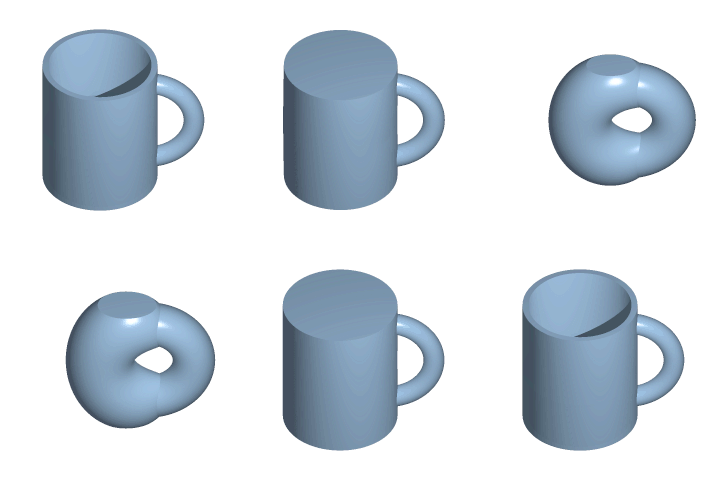
Topology often gets described in terms of coffee cups and donuts. In topology, two shapes are the same if you can smoothly change one into another, so a coffee cup and a donut are really the same shape.

mug_and_torus_morphMost explanations stop there, which makes it hard to see how topology could be useful for physics. The missing part is that topology studies not just which shapes can smoothly change into each other, but which things, in general, can change smoothly into each other.

That’s important, because in physics most changes are smooth. If two things can’t change smoothly into each other, something special needs to happen to bridge the gap between them.

There are a lot of different sorts of implications this can have. Topology means that some materials can be described by a number that’s conserved no matter what (smooth) changes occur, leading to experiments that see specific “levels” rather than a continuous range of outcomes. It means that certain physical setups can’t change smoothly into other ones, which protects those setups from changing: an idea people are investigating in the quest to build a quantum computer, where extremely delicate quantum states can be disrupted by even the slightest change.

Overall, topology has been enormously important in physics, and Thouless, Haldane, and Kosterlitz deserve a significant chunk of the credit for bringing it into the spotlight.