
Monthly Archives: February 2016

Symbology 101

I work with functions called polylogarithms. There’s a whole field of techniques out there for manipulating these functions, and for better or worse people often refer to them as symbology.

My plan for this post is to give a general feel for how symbology works: what we know how to do, and why. It’s going to be a lot more technical than my usual posts, so the lay reader may want to skip this one. At the same time, I’m not planning to go through anything rigorously. If you want that sort of thing there are plenty of good papers on the subject, here’s one of mine that covers the basics. Rather, I’m going to draw what I hope is an illuminating sketch of what it is we do.

Still here? Let’s start with an easy question.

What’s a log?

balch_park_hollow_log

Ok, besides one of these.

For our purposes, a log is what happens when you integrate dx/x.

\log x=\int \frac{dx}{x}

 Schematically, a polylog is then what happens when you iterate these integrations:

G=\int \frac{dx_1}{x_1} \int \frac{dx_2}{x_2}\ldots

The simplest thing you can get from this is of course just a product of logs. The next most simple thing is one of the classical polylogarithms. But in general, this is a much wider class of functions, known as multiple, or Goncharov, polylogarithms.

The number of integrations is the transcendental weight. Naively, you’d expect an L-loop Feynman integral in four dimensions to give you something with transcendental weight 4L. In practice, that’s not the case: some of the momentum integrations end up just giving delta functions, so in the end an L-loop amplitude has transcendental weight 2L.

In most theories, you get a mix of functions: some with weight 2L, some with weight 2L-1, etc., all the way down to rational functions. N=4 super Yang-Mills is special: there, everything is at the maximum transcendental weight. In either case, though, being able to manipulate transcendental functions is very useful, and the symbol is one of the simplest ways to do so.

The core idea of the symbol is pretty easy to state, though it takes a bit more technology to state it rigorously. Essentially, we take our schematic polylog from above, and just list the logs:

\mathcal{S}(G)=\ldots\otimes x_2\otimes x_1

(Here I have switched the order in order to agree with standard conventions.)

What does that do? Well, it reminds us that these aren’t just some weird functions we don’t understand: they’re collections of logs, and we can treat them like collections of logs.

In particular, we can do this with logs,

\log (x y)=\log x+\log y

so we can do it with symbols as well:

x_1\otimes x y\otimes x_3=x_1\otimes x \otimes x_3+x_1\otimes y\otimes x_3

Similarly, we can always get rid of unwelcome exponents, like so:

\log (x^n)=n\log x

x_1\otimes x^n\otimes x_3=n( x_1\otimes x \otimes x_3)

This means that, in general, we can always factorize any polynomial or rational function that appears in a symbol. As such, we often express symbols in terms of some fixed symbol alphabet, a basis of rational functions that can be multiplied to get any symbol entry in the function we’re working with. In general, it’s a lot easier to calculate amplitudes when we know the symbol alphabet beforehand. For six-particle amplitudes in N=4 super Yang-Mills, the symbol alphabet contains just nine “letters”, which makes it particularly easy to work with.

That’s arguably the core of symbol methods. It’s how Spradlin and Volovich managed to get a seventeen-page expression down to two lines. Express a symbol in the right alphabet, and it tends to look a lot more simple. And once you know the right alphabet, it’s pretty straightforward to build an ansatz with it and constrain it until you get a candidate function for whatever you’re interested in.

There’s more technical detail I could give here: how to tell whether a symbol actually corresponds to a function, how to take limits and do series expansions and take derivatives and discontinuities…but I’m not sure whether anyone reading this would be interested.

As-is, I’ll just mention that the symbol is only part of the story. In particular, it’s a special case of something called a coproduct, which breaks up polylogarithms into various chunks. Break them down fully until each chunk is just an individual log, and you get the symbol. Break them into larger chunks, and you get other components of the coproduct, consisting of tensor products of polylogarithms with lower transcendental weight. These larger chunks mean we can capture as much of a function’s behavior as we like, while still taking advantage of these sorts of tricks. While in older papers you might have seen mention of “beyond-the-symbol” terms that the symbol couldn’t capture, this doesn’t tend to be a problem these days.

You Go, LIGO!

Well folks, they did it. LIGO has detected gravitational waves!

FAQ:

What’s a gravitational wave?

Gravitational waves are ripples in space and time. As Einstein figured out a century ago, masses bend space and time, which causes gravity. Wiggle masses in the right way and you get a gravity wave, like a ripple on a pond.

Ok, but what is actually rippling? It’s some stuff, right? Dust or something?

In a word, no. Not everything has to be “stuff”. Energy isn’t “stuff”, and space-time isn’t either, but space-time is really what vibrates when a gravitational wave passes by. Distances themselves are changing, in a way that is described by the same math and physics as a ripple in a pond.

What’s LIGO?

LIGO is the Laser Interferometer Gravitational-Wave Observatory. In simple terms, it’s an observatory (or rather, a pair of observatories in Washington and Louisiana) that can detect gravitational waves. It does this using beams of laser light four kilometers long. Gravitational waves change the length of these beams when they pass through, causing small but measurable changes in the laser light observed.

Are there other gravitational wave observatories?

Not currently in operation. LIGO originally ran from 2002 to 2010, and during that time there were other gravitational wave observatories also in operation (VIRGO in Italy and GEO600 in Germany). All of them (including LIGO) failed to detect anything, and so LIGO and VIRGO were shut down in order for them to be upgraded to more sensitive, advanced versions. Advanced LIGO went into operation first, and made the detection. VIRGO is still under construction, as is KAGRA, a detector in Japan. There are also plans for a detector in India.

Other sorts of experiments can detect gravitational waves on different scales. eLISA is a planned space-based gravitational wave observatory, while Pulsar Timing Arrays could use distant neutron stars as an impromptu detector.

What did they detect? What could they detect?

The gravitational waves that LIGO detected came from a pair of black holes merging. In general, gravitational waves come from a pair of masses, or one mass with an uneven and rapidly changing shape. As such, LIGO and future detectors might be able to observe binary stars, supernovas, weird-shaped neutron stars, colliding galaxies…pretty much any astrophysical event involving large things moving comparatively fast.

What does this say about string theory?

Basically nothing. There are gravity waves in string theory, sure (and they play a fairly important role), but there were gravity waves in Einstein’s general relativity. As far as I’m aware, no-one at this point seriously thought that gravitational waves didn’t exist. Nothing that LIGO observed has any bearing on the quantum properties of gravity.

But what about cosmic strings? They mentioned those in the announcement!

Cosmic strings, despite the name, aren’t a unique prediction of string theory. They’re big, string-shaped wrinkles in space and time, possible results of the rapid expansion of space during cosmic inflation. You can think of them a bit like the cracks that form in an over-inflated balloon right before it bursts.

Cosmic strings, if they exist, should produce gravitational waves. This means that in the future we may have concrete evidence of whether or not they exist. This wouldn’t say all that much about string theory: while string theory does have its own explanations for cosmic strings, it’s unclear whether it actually has unique predictions about them. It would say a lot about cosmic inflation, though, and would presumably help distinguish it from proposed alternatives. So keep your eyes open: in the next few years, gravitational wave observatories may well have something important to say about the overall history of the universe.

Why is this discovery important, though? If we already knew that gravitational waves existed, why does discovering them matter?

LIGO didn’t discover that gravitational waves exist. LIGO discovered that we can detect them.

The existence of gravitational waves is no discovery. But the fact that we now have observatories sensitive enough to detect them is huge. It opens up a whole new type of astronomy: we can now observe the universe not just by the light it sheds (and neutrinos), but through a whole new lens. And every time we get another observational tool like this, we notice new things, things we couldn’t have seen without it. It’s the dawn of a new era in astronomy, and LIGO was right to announce it with all the pomp and circumstance they could muster.


My impressions from the announcement:

Speaking of pomp and circumstance, I was impressed by just how well put-together LIGO’s announcement was.

As the US presidential election heats up, I’ve seen a few articles about the various candidates’ (well, usually Trump’s) use of the language of political propaganda. The idea is that there are certain visual symbols at political events for which people have strong associations, whether with historical events or specific ideas or the like, and that using these symbols makes propaganda more powerful.

What I haven’t seen is much discussion of a language of scientific propaganda. Still, the overwhelming impression I got from LIGO’s announcement is that it was shaped by a master in the use of such a language. They tapped in to a wide variety of powerful images: from the documentary-style interviews at the beginning, to Weiss’s tweed jacket and handmade demos, to the American flag in the background, that tied LIGO’s result to the history of scientific accomplishment.

Perimeter’s presentations tend to have a slicker look, my friends at Stony Brook are probably better at avoiding jargon. But neither is quite as good at propaganda, at saying “we are part of history” and doing so without a hitch, as the folks at LIGO have shown themselves to be with this announcement.

I was also fairly impressed that they kept this under wraps for so long. While there were leaks, I don’t think many people had a complete grasp of what was going to be announced until the week before. Somehow, LIGO made sure a collaboration of thousands was able to (mostly) keep their mouths shut!

Beyond the organizational and stylistic notes, my main thought was “What’s next?” They’ve announced the detection of one event. I’ve heard others rattle off estimates, that they should be detecting anywhere from one black hole merger per year to a few hundred. Are we going to see more events soon, or should we settle into a long wait? Could they already have detected more, with the evidence buried in their data, to be revealed by careful analysis? (The waves from this black hole merger were clear enough for them to detect them in real-time, but more subtle events might not make things so easy!) Should we be seeing more events already, and does not seeing them tell us something important about the universe?

Most of the reason I delayed my post till this week was to see if anyone had an answer to these questions. So far, I haven’t seen one, besides the “one to a few hundred” estimate mentioned. As more people weigh in and more of LIGO’s run is analyzed, it will be interesting to see where that side of the story goes.

Gravitational Waves, and Valentine’s Day Physics Poem 2016

By the time this post goes up, you’ll probably have seen Advanced LIGO’s announcement of the first direct detection of a gravitational wave. We got the news a bit early here at Perimeter, which is why we were able to host a panel discussion right after the announcement.

From what I’ve heard, this is the real deal. They’ve got a beautifully clear signal, and unlike BICEP, they kept this under wraps until they could get it looked at by non-LIGO physicists. While I think peer review gets harped on a little too much in these sorts of contexts, in this case their paper getting through peer review is a good sign that they’re really seeing something.

IMG_20160211_104600

Pictured: a very clear, very specific something

I’ll have more to say next week: explanations of gravitational waves and LIGO for my non-expert audience, and impressions from the press release and PI’s panel discussion for those who are interested. For now, though, I’ll wait until the dust (metaphorical this time) settles. If you’re hungry for immediate coverage, I’m sure that half the blogs on my blogroll have posts up, or will in the next few days.

In the meantime, since Valentine’s Day is in two days, I’ll continue this blog’s tradition and post one of my old physics poems.


When a sophisticated string theorist seeks an interaction

He does not go round and round in loops

As a young man would.


Instead he turns to topology.


Mature, the string theorist knows

That what happens on

(And between)

The (world) sheets,

Is universal.


That the process is the same

No matter which points

Which interactions

One chooses.


Only the shapes of things matter.


Only the topology.


For such a man there is no need.

To obsess

To devote

To choose

One point or another.

The interaction is the same.


The world, though

Is not an exercise in theory.

Is not a mere possibility.

And if a theorist would compute

An experiment

A probability


He must pick and choose

Obsess and devote

Label his interactions with zeroes and infinities


Because there is more to life

Than just the shapes of things

Than just topology.


The Universe, Astronomy’s Lab

There’s a theme in a certain kind of science fiction.

Not in the type with laser swords and space elves, and not in cyberpunk dystopias…but when sci-fi tries to explore what humanity might do if it really got a chance to explore its own capabilities. In a word, the theme is scale.

We start out with a Dyson sphere, built around our own sun to trap its energy. As time goes on, the projects get larger and larger, involving multiple stars and, eventually, reshaping the galaxy.

There’s an expectation, though, that this sort of thing is far in our future. Treating the galaxy as a resource, as a machine, seems well beyond our present capabilities.

On Wednesday, Victoria Kaspi gave a public lecture at Perimeter about neutron stars. At the very end of the lecture, she talked a bit about something she covered in more detail during her colloquium earlier that day, called a Pulsar Timing Array.

Neutron stars are one of the ways a star can end its life. Too big to burn out quietly and form a white dwarf, and too small to collapse all the way into a black hole, the progenitors of neutron stars have so much gravity that they force protons and electrons to merge, so that the star ends up as a giant ball of neutrons, like an enormous atomic nucleus.

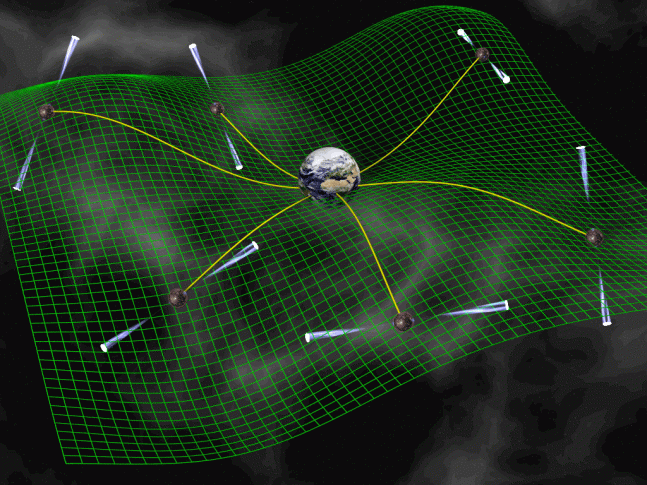
Many of these neutron stars have strong magnetic fields. A good number of them are what are called pulsars: stars that emit powerful pulses of electromagnetic radiation, often at regular intervals. Some of these pulsars are very regular indeed, rivaling atomic clocks in their precision. The idea of a Pulsar Timing Array is to exploit this regularity by using these pulsars as a gravitational wave telescope.

Gravitational waves are ripples in space-time. They were predicted by Einstein’s theory, and we’ve observed their indirect effects, but so far we have yet to detect them directly. Attempts have been made: vast detectors like LIGO have been built that bounce light across long “arms”, trying to detect minute disruptions in space. The problem is, it’s hard to distinguish these disruptions from ordinary vibrations in the area, like minor earthquakes. Size also limits the effectiveness of these detectors, with larger detectors able to see the waves from bigger astronomical events.

Pulsar Timing Arrays sidestep both of those problems. Instead of trying to build a detector on the ground like LIGO (or even in space like LISA), they use the pulsars themselves as the “arms” of a galaxy-sized detector. Because these pulsars emit light so regularly, small disruptions can be a sign that a gravitational wave is passing by the earth and disrupting the signal. Because they are spread roughly evenly across the galaxy, we can correlate signals across multiple pulsars, to make sure we’re really seeing gravitational waves. And because they’re so far apart, we can use them to detect waves from some of the biggest astronomical events, like galaxies colliding.

ptas

Earth very much not to scale.

Longtime readers know that I find astronomy really inspiring, but Kaspi’s talk woke me up to a completely different aspect, that of our mastery of scale.

Want to dream of a future where we use the solar system and the galaxy as resources? We’re there, and we’ve been there for a long time. We’re a civilization that used nearby planets to bootstrap up the basic laws of motion before we even had light bulbs. We’ve honed our understanding of space and time using distant stars. And now, we’re using an array of city-sized balls of neutronium, distributed across the galaxy, as a telescope. If that’s not the stuff of science fiction, I don’t know what is.


By the way, speaking of webcast lectures, I’m going to be a guest on the Alda Center’s Science Unplugged show next week. Tune in if you want to hear about the sort of stuff I work on, using string theory as a tool to develop shortcuts for particle physics calculations.