Monthly Archives: July 2014

“China” plans super collider

When I saw the headline, I was excited.

“China plans super collider” says Nature News.

There’s been a lot of worry about what may happen if the Large Hadron Collider finishes its run without discovering anything truly new. If that happens, finding new particles might require a much bigger machine…and since even that machine has no guarantee of finding anything at all, world governments may be understandably reluctant to fund it.

As such, several prominent people in the physics community have put their hopes on China. The country’s somewhat autocratic nature means that getting funding for a collider is a matter of convincing a few powerful people, not a whole fractious gaggle of legislators. It’s a cynical choice, but if it keeps the field alive so be it.

If China was planning a super collider, then, that would be great news!

Too bad it’s not.

Buried eight paragraphs in to Nature’s article we find the following:

The Chinese government is yet to agree on any funding, but growing economic confidence in the country has led its scientists to believe that the political climate is ripe, says Nick Walker, an accelerator physicist at DESY, Germany’s high-energy physics laboratory in Hamburg. Although some technical issues remain, such as keeping down the power demands of an energy-hungry ring, none are major, he adds.

The Chinese government is yet to agree on any funding. China, if by China you mean the Chinese government, is not planning a super collider.

So who is?

Someone must have drawn these diagrams, after all.

Reading the article, the most obvious answer is Beijing’s Institute of High Energy Physics (IHEP). While this is true, the article leaves out any mention of a more recently founded site, the Center for Future High Energy Physics (CFHEP).

This is a bit odd, given that CFHEP’s whole purpose is to compose a plan for the next generation of colliders, and persuade China’s government to implement it. They were founded, with heavy involvement from non-Chinese physicists including their director Nima Arkani-Hamed, with that express purpose in mind. And since several of the quotes in the article come from Yifang Wang, director of IHEP and member of the advisory board of CFHEP, it’s highly unlikely that this isn’t CFHEP’s plan.

So what’s going on here? On one level, it could be a problem on the journalists’ side. News editors love to rewrite headlines to be more misleading and click-bait-y, and claiming that China is definitely going to build a collider draws much more attention than pointing out the plans of a specialized think tank. I hope that it’s just something like that, and not the sort of casual racism that likes to think of China as a single united will. Similarly, I hope that the journalists involved just didn’t dig deep enough to hear about CFHEP, or left it out to simplify things, because there is a somewhat darker alternative.

CFHEP’s goal is to convince the Chinese government to build a collider, and what better way to do that than to present them with a fait accompli? If the public thinks that this is “China’s” plan, that wheels are already in motion, wouldn’t it benefit the Chinese government to play along? Throw in a few sweet words about the merits of international collaboration (a big part of the strategy of CFHEP is to bring international scientists to China to show the sort of community a collider could attract) and you’ve got a winning argument, or at least enough plausibility to get US and European funding agencies in a competitive mood.

This…is probably more cynical than what’s actually going on. For one, I don’t even know whether this sort of tactic would work.

Do these guys look like devious manipulators?

Indeed, it might just be a journalistic omission, part of a wider tendency of science journalists to focus on big projects and ignore the interesting part, the nitty-gritty things that people do to push them forward. It’s a shame, because people are what drive the news forward, and as long as science is viewed as something apart from real human beings people are going to continue to mistrust and misunderstand it.

Either way, one thing is clear. The public deserves to hear a lot more about CFHEP.
Welcome to the New Site!

Welcome to the newly improved 4gravitons.wordpress.com!

I’ll be keeping redirects up from the old blog at 4gravitonsandagradstudent.wordpress.com, so old links should still work. Those of you following on WordPress Reader, I think the blog should be properly transferred there as well.

In addition to the spiffy new graphics, the blog has a number of handy new features. I’ve added categories to all of the posts from the following list: (2, 0) Theory, Amateur Philosophy, Amplitudes Methods, Astrophysics/Cosmology, General QFT, Gravity, Life as a Physicist, Science Communication, String Theory, Yang-Mills, and Misc. There’s a menu in the sidebar that lets you pick a category and look at posts from only that category.

I’ve also added a variety of tags, many of which are listed in the tag cloud in the sidebar. Bigger tags indicate more content.

There’s a blogroll now, of blogs I think are worth reading, including a mix of established folks and interesting people I’ve run into.

I’ve put the guide to N=8 supergravity up in the menus at the top, along with a collection of my posts on physics careers, and some general quantum field theory posts that I reference a lot. Each is in a separate section under Handy Handbooks. The posts have been cleaned up a bit, so if you missed them the first time be sure to take a gander.

Finally, I’ve added a Contact page, in case you want to ask me questions that don’t make sense as comments.

Take some time to explore the new features! And welcome to the next phase in the trials and tribulations of four gravitons and a postdoc!

Feeling Perturbed?

You might think of physics as the science of certainties and exact statements: action and reaction, F=ma, and all that. However, most calculations in physics aren’t exact, they’re approximations. This is especially true today, but it’s been true almost since the dawn of physics. In particular, approximations are performed via a method known as perturbation theory.

Perturbation theory is a trick used to solve problems that, for one reason or another, are too difficult to solve all in one go. It works by solving a simpler problem, then perturbing that solution, adjusting it closer to the target.

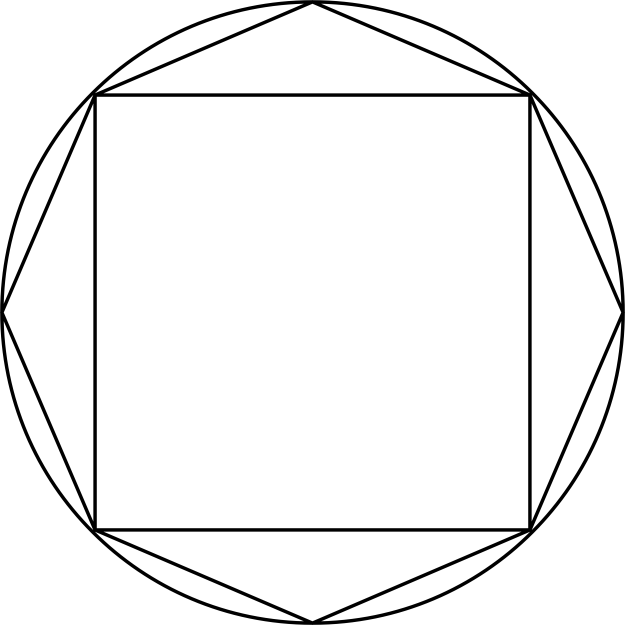
To give an analogy: let’s say you want to find the area of a circle, but you only know how to draw straight lines. You could start by drawing a square: it’s easy to find the area, and you get close to the area of the circle. But you’re still a long ways away from the total you’re aiming for. So you add more straight lines, getting an octagon. Now it’s harder to find the area, but you’re closer to the full circle. You can keep adding lines, each step getting closer and closer.

And so on.

And so on.

This, broadly speaking, is what’s going on when particle physicists talk about loops. The calculation with no loops (or “tree-level” result) is the easier problem to solve, omitting quantum effects. Each loop then is the next stage, more complicated but closer to the real total.

There are, as usual, holes in this analogy. One is that it leaves out an important aspect of perturbation theory, namely that it involves perturbing with a parameter. When that parameter is small, perturbation theory works, but as it gets larger the approximation gets worse and worse. In the case of particle physics, the parameter is the strength of the forces involves, with weaker forces (like the weak nuclear force, or electromagnetism) having better approximations than stronger forces (like the strong nuclear force). If you squint, this can still fit the analogy: different shapes might be harder to approximate than the circle, taking more sets of lines to get acceptably close.

Where the analogy fails completely, though, is when you start approaching infinity. Keep adding more lines, and you should be getting closer and closer to the circle each time. In quantum field theory, though, this frequently is not the case. As I’ve mentioned before, while lower loops keep getting closer to the true (and experimentally verified) results, going all the way out to infinite loops results not in the full circle, but in an infinite result instead. There’s an understanding of why this happens, but it does mean that perturbation theory can’t be thought of in the most intuitive way.

Almost every calculation in particle physics uses perturbation theory, which means almost always we are just approximating the real result, trying to draw a circle using straight lines. There are only a few theories where we can bypass this process and look at the full circle. These are known as integrable theories. N=4 super Yang-Mills may be among them, one of many reasons why studying it offers hope for a deeper understanding of particle physics.

N=8: That’s a Whole Lot of Symmetry

In two weeks, I’m planning an extensive overhaul of the blog. I’ll be switching from 4gravitons.wordpress.com to just 4gravitons.wordpress.com, since I’m no longer a grad student. Don’t worry, I’ll be forwarding traffic from the old address, so if you miss the changeover you’ll have plenty of time to readjust. I’ll also be changing the blog’s look a bit, and adding some new tools and sections, including my current project, a series on the theory N=8 supergravity. This is post will be the last in the N=8 supergravity series.

I’ve told you about how gravity can be thought of as interactions with spin 2 particles, called gravitons. I’ve talked about how adding supersymmetry gives you a whole new type of particle, a gravitino, one different from all of the other particles we’ve seen in nature. Add supersymmetry to gravity, and you get a type of theory called supergravity.

In this post I want to discuss a particularly interesting form of supergravity. It’s called N=8 supergravity, and it’s closely related to N=4 super Yang-Mills.

In my articles about N=4 super Yang-Mills, I talked about supersymmetry. Supersymmetry is a relationship between particles of spin X and particles of spin X-½, but it gets more complicated when N (the number of “directions” of supersymmetry) is greater than one.

I’d encourage you to read at least the two links in the above paragraph. The gist is that just like a symmetrical object can be turned in different directions and still remain the same, a supersymmetrical theory can be “turned” so that a particle with spin X becomes a particle of spin X-½ (a different type of particle), and the theory will remain the same. The higher the number N, the more different directions the theory can be “turned”.

N=4 was something I could depict in a picture. We started with a particle of spin 1, then could “turn” it in four different directions, each resulting in a different particle of spin ½. By combining two different “turns” we ended up with six distinct particles of spin 0. Miraculously, I could fit this all into one image.

N=8 is tougher. This time, we start with 1 particle of spin 2: the graviton, the particle that corresponds to the force of gravity. From there we can “turn” the theory in eight different directions, leading to 8 different gravitino particles with spin 3/2.

After that, things get more complicated. You can “turn” the theory twice to reach spin 1. Spin 1 particles correspond to Yang-Mills forces, the fundamental forces of nature (besides gravity). Photons are the spin 1 particles that correspond to Electromagnetism. The spin 1 particles here, connected as they are to gravity by supersymmetry, are typically called graviphotons. There are 28 distinct graviphotons in N=8 supergravity.

From the graviphotons, we can keep turning, getting to spin ½, where we find 56 new particles of the same “type” as electrons and quarks. On our fourth turn, we get to spin 0, the scalars, with 70 new particles. Turning further takes us back: from spin 0 to spin ½, spin ½ to spin 1, spin 1 to spin 3/2, and spin 3/2 to spin 2, back where we started after eight “turns”.

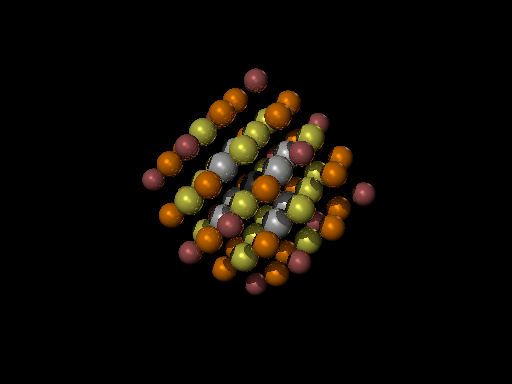
I’ve tried to depict this in the same way as N=4 super Yang-Mills, but there’s just no way to fit everything in. The best I can do is to take a slice through the space, letting certain particles overlap to give at best a general impression of what’s going on.

Graviton in black, gravitinos in grey, graviphotons in yellow, fermions in orange, scalars in red, and comprehensibility omitted entirely.

Graviton in black, gravitinos in grey, graviphotons in yellow, fermions in orange, scalars in red, making a firework of incomprehensible graphics. Incidentally, happy 4th of July to my American readers.

That picture doesn’t give you any intuition about the numbers. It doesn’t show you why there are 28 graviphotons, or 70 scalars. To explain that, it’s best to turn to another, hopefully more familiar picture, Pascal’s triangle.

Getting math class flashbacks yet?

Pascal’s triangle is a way of writing down how many distinct combinations you can make out of a list, and that’s really all that’s going on here. If you have four directions to “turn” and you pick one, you have four options, while picking two gives you six distinct choices. That’s just the 1-4-6-4-1 line on the triangle. If you go down to the eighth, you’ll spot the numbers from N=8 supergravity: 1 graviton, 8 gravitinos, 28 graviphotons, 56 fermions, and 70 scalars.

That’s a lot of particles. With that many particles, you might wonder if you could somehow fit the real world in there.

Actually, that isn’t such a naive thought. When N=8 supergravity was first discovered, people tried to fit the existing particles of nature inside it, hoping that it could explain them. Over the years though, it was realized that N=8 supergravity simply doesn’t provide enough tools to fully capture the particles of the standard model. Something more diverse, like string theory, would be needed.

That means that N=8 supergravity, like many of the things theorists call theories, does not describe the real world. Instead, it’s interesting for a different reason.

You’ve probably heard that gravity and quantum mechanics are incompatible. That’s not exactly true: you can write down a quantum theory of gravity about as easily as you can write down a quantum theory of anything else. The problem is that most such theories have divergences, infinite results that shouldn’t be infinite. Dealing with those results involves a process called renormalization, which papers over the infinities but reduces our ability to make predictions. For gravity theories, this process has to be performed an infinite number of times, resulting in an infinite loss of predictability. So while you can certainly write down a theory of quantum gravity, you can’t predict anything with it.

String theory is different. It doesn’t have the same sorts of infinite results, doesn’t require renormalization. That, really, is it’s purpose, it’s biggest virtue: everything else is a side benefit.

N=4 super Yang-Mills isn’t a theory of gravity at all, but it does have that same neat trait: you never get this sort of infinite results, so you never need to give up predictive power.

What’s so cool about N=8 supergravity is that it just might be in the same category. By all rights, it shouldn’t be…but loop after loop its divergences seem to be behaving much like N=4 super Yang-Mills. (For those new to this blog, loops are a measure of how complex a calculation is in particle physics. Most practical calculations only involve one or two loops, while four loops represents possibly the most precise test ever performed by science.)

Now, two predictions are at the fore. One suggests that this magic behavior will be broken at the terrifyingly complex level of seven loops. The other proposes that the magic will continue, and N=8 supergravity will never see a divergence. The only way for certain is to do the calculation, look at four gravitons at seven loops and see what happens.

If N=8 supergravity really doesn’t diverge, then the biggest “point” of string theory isn’t unique anymore. If you don’t need all the bells and whistles of string theory to get an acceptable quantum theory of gravity, then maybe there’s a better way to think about the problem of quantum gravity in general. Even if N=8 supergravity doesn’t describe the real world, there may be other ways forward, other ways to handle the problem of divergences. If someone can manage that calculation (not as impossible as it sounds nowadays, but still very very hard) then we might see something really truly new.