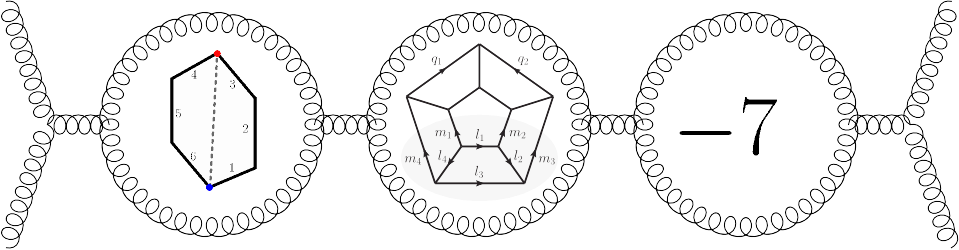
(No relation to Russel’s Why I Am Not A Christian. Well, not much.)
I am a theorist. I study theories. Not the well-supported theories of the AAAS definition, but simply potential lists of particles, and lists that, further, are almost certainly not “true”.
Most people find that disconcerting. Used to thinking of scientists as people who investigate the real world, people whose ideas are always tested in the fire of experiment, the idea of a scientist whose work has no direct connection to the real world is a major source of cognitive dissonance…for at least a few minutes. After that, a light dawns in most people’s heads, as they turn to me with a sigh of relief and say,
“Oh. So you’re a Mathematician.”
No.
No, I am not a Mathematician. There is a difference, subtle but vast, between what I do and a mathematician does.
An illustrative example: Quantum Electro-Dynamics, or QED, is the most successful theory in the entirety of science. Yes, I do mean the entirety of science. Quantum Electro-Dynamics, the theory of how electrons and light behave, agrees with experiments to ten decimal places. Ten digits of detail, predicted then observed. That’s more confirmed accuracy than anything else in physics, in science at all, has ever achieved.
And if you ask a mathematician who specializes in this sort of thing, they’ll tell you that QED probably doesn’t exist.
Now, by this they don’t mean that electrons don’t exist, or that light doesn’t exist. What they mean is that, if you follow the theory’s implications all the way, you get a contradiction. You can calculate each step of the way, getting reasonable results each time, results that keep agreeing perfectly with experiments…but if you were to go all the way, off to infinity, you get results that make your whole theory stop making any sort of reasonable sense.
But as physicists, we keep using it. Because before reaching infinity, for any real calculation, it works. Perfectly.
That’s the difference between a theoretical physicist and a mathematician: for a mathematician, everything must be completely rigorous, and every implication, out to infinity, has to be vetted. For a physicist, if a theory gives reasonable results, we don’t really care whether it is completely clear how it works mathematically. We use physical reasoning, using concepts that work in the physical world, even if we’re studying a theory that doesn’t actually exist in the physical world. And while that sounds like a poor way to study abstract ideas, it allows us to take risks mathematicians can’t, which sometimes means we can make discoveries that even the mathematicians find interesting.




 4 gravitons