Tag Archives: string theory

Pop Goes the Universe and Other Cosmic Microwave Background Games

(With apologies to whoever came up with this “book”.)

Back in February, Ijjas, Steinhardt, and Loeb wrote an article for Scientific American titled “Pop Goes the Universe” criticizing cosmic inflation, the proposal that the universe underwent a period of rapid expansion early in its life, smoothing it out to achieve the (mostly) uniform universe we see today. Recently, Scientific American published a response by Guth, Kaiser, Linde, Nomura, and 29 co-signers. This was followed by a counterresponse, which is the usual number of steps for this sort of thing before it dissipates harmlessly into the blogosphere.

In general, string theory, supersymmetry, and inflation tend to be criticized in very similar ways. Each gets accused of being unverifiable, able to be tuned to match any possible experimental result. Each has been claimed to be unfairly dominant, its position as “default answer” more due to the bandwagon effect than the idea’s merits. All three tend to get discussed in association with the multiverse, and blamed for dooming physics as a result. And all are frequently defended with one refrain: “If you have a better idea, what is it?”

It’s probably tempting (on both sides) to view this as just another example of that argument. In reality, though, string theory, supersymmetry, and inflation are all in very different situations. The details matter. And I worry that in this case both sides are too ready to assume the other is just making the “standard argument”, and ended up talking past each other.

When people say that string theory makes no predictions, they’re correct in a sense, but off topic: the majority of string theorists aren’t making the sort of claims that require successful predictions. When people say that inflation makes no predictions, if you assume they mean the same thing that people mean when they accuse string theory of making no predictions, then they’re flat-out wrong. Unlike string theorists, most people who work on inflation care a lot about experiment. They write papers filled with predictions, consequences for this or that model if this or that telescope sees something in the near future.

I don’t think Ijjas, Steinhardt, and Loeb were making that kind of argument.

When people say that supersymmetry makes no predictions, there’s some confusion of scope. (Low-energy) supersymmetry isn’t one specific proposal that needs defending on its own. It’s a class of different models, each with its own predictions. Given a specific proposal, one can see if it’s been ruled out by experiment, and predict what future experiments might say about it. Ruling out one model doesn’t rule out supersymmetry as a whole, but it doesn’t need to, because any given researcher isn’t arguing for supersymmetry as a whole: they’re arguing for their particular setup. The right “scope” is between specific supersymmetric models and specific non-supersymmetric models, not both as general principles.

Guth, Kaiser, Linde, and Nomura’s response follows similar lines in defending inflation. They point out that the wide variety of models are subject to being ruled out in the face of observation, and compare to the construction of the Standard Model in particle physics, with many possible parameters under the overall framework of Quantum Field Theory.

Ijjas, Steinhardt, and Loeb’s article certainly looked like it was making this sort of mistake. But as they clarify in the FAQ of their counter-response, they’ve got a more serious objection. They’re arguing that, unlike in the case of supersymmetry or the Standard Model, specific inflation models do not lead to specific predictions. They’re arguing that, because inflation typically leads to a multiverse, any specific model will in fact lead to a wide variety of possible observations. In effect, they’re arguing that the multitude of people busily making predictions based on inflationary models are missing a step in their calculations, underestimating their errors by a huge margin.

This is where I really regret that these arguments usually end after three steps (article, response, counter-response). Here Ijjas, Steinhardt, and Loeb are making what is essentially a technical claim, one that Guth, Kaiser, Linde, and Nomura could presumably respond to with a technical response, after which the rest of us would actually learn something. As-is, I certainly don’t have the background in inflation to know whether or not this point makes sense, and I’d love to hear from someone who does.

One aspect of this exchange that baffled me was the “accusation” that Ijjas, Steinhardt, and Loeb were just promoting their own work on bouncing cosmologies. (I put “accusation” in quotes because while Ijjas, Steinhardt, and Loeb seem to treat it as if it were an accusation, Guth, Kaiser, Linde, and Nomura don’t obviously mean it as one.)

“Bouncing cosmology” is Ijjas, Steinhardt, and Loeb’s answer to the standard “If you have a better idea, what is it?” response. It wasn’t the focus of their article, but while they seem to think this speaks well of them (hence their treatment of “promoting their own work” as if it were an accusation), I don’t. I read a lot of Scientific American growing up, and the best articles focused on explaining a positive vision: some cool new idea, mainstream or not, that could capture the public’s interest. That kind of article could still have included criticism of inflation, you’d want it in there to justify the use of a bouncing cosmology. But by going beyond that, it would have avoided falling into the standard back and forth that these arguments tend to, and maybe we would have actually learned from the exchange.
KITP Conference Retrospective

I’m back from the conference in Santa Barbara, and I thought I’d share a few things I found interesting. (For my non-physicist readers: I know it’s been a bit more technical than usual recently, I promise I’ll get back to some general audience stuff soon!)

James Drummond talked about efforts to extend the hexagon function method I work on to amplitudes with seven (or more) particles. In general, the method involves starting with a guess for what an amplitude should look like, and honing that guess based on behavior in special cases where it’s easier to calculate. In one of those special cases (called the multi-Regge limit), I had thought it would be quite difficult to calculate for more than six particles, but James clarified for me that there’s really only one additional piece needed, and they’re pretty close to having a complete understanding of it.

There were a few talks about ways to think about amplitudes in quantum field theory as the output of a string theory-like setup. There’s been progress pushing to higher quantum-ness, and in understanding the weird web of interconnected theories this setup gives rise to. In the comments, Thoglu asked about one part of this web of theories called Z theory.

Z theory is weird. Most of the theories that come out of this “web” come from a consistent sort of logic: just like you can “square” Yang-Mills to get gravity, you can “square” other theories to get more unusual things. In possibly the oldest known example, you can “square” the part of string theory that looks like Yang-Mills at low energy (open strings) to get the part that looks like gravity (closed strings). Z theory asks: could the open string also come from “multiplying” two theories together? Weirdly enough, the answer is yes: it comes from “multiplying” normal Yang-Mills with a part that takes care of the “stringiness”, a part which Oliver Schlotterer is calling “Z theory”. It’s not clear whether this Z theory makes sense as a theory on its own (for the experts: it may not even be unitary) but it is somewhat surprising that you can isolate a “building block” that just takes care of stringiness.

Peter Young in the comments asked about the Correlahedron. Scattering amplitudes ask a specific sort of question: if some particles come in from very far away, what’s the chance they scatter off each other and some other particles end up very far away? Correlators ask a more general question, about the relationships of quantum fields at different places and times, of which amplitudes are a special case. Just as the Amplituhedron is a geometrical object that specifies scattering amplitudes (in a particular theory), the Correlahedron is supposed to represent correlators (in the same theory). In some sense (different from the sense above) it’s the “square” of the Amplituhedron, and the process that gets you from it to the Amplituhedron is a geometrical version of the process that gets you from the correlator to the amplitude.

For the Amplituhedron, there’s a reasonably smooth story of how to get the amplitude. News articles tended to say the amplitude was the “volume” of the Amplituhedron, but that’s not quite correct. In fact, to find the amplitude you need to add up, not the inside of the Amplituhedron, but something that goes infinite at the Amplituhedron’s boundaries. Finding this “something” can be done on a case by case basis, but it get tricky in more complicated cases.

For the Correlahedron, this part of the story is missing: they don’t know how to define this “something”, the old recipe doesn’t work. Oddly enough, this actually makes me optimistic. This part of the story is something that people working on the Amplituhedron have been trying to avoid for a while, to find a shape where they can more honestly just take the volume. The fact that the old story doesn’t work for the Correlahedron suggests that it might provide some insight into how to build the Amplituhedron in a different way, that bypasses this problem.

There were several more talks by mathematicians trying to understand various aspects of the Amplituhedron. One of them was by Hugh Thomas, who as a fun coincidence actually went to high school with Nima Arkani-Hamed, one of the Amplituhedron’s inventors. He’s now teamed up with Nima and Jaroslav Trnka to try to understand what it means to be inside the Amplituhedron. In the original setup, they had a recipe to generate points inside the Amplituhedron, but they didn’t have a fully geometrical picture of what put them “inside”. Unlike with a normal shape, with the Amplituhedron you can’t just check which side of the wall you’re on. Instead, they can flatten the Amplituhedron, and observe that for points “inside” the Amplituhedron winds around them a specific number of times (hence “Unwinding the Amplituhedron“). Flatten it down to a line and you can read this off from the list of flips over your point, an on-off sequence like binary. If you’ve ever heard the buzzword “scattering amplitudes as binary code”, this is where that comes from.

They also have a better understanding of how supersymmetry shows up in the Amplituhedron, which Song He talked about in his talk. Previously, supersymmetry looked to be quite central, part of the basic geometric shape. Now, they can instead understand it in a different way, with the supersymmetric part coming from derivatives (for the specialists: differential forms) of the part in normal space and time. The encouraging thing is that you can include these sorts of derivatives even if your theory isn’t supersymmetric, to keep track of the various types of particles, and Song provided a few examples in his talk. This is important, because it opens up the possibility that something Amplituhedron-like could be found for a non-supersymmetric theory. Along those lines, Nima talked about ways that aspects of the “nice” description of space and time we use for the Amplituhedron can be generalized to other messier theories.

While he didn’t talk about it at the conference, Jake Bourjaily has a new paper out about a refinement of the generalized unitarity technique I talked about a few weeks back. Generalized unitarity involves matching a “cut up” version of an amplitude to a guess. What Jake is proposing is that in at least some cases you can start with a guess that’s as easy to work with as possible, where each piece of the guess matches up to just one of the “cuts” that you’re checking.  Think about it like a game of twenty questions where you’ve divided all possible answers into twenty individual boxes: for each box, you can just ask “is it in this box”?

Finally, I’ve already talked about the highlight of the conference, so I can direct you to that post for more details. I’ll just mention here that there’s still a fair bit of work to do for Zvi Bern and collaborators to get their result into a form they can check, since the initial output of their setup is quite messy. It’s led to worries about whether they’ll have enough computer power at higher loops, but I’m confident that they still have a few tricks up their sleeves.

Scattering Amplitudes at KITP

I’ve been visiting the Kavli Institute for Theoretical Physics in Santa Barbara for a program on scattering amplitudes. This week they’re having a conference, so I don’t have time to say very much.

scamp-c17

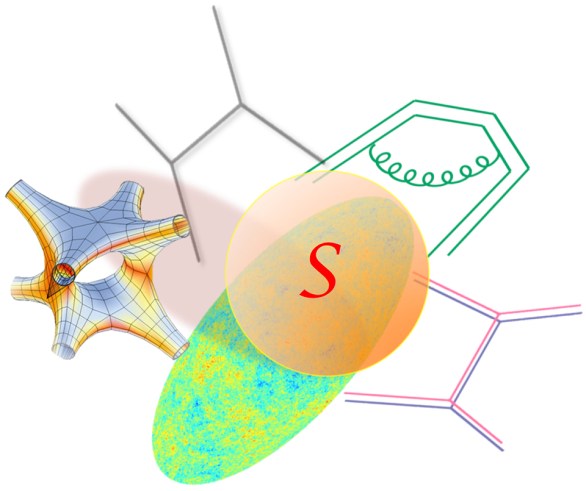
The conference logo, on the other hand, seems to be saying quite a lot

We’ve had talks from a variety of corners of amplitudes, with major themes including the web of theories that can sort of be described by string theory-esque models, the amplituhedron, and theories you can “square” to get other theories. I’m excited about Zvi Bern’s talk at the end of the conference, which will describe the progress I talked about last week. There’s also been recent progress on understanding the amplituhedron, which I will likely post about in the near future.

We also got an early look at Whispers of String Theory, a cute short documentary filmed at the IGST conference.

The Road to Seven-Loop Supergravity

There’s an obvious way to put together a theory of quantum gravity. And it doesn’t work.

Do the same thing you would with any other theory, and you get infinity. You get repeated infinities, an infinity of infinities. And while you could fix one or two infinities, fixing an infinite number requires giving up an infinity of possible predictions, so in the end your theory predicts nothing.

String theory fixes this with its own infinity, the infinite number of ways a string can vibrate. Because this infinity is organized and structured and well-understood, you’re left with a theory that is still at least capable of making predictions.

(Note that this is an independent question from whether string theory can make predictions for experiments in the real world. This is a much more “in-principle” statement: if we knew everything we might want to about physics, all the fields and particles and shapes of the extra dimensions, we could use string theory to make predictions. Even if we knew all of that, we still couldn’t make predictions from naive quantum gravity.)

Are there ways to fix the problem that don’t involve an infinity of vibrations? Or at least, to fix part of the problem?

That’s what Zvi Bern, John Joseph Carrasco, Henrik Johansson, and a growing cast of collaborators have been trying to find out.

They’re investigating N=8 supergravity, a theory that takes gravity and adds on a host of related particles. It’s one of the easiest theories to get from string theory, by curling up extra dimensions in a particularly simple way and ignoring higher-energy vibrations.

Bern, along with Lance Dixon and David Kosower, invented the generalized unitarity technique I talked about last week. Along with Carrasco and Johansson, he figured out another important trick: the idea that you can do calculations in gravity by squaring the appropriate part of calculations in Yang-Mills theory. For N=8 supergravity, the theory you need to square is my favorite theory, N=4 super Yang-Mills.

Using this, they started pushing forward, calculating approximations to greater and greater precision (more and more loops).

What they found, at each step, was that N=8 supergravity behaved better than expected. In fact, it behaved like N=4 super Yang-Mills.

N=4 super Yang-Mills is special, because in four dimensions (three space and one time, the dimensions we’re used to in daily life) there are no infinities to fix. In a world with more dimensions, though, you start getting infinities, and with more and more loops you need fewer and fewer dimensions to see them.

N=8 supergravity, unexpectedly, was giving infinities in the same dimensions that N=4 super Yang-Mills did (and no earlier). If it kept doing that, you might guess that it also had no infinities in four dimensions. You might wonder if, at least loop by loop, N=8 supergravity could be a way to fix quantum gravity without string theory.

Of course, you’d only really know if you could check in four dimensions.

If you want to check in four dimensions, though, you run into a problem. The fewer dimensions you’re looking at, the more loops you need before N=8 supergravity could possibly give infinity. In four dimensions, you need a forbidding seven loops of precision.

(To compare, the highest precision of things we’ve actually tested in the real world is four loops.)

Still, Bern, Carrasco, and Johansson were up to the challenge. Along with Lance Dixon, David Kosower, and Radu Roiban, they looked at three loops, calculating an interaction of four gravitons, and the pattern continued. Four loops, and it was still going strong.

At around this time, I had just started grad school. My first project was a cumbersome numerical calculation. To keep me motivated, my advisor mentioned that the work I was doing would be good preparation for a much grander project: the calculation of whether the four-graviton interaction in N=8 supergravity diverges at seven loops. All I’d have to do was wait for Bern and collaborators to get there.

I named this blog “4 gravitons and a grad student”, and hoped I would get a chance to contribute.

And then something unexpected happened. They got stuck at five loops.

The method they were using, generalized unitarity, is an ansatz-based method. You start with a guess, then refine it. As such, the method is ultimately only as good as your guess.

Their guesses, in general, were pretty good. The trick they were using, squaring N=4 to get N=8, requires a certain type of guess: one in which the pieces they square have similar relationships to the different types of charge in Yang-Mills theory. There’s still an infinite number of guesses that can obey this, so they applied more restrictions, expectations based on other calculations, to get something more manageable. This worked at three loops, and worked (with a little extra thought) at four loops.

But at five loops they were stuck. They couldn’t find anything, with their restrictions, that gave the correct answer when “cut up” by generalized unitarity. And while they could drop some restrictions, if they dropped too many they’d end up with far too general a guess, something that could take months of computer time to solve.

So they stopped.

They did quite a bit of interesting work in the meantime. They found more theories they could square to get gravity theories, of more and more unusual types. They calculated infinities in other theories, and found surprises there too, other cases where infinities didn’t show up when they were “supposed” to. But for some time, the N=8 supergravity calculation was stalled.

And in the meantime, I went off in another direction, which long-time readers of this blog already know about.

Recently, though, they’ve broken the stall.

What they realized is that the condition on their guess, that the parts they square be related like Yang-Mills charges, wasn’t entirely necessary. Instead, they could start with a “bad” guess, and modify it, using the failure of those relations to fill in the missing pieces.

It looks like this is going to work.

We’re all at an amplitudes program right now in Santa Barbara. Walking through the halls of the KITP, I overhear conversations about five loops. They’re paring things down, honing their code, getting rid of the last few bugs, and checking their results.

They’re almost there, and it’s exciting. It looks like finally things are moving again, like the train to seven loops has once again left the station.

Increasingly, they’re beginning to understand the absent infinities, to see that they really are due to something unexpected and new.

N=8 supergravity isn’t going to be the next theory of everything. (For one, you can’t get chiral fermions out of it.) But if it really has no infinities at any loop, that tells us something about what a theory of quantum gravity is allowed to be, about the minimum necessary to at least make sense on a loop-by-loop level.

And that, I think, is worth being excited about.

What’s in a Conjecture? An ER=EPR Example

A few weeks back, Caltech’s Institute of Quantum Information and Matter released a short film titled Quantum is Calling. It’s the second in what looks like will become a series of pieces featuring Hollywood actors popularizing ideas in physics. The first used the game of Quantum Chess to talk about superposition and entanglement. This one, featuring Zoe Saldana, is about a conjecture by Juan Maldacena and Leonard Susskind called ER=EPR. The conjecture speculates that pairs of entangled particles (as investigated by Einstein, Podolsky, and Rosen) are in some sense secretly connected by wormholes (or Einstein-Rosen bridges).

The film is fun, but I’m not sure ER=EPR is established well enough to deserve this kind of treatment.

At this point, some of you are nodding your heads for the wrong reason. You’re thinking I’m saying this because ER=EPR is a conjecture.

I’m not saying that.

The fact of the matter is, conjectures play a very important role in theoretical physics, and “conjecture” covers a wide range. Some conjectures are supported by incredibly strong evidence, just short of mathematical proof. Others are wild speculations, “wouldn’t it be convenient if…” ER=EPR is, well…somewhere in the middle.

Most popularizers don’t spend much effort distinguishing things in this middle ground. I’d like to talk a bit about the different sorts of evidence conjectures can have, using ER=EPR as an example.

octopuswormhole_v1

Our friendly neighborhood space octopus

The first level of evidence is motivation.

At its weakest, motivation is the “wouldn’t it be convenient if…” line of reasoning. Some conjectures never get past this point. Hawking’s chronology protection conjecture, for instance, points out that physics (and to some extent logic) has a hard time dealing with time travel, and wouldn’t it be convenient if time travel was impossible?

For ER=EPR, this kind of motivation comes from the black hole firewall paradox. Without going into it in detail, arguments suggested that the event horizons of older black holes would resemble walls of fire, incinerating anything that fell in, in contrast with Einstein’s picture in which passing the horizon has no obvious effect at the time. ER=EPR provides one way to avoid this argument, making event horizons subtle and smooth once more.

Motivation isn’t just “wouldn’t it be convenient if…” though. It can also include stronger arguments: suggestive comparisons that, while they could be coincidental, when put together draw a stronger picture.

In ER=EPR, this comes from certain similarities between the type of wormhole Maldacena and Susskind were considering, and pairs of entangled particles. Both connect two different places, but both do so in an unusually limited way. The wormholes of ER=EPR are non-traversable: you cannot travel through them. Entangled particles can’t be traveled through (as you would expect), but more generally can’t be communicated through: there are theorems to prove it. This is the kind of suggestive similarity that can begin to motivate a conjecture.

(Amusingly, the plot of the film breaks this in both directions. Keanu Reeves can neither steal your cat through a wormhole, nor send you coded messages with entangled particles.)

rjxhfqj

Nor live forever as the portrait in his attic withers away

Motivation is a good reason to investigate something, but a bad reason to believe it. Luckily, conjectures can have stronger forms of evidence. Many of the strongest conjectures are correspondences, supported by a wealth of non-trivial examples.

In science, the gold standard has always been experimental evidence. There’s a reason for that: when you do an experiment, you’re taking a risk. Doing an experiment gives reality a chance to prove you wrong. In a good experiment (a non-trivial one) the result isn’t obvious from the beginning, so that success or failure tells you something new about the universe.

In theoretical physics, there are things we can’t test with experiments, either because they’re far beyond our capabilities or because the claims are mathematical. Despite this, the overall philosophy of experiments is still relevant, especially when we’re studying a correspondence.

“Correspondence” is a word we use to refer to situations where two different theories are unexpectedly computing the same thing. Often, these are very different theories, living in different dimensions with different sorts of particles. With the right “dictionary”, though, you can translate between them, doing a calculation in one theory that matches a calculation in the other one.

Even when we can’t do non-trivial experiments, then, we can still have non-trivial examples. When the result of a calculation isn’t obvious from the beginning, showing that it matches on both sides of a correspondence takes the same sort of risk as doing an experiment, and gives the same sort of evidence.

Some of the best-supported conjectures in theoretical physics have this form. AdS/CFT is technically a conjecture: a correspondence between string theory in a hyperbola-shaped space and my favorite theory, N=4 super Yang-Mills. Despite being a conjecture, the wealth of nontrivial examples is so strong that it would be extremely surprising if it turned out to be false.

ER=EPR is also a correspondence, between entangled particles on the one hand and wormholes on the other. Does it have nontrivial examples?

Some, but not enough. Originally, it was based on one core example, an entangled state that could be cleanly matched to the simplest wormhole. Now, new examples have been added, covering wormholes with electric fields and higher spins. The full “dictionary” is still unclear, with some pairs of entangled particles being harder to describe in terms of wormholes. So while this kind of evidence is being built, it isn’t as solid as our best conjectures yet.

I’m fine with people popularizing this kind of conjecture. It deserves blog posts and press articles, and it’s a fine idea to have fun with. I wouldn’t be uncomfortable with the Bohemian Gravity guy doing a piece on it, for example. But for the second installment of a star-studded series like the one Caltech is doing…it’s not really there yet, and putting it there gives people the wrong idea.

I hope I’ve given you a better idea of the different types of conjectures, from the most fuzzy to those just shy of certain. I’d like to do this kind of piece more often, though in future I’ll probably stick with topics in my sub-field (where I actually know what I’m talking about 😉 ). If there’s a particular conjecture you’re curious about, ask in the comments!

The Parable of the Entanglers and the Bootstrappers

There’s been some buzz around a recent Quanta article by K. C. Cole, The Strange Second Life of String Theory. I found it a bit simplistic of a take on the topic, so I thought I’d offer a different one.

String theory has been called the particle physicist’s approach to quantum gravity. Other approaches use the discovery of general relativity as a model: they’re looking for a big conceptual break from older theories. String theory, in contrast, starts out with a technical problem (naive quantum gravity calculations that give infinity) proposes physical objects that could solve the problem (strings, branes), and figures out which theories of these objects are consistent with existing data (originally the five superstring theories, now all understood as parts of M theory).

That approach worked. It didn’t work all the way, because regardless of whether there are indirect tests that can shed light on quantum gravity, particle physics-style tests are far beyond our capabilities. But in some sense, it went as far as it can: we’ve got a potential solution to the problem, and (apart from some controversy about the cosmological constant) it looks consistent with observations. Until actual evidence surfaces, that’s the end of that particular story.

When people talk about the failure of string theory, they’re usually talking about its aspirations as a “theory of everything”. String theory requires the world to have eleven dimensions, with seven curled up small enough that we can’t observe them. Different arrangements of those dimensions lead to different four-dimensional particles. For a time, it was thought that there would be only a few possible arrangements: few enough that people could find the one that describes the world and use it to predict undiscovered particles.

That particular dream didn’t work out. Instead, it became apparent that there were a truly vast number of different arrangements of dimensions, with no unique prediction likely to surface.

By the time I took my first string theory course in grad school, all of this was well established. I was entering a field shaped by these two facts: string theory’s success as a particle-physics style solution to quantum gravity, and its failure as a uniquely predictive theory of everything.

The quirky thing about science: sociologically, success and failure look pretty similar. Either way, it’s time to find a new project.

A colleague of mine recently said that we’re all either entanglers or bootstrappers. It was a joke, based on two massive grants from the Simons Foundation. But it’s also a good way to summarize two different ways string theory has moved on, from its success and from its failure.

The entanglers start from string theory’s success and say, what’s next?

As it turns out, a particle-physics style understanding of quantum gravity doesn’t tell you everything you need to know. Some of the big conceptual questions the more general relativity-esque approaches were interested in are still worth asking. Luckily, string theory provides tools to answer them.

Many of those answers come from AdS/CFT, the discovery that string theory in a particular warped space-time is dual (secretly the same theory) to a more particle-physics style theory on the edge of that space-time. With that discovery, people could start understanding properties of gravity in terms of properties of particle-physics style theories. They could use concepts like information, complexity, and quantum entanglement (hence “entanglers”) to ask deeper questions about the structure of space-time and the nature of black holes.

The bootstrappers, meanwhile, start from string theory’s failure and ask, what can we do with it?

Twisting up the dimensions of string theory yields a vast number of different arrangements of particles. Rather than viewing this as a problem, why not draw on it as a resource?

“Bootstrappers” explore this space of particle-physics style theories, using ones with interesting properties to find powerful calculation tricks. The name comes from the conformal bootstrap, a technique that finds conformal theories (roughly: theories that are the same at every scale) by “pulling itself by its own boostraps”, using nothing but a kind of self-consistency.

Many accounts, including Cole’s, attribute people like the boostrappers to AdS/CFT as well, crediting it with inspiring string theorists to take a closer look at particle physics-style theories. That may be true in some cases, but I don’t think it’s the whole story: my subfield is bootstrappy, and while it has drawn on AdS/CFT that wasn’t what got it started. Overall, I think it’s more the case that the tools of string theory’s “particle physics-esque approach”, like conformal theories and supersymmetry, ended up (perhaps unsurprisingly) useful for understanding particle physics-style theories.

Not everyone is a “boostrapper” or an “entangler”, even in the broad sense I’m using the words. The two groups also sometimes overlap. Nevertheless, it’s a good way to think about what string theorists are doing these days. Both of these groups start out learning string theory: it’s the only way to learn about AdS/CFT, and it introduces the bootstrappers to a bunch of powerful particle physics tools all in one course. Where they go from there varies, and can be more or less “stringy”. But it’s research that wouldn’t have existed without string theory to get it started.

So You Want to Prove String Theory, Part II: How Can QCD Be a String Theory?

A couple weeks back, I had a post about Nima Arkani-Hamed’s talk at Strings 2016. Nima and his collaborators were trying to find what sorts of scattering amplitudes (formulas that calculate the chance that particles scatter off each other) are allowed in a theory of quantum gravity. Their goal was to show that, with certain assumptions, string theory gives the only consistent answer.

At the time, my old advisor Michael Douglas suggested that I might find Zohar Komargodski’s talk more interesting. Now that I’ve finally gotten around to watching it, I agree. The story is cleaner, more conclusive…and it gives me an excuse to say something else I’ve been meaning to talk about.

Zohar Komargodski has a track record of deriving interesting results that are true not just for the sorts of toy models we like to work with but for realistic theories as well. He’s collaborating with amplitudes miracle-worker Simon Caron-Huot (who I’ve collaborated with recently), Amit Sever (one of the integrability wizards who came up with the POPE program) and Alexander Zhiboedov, whose name seems to show up all over the place. Overall, the team is 100% hot young talent, which tends to be a recipe for success.

While Nima’s calculation focuses on gravity, Zohar and company are asking a broader question. They’re looking at any theory with particles of high spin and nonzero mass. Like Nima, they’re looking at scattering amplitudes, in the limit that the forces involved are weak. Unlike Nima, they’re focusing on a particular limit: rather than trying to fix the full form of the amplitude, they’re interested in how it behaves for extreme, unphysical values for the particles’ momenta. Despite being unphysical, this limit can reveal something about how the theory works.

What they figured out is that, for the sorts of theories they’re looking at, the amplitude has to take a particular form in their unphysical limit. In particular, it takes a form that indicates the presence of strings.

What sort of theories are they looking at? What theories have “particles of high spin and nonzero mass”? Well, some are string theories. Others are Yang-Mills theories … theories similar to QCD.

For the experts, I encourage you to watch Zohar’s talk or read the paper for more detail. It’s a fun story that showcases how very general constraints on scattering amplitudes can translate into quite specific statements.

For the non-experts, though, there’s something that may already be confusing. When I’ve talked about Yang-Mills theories before, I’ve talked about them in terms of particles of spin 1. Where did these “higher spin” particles come from? And where are the strings? How can there be strings in a theory that I’ve described as “similar to QCD”?

If I just stuck to the higher spin particles, things could almost stay familiar. The fundamental particles of Yang-Mills theories have spin 1, but these particles can combine into composite particles, which can have higher spin and higher mass. That should be intuitive: in some sense, it’s just like protons, neutrons, and electrons combining to form atoms.

What about the strings? I’ve actually talked about that before, but I’d like to try out a new analogy. Have you ever heard of Conway’s Game of Life?

pic288405_md

Not this one!

gospers_glider_gun

This one!

Conway’s Game of Life starts with a grid of black and white squares, and evolves in steps, with each square’s color determined by the color of adjacent squares in the last step. “Fundamentally”, the game is just those rules. In practice, though, structure can emerge: a zoo of self-propagating creatures that dance across the screen.

The strings that can show up in Yang-Mills theories are like this. They aren’t introduced directly in the definition of the theory. Instead, they’re consequences: structures that form when you let the rules evolve and see what they create. They’re another description of the theory, one with its own advantages.

When I tell people I’m a theoretical physicist, they inevitably ask me “Have any of your theories been tested?” They’re operating from one idea of what a theoretical physicist does: propose new theories to describe the world, based on available evidence. Lots of theorists do that, they’re called phenomenologists, but it’s not what I do, or what most theorists I interact with day-to-day do.

So I describe what I do, how I test new mathematical techniques to make particle physics calculations faster. And in general, that’s pretty easy for people to understand. Just as they can imagine people out there testing theories, they can imagine people who work to support the others, making tools to make their work easier. But while that’s what I do, it’s not the best description of what most of my colleagues do.

What most theorists I know do is like finding new animals in Conway’s game of life. They start with theories for which we know the rules: well-tested theories like QCD, or well-studied proposals like string theory. They ask themselves, not how they can change the rules, but what results the rules have. They look for structures, and in doing so find new perspectives, learning to see the animals that live on Conway’s black and white grid. (This is something I’ve gestured at before, but this seems like a cleaner framing.)

Doing that, theorists have seen strings in the structure of QCD-like theories. And now Zohar and collaborators have a clean argument that the structures others have seen should show up, not only there, but in a broader class of theories.

This isn’t about whether the world is fundamentally described by string theory, ten dimensions and all. That’s an entirely different topic. What it is is a question about what sorts of structures emerge when we try to describe the world. What it does is show that strings are, in some sense (and, as for Nima, [with some conditions]) inevitable, that they come out of our rules even if we don’t expect them to.

So You Want to Prove String Theory (Or: Nima Did Something Cool Again)

Nima Arkani-Hamed, of Amplituhedron fame, has been making noises recently about proving string theory.

Now, I can already hear the smartarses in the comments correcting me here. You can’t prove a scientific theory, you can only provide evidence for it.

Well, in this case I don’t mean “provide evidence”. (Direct evidence for string theory is quite unlikely at the moment given the high energies at which it becomes relevant and large number of consistent solutions, but an indirect approach might yet work.) I actually mean “prove”.

See, there are two ways to think about the problem of quantum gravity. One is as an experimental problem: at high enough energies for quantum gravity to be relevant, what actually happens? Since it’s going to be a very long time before we can probe those energies, though, in practice we instead have a technical problem: can we write down a theory that looks like gravity in familiar situations, while avoiding the pesky infinities that come with naive attempts at quantum gravity?

If you can prove that string theory is the only theory that does that, then you’ve proven string theory. If you can prove that string theory is the only theory that does that [with certain conditions] then you’ve proven string theory [with certain conditions].

That, in broad terms, is what Nima has been edging towards. At this year’s Strings conference, he unveiled some progress towards that goal. And since I just recently got around to watching his talk, you get to hear my take on it.

 Nima has been working with Yu-tin Huang, an amplitudeologist who tends to show up everywhere, and one of his students. Working in parallel, an all-star cast has been doing a similar calculation for Yang-Mills theory. The Yang-Mills story is cool, and probably worth a post in its own right, but I think you guys are more interested in the quantum gravity one.

What is Nima doing here?

Nima is looking at scattering amplitudes, probabilities for particles to scatter off of each other. In this case, the particles are gravitons, the particle form of gravitational waves.

Normally, the problems with quantum gravity show up when your scattering amplitudes have loops. Here, Nima is looking at amplitudes without loops, the most important contributions when the force in question is weak (the “weakly coupled” in Nima’s title).

Even for these amplitudes you can gain insight into quantum gravity by seeing what happens at high energies (the “UV” in the title). String amplitudes have nice behavior at high energies, naive gravity amplitudes do not. The question then becomes, are there other amplitudes that preserve this nice behavior, while still obeying the rules of physics? Or is string theory truly unique, the only theory that can do this?

The team that asked a similar question about Yang-Mills theory found that string theory was unique, that every theory that obeyed their conditions was in some sense “stringy”. That makes it even more surprising that, for quantum gravity, the answer was no: the string theory amplitude is not unique. In fact, Nima and his collaborators found an infinite set of amplitudes that met their conditions, related by a parameter they could vary freely.

What are these other amplitudes, then?

Nima thinks they can’t be part of a consistent theory, and he’s probably right. They have a number of tests they haven’t done: in particular, they’ve only been looking at amplitudes involving two gravitons scattering off each other, but a real theory should have consistent answers for any number of gravitons interacting, and it’s doesn’t look like these “alternate” amplitudes can be generalized to work for that.

That said, at this point it’s still possible that these other amplitudes are part of some sort of sensible theory. And that would be incredibly interesting, because we’ve never seen anything like that before.

There are approaches to quantum gravity besides string theory, sure. But common to all of them is an inability to actually calculate scattering amplitudes. If there really were a theory that generated these “alternate” amplitudes, it wouldn’t correspond to any existing quantum gravity proposal.

(Incidentally, this is also why this sort of “proof” of string theory might not convince everyone. Non-string quantum gravity approaches tend to talk about things fairly far removed from scattering amplitudes, so some would see this kind of thing as apples and oranges.)

I’d be fascinated to see where this goes. Either we have a new set of gravity scattering amplitudes to work with, or string theory turns out to be unique in a more rigorous and specific way than we’ve previously known. No matter what, something interesting is going to happen.

After the talk David Gross drew on his experience of the origin of string theory to question whether this work is just retreading the path to an old dead end. String theory arose from an attempt to find a scattering amplitude with nice properties, but it was only by understanding this amplitude physically in terms of vibrating strings that it was able to make real progress.

I generally agree with Nima’s answer, but to re-frame it in my own words: in the amplitudes sub-field, there’s something of a cycle. We try to impose general rules, until by using those rules we have a new calculation technique. We then do a bunch of calculations with the new technique. Finally, we look at the results of those calculations, try to find new general rules, and start the cycle again.

String theory is the result of people applying general rules to scattering amplitudes and learning enough to discover not just a new calculation technique, but a new physical theory. Now, we’ve done quite a lot of string theory calculations, and quite a lot more quantum field theory calculations as well. We have a lot of “data”.

And when you have a lot of data, it becomes much more productive to look for patterns. Now, if we start trying to apply general rules, we have a much better idea of what we’re looking for. This lets us get a lot further than people did the first time through the cycle. It’s what let Nima find the Amplituhedron, and it’s something Yu-tin has a pretty good track record of as well.

So in general, I’m optimistic. As a community, we’re poised to find out some very interesting things about what gravity scattering amplitudes can look like. Maybe, we’ll even prove string theory. [With certain conditions, of course. 😉 ]

Amplitudes 2016

I’m at Amplitudes this week, in Stockholm.

IMG_20160704_225049

The land of twilight at 11pm

Last year, I wrote a post giving a tour of the field. If I had to write it again this year most of the categories would be the same, but the achievements listed would advance in loops and legs, more complicated theories and more insight.

The ambitwistor string now goes to two loops, while my collaborators and I have pushed the polylogarithm program to five loops (dedicated post on that soon!) A decent number of techniques can now be applied to QCD, including a differential equation-based method that was used to find a four loop, three particle amplitude. Others tied together different approaches, found novel structures in string theory, or linked amplitudes techniques to physics from other disciplines. The talks have been going up on YouTube pretty quickly, due to diligent work by Nordita’s tech guy, so if you’re at all interested check it out!

Most of String Theory Is Not String Pheno

Last week, Sabine Hossenfelder wrote a post entitled “Why not string theory?” In it, she argued that string theory has a much more dominant position in physics than it ought to: that it’s crowding out alternative theories like Loop Quantum Gravity and hogging much more funding than it actually merits.

If you follow the string wars at all, you’ve heard these sorts of arguments before. There’s not really anything new here.

That said, there were a few sentences in Hossenfelder’s post that got my attention, and inspired me to write this post.

So far, string theory has scored in two areas. First, it has proved interesting for mathematicians. But I’m not one to easily get floored by pretty theorems – I care about math only to the extent that it’s useful to explain the world. Second, string theory has shown to be useful to push ahead with the lesser understood aspects of quantum field theories. This seems a fruitful avenue and is certainly something to continue. However, this has nothing to do with string theory as a theory of quantum gravity and a unification of the fundamental interactions.

(Bolding mine)

Here, Hossenfelder explicitly leaves out string theorists who work on “lesser understood aspects of quantum field theories” from her critique. They’re not the big, dominant program she’s worried about.

What Hossenfelder doesn’t seem to realize is that right now, it is precisely the “aspects of quantum field theories” crowd that is big and dominant. The communities of string theorists working on something else, and especially those making bold pronouncements about the nature of the real world, are much, much smaller.

Let’s define some terms:

Phenomenology (or pheno for short) is the part of theoretical physics that attempts to make predictions that can be tested in experiments. String pheno, then, covers attempts to use string theory to make predictions. In practice, though, it’s broader than that: while some people do attempt to predict the results of experiments, more work on figuring out how models constructed by other phenomenologists can make sense in string theory. This still attempts to test string theory in some sense: if a phenomenologist’s model turns out to be true but it can’t be replicated in string theory then string theory would be falsified. That said, it’s more indirect. In parallel to string phenomenology, there is also the related field of string cosmology, which has a similar relationship with cosmology.

If other string theorists aren’t trying to make predictions, what exactly are they doing? Well, a large number of them are studying quantum field theories. Quantum field theories are currently our most powerful theories of nature, but there are many aspects of them that we don’t yet understand. For a large proportion of string theorists, string theory is useful because it provides a new way to understand these theories in terms of different configurations of string theory, which often uncovers novel and unexpected properties. This is still physics, not mathematics: the goal, in the end, is to understand theories that govern the real world. But it doesn’t involve the same sort of direct statements about the world as string phenomenology or string cosmology: crucially, it doesn’t depend on whether string theory is true.

Last week, I said that before replying to Hossenfelder’s post I’d have to gather some numbers. I was hoping to find some statistics on how many people work on each of these fields, or on their funding. Unfortunately, nobody seems to collect statistics broken down by sub-field like this.

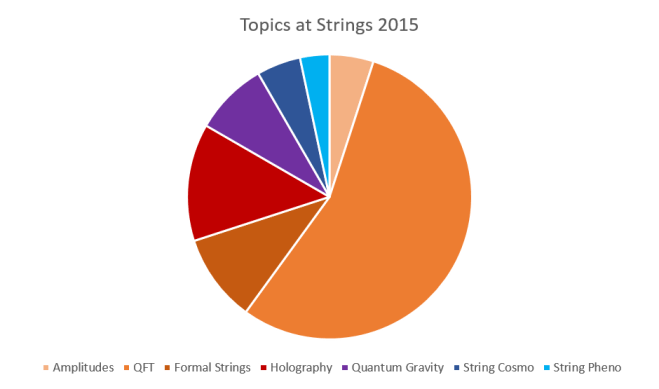
As a proxy, though, we can look at conferences. Strings is the premier conference in string theory. If something has high status in the string community, it will probably get a talk at Strings. So to investigate, I took a look at the talks given last year, at Strings 2015, and broke them down by sub-field.

strings2015topics

Here I’ve left out the historical overview talks, since they don’t say much about current research.

“QFT” is for talks about lesser understood aspects of quantum field theories. Amplitudes, my own sub-field, should be part of this: I’ve separated it out to show what a typical sub-field of the QFT block might look like.

“Formal Strings” refers to research into the fundamentals of how to do calculations in string theory: in principle, both the QFT folks and the string pheno folks find it useful.

“Holography” is a sub-topic of string theory in which string theory in some space is equivalent to a quantum field theory on the boundary of that space. Some people study this because they want to learn about quantum field theory from string theory, others because they want to learn about quantum gravity from quantum field theory. Since the field can’t be cleanly divided into quantum gravity and quantum field theory research, I’ve given it its own category.

While all string theory research is in principle about quantum gravity, the “Quantum Gravity” section refers to people focused on the sorts of topics that interest non-string quantum gravity theorists, like black hole entropy.

Finally, we have String Cosmology and String Phenomenology, which I’ve already defined.

Don’t take the exact numbers here too seriously: not every talk fit cleanly into a category, so there were some judgement calls on my part. Nonetheless, this should give you a decent idea of the makeup of the string theory community.

The biggest wedge in the diagram by far, taking up a majority of the talks, is QFT. Throwing in Amplitudes (part of QFT) and Formal Strings (useful to both), and you’ve got two thirds of the conference. Even if you believe Hossenfelder’s tale of the failures of string theory, then, that only matters to a third of this diagram. And once you take into account that many of the Holography and Quantum Gravity people are interested in aspects of QFT as well, you’re looking at an even smaller group. Really, Hossenfelder’s criticism is aimed at two small slices on the chart: String Pheno, and String Cosmo.

Of course, string phenomenologists also have their own conference. It’s called String Pheno, and last year it had 130 participants. In contrast, LOOPS’ 2015, the conference for string theory’s most famous “rival”, had…190 participants. The fields are really pretty comparable.

Now, I have a lot more sympathy for the string phenomenologists and string cosmologists than I do for loop quantum gravity. If other string theorists felt the same way, then maybe that would cause the sort of sociological effect that Hossenfelder is worried about.

But in practice, I don’t think this happens. I’ve met string theorists who didn’t even know that people still did string phenomenology. The two communities are almost entirely disjoint: string phenomenologists and string cosmologists interact much more with other phenomenologists and cosmologists than they do with other string theorists.

You want to talk about sociology? Sociologically, people choose careers and fund research because they expect something to happen soon. People don’t want to be left high and dry by a dearth of experiments, don’t feel comfortable working on something that may only be vindicated long after they’re dead. Most people choose the safe option, the one that, even if it’s still aimed at a distant goal, is also producing interesting results now (aspects of quantum field theories, for example).

The people that don’t? Tend to form small, tight-knit, passionate communities. They carve out a few havens of like-minded people, and they think big thoughts while the world around them seems to only care about their careers.

If you’re a loop quantum gravity theorist, or a quantum gravity phenomenologist like Hossenfelder, and you see some of your struggles in that paragraph, please realize that string phenomenology is like that too.

I feel like Hossenfelder imagines a world in which string theory is struck from its high place, and alternative theories of quantum gravity are of comparable size and power. But from where I’m sitting, it doesn’t look like it would work out that way. Instead, you’d have alternatives grow to the same size as similarly risky parts of string theory, like string phenomenology. And surprise, surprise: they’re already that size.

In certain corners of the internet, people like to argue about “punching up” and “punching down”. Hossenfelder seems to think she’s “punching up”, giving the big dominant group a taste of its own medicine. But by leaving out string theorists who study QFTs, she’s really “punching down”, or at least sideways, and calling out a sub-group that doesn’t have much more power than her own.