Tag Archives: quantum field theory

The Parable of the Entanglers and the Bootstrappers

There’s been some buzz around a recent Quanta article by K. C. Cole, The Strange Second Life of String Theory. I found it a bit simplistic of a take on the topic, so I thought I’d offer a different one.

String theory has been called the particle physicist’s approach to quantum gravity. Other approaches use the discovery of general relativity as a model: they’re looking for a big conceptual break from older theories. String theory, in contrast, starts out with a technical problem (naive quantum gravity calculations that give infinity) proposes physical objects that could solve the problem (strings, branes), and figures out which theories of these objects are consistent with existing data (originally the five superstring theories, now all understood as parts of M theory).

That approach worked. It didn’t work all the way, because regardless of whether there are indirect tests that can shed light on quantum gravity, particle physics-style tests are far beyond our capabilities. But in some sense, it went as far as it can: we’ve got a potential solution to the problem, and (apart from some controversy about the cosmological constant) it looks consistent with observations. Until actual evidence surfaces, that’s the end of that particular story.

When people talk about the failure of string theory, they’re usually talking about its aspirations as a “theory of everything”. String theory requires the world to have eleven dimensions, with seven curled up small enough that we can’t observe them. Different arrangements of those dimensions lead to different four-dimensional particles. For a time, it was thought that there would be only a few possible arrangements: few enough that people could find the one that describes the world and use it to predict undiscovered particles.

That particular dream didn’t work out. Instead, it became apparent that there were a truly vast number of different arrangements of dimensions, with no unique prediction likely to surface.

By the time I took my first string theory course in grad school, all of this was well established. I was entering a field shaped by these two facts: string theory’s success as a particle-physics style solution to quantum gravity, and its failure as a uniquely predictive theory of everything.

The quirky thing about science: sociologically, success and failure look pretty similar. Either way, it’s time to find a new project.

A colleague of mine recently said that we’re all either entanglers or bootstrappers. It was a joke, based on two massive grants from the Simons Foundation. But it’s also a good way to summarize two different ways string theory has moved on, from its success and from its failure.

The entanglers start from string theory’s success and say, what’s next?

As it turns out, a particle-physics style understanding of quantum gravity doesn’t tell you everything you need to know. Some of the big conceptual questions the more general relativity-esque approaches were interested in are still worth asking. Luckily, string theory provides tools to answer them.

Many of those answers come from AdS/CFT, the discovery that string theory in a particular warped space-time is dual (secretly the same theory) to a more particle-physics style theory on the edge of that space-time. With that discovery, people could start understanding properties of gravity in terms of properties of particle-physics style theories. They could use concepts like information, complexity, and quantum entanglement (hence “entanglers”) to ask deeper questions about the structure of space-time and the nature of black holes.

The bootstrappers, meanwhile, start from string theory’s failure and ask, what can we do with it?

Twisting up the dimensions of string theory yields a vast number of different arrangements of particles. Rather than viewing this as a problem, why not draw on it as a resource?

“Bootstrappers” explore this space of particle-physics style theories, using ones with interesting properties to find powerful calculation tricks. The name comes from the conformal bootstrap, a technique that finds conformal theories (roughly: theories that are the same at every scale) by “pulling itself by its own boostraps”, using nothing but a kind of self-consistency.

Many accounts, including Cole’s, attribute people like the boostrappers to AdS/CFT as well, crediting it with inspiring string theorists to take a closer look at particle physics-style theories. That may be true in some cases, but I don’t think it’s the whole story: my subfield is bootstrappy, and while it has drawn on AdS/CFT that wasn’t what got it started. Overall, I think it’s more the case that the tools of string theory’s “particle physics-esque approach”, like conformal theories and supersymmetry, ended up (perhaps unsurprisingly) useful for understanding particle physics-style theories.

Not everyone is a “boostrapper” or an “entangler”, even in the broad sense I’m using the words. The two groups also sometimes overlap. Nevertheless, it’s a good way to think about what string theorists are doing these days. Both of these groups start out learning string theory: it’s the only way to learn about AdS/CFT, and it introduces the bootstrappers to a bunch of powerful particle physics tools all in one course. Where they go from there varies, and can be more or less “stringy”. But it’s research that wouldn’t have existed without string theory to get it started.
So You Want to Prove String Theory, Part II: How Can QCD Be a String Theory?

A couple weeks back, I had a post about Nima Arkani-Hamed’s talk at Strings 2016. Nima and his collaborators were trying to find what sorts of scattering amplitudes (formulas that calculate the chance that particles scatter off each other) are allowed in a theory of quantum gravity. Their goal was to show that, with certain assumptions, string theory gives the only consistent answer.

At the time, my old advisor Michael Douglas suggested that I might find Zohar Komargodski’s talk more interesting. Now that I’ve finally gotten around to watching it, I agree. The story is cleaner, more conclusive…and it gives me an excuse to say something else I’ve been meaning to talk about.

Zohar Komargodski has a track record of deriving interesting results that are true not just for the sorts of toy models we like to work with but for realistic theories as well. He’s collaborating with amplitudes miracle-worker Simon Caron-Huot (who I’ve collaborated with recently), Amit Sever (one of the integrability wizards who came up with the POPE program) and Alexander Zhiboedov, whose name seems to show up all over the place. Overall, the team is 100% hot young talent, which tends to be a recipe for success.

While Nima’s calculation focuses on gravity, Zohar and company are asking a broader question. They’re looking at any theory with particles of high spin and nonzero mass. Like Nima, they’re looking at scattering amplitudes, in the limit that the forces involved are weak. Unlike Nima, they’re focusing on a particular limit: rather than trying to fix the full form of the amplitude, they’re interested in how it behaves for extreme, unphysical values for the particles’ momenta. Despite being unphysical, this limit can reveal something about how the theory works.

What they figured out is that, for the sorts of theories they’re looking at, the amplitude has to take a particular form in their unphysical limit. In particular, it takes a form that indicates the presence of strings.

What sort of theories are they looking at? What theories have “particles of high spin and nonzero mass”? Well, some are string theories. Others are Yang-Mills theories … theories similar to QCD.

For the experts, I encourage you to watch Zohar’s talk or read the paper for more detail. It’s a fun story that showcases how very general constraints on scattering amplitudes can translate into quite specific statements.

For the non-experts, though, there’s something that may already be confusing. When I’ve talked about Yang-Mills theories before, I’ve talked about them in terms of particles of spin 1. Where did these “higher spin” particles come from? And where are the strings? How can there be strings in a theory that I’ve described as “similar to QCD”?

If I just stuck to the higher spin particles, things could almost stay familiar. The fundamental particles of Yang-Mills theories have spin 1, but these particles can combine into composite particles, which can have higher spin and higher mass. That should be intuitive: in some sense, it’s just like protons, neutrons, and electrons combining to form atoms.

What about the strings? I’ve actually talked about that before, but I’d like to try out a new analogy. Have you ever heard of Conway’s Game of Life?

pic288405_md

Not this one!

gospers_glider_gun

This one!

Conway’s Game of Life starts with a grid of black and white squares, and evolves in steps, with each square’s color determined by the color of adjacent squares in the last step. “Fundamentally”, the game is just those rules. In practice, though, structure can emerge: a zoo of self-propagating creatures that dance across the screen.

The strings that can show up in Yang-Mills theories are like this. They aren’t introduced directly in the definition of the theory. Instead, they’re consequences: structures that form when you let the rules evolve and see what they create. They’re another description of the theory, one with its own advantages.

When I tell people I’m a theoretical physicist, they inevitably ask me “Have any of your theories been tested?” They’re operating from one idea of what a theoretical physicist does: propose new theories to describe the world, based on available evidence. Lots of theorists do that, they’re called phenomenologists, but it’s not what I do, or what most theorists I interact with day-to-day do.

So I describe what I do, how I test new mathematical techniques to make particle physics calculations faster. And in general, that’s pretty easy for people to understand. Just as they can imagine people out there testing theories, they can imagine people who work to support the others, making tools to make their work easier. But while that’s what I do, it’s not the best description of what most of my colleagues do.

What most theorists I know do is like finding new animals in Conway’s game of life. They start with theories for which we know the rules: well-tested theories like QCD, or well-studied proposals like string theory. They ask themselves, not how they can change the rules, but what results the rules have. They look for structures, and in doing so find new perspectives, learning to see the animals that live on Conway’s black and white grid. (This is something I’ve gestured at before, but this seems like a cleaner framing.)

Doing that, theorists have seen strings in the structure of QCD-like theories. And now Zohar and collaborators have a clean argument that the structures others have seen should show up, not only there, but in a broader class of theories.

This isn’t about whether the world is fundamentally described by string theory, ten dimensions and all. That’s an entirely different topic. What it is is a question about what sorts of structures emerge when we try to describe the world. What it does is show that strings are, in some sense (and, as for Nima, [with some conditions]) inevitable, that they come out of our rules even if we don’t expect them to.

Hexagon Functions IV: Steinmann Harder

It’s paper season! I’ve got another paper out this week, this one a continuation of the hexagon function story.

The story so far:

My collaborators and I have been calculating “six-particle” (two particles collide, four come out, or three collide, three come out…) scattering amplitudes (probabilities that particles scatter) in N=4 super Yang-Mills. We calculate them starting with an ansatz (a guess, basically) made up of a type of functions called hexagon functions: “hexagon” because they’re the right functions for six-particle scattering. We then narrow down our guess by bringing in other information: for example, if two particles are close to lining up, our answer needs to match the one calculated with something called the POPE, so we can throw out guesses that don’t match that. In the end, only one guess survives, and we can check that it’s the right answer.

So what’s new this time?

More loops:

In quantum field theory, most of our calculations are approximate, and we measure the precision in something called loops. The more loops, the closer we are to the exact result, and the more complicated the calculation becomes.

This time, we’re at five loops of precision. To give you an idea of how complicated that is: I store these functions in text files. We’ve got a new, more efficient notation for them. With that, the two-loop functions fit into files around 20KB. Three loops, 500KB. Four, 15MB. And five? 300MB.

So if you want to imagine five loops, think about something that needs to be stored in a 300MB text file.

More insight:

We started out having noticed some weird new symmetries of our old results, so we brought in Simon Caron-Huot, expert on weird new symmetries. He couldn’t figure out that one…but he did notice an entirely different symmetry, one that turned out to have been first noticed in the 60’s, called the Steinmann relations.

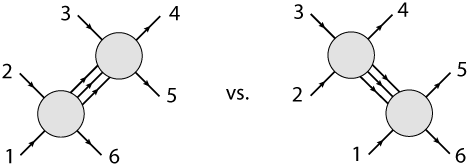
The core idea of the Steinmann relations goes back to the old method of calculating amplitudes, with Feynman diagrams. In Feynman diagrams, lines represent particles traveling from one part of the diagram to the other. In a simplified form, the Steinmann conditions are telling us that diagrams can’t take two mutually exclusive shapes at the same time. If three particles are going one way, they can’t also be going another way.

steinmann2

With the Steinmann relations, things suddenly became a whole lot easier. Calculations that we had taken months to do, Simon was now doing in a week. Finally we could narrow things down and get the full answer, and we could do it with clear, physics-based rules.

More bootstrap:

In physics, when we call something a “bootstrap” it’s in reference to the phrase “pull yourself up by your own boostraps”. That impossible task, lifting yourself  with no outside support, is essentially what we do when we “bootstrap”: we do a calculation with no external input, simply by applying general rules.

In the past, our hexagon function calculations always had some sort of external data. For the first time, with the Steinmann conditions, we don’t need that. Every constraint, everything we do to narrow down our guess, is either a general rule or comes out of our lower-loop results. We never need detailed information from anywhere else.

This is big, because it might allow us to avoid loops altogether. Normally, each loop is an approximation, narrowed down using similar approximations from others. If we don’t need the approximations from others, though, then we might not need any approximations at all. For this particular theory, for this toy model, we might be able to actually calculate scattering amplitudes exactly, for any strength of forces and any energy. Nobody’s been able to do that for this kind of theory before.

We’re already making progress. We’ve got some test cases, simpler quantities that we can understand with no approximations. We’re starting to understand the tools we need, the pieces of our bootstrap. We’ve got a real chance, now, of doing something really fundamentally new.

So keep watching this blog, keep your eyes on arXiv: big things are coming.

Physics Is about Legos

There’s a summer camp going on at Waterloo’s Institute for Quantum Computing called QCSYS, the Quantum Cryptography School for Young Students. A lot of these kids are interested in physics in general, not just quantum computing, so they give them a tour of Perimeter. While they’re here, they get a talk from a local postdoc, and this year that postdoc was me.

There’s an image that Perimeter has tossed around a lot recently, All Known Physics in One Equation. This article has an example from a talk given by Neil Turok. I thought it would be fun to explain that equation in terms a (bright, recently taught about quantum mechanics) high school student could understand. To do that, I’d have to explain what the equation is made of: spinors and vectors and tensors and the like.

The last time I had to explain that kind of thing here, I used a video game metaphor. For this talk, I came up with a better metaphor: legos.

Vectors are legos. Spinors are legos. Tensors are legos. They’re legos because they can be connected up together, but only in certain ways. Their “bumps” have to line up properly. And their nature as legos determines what you can build with them.

If you’re interested, here’s my presentation. Experts be warned: there’s a handwaving warning early in this talk, and it applies to a lot of it. In particular, the discussion of gauge group indices leaves out a lot. My goal in this talk was to give a vague idea of what the Standard Model Lagrangian is “made of”, and from the questions I got I think I succeeded.

Most of String Theory Is Not String Pheno

Last week, Sabine Hossenfelder wrote a post entitled “Why not string theory?” In it, she argued that string theory has a much more dominant position in physics than it ought to: that it’s crowding out alternative theories like Loop Quantum Gravity and hogging much more funding than it actually merits.

If you follow the string wars at all, you’ve heard these sorts of arguments before. There’s not really anything new here.

That said, there were a few sentences in Hossenfelder’s post that got my attention, and inspired me to write this post.

So far, string theory has scored in two areas. First, it has proved interesting for mathematicians. But I’m not one to easily get floored by pretty theorems – I care about math only to the extent that it’s useful to explain the world. Second, string theory has shown to be useful to push ahead with the lesser understood aspects of quantum field theories. This seems a fruitful avenue and is certainly something to continue. However, this has nothing to do with string theory as a theory of quantum gravity and a unification of the fundamental interactions.

(Bolding mine)

Here, Hossenfelder explicitly leaves out string theorists who work on “lesser understood aspects of quantum field theories” from her critique. They’re not the big, dominant program she’s worried about.

What Hossenfelder doesn’t seem to realize is that right now, it is precisely the “aspects of quantum field theories” crowd that is big and dominant. The communities of string theorists working on something else, and especially those making bold pronouncements about the nature of the real world, are much, much smaller.

Let’s define some terms:

Phenomenology (or pheno for short) is the part of theoretical physics that attempts to make predictions that can be tested in experiments. String pheno, then, covers attempts to use string theory to make predictions. In practice, though, it’s broader than that: while some people do attempt to predict the results of experiments, more work on figuring out how models constructed by other phenomenologists can make sense in string theory. This still attempts to test string theory in some sense: if a phenomenologist’s model turns out to be true but it can’t be replicated in string theory then string theory would be falsified. That said, it’s more indirect. In parallel to string phenomenology, there is also the related field of string cosmology, which has a similar relationship with cosmology.

If other string theorists aren’t trying to make predictions, what exactly are they doing? Well, a large number of them are studying quantum field theories. Quantum field theories are currently our most powerful theories of nature, but there are many aspects of them that we don’t yet understand. For a large proportion of string theorists, string theory is useful because it provides a new way to understand these theories in terms of different configurations of string theory, which often uncovers novel and unexpected properties. This is still physics, not mathematics: the goal, in the end, is to understand theories that govern the real world. But it doesn’t involve the same sort of direct statements about the world as string phenomenology or string cosmology: crucially, it doesn’t depend on whether string theory is true.

Last week, I said that before replying to Hossenfelder’s post I’d have to gather some numbers. I was hoping to find some statistics on how many people work on each of these fields, or on their funding. Unfortunately, nobody seems to collect statistics broken down by sub-field like this.

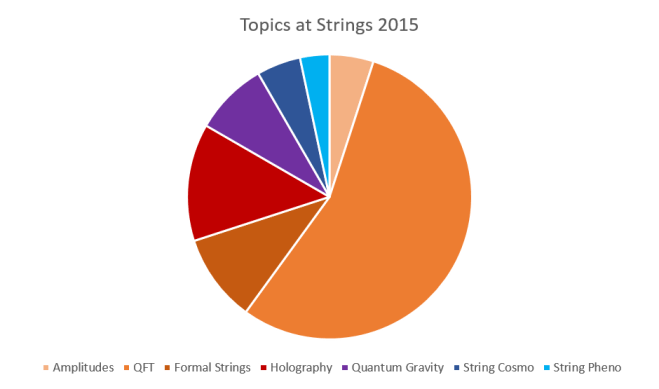
As a proxy, though, we can look at conferences. Strings is the premier conference in string theory. If something has high status in the string community, it will probably get a talk at Strings. So to investigate, I took a look at the talks given last year, at Strings 2015, and broke them down by sub-field.

strings2015topics

Here I’ve left out the historical overview talks, since they don’t say much about current research.

“QFT” is for talks about lesser understood aspects of quantum field theories. Amplitudes, my own sub-field, should be part of this: I’ve separated it out to show what a typical sub-field of the QFT block might look like.

“Formal Strings” refers to research into the fundamentals of how to do calculations in string theory: in principle, both the QFT folks and the string pheno folks find it useful.

“Holography” is a sub-topic of string theory in which string theory in some space is equivalent to a quantum field theory on the boundary of that space. Some people study this because they want to learn about quantum field theory from string theory, others because they want to learn about quantum gravity from quantum field theory. Since the field can’t be cleanly divided into quantum gravity and quantum field theory research, I’ve given it its own category.

While all string theory research is in principle about quantum gravity, the “Quantum Gravity” section refers to people focused on the sorts of topics that interest non-string quantum gravity theorists, like black hole entropy.

Finally, we have String Cosmology and String Phenomenology, which I’ve already defined.

Don’t take the exact numbers here too seriously: not every talk fit cleanly into a category, so there were some judgement calls on my part. Nonetheless, this should give you a decent idea of the makeup of the string theory community.

The biggest wedge in the diagram by far, taking up a majority of the talks, is QFT. Throwing in Amplitudes (part of QFT) and Formal Strings (useful to both), and you’ve got two thirds of the conference. Even if you believe Hossenfelder’s tale of the failures of string theory, then, that only matters to a third of this diagram. And once you take into account that many of the Holography and Quantum Gravity people are interested in aspects of QFT as well, you’re looking at an even smaller group. Really, Hossenfelder’s criticism is aimed at two small slices on the chart: String Pheno, and String Cosmo.

Of course, string phenomenologists also have their own conference. It’s called String Pheno, and last year it had 130 participants. In contrast, LOOPS’ 2015, the conference for string theory’s most famous “rival”, had…190 participants. The fields are really pretty comparable.

Now, I have a lot more sympathy for the string phenomenologists and string cosmologists than I do for loop quantum gravity. If other string theorists felt the same way, then maybe that would cause the sort of sociological effect that Hossenfelder is worried about.

But in practice, I don’t think this happens. I’ve met string theorists who didn’t even know that people still did string phenomenology. The two communities are almost entirely disjoint: string phenomenologists and string cosmologists interact much more with other phenomenologists and cosmologists than they do with other string theorists.

You want to talk about sociology? Sociologically, people choose careers and fund research because they expect something to happen soon. People don’t want to be left high and dry by a dearth of experiments, don’t feel comfortable working on something that may only be vindicated long after they’re dead. Most people choose the safe option, the one that, even if it’s still aimed at a distant goal, is also producing interesting results now (aspects of quantum field theories, for example).

The people that don’t? Tend to form small, tight-knit, passionate communities. They carve out a few havens of like-minded people, and they think big thoughts while the world around them seems to only care about their careers.

If you’re a loop quantum gravity theorist, or a quantum gravity phenomenologist like Hossenfelder, and you see some of your struggles in that paragraph, please realize that string phenomenology is like that too.

I feel like Hossenfelder imagines a world in which string theory is struck from its high place, and alternative theories of quantum gravity are of comparable size and power. But from where I’m sitting, it doesn’t look like it would work out that way. Instead, you’d have alternatives grow to the same size as similarly risky parts of string theory, like string phenomenology. And surprise, surprise: they’re already that size.

In certain corners of the internet, people like to argue about “punching up” and “punching down”. Hossenfelder seems to think she’s “punching up”, giving the big dominant group a taste of its own medicine. But by leaving out string theorists who study QFTs, she’s really “punching down”, or at least sideways, and calling out a sub-group that doesn’t have much more power than her own.

Quick Post

I’m traveling this week, so I don’t have time for a long post. I am rather annoyed with Sabine Hossenfelder’s recent post about string theory, but I don’t have time to write much about it now.

(Broadly speaking, she dismisses string theory’s success in investigating quantum field theories as irrelevant to string theory’s dominance, but as far as I’ve seen the only part of string theory that has any “institutional dominance” at all is the “investigating quantum field theories” part, while string theorists who spend their time making statements about the real world are roughly as “marginalized” as non-string quantum gravity theorists. But I ought to gather some numbers before I really commit to arguing this.)

Mass Is Just Energy You Haven’t Met Yet

How can colliding two protons give rise to more massive particles? Why do vibrations of a string have mass? And how does the Higgs work anyway?

There is one central misunderstanding that makes each of these topics confusing. It’s something I’ve brought up before, but it really deserves its own post. It’s people not realizing that mass is just energy you haven’t met yet.

It’s quite intuitive to think of mass as some sort of “stuff” that things can be made out of. In our everyday experience, that’s how it works: combine this mass of flour and this mass of sugar, and get this mass of cake. Historically, it was the dominant view in physics for quite some time. However, once you get to particle physics it starts to break down.

It’s probably most obvious for protons. A proton has a mass of 938 MeV/c², or 1.6×10⁻²⁷ kg in less physicist-specific units. Protons are each made of three quarks, two up quarks and a down quark. Naively, you’d think that the quarks would have to be around 300 MeV/c². They’re not, though: up and down quarks both have masses less than 10 MeV/c². Those three quarks account for less than a fiftieth of a proton’s mass.

The “extra” mass is because a proton is not just three quarks. It’s three quarks interacting. The forces between those quarks, the strong nuclear force that binds them together, involves a heck of a lot of energy. And from a distance, that energy ends up looking like mass.

This isn’t unique to protons. In some sense, it’s just what mass is.

The quarks themselves get their mass from the Higgs field. Far enough away, this looks like the quarks having a mass. However, zoom in and it’s energy again, the energy of interaction between quarks and the Higgs. In string theory, mass comes from the energy of vibrating strings. And so on. Every time we run into something that looks like a fundamental mass, it ends up being just another energy of interaction.

If mass is just energy, what about gravity?

When you’re taught about gravity, the story is all about mass. Mass attracts mass. Mass bends space-time. What gets left out, until you actually learn the details of General Relativity, is that energy gravitates too.

Normally you don’t notice this, because mass contributes so much more to energy than anything else. That’s really what E=m is really about: it’s a unit conversion formula. It tells you that if you want to know how much energy a given mass “really is”, you multiply it by the speed of light squared. And that’s a large enough number that most of the time, when you notice energy gravitating, it’s because that energy looks like a big chunk of mass. (It’s also why physicists like silly units like MeV/c² for mass: we can just multiply by c² and get an energy!)

It’s really tempting to think about mass as a substance, of mass as always conserved, of mass as fundamental. But in physics we often have to toss aside our everyday intuitions, and this is no exception. Mass really is just energy. It’s just energy that we’ve “zoomed out” enough not to notice.

Those Wacky 60’s Physicists

The 60’s were a weird time in academia. Psychologists were busy experimenting with LSD, seeing if they could convince people to electrocute each other, and otherwise doing the sorts of shenanigans that ended up saddling them with Institutional Review Boards so that nowadays they can’t even hand out surveys without a ten page form attesting that it won’t have adverse effects on pregnant women.

We don’t have IRBs in theoretical physics. We didn’t get quite as wacky as the psychologists did. But the 60’s were still a time of utopian dreams and experimentation, even in physics. We may not have done unethical experiments on people…but we did have the Analytic S-Matrix Program.

The Analytic S-Matrix Program was an attempt to rebuild quantum field theory from the ground up. The “S” in S-Matrix stands for “scattering”: the S-Matrix is an enormous matrix that tells you, for each set of incoming particles, the probability that they scatter into some new set of outgoing particles. Normally, this gets calculated piece by piece with what are called Feynman diagrams. The goal of the Analytic S-Matrix program was a loftier one: to derive the S-Matrix from first principles, without building it out of quantum field theory pieces. Without Feynman diagrams’ reliance on space and time, people like  Geoffrey Chew, Stanley Mandelstam, Tullio Regge, and Lev Landau hoped to reach a deeper understanding of fundamental physics.

If this sounds familiar, it should. Amplitudeologists like me view the physicists of the Analytic S-Matrix Program as our spiritual ancestors. Like us, they tried to skip the mess of Feynman diagrams, looking for mathematical tricks and unexpected symmetries to show them the way forward.

Unfortunately, they didn’t have the tools we do now. They didn’t understand the mathematical functions they needed, nor did they have novel ways of writing down their results like the amplituhedron. Instead, they had to work with what they knew, which in practice usually meant going back to Feynman diagrams.

Paradoxically then, much of the lasting impact of the Analytic S-Matrix Program has been on how we understand the results of Feynman diagram calculations. Just as psychologists learn about the Milgram experiment in school, we learn about Mandelstam variables and Regge trajectories. Recently, we’ve been digging up old concepts from those days and finding new applications, like the recent work on Landau singularities, or some as-yet unpublished work I’ve been doing.

Of course, this post wouldn’t be complete without mentioning the Analytic S-Matrix Program’s most illustrious child, String Theory. Some of the mathematics cooked up by the physicists of the 60’s, while dead ends for the problems they were trying to solve, ended up revealing a whole new world of potential.

The physicists of the 60’s were overly optimistic. Nevertheless, their work opened up questions that are still worth asking today. Much as psychologists can’t ignore what they got up to in the 60’s, it’s important for physicists to be aware of our history. You never know what you might dig up.

0521523362cvr.qxd (Page 1)

And as Levar Burton would say, you don’t have to take my word for it.

GUTs vs ToEs: What Are We Unifying Here?

“Grand Unified Theory” and “Theory of Everything” may sound like meaningless grandiose titles, but they mean very different things.

In particular, Grand Unified Theory, or GUT, is a technical term, referring to a specific way to unify three of the fundamental interactions: electromagnetism, the weak force, and the strong force.

blausen_0817_smallintestine_anatomy

In contrast, guts unify the two fundamental intestines.

Those three forces are called Yang-Mills forces, and they can all be described in the same basic way. In particular, each has a strength (the coupling constant) and a mathematical structure that determines how it interacts with itself, called a group.

The core idea of a GUT, then, is pretty simple: to unite the three Yang-Mills forces, they need to have the same strength (the same coupling constant) and be part of the same group.

But wait! (You say, still annoyed at the pun in the above caption.) These forces don’t have the same strength at all! One of them’s strong, one of them’s weak, and one of them is electromagnetic!

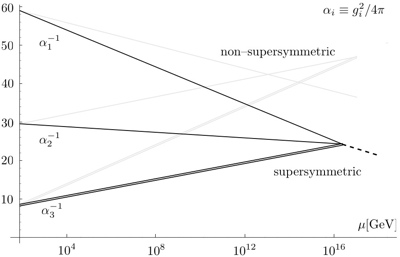
As it turns out, this isn’t as much of a problem as it seems. While the three Yang-Mills forces seem to have very different strengths on an everyday scale, that’s not true at very high energies. Let’s steal a plot from Sweden’s Royal Institute of Technology:

running

Why Sweden? Why not!

What’s going on in this plot?

Here, each \alpha represents the strength of a fundamental force. As the force gets stronger, \alpha gets bigger (and so \alpha^{-1} gets smaller). The variable on the x-axis is the energy scale. The grey lines represent a world without supersymmetry, while the black lines show the world in a supersymmetric model.

So based on this plot, it looks like the strengths of the fundamental forces change based on the energy scale. That’s true, but if you find that confusing there’s another, mathematically equivalent way to think about it.

You can think about each force as having some sort of ultimate strength, the strength it would have if the world weren’t quantum. Without quantum mechanics, each force would interact with particles in only the simplest of ways, corresponding to the simplest diagram here.

However, our world is quantum mechanical. Because of that, when we try to measure the strength of a force, we’re not really measuring its “ultimate strength”. Rather, we’re measuring it alongside a whole mess of other interactions, corresponding to the other diagrams in that post. These extra contributions mean that what looks like the strength of the force gets stronger or weaker depending on the energy of the particles involved.

(I’m sweeping several things under the rug here, including a few infinities and electroweak unification. But if you just want a general understanding of what’s going on, this should be a good starting point.)

If you look at the plot, you’ll see the forces meet up somewhere around 10^16 GeV. They miss each-other for the faint, non-supersymmetric lines, but they meet fairly cleanly for the supersymmetric ones.

So (at least if supersymmetry is true), making the Yang-Mills forces have the same strength is not so hard. Putting them in the same mathematical group is where things get trickier. This is because any group that contains the groups of the fundamental forces will be “bigger” than just the sum of those forces: it will contain “extra forces” that we haven’t observed yet, and these forces can do unexpected things.

In particular, the “extra forces” predicted by GUTs usually make protons unstable. As far as we can tell, protons are very long-lasting: if protons decayed too fast, we wouldn’t have stars. So if protons decay, they must do it only very rarely, detectable only with very precise experiments. These experiments are powerful enough to rule out most of the simplest GUTs. The more complicated GUTs still haven’t been ruled out, but it’s enough to make fewer people interested in GUTs as a research topic.

What about Theories of Everything, or ToEs?

While GUT is a technical term, ToE is very much not. Instead, it’s a phrase that journalists have latched onto because it sounds cool. As such, it doesn’t really have a clear definition. Usually it means uniting gravity with the other fundamental forces, but occasionally people use it to refer to a theory that also unifies the various Standard Model particles into some sort of “final theory”.

Gravity is very different from the other fundamental forces, different enough that it’s kind of silly to group them as “fundamental forces” in the first place. Thus, while GUT models are the kind of thing one can cook up and tinker with, any ToE has to be based on some novel insight, one that lets you express gravity and Yang-Mills forces as part of the same structure.

So far, string theory is the only such insight we have access to. This isn’t just me being arrogant: while there are other attempts at theories of quantum gravity, aside from some rather dubious claims none of them are even interested in unifying gravity with other forces.

This doesn’t mean that string theory is necessarily right. But it does mean that if you want a different “theory of everything”, telling physicists to go out and find a new one isn’t going to be very productive. “Find a theory of everything” is a hope, not a research program, especially if you want people to throw out the one structure we have that even looks like it can do the job.

Four Gravitons and Some Wildly Irresponsible Amplitudes Predictions

My post on the “physics of decimals” a couple of weeks back caught physics blogger Luboš Motl’s attention, with predictable results. Mostly, this led to a rather unproductive debate about semantics, but he did bring up one thing that I think deserves some further clarification.

In my post, I asked you to imagine asking a genie for the full consequences of quantum field theory. Short of genie-based magic, is this the sort of thing I think it’s at all possible to know?

robinwilliams_aladdin

A Candle of Invocation? Sure, why not.

In a word, no.

The world is messy, not the sort of thing that tends to be described by neat exact solutions. That’s why we use approximations, and it’s why physicists can’t just step in and solve biology or psychology by deriving everything from first principles.

That said, the nice thing about approximations is that there’s often room for improvement. Sometimes this is quantitative, literally pushing to the next order of decimals, while sometimes it’s qualitative, viewing problems from a new perspective and attacking them from a new approach.

I’d like to give you some idea of the sorts of improvements I think are possible. I’ll focus on scattering amplitudes, since they’re my field. In order to be precise, I’ll be using technical terms here without much explanation; if you’re curious about something specific go ahead and ask in the comments. Finally, there are no implied time-scales here: I’ll be rating things based on whether I think they’re likely to eventually be understood, not on how long it will take us to get there.

Let’s begin with the most likely category:

Probably going to happen:

Mathematicians characterize the set of n-point cluster polylogarithms whose collinear limits are well-defined (n-1)-point cluster polylogarithms.

The seven-loop N=8 supergravity integrand is found, and the coefficient of its potential divergence is evaluated.

The dual Amplituhedron is found.

A general procedure is described for re-summing the L-loop coefficient of the Pentagon OPE for any L into a polylogarithmic form, at least at six points.

We figure out what the heck is up with the MHV-NMHV relation we found here.

Likely to happen, but there may be unforeseen complications:

N=8 supergravity is found to be finite at seven loops.

A symbol bootstrap becomes workable for QCD amplitudes at two or three loops, perhaps involving Landau singularities.

Something like a symbol bootstrap becomes workable for elliptic integrals, though it may only pass a “physicist” level of rigor.

Analogues to all of the work up to the actual Amplituhedron itself are performed for non-planar N=4 super Yang-Mills.

Quite possible, but I’m likely overoptimistic:

The space of n-point cluster polylogarithms whose collinear limits are well-defined (n-1)-point cluster polylogarithms that also obey the first entry condition and some number of final entry conditions turns out to be well-constrained enough that some all-loop all-point statements can be made, at least for MHV.

The enhanced cancellations observed in supergravity theories are understood, and used to provide a strong argument that N=8 supergravity is perturbatively finite.

All-multiplicity analytic QCD results at two loops, for at least the simpler helicity configurations.

The volume of the dual Amplituhedron is characterized by mathematicians and the connection to cluster polylogarithms is fully explored.

A non-planar Amplituhedron is found.

Less likely, but if all of the above happens I would not be all that surprised:

A way is found to double-copy the non-planar Amplituhedron to get an N=8 supergravity Amplituhedron.

The enhanced cancellations in N=8 supergravity turn out to be something “deep”: perhaps they are derivable from string theory, or provide a novel constraint on quantum gravity theories.

Various all-loop statements about the polylogarithms present in N=4 are used to make more restricted all-loop statements about QCD.

The Pentagon OPE is re-summed for finite coupling, if not into known functions than into a form that admits good numerics and various analytic manipulations. Alternatively, the sorts of functions that the Pentagon OPE can sum to are characterized and a bootstrap procedure becomes viable for them.

Irresponsible speculations, suited to public talks or grant applications:

The N=8 Amplituhedron leads to some sort of reformulation of space-time in a way that solves various quantum gravity paradoxes.

The sorts of mathematical objects found in the finite-coupling resummation of the Pentagon OPE lead to a revival of the original analytic S-matrix program, now with an actual chance to succeed.

Extremely unlikely:

Analytic all-loop QCD results.

Magical genie land:

Analytic finite coupling QCD results.