Tag Archives: quantum computing

Congratulations to John Clarke, Michel Devoret, and John Martinis!

The 2025 Physics Nobel Prize was announced this week, awarded to John Clarke, Michel Devoret, and John Martinis for building an electrical circuit that exhibited quantum effects like tunneling and energy quantization on a macroscopic scale.

Press coverage of this prize tends to focus on two aspects: the idea that these three “scaled up” quantum effects to medium-sized objects (the technical account quotes a description that calls it “big enough to get one’s grubby fingers on”), and that the work paved the way for some of the fundamental technologies people are exploring for quantum computing.

That’s a fine enough story, but it leaves out what made these folks’ work unique, why it differs from other Nobel laureates working with other quantum systems. It’s a bit more technical of a story, but I don’t think it’s that technical. I’ll try to tell it here.

To start, have you heard of Bose-Einstein Condensates?

Bose-Einstein Condensates are macroscopic quantum states that have already won Nobel prizes. First theorized based on ideas developed by Einstein and Bose (the namesake of bosons), they involve a large number of particles moving together, each in the same state. While the first gas that obeyed Einstein’s equations for a Bose-Einstein Condensate was created in the 1990’s, after Clarke, Devoret, and Martinis’s work, other things based on essentially the same principles were created much earlier. A laser works on the same principles as a Bose-Einstein condensate, as do phenomena like superconductivity and superfluidity.

This means that lasers, superfluids, and superconductors had been showing off quantum mechanics on grubby finger scales well before Clarke, Devoret, and Martinis’s work. But the science rewarded by this year’s Nobel turns out to be something quite different.

Because the different photons in laser light are independently in identical quantum states, lasers are surprisingly robust. You can disrupt the state of one photon, and it won’t interfere with the other states. You’ll have weakened the laser’s consistency a little bit, but the disruption won’t spread much, if at all.

That’s very different from the way quantum systems usually work. Schrodinger’s cat is the classic example. You have a box with a radioactive atom, and if that atom decays, it releases poison, killing the cat. You don’t know if the atom has decayed or not, and you don’t know if the cat is alive or not. We say the atom’s state is a superposition of decayed and not decayed, and the cat’s state is a superposition of alive and dead.

But unlike photons in a laser, the atom and the cat in Schrodinger’s cat are not independent: if the atom has decayed, the cat is dead, if the atom has not, the cat is alive. We say the states of atom and cat are entangled.

That makes these so-called “Schrodinger’s cat” states much more delicate. The state of the cat depends on the state of the atom, and those dependencies quickly “leak” to the outside world. If you haven’t sealed the box well, the smell of the room is now also entangled with the cat…which, if you have a sense of smell, means that you are entangled with the cat. That’s the same as saying that you have measured the cat, so you can’t treat it as quantum any more.

What Clarke, Devoret, and Martinis did was to build a circuit that could exhibit, not a state like a laser, but a “cat state”: delicately entangled, at risk of total collapse if measured.

That’s why they deserved a Nobel, even in a world where there are many other Nobels for different types of quantum states. Lasers, superconductors, even Bose-Einstein condensates were in a sense “easy mode”, robust quantum states that didn’t need all that much protection. This year’s physics laureates, in contrast, showed it was possible to make circuits that could make use of quantum mechanics’ most delicate properties.

That’s also why their circuits, in particular, are being heralded as a predecessor for modern attempts at quantum computers. Quantum computers do tricks with entanglement, they need “cat states”, not Bose-Einstein Condensates. And Clarke, Devoret, and Martinis’s work in the 1980’s was the first clear proof that this was a feasible thing to do.

Bonus info for Reversible Computing and Megastructures

After some delay, a bonus info post!

At FirstPrinciples.org, I had a piece covering work by engineering professor Colin McInnes on stability of Dyson spheres and ringworlds. This was a fun one to cover, mostly because of how it straddles the borderline between science fiction and practical physics and engineering. McInnes’s claim to fame is work on solar sails, which seem like a paradigmatic example of that kind of thing: a common sci-fi theme that’s surprisingly viable. His work on stability was interesting to me because it’s the kind of work that a century and a half ago would have been paradigmatic physics. Now, though, very few physicists work on orbital mechanics, and a lot of the core questions have passed on to engineering. It’s fascinating to see how these classic old problems can still have undiscovered solutions, and how the people best equipped to find them now are tinkerers practicing their tools instead of cutting-edge mathematicians.

At Quanta Magazine, I had a piece about reversible computing. Readers may remember I had another piece on that topic at the end of March, a profile on the startup Vaire Computing at FirstPrinciples.org. That piece talked about FirstPrinciples, but didn’t say much about reversible computing. I figured I’d combine the “bonus info” for both posts here.

Neither piece went into much detail about the engineering involved, as it didn’t really make sense in either venue. One thing that amused me a bit is that the core technology that drove Vaire into action is something that actually should be very familiar to a physics or engineering student: a resonator. Theirs is obviously quite a bit more sophisticated than the base model, but at its heart it’s doing the same thing: storing charge and controlling frequency. It turns out that those are both essential to making reversible computers work: you need to store charge so it isn’t lost to ground when you empty a transistor, and you need to control the frequency so you can have waves with gentle transitions instead of the more sharp corners of the waves used in normal computers, thus wasting less heat in rapid changes of voltage. Vaire recently announced they’re getting 50% charge recovery from their test chips, and they’re working on raising that number.

Originally, the Quanta piece was focused more on reversible programming than energy use, as the energy angle seemed a bit more physics-focused than their computer science desk usually goes. The emphasis ended up changing as I worked on the draft, but it meant that an interesting parallel story got lost on the cutting-room floor. There’s a community of people who study reversible computing not from the engineering side, but from the computer science side, studying reversible logic and reversible programming languages. It’s a pursuit that goes back to the 1980’s, where at Caltech around when Feynman was teaching his course on the physics of computing a group of students were figuring out how to set up a reversible programming language. Called Janus, they sent their creation to Landauer, and the letter ended up with Michael Frank after Landauer died. There’s a lovely quote from it regarding their motivation: “We did it out of curiosity over whether such an odd animal as this was possible, and because we were interested in knowing where we put information when we programmed. Janus forced us to pay attention to where our bits went since none could be thrown away.”

Being forced to pay attention to information, in turn, is what has animated the computer science side of the reversible computing community. There are applications to debugging, where you can run code backwards when it gets stuck, to encryption and compression, where you want to be able to recover the information you hid away, and to security, where you want to keep track of information to make sure a hacker can’t figure out things they shouldn’t. Also, for a lot of these people, it’s just a fun puzzle. Early on my attention was caught by a paper by Hannah Earley describing a programming language called Alethe, a word you might recognize from the Greek word for truth, which literally means something like “not-forgetting”.

(Compression is particularly relevant for the “garbage data” you need to output in a reversible computation. If you want to add two numbers reversibly, naively you need to keep both input numbers and their output, but you can be more clever than that and just keep one of the inputs since you can subtract to find the other. There are a lot of substantially more clever tricks in this vein people have figured out over the years.)

I didn’t say anything about the other engineering approaches to reversible computing, that try to do something outside of traditional computer chips. There’s DNA computing, which tries to compute with a bunch of DNA in solution. There’s the old concept of ballistic reversible computing, where you imagine a computer that runs like a bunch of colliding billiard balls, conserving energy. Coordinating such a computer can be a nightmare, and early theoretical ideas were shown to be disrupted by something as tiny as a few stray photons from a distant star. But people like Frank figured out ways around the coordination problem, and groups have experimented with superconductors as places to toss those billiard balls around. The early billiard-inspired designs also had a big impact on quantum computing, where you need reversible gates and the only irreversible operation is the measurement. The name “Toffoli” comes up a lot in quantum computing discussions, I hadn’t known before this that Toffoli gates were originally for reversible computing in general, not specifically quantum computing.

Finally, I only gestured at the sci-fi angle. For reversible computing’s die-hards, it isn’t just a way to make efficient computers now. It’s the ultimate future of the technology, the kind of energy-efficiency civilization will need when we’re covering stars with shells of “computronium” full of busy joyous artificial minds.

And now that I think about it, they should chat with McInnes. He can tell them the kinds of stars they should build around.

Some FAQ for Microsoft’s Majorana 1 Chip

Recently, Microsoft announced a fancy new quantum computing chip called Majorana 1. I’ve noticed quite a bit of confusion about what they actually announced, and while there’s a great FAQ page about it on the quantum computing blog Shtetl Optimized, the post there aims at a higher level, assuming you already know the basics. You can think of this post as a complement to that one, that tries to cover some basic things Shtetl Optimized took for granted.

Q: In the announcement, Microsoft said:

“It leverages the world’s first topoconductor, a breakthrough type of material which can observe and control Majorana particles to produce more reliable and scalable qubits, which are the building blocks for quantum computers.”

That sounds wild! Are they really using particles in a computer?

A: All computers use particles. Electrons are particles!

Q: You know what I mean!

A: You’re asking if these are “particle physics” particles, like the weird types they try to observe at the LHC?

No, they’re not.

Particle physicists use a mathematical framework called quantum field theory, where particles are ripples in things called quantum fields that describe properties of the universe. But they aren’t the only people to use that framework. Instead of studying properties of the universe you can study properties of materials, weird alloys and layers of metal and crystal that do weird and useful things. The properties of these materials can be approximately described with the same math, with quantum fields. Just as the properties of the universe ripple to produce particles, these properties of materials ripple to produce what are called quasiparticles. Ultimately, these quasiparticles come down to movements of ordinary matter, usually electrons in the original material. They’re just described with a kind of math that makes them look like their own particles.

Q: So, what are these Majorana particles supposed to be?

A: In quantum field theory, most particles come with an antimatter partner. Electrons, for example, have partners called positrons, with a positive electric charge instead of a negative one. These antimatter partners have to exist due to the math of quantum field theory, but there is a way out: some particles are their own antimatter partner, letting one particle cover both roles. This happens for some “particle physics particles”, but all the examples we’ve found are a type of particle called a “boson”, particles related to forces. In 1937, the physicist Ettore Majorana figured out the math you would need to make a particle like this that was a fermion instead, the other main type of particle that includes electrons and protons. So far, we haven’t found one of these Majorana fermions in nature, though some people think the elusive neutrino particles could be an example. Others, though, have tried instead to find a material described by Majorana’s theory. This should in principle be easier, you can build a lot of different materials after all. But it’s proven quite hard for people to do. Back in 2018, Microsoft claimed they’d managed this, but had to retract the claim. This time, they seem more confident, though the scientific community is still not convinced.

Q: And what’s this topoconductor they’re talking about?

A: Topoconductor is short for topological superconductor. Superconductors are materials that conduct electricity much better than ordinary metals.

Q: And, topological means? Something about donuts, right?

A: If you’ve heard anything about topology, you’ve heard that it’s a type of mathematics where donuts are equivalent to coffee cups. You might have seen an animation of a coffee cup being squished and mushed around until the ring of the handle becomes the ring of a donut.

This isn’t actually the important part of topology. The important part is that, in topology, a ball is not equivalent to a donut.

Topology is the study of which things can change smoothly into one another. If you want to change a donut into a ball, you have to slice through the donut’s ring or break the surface inside. You can’t smoothly change one to another. Topologists study shapes of different kinds of things, figuring out which ones can be changed into each other smoothly and which can’t.

Q: What does any of that have to do with quantum computers?

A: The shapes topologists study aren’t always as simple as donuts and coffee cups. They can also study the shape of quantum fields, figuring out which types of quantum fields can change smoothly into each other and which can’t.

The idea of topological quantum computation is to use those rules about what can change into each other to encode information. You can imagine a ball encoding zero, and a donut encoding one. A coffee cup would then also encode one, because it can change smoothly into a donut, while a box would encode zero because you can squash the corners to make it a ball. This helps, because it means that you don’t screw up your information by making smooth changes. If you accidentally drop your box that encodes zero and squish a corner, it will still encode zero.

This matters in quantum computing because it is very easy to screw up quantum information. Quantum computers are very delicate, and making them work reliably has been immensely challenging, requiring people to build much bigger quantum computers so they can do each calculation with many redundant backups. The hope is that topological superconductors would make this easier, by encoding information in a way that is hard to accidentally change.

Q: Cool. So does that mean Microsoft has the best quantum computer now?

A: The machine Microsoft just announced has only a single qubit, the quantum equivalent of just a single bit of computer memory. At this point, it can’t do any calculations. It can just be read, giving one or zero. The hope is that the power of the new method will let Microsoft catch up with companies that have computers with hundred of qubits, and help them arrive faster at the millions of qubits that will be needed to do anything useful.

Q: Ah, ok. But it sounds like they accomplished some crazy Majorana stuff at least, right?

A: Umm…

Read the Shtetl-Optimized FAQ if you want more details. The short answer is that this is still controversial. So far, the evidence they’ve made public isn’t enough to show that they found these Majorana quasiparticles, or that they made a topological superconductor. They say they have more recent evidence that they haven’t published yet. We’ll see.

Simulated Wormhole Analogies

Last week, I talked about how Google’s recent quantum simulation of a toy model wormhole was covered in the press. What I didn’t say much about, was my own opinion of the result. Was the experiment important? Was it worth doing? Did it deserve the hype?

Here on this blog, I don’t like to get into those kinds of arguments. When I talk about public understanding of science, I share the same concerns as the journalists: we all want to prevent misunderstandings, and to spread a clearer picture. I can argue that some choices hurt the public understanding and some help it, and be reasonably confident that I’m saying something meaningful, something that would resonate with their stated values.

For the bigger questions, what goals science should have and what we should praise, I have much less of a foundation. We don’t all have a clear shared standard for which science is most important. There isn’t some premise I can posit, a fundamental principle I can use to ground a logical argument.

That doesn’t mean I don’t have an opinion, though. It doesn’t even mean I can’t persuade others of it. But it means the persuasion has to be a bit more loose. For example, I can use analogies.

So let’s say I’m looking at a result like this simulated wormhole. Researchers took advanced technology (Google’s quantum computer), and used it to model a simple system. They didn’t learn anything especially new about that system (since in this case, a normal computer can simulate it better). I get the impression they didn’t learn all that much about the advanced technology: the methods used, at this point, are pretty well-known, at least to Google. I also get the impression that it wasn’t absurdly expensive: I’ve seen other people do things of a similar scale with Google’s machine, and didn’t get the impression they had to pay through the nose for the privilege. Finally, the simple system simulated happens to be “cool”: it’s a toy model studied by quantum gravity researchers, a simple version of that sci-fi standard, the traversible wormhole.

What results are like that?

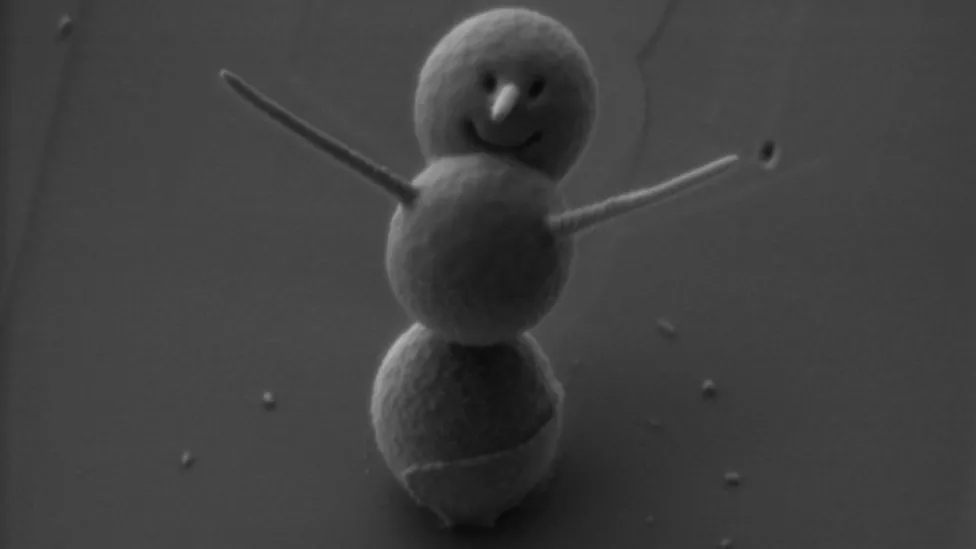
Occasionally, scientists build tiny things. If the tiny things are cute enough, or cool enough, they tend to get media attention. The most recent example I can remember was a tiny snowman, three microns tall. These tiny things tend to use very advanced technology, and it’s hard to imagine the scientists learn much from making them, but it’s also hard to imagine they cost all that much to make. They’re amusing, and they absolutely get press coverage, spreading wildly over the web. I don’t think they tend to get published in Nature unless they are a bit more advanced, but I wouldn’t be too surprised if I heard of a case that did, scientific journals can be suckers for cute stories too. They don’t tend to get discussed in glowing terms linking them to historical breakthroughs.

That seems like a pretty close analogy. Taken seriously, it would suggest the wormhole simulation was probably worth doing, probably worth a press release and some media coverage, likely not worth publication in Nature, and definitely not worth being heralded as a major breakthrough.

Ok, but proponents of the experiment might argue I’m leaving something out here. This experiment isn’t just a cute simulation. It’s supposed to be a proof of principle, an early version of an experiment that will be an actually useful simulation.

As an analogy for that…did you know LIGO started taking data in 2002?

Most people first heard of the Laser Interferometer Gravitational-Wave Observatory in 2016, when they reported their first detection of gravitational waves. But that was actually “advanced LIGO”. The original LIGO ran from 2002 to 2010, and didn’t detect anything. It just wasn’t sensitive enough. Instead, it was a prototype, an early version designed to test the basic concept.

Similarly, while this wormhole situation didn’t teach anything new, future ones might. If the quantum simulation was made larger, it might be possible to simulate more complicated toy models, ones that are too complicated to simulate on a normal computer. These aren’t feasible now, but may be feasible with somewhat bigger quantum computers: still much smaller than the computers that would be needed to break encryption, or even to do simulations that are useful for chemists and materials scientists. Proponents argue that some of these quantum toy models might teach them something interesting about the mathematics of quantum gravity.

Here, though, a number of things weaken the analogy.

LIGO’s first run taught them important things about the noise they would have to deal with, things that they used to build the advanced version. The wormhole simulation didn’t show anything novel about how to use a quantum computer: the type of thing they were doing was well-understood, even if it hadn’t been used to do that yet.

Detecting gravitational waves opened up a new type of astronomy, letting us observe things we could never have observed before. For these toy models, it isn’t obvious to me that the benefit is so unique. Future versions may be difficult to classically simulate, but it wouldn’t surprise me if theorists figured out how to understand them in other ways, or gained the same insight from other toy models and moved on to new questions. They’ll have a while to figure it out, because quantum computers aren’t getting bigger all that fast. I’m very much not an expert in this type of research, so maybe I’m wrong about this…but just comparing to similar research programs, I would be surprised if the quantum simulations end up crucial here.

Finally, even if the analogy held, I don’t think it proves very much. In particular, as far as I can tell, the original LIGO didn’t get much press. At the time, I remember meeting some members of the collaboration, and they clearly didn’t have the fame the project has now. Looking through google news and the archives of the New York times, I can’t find all that much about the experiment: a few articles discussing its progress and prospects, but no grand unveiling, no big press releases.

So ultimately, I think viewing the simulation as a proof of principle makes it, if anything, less worth the hype. A prototype like that is only really valuable when it’s testing new methods, and only in so far as the thing it’s a prototype for will be revolutionary. Recently, a prototype fusion device got a lot of press for getting more energy out of a plasma than they put into it (though still much less than it takes to run the machine). People already complained about that being overhyped, and the simulated wormhole is nowhere near that level of importance.

If anything, I think the wormhole-simulators would be on a firmer footing if they thought of their work like the tiny snowmen. It’s cute, a fun side benefit of advanced technology, and as such something worth chatting about and celebrating a bit. But it’s not the start of a new era.

Simulated Wormholes for My Real Friends, Real Wormholes for My Simulated Friends

Maybe you’ve recently seen a headline like this:

Actually, I’m more worried that you saw that headline before it was edited, when it looked like this:

If you’ve seen either headline, and haven’t read anything else about it, then please at least read this:

Physicists have not created an actual wormhole. They have simulated a wormhole on a quantum computer.

If you’re willing to read more, then read the rest of this post. There’s a more subtle story going on here, both about physics and about how we communicate it. And for the experts, hold on, because when I say the wormhole was a simulation I’m not making the same argument everyone else is.

[And for the mega-experts, there’s an edit later in the post where I soften that claim a bit.]

The headlines at the top of this post come from an article in Quanta Magazine. Quanta is a web-based magazine covering many fields of science. They’re read by the general public, but they aim for a higher standard than many science journalists, with stricter fact-checking and a goal of covering more challenging and obscure topics. Scientists in turn have tended to be quite happy with them: often, they cover things we feel are important but that the ordinary media isn’t able to cover. (I even wrote something for them recently.)

Last week, Quanta published an article about an experiment with Google’s Sycamore quantum computer. By arranging the quantum bits (qubits) in a particular way, they were able to observe behaviors one would expect out of a wormhole, a kind of tunnel linking different points in space and time. They published it with the second headline above, claiming that physicists had created a wormhole with a quantum computer and explaining how, using a theoretical picture called holography.

This pissed off a lot of physicists. After push-back, Quanta’s twitter account published this statement, and they added the word “Holographic” to the title.

Why were physicists pissed off?

It wasn’t because the Quanta article was wrong, per se. As far as I’m aware, all the technical claims they made are correct. Instead, it was about two things. One was the title, and the implication that physicists “really made a wormhole”. The other was the tone, the excited “breaking news” framing complete with a video comparing the experiment with the discovery of the Higgs boson. I’ll discuss each in turn:

The Title

Did physicists really create a wormhole, or did they simulate one? And why would that be at all confusing?

The story rests on a concept from the study of quantum gravity, called holography. Holography is the idea that in quantum gravity, certain gravitational systems like black holes are fully determined by what happens on a “boundary” of the system, like the event horizon of a black hole. It’s supposed to be a hologram in analogy to 3d images encoded in 2d surfaces, rather than like the hard-light constructions of science fiction.

The best-studied version of holography is something called AdS/CFT duality. AdS/CFT duality is a relationship between two different theories. One of them is a CFT, or “conformal field theory”, a type of particle physics theory with no gravity and no mass. (The first example of the duality used my favorite toy theory, N=4 super Yang-Mills.) The other one is a version of string theory in an AdS, or anti-de Sitter space, a version of space-time curved so that objects shrink as they move outward, approaching a boundary. (In the first example, this space-time had five dimensions curled up in a sphere and the rest in the anti-de Sitter shape.)

These two theories are conjectured to be “dual”. That means that, for anything that happens in one theory, you can give an alternate description using the other theory. We say the two theories “capture the same physics”, even though they appear very different: they have different numbers of dimensions of space, and only one has gravity in it.

Many physicists would claim that if two theories are dual, then they are both “equally real”. Even if one description is more familiar to us, both descriptions are equally valid. Many philosophers are skeptical, but honestly I think the physicists are right about this one. Philosophers try to figure out which things are real or not real, to make a list of real things and explain everything else as made up of those in some way. I think that whole project is misguided, that it’s clarifying how we happen to talk rather than the nature of reality. In my mind, dualities are some of the clearest evidence that this project doesn’t make any sense: two descriptions can look very different, but in a quite meaningful sense be totally indistinguishable.

That’s the sense in which Quanta and Google and the string theorists they’re collaborating with claim that physicists have created a wormhole. They haven’t created a wormhole in our own space-time, one that, were it bigger and more stable, we could travel through. It isn’t progress towards some future where we actually travel the galaxy with wormholes. Rather, they created some quantum system, and that system’s dual description is a wormhole. That’s a crucial point to remember: even if they created a wormhole, it isn’t a wormhole for you.

If that were the end of the story, this post would still be full of warnings, but the title would be a bit different. It was going to be “Dual Wormholes for My Real Friends, Real Wormholes for My Dual Friends”. But there’s a list of caveats. Most of them arguably don’t matter, but the last was what got me to change the word “dual” to “simulated”.

  1. The real world is not described by N=4 super Yang-Mills theory. N=4 super Yang-Mills theory was never intended to describe the real world. And while the real world may well be described by string theory, those strings are not curled up around a five-dimensional sphere with the remaining dimensions in anti-de Sitter space. We can’t create either theory in a lab either.
  2. The Standard Model probably has a quantum gravity dual too, see this cute post by Matt Strassler. But they still wouldn’t have been able to use that to make a holographic wormhole in a lab.
  3. Instead, they used a version of AdS/CFT with fewer dimensions. It relates a weird form of gravity in one space and one time dimension (called JT gravity), to a weird quantum mechanics theory called SYK, with an infinite number of quantum particles or qubits. This duality is a bit more conjectural than the original one, but still reasonably well-established.
  4. Quantum computers don’t have an infinite number of qubits, so they had to use a version with a finite number: seven, to be specific. They trimmed the model down so that it would still show the wormhole-dual behavior they wanted. At this point, you might say that they’re definitely just simulating the SYK theory, using a small number of qubits to simulate the infinite number. But I think they could argue that this system, too, has a quantum gravity dual. The dual would have to be even weirder than JT gravity, and even more conjectural, but the signs of wormhole-like behavior they observed (mostly through simulations on an ordinary computer, which is still better at this kind of thing than a quantum computer) could be seen as evidence that this limited theory has its own gravity partner, with its own “real dual” wormhole.
  5. But those seven qubits don’t just have the interactions they were programmed to have, the ones with the dual. They are physical objects in the real world, so they interact with all of the forces of the real world. That includes, though very weakly, the force of gravity.

And that’s where I think things break, and you have to call the experiment a simulation. You can argue, if you really want to, that the seven-qubit SYK theory has its own gravity dual, with its own wormhole. There are people who expect duality to be broad enough to include things like that.

But you can’t argue that the seven-qubit SYK theory, plus gravity, has its own gravity dual. Theories that already have gravity are not supposed to have gravity duals. If you pushed hard enough on any of the string theorists on that team, I’m pretty sure they’d admit that.

That is what decisively makes the experiment a simulation. It approximately behaves like a system with a dual wormhole, because you can approximately ignore gravity. But if you’re making some kind of philosophical claim, that you “really made a wormhole”, then “approximately” doesn’t cut it: if you don’t exactly have a system with a dual, then you don’t “really” have a dual wormhole: you’ve just simulated one.

Edit: mitchellporter in the comments points out something I didn’t know: that there are in fact proposals for gravity theories with gravity duals. They are in some sense even more conjectural than the series of caveats above, but at minimum my claim above, that any of the string theorists on the team would agree that the system’s gravity means it can’t have a dual, is probably false.

I think at this point, I’d soften my objection to the following:

Describing the system of qubits in the experiment as a limited version of the SYK theory is in one way or another an approximation. It approximates them as not having any interactions beyond those they programmed, it approximates them as not affected by gravity, and because it’s a quantum mechanical description it even approximates the speed of light as small. Those approximations don’t guarantee that the system doesn’t have a gravity dual. But in order for them to, then our reality, overall, would have to have a gravity dual. There would have to be a dual gravity interpretation of everything, not just the inside of Google’s quantum computer, and it would have to be exact, not just an approximation. Then the approximate SYK would be dual to an approximate wormhole, but that approximate wormhole would be an approximation of some “real” wormhole in the dual space-time.

That’s not impossible, as far as I can tell. But it piles conjecture upon conjecture upon conjecture, to the point that I don’t think anyone has explicitly committed to the whole tower of claims. If you want to believe that this experiment literally created a wormhole, you thus can, but keep in mind the largest asterisk known to mankind.

End edit.

If it weren’t for that caveat, then I would be happy to say that the physicists really created a wormhole. It would annoy some philosophers, but that’s a bonus.

But even if that were true, I wouldn’t say that in the title of the article.

The Title, Again

These days, people get news in two main ways.

Sometimes, people read full news articles. Reading that Quanta article is a good way to understand the background of the experiment, what was done and why people care about it. As I mentioned earlier, I don’t think anything said there was wrong, and they cover essentially all of the caveats you’d care about (except for that last one 😉 ).

Sometimes, though, people just see headlines. They get forwarded on social media, observed at a glance passed between friends. If you’re popular enough, then many more people will see your headline than will actually read the article. For many people, their whole understanding of certain scientific fields is formed by these glancing impressions.

Because of that, if you’re popular and news-y enough, you have to be especially careful with what you put in your headlines, especially when it implies a cool science fiction story. People will almost inevitably see them out of context, and it will impact their view of where science is headed. In this case, the headline may have given many people the impression that we’re actually making progress towards travel via wormholes.

Some of my readers might think this is ridiculous, that no-one would believe something like that. But as a kid, I did. I remember reading popular articles about wormholes, describing how you’d need energy moving in a circle, and other articles about optical physicists finding ways to bend light and make it stand still. Putting two and two together, I assumed these ideas would one day merge, allowing us to travel to distant galaxies faster than light.

If I had seen Quanta’s headline at that age, I would have taken it as confirmation. I would have believed we were well on the way to making wormholes, step by step. Even the New York Times headline, “the Smallest, Crummiest Wormhole You Can Imagine”, wouldn’t have fazed me.

(I’m not sure even the extra word “holographic” would have. People don’t know what “holographic” means in this context, and while some of them would assume it meant “fake”, others would think about the many works of science fiction, like Star Trek, where holograms can interact physically with human beings.)

Quanta has a high-brow audience, many of whom wouldn’t make this mistake. Nevertheless, I think Quanta is popular enough, and respectable enough, that they should have done better here.

At minimum, they could have used the word “simulated”. Even if they go on to argue in the article that the wormhole is real, and not just a simulation, the word in the title does no real harm. It would be a lie, but a beneficial “lie to children”, the basic stock-in-trade of science communication. I think they could have defended it to the string theorists they interviewed on those grounds.

The Tone

Honestly, I don’t think people would have been nearly so pissed off were it not for the tone of the article. There are a lot of physics bloggers who view themselves as serious-minded people, opposed to hype and publicity stunts. They view the research program aimed at simulating quantum gravity on a quantum computer as just an attempt to link a dying and un-rigorous research topic to an over-hyped and over-funded one, pompous storytelling aimed at promoting the careers of people who are already extremely successful.

These people tend to view Quanta favorably, because it covers serious-minded topics in a thorough way. And so many of them likely felt betrayed, seeing this Quanta article as a massive failure of that serious-minded-ness, falling for or even endorsing the hypiest of hype.

To those people, I’d like to politely suggest you get over yourselves.

Quanta’s goal is to cover things accurately, to represent all the facts in a way people can understand. But “how exciting something is” is not a fact.

Excitement is subjective. Just because most of the things Quanta finds exciting you also find exciting, does not mean that Quanta will find the things you find unexciting unexciting. Quanta is not on “your side” in some war against your personal notion of unexciting science, and you should never have expected it to be.

In fact, Quanta tends to find things exciting, in general. They were more excited than I was about the amplituhedron, and I’m an amplitudeologist. Part of what makes them consistently excited about the serious-minded things you appreciate them for is that they listen to scientists and get excited about the things they’re excited about. That is going to include, inevitably, things those scientists are excited about for what you think are dumb groupthinky hype reasons.

I think the way Quanta titled the piece was unfortunate, and probably did real damage. I think the philosophical claim behind the title is wrong, though for subtle and weird enough reasons that I don’t really fault anybody for ignoring them. But I don’t think the tone they took was a failure of journalistic integrity or research or anything like that. It was a matter of taste. It’s not my taste, it’s probably not yours, but we shouldn’t have expected Quanta to share our tastes in absolutely everything. That’s just not how taste works.