Tag Archives: LHC

Misleading Headlines and Tacky Physics, Oh My!

It’s been making the rounds on the blogosphere (despite having come out three months ago). It’s probably showed up on your Facebook feed. It’s the news that (apparently) one of the biggest discoveries of recent years may have been premature. It’s….

The Huffington Post writing a misleading headline to drum up clicks!

The article linked above is titled “Scientists Raise Doubts About Higgs Boson Discovery, Say It Could Be Another Particle”. And while that is indeed technically all true, it’s more than a little misleading.

When the various teams at the Large Hadron Collider announced their discovery of the Higgs, they didn’t say it was exactly the Higgs predicted by the Standard Model. In fact, it probably shouldn’t be: most of the options for extending the Standard Model, like supersymmetry, predict a Higgs boson with slightly different properties. Until the Higgs is measured more precisely, these slightly different versions won’t be ruled out.

Of course, “not ruled out” is not exactly newsworthy, which is the main problem with this article. The Huffington Post quotes a paper that argues, not that there is new evidence for an alternative to the Higgs, but simply that one particular alternative that the authors like hasn’t been ruled out yet.

Also, it’s probably the tackiest alternative out there.

The theory in question is called Technicolor, and if you’re imagining a certain coat then you may have an idea of how tacky we’re talking.

Any Higgs will do…

To describe technicolor, let’s take a brief aside and talk about the colors of quarks.

Rather than having one type of charge going from plus to minus like Electromagnetism, the Strong Nuclear Force has three types of charge, called red, green, and blue. Quarks are charged under the strong force, and can be red, green, or blue, while the antimatter partners of quarks have the equivalent of negative charges, anti-red, anti-green, and anti-blue. The strong force binds quarks together into protons and neutrons. The strong force is also charged under itself, which means that not only does it bind quarks together, it also binds itself together, so that it only acts at very very short range.

In combination, these two facts have one rather surprising consequence. A proton contains three quarks, but a proton’s mass is over a hundred times the total mass of three quarks. The same is true of neutrons.

The reason why is that most of the mass isn’t coming from the quarks, it’s coming from the strength of the strong force. Mass, contrary to what you might think, isn’t fundamental “stuff”. It’s just a handy way of talking about energy that isn’t due to something we can easily see. Particles have energy because they move, but they also have energy due to internal interactions, as well as interactions with other fields like the Higgs field. While a lone quark’s mass is due to its interaction with the Higgs field, the quarks inside a proton are also interacting with each other, gaining enormous amounts of energy from the strong force trapped within. That energy, largely invisible from an outside view, contributes most of what we see as the mass of the proton.

Technicolor asks the following: what if it’s not just protons and neutrons? What if the mass of everything, quarks and electrons and the W and Z bosons, was due not truly to the Higgs, but to another force, like the strong force but even stronger? The Higgs we think we saw at the LHC would not be fundamental, but merely a composite, made up of  two “techni-quarks” with “technicolor” charges. [Edited to remove confusion with Preon Theory]

It’s…an idea. But it’s never been a very popular one.

Part of the problem is that the simpler versions of technicolor have been ruled out, so theorists are having to invoke increasingly baroque models to try to make it work. But that, to some extent, is also true of supersymmetry.

A bigger problem is that technicolor is just kind of…tacky.

Technicolor doesn’t say anything deep about the way the universe works. It doesn’t propose new [types of] symmetries, and it doesn’t say anything about what happens at the very highest energies. It’s not really tied in to any of the other lines of speculation in physics, it doesn’t lead to a lot of discussion between researchers. It doesn’t require an end, a fundamental lowest level with truly fundamental particles. You could potentially keep adding new levels of technicolor, new things made up of other things made up of other things, ad infinitum.

And the fleas that bite ’em, presumably.

[Note: to clarify, technicolor theories don’t actually keep going like this, their extra particles don’t require another layer of technicolor to gain their masses. That would be an actual problem with the concept itself, not a reason it’s tacky. It’s tacky because, in a world where most physicists feel like we’ve really gotten down to the fundamental particles, adding new composite objects seems baroque and unnecessary, like adding epicycles. Fleas upon fleas as it were.]

In a word, it’s not sexy.

Does that mean it’s wrong? No, of course not. As the paper linked by Huffington Post points out, technicolor hasn’t been ruled out yet.

Does that mean I think people shouldn’t study it? Again, no. If you really find technicolor meaningful and interesting, go for it! Maybe you’ll be the kick it needs to prove itself!

But good grief, until you manage that, please don’t spread your tacky, un-sexy theory all over Facebook. A theory like technicolor should get press when it’s got a good reason, and “we haven’t been ruled out yet” is never, ever, a good reason.


[Edit: Esben on Facebook is more well-informed about technicolor than I am, and pointed out some issues with this post. Some of them are due to me conflating technicolor with another old and tacky theory, while some were places where my description was misleading. Corrections in bold.]

No, Hawking didn’t say that a particle collider could destroy the universe

So apparently Hawking says that the Higgs could destroy the universe.

HawkingHiggs

I’ve covered this already, right? No need to say anything more?

Ok, fine, I’ll write a real blog post.

The Higgs is a scalar field: a number, sort of like temperature, that can vary across space and time. In the case of the Higgs this number determines the mass of almost every fundamental particle (the jury is still somewhat out on neutrinos). The Higgs doesn’t vary much at all, in fact it takes an enormous (Large Hadron Collider-sized) amount of energy to get it to wobble even a little bit. That is because the Higgs is in a very very stable state.

Hawking was pointing out that, given our current model of the Higgs, there’s actually another possible state for the Higgs to be in, one that’s even more stable (because it takes less energy, essentially). In that state, the number the Higgs corresponds to is much larger, so everything would be much more massive, with potentially catastrophic results. (Matt Strassler goes into some detail about the assumptions behind this.)

For those who have been following my blog for a while, you may find these “stable states” familiar. They’re vacua, different possible ways to set up “empty” space. In that post, I may have given the impression that there’s no way to change from one stable state, one “vacuum”, to another. In the case of the Higgs, the state it’s in is so stable that vast amounts of energy (again, a Large Hadron Collider-worth) only serve to create a small, unstable fluctuation, the Higgs boson, which vanishes in a fraction of a second.

And that would be the full story, were it not for a curious phenomenon called quantum tunneling.

If you’ve heard someone else describe quantum tunneling, you’ve probably heard that quantum particles placed on one side of a wall have a very small chance of being found later on the other side of the wall, as if they had tunneled there.

Using their incredibly tiny shovels.

However, quantum tunneling applies to much more than just walls. In general, a particle in an otherwise stable state (whether stable because there are walls keeping it in place, or for other reasons) can tunnel into another state, provided that the new state is “more stable” (has lower energy).

The chance of doing this is small, and it gets smaller the more “stable” the particle’s initial state is. Still, if you apply that logic to the Higgs, you realize there’s a very very very small chance that one day the Higgs could just “tunnel” away from its current stable state, destroying the universe as we know it in the process.

If that happened, everything we know would vanish at the speed of light, and we wouldn’t see it coming.

While that may sound scary, it’s also absurdly unlikely, to the extent that it probably won’t happen until the universe is many times older than it is now. It’s not the sort of thing anybody should worry about, at least on a personal level.

Is Hawking fear-mongering, then, by pointing this out? Hardly. He’s just explaining science. Pointing out the possibility that the Higgs could spontaneously change and end the universe is a great way to emphasize the sheer scale of physics, and it’s pretty common for science communicators to mention it. I seem to recall a section about it in Particle Fever, and Sean Carroll even argues that it’s a good thing, due to killing off spooky Boltzmann Brains.

What do particle colliders have to do with all this? Well, apart from quantum tunneling, just inputting enough energy in the right way can cause a transition from one stable state to another. Here “enough energy” means about a million times that produced by the Large Hadron Collider. As Hawking jokes, you’d need a particle collider the size of the Earth to get this effect. I don’t know whether he actually ran the numbers, but if anything I’d guess that a Large Earth Collider would actually be insufficient.

Either way, Hawking is just doing standard science popularization, which isn’t exactly newsworthy. Once again, “interpret something Hawking said in the most ridiculous way possible” seems to be the du jour replacement for good science writing.

What’s an Amplitude? Just about everything.

I am an Amplitudeologist. In other words, I study scattering amplitudes. I’ve explained bits and pieces of what scattering amplitudes are in other posts, but I ought to give a short definition here so everyone’s on the same page:

A scattering amplitude is the formula used to calculate the probability that some collection of particles will “scatter”, emerging as some (possibly different) collection of particles.

Note that I’m using some weasel words here. The scattering amplitude is not a probability itself, but “the formula used to calculate the probability”. For those familiar with the mathematics of waves, the scattering amplitude gives the amplitude of a “probability wave” that must be squared to get the probability. (Those familiar with waves might also ask: “If this is the amplitude, what about the period?” The truth is that because scattering amplitudes are calculated using complex numbers, what we call the “amplitude” also contains information about the wave’s “period”. It may seem like an inconsistent way to name things from the perspective of a beginning student, but it is actually consistent with the terminology in a large chunk of physics.)

In some of the simplest scattering amplitudes particles literally “scatter”, with two particles “colliding” and emerging traveling in different directions.

A scattering amplitude can also describe a more complicated situation, though. At particle colliders like the Large Hadron Collider, two particles (a pair of protons for the LHC) are accelerated fast enough that when they collide they release a whole slew of new particles. Since it still fits the “some particles go in, some particles go out” template, this is still described by a scattering amplitude.

It goes even further than that, though, because “some particles” could also just be “one particle”. If you’re dealing with something unstable (the particle equivalent of radioactive, essentially) then one particle can decay into two or more particles. There’s a whole slew of questions that require that sort of calculation. For example, if unstable particles were produced in the early universe, how many of them would be left around today? If dark matter is unstable (and some possible candidates are), when it decays it might release particles we could detect. In general, this sort of scattering amplitude is often of interest to astrophysicists when they happen to get involved in particle physics.

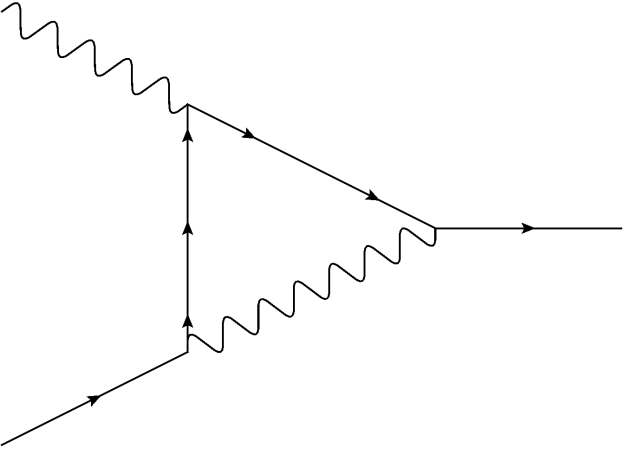
You can even use scattering amplitudes to describe situations that, at first glance, don’t sound like collisions of particles at all. If you want to find the effect of a magnetic field on an electron to high accuracy, the calculation also involves a scattering amplitude. A magnetic field can be thought of in terms of photons, particles of light, because light is a vibration in the electro-magnetic field. This means that the effect of a magnetic field on an electron can be calculated by “scattering” an electron and a photon.

4gravanom

If this looks familiar, check the handbook section.

In fact, doing the calculation in this way leads to what is possibly the most accurately predicted number in all of science.

Scattering amplitudes show up all over the place, from particle physics at the Large Hadron Collider to astrophysics to delicate experiments on electrons in magnetic fields. That said, there are plenty of things people calculate in theoretical physics that don’t use scattering amplitudes, either because they involve questions that are difficult to answer from the scattering amplitude point of view, or because they invoke different formulas altogether. Still, scattering amplitudes are central to the work of a large number of physicists. They really do cover just about everything.

“China” plans super collider

When I saw the headline, I was excited.

“China plans super collider” says Nature News.

There’s been a lot of worry about what may happen if the Large Hadron Collider finishes its run without discovering anything truly new. If that happens, finding new particles might require a much bigger machine…and since even that machine has no guarantee of finding anything at all, world governments may be understandably reluctant to fund it.

As such, several prominent people in the physics community have put their hopes on China. The country’s somewhat autocratic nature means that getting funding for a collider is a matter of convincing a few powerful people, not a whole fractious gaggle of legislators. It’s a cynical choice, but if it keeps the field alive so be it.

If China was planning a super collider, then, that would be great news!

Too bad it’s not.

Buried eight paragraphs in to Nature’s article we find the following:

The Chinese government is yet to agree on any funding, but growing economic confidence in the country has led its scientists to believe that the political climate is ripe, says Nick Walker, an accelerator physicist at DESY, Germany’s high-energy physics laboratory in Hamburg. Although some technical issues remain, such as keeping down the power demands of an energy-hungry ring, none are major, he adds.

The Chinese government is yet to agree on any funding. China, if by China you mean the Chinese government, is not planning a super collider.

So who is?

Someone must have drawn these diagrams, after all.

Reading the article, the most obvious answer is Beijing’s Institute of High Energy Physics (IHEP). While this is true, the article leaves out any mention of a more recently founded site, the Center for Future High Energy Physics (CFHEP).

This is a bit odd, given that CFHEP’s whole purpose is to compose a plan for the next generation of colliders, and persuade China’s government to implement it. They were founded, with heavy involvement from non-Chinese physicists including their director Nima Arkani-Hamed, with that express purpose in mind. And since several of the quotes in the article come from Yifang Wang, director of IHEP and member of the advisory board of CFHEP, it’s highly unlikely that this isn’t CFHEP’s plan.

So what’s going on here? On one level, it could be a problem on the journalists’ side. News editors love to rewrite headlines to be more misleading and click-bait-y, and claiming that China is definitely going to build a collider draws much more attention than pointing out the plans of a specialized think tank. I hope that it’s just something like that, and not the sort of casual racism that likes to think of China as a single united will. Similarly, I hope that the journalists involved just didn’t dig deep enough to hear about CFHEP, or left it out to simplify things, because there is a somewhat darker alternative.

CFHEP’s goal is to convince the Chinese government to build a collider, and what better way to do that than to present them with a fait accompli? If the public thinks that this is “China’s” plan, that wheels are already in motion, wouldn’t it benefit the Chinese government to play along? Throw in a few sweet words about the merits of international collaboration (a big part of the strategy of CFHEP is to bring international scientists to China to show the sort of community a collider could attract) and you’ve got a winning argument, or at least enough plausibility to get US and European funding agencies in a competitive mood.

This…is probably more cynical than what’s actually going on. For one, I don’t even know whether this sort of tactic would work.

Do these guys look like devious manipulators?

Indeed, it might just be a journalistic omission, part of a wider tendency of science journalists to focus on big projects and ignore the interesting part, the nitty-gritty things that people do to push them forward. It’s a shame, because people are what drive the news forward, and as long as science is viewed as something apart from real human beings people are going to continue to mistrust and misunderstand it.

Either way, one thing is clear. The public deserves to hear a lot more about CFHEP.

What if there’s nothing new?

In the weeks after the folks at the Large Hadron Collider announced that they had found the Higgs, people I met would ask if I was excited. After all, the Higgs was what particle physicists were searching for, right?

 As usual in this blog, the answer is “Not really.”

We were all pretty sure the Higgs had to exist; we just didn’t know what its mass would be. And while many people had predictions for what properties the Higgs might have (including some string theorists), fundamentally they were interested for other reasons.

Those reasons, for the most part, are supersymmetry. If the Higgs had different properties than we expected, it could be evidence for one or another proposed form of supersymmetry. Supersymmetry is still probably the best explanation for dark matter, and it’s necessary in some form or another for string theory. It also helps with other goals of particle physics, like unifying the fundamental forces and getting rid of fine-tuned parameters.

Fundamentally, though, the Higgs isn’t likely to answer these questions. To get enough useful information we’ll need to discover an actual superpartner particle. And so far…we haven’t.

That’s why we’re not all that excited about the Higgs anymore. And that’s why, increasingly, particle physics is falling into doom and gloom.

Sure, when physicists talk about the situation, they’re quick to claim that they’re just as hopeful as ever. We still may well see supersymmetry in later runs of the LHC, as it still has yet to reach its highest energies. But people are starting, quietly and behind closed doors, to ask: what if we don’t?

What happens if we don’t see any new particles in the LHC?

There are good mathematical reasons to think that some form of supersymmetry holds. Even if we don’t see supersymmetric particles in the LHC, they may still exist. We just won’t know anything new about them.

That’s a problem.

We’ve been spinning our wheels for too long, and it’s becoming more and more obvious. With no new information from experiments, it’s not clear what we can do anymore.

And while, yes, many theorists are studying theories that aren’t true, sometimes without even an inkling of a connection to the real world, we’re all part of the same zeitgeist. We may not be studying reality itself, but at least we’re studying parts of reality, rearranged in novel ways. Without the support of experiment the rest of the field starts to decay. And one by one, those who can are starting to leave.

Despite how it may seem, most of physics doesn’t depend on supersymmetry. If you’re investigating novel materials, or the coolest temperatures ever achieved, or doing other awesome things with lasers, then the LHC’s failure to find supersymmetry will mean absolutely nothing to you. It’s only a rather small area of physics that will progressively fall into self-doubt until the only people left are the insane or the desperate.

But those of us in that area? If there really is nothing new? Yeah, we’re screwed.

What are colliders for, anyway?

Above is a thoroughly famous photo from ATLAS, one of six different particle detectors that sit around the ring of the Large Hadron Collider (or LHC for short). Forming a 26 kilometer ring spanning a chunk of southern France and Switzerland, the LHC is the biggest experiment of its kind, with the machine alone costing around 4 billion dollars.

But what is “its kind”? And why does it need to be so huge?

Aesthetics, clearly.

Explaining what a particle collider like the LHC does is actually fairly simple, if you’re prepared for some rather extreme mental images: using incredibly strong magnetic fields, the LHC accelerates protons until they’re moving at 99.9999991% of the speed of light, then lets them smash into each other in the middle of sophisticated detectors designed to observe and track everything that comes out of the collision.

That’s all well and awesome, but why do the protons need to be moving so fast? Are they really really hard to crack open, or something?

This gets at a common misunderstanding of particle physics, which I’d like to correct here.

When most people imagine what a particle collider does, they picture it smashing particles together like hollow shells, revealing the smaller particles trapped inside. You may have even heard particle colliders referred to as “atom smashers”, and if you’re used to hearing about scientists “splitting the atom”, this all makes sense: with lots of energy, atoms can be broken apart into protons and neutrons, which is what they are made of. Protons are made of quarks, and quarks were discovered using particle colliders, so the story seems to check out, right?

The thing is, lots of things have been discovered using particle colliders that definitely aren’t part of protons and neutrons. Relatives of the electron like muons and tau particles, new varieties of neutrinos, heavier quarks…pretty much the only particles that are part of protons or neutrons are the three lightest quarks (and that’s leaving aside the fact that what is or is not “part of” a proton is a complicated question in its own right).

So where do the extra particles come from? How do you crash two protons together and get something out that wasn’t in either of them?

You…throw Einstein at them?

E equals m c squared. This equation, famous to the point of cliché, is often misinterpreted. One useful way to think about it is that it describes mass as a type of energy, and clarifies how to convert between units of mass and units of energy. Then E in the equation is merely the contribution to the energy of a particle from its mass, while the full energy also includes kinetic energy, the energy of motion.

Energy is conserved, that is, cannot be created or destroyed. Mass, on the other hand, being merely one type of energy, is not necessarily conserved. The reason why mass seems to be conserved in day to day life is because it takes a huge amount of energy to make any appreciable mass: the c in m c squared is the speed of light, after all. That’s why if you’ve got a radioactive atom it will decay into lighter elements, never heavier ones.

However, this changes with enough kinetic energy. If you get something like a proton accelerated to up near the speed of light, its kinetic energy will be comparable to (or even much higher than) its mass. With that much “spare” energy, energy can transform from one form into another: from kinetic energy into mass!

Of course, it’s not quite that simple. Energy isn’t the only thing that’s conserved: so is charge, and not just electric charge, but other sorts of charge too, like the colors of quarks.  All in all, the sorts of particles that are allowed to be created are governed by the ways particles can interact. So you need not just one high energy particle, but two high energy particles interacting in order to discover new particles.

And that, in essence, is what a particle collider is all about. By sending two particles hurtling towards each other at almost the speed of light you are allowing two high energy particles to interact. The bigger the machine, the faster those particles can go, and thus the more kinetic energy is free to transform into mass. Thus the more powerful you make your particle collider, the more likely you are to see rare, highly massive particles that if left alone in nature would transform unseen into less massive particles in order to release their copious energy. By producing these massive particles inside a particle collider we can make sure they are created inside of sophisticated particle detectors, letting us observe what they turn into with precision and extrapolate what the original particles were. That’s how we found the Higgs, and it’s how we’re trying to find superpartners. It’s one of the only ways we have to answer questions about the fundamental rules that govern the universe.