
An older professor in my field has a quirk: every time he organizes a conference, he publishes all the talks in a conference proceeding.
In some fields, this would be quite normal. In computer science, where progress flows like a torrent, new developments are announced at conferences long before they have the time to be written up carefully as a published paper. Conference proceedings are summaries of what was presented at the conference, published so that anyone can catch up on the new developments.
In my field, this is rarer. A few results at each conference will be genuinely new, never-before-published discoveries. Most, though, are talks on older results, results already available online. Writing them up again in summarized form as a conference proceeding seems like a massive waste of time.
The cynical explanation is that this professor is doing this for the citations. Each conference proceeding one of his students publishes is another publication on their CV, another work that they can demand people cite whenever someone uses their ideas or software, something that puts them above others’ students without actually doing any extra scientific work.
I don’t think that’s how this professor thinks about it, though. He certainly cares about his students’ careers, and will fight for them to get cited as much as possible. But he asks everyone at the conference to publish a proceeding, not just his students. I think he’d argue that proceedings are helpful, that they can summarize papers in new ways and make them more accessible. And if they give everyone involved a bit more glory, if they let them add new entries to their CV and get fancy books on their shelves, so much the better for everyone.
My guess is, he really believes something like that. And I’m fairly sure he’s wrong.
The occasional conference proceeding helps, but only because it makes us more flexible. Sometimes, it’s important to let others know about a new result that hasn’t been published yet, and we let conference proceedings go into less detail than a full published paper, so this can speed things up. Sometimes, an old result can benefit from a new, clearer explanation, which normally couldn’t be published without it being a new result (or lecture notes). It’s good to have the option of a conference proceeding.
But there is absolutely no reason to have one for every single talk at a conference.
Between the cynical reason and the explicit reason, there’s the banal one. This guy insists on conference proceedings because they were more useful in the past, because they’re useful in other fields, and because he’s been doing them himself for years. He insists on them because to him, they’re a part of what it means to be a responsible scientist.
And people go along with it. Because they don’t want to get into a fight with this guy, certainly. But also because it’s a bit of extra work that could give a bit of a career boost, so what’s the harm?
I think something similar to this is why academic journals still work the way they do.
In the past, journals were the way physicists heard about new discoveries. They would get each edition in the mail, and read up on new developments. The journal needed to pay professional copyeditors and printers, so they needed money, and they got that money from investors by being part of for-profit companies that sold shares.
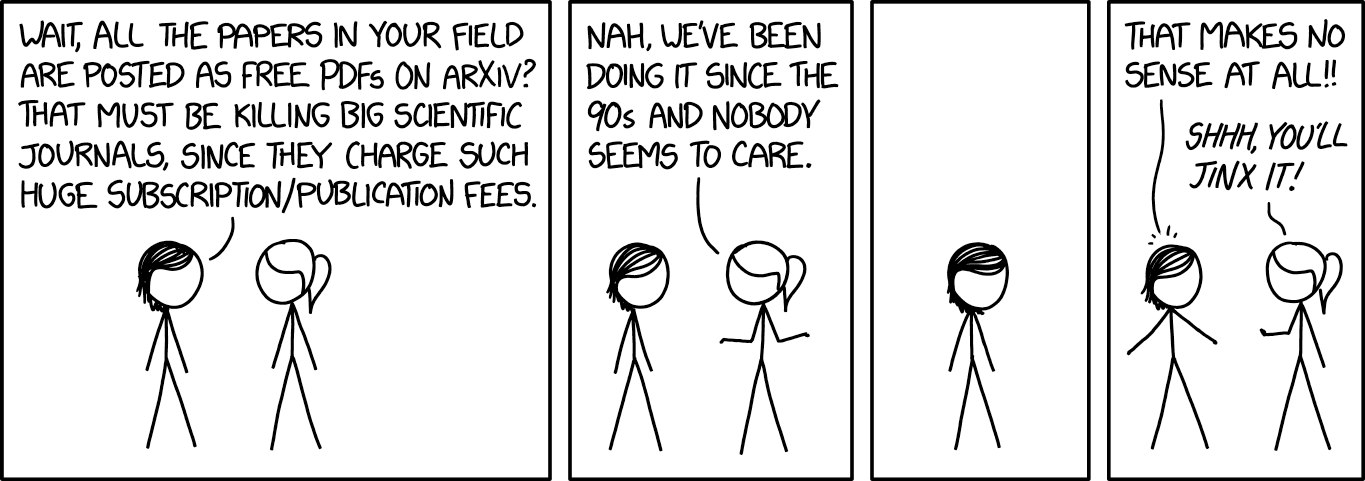
Now, though, physicists in my field don’t read journals. We publish our new discoveries online on a non-profit website, formatting them ourselves with software that uses the same programming skills we use in the rest of our professional lives. We then discuss the papers in email threads and journal club meetings. When a paper is wrong, or missing something important, we tell the author, and they fix it.
Oh, and then after that we submit the papers to the same for-profit journals and the same review process that we used to use before we did all this, listing the journals that finally accept the papers on our CVs.
Why do we still do that?
Again, you can be cynical. You can accuse the journals of mafia-ish behavior, you can tie things back to the desperate need to publish in high-ranked journals to get hired. But I think the real answer is a bit more innocent, and human, than that.
Imagine that you’re a senior person in the field. You may remember the time before we had all of these nice web-based publishing options, when journals were the best way to hear about new developments. More importantly than that, though, you’ve worked with these journals. You’ve certainly reviewed papers for them, everyone in the field does that, but you may have also served as an editor, tracking down reviewers and handling communication between the authors and the journal. You’ve seen plenty of cases where the journal mattered, where tracking down the right reviewers caught a mistake or shot down a crackpot’s ambitions, where the editing cleaned something up or made a work more appear more professional. You think of the journals as having high standards, standards you have helped to uphold: when choosing between candidates for a job, you notice that one has several papers in Physical Review Letters, and remember papers you’ve rejected for not meeting what you intuited were that journal’s standards. To you, journals are a key part of being a responsible scientist.
Does any of that make journals worth it, though?
Well, that depends on costs. It depends on alternatives. It depends not merely on what the journals catch, but on how often they do it, and how much would have been caught on its own. It depends on whether the high standards you want to apply to job applicants are already being applied by the people who write their recommendation letters and establish their reputations.
And you’re not in a position to evaluate any of that, of course. Few people are, who don’t spend a ton of time thinking about scientific publishing.
And thus, for the non-senior people, there’s not much reason to push back. One hears a few lofty speeches about Elsevier’s profits, and dreams about the end of the big for-profit journals. But most people aren’t cut out to be crusaders or reformers, especially when they signed up to be scientists. Most people are content not to annoy the most respected people in their field by telling them that something they’ve spent an enormous amount of time on is now pointless. Most people want to be seen as helpful by these people, to not slack off on work like reviewing that they argue needs doing.
And most of us have no reason to think we know that much better, anyway. Again, we’re scientists, not scientific publishing experts.
I don’t think it’s good practice to accuse people of cognitive biases. Everyone thinks they have good reasons to believe what they believe, and the only way to convince them is to address those reasons.
But the way we use journals in physics these days is genuinely baffling. It’s hard to explain, it’s the kind of thing people have been looking quizzically at for years. And this kind of explanation is the only one I’ve found that matches what I’ve seen. Between the cynical explanation and the literal arguments, there’s the basic human desire to do what seems like the responsible thing. That tends to explain a lot.


 4 gravitons