Tag Archives: academia

Visiting LBNL

I’ve been traveling this week, giving a talk at Lawrence Berkeley National Laboratory, so this will be a short post.

In my experience, most non-scientists don’t know about the national labs. In the US, the majority of scientists work for universities, but a substantial number work at one of the seventeen national labs overseen by the Department of Energy. It’s a good gig, if you can get it: no teaching duties, and a fair amount of freedom in what you research.

Each lab has its own focus, and its own culture. In the past I’ve spent a lot of time at SLAC, which runs a particle accelerator near Stanford (among other things). Visiting LBNL, I was amused by some of the differences. At SLAC, the guest rooms have ads for Stanford-branded bed covers. LBNL, meanwhile, brags about its beeswax-based toiletries in recyclable cardboard bottles. SLAC is flat, spread out, and fairly easy to navigate. LBNL is a maze of buildings arranged in tight terraces on a steep hill.

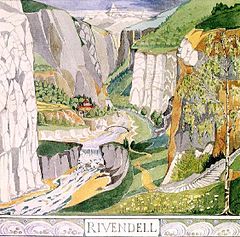
240px-rivendell_illustration

I forgot to take a picture, but someone appears to have drawn one.

While the differences were amusing, physicists are physicists everywhere. It was nice to share my work with people who mostly hadn’t heard about it before, and to get an impression of what they were working on.

Thoughts from the Winter School

There are two things I’d like to talk about this week.

First, as promised, I’ll talk about what I worked on at the PSI Winter School.

Freddy Cachazo and I study what are called scattering amplitudes. At first glance, these are probabilities that two subatomic particles scatter off each other, relevant for experiments like the Large Hadron Collider. In practice, though, they can calculate much more.

For example, let’s say you have two black holes circling each other, like the ones LIGO detected. Zoom out far enough, and you can think of each one as a particle. The two particle-black holes exchange gravitons, and those exchanges give rise to the force of gravity between them.
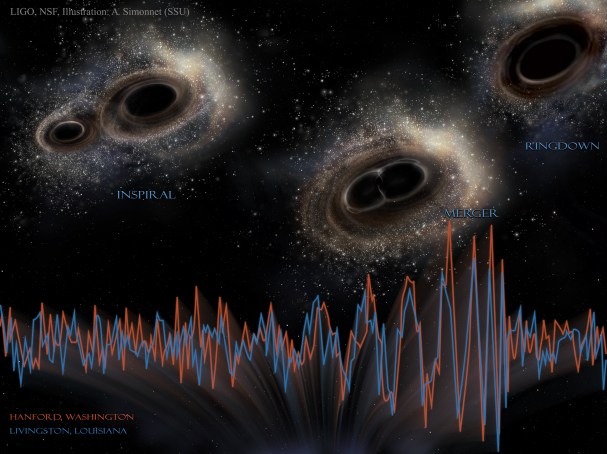
bhmerger_ligo_3600

In the end, it’s all just particle physics.


Based on that, we can use our favorite scattering amplitudes to make predictions for gravitational wave telescopes like LIGO.

There’s a bit of weirdness to this story, though, because these amplitudes don’t line up with predictions in quite the way we’re used to. The way we calculate amplitudes involves drawing diagrams, and those diagrams have loops. Normally, each “loop” makes the amplitude more quantum-mechanical. Only the diagrams with no loops (“tree diagrams”) come from classical physics alone.

(Here “classical physics” just means “not quantum”: I’m calling general relativity “classical”.)

For this problem, we only care about classical physics: LIGO isn’t sensitive enough to see quantum effects. The weird thing is, despite that, we still need loops.

(Why? This is a story I haven’t figured out how to tell in a non-technical way. The technical explanation has to do with the fact that we’re calculating a potential, not an amplitude, so there’s a Fourier transformation, and keeping track of the dimensions entails tossing around some factors of Planck’s constant. But I feel like this still isn’t quite the full story.)

So if we want to make predictions for LIGO, we want to compute amplitudes with loops. And as amplitudeologists, we should be pretty good at that.

As it turns out, plenty of other people have already had that idea, but there’s still room for improvement.

Our time with the students at the Winter School was limited, so our goal was fairly modest. We wanted to understand those other peoples’ calculations, and perhaps to think about them in a slightly cleaner way. In particular, we wanted to understand why “loops” are really necessary, and whether there was some way of understanding what the “loops” were doing in a more purely classical picture.

At this point, we feel like we’ve got the beginning of an idea of what’s going on. Time will tell whether it works out, and I’ll update you guys when we have a more presentable picture.


Unfortunately, physics wasn’t the only thing I was thinking about last week, which brings me to my other topic.

This blog has a fairly strong policy against talking politics. This is for several reasons. Partly, it’s because politics simply isn’t my area of expertise. Partly, it’s because talking politics tends to lead to long arguments in which nobody manages to learn anything. Despite this, I’m about to talk politics.

Last week, citizens of Iran, Iraq, Libya, Somalia, Sudan, Syria and Yemen were barred from entering the US. This included not only new visa applicants, but also those who already have visas or green cards. The latter group includes long-term residents of the US, many of whom were detained in airports and threatened with deportation when their flights arrived shortly after the ban was announced. Among those was the president of the Graduate Student Organization at my former grad school.

A federal judge has blocked parts of the order, and the Department of Homeland Security has announced that there will be case-by-case exceptions. Still, plenty of people are stuck: either abroad if they didn’t get in in time, or in the US, afraid that if they leave they won’t be able to return.

Politics isn’t in my area of expertise. But…

I travel for work pretty often. I know how terrifying and arbitrary border enforcement can be. I know how it feels to risk thousands of dollars and months of planning because some consulate or border official is having a bad day.

I also know how essential travel is to doing science. When there’s only one expert in the world who does the sort of work you need, you can’t just find a local substitute.

And so for this, I don’t need to be an expert in politics. I don’t need a detailed case about the risks of terrorism. I already know what I need to, and I know that this is cruel.

And so I stand in solidarity with the people who were trapped in airports, and those still trapped abroad and trapped in the US. You have been treated cruelly, and you shouldn’t have been. Hopefully, that sort of message can transcend politics.


One final thing: I’m going to be a massive hypocrite and continue to ban political comments on this blog. If you want to talk to me about any of this (and you think one or both of us might actually learn something from the exchange) please contact me in private.

Digging up Variations

The best parts of physics research are when I get a chance to push out into the unknown, doing calculations no-one has done before. Sometimes, though, research is more…archeological.

2016-05-441-134ap_archeologyexcavation_loropc3a9ni_ruins_nr-loropc3a9niponi_prv-bf_sun15may2016-1119h

Pictured: not what I signed up for

Recently, I’ve been digging through a tangle of papers, each of which calculates roughly the same thing in a slightly different way. Like any good archeologist, I need to figure out not just what the authors of these papers were doing, but also why.

(As a physicist, why do I care about “why”? In this case, it’s because I want to know which of the authors’ choices are worth building on. If I can figure out why they made the choices they did, I can decide whether I share their motivations, and thus which aspects of their calculations are useful for mine.)

My first guess at “why” was a deeply cynical one. Why would someone publish slight variations on an old calculation? To get more publications!

This is a real problem in science. In certain countries in particular, promotions and tenure are based not on honestly assessing someone’s work but on quick and dirty calculations based on how many papers they’ve published. This motivates scientists to do the smallest amount possible in order to get a paper out.

That wasn’t what was happening in these papers, though. None of the authors lived in those kinds of countries, and most were pretty well established people: not the sort who worry about keeping up with publications.

So I put aside my cynical first-guess, and actually looked at the papers. Doing that, I found a more optimistic explanation.

These authors were in the process of building research programs. Each had their own long-term goal, a set of concepts and methods they were building towards. And each stopped along the way, to do another variation on this well-trod calculation. They weren’t doing this just because they needed a paper, or just because they could. They were trying to sift out insights, to debug their nascent research program in a well-understood case.

Thinking about it this way helped untwist the tangle of papers. The confusion of different choices suddenly made sense, as the result of different programs with different goals. And in turn, understanding which goals contributed to which papers helped me sort out which goals I shared, and which ideas would turn out to be helpful.

Would it have been less confusing if some of these people had sat on their calculations, and not published? Maybe at first. But in the end, the variations help, giving me a clearer understanding of the whole.

Next Year in Copenhagen!

As some of you might be aware, this is my last year at the Perimeter Institute. It’s been great, but the contract was only for three years, and come August I’ll be heading elsewhere.

Determining that “elsewhere” was the subject of an extensive job search. Now that the search has resolved, I can tell you that “elsewhere” is the Niels Bohr International Academy at the Niels Bohr Institute in Copenhagen, where I’ll be starting a three-year postdoc job in the fall.

blegdamsvej_forside

Probably in the building on the left

There are some pretty stellar amplitudes people at NBIA, so I’m pretty excited to be going there. It’s going to be a great opportunity to both build on what I’ve been doing and expand beyond. They’re also hiring several other amplitudes-focused postdocs this year, so overall it should be a really fun group.

It’s also a bit daunting. Moving to Canada from the US was reasonably smooth, I could drive most of my things over in a U-Haul truck. Moving to Denmark is going to be quite a bit more complicated. I’ll need to learn a new language and get used to a fairly different culture.

I can take solace in the fact that in some sense I’m retracing my great-grandfather’s journey in the opposite direction. My great-grandfather worked at the Niels Bohr Institute on his way out of Europe in the 1930’s, and made friends with the Bohrs along the way, before coming to the US. I’ll get a chance to explore a piece of family history, and likely collaborate with a Bohr as well.

A Tale of Two Archives

When it comes to articles about theoretical physics, I have a pet peeve, one made all the more annoying by the fact that it appears even in pieces that are otherwise well written. It involves the following disclaimer:

“This article has not been peer-reviewed.”

Here’s the thing: if you’re dealing with experiments, peer review is very important. Plenty of experiments have subtle problems with their methods, enough that it’s important to have a group of experts who can check them. In experimental fields, you really shouldn’t trust things that haven’t been through a journal yet: there’s just a lot that can go wrong.

In theoretical physics, though, peer review is important for different reasons. Most papers are mathematically rigorous enough that they’re not going to be wrong per se, and most of the ways they could be wrong won’t be caught by peer review. While peer review sometimes does catch mistakes, much more often it’s about assessing the significance of a result. Peer review determines whether a result gets into a prestigious journal or a less prestigious one, which in turn matters for job and grant applications.

As such, it doesn’t really make sense for a journalist to point out that a theoretical physics paper hasn’t been peer reviewed yet. If you think it’s important enough to write an article about, then you’ve already decided it’s significant: peer review wasn’t going to tell you anything else.

We physicists post our papers to arXiv, a free-to-access paper repository, before submitting them to journals. While arXiv does have some moderation, it’s not much: pretty much anyone in the field can post whatever they want.

This leaves a lot of people confused. In that sort of system, how do we know which papers to trust?

Let’s compare to another archive: Archive of Our Own, or AO3 for short.

Unlike arXiv, AO3 hosts not physics, but fanfiction. However, like arXiv it’s quite lightly moderated and free to access. On arXiv you want papers you can trust, on AO3 you want stories you enjoy. In each case, if anyone can post, how do you find them?

The first step is filtering. AO3 and arXiv both have systems of tags and subject headings. The headings on arXiv are simpler and more heavily moderated than those on AO3, but they both serve the purpose of letting people filter out the subjects, whether scientific or fictional, that they find interesting. If you’re interested in astrophysics, try astro-ph on arXiv. If you want Harry Potter fanfiction, try the “Harry Potter – J.K. Rowling” tag on AO3.

Beyond that, it helps to pay attention to authors. When an author has written something you like, it’s worth it not only to keep up with other things they write, but to see which other authors they like and pay attention to them as well. That’s true whether the author is Juan Maldacena or your favorite source of Twilight fanfic.

Even if you follow all of this, you can’t trust every paper you find on arXiv. You also won’t enjoy everything you dig up on AO3. Either way, publication (in journals or books) won’t solve your problem: both are an additional filter, but not an infallible one. Judgement is still necessary.

This is all to say that “this article has not been peer-reviewed” can be a useful warning, but often isn’t. In theoretical physics, knowing who wrote an article and what it’s about will often tell you much more than whether or not it’s been peer-reviewed yet.

Wait, How Do Academics Make Money?

I’ve been working on submitting one of my papers to a journal, which reminded me of the existence of publication fees. That in turn reminded me of a conversation I saw on tumblr a while back:

beatontumblr

“beatonna” here is Kate Beaton, of the history-themed webcomic Hark! a Vagrant. She’s about as academia-adjacent as a non-academic gets, but even she thought that the academic database JSTOR paid academics for their contributions, presumably on some kind of royalty system.

In fact, academics don’t get paid by databases, journals, or anyone else that publishes or hosts our work. In the case of journals, we’re often the ones who pay publication fees. Those who write textbooks get royalties, but that’s about it on that front.

Kate Beaton’s confusion here is part of a more general confusion: in my experience, most people don’t know how academics are paid.

The first assumption is usually that we’re paid to teach. I can’t count the number of times I’ve heard someone respond to someone studying physics or math with the question “Oh, so you’re going to teach?”

This one is at least sort of true. Most academics work at universities, and usually have teaching duties. Often, part of an academic’s salary is explicitly related to teaching.

Still, it’s a bit misleading to think of academics as paid to teach: at a big research university, teaching often doesn’t get much emphasis. The extent to which the quality of teaching determines a professor’s funding or career prospects is often quite minimal. Academics teach, but their job isn’t “teacher”.

From there, the next assumption is the one Kate Beaton made. If academics aren’t paid to teach, are they paid to write?

Academia is often described as publish-or-perish, and research doesn’t really “count” until it’s made it to a journal. It would be reasonable to assume that academics are like writers, paid when someone buys our content. As mentioned, though, that’s just not how it works: if anything, sometimes we are the ones who pay the publishers!

It’s probably more accurate (though still not the full story) to say that academics are paid to research.

Research universities expect professors not only to teach, but to do novel and interesting research. Publications are important not because we get paid to write them, but because they give universities an idea of how productive we are. Promotions and the like, at least at research universities, are mostly based on those sorts of metrics.

Professors get some of their money from their universities, for teaching and research. The rest comes from grants. Usually, these come from governments, though private donors are a longstanding and increasingly important group. In both cases, someone decides that a certain general sort of research ought to be done and solicits applications from people interested in doing it. Different people apply with specific proposals, which are assessed with a wide range of esoteric criteria (but yes publications are important), and some people get funding. That funding includes not just equipment, but contributions to salaries as well. Academics really are, in many cases, paid by grants.

This is really pretty dramatically different from any other job. There’s no “customer” in the normal sense, and even the people in charge of paying us are more concerned that a certain sort of work be done than that they have control over it. It’s completely understandable that the public rounds that off to “teaching” or “writing”. It’s certainly more familiar.


“Maybe” Isn’t News

It’s been published several places, but you’ve probably seen this headline:

expansionheadlineIf you’ve been following me for a while, you know where this is going:

No, these physicists haven’t actually shown that the Universe isn’t expanding at an accelerated rate.

What they did show is that the original type of data used to discover that the universe was accelerating back in the 90’s, measurements of supernovae, doesn’t live up to the rigorous standards that we physicists use to evaluate discoveries. We typically only call something a discovery if the evidence is good enough that, in a world where the discovery wasn’t actually true, we’d only have a one in 3.5 million chance of getting the same evidence (“five sigma” evidence). In their paper, Nielsen, Guffanti, and Sarkar argue that looking at a bigger collection of supernovae leads to a hazier picture: the chance that we could get the same evidence in a universe that isn’t accelerating is closer to one in a thousand, giving “three sigma” evidence.

This might sound like statistical quibbling: one in a thousand is still pretty unlikely, after all. But a one in a thousand chance still happens once in a thousand times, and there’s a long history of three sigma evidence turning out to just be random noise. If the discovery of the accelerating universe was new, this would be an important objection, a reason to hold back and wait for more data before announcing a discovery.

The trouble is, the discovery isn’t new. In the twenty years since it was discovered that the universe was accelerating, people have built that discovery into the standard model of cosmology. They’ve used that model to make other predictions, explaining a wide range of other observations. People have built on the discovery, and their success in doing so is its own kind of evidence.

So the objection, that one source of evidence isn’t as strong as people thought, doesn’t kill cosmic acceleration. What it is is a “maybe”, showing that there is at least room in some of the data for a non-accelerating universe.

People publish “maybes” all the time, nothing bad about that. There’s a real debate to be had about how strong the evidence is, and how much it really establishes. (And there are already voices on the other side of that debate.)

But a “maybe” isn’t news. It just isn’t.

Science journalists (and university press offices) have a habit of trying to turn “maybes” into stories. I’ve lost track of the times I’ve seen ideas that were proposed a long time ago (technicolor, MOND, SUSY) get new headlines not for new evidence or new ideas, but just because they haven’t been ruled out yet. “SUSY hasn’t been ruled out yet” is an opinion piece, perhaps a worthwhile one, but it’s no news article.

The thing is, I can understand why journalists do this. So much of science is building on these kinds of “maybes”, working towards the tipping point where a “maybe” becomes a “yes” (or a “no”). And journalists (and university press offices, and to some extent the scientists themselves) can’t just take time off and wait for something legitimately newsworthy. They’ve got pages to fill and careers to advance, they need to say something.

I post once a week. As a consequence, a meaningful fraction of my posts are garbage. I’m sure that if I posted every day, most of my posts would be garbage.

Many science news sites post multiple times a day. They’ve got multiple writers, sure, and wider coverage…but they still don’t have the luxury of skipping a “maybe” when someone hands it to them.

I don’t know if there’s a way out of this. Maybe we need a new model for science journalism, something that doesn’t try to ape the pace of the rest of the news cycle. For the moment, though, it’s publish or perish, and that means lots and lots of “maybes”.

EDIT: More arguments against the paper in question, pointing out that they made some fairly dodgy assumptions.

EDIT: The paper’s authors respond here.

Jury-Rigging: The Many Uses of Dropbox

I’ll be behind the Great Firewall of China next week, so I’ve been thinking about various sites I won’t be able to access. Prominent among them is Dropbox, a service that hosts files online.

250px-dropbox_icon-svg

A helpful box to drop things in

What do physicists do with Dropbox? Quite a lot.

For us, Dropbox is a great way to keep collaborations on the same page. By sharing a Dropbox folder, we can share research programs, mathematical expressions, and paper drafts. It makes it a lot easier to keep one consistent version of a document between different people, and it’s a lot simpler than emailing files back and forth.

All that said, Dropbox has its drawbacks. You still need to be careful not to have two people editing the same thing at the same time, lest one overwrite the other’s work. You’ve got the choice between editing in place, making everyone else receive notifications whenever the files change, or editing in a separate folder, and having to be careful to keep it coordinated with the shared one.

Programmers will know there are cleaner solutions to these problems. GitHub is designed to share code, and you can work together on a paper with ShareLaTeX. So why do we use Dropbox?

Sometimes, it’s more important for a tool to be easy and universal, even if it doesn’t do everything you want. GitHub and ShareLaTeX might solve some of the problems we have with Dropbox, but they introduce extra work too. Because no one disadvantage of Dropbox takes up too much time, it’s simpler to stick with it than to introduce a variety of new services to fill the same role.

This is the source of a lot of jury-rigging in science. Our projects aren’t often big enough to justify more professional approaches: usually, something hacked together out of what’s available really is the best choice.

For one, it’s why I use wordpress. WordPress.com is not a great platform for professional blogging: it doesn’t give you a lot of control without charging, and surprise updates can make using it confusing. However, it takes a lot less effort than switching to something more professional, and for the moment at least I’m not really in a position that justifies the extra work.

Ingredients of a Good Talk

It’s one of the hazards of physics that occasionally we have to attend talks about other people’s sub-fields.

Physics is a pretty heavily specialized field. It’s specialized enough that an otherwise perfectly reasonable talk can be totally incomprehensible to someone just a few sub-fields over.

I went to a talk this week on someone else’s sub-field, and was pleasantly surprised by how much I could follow. I thought I’d say a bit about what made it work.

In my experience, a good talk tells me why I should care, what was done, and what we know now.

Most talks start with a Motivation section, covering the why I should care part. If a talk doesn’t provide any motivation, it’s assuming that everyone finds the point of the research self-evident, and that’s a risky assumption.

Even for talks with a Motivation section, though, there’s a lot of variety. I’ve been to plenty of talks where the motivation presented is very sketchy: “this sort of thing is important in general, so we’re going to calculate one”. While that’s technically a motivation, all it does for an outsider is to tell them which sub-field you’re part of. Ideally, a motivation section does more: for a good talk, the motivation should not only say why you’re doing the work, but what question you’re asking and how your work can answer it.

The bulk of any talk covers what was done, but here there’s also varying quality. Bad talks often make it unclear how much was done by the presenter versus how much was done before. This is important not just to make sure the right people get credit, but because it can be hard to tell how much progress has been made. A good talk makes it clear not only what was done, but why it wasn’t done before. The whole point of a talk is to show off something new, so it should be clear what the new thing is.

If those two parts are done well, it becomes a lot easier to explain what we know now. If you’re clear on what question you were asking and what you did to answer it, then you’ve already framed things in those terms, and the rest is just summarizing. If not, you have to build it up from scratch, ending up with the important information packed in to the last few minutes.

This isn’t everything you need for a good talk, but it’s important, and far too many people neglect it. I’ll be giving a few talks next week, and I plan to keep this structure in mind.

Science Is a Collection of Projects, Not a Collection of Beliefs

Read a textbook, and you’ll be confronted by a set of beliefs about the world.

(If it’s a half-decent textbook, it will give justifications for those beliefs, and they will be true, putting you well on the way to knowledge.)

The same is true of most science popularization. In either case, you’ll be instructed that a certain set of statements about the world (or about math, or anything else) are true.

If most of your experience with science comes from popularizations and textbooks, you might think that all of science is like this. In particular, you might think of scientific controversies as matters of contrasting beliefs. Some scientists “believe in” supersymmetry, some don’t. Some “believe in” string theory, some don’t. Some “believe in” a multiverse, some don’t.

In practice, though, only settled science takes the form of beliefs. The rest, science as it is actually practiced, is better understood as a collection of projects.

Scientists spend most of their time working on projects. (Well, or procrastinating in my case.) Those projects, not our beliefs about the world, are how we influence other scientists, because projects build off each other. Any time we successfully do a calculation or make a measurement, we’re opening up new calculations and measurements for others to do. We all need to keep working and publishing, so anything that gives people something concrete to do is going to be influential.

The beliefs that matter come later. They come once projects have been so successful, and so widespread, that their success itself is evidence for beliefs. They’re the beliefs that serve as foundational assumptions for future projects. If you’re going to worry that some scientists are behaving unscientifically, these are the sorts of beliefs you want to worry about. Even then, things are often constrained by viable projects: in many fields, you can’t have a textbook without problem sets.

Far too many people seem to miss this distinction. I’ve seen philosophers focus on scientists’ public statements instead of their projects when trying to understand the implications of their science. I’ve seen bloggers and journalists who mostly describe conflicts of beliefs, what scientists expect and hope to be true rather than what they actually work on.

Do scientists have beliefs about controversial topics? Absolutely. Do those beliefs influence what they work on? Sure. But only so far as there’s actually something there to work on.

That’s why you see quite a few high-profile physicists endorsing some form of multiverse, but barely any actual journal articles about it. The belief in a multiverse may or may not be true, but regardless, there just isn’t much that one can do with the idea right now, and it’s what scientists are doing, not what they believe, that constitutes the health of science.

Different fields seem to understand this to different extents. I’m reminded of a story I heard in grad school, of two dueling psychologists. One of them believed that conversation was inherently cooperative, and showed that, unless unusually stressed or busy, people would put in the effort to understand the other person’s perspective. The other believed that conversation was inherently egocentric, and showed that, the more you stressed or busy people are, the more they assume that everyone else has the same perspective they do.

Strip off the “beliefs”, and these two worked on the exact same thing, with the same results. With their beliefs included, though, they were bitter rivals who bristled if their grad students so much as mentioned the other scientist.

We need to avoid this kind of mistake. The skills we have, the kind of work we do, these are important, these are part of science. The way we talk about it to reporters, the ideas we champion when we debate, those are sidelines. They have some influence, dragging people one way or another. But they’re not what science is, because on the front lines, science is about projects, not beliefs.