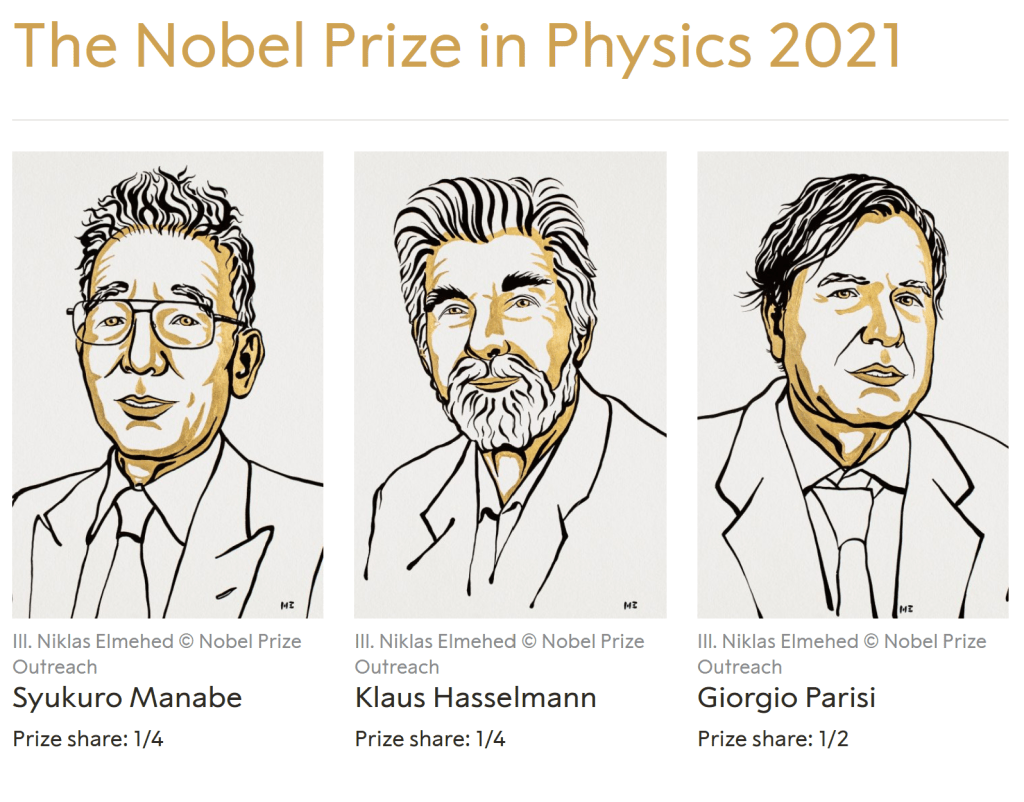
Congratulations to Syukuro Manabe, Klaus Hasselmann, and Giorgio Parisi!

The 2021 Nobel Prize in Physics was announced this week, awarded to Syukuro Manabe and Klaus Hasselmann for climate modeling and Giorgio Parisi for understanding a variety of complex physical systems.
Before this year’s prize was announced, I remember a few “water cooler chats” about who might win. No guess came close, though. The Nobel committee seems to have settled in to a strategy of prizes on a loosely linked “basket” of topics, with half the prize going to a prominent theorist and the other half going to two experimental, observational, or (in this case) computational physicists. It’s still unclear why they’re doing this, but regardless it makes it hard to predict what they’ll do next!

When I read the announcement, my first reaction was, “surely it’s not that Parisi?” Giorgio Parisi is known in my field for the Altarelli-Parisi equations (more properly known as the DGLAP equations, the longer acronym because, as is often the case in physics, the Soviets got there first). These equations are in some sense why the scattering amplitudes I study are ever useful at all. I calculate collisions of individual fundamental particles, like quarks and gluons, but a real particle collider like the LHC collides protons. Protons are messy, interacting combinations of quarks and gluons. When they collide you need not merely the equations describing colliding quarks and gluons, but those that describe their messy dynamics inside the proton, and in particular how those dynamics look different for experiments with different energies. The equation that describes that is the DGLAP equation.

As it turns out, Parisi is known for a lot more than the DGLAP equation. He is best known for his work on “spin glasses”, models of materials where quantum spins try to line up with each other, never quite settling down. He also worked on a variety of other complex systems, including flocks of birds!

I don’t know as much about Manabe and Hasselmann’s work. I’ve only seen a few talks on the details of climate modeling. I’ve seen plenty of talks on other types of computer modeling, though, from people who model stars, galaxies, or black holes. And from those, I can appreciate what Manabe and Hasselmann did. Based on those talks, I recognize the importance of those first one-dimensional models, a single column of air, especially back in the 60’s when computer power was limited. Even more, I recognize how impressive it is for someone to stay on the forefront of that kind of field, upgrading models for forty years to stay relevant into the 2000’s, as Manabe did. Those talks also taught me about the challenge of coupling different scales: how small effects in churning fluids can add up and affect the simulation, and how hard it is to model different scales at once. To use these effects to discover which models are reliable, as Hasselmann did, is a major accomplishment.

Breaking Out of “Self-Promotion Voice”

What do TED talks and grant applications have in common?

Put a scientist on a stage, and what happens? Some of us panic and mumble. Others are as smooth as a movie star. Most, though, fall back on a well-practiced mode: “self-promotion voice”.

A scientist doing self-promotion voice is easy to recognize. We focus on ourselves, of course (that’s in the name!), talking about all the great things we’ve done. If we have to mention someone else, we make sure to link it in some way: “my colleague”, “my mentor”, “which inspired me to”. All vulnerability is “canned” in one way or another: “challenges we overcame”, light touches on the most sympathetic of issues. Usually, we aren’t negative towards our colleagues either: apart from the occasional very distant enemy, everyone is working with great scientific virtue. If we talk about our past, we tell the same kinds of stories, mentioning our youthful curiosity and deep buzzwordy motivations. Any jokes or references are carefully pruned, made accessible to the lowest-common-denominator. This results in a standard vocabulary: see a metaphor, a quote, or a turn of phrase, and you’re bound to see it in talks again and again and again. Things get even more repetitive when you take into account how often we lean on the voice: a given speech or piece will be assembled from elementary pieces, snippets of practiced self-promotion that we pour in like packing peanuts after a minimal edit, filling all available time and word count.

“My passion for teaching manifests…”

Packing peanuts may not be glamorous, but they get the job done. A scientist who can’t do “the voice” is going to find life a lot harder, their negativity or clumsiness turning away support when they need it most. Except for the greatest of geniuses, we all have to learn a bit of self-promotion to stay employed.

We don’t have to stop there, though. Self-promotion voice works, but it’s boring and stilted, and it all looks basically the same. If we can do something a bit more authentic then we stand out from the crowd.

I’ve been learning this more and more lately. My blog posts have always run the gamut: some are pure formula, but the ones I’m most proud of have a voice all their own. Over the years, I’ve been pushing my applications in that direction. Each grant and job application has a bit of the standard self-promotion voice pruned away, and a bit of another voice (my own voice?) sneaking in. This year, as I send out applications, I’ve been tweaking things. I almost hope the best jobs come late in the year, my applications will be better then!

Why Can’t I Pay Academics to Do Things for Me?

A couple weeks back someone linked to this blog with a problem. A non-academic, he had done some mathematical work but didn’t feel it was ready to publish. He reached out to a nearby math department and asked what they would charge to help him clean up the work. If the price was reasonable, he’d do it, if not at least he’d know what it would cost.

Neither happened. He got no response, and got more and more frustrated.

For many of you, that result isn’t a big surprise. My academic readers are probably cringing at the thought of getting an email like that. But the guy’s instinct here isn’t too off-base. Certainly, in many industries that kind of email would get a response with an actual quote. Academia happens to be different, in a way that makes the general rule not really apply.

There’s a community called Effective Altruists that evaluate charities. They have a saying, “Money is the Unit of Caring”. The point of the saying isn’t that people with more money care more, or anything like that. Rather, it’s a reminder that, whatever a charity wants to accomplish, more money makes it easier. A lawyer could work an hour in a soup kitchen, but if they donated the proceeds of an hour’s work the soup kitchen could hire four workers instead. Food banks would rather receive money than food, because the money lets them buy whatever they need in bulk. As the Simpsons meme says, “money can be exchanged for goods and services”.

If you pay a charity, or a business, it helps them achieve what they want to do. If you pay an academic, it gets a bit more complicated.

The problem is that for academics, time matters a lot more than our bank accounts. If we want to settle down with a stable job, we need to spend our time doing things that look good on job applications: writing papers, teaching students, and so on. The rest of the time gets spent resting so we have the energy to do all of that.

(What about tenured professors? They don’t have to fight for their own jobs…but by that point, they’ve gotten to know their students and other young people in their sub-field. They want them to get jobs too!)

Money can certainly help with those goals, but not personal money: grant money. With grant money we can hire students and postdocs to do some of that work for us, or pay our own salary so we’re easier for a university to hire. We can buy equipment for those who need that sort of thing, and get to do more interesting science. Rather than “Money is the Unit of Caring”, for academics, “Grant Money is the Unit of Caring”.

Personal money, in contrast, just matters for our rest time. And unless we have expensive tastes, we usually get paid enough for that.

(The exception is for extremely underpaid academics, like PhD students and adjuncts. For some of them money can make a big difference to their quality of life. I had quite a few friends during my PhD who had side gigs, like tutoring, to live a bit more comfortably.)

This is not to say that it’s impossible to pay academics to do side jobs. People do. But when it works, it’s usually due to one of these reasons:

  1. It’s fun. Side work trades against rest time, but if it helps us rest up then it’s not really a tradeoff. Even if it’s a little more boring that what we’d rather do, if it’s not so bad the money can make up the difference.
  2. It looks good on a CV. This covers most of the things academics are sometimes paid to do, like writing articles for magazines. If we can spin something as useful to our teaching or research, or as good for the greater health of the field (or just for our “personal brand”), then we can justify doing it.
  3. It’s a door out of academia. I’ve seen the occasional academic take time off to work for a company. Usually that’s a matter of seeing what it’s like, and deciding whether it looks like a better life. It’s not really “about the money”, even in those cases.

So what if you need an academic’s help with something? You need to convince them it’s worth their time. Money could do it, but only if they’re living precariously, like some PhD students. Otherwise, you need to show that what you’re asking helps the academic do what they’re trying to do: that it is likely to move the field forward, or that it fulfills some responsibility tied to their personal brand. Without that, you’re not likely to hear back.

Four Gravitons and a…What Exactly Are You Now?

I cleaned up my “Who Am I?” page this week, and some of you might notice my title changed. I’m no longer a Postdoc. As of this month, I’m an Assistant Professor.

Before you start congratulating me too much, saying I’ve made it and so on…to be clear, I’m not that kind of Assistant Professor.

Universities in Europe and the US work a bit differently. The US has the tenure-track system: professors start out tenure-track, and have a fixed amount of time to prove themselves. If they do, they get tenure, and essentially permanent employment. If not, they leave.

Some European countries are starting to introduce a tenure track, sometimes just university by university or job-by-job. For the rest, professors are divided not into tenured and tenure-track, but into permanent and fixed-term. Permanent professors are permanent in the way a normal employee of a company would be: they can still be fired, but if not their contract continues indefinitely. Fixed-term professors, then, have contracts for just a fixed span of time. In some cases this can be quite short. In my case, it’s one year.

Some US readers might be thinking this sounds a bit like an Adjunct. In a very literal sense that’s right, in Danish my title is Adjunkt. But it’s not the type of Adjunct you’re thinking of. US universities employ Adjuncts primarily for teaching. They’re often paid per class, and re-hired each year (though with no guarantees, leading to a lot of stress). That’s not my situation. I’m paid a fixed salary, and my primary responsibility is research, not teaching. I also won’t be re-hired next year, unless I find a totally different source of funding. Practically speaking, my situation is a lot like an extra year of Postdoc.

There are some differences. I’m paid a little more than I was as a Postdoc, and I have a few more perks. I’m getting more pedagogy training in the spring, I don’t know if I would have gotten that opportunity if I was still just a Postdoc. It’s an extra level of responsibility, and that does mean something.

But it does also mean I’m still looking for a job. Once again I find myself in application season: polishing my talks and crossing my fingers, not knowing exactly where I’ll end up.

Stop Listing the Amplituhedron as a Competitor of String Theory

The Economist recently had an article (paywalled) that meandered through various developments in high-energy physics. It started out talking about the failure of the LHC to find SUSY, argued this looked bad for string theory (which…not really?) and used it as a jumping-off point to talk about various non-string “theories of everything”. Peter Woit quoted it a few posts back as kind of a bellwether for public opinion on supersymmetry and string theory.

The article was a muddle, but a fairly conventional muddle, explaining or mis-explaining things in roughly the same way as other popular physics pieces. For the most part that didn’t bug me, but one piece of the muddle hit a bit close to home:

The names of many of these [non-string theories of everything] do, it must be conceded, torture the English language. They include “causal dynamical triangulation”, “asymptotically safe gravity”, “loop quantum gravity” and the “amplituhedron formulation of quantum theory”.

I’ve posted about the amplituhedron more than a few times here on this blog. Out of every achievement of my sub-field, it has most captured the public imagination. It’s legitimately impressive, a way to translate calculations of probabilities of collisions of fundamental particles (in a toy model, to be clear) into geometrical objects. What it isn’t, and doesn’t pretend to be, is a theory of everything.

To be fair, the Economist piece admits this:

Most attempts at a theory of everything try to fit gravity, which Einstein describes geometrically, into quantum theory, which does not rely on geometry in this way. The amplituhedron approach does the opposite, by suggesting that quantum theory is actually deeply geometric after all. Better yet, the amplituhedron is not founded on notions of spacetime, or even statistical mechanics. Instead, these ideas emerge naturally from it. So, while the amplituhedron approach does not as yet offer a full theory of quantum gravity, it has opened up an intriguing path that may lead to one.

The reasoning they have leading up to it has a few misunderstandings anyway. The amplituhedron is geometrical, but in a completely different way from how Einstein’s theory of gravity is geometrical: Einstein’s gravity is a theory of space and time, the amplituhedron’s magic is that it hides space and time behind a seemingly more fundamental mathematics.

This is not to say that the amplituhedron won’t lead to insights about gravity. That’s a big part of what it’s for, in the long-term. Because the amplituhedron hides the role of space and time, it might show the way to theories that lack them altogether, theories where space and time are just an approximation for a more fundamental reality. That’s a real possibility, though not at this point a reality.

Even if you take this possibility completely seriously, though, there’s another problem with the Economist’s description: it’s not clear that this new theory would be a non-string theory!

The main people behind the amplituhedron are pretty positively disposed to string theory. If you asked them, I think they’d tell you that, rather than replacing string theory, they expect to learn more about string theory: to see how it could be reformulated in a way that yields insight about trickier problems. That’s not at all like the other “non-string theories of everything” in that list, which frame themselves as alternatives to, or even opponents of, string theory.

It is a lot like several other research programs, though, like ER=EPR and It from Qubit. Researchers in those programs try to use physical principles and toy models to say fundamental things about quantum gravity, trying to think about space and time as being made up of entangled quantum objects. By that logic, they belong in that list in the article alongside the amplituhedron. The reason they aren’t is obvious if you know where they come from: ER=EPR and It from Qubit are worked on by string theorists, including some of the most prominent ones.

The thing is, any reason to put the amplituhedron on that list is also a reason to put them. The amplituhedron is not a theory of everything, it is not at present a theory of quantum gravity. It’s a research direction that might shed new insight about quantum gravity. It doesn’t explicitly involve strings, but neither does It from Qubit most of the time. Unless you’re going to describe It from Qubit as a “non-string theory of everything”, you really shouldn’t describe the amplituhedron as one.

The amplituhedron is a really cool idea, one with great potential. It’s not something like loop quantum gravity, or causal dynamical triangulations, and it doesn’t need to be. Let it be what it is, please!

Sandbox Collaboration

In science, every project is different. Sometimes, my collaborators and I have a clear enough goal, and a clear enough way to get there. There are always surprises along the way, of course, but nonetheless we keep a certain amount of structure. That can mean dividing tasks (“you find the basis, I’ll find the constraints”), or it can mean everyone doing the same work in parallel, like a group of students helping each other with homework.

Recently, I’ve experienced a different kind of collaboration. The goals are less clear, and the methods are more…playful.

Oh, are you building a sandcastle? Or a polylogarithm?

A big task improves with collaboration: you can divide it up. A delicate task improves with collaboration: you can check each other’s work. An unclear task also improves with collaboration: you can explore more ground.

Picture a bunch of children playing in a sandbox. The children start out sitting by themselves, each digging in the sand. Some are building castles, others dig moats, or search for buried treasure, or dinosaur bones. As the children play, their games link up: the moat protects the castle, the knights leave for treasure, the dinosaur awakens and attacks. The stories feed back on one another, and the game grows.

The project I’m working on now is a bit like that sandbox. Each of us has our own ideas about what we’d like to build, and each experiments with them. We see what works and what doesn’t, which castles hold and which fall over. We keep an eye on what each other are doing, and adjust: if that castle is close to done, maybe a moat would improve the view. Piece by piece, the unclear task becomes clearer. Our individual goals draw us in different directions, but what we discover in the end brings us back together, richer for our distant discoveries.

Working this way requires a lot of communication! In the past, I was mystified when I saw other physicists spend hours talking at a blackboard. I thought that must be a waste of time: surely they’d get more done if they sat at their desks and worked things out, rather than having to talk through every step. Now I realize they were likely part of a different kind of collaboration: not dividing tasks or working in parallel on a clear calculation, but exploring different approaches. In these collaborations, those long chats are a kind of calibration: by explaining what you’re trying to do, you see whether it makes sense to your collaborators. You can drop the parts that don’t make sense and build in some of your collaborators’ ideas. In the end you begin to converge, to something that everyone can endorse. Your sandcastles meet up, your stories become one story. When everything looks good, you’re ready to call over your mom (or in this case, the arXiv) and show it off.

Amplitudes 2021 Retrospective

Phew!

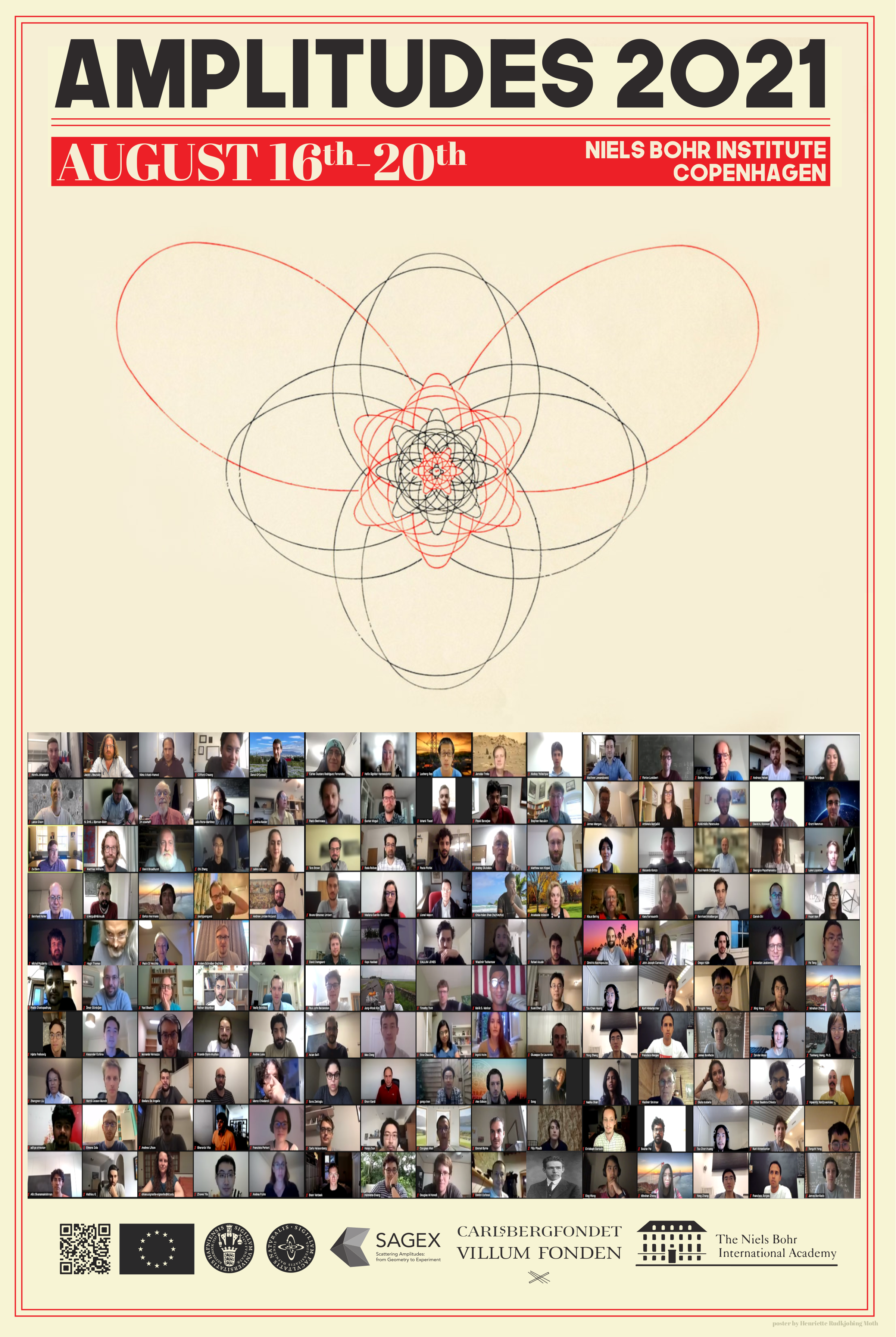
The conference photo

Now that I’ve rested up after this year’s Amplitudes, I’ll give a few of my impressions.

Overall, I think the conference went pretty well. People seemed amused by the digital Niels Bohr, even if he looked a bit like a puppet (Lance compared him to Yoda in his final speech, which was…apt). We used Gather.town, originally just for the poster session and a “virtual reception”, but later we also encouraged people to meet up in it during breaks. That in particular was a big hit: I think people really liked the ability to just move around and chat in impromptu groups, and while nobody seemed to use the “virtual bar”, the “virtual beach” had a lively crowd. Time zones were inevitably rough, but I think we ended up with a good compromise where everyone could still see a meaningful chunk of the conference.

A few things didn’t work as well. For those planning conferences, I would strongly suggest not making a brand new gmail account to send out conference announcements: for a lot of people the emails went straight to spam. Zulip was a bust: I’m not sure if people found it more confusing than last year’s Slack or didn’t notice it due to the spam issue, but almost no-one posted in it. YouTube was complicated: the stream went down a few times and I could never figure out exactly why, it may have just been internet issues here at the Niels Bohr Institute (we did have a power outage one night and had to scramble to get internet access back the next morning). As far as I could tell YouTube wouldn’t let me re-open the previous stream so each time I had to post a new link, which probably was frustrating for those following along there.

That said, this was less of a problem than it might have been, because attendance/”viewership” as a whole was lower than expected. Zoomplitudes last year had massive numbers of people join in both on Zoom and via YouTube. We had a lot fewer: out of over 500 registered participants, we had fewer than 200 on Zoom at any one time, and at most 30 or so on YouTube. Confusion around the conference email might have played a role here, but I suspect part of the difference is simple fatigue: after over a year of this pandemic, online conferences no longer feel like an exciting new experience.

The actual content of the conference ranged pretty widely. Some people reviewed earlier work, others presented recent papers or even work-in-progress. As in recent years, a meaningful chunk of the conference focused on applications of amplitudes techniques to gravitational wave physics. This included a talk by Thibault Damour, who has by now mostly made his peace with the field after his early doubts were sorted out. He still suspected that the mismatch of scales (weak coupling on the one hand, classical scattering on the other) would cause problems in future, but after his work with Laporta and Mastrolia even he had to acknowledge that amplitudes techniques were useful.

In the past I would have put the double-copy and gravitational wave researchers under the same heading, but this year they were quite distinct. While a few of the gravitational wave talks mentioned the double-copy, most of those who brought it up were doing something quite a bit more abstract than gravitational wave physics. Indeed, several people were pushing the boundaries of what it means to double-copy. There were modified KLT kernels, different versions of color-kinematics duality, and explorations of what kinds of massive particles can and (arguably more interestingly) cannot be compatible with a double-copy framework. The sheer range of different generalizations had me briefly wondering whether the double-copy could be “too flexible to be meaningful”, whether the right definitions would let you double-copy anything out of anything. I was reassured by the points where each talk argued that certain things didn’t work: it suggests that wherever this mysterious structure comes from, its powers are limited enough to make it meaningful.

A fair number of talks dealt with what has always been our main application, collider physics. There the context shifted, but the message stayed consistent: for a “clean” enough process two or three-loop calculations can make a big difference, taking a prediction that would be completely off from experiment and bringing it into line. These are more useful the more that can be varied about the calculation: functions are more useful than numbers, for example. I was gratified to hear confirmation that a particular kind of process, where two massless particles like quarks become three massive particles like W or Z bosons, is one of these “clean enough” examples: it means someone will need to compute my “tardigrade” diagram eventually.

If collider physics is our main application, N=4 super Yang-Mills has always been our main toy model. Jaroslav Trnka gave us the details behind Nima’s exciting talk from last year, and Nima had a whole new exciting talk this year with promised connections to category theory (connections he didn’t quite reach after speaking for two and a half hours). Anastasia Volovich presented two distinct methods for predicting square-root symbol letters, while my colleague Chi Zhang showed some exciting progress with the elliptic double-box, realizing the several-year dream of representing it in a useful basis of integrals and showcasing several interesting properties. Anne Spiering came over from the integrability side to show us just how special the “planar” version of the theory really is: by increasing the number of colors of gluons, she showed that one could smoothly go between an “integrability-esque” spectrum and a “chaotic” spectrum. Finally, Lance Dixon mentioned his progress with form-factors in his talk at the end of the conference, showing off some statistics of coefficients of different functions and speculating that machine learning might be able to predict them.

On the more mathematical side, Francis Brown showed us a new way to get numbers out of graphs, one distinct but related to our usual interpretation in terms of Feynman diagrams. I’m still unsure what it will be used for, but the fact that it maps every graph to something finite probably has some interesting implications. Albrecht Klemm and Claude Duhr talked about two sides of the same story, their recent work on integrals involving Calabi-Yau manifolds. They focused on a particular nice set of integrals, and time will tell whether the methods work more broadly, but there are some exciting suggestions that at least parts will.

There’s been a resurgence of the old dream of the S-matrix community, constraining amplitudes via “general constraints” alone, and several talks dealt with those ideas. Sebastian Mizera went the other direction, and tried to test one of those “general constraints”, seeing under which circumstances he could prove that you can swap a particle going in with an antiparticle going out. Others went out to infinity, trying to understand amplitudes from the perspective of the so-called “celestial sphere” where they appear to be governed by conformal field theories of some sort. A few talks dealt with amplitudes in string theory itself: Yvonne Geyer built them out of field-theory amplitudes, while Ashoke Sen explained how to include D-instantons in them.

We also had three “special talks” in the evenings. I’ve mentioned Nima’s already. Zvi Bern gave a retrospective talk that I somewhat cheesily describe as “good for the soul”: a look to the early days of the field that reminded us of why we are who we are. Lance Dixon closed the conference with a light-hearted summary and a look to the future. That future includes next year’s Amplitudes, which after a hasty discussion during this year’s conference has now localized to Prague. Let’s hope it’s in person!

Busy Organizing Amplitudes 2021

I’m busy this week with Amplitudes 2021. Being behind the “organizer’s desk” for one of these conferences is an entirely different experience. There’s a lot to keep track of, keeping the Zoom going smoothly, the website up to date, and the YouTube stream running. Luckily we have good help, a team of students handling a lot of the more finicky details. I think we’ve been putting on a good conference, but there are definitely lessons I’ve learned for the next time I host something.

The content has been interesting too of course, and despite being busy I’ve still gotten to watch the talks. I’ll say more about this after the conference, there have been quite a few interesting developments in the past year.

Next Week, Amplitudes 2021!

I calculate things called scattering amplitudes, the building-blocks of predictions in particle physics. I’m part of a community of “amplitudeologists” that try to find better ways to compute these things, to achieve more efficiency and deeper understanding. We meet once a year for our big conference, called Amplitudes. And this year, I’m one of the organizers.

This year also happens to be the 100th anniversary of the founding of the Niels Bohr Institute, so we wanted to do something special. We found a group of artists working on a rendering of Niels Bohr. The original idea was to do one of those celebrity holograms, but after the conference went online we decided to make a few short clips instead. I wrote a Bohr-esque script, and we got help from one of Bohr’s descendants to get the voice just-so. Now, you can see the result, as our digital Bohr invites you to the conference.

We’ll be livestreaming the conference on the same YouTube channel, and posting videos of the talks each day. If you’re curious about the latest developments in scattering amplitudes, I encourage you to tune in. And if you’re an amplitudeologist yourself, registration is still open!

Of Cows and Razors

Last week’s post came up on Reddit, where a commenter made a good point. I said that one of the mysteries of neutrinos is that they might not get their mass from the Higgs boson. This is true, but the commenter rightly points out it’s true of other particles too: electrons might not get their mass from the Higgs. We aren’t sure. The lighter quarks might not get their mass from the Higgs either.

When talking physics with the public, we usually say that electrons and quarks all get their mass from the Higgs. That’s how it works in our Standard Model, after all. But even though we’ve found the Higgs boson, we can’t be 100% sure that it functions the way our model says. That’s because there are aspects of the Higgs we haven’t been able to measure directly. We’ve measured how it affects the heaviest quark, the top quark, but measuring its interactions with other particles will require a bigger collider. Until we have those measurements, the possibility remains open that electrons and quarks get their mass another way. It would be a more complicated way: we know the Higgs does a lot of what the model says, so if it deviates in another way we’d have to add more details, maybe even more undiscovered particles. But it’s possible.

If I wanted to defend the idea that neutrinos are special here, I would point out that neutrino masses, unlike electron masses, are not part of the Standard Model. For electrons, we have a clear “default” way for them to get mass, and that default is in a meaningful way simpler than the alternatives. For neutrinos, every alternative is complicated in some fashion: either adding undiscovered particles, or unusual properties. If we were to invoke Occam’s Razor, the principle that we should always choose the simplest explanation, then for electrons and quarks there is a clear winner. Not so for neutrinos.

I’m not actually going to make this argument. That’s because I’m a bit wary of using Occam’s Razor when it comes to questions of fundamental physics. Occam’s Razor is a good principle to use, if you have a good idea of what’s “normal”. In physics, you don’t.

To illustrate, I’ll tell an old joke about cows and trains. Here’s the version from The Curious Incident of the Dog in the Night-Time:

There are three men on a train. One of them is an economist and one of them is a logician and one of them is a mathematician. And they have just crossed the border into Scotland (I don’t know why they are going to Scotland) and they see a brown cow standing in a field from the window of the train (and the cow is standing parallel to the train). And the economist says, ‘Look, the cows in Scotland are brown.’ And the logician says, ‘No. There are cows in Scotland of which at least one is brown.’ And the mathematician says, ‘No. There is at least one cow in Scotland, of which one side appears to be brown.’

One side of this cow appears to be very fluffy.

If we want to be as careful as possible, the mathematician’s answer is best. But we expect not to have to be so careful. Maybe the economist’s answer, that Scottish cows are brown, is too broad. But we could imagine an agronomist who states “There is a breed of cows in Scotland that is brown”. And I suggest we should find that pretty reasonable. Essentially, we’re using Occam’s Razor: if we want to explain seeing a brown half-cow from a train, the simplest explanation would be that it’s a member of a breed of cows that are brown. It would be less simple if the cow were unique, a brown mutant in a breed of black and white cows. It would be even less simple if only one side of the cow were brown, and the other were another color.

When we use Occam’s Razor in this way, we’re drawing from our experience of cows. Most of the cows we meet are members of some breed or other, with similar characteristics. We don’t meet many mutant cows, or half-colored cows, so we think of those options as less simple, and less likely.

But what kind of experience tells us which option is simpler for electrons, or neutrinos?

The Standard Model is a type of theory called a Quantum Field Theory. We have experience with other Quantum Field Theories: we use them to describe materials, metals and fluids and so forth. Still, it seems a bit odd to say that if something is typical of these materials, it should also be typical of the universe. As another physicists in my sub-field, Nima Arkani-Hamed, likes to say, “the universe is not a crappy metal!”

We could also draw on our experience from other theories in physics. This is a bit more productive, but has other problems. Our other theories are invariably incomplete, that’s why we come up with new theories in the first place…and with so few theories, compared to breeds of cows, it’s unclear that we really have a good basis for experience.

Physicists like to brag that we study the most fundamental laws of nature. Ordinarily, this doesn’t matter as much as we pretend: there’s a lot to discover in the rest of science too, after all. But here, it really makes a difference. Unlike other fields, we don’t know what’s “normal”, so we can’t really tell which theories are “simpler” than others. We can make aesthetic judgements, on the simplicity of the math or the number of fields or the quality of the stories we can tell. If we want to be principled and forego all of that, then we’re left on an abyss, a world of bare observations and parameter soup.

If a physicist looks out a train window, will they say that all the electrons they see get their mass from the Higgs? Maybe, still. But they should be careful about it.