
I saw Interstellar this week. There’s been a lot of buzz among physicists about it, owing in part to the involvement of black hole expert Kip Thorne in the film’s development. I’d just like to comment on one aspect of the film that bugged me, a problem that shows up pretty frequently in science fiction.
In the film, Michael Caine plays a theoretical physicist working for NASA. His dream is to save humanity from an Earth plagued by a blight that is killing off the world’s food supply. To do this, he plans to build giant anti-gravity spaceships capable of taking as many people as possible away from the dying Earth to find a new planet capable of supporting human life. And in order to do that, apparently, he needs a theory of quantum gravity.
The thing is, quantum gravity has nothing to do with making giant anti-gravity spaceships.

Michael Caine lied to us?
This mistake isn’t unique to Interstellar. Lots of science fiction works assume that once we understand quantum gravity then everything else will follow: faster than light travel, wormholes, anti-gravity…pretty much every sci-fi staple.
It’s not just present in science fiction, either. Plenty of science popularizers like to mention all of the marvelous technology that’s going to come out of quantum gravity, including people who really should know better. A good example comes from a recent piece by quantum gravity researcher Sabine Hossenfelder:
But especially in high energy physics and quantum gravity, progress has basically stalled since the development of the standard model in the mid 70s. […] it is a frustrating situation and this makes you wonder if not there are other reasons for lack of progress, reasons that we can do something about. Especially in a time when we really need a game changer, some breakthrough technology, clean energy, that warp drive, a transporter!
None of these are things we’re likely to get from quantum gravity, and the reason is rather basic. It boils down to one central issue: if we can’t control the classical physics, we can’t control the quantum physics.
When science fiction authors speculate about the benefits of quantum gravity, they’re thinking about the benefits of quantum mechanics. Understanding the quantum world has allowed some of the greatest breakthroughs of the 20th century, from miniaturizing circuits to developing novel materials.
The assumption writers make is that the same will be true for quantum gravity: understand it, and gravity technology will flow. But this assumption forgets that quantum mechanics was so successful because it let us understand things we were already working with.
In order to miniaturize circuits, you have to know how to build a circuit in the first place. Only then, when you try to make the circuit smaller and don’t understand why it stops working, does quantum mechanics step in to tell you what you’re missing. Quantum mechanics helps us develop new materials because it helps us understand how existing materials work.
We don’t have any gravity circuits to shrink down, or gravity materials to understand. When gravity limits our current technology, it does so on a macro level (such as the effect of the Earth’s gravity on GPS satellites) not on a quantum level. If there isn’t a way to build anti-gravity technology using classical physics, there probably isn’t a way using quantum physics.
Scientists and popularizers generally argue that we can’t know what the future will bring. This is true, up to a point. When Maxwell wrote down equations to unify electricity and magnetism he could not have imagined the wealth of technology we have today. And often, technologies come from unexpected places. The spinoff technologies of the space race are the most popular example, another is that CERN (the facility that houses the Large Hadron Collider) was instrumental in developing the world wide web.
While it’s great to emphasize the open-ended promise of scientific advances (especially on grant applications!), in this context it’s misleading because it erases the very real progress people are making on these issues without quantum gravity.
Want to invest in clean energy? There are a huge number of scientists working on it, with projects ranging from creating materials that can split water using solar energy to nuclear fusion. Quantum gravity is just about the last science likely to give us clean energy, and I’m including the social sciences in that assessment.
How about a warp drive?

Indeed, how about one?
That’s not obviously related to quantum gravity either. There has actually been some research into warp drives, but they’re based on a solution to Einstein’s equations without quantum mechanics. It’s not clear whether quantum gravity has something meaningful to say about them…while there are points to be made, from what I’ve been able to gather they’re more related to talking about how other quantum systems interact with gravity than the quantum properties of gravity itself. The same seems to apply to the difficulties involved in wormholes, another sci-fi concept that comes straight out of Einstein’s theory.
As for teleportation, that’s an entirely different field, and it probably doesn’t work how you think it does.
So what is quantum gravity actually good for?
Quantum gravity becomes relevant when gravity becomes very strong, places where Einstein’s theory would predict infinitely dense singularities. That means the inside of black holes, and the Big Bang. Quantum gravity smooths out these singularities, which means it can tell you about the universe’s beginnings (by smoothing out the big bang and showing what could cause it), or its long-term future (for example, problems with the long-term evolution of black holes).
These are important questions! They tell us about where we come from and where we’re going: in short, about our ultimate place in the universe. Almost every religion in history has tried to answer these questions. They’re very important to us as a species, even if they don’t directly impact our daily lives.
What they are not, however, is a source of technology.
So please, science fiction, use some other field for your plot-technology. There are plenty of scientific advances to choose from, people who are really working on cutting-edge futuristic stuff. They don’t need to wait on a theory of quantum gravity to get their work done. Neither do you.







 and
and  come from gravity. Normally, they would depend on x and y, modifying the formula and thus “bending” space.
 because physicists are overly enamored of Greek letters. If
  is its momentum (physicists also really love subscripts), then its total momentum can be calculated using the Pythagorean Theorem as well: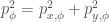

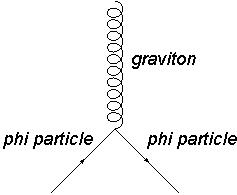
 4 gravitons