Category Archives: General QFT

Assumptions for Naturalness

Why did physicists expect to see something new at the LHC, more than just the Higgs boson? Mostly, because of something called naturalness.

Naturalness, broadly speaking, is the idea that there shouldn’t be coincidences in physics. If two numbers that appear in your theory cancel out almost perfectly, there should be a reason that they cancel. Put another way, if your theory has a dimensionless constant in it, that constant should be close to one.

(To see why these two concepts are the same, think about a theory where two large numbers miraculously almost cancel, leaving just a small difference. Take the ratio of one of those large numbers to the difference, and you get a very large dimensionless number.)

You might have heard it said that the mass of the Higgs boson is “unnatural”. There are many different physical processes that affect what we measure as the mass of the Higgs. We don’t know exactly how big these effects are, but we do know that they grow with the scale of “new physics” (aka the mass of any new particles we might have discovered), and that they have to cancel to give the Higgs mass we observe. If we don’t see any new particles, the Higgs mass starts looking more and more unnatural, driving some physicists to the idea of a “multiverse”.

If you find parts of this argument hokey, you’re not alone. Critics of naturalness point out that we don’t really have a good reason to favor “numbers close to one”, nor do we have any way to quantify how “bad” a number far from one is (we don’t know the probability distribution, in other words). They critique theories that do preserve naturalness, like supersymmetry, for being increasingly complicated and unwieldy, violating Occam’s razor. And in some cases they act baffled by the assumption that there should be any “new physics” at all.

Some of these criticisms are reasonable, but some are distracting and off the mark. The problem is that the popular argument for naturalness leaves out some important assumptions. These assumptions are usually kept in mind by the people arguing for naturalness (at least the more careful people), but aren’t often made explicit. I’d like to state some of these assumptions. I’ll be framing the naturalness argument in a bit of an unusual (if not unprecedented) way. My goal is to show that some criticisms of naturalness don’t really work, while others still make sense.

I’d like to state the naturalness argument as follows:

  1. The universe should be ultimately described by a theory with no free dimensionless parameters at all. (For the experts: the theory should also be UV-finite.)
  2. We are reasonably familiar with theories of the sort described in 1., we know roughly what they can look like.
  3. If we look at such a theory at low energies, it will appear to have dimensionless parameters again, based on the energy where we “cut off” our description. We understand this process well enough to know what kinds of values these parameters can take, starting from 2.
  4. Point 3. can only be consistent with the observed mass of the Higgs if there is some “new physics” at around the scales the LHC can measure. That is, there is no known way to start with a theory like those of 2. and get the observed Higgs mass without new particles.

Point 1. is often not explicitly stated. It’s an assumption, one that sits in the back of a lot of physicists’ minds and guides their reasoning. I’m really not sure if I can fully justify it, it seems like it should be a consequence of what a final theory is.

(For the experts: you’re probably wondering why I’m insisting on a theory with no free parameters, when usually this argument just demands UV-finiteness. I demand this here because I think this is the core reason why we worry about coincidences: free parameters of any intermediate theory must eventually be explained in a theory where those parameters are fixed, and “unnatural” coincidences are those we don’t expect to be able to fix in this way.)

Point 2. may sound like a stretch, but it’s less of one than you might think. We do know of a number of theories that have few or no dimensionless parameters (and that are UV-finite), they just don’t describe the real world. Treating these theories as toy models, we can hopefully get some idea of how theories like this should look. We also have a candidate theory of this kind that could potentially describe the real world, M theory, but it’s not fleshed out enough to answer these kinds of questions definitively at this point. At best it’s another source of toy models.

Point 3. is where most of the technical arguments show up. If someone talking about naturalness starts talking about effective field theory and the renormalization group, they’re probably hashing out the details of point 3. Parts of this point are quite solid, but once again there are some assumptions that go into it, and I don’t think we can say that this point is entirely certain.

Once you’ve accepted the arguments behind points 1.-3., point 4. follows. The Higgs is unnatural, and you end up expecting new physics.

Framed in this way, arguments about the probability distribution of parameters are missing the point, as are arguments from Occam’s razor.

The point is not that the Standard Model has unlikely parameters, or that some in-between theory has unlikely parameters. The point is that there is no known way to start with the kind of theory that could be an ultimate description of the universe and end up with something like the observed Higgs and no detectable new physics. Such a theory isn’t merely unlikely, if you take this argument seriously it’s impossible. If your theory gets around this argument, it can be as cumbersome and Occam’s razor-violating as it wants, it’s still a better shot than no possible theory at all.

In general, the smarter critics of naturalness are aware of this kind of argument, and don’t just talk probabilities. Instead, they reject some combination of point 2. and point 3.

This is more reasonable, because point 2. and point 3. are, on some level, arguments from ignorance. We don’t know of a theory with no dimensionless parameters that can give something like the Higgs with no detectable new physics, but maybe we’re just not trying hard enough. Given how murky our understanding of M theory is, maybe we just don’t know enough to make this kind of argument yet, and the whole thing is premature. This is where probability can sneak back in, not as some sort of probability distribution on the parameters of physics but just as an estimate of our own ability to come up with new theories. We have to guess what kinds of theories can make sense, and we may well just not know enough to make that guess.

One thing I’d like to know is how many critics of naturalness reject point 1. Because point 1. isn’t usually stated explicitly, it isn’t often responded to explicitly either. The way some critics of naturalness talk makes me suspect that they reject point 1., that they honestly believe that the final theory might simply have some unexplained dimensionless numbers in it that we can only fix through measurement. I’m curious whether they actually think this, or whether I’m misreading them.

There’s a general point to be made here about framing. Suppose that tomorrow someone figures out a way to start with a theory with no dimensionless parameters and plausibly end up with a theory that describes our world, matching all existing experiments. (People have certainly been trying.) Does this mean naturalness was never a problem after all? Or does that mean that this person solved the naturalness problem?

Those sound like very different statements, but it should be clear at this point that they’re not. In principle, nothing distinguishes them. In practice, people will probably frame the result one way or another based on how interesting the solution is.

If it turns out we were missing something obvious, or if we were extremely premature in our argument, then in some sense naturalness was never a real problem. But if we were missing something subtle, something deep that teaches us something important about the world, then it should be fair to describe it as a real solution to a real problem, to cite “solving naturalness” as one of the advantages of the new theory.

If you ask for my opinion? You probably shouldn’t, I’m quite far from an expert in this corner of physics, not being a phenomenologist. But if you insist on asking anyway, I suspect there probably is something wrong with the naturalness argument. That said, I expect that whatever we’re missing, it will be something subtle and interesting, that naturalness is a real problem that needs to really be solved.
Why the Coupling Constants Aren’t Constant: Epistemology and Pragmatism

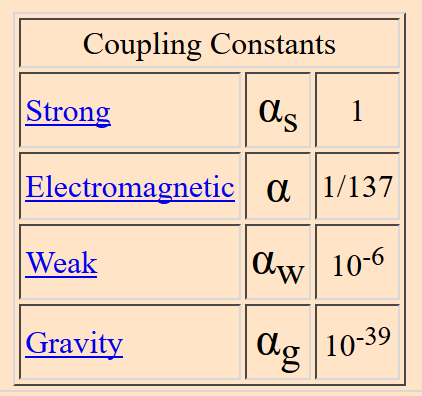
If you’ve heard a bit about physics, you might have heard that each of the fundamental forces (electromagnetism, the weak nuclear force, the strong nuclear force, and gravity) has a coupling constant, a number, handed down from nature itself, that determines how strong of a force it is. Maybe you’ve seen them in a table, like this:

tablefromhyperphysics

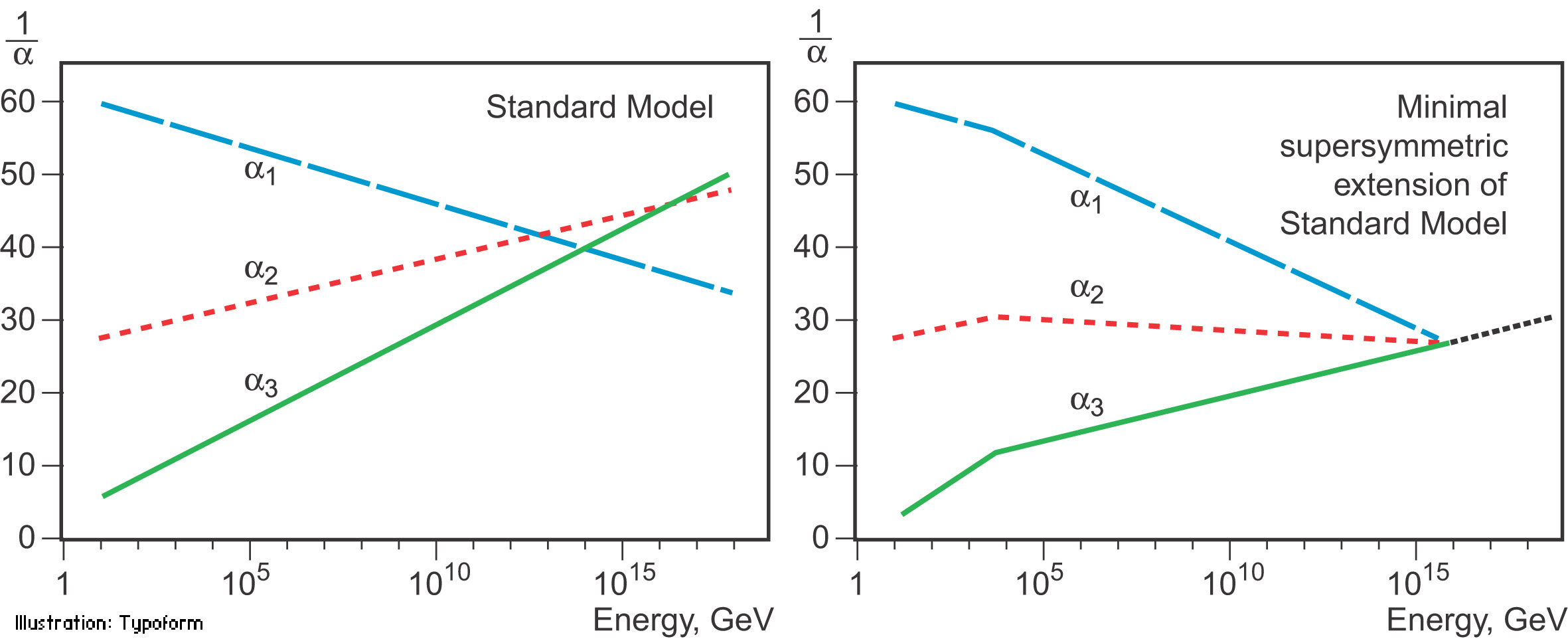
If you’ve heard a bit more about physics, though, you’ll have heard that those coupling constants aren’t actually constant! Instead, they vary with energy. Maybe you’ve seen them plotted like this:

phypub4highen

The usual way physicists explain this is in terms of quantum effects. We talk about “virtual particles”, and explain that any time particles and forces interact, these virtual particles can pop up, adding corrections that change with the energy of the interacting particles. The coupling constant includes all of these corrections, so it can’t be constant, it has to vary with energy.

renormalized-vertex

Maybe you’re happy with this explanation. But maybe you object:

“Isn’t there still a constant, though? If you ignore all the virtual particles, and drop all the corrections, isn’t there some constant number you’re correcting? Some sort of `bare coupling constant’ you could put into a nice table for me?”

There are two reasons I can’t do that. One is an epistemological reason, that comes from what we can and cannot know. The other is practical: even if I knew the bare coupling, most of the time I wouldn’t want to use it.

Let’s start with the epistemology:

The first thing to understand is that we can’t measure the bare coupling directly. When we measure the strength of forces, we’re always measuring the result of quantum corrections. We can’t “turn off” the virtual particles.

You could imagine measuring it indirectly, though. You’d measure the end result of all the corrections, then go back and calculate. That calculation would tell you how big the corrections were supposed to be, and you could subtract them off, solve the equation, and find the bare coupling.

And this would be a totally reasonable thing to do, except that when you go and try to calculate the quantum corrections, instead of something sensible, you get infinity.

We think that “infinity” is due to our ignorance: we know some of the quantum corrections, but not all of them, because we don’t have a final theory of nature. In order to calculate anything we need to hedge around that ignorance, with a trick called renormalization. I talk about that more in an older post. The key message to take away there is that in order to calculate anything we need to give up the hope of measuring certain bare constants, even “indirectly”. Once we fix a few constants that way, the rest of the theory gives reliable predictions.

So we can’t measure bare constants, and we can’t reason our way to them. We have to find the full coupling, with all the quantum corrections, and use that as our coupling constant.

Still, you might wonder, why does the coupling constant have to vary? Can’t I just pick one measurement, at one energy, and call that the constant?

This is where pragmatism comes in. You could fix your constant at some arbitrary energy, sure. But you’ll regret it.

In particle physics, we usually calculate in something called perturbation theory. Instead of calculating something exactly, we have to use approximations. We add up the approximations, order by order, expecting that each time the corrections will get smaller and smaller, so we get closer and closer to the truth.

And this works reasonably well if your coupling constant is small enough, provided it’s at the right energy.

If your coupling constant is at the wrong energy, then your quantum corrections will notice the difference. They won’t just be small numbers anymore. Instead, they end up containing logarithms of the ratio of energies. The more difference between your arbitrary energy scale and the correct one, the bigger these logarithms get.

This doesn’t make your calculation wrong, exactly. It makes your error estimate wrong. It means that your assumption that the next order is “small enough” isn’t actually true. You’d need to go to higher and higher orders to get a “good enough” answer, if you can get there at all.

Because of that, you don’t want to think about the coupling constants as actually constant. If we knew the final theory then maybe we’d know the true numbers, the ultimate bare coupling constants. But we still would want to use coupling constants that vary with energy for practical calculations. We’d still prefer the plot, and not just the table.

Classical Teleportation Is Easier Than Quantum Teleportation

Quantum teleportation confuses people.

Maybe you’ve heard the buzzword, and you imagine science fiction become reality: teleporting people across the galaxy, or ansibles communicating faster than light. Maybe you’ve heard a bit more, and know that quantum teleportation can’t transfer information faster than light, that it hasn’t been used on something even as complicated as a molecule…and you’re still confused, because if so, why call it teleportation in the first place?

There’s a simple way to clear up this confusion. You just have to realize that classical teleportation is easy.

What do I mean by “classical teleportation”?

Let’s start with the simplest teleporter you could imagine. It scans you on one end, then vaporizes you, and sends your information to a teleportation pad on the other end. The other end uses that information to build a copy of your body from some appropriate raw materials, and there you are!

(If the machine doesn’t vaporize you, then you end up with an army of resurrected Derek Parfits.)

Doing this with a person is, of course, absurdly difficult, and well beyond the reach of current technology.

transporter2

And no, nothing about the Star Trek version changes that

Do it with a document, though, and you’ve essentially invented the fax machine.

Yes, faxes don’t copy a piece of paper atom by atom, but they don’t need to: they just send what’s written on it. This sort of “classical teleportation” is commonplace. Trade Pokémon, and your Pikachu gets “classical teleported” from one device to another. Send an email, and your laptop teleports it to someone else. The ability to “classically teleport” is essential for computers to function, the idea that you can take the “important information” about something and copy it somewhere else.

Note that under this definition, “classical teleportation” is not faster than light. You still need to send a signal, between a “scanner” and a “printer”, and that’s only as fast as your signal normally is. Note also that the “printer” needs some “ink”, you still need the right materials to build or record whatever is being teleported over.

So suppose you’re building a quantum computer, one that uses the unique properties of quantum mechanics. Naturally, you want to be able to take a quantum state and copy it somewhere else. You need “quantum teleportation”. And the first thing you realize is that it’s harder than it looks.

The problem comes when you try to “scan” your quantum state. You might have heard quantum states described as “inherently uncertain” or “inherently indeterminate”. For this post, a better way to think about them is “inherently unknown”. For any quantum state, there is something you can’t know about its behavior. You can’t know which slit the next electron will go through, you can’t know whether Schrödinger’s cat is alive or dead. If you did, the state wouldn’t be quantum: no matter how you figure it out, there isn’t a way to discover which slit the electron will go through without getting rid of the quantum diffraction pattern.

This means that if you try to just “classically teleport” a quantum state, you lose the very properties you care about. To “scan” your state, you have to figure out everything important about it. The only way to do that, for an arbitrary state on your teleportation pad, is to observe its behavior. If you do that, though, you’ll end up knowing too much: a state whose behavior you know is not a quantum state, and it won’t do what you want it to on the other end. You’ve tried to “clone” it, and there’s a theorem proving you can’t.

(Note that this description should make sense even if you believe in a “hidden variable” interpretation of quantum mechanics. Those hidden variables have to be “non-local”, they aren’t close enough for your “scanner” to measure them.)

Since you can’t “classically teleport” your quantum state, you have to do something more subtle. That’s where “quantum teleportation” comes in. Quantum teleportation uses “entanglement”, long-distance correlations between quantum states. With a set of two entangled states, you can sneak around the “scanning” part, manipulating the states on one end to compute instructions that let someone use the other entangled particle to rebuild the “teleported” state.

Those instructions still have to be transferred normally, once again quantum teleportation isn’t faster than light. You still need the right kind of quantum state at your target, your “printer” still needs ink. What you get, though, is a way to transport the “inherently unknown” behavior of a quantum state, without scanning it and destroying the “mystery”. Quantum teleportation isn’t easier than classical teleportation, it’s harder. What’s exciting is that it’s possible at all.


On an unrelated topic, KKLT have fired back at their critics, with an impressive salvo of papers. (See also this one from the same day.) I don’t have the time or expertise to write a good post about this at the moment, currently hoping someone else does!

IGST 2018

Conference season in Copenhagen continues this week, with Integrability in Gauge and String Theory 2018. Integrability here refers to integrable theories, theories where physicists can calculate things exactly, without the perturbative approximations we typically use. Integrable theories come up in a wide variety of situations, but this conference was focused on the “high-energy” side of the field, on gauge theories (roughly, theories of fundamental forces like Yang-Mills) and string theory.

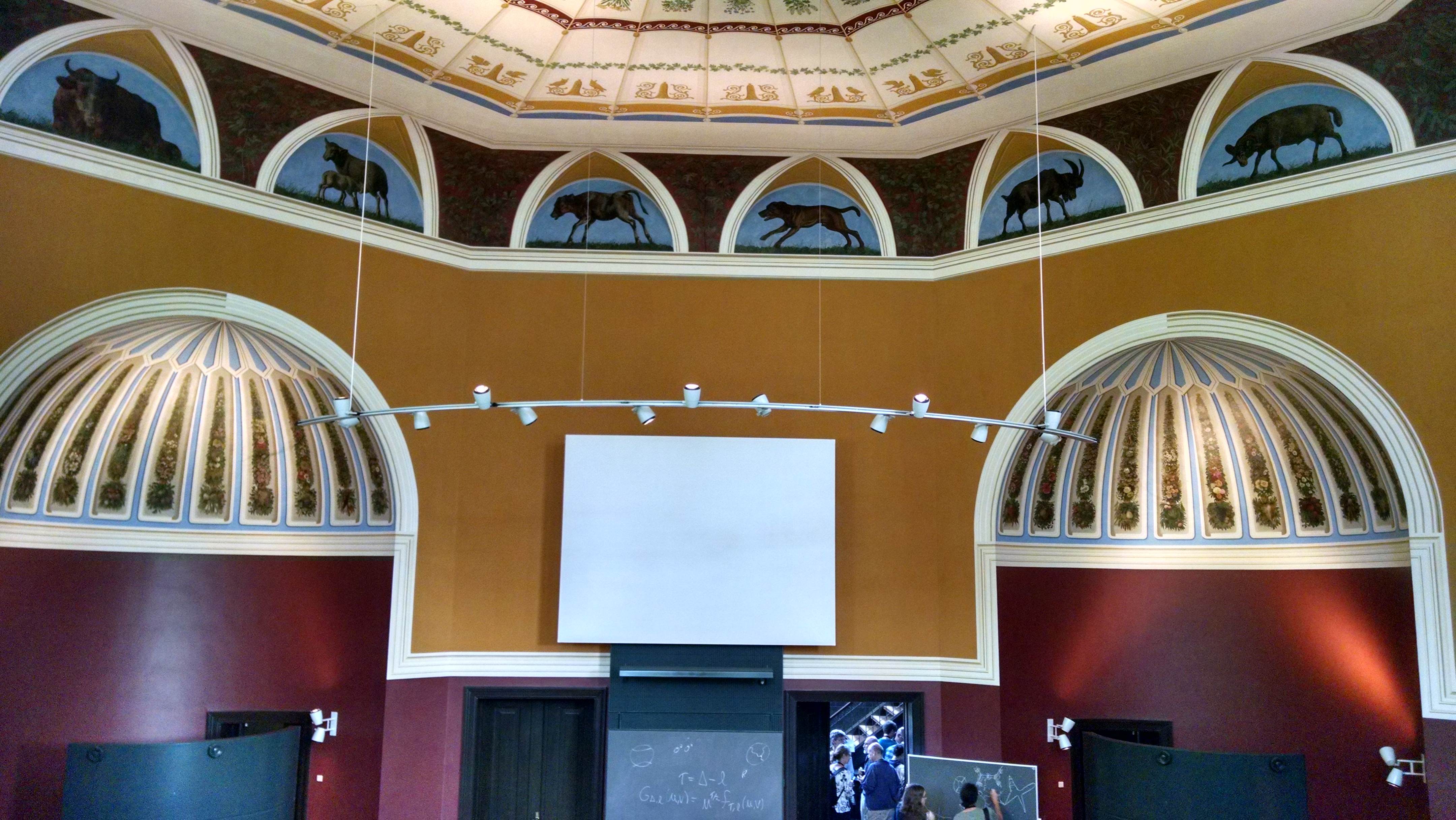
Integrability is one of the bigger sub-fields in my corner of physics, about the same size as amplitudes. It’s big enough that we can’t host the conference in the old Niels Bohr Institute auditorium.

IMG_20180820_162035401_HDR

Instead, they herded us into the old agriculture school

I don’t normally go to integrability conferences, but when the only cost is bus fare there’s not much to lose. Integrability is arguably amplitudes’s nearest neighbor. The two fields have a history of sharing ideas, and they have similar reputations in the wider community, seen as alternately deep and overly technical. Many of the talks still went over my head, but it was worth getting a chance to see how the neighbors are doing.

Why a New Particle Matters

A while back, when the MiniBoone experiment announced evidence for a sterile neutrino, I was excited. It’s still not clear whether they really found something, here’s an article laying out the current status. If they did, it would be a new particle beyond those predicted by the Standard Model, something like the neutrinos but which doesn’t interact with any of the fundamental forces except gravity.

At the time, someone asked me why this was so exciting. Does it solve the mystery of dark matter, or any other long-standing problems?

The sterile neutrino MiniBoone is suggesting isn’t, as far as I’m aware, a plausible candidate for dark matter. It doesn’t solve any long-standing problems (for example, it doesn’t explain why the other neutrinos are so much lighter than other particles). It would even introduce new problems of its own!

It still matters, though. One reason, which I’ve talked about before, is that each new type of particle implies a new law of nature, a basic truth about the universe that we didn’t know before. But there’s another reason why a new particle matters.

There’s a malaise in particle physics. For most of the twentieth century, theory and experiment were tightly linked. Unexpected experimental results would demand new theory, which would in turn suggest new experiments, driving knowledge forward. That mostly stopped with the Standard Model. There are a few lingering anomalies, like the phenomena we attribute to dark matter, that show the Standard Model can’t be the full story. But as long as every other experiment fits the Standard Model, we have no useful hints about where to go next. We’re just speculating, and too much of that warps the field.

Critics of the physics mainstream pick up on this, but I’m not optimistic about what I’ve seen of their solutions. Peter Woit has suggested that physics should emulate the culture of mathematics, caring more about rigor and being more careful to confirm things before speaking. The title of Sabine Hossenfelder’s “Lost in Math” might suggest the opposite, but I get the impression she’s arguing for something similar: that particle physicists have been using sloppy arguments and should clean up their act, taking foundational problems seriously and talking to philosophers to help clarify their ideas.

Rigor and clarity are worthwhile, but the problems they’ll solve aren’t the ones causing the malaise. If there are problems we can expect to solve just by thinking better, they’re problems that we found by thinking in the first place: quantum gravity theories that stop making sense at very high energies, paradoxical thought experiments with black holes. There, rigor and clarity can matter: to some extent they’re already there, but I can appreciate the argument that it’s not yet nearly enough.

What rigor and clarity won’t do is make physics feel (and function) like it did in the twentieth century. For that, we need new evidence: experiments that disobey the Standard Model, and do it in a clear enough way that we can’t just chalk it up to predictable errors. We need a new particle, or something like it. Without that, our theories are most likely underdetermined by the data, and anything we propose is going to be subjective. Our subjective judgements may get better, we may get rid of the worst-justified biases, but at the end of the day we still won’t have enough information to actually make durable progress.

That’s not a popular message, in part, because it’s not something we can control. There’s a degree of helplessness in realizing that if nature doesn’t throw us a bone then we’ll probably just keep going in circles forever. It’s not the kind of thing that lends itself to a pithy blog post.

If there’s something we can do, it’s to keep our eyes as open as possible, to make sure we don’t miss nature’s next hint. It’s why people are getting excited about low-energy experiments, about precision calculations, about LIGO. Even this seemingly clickbaity proposal that dark matter killed the dinosaurs is motivated by the same sort of logic: if the only evidence for dark matter we have is gravitational, what can gravitational evidence tell us about what it’s made of? In each case, we’re trying to widen our net, to see new phenomena we might have missed.

I suspect that’s why this reviewer was disappointed that Hossenfelder’s book lacked a vision for the future. It’s not that the book lacked any proposals whatsoever. But it lacked this kind of proposal, of a new place to look, where new evidence, and maybe a new particle, might be found. Without that we can still improve things, we can still make progress on deep fundamental mathematical questions, we can kill off the stupidest of the stupid arguments. But the malaise won’t lift, we won’t get back to the health of twentieth century physics. For that, we need to see something new.

Path Integrals and Loop Integrals: Different Things!

When talking science, we need to be careful with our words. It’s easy for people to see a familiar word and assume something totally different from what we intend. And if we use the same word twice, for two different things…

I’ve noticed this problem with the word “integral”. When physicists talk about particle physics, there are two kinds of integrals we mention: path integrals, and loop integrals. I’ve seen plenty of people get confused, and assume that these two are the same thing. They’re not, and it’s worth spending some time explaining the difference.

Let’s start with path integrals (also referred to as functional integrals, or Feynman integrals). Feynman promoted a picture of quantum mechanics in which a particle travels along many different paths, from point A to point B.

three_paths_from_a_to_b

You’ve probably seen a picture like this. Classically, a particle would just take one path, the shortest path, from A to B. In quantum mechanics, you have to add up all possible paths. Most longer paths cancel, so on average the short, classical path is the most important one, but the others do contribute, and have observable, quantum effects. The sum over all paths is what we call a path integral.

It’s easy enough to draw this picture for a single particle. When we do particle physics, though, we aren’t usually interested in just one particle: we want to look at a bunch of different quantum fields, and figure out how they will interact.

We still use a path integral to do that, but it doesn’t look like a bunch of lines from point A to B, and there isn’t a convenient image I can steal from Wikipedia for it. The quantum field theory path integral adds up, not all the paths a particle can travel, but all the ways a set of quantum fields can interact.

How do we actually calculate that?

One way is with Feynman diagrams, and (often, but not always) loop integrals.

4grav2loop

I’ve talked about Feynman diagrams before. Each one is a picture of one possible way that particles can travel, or that quantum fields can interact. In some (loose) sense, each one is a single path in the path integral.

Each diagram serves as instructions for a calculation. We take information about the particles, their momenta and energy, and end up with a number. To calculate a path integral exactly, we’d have to add up all the diagrams we could possibly draw, to get a sum over all possible paths.

(There are ways to avoid this in special cases, which I’m not going to go into here.)

Sometimes, getting a number out of a diagram is fairly simple. If the diagram has no closed loops in it (if it’s what we call a tree diagram) then knowing the properties of the in-coming and out-going particles is enough to know the rest. If there are loops, though, there’s uncertainty: you have to add up every possible momentum of the particles in the loops. You do that with a different integral, and that’s the one that we sometimes refer to as a loop integral. (Perhaps confusingly, these are also often called Feynman integrals: Feynman did a lot of stuff!)

\frac{i^{a+l(1-d/2)}\pi^{ld/2}}{\prod_i \Gamma(a_i)}\int_0^\infty...\int_0^\infty \prod_i\alpha_i^{a_i-1}U^{-d/2}e^{iF/U-i\sum m_i^2\alpha_i}d\alpha_1...d\alpha_n

Loop integrals can be pretty complicated, but at heart they’re the same sort of thing you might have seen in a calculus class. Mathematicians are pretty comfortable with them, and they give rise to numbers that mathematicians find very interesting.

Path integrals are very different. In some sense, they’re an “integral over integrals”, adding up every loop integral you could write down. Mathematicians can define path integrals in special cases, but it’s still not clear that the general case, the overall path integral picture we use, actually makes rigorous mathematical sense.

So if you see physicists talking about integrals, it’s worth taking a moment to figure out which one we mean. Path integrals and loop integrals are both important, but they’re very, very different things.

Unreasonably Big Physics

The Large Hadron Collider is big, eight and a half kilometers across. It’s expensive, with a cost to construct and operate in the billions. And with an energy of 6.5 TeV per proton, it’s the most powerful collider in the world, accelerating protons to 0.99999999 of the speed of light.

The LHC is reasonable. After all, it was funded, and built. What does an unreasonable physics proposal look like?

It’s probably unfair to call the Superconducting Super Collider unreasonable, after all, it did almost get built. It would have been a 28 kilometer-wide circle in the Texas desert, accelerating protons to an energy of 20 TeV, three times the energy of the LHC. When it was cancelled in 1993, it was projected to cost twelve billion dollars, and two billion had already been spent digging the tunnel. The US hasn’t invested in a similarly sized project since.

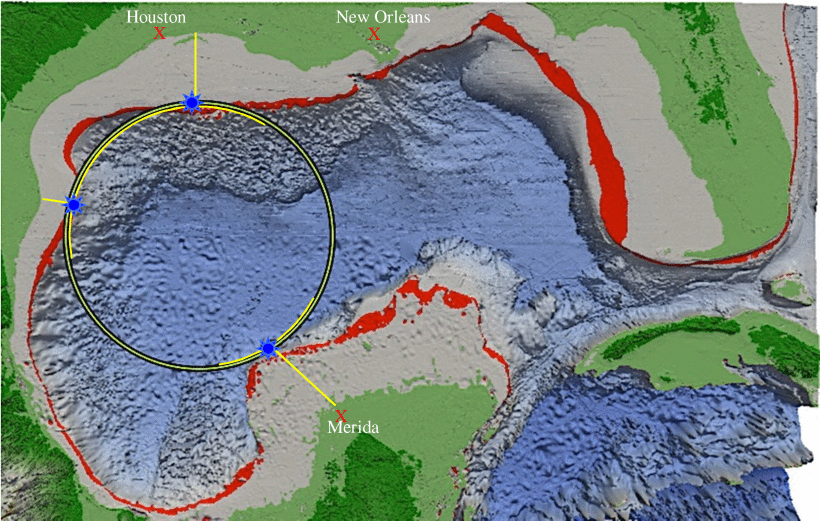
A better example of an unreasonable proposal might be the Collider-in-the-Sea. (If that link is paywalled, this paper covers most of the same information.)

mcint2-2656157-large

If you run out of room on land, why not build your collider underwater?

Ok, there are pretty obvious reasons why not. Surprisingly, the people proposing the Collider-in-the-Sea do a decent job of answering them. They plan to put it far enough out that it won’t disrupt shipping, and deep enough down that it won’t interfere with fish. Apparently at those depths even a hurricane barely ripples the water, and they argue that the technology exists to keep a floating ring stable under those conditions. All in all, they’re imagining a collider 600 kilometers in diameter, accelerating protons to 250 TeV, all for a cost they claim would be roughly comparable to the (substantially smaller) new colliders that China and Europe are considering.

I’m sure that there are reasons I’ve overlooked why this sort of project is impossible. (I mean, just look at the map!) Still, it’s impressive that they can marshal this much of an argument.

Besides, there are even more impossible projects, like this one, by Sugawara, Hagura, and Sanami. Their proposal for a 1000 TeV neutrino beam isn’t intended for research: rather, the idea is a beam powerful enough to send neutrinos through the Earth to destroy nuclear bombs. Such a beam could cause the bombs to detonate prematurely, “fizzling” with about 3% the explosion they would have normally.

In this case, Sugawara and co. admit that their proposal is pure fantasy. With current technology they would need a ring larger than the Collider-in-the-Sea, and the project would cost hundreds of billions of dollars. It’s not even clear who would want to build such a machine, or who could get away with building it: the authors imagine a science fiction-esque world government to foot the bill.

There’s a spectrum of papers that scientists write, from whimsical speculation to serious work. The press doesn’t always make the difference clear, so it’s a useful skill to see the clues in the writing that show where a given proposal lands. In the case of the Sugawara and co. proposal, the paper is littered with caveats, explicitly making it clear that it’s just a rough estimate. Even the first line, dedicating the paper to another professor, should get you to look twice: while this sometimes happens on serious papers, often it means the paper was written as a fun gift for the professor in question. The Collider-in-the-Sea doesn’t have these kinds of warning signs, and it’s clear its authors take it a bit more seriously. Nonetheless, comparing the level of detail to other accelerator proposals, even those from the same people, should suggest that the Collider-in-the-Sea isn’t entirely on the same level. As wacky as it is to imagine, we probably won’t get a collider that takes up most of the Gulf of Mexico, or a massive neutrino beam capable of blowing up nukes around the world.

The Rippling Pond Universe

[Background: Someone told me they couldn’t imagine popularizing Quantum Field Theory in the same flashy way people popularize String Theory. Naturally I took this as a challenge. Please don’t take any statements about what “really exists” here too seriously, this isn’t intended as metaphysics, just metaphor.]


You probably learned about atoms in school.

Your teacher would have explained that these aren’t the same atoms the ancient Greeks imagined. Democritus thought of atoms as indivisible, unchanging spheres, the fundamental constituents of matter. We know, though, that atoms aren’t indivisible. They’re clouds of electrons, buzzing in their orbits around a nucleus of protons and neutrons. Chemists can divide the electrons from the rest, nuclear physicists can break the nucleus. The atom is not indivisible.

And perhaps your teacher remarked on how amazing it is, that the nucleus is such a tiny part of the atom, that the atom, and thus all solid matter, is mostly empty space.


You might have learned that protons and neutrons, too, are not indivisible. That each proton, and each neutron, is composed of three particles called quarks, particles which can be briefly freed by powerful particle colliders.

And you might have wondered, then, even if you didn’t think to ask: are quarks atoms? The real atoms, the Greek atoms, solid indestructible balls of fundamental matter?


They aren’t, by the way.


You might have gotten an inkling of this, learning about beta decay. In beta decay, a neutron transforms, becoming a proton, an electron, and a neutrino. Look for an electron inside a neutron, and you won’t find one. Even if you look at the quarks, you see the same transformation: a down quark becomes an up quark, plus an electron, plus a neutrino. If quarks were atoms, indivisible and unchanging, this couldn’t happen. There’s nowhere for the electron to hide.


In fact, there are no atoms, not the way the Greeks imagined. Just ripples.

Water Drop

Picture the universe as a pond. This isn’t a still pond: something has disturbed it, setting ripples and whirlpools in motion. These ripples and whirlpools skim along the surface of the pond, eddying together and scattering apart.

Our universe is not a simple pond, and so these are not simple ripples. They shine and shimmer, each with their own bright hue, colors beyond our ordinary experience that mix in unfamiliar ways. The different-colored ripples interact, merge and split, and the pond glows with their light.

Stand back far enough, and you notice patterns. See that red ripple, that stays together and keeps its shape, that meets other ripples and interacts in predictable ways. You might imagine the red ripple is an atom, truly indivisible…until it splits, transforms, into ripples of new colors. The quark has changed, down to up, an electron and a neutrino rippling away.

All of our world is encoded in the colors of these ripples, each kind of charge its own kind of hue. With a wink (like your teacher’s, telling you of empty atoms), I can tell you that distance itself is just a kind of ripple, one that links other ripples together. The pond’s very nature as a place is defined by the ripples on it.


This is Quantum Field Theory, the universe of ripples. Democritus said that in truth there are only atoms and the void, but he was wrong. There are no atoms. There is only the void. It ripples and shimmers, and each of us lives as a collection of whirlpools, skimming the surface, seeming concrete and real and vital…until the ripples dissolve, and a new pattern comes.

The Way You Think Everything Is Connected Isn’t the Way Everything Is Connected

I hear it from older people, mostly.

“Oh, I know about quantum physics, it’s about how everything is connected!”

“String theory: that’s the one that says everything is connected, right?”

“Carl Sagan said we are all stardust. So really, everything is connected.”

connect_four

It makes Connect Four a lot easier anyway

I always cringe a little when I hear this. There’s a misunderstanding here, but it’s not a nice clean one I can clear up in a few sentences. It’s a bunch of interconnected misunderstandings, mixing some real science with a lot of confusion.

To get it out of the way first, no, string theory is not about how “everything is connected”. String theory describes the world in terms of strings, yes, but don’t picture those strings as links connecting distant places: string theory’s proposed strings are very, very short, much smaller than the scales we can investigate with today’s experiments. The reason they’re thought to be strings isn’t because they connect distant things, it’s because it lets them wiggle (counteracting some troublesome wiggles in quantum gravity) and wind (curling up in six extra dimensions in a multitude of ways, giving us what looks like a lot of different particles).

(Also, for technical readers: yes, strings also connect branes, but that’s not the sort of connection these people are talking about.)

What about quantum mechanics?

Here’s where it gets trickier. In quantum mechanics, there’s a phenomenon called entanglement. Entanglement really does connect things in different places…for a very specific definition of “connect”. And there’s a real (but complicated) sense in which these connections end up connecting everything, which you can read about here. There’s even speculation that these sorts of “connections” in some sense give rise to space and time.

You really have to be careful here, though. These are connections of a very specific sort. Specifically, they’re the sort that you can’t do anything through.

Connect two cans with a length of string, and you can send messages between them. Connect two particles with entanglement, though, and you can’t send messages between them…at least not any faster than between two non-entangled particles. Even in a quantum world, physics still respects locality: the principle that you can only affect the world where you are, and that any changes you make can’t travel faster than the speed of light. Ansibles, science-fiction devices that communicate faster than light, can’t actually exist according to our current knowledge.

What kind of connection is entanglement, then? That’s a bit tricky to describe in a short post. One way to think about entanglement is as a connection of logic.

Imagine someone takes a coin and cuts it along the rim into a heads half and a tails half. They put the two halves in two envelopes, and randomly give you one. You don’t know whether you have heads or tails…but you know that if you open your envelope and it shows heads, the other envelope must have tails.

m_nickel

Unless they’re a spy. Then it could contain something else.

Entanglement starts out with connections like that. Instead of a coin, take a particle that isn’t spinning and “split” it into two particles spinning in different directions, “spin up” and “spin down”. Like the coin, the two particles are “logically connected”: you know if one of them is “spin up” the other is “spin down”.

What makes a quantum coin different from a classical coin is that there’s no way to figure out the result in advance. If you watch carefully, you can see which coin gets put in to which envelope, but no matter how carefully you look you can’t predict which particle will be spin up and which will be spin down. There’s no “hidden information” in the quantum case, nowhere nearby you can look to figure it out.

That makes the connection seem a lot weirder than a regular logical connection. It also has slightly different implications, weirdness in how it interacts with the rest of quantum mechanics, things you can exploit in various ways. But none of those ways, none of those connections, allow you to change the world faster than the speed of light. In a way, they’re connecting things in the same sense that “we are all stardust” is connecting things: tied together by logic and cause.

So as long as this is all you mean by “everything is connected” then sure, everything is connected. But often, people seem to mean something else.

Sometimes, they mean something explicitly mystical. They’re people who believe in dowsing rods and astrology, in sympathetic magic, rituals you can do in one place to affect another. There is no support for any of this in physics. Nothing in quantum mechanics, in string theory, or in big bang cosmology has any support for altering the world with the power of your mind alone, or the stars influencing your day to day life. That’s just not the sort of connection we’re talking about.

Sometimes, “everything is connected” means something a bit more loose, the idea that someone’s desires guide their fate, that you could “know” something happened to your kids the instant it happens from miles away. This has the same problem, though, in that it’s imagining connections that let you act faster than light, where people play a special role. And once again, these just aren’t that sort of connection.

Sometimes, finally, it’s entirely poetic. “Everything is connected” might just mean a sense of awe at the deep physics in mundane matter, or a feeling that everyone in the world should get along. That’s fine: if you find inspiration in physics then I’m glad it brings you happiness. But poetry is personal, so don’t expect others to find the same inspiration. Your “everyone is connected” might not be someone else’s.

The Many Worlds of Condensed Matter

Physics is the science of the very big and the very small. We study the smallest scales, the fundamental particles that make up the universe, and the largest, stars on up to the universe as a whole.

We also study the world in between, though.

That’s the domain of condensed matter, the study of solids, liquids, and other medium-sized arrangements of stuff. And while it doesn’t make the news as often, it’s arguably the biggest field in physics today.

(In case you’d like some numbers, the American Physical Society has divisions dedicated to different sub-fields. Condensed Matter Physics is almost twice the size of the next biggest division, Particles & Fields. Add in other sub-fields that focus on medium-sized-stuff, like those who work on solid state physics, optics, or biophysics, and you get a majority of physicists focused on the middle of the distance scale.)

When I started grad school, I didn’t pay much attention to condensed matter and related fields. Beyond the courses in quantum field theory and string theory, my “breadth” courses were on astrophysics and particle physics. But over and over again, from people in every sub-field, I kept hearing the same recommendation:

“You should take Solid State Physics. It’s a really great course!”

At the time, I never understood why. It was only later, once I had some research under my belt, that I realized:

Condensed matter uses quantum field theory!

The same basic framework, describing the world in terms of rippling quantum fields, doesn’t just work for fundamental particles. It also works for materials. Rather than describing the material in terms of its fundamental parts, condensed matter physicists “zoom out” and talk about overall properties, like sound waves and electric currents, treating them as if they were the particles of quantum field theory.

This tends to confuse the heck out of journalists. Not used to covering condensed matter (and sometimes egged on by hype from the physicists), they mix up the metaphorical particles of these systems with the sort of particles made by the LHC, with predictably dumb results.

Once you get past the clumsy journalism, though, this kind of analogy has a lot of value.

Occasionally, you’ll see an article about string theory providing useful tools for condensed matter. This happens, but it’s less widespread than some of the articles make it out to be: condensed matter is a huge and varied field, and string theory applications tend to be of interest to only a small piece of it.

It doesn’t get talked about much, but the dominant trend is actually in the other direction: increasingly, string theorists need to have at least a basic background in condensed matter.

String theory’s curse/triumph is that it can give rise not just to one quantum field theory, but many: a vast array of different worlds obtained by twisting extra dimensions in different ways. Particle physicists tend to study a fairly small range of such theories, looking for worlds close enough to ours that they still fit the evidence.

Condensed matter, in contrast, creates its own worlds. Pick the right material, take the right slice, and you get quantum field theories of almost any sort you like. While you can’t go to higher dimensions than our usual four, you can certainly look at lower ones, at the behavior of currents on a sheet of metal or atoms arranged in a line. This has led some condensed matter theorists to examine a wide range of quantum field theories with one strange behavior or another, theories that wouldn’t have occurred to particle physicists but that, in many cases, are part of the cornucopia of theories you can get out of string theory.

So if you want to explore the many worlds of string theory, the many worlds of condensed matter offer a useful guide. Increasingly, tools from that community, like integrability and tensor networks, are migrating over to ours.

It’s gotten to the point where I genuinely regret ignoring condensed matter in grad school. Parts of it are ubiquitous enough, and useful enough, that some of it is an expected part of a string theorist’s background. The many worlds of condensed matter, as it turned out, were well worth a look.