Author Archives: 4gravitons

Why Your Idea Is Bad

By A. Physicist


Your idea is bad…


…because it disagrees with precision electroweak measurements

…………………………………..with bounds from ATLAS and CMS

…………………………………..with the power spectrum of the CMB

…………………………………..with Eötvös experiments

…because it isn’t gauge invariant

………………………….Lorentz invariant

………………………….diffeomorphism invariant

………………………….background-independent, whatever that means

…because it violates unitarity

…………………………………locality

…………………………………causality

…………………………………observer-independence

…………………………………technical naturalness

…………………………………international treaties

…………………………………cosmic censorship

…because you screwed up the calculation

…because you didn’t actually do the calculation

…because I don’t understand the calculation

…because you predict too many magnetic monopoles

……………………………………too many proton decays

……………………………………too many primordial black holes

…………………………………..remnants, at all

…because it’s fine-tuned

…because it’s suspiciously finely-tuned

…because it’s finely tuned to be always outside of experimental bounds

…because you’re misunderstanding quantum mechanics

…………………………………………………………..black holes

………………………………………………………….effective field theory

…………………………………………………………..thermodynamics

…………………………………………………………..the scientific method

…because Condensed Matter would contribute more to Chinese GDP

…because the approximation you’re making is unjustified

…………………………………………………………………………is not valid

…………………………………………………………………………is wildly overoptimistic

………………………………………………………………………….is just kind of lazy

…because there isn’t a plausible UV completion

…because you care too much about the UV

…because it only works in polynomial time

…………………………………………..exponential time

…………………………………………..factorial time

…because even if it’s fast it requires more memory than any computer on Earth

…because it requires more bits of memory than atoms in the visible universe

…because it has no meaningful advantages over current methods

…because it has meaningful advantages over my own methods

…because it can’t just be that easy

…because it’s not the kind of idea that usually works

…because it’s not the kind of idea that usually works in my field

…because it isn’t canonical

…because it’s ugly

…because it’s baroque

…because it ain’t baroque, and thus shouldn’t be fixed

…because only a few people work on it

…because far too many people work on it

…because clearly it will only work for the first case

……………………………………………………………….the first two cases

……………………………………………………………….the first seven cases

……………………………………………………………….the cases you’ve published and no more

…because I know you’re wrong

…because I strongly suspect you’re wrong

…because I strongly suspect you’re wrong, but saying I know you’re wrong looks better on a grant application

…….in a blog post

…because I’m just really pessimistic about something like that ever actually working

…because I’d rather work on my own thing, that I’m much more optimistic about

…because if I’m clear about my reasons

……and what I know

…….and what I don’t

……….then I’ll convince you you’re wrong.


……….or maybe you’ll convince me?


Unreasonably Big Physics

The Large Hadron Collider is big, eight and a half kilometers across. It’s expensive, with a cost to construct and operate in the billions. And with an energy of 6.5 TeV per proton, it’s the most powerful collider in the world, accelerating protons to 0.99999999 of the speed of light.

The LHC is reasonable. After all, it was funded, and built. What does an unreasonable physics proposal look like?

It’s probably unfair to call the Superconducting Super Collider unreasonable, after all, it did almost get built. It would have been a 28 kilometer-wide circle in the Texas desert, accelerating protons to an energy of 20 TeV, three times the energy of the LHC. When it was cancelled in 1993, it was projected to cost twelve billion dollars, and two billion had already been spent digging the tunnel. The US hasn’t invested in a similarly sized project since.

A better example of an unreasonable proposal might be the Collider-in-the-Sea. (If that link is paywalled, this paper covers most of the same information.)

mcint2-2656157-large

If you run out of room on land, why not build your collider underwater?

Ok, there are pretty obvious reasons why not. Surprisingly, the people proposing the Collider-in-the-Sea do a decent job of answering them. They plan to put it far enough out that it won’t disrupt shipping, and deep enough down that it won’t interfere with fish. Apparently at those depths even a hurricane barely ripples the water, and they argue that the technology exists to keep a floating ring stable under those conditions. All in all, they’re imagining a collider 600 kilometers in diameter, accelerating protons to 250 TeV, all for a cost they claim would be roughly comparable to the (substantially smaller) new colliders that China and Europe are considering.

I’m sure that there are reasons I’ve overlooked why this sort of project is impossible. (I mean, just look at the map!) Still, it’s impressive that they can marshal this much of an argument.

Besides, there are even more impossible projects, like this one, by Sugawara, Hagura, and Sanami. Their proposal for a 1000 TeV neutrino beam isn’t intended for research: rather, the idea is a beam powerful enough to send neutrinos through the Earth to destroy nuclear bombs. Such a beam could cause the bombs to detonate prematurely, “fizzling” with about 3% the explosion they would have normally.

In this case, Sugawara and co. admit that their proposal is pure fantasy. With current technology they would need a ring larger than the Collider-in-the-Sea, and the project would cost hundreds of billions of dollars. It’s not even clear who would want to build such a machine, or who could get away with building it: the authors imagine a science fiction-esque world government to foot the bill.

There’s a spectrum of papers that scientists write, from whimsical speculation to serious work. The press doesn’t always make the difference clear, so it’s a useful skill to see the clues in the writing that show where a given proposal lands. In the case of the Sugawara and co. proposal, the paper is littered with caveats, explicitly making it clear that it’s just a rough estimate. Even the first line, dedicating the paper to another professor, should get you to look twice: while this sometimes happens on serious papers, often it means the paper was written as a fun gift for the professor in question. The Collider-in-the-Sea doesn’t have these kinds of warning signs, and it’s clear its authors take it a bit more seriously. Nonetheless, comparing the level of detail to other accelerator proposals, even those from the same people, should suggest that the Collider-in-the-Sea isn’t entirely on the same level. As wacky as it is to imagine, we probably won’t get a collider that takes up most of the Gulf of Mexico, or a massive neutrino beam capable of blowing up nukes around the world.

The Rippling Pond Universe

[Background: Someone told me they couldn’t imagine popularizing Quantum Field Theory in the same flashy way people popularize String Theory. Naturally I took this as a challenge. Please don’t take any statements about what “really exists” here too seriously, this isn’t intended as metaphysics, just metaphor.]


You probably learned about atoms in school.

Your teacher would have explained that these aren’t the same atoms the ancient Greeks imagined. Democritus thought of atoms as indivisible, unchanging spheres, the fundamental constituents of matter. We know, though, that atoms aren’t indivisible. They’re clouds of electrons, buzzing in their orbits around a nucleus of protons and neutrons. Chemists can divide the electrons from the rest, nuclear physicists can break the nucleus. The atom is not indivisible.

And perhaps your teacher remarked on how amazing it is, that the nucleus is such a tiny part of the atom, that the atom, and thus all solid matter, is mostly empty space.


You might have learned that protons and neutrons, too, are not indivisible. That each proton, and each neutron, is composed of three particles called quarks, particles which can be briefly freed by powerful particle colliders.

And you might have wondered, then, even if you didn’t think to ask: are quarks atoms? The real atoms, the Greek atoms, solid indestructible balls of fundamental matter?


They aren’t, by the way.


You might have gotten an inkling of this, learning about beta decay. In beta decay, a neutron transforms, becoming a proton, an electron, and a neutrino. Look for an electron inside a neutron, and you won’t find one. Even if you look at the quarks, you see the same transformation: a down quark becomes an up quark, plus an electron, plus a neutrino. If quarks were atoms, indivisible and unchanging, this couldn’t happen. There’s nowhere for the electron to hide.


In fact, there are no atoms, not the way the Greeks imagined. Just ripples.

Water Drop

Picture the universe as a pond. This isn’t a still pond: something has disturbed it, setting ripples and whirlpools in motion. These ripples and whirlpools skim along the surface of the pond, eddying together and scattering apart.

Our universe is not a simple pond, and so these are not simple ripples. They shine and shimmer, each with their own bright hue, colors beyond our ordinary experience that mix in unfamiliar ways. The different-colored ripples interact, merge and split, and the pond glows with their light.

Stand back far enough, and you notice patterns. See that red ripple, that stays together and keeps its shape, that meets other ripples and interacts in predictable ways. You might imagine the red ripple is an atom, truly indivisible…until it splits, transforms, into ripples of new colors. The quark has changed, down to up, an electron and a neutrino rippling away.

All of our world is encoded in the colors of these ripples, each kind of charge its own kind of hue. With a wink (like your teacher’s, telling you of empty atoms), I can tell you that distance itself is just a kind of ripple, one that links other ripples together. The pond’s very nature as a place is defined by the ripples on it.


This is Quantum Field Theory, the universe of ripples. Democritus said that in truth there are only atoms and the void, but he was wrong. There are no atoms. There is only the void. It ripples and shimmers, and each of us lives as a collection of whirlpools, skimming the surface, seeming concrete and real and vital…until the ripples dissolve, and a new pattern comes.

Tutoring at GGI

I’m still at the Galileo Galilei Institute this week, tutoring at the winter school.

At GGI’s winter school, each week is featuring a pair of lecturers. This week, the lectures alternate between Lance Dixon covering the basics of amplitudeology and Csaba Csaki, discussing ways in which the Higgs could be a composite made up of new fundamental particles.

Most of the students at this school are phenomenologists, physicists who make predictions for particle physics. I’m an amplitudeologist, I study the calculation tools behind those predictions. You’d think these would be very close areas, but it’s been interesting seeing how different our approaches really are.

Some of the difference is apparent just from watching the board. In Csaki’s lectures, the equations that show up are short, a few terms long at most. When amplitudes show up, it’s for their general properties: how many factors of the coupling constant, or the multipliers that show up with loops. There aren’t any long technical calculations, and in general they aren’t needed: he’s arguing about the kinds of physics that can show up, not the specifics of how they give rise to precise numbers.

In contrast, Lance’s board filled up with longer calculations, each with many moving parts. Even things that seem simple from our perspective take a decent amount of board space to derive, and involve no small amount of technical symbol-shuffling. For most of the students, working out an amplitude this complicated was an unfamiliar experience. There are a few applications for which you need the kind of power that amplitudeology provides, and a few students were working on them. For the rest, it was a bit like learning about a foreign culture, an exercise in understanding what other people are doing rather than picking up a new skill themselves. Still, they made a strong go at it, and it was enlightening to see the pieces that ended up mattering to them, and to hear the kinds of questions they asked.

At the GGI Lectures on the Theory of Fundamental Interactions

I’m at the Galileo Galilei Institute for Theoretical Physics in Florence at their winter school, the GGI Lectures on the Theory of Fundamental Interactions. Next week I’ll be helping Lance Dixon teach Amplitudeology, this week, I’m catching the tail end of Ira Rothstein’s lectures.

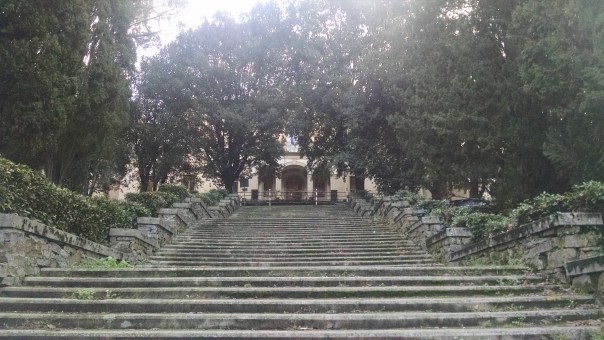
IMG_20180112_082716844

The Galileo Galilei Institute, at the end of a long, winding road filled with small, speedy cars and motorcycles, in classic Italian fashion

Rothstein has been heavily involved in doing gravitational wave calculations using tools from quantum field theory, something that has recently captured a lot of interest from amplitudes people. Specifically, he uses Effective Field Theory, theories that are “effectively” true at some scale but hide away higher-energy physics. In the case of gravitational waves, these theories are a powerful way to calculate the waves that LIGO and VIRGO can observe without using the full machinery of general relativity.

After seeing Rothstein’s lectures, I’m reminded of something he pointed out at the QCD Meets Gravity conference in December. He emphasized then that even if amplitudes people get very good at drawing diagrams for classical general relativity, that won’t be the whole story: there’s a series of corrections needed to “match” between the quantities LIGO is able to see and the ones we’re able to calculate. Different methods incorporate these corrections in different ways, and the most intuitive approach for us amplitudes folks may still end up cumbersome once all the corrections are included. In typical amplitudes fashion, this just makes me wonder if there’s a shortcut: some way to compute, not just a piece that gets plugged in to an Effective Field Theory story, but the waves LIGO sees in one fell swoop (or at least, the part where gravity is weak enough that our methods are still useful). That’s probably a bit naive of me, though.

Proofs and Insight

Hearing us talking about the Amplituhedron, the professor across the table chimed in.

“The problem with you amplitudes people, I never know what’s a conjecture and what’s proven. The Amplituhedron, is that still a conjecture?”

The Amplituhedron, indeed, is still a conjecture (although a pretty well-supported one at this point). After clearing that up, we got to talking about the role proofs play in theoretical physics.

The professor was worried that we weren’t being direct enough in stating which ideas in amplitudes had been proven. While I agreed that we should be clearer, one of his points stood out to me: he argued that one benefit of clearly labeling conjectures is that it motivates people to go back and prove things. That’s a good thing to do in general, to be sure that your conjecture is really true, but often it has an added benefit: even if you’re pretty sure your conjecture is true, proving it can show you why it’s true, leading to new and valuable insight.

There’s a long history of important physics only becoming clear when someone took the time to work out a proof. But in amplitudes right now, I don’t think our lack of proofs is leading to a lack of insight. That’s because the kinds of things we’d like to prove often require novel insight themselves.

It’s not clear what it would take to prove the Amplituhedron. Even if you’ve got a perfectly clear, mathematically nice definition for it, you’d still need to prove that it does what it’s supposed to do: that it really calculates scattering amplitudes in N=4 super Yang-Mills. In order to do that, you’d need a very complete understanding of how those calculations work. You’d need to be able to see how known methods give rise to something like the Amplituhedron, or to find the Amplituhedron buried deep in the structure of the theory.

If you had that kind of insight? Then yeah, you could prove the Amplituhedron, and accomplish remarkable things along the way. But more than that, if you had that sort of insight, you would prove the Amplituhedron. Even if you didn’t know about the Amplituhedron to begin with, or weren’t sure whether or not it was a conjecture, once you had that kind of insight proving something like the Amplituhedron would be the inevitable next step. The signpost, “this is a conjecture” is helpful for other reasons, but it doesn’t change circumstances here: either you have what you need, or you don’t.

This contrasts with how progress works in other parts of physics, and how it has worked at other times. Sometimes, a field is moving so fast that conjectures get left by the wayside, even when they’re provable. You get situations where everyone busily assumes something is true and builds off it, and no-one takes the time to work out why. In that sort of field, it can be really valuable to clearly point out conjectures, so that someone gets motivated to work out the proof (and to hopefully discover something along the way).

I don’t think amplitudes is in that position though. It’s still worthwhile to signal our conjectures, to make clear what needs a proof and what doesn’t. But our big conjectures, like the Amplituhedron, aren’t the kind of thing someone can prove just by taking some time off and working on it. They require new, powerful insight. Because of that, our time is typically best served looking for that insight, finding novel examples and unusual perspectives that clear up what’s really going on. That’s a fair bit broader an activity than just working out a proof.

Epistemology, Not Metaphysics, Justifies Experiments

While I was visiting the IAS a few weeks back, they had a workshop on Quantum Information and Black Holes. I didn’t see many of the talks, but I did get to see Leonard Susskind talk about his new slogan, GR=QM.

For some time now, researchers have been uncovering deep connections between gravity and quantum mechanics. Juan Maldacena jump-started the field with the discovery of AdS/CFT, showing that theories that describe gravity in a particular curved space (Anti-de Sitter, or AdS) are equivalent to non-gravity quantum theories describing the boundary of that space (specifically, Conformal Field Theories, or CFTs). The two theories contain the same information and, with the right “dictionary”, describe the same physics: in our field’s vernacular, they’re dual. Since then, physicists have found broader similarities, situations where properties of quantum mechanics, like entanglement, are closely linked to properties of gravity theories. Maldacena’s ER=EPR may be the most publicized of these, a conjectured equivalence between Einstein-Rosen bridges (colloquially known as wormholes) and entangled pairs of particles (famously characterized by Einstein, Podolsky, and Rosen).

GR=QM is clearly a riff on ER=EPR, but Susskind is making a more radical claim. Based on these developments, including his own work on quantum complexity, Susskind is arguing that the right kind of quantum mechanical system automatically gives rise to quantum gravity. What’s more, he claims that these systems will be available, using quantum computers, within roughly a decade. Within ten years or so, we’ll be able to do quantum gravity experiments.

That sounds ridiculous, until you realize he’s talking about dual theories. What he’s imagining is not an experiment at the absurdly high energies necessary to test quantum gravity, but rather a low-energy quantum mechanics experiment that is equivalent, by something like AdS/CFT, to a quantum gravity experiment.

Most people would think of that as a simulation, not an actual test of quantum gravity. Susskind, though, spends quite a bit of time defending the claim that it really is gravity, that literally GR=QM. His description of clever experiments and overarching physical principles is aimed at piling on evidence for that particular claim.

What do I think? I don’t think it matters much.

The claim Susskind is making is one of metaphysics: the philosophy of which things do and do not “really” exist. Unlike many physicists, I think metaphysics is worth discussing, that there are philosophers who make real progress with it.

But ultimately, Susskind is proposing a set of experiments. And what justifies experiments isn’t metaphysics, it’s epistemology: not what’s “really there”, but what we can learn.

What can we learn from the sorts of experiments Susskind is proposing?

Let’s get this out of the way first: we can’t learn which theory describes quantum gravity in our own world.

That’s because every one of these experiments relies on setting up a quantum system with particular properties. Every time, you’re choosing the “boundary theory”, the quantum mechanical side of GR=QM. Either you choose a theory with a known gravity partner, and you know how the inside should behave, or you choose a theory with an unknown partner. Either way, you have no reason to expect the gravity side to resemble the world we live in.

Plenty of people would get suspicious of Susskind here, and accuse him of trying to mislead people. They’re imagining headlines, “Experiment Proves String Theory”, based on a system intentionally set up to have a string theory dual, a system that can’t actually tell us whether string theory describes the real world.

That’s not where I’m going with this.

The experiments that Susskind is describing can’t prove string theory. But we could still learn something from them.

For one, we could learn whether these pairs of theories really are equivalent. AdS/CFT, ER=EPR, these are conjectures. In some cases, they’re conjectures with very good evidence. But they haven’t been proven, so it’s still possible there’s a problem people overlooked. One of the nice things about experiments and simulations is that they’re very good at exposing problems that were overlooked.

For another, we could get a better idea of how gravity behaves in general. By simulating a wide range of theories, we could look for overarching traits, properties that are common to most gravitational theories. We wouldn’t be sure that those properties hold in our world…but with enough examples, we could get pretty confident. Hopefully, we’d stumble on things that gravity has to do, in order to be gravity.

Susskind is quite capable of making these kinds of arguments, vastly more so than I. So it frustrates me that every time I’ve seen him talk or write about this, he hasn’t. Instead, he keeps framing things in terms of metaphysics, whether quantum mechanics “really is” gravity, whether the experiment “really” explores a wormhole. If he wants to usher in a new age of quantum gravity experiments, not just as a buzzword but as real, useful research, then eventually he’s going to have to stop harping on metaphysics and start talking epistemology. I look forward to when that happens.

Of Grad Students and Money

I usually avoid talking politics on this blog. In part, that’s because I usually don’t have something worth saying.

When the US House of Representatives voted on a tax bill that included a tax on grad student tuition waivers, though, I was tempted. Grad school wasn’t so long ago for me, and combining my friends’ experiences with mine I thought I knew enough for a post.

I still had questions, though. So I asked around, and tried to learn more.

In the end, the tax on tuition waivers was dropped from the bill. I’m not going to comment on the rest of the bill, I really don’t have any relevant expertise there.

I do want to say a bit about what I learned, though.

First, the basics:

In the US, PhD students don’t typically pay tuition. Instead, they get paid a stipend, which gets taxed just like any other income. In exchange, they work for their department at the university, as Teaching Assistants and Research Assistants.

PhD tuition isn’t zero, though. Their tuition (often comparable to undergraduate tuition at the same university) is waived, but someone still pays it. Sometimes that “someone” is the department, paying tuition alongside wages as part of the cost of a Teaching Assistant. Sometimes it’s a grant held by a professor, as part of the cost of that professor hiring a Research Assistant. Sometimes it’s another organization: the National Science Foundation or the Fulbright Program, paying for a student who showed their worth in an application process.


My first question, then, was this: what determines PhD student tuition?

I know a fair number of professors, many of whom have worked with university administrations, so I thought this would be simple to answer. Then I started asking people, and everyone I asked said something different.

Some thought it was mostly set by comparing to other universities. Others had the impression it was tied to undergrad tuition, that the university had a standard price it charges per course. Others pointed out that at many places, the cost of funding a grad student is the same as the cost of a postdoc. Since postdoc salaries are at least somewhat competitive, this implies that the total of grad student tuition plus stipend is set by the postdoc market, and then the university takes as much of it for tuition as they can before the stipend becomes unreasonably low.

What no one claimed, even after I asked them directly, was that grad student tuition represented the cost of educating a grad student. Grad education does cost money, in professor salaries and campus resources. But I couldn’t find anyone who would claim that this cost was anywhere near what universities charged in PhD tuition.

Rather, grad tuition seems to be part of the bulk of mysterious “overhead” that universities take out of grants. “Overhead” varies from grant to grant and situation to situation, with universities taking less out of some places and more out of others. Either way, it isn’t really overhead in the conventional sense: rather than being the cost to the university of administering that grant or educating that grad student, it’s treated as a source of money for the university to funnel elsewhere, to fund everything else they do.


If grad tuition waivers had ended up taxed, couldn’t universities just pay their grad students’ tuition some other way?

Yes, but you probably wouldn’t like it.

Waiving tuition is only one way to let grad students go tuition-free. Another way, which would not have been taxed under the proposed bill, is scholarships.

There are already some US universities that cover grad student tuition with scholarships, and I get the impression it’s a common setup in Canada. But from what I’ve seen, it doesn’t work very well.

The problem, as far as I can tell, is that once a university decides that something is a “scholarship”, it wants to pay it like a scholarship. For some reason, this appears to mean randomly, over the course of the year, rather than at the beginning of the year. This isn’t a huge problem when it’s just tuition, since usually universities are sensible enough to wait until you’ve gotten your scholarship to charge you. But often, universities that are already covering tuition with a scholarship will cover a significant chunk of stipend with it too.

The end result, as I’ve seen happen in several places, is that students show up and are told they’ll be paid a particular stipend. They sign rental contracts, they make plans assuming that money will be there. And then several months pass, and it turns out most of the stipend they were promised is a “scholarship”, and that scholarship won’t actually be paid until the university feels like it. So for the first few months, those students have to hope they have forgiving landlords, because it’s not like they can get the university to pay them on time just because they said they were going to.


Of course, I should mention that even without scholarships, there are universities that pay their students late, which leads into my overall point: this system is a huge mess. Grad students are in a weird in-between place, treated like employees part of the time and students part of the time, with the actual rationale in each case frustratingly opaque. In some places, with attentive departments or savvy grad student unions, the mess gets kept to a minimum. Others aren’t so lucky. What’s worse is that this kind of system is often the sort where, if you put it under any pressure, it shuffles the problem around until it ends up with someone who can’t complain. And chances are, that person is a grad student.

I don’t know how to fix this. It seems like the sort of thing where you have to just reform the system all in one go, in a way that takes everything into account. I don’t know of any proposed plans that do that.


One final note: I usually have a ban on politics in the comments. That would be more than a little hypocritical to enforce here. I’d still like to prevent the more vicious arguments, to keep the discussion civil and informative. As such, the following rules are intended as conversational speed bumps, with the hope that in writing around them you take a bit more time to think about what you have to say.

For the comments here, please: do not mention specific politicians, political parties, or ideologies. Please avoid personal insults, especially towards your fellow commenters. Please try to avoid speculation about peoples’ motives, and focus as much as possible on specifics: specific experiences you’ve had, specific rules and regulations, specific administrative practices, specific economic studies. If at all possible, try to inform, not just vent, and maybe we can learn something from each other.
4gravitons Meets QCD Meets Gravity

I’m at UCLA this week, for the workshop QCD Meets Gravity. I haven’t worked on QCD or gravity yet, so I’m mostly here as an interested observer, and as an excuse to enjoy Los Angeles in December.

IMG_20171213_082840263_HDR

I think there’s a song about this…

QCD Meets Gravity is a conference centered around the various ways that “gravity is Yang-Mills squared”. There are a number of tricks that let you “square” calculations in Yang-Mills theories (a type of theory that includes QCD) to get calculations in gravity, and this conference showcased most of them.

At Amplitudes this summer, I was disappointed there were so few surprises. QCD Meets Gravity was different, with several talks on new or preliminary results, including one by Julio Parra-Martinez where the paper went up in the last few minutes of the talk! Yu-tin Huang talked about his (still-unpublished) work with Nima Arkani-Hamed on “UV/IR Polytopes”. The story there is a bit like the conformal bootstrap, with constraints (in this case based on positivity) marking off a space of “allowed” theories. String theory, interestingly, is quite close to the boundary of what is allowed. Enrico Herrmann is working on a way to figure out which gravity integrands are going to diverge without actually integrating them, while Simon Caron-Huot, in his characteristic out-of-the-box style, is wondering whether supersymmetric black holes precess. We also heard a bit more about a few recent papers. Oliver Schlotterer’s talk cleared up one thing: apparently the GEF functions he defines in his paper on one-loop “Z theory” are pronounced “Jeff”. I kept waiting for him to announce “Jeff theory”, but unfortunately no such luck. Sebastian Mizera’s talk was a very clear explanation of intersection theory, the subject of his recent paper. As it turns out, intersection theory is the study of mathematical objects like the Beta function (which shows up extensively in string theory), taking them apart in a way very reminiscent of the “squaring” story of Yang-Mills and gravity.

The heart of the workshop this year was gravitational waves. Since LIGO started running, amplitudes researchers (including, briefly, me) have been looking for ways to get involved. This conference’s goal was to bring together amplitudes people and the gravitational wave community, to get a clearer idea of what we can contribute. Between talks and discussions, I feel like we all understand the problem better. Some things that the amplitudes community thought were required, like breaking the symmetries of special relativity, turn out to be accidents of how the gravitational wave community calculates things: approximations that made things easier for them, but make things harder for us. There are areas in which we can make progress quite soon, even areas in which amplitudes people have already made progress. The detectors for which the new predictions matter might still be in the future (LIGO can measure two or three “loops”, LISA will see up to four), but they will eventually be measured. Amplitudes and gravitational wave physics could turn out to be a very fruitful partnership.


An Elliptical Workout

I study scattering amplitudes, probabilities that particles scatter off each other.

In particular, I’ve studied them using polylogarithmic functions. Polylogarithmic functions can be taken apart into “logs”, which obey identities much like logarithms do. They’re convenient and nice, and for my favorite theory of N=4 super Yang-Mills they’re almost all you need.

Well, until ten particles get involved, anyway.

That’s when you start needing elliptic integrals, and elliptic polylogarithms. These integrals substitute one of the “logs” of a polylogarithm with an integration over an elliptic curve.

And with Jacob Bourjaily, Andrew McLeod, Marcus Spradlin, and Matthias Wilhelm, I’ve now computed one.

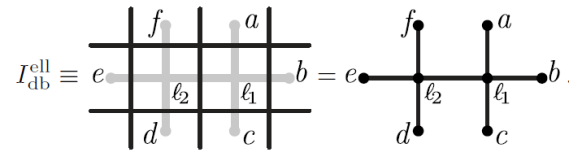
tenpointimage

This one, to be specific

Our paper, The Elliptic Double-Box Integral, went up on the arXiv last night.

The last few weeks have been a frenzy of work, finishing up our calculations and writing the paper. It’s the fastest I’ve ever gotten a paper out, which has been a unique experience.

Computing this integral required new, so far unpublished tricks by Jake Bourjaily, as well as some rather powerful software and Mark Spradlin’s extensive expertise in simplifying polylogarithms. In the end, we got the integral into a “canonical” form, one other papers had proposed as the right way to represent it, with the elliptic curve in a form standardized by Weierstrass.

One of the advantages of fixing a “canonical” form is that it should make identities obvious. If two integrals are actually the same, then writing them according to the same canonical rules should make that clear. This is one of the nice things about polylogarithms, where these identities are really just identities between logs and the right form is comparatively easy to find.

Surprisingly, the form we found doesn’t do this. We can write down an integral in our “canonical” form that looks different, but really is the same as our original integral. The form other papers had suggested, while handy, can’t be the final canonical form.

What the final form should be, we don’t yet know. We have some ideas, but we’re also curious what other groups are thinking. We’re relatively new to elliptic integrals, and there are other groups with much more experience with them, some with papers coming out soon. As far as we know they’re calculating slightly different integrals, ones more relevant for the real world than for N=4 super Yang-Mills. It’s going to be interesting seeing what they come up with. So if you want to follow this topic, don’t just watch for our names on the arXiv: look for Claude Duhr and Falko Dulat, Luise Adams and Stefan Weinzierl. In the elliptic world, big things are coming.