
Monthly Archives: August 2026

Don’t Judge an Explanation by Its Cover

Dark matter bugs people.

I’ve talked before about why, and why it, and other beyond-the-standard-model proposals like those inspired by MOND, are nonetheless credible with physicists. But beyond the logic in that post, there’s a deeper reason people find dark matter strange. It’s that they don’t know what kind of an explanation dark matter is.

Dark matter sounds very lazy. If you can’t explain the movements of stars based on the matter you can see, then proposing invisible matter sounds like the easy way out. But it’s actually a lot less easy than it sounds, because matter is something quite specific. Matter gravitates and bends light. Matter moves. Matter can be described with a pressure, one like gas and dust and not like other things like light or the Higgs field. If you propose a new type of matter, you have to check and see that all of those consequences hold, with detailed implications for almost every observation every astronomer takes.

For the most part, those consequences have been checked, and they do hold. Sometimes they fail, and it’s those failures, and not the idea that dark matter is “lazy”, that drive dark matter’s critics in the physics profession. Physicists who oppose dark matter have other explanations with their own consequences, for example new types of quantum fields that often get described to the public as “modified gravity”. When they argue against dark matter, they do it by comparing those consequences in detail, working through the implications and seeing which phenomena hold.

Dark matter, as it turns out, is a very constraining explanation, one with strict consequences. There are other corners of physics where the explanations may seem less lazy, but actually have fewer consequences, and thereby less scientific heft.

For example, consider the debate about evidence for dark energy I wrote about last month. A key question there was how to interpret light from supernovae. Some groups argued that supernovae change in brightness with distance, others that they change based on how old their galaxies are. Sabine Hossenfelder glossed the debate by saying it comes down to how you model supernovae. And while that’s true, it can give the wrong impression.

You might think that these people are comparing detailed computer models of supernovae, and making different assumptions when they set their models up. But in reality, it’s much less detailed. The people on both sides of this debate are looking at correlations, trying to draw statistical lines through supernova datasets. The difference between one model and another isn’t a complicated physical setup you can put into a simulation, it’s just which lines on a graph you account for and which you ignore.

Because of that, while these models may sound much more sophisticated than dark matter, they actually have much less scientific weight. The different supernova models don’t have grand, widespread consequences, they’re not mucking with the laws of physics or proposing new classes of object that every astronomer needs to account for. They’re pretty much just proposing tweaks to how to interpret one very specific type of data. That makes their questions much harder to resolve, and their answers much less universally convincing.

If you’re not a scientist, if you read science news, it can be hard to tell the difference. Some ideas in science may sound simple, but have a whole raft of consequences that distinguish them from other ideas. Others may sound sophisticated, but are much more like “fudge factors”, only distinguished by statistical arguments, not by a rich trail of qualitative evidence.

For the most part, as an outsider, you’ll never know which is which. But as always, it’s best to be aware of your limits.
Newsworthiness Guide for Scientists

I had a recurring “elevator pitch” at Lancefest earlier this summer. After explaining that I’m a science journalist now, I’d end with “so if you run into a story, let me know!”

One person had a question that left me stumped: “What counts as a story?”

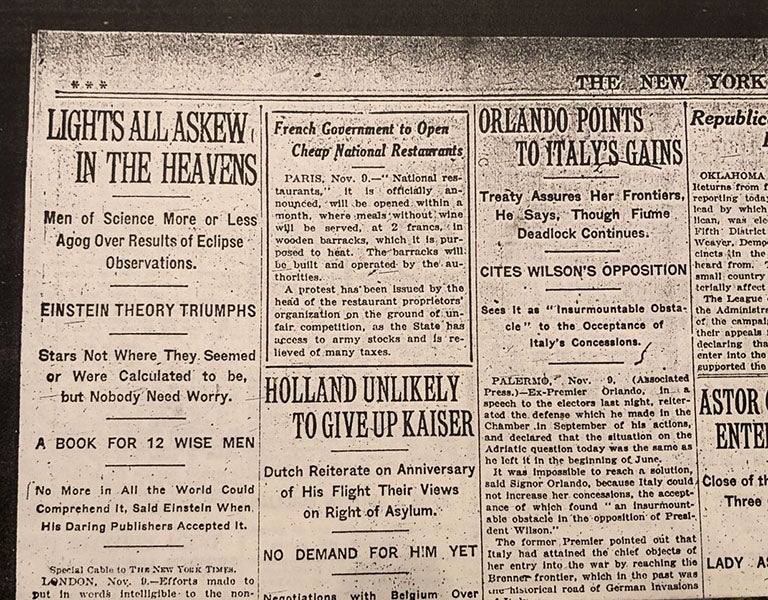
For those of us who don’t happen to be Einstein

I didn’t have a good response then. I’ve got a better one now, though I’m afraid it doesn’t fit in an elevator pitch. This is all based on my experience, so take it with a grain of salt. But here are the criteria that seem to matter:

First, a story usually needs a news hook. News is, in particular, supposed to be “new”. That doesn’t mean I can’t write about history, or established science. But editors like those stories a lot better if there is some recent development, within the past year or so, to tie it to. The new development doesn’t have to be all that important, the story can mostly focus on something else. But it needs to be somewhere in there.

Second, news stories are usually qualitative, not quantitative. I need to be able to tell a story about what happened, what actions people took and why they mattered. Quantitative developments usually only make the news if they’re so big that they shade into the qualitative: something doubling unexpectedly, for example.

Third, ideally a science news story is something that is getting the experts excited. Journalists aren’t supposed to judge the scientific merit of ideas on their own, they’re supposed to rely on experts. The most solid stories, the ones that are easiest to pitch, are ones where there’s a community of experts that largely think something is cool. That makes it easier to get good quotes, and easier to justify its relevance. If you accomplished something and you’re having trouble convincing anyone it matters, don’t start with me, start with your colleagues!

Fourth: less importantly, it helps when stories have a human angle. If you can tell a tale about how you came up with an idea, if you came from an unusual background, if something was hotly debated but now is deemed essential: these things sweeten a story, they capture readers’ interest, and editors see their value.

Finally, stories involve something changing. It can be something that just changed now, for a news piece, but it can also be something that changed over time, for a feature in a magazine. The key is change. “Old method still works” is not going to excite people, and it won’t count as news.

After writing all that out, I’m still not sure I answered the original question. But hopefully I’ve at least given some tips that can get you started. If you’re a scientist, and you see something that hits most of the boxes on this list but hasn’t been covered in the news yet, consider reaching out to me. You may have run into a story!

Better Bounds

I swear this isn’t turning into an AI blog. But did you see the one about the Riemann hypothesis?

Someone at Anthropic did something I’m sure they’re all tempted to do, and tried to use an internal version of their Claude AI system to prove the most famous open conjecture in mathematics. It didn’t work, to be clear, and I get the impression they didn’t expect it to. But out of six hundred or so fruitless tries, one attempt did prove a new bound. Previously, mathematicians had been able to prove that at least 41.6% of the zeroes of the Riemann zeta function satisfied the Riemann hypothesis. Now, the new proof shows that at least 67.2% satisfy it.

Anthropic’s press release is impressively careful. As someone who’s had to think about how to write content that both excites the public and doesn’t piss off experts too much, they do an admirable job walking that line. They even say, straight-out, “We don’t expect that the techniques Claude used will lead to proving the Riemann hypothesis.”

Bounds are like that, sometimes.

I should know. Physicists also find bounds.

Physics has its own conjectures with the fame of the Riemann hypothesis. Dark matter might be made of detectable particles. Protons could decay. There might be extra dimensions, or magnetic monopoles, or cosmic strings. General relativity might be subtly wrong.

It would be an amazing achievement to demonstrate any of these things. But most physicists won’t manage that. Instead, they bound them.

Physicists compete to get better bounds, excluding unusual possibilities with greater and greater care. They find evidence that dark matter can’t be of a specific mass with a specific charge, so the next experiment has to look somewhere else, or find evidence that general relativity holds to even greater precision, so any deviation must be even smaller. Some work to improve experiments with better and better bounds. Others analyze data from older experiments, or find under-appreciated consequences of known facts, and can get even better bounds.

Bounds aren’t typically newsworthy (though occasionally they make it through), so most people don’t hear about them. If you read the news, you hear about positive claims much more often than negative ones: evidence for something new, not evidence that our current knowledge holds. But the nature of physics is that most work supports the status quo. Most work improves bounds.

Do bounds lead, with time, to the positive claims? Sometimes, but not always. Often, bounds are just bounds. They’re attempts to use the methods physicists have to learn something new about the world. Even if the new fact is just “don’t look here”.

It Only Counts When AI Gets to My Field

It’s a meme at this point.

When Deep Blue beat Kasparov, Go players could say that their game, unlike Chess, was too complex to fall to a computer program. Then AlphaGo showed they were wrong. It just took a better approach.

When AlphaFold leaped ahead of human experts in predicting how proteins fold, it was due to a mountain of carefully labeled protein structure data. Other scientists and mathematicians could argue that nothing like that existed in their field, so a similar success was unlikely. But LLMs can now navigate scientific literature, and loosely imitate the reasoning process of a mathematical proof. And increasingly, the math and computer science results coming out of AI labs are ones that humans find impressive.

Now, experts argue about how far AI can really go. Will AI mathematics only be good at finding counterexamples and solving cute puzzles, not introducing new concepts and frameworks? Will AI only be meaningfully good at fields like mathematics with clear rules and carefully collected conjectures, not fuzzier fields like physics? Will AI-powered labs only manage to optimize specific procedures, and not carry out entire experimental programs? Each time, the pattern seems to be that scholars are skeptical, until AI gets to their field.

I’m aware of this pattern. But I’m willing to take the risk.

I think my old field, scattering amplitudes, is special. And when AI can do something meaningful there, I’ll really start to worry.

By “something meaningful”, I don’t mean the student-level results that have come out so far. I mean tackling some of the field’s big outstanding problems: determining whether N=8 supergravity diverges at seven loops, or finding the six-particle amplitude in N=4 super Yang-Mills to nine loops. Getting another loop past the state of the art for gravitational wave physics or collider physics would also count.

These problems are difficult not just because people haven’t had the right ideas, but because they’re hard in a computational sense. Each loop, a rough measure of the precision of the end result, represents an increase in complexity, in calculations that typically scale exponentially or even factorially in the number of loops. In principle, amplitudes researchers could do any of these with no new ideas, just using known methods. They’d just need access to a lot more computing power.

See, while everyone else is preoccupied with whether AI can come up with genuinely new ideas, I think the real measure is what those ideas accomplish. And the most important measure of accomplishment, if you’re worried about how scared to be about AI, is whether it can do things that seem like they would take too much computing power.

In the past, when people dreamed up the scariest hypothetical things AI could achieve, critics argued they were impossible due to a lack of computing power. Apocalypse scenarios often involve designing self-replicating nanobots based on computer models of molecules, or unstoppable social manipulation based on simulating the minds of the humans the AI interacts with. If AI is going to manage these things, or something like them, it will take an approach that somehow bypasses that need for more computers than we can build.

So if AI companies want to impress people like me (or scare us, for that matter), then they need to tackle my old field. Show that an AI can take the kinds of computer resources an academic has access to, and solve one of the scattering amplitudes field’s big outstanding problems. Show that a computational limit everyone expected to be a problem doesn’t actually matter. Give us N=8 supergravity to seven loops, or N=4 super Yang-Mills to nine loops.