
Monthly Archives: February 2026

Hypothesis: If AI Is Bad at Originality, It’s a Documentation Problem

Recently, a few people have asked me about this paper.

A couple weeks back, OpenAI announced a collaboration with a group of amplitudes researchers, physicists who study the types of calculations people do to make predictions at particle colliders. The amplitudes folks had identified an interesting loophole, finding a calculation that many would have expected to be zero actually gave a nonzero answer. They did the calculation for different examples involving more and more particles, and got some fairly messy answers. They suspected, as amplitudes researchers always expect, that there was a simpler formula, one that worked for any number of particles. But they couldn’t find it.

Then a former amplitudes researcher at OpenAI suggested that they use AI to find it.

“Use AI” can mean a lot of different things, and most of them don’t look much like the way the average person talks to ChatGPT. This was closer than most. They were using “reasoning models”, loops that try to predict the next few phrases in a “chain of thought” again and again and again. Using that kind of tool, they were able to find that simpler formula, and mathematically prove that it was correct.

A few of you are hoping for an in-depth post about what they did, and its implications. This isn’t that. I’m still figuring out if I’ll be writing that for an actual news site, for money, rather than free, for you folks.

Instead, I want to talk about a specific idea I’ve seen crop up around the paper.

See, for some, the existence of a result like this isn’t all that surprising.

Mathematicians have been experimenting with reasoning models for a bit, now. Recently, a group published a systematic study, setting the AI loose on a database of minor open problems proposed by the famously amphetamine-fueled mathematician Paul Erdös. The AI managed to tackle a few of the problems, sometimes by identifying existing solutions that had not yet been linked to the problem database, but sometimes by proofs that appeared to be new.

The Erdös problems solved by the AI were not especially important. Neither was the problem solved by the amplitudes researchers, as far as I can tell at this point.

But I get the impression the amplitudes problem was a bit more interesting than the Erdös problems. The difference, so far, has mostly been attributed to human involvement. This amplitudes paper started because human amplitudes researchers found an interesting loophole, and only after that used the AI. Unlike the mathematicians, they weren’t just searching a database.

This lines up with a general point, one people tend to make much less carefully. It’s often said that, unlike humans, AI will never be truly creative. It can solve mechanical problems, do things people have done before, but it will never be good at having truly novel ideas.

To me, that line of thinking goes a bit too far. I suspect it’s right on one level, that it will be hard for any of these reasoning models to propose anything truly novel. But if so, I think it will be for a different reason.

The thing is, creativity is not as magical as we make it out to be. Our ideas, scientific or artistic, don’t just come from the gods. They recombine existing ideas, shuffling them in ways more akin to randomness than miracle. They’re then filtered through experience, deep heuristics honed over careers. Some people are good at ideas, and some are bad at them. Having ideas takes work, and there are things people do to improve their ideas. Nothing about creativity suggests it should be impossible to mechanize.

However, a machine trained on text won’t necessarily know how to do any of that.

That’s because in science, we don’t write down our inspirations. By the time a result gets into a scientific paper or textbook, it’s polished and refined into a pure argument, cutting out most of the twists and turns that were an essential part of the creative process. Mathematics is even worse, most math papers don’t even mention the motivation behind the work, let alone the path taken to the paper.

This lack of documentation makes it hard for students, making success much more a function of having the right mentors to model good practices, rather than being able to pick them up from literature everyone can access. I suspect it makes it even harder for language models. And if today’s language model-based reasoning tools are bad at that crucial, human-seeming step, of coming up with the right idea at the right time? I think that has more to do with this lack of documentation, than with the fact that they’re “statistical parrots”.
Most Academics Don’t Choose Their Specialty

It’s there in every biography, and many interviews: the moment the scientist falls in love with an idea. It can be a kid watching ants in the backyard, a teen peering through a telescope, or an undergrad seeing a heart cell beat on a slide. It’s a story so common that it forms the heart of the public idea of a scientist: not just someone smart enough to understand the world, but someone passionate enough to dive in to their one particular area above all else. It’s easy to think of it as a kind of passion most people never get to experience.

And it does happen, sometimes. But it’s a lot less common than you’d think.

I first started to suspect this as a PhD student. In the US, getting accepted into a PhD program doesn’t guarantee you an advisor to work with. You have to impress a professor to get them to spend limited time and research funding on you. In practice, the result was the academic analog of the dating scene. Students looked for who they might have a chance with, based partly on interest but mostly on availability and luck and rapport, and some bounced off many potential mentors before finding one that would stick.

Then, for those who continued to postdoctoral positions, the same story happened all over again. Now, they were applying for jobs, looking for positions where they were qualified enough and might have some useful contacts, with interest into the specific research topic at best a distant third.

Working in the EU, I’ve seen the same patterns, but offset a bit. Students do a Master’s thesis, and the search for a mentor there is messy and arbitrary in similar ways. Then for a PhD, they apply for specific projects elsewhere, and as each project is its own funded position the same job search dynamics apply.

The picture only really clicked for me, though, when I started doing journalism.

Nowadays, I don’t do science, I interview people about it. The people I interview are by and large survivors: people who got through the process of applying again and again and now are sitting tight in an in-principle permanent position. They’re people with a lot of freedom to choose what to do.

And so I often ask for that reason, that passion, that scientific love at first sight moment: why do you study what you do? It’s a story that audiences love, and thus that editors love, it’s always a great way to begin a piece.

But surprisingly often, I get an unromantic answer. Why study this? Because it was available. Because in the Master’s, that professor taught the intro course. Because in college, their advisor had contacts with that lab to arrange a study project. Because that program accepted people from that country.

And I’ve noticed how even the romantic answers tend to be built on the unromantic ones. The professors who know how to weave a story, to self-promote and talk like a politician, they’ll be able to tell you about falling in love with something, sure. But if you read between the lines, you’ll notice where their anecdotes fall, how they trace a line through the same career steps that less adroit communicators admit were the real motivation.

There’s been times I’ve thought that my problem was a lack of passion, that I wasn’t in love the same way other scientists were in love. I’ve even felt guilty, that I took resources and positions from people who were. There is still some truth in that guilt, I don’t think I had the same passion for my science as most of my colleagues.

But I appreciate more now, that that passion is in part a story. We don’t choose our specialty, making some grand agentic move. Life chooses for us. And the romance comes in how you tell that story, after the fact.

Valentine’s Day Physics Poem 2026

Tomorrow is Valentine’s Day, so it’s time for this blog’s yearly tradition of posting a poem. Next week there may be a prose take on the same topic.

You’ve heard love stories like Oliver’s, I’m sure.
Meeting that childhood sweetheart
In the back room, with the garden view
And trust that, with a wink, the parents may regret.
Stories tungsten-milled
To fit our expectations.

And you’ve heard wilder stories
From genuinely riskier lives.
The rescue and the love linked under the Milky Way
Like an action movie.
The love’s reality, even so,
Defying summary.

You’ve heard stories of wide-eyed students
Realizing they can be adults.
Of those moments in study or celebration
Turning points in self-conception.
And maybe you don’t ask
About the other times.

Love happens,
And we love love to happen.
But we build love too.

May that which we build
Outgrow the story.

The Timeline for Replacing Theorists Is Not Technological

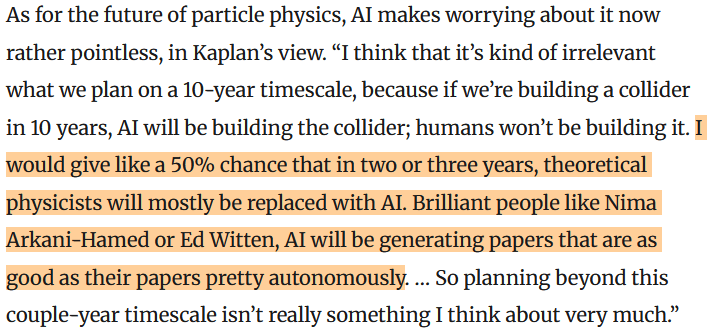
Quanta Magazine recently published a reflection by Natalie Wolchover on the state of fundamental particle physics. The discussion covers a lot of ground, but one particular paragraph has gotten the lion’s share of the attention. Wolchover talked to Jared Kaplan, the ex-theoretical physicist turned co-founder of Anthropic, one of the foremost AI companies today.

Kaplan was one of Nima Arkani-Hamed’s PhD students, which adds an extra little punch.

There’s a lot to contest here. Is AI technology anywhere close to generating papers as good as the top physicists, or is that relegated to the sci-fi future? Does Kaplan really believe this, or is he just hyping up his company?

I don’t have any special insight into those questions, about the technology and Kaplan’s motivations. But I think that, even if we trusted him on the claim that AI could be generating Witten- or Nima-level papers in three years, that doesn’t mean it will replace theoretical physicists. That part of the argument isn’t a claim about the technology, but about society.

So let’s take the technological claims as given, and make them a bit more specific. Since we don’t have any objective way of judging the quality of scientific papers, let’s stick to the subjective. Today, there are a lot of people who get excited when Witten posts a new paper. They enjoy reading them, they find the insights inspiring, they love the clarity of the writing and their tendency to clear up murky ideas. They also find them reliable: the papers very rarely have mistakes, and don’t leave important questions unanswered.

Let’s use that as our baseline, then. Suppose that Anthropic had an AI workflow that could reliably write papers that were just as appealing to physicists as Witten’s papers are, for the same reasons. What happens to physicists?

Witten himself is retired, which for an academic means you do pretty much the same thing you were doing before, but now paid out of things like retirement savings and pension funds, not an institute budget. Nobody is going to fire Witten, there’s no salary to fire him from. And unless he finds these developments intensely depressing and demoralizing (possible, but very much depends on how this is presented), he’s not going to stop writing papers. Witten isn’t getting replaced.

More generally, though, I don’t think this directly results in anyone getting fired, or in universities trimming positions. The people making funding decisions aren’t just sitting on a pot of money, trying to maximize research output. They’ve got money to be spent on hires, and different pools of money to be spent on equipment, and the hires get distributed based on what current researchers at the institutes think is promising. Universities want to hire people who can get grants, to help fund the university, and absent rules about AI personhood, the AIs won’t be applying for grants.

Funding cuts might be argued for based on AI, but that will happen long before AI is performing at the Witten level. We already see this happening in other industries or government agencies, where groups that already want to cut funding are getting think tanks and consultants to write estimates that justify cutting positions, without actually caring whether those estimates are performed carefully enough to justify their conclusions. That can happen now, and doesn’t depend on technological progress.

AI could also replace theoretical physicists in another sense: the physicists themselves might use AI to do most of their work. That’s more plausible, but here adoption still heavily depends on social factors. Will people feel like they are being assessed on whether they can produce these Witten-level papers, and that only those who make them get hired, or funded? Maybe. But it will propagate unevenly, from subfield to subfield. Some areas will make their own rules forbidding AI content, there will be battles and scandals and embarrassments aplenty. It won’t be a single switch, the technology alone setting the timeline.

Finally, AI could replace theoretical physicists in another way, by people outside of academia filling the field so much that theoretical physicists have nothing more that they want to do. Some non-physicists are very passionate about physics, and some of those people have a lot of money. I’ve done writing work for one such person, whose foundation is now attempting to build an AI Physicist. If these AI Physicists get to Witten-level quality, they might start writing compelling paper after compelling paper. Those papers, though, will due to their origins be specialized. Much as philanthropists mostly fund the subfields they’ve heard of, philanthropist-funded AI will mostly target topics the people running the AI have heard are important. Much like physicists themselves adopting the technology, there will be uneven progress from subfield to subfield, inch by socially-determined inch.

In a hard-to-quantify area like progress in science, that’s all you can hope for. I suspect Kaplan got a bit of a distorted picture of how progress and merit work in theoretical physics. He studied with Nima Arkani-Hamed, who is undeniably exceptionally brilliant but also undeniably exceptionally charismatic. It must feel to a student of Nima’s that academia simply hires the best people, that it does whatever it takes to accomplish the obviously best research. But the best research is not obvious.

I think some of these people imagine a more direct replacement process, not arranged by topic and tastes, but by goals. They picture AI sweeping in and doing what theoretical physics was always “meant to do”: solve quantum gravity, and proceed to shower us with teleporters and antigravity machines. I don’t think there’s any reason to expect that to happen. If you just asked a machine to come up with the most useful model of the universe for a near-term goal, then in all likelihood it wouldn’t consider theoretical high-energy physics at all. If you see your AI as a tool to navigate between utopia and dystopia, theoretical physics might matter at some point: when your AI has devoured the inner solar system, is about to spread beyond the few light-minutes when it can signal itself in real-time, and has to commit to a strategy. But as long as the inner solar system remains un-devoured, I don’t think you’ll see an obviously successful theory of fundamental physics.