Monthly Archives: May 2024

Does Science Require Publication?

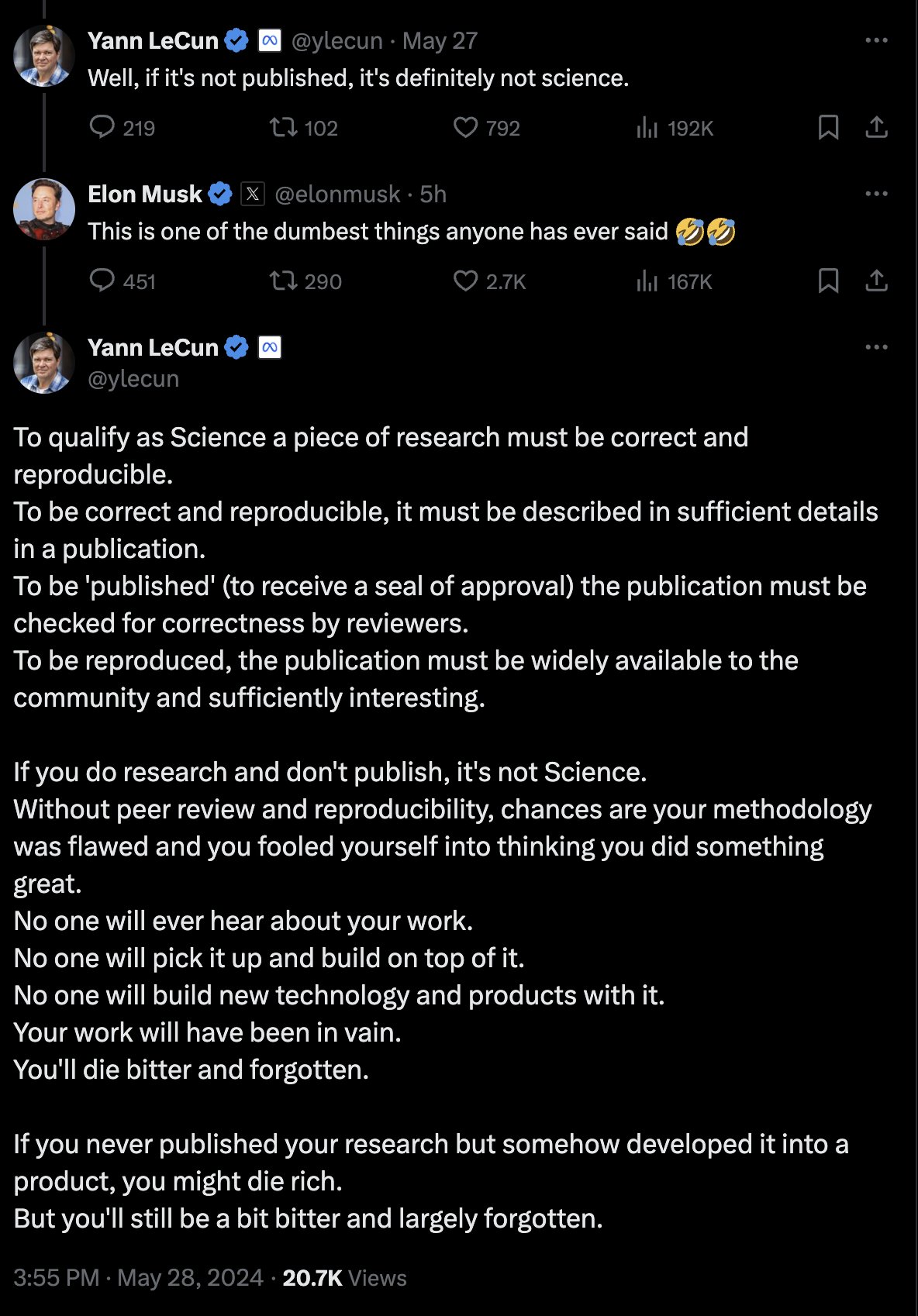
Seen on Twitter:

As is traditional, twitter erupted into dumb arguments over this. Some made fun of Yann LeCun for implying that Elon Musk will be forgotten, which despite any other faults of his seems unlikely. Science popularizer Sabine Hossenfelder pointed out that there are two senses of “publish” getting confused here: publish as in “make public” and publish as in “put in a scientific journal”. The latter tends to be necessary for scientists in practice, but is not required in principle. (The way journals work has changed a lot over just the last century!) The former, Sabine argued, is still 100% necessary.

Plenty of people on twitter still disagreed (this always happens). It got me thinking a bit about the role of publication in science.

When we talk about what science requires or doesn’t require, what are we actually talking about?

“Science” is a word, and like any word its meaning is determined by how it is used. Scientists use the word “science” of course, as do schools and governments and journalists. But if we’re getting into arguments about what does or does not count as science, then we’re asking about a philosophical problem, one in which philosophers of science try to understand what counts as science and what doesn’t.

What do philosophers of science want? Many things, but a big one is to explain why science works so well. Over a few centuries, humanity went from understanding the world in terms of familiar materials and living creatures to decomposing them in terms of molecules and atoms and cells and proteins. In doing this, we radically changed what we were capable of, computers out of the reach of blacksmiths and cures for diseases that weren’t even distinguishable. And while other human endeavors have seen some progress over this time (democracy, human rights…), science’s accomplishment demands an explanation.

Part of that explanation, I think, has to include making results public. Alchemists were interested in many of the things later chemists were, and had started to get some valuable insights. But alchemists were fearful of what their knowledge would bring (especially the ones who actually thought they could turn lead into gold). They published almost only in code. As such, the pieces of progress they made didn’t build up, didn’t aggregate, didn’t become overall progress. It was only when a new scientific culture emerged, when natural philosophers and physicists and chemists started writing to each other as clearly as they could, that knowledge began to build on itself.

Some on twitter pointed out the example of the Manhattan project during World War II. A group of scientists got together and made progress on something almost entirely in secret. Does that not count as science?

I’m willing to bite this bullet: I don’t think it does! When the Soviets tried to replicate the bomb, they mostly had to start from scratch, aside from some smuggled atomic secrets. Today, nations trying to build their own bombs know more, but they still must reinvent most of it. We may think this is a good thing, we may not want more countries to make progress in this way. But I don’t think we can deny that it genuinely does slow progress!

At the same time, to contradict myself a bit: I think you can think of science that happens within a particular community. The scientists of the Manhattan project didn’t publish in journals the Soviets could read. But they did write internal reports, they did publish to each other. I don’t think science by its nature has to include the whole of humanity (if it does, then perhaps studying the inside of black holes really is unscientific). You probably can do science sticking to just your own little world. But it will be slower. Better, for progress’s sake, if you can include people from across the world.

At Quanta This Week, and Some Bonus Material

When I moved back to Denmark, I mentioned that I was planning to do more science journalism work. The first fruit of that plan is up this week: I have a piece at Quanta Magazine about a perennially trendy topic in physics, the S-matrix.

It’s been great working with Quanta again. They’ve been thorough, attentive to the science, and patient with my still-uncertain life situation. I’m quite likely to have more pieces there in future, and I’ve got ideas cooking with other outlets as well, so stay tuned!

My piece with Quanta is relatively short, the kind of thing they used to label a “blog” rather than say a “feature”. Since the S-matrix is a pretty broad topic, there were a few things I couldn’t cover there, so I thought it would be nice to discuss them here. You can think of this as a kind of “bonus material” section for the piece. So before reading on, read my piece at Quanta first!

Welcome back!

At Quanta I wrote a kind of cartoon of the S-matrix, asking you to think about it as a matrix of probabilities, with rows for input particles and columns for output particles. There are a couple different simplifications I snuck in there, the pop physicist’s “lies to children“. One, I already flag in the piece: the entries aren’t really probabilities, they’re complex numbers, probability amplitudes.

There’s another simplification that I didn’t have space to flag. The rows and columns aren’t just lists of particles, they’re lists of particles in particular states.

What do I mean by states? A state is a complete description of a particle. A particle’s state includes its energy and momentum, including the direction it’s traveling in. It includes its spin, and the direction of its spin: for example, clockwise or counterclockwise? It also includes any charges, from the familiar electric charge to the color of a quark.

This makes the matrix even bigger than you might have thought. I was already describing an infinite matrix, one where you can have as many columns and rows as you can imagine numbers of colliding particles. But the number of rows and columns isn’t just infinite, but uncountable, as many rows and columns as there are different numbers you can use for energy and momentum.

For some of you, an uncountably infinite matrix doesn’t sound much like a matrix. But for mathematicians familiar with vector spaces, this is totally reasonable. Even if your matrix is infinite, or even uncountably infinite, it can still be useful to think about it as a matrix.

Another subtlety, which I’m sure physicists will be howling at me about: the Higgs boson is not supposed to be in the S-matrix!

In the article, I alluded to the idea that the S-matrix lets you “hide” particles that only exist momentarily inside of a particle collision. The Higgs is precisely that sort of particle, an unstable particle. And normally, the S-matrix is supposed to only describe interactions between stable particles, particles that can survive all the way to infinity.

In my defense, if you want a nice table of probabilities to put in an article, you need an unstable particle: interactions between stable particles depend on their energy and momentum, sometimes in complicated ways, while a single unstable particle will decay into a reliable set of options.

More technically, there are also contexts in which it’s totally fine to think about an S-matrix between unstable particles, even if it’s not usually how we use the idea.

My piece also didn’t have a lot of room to discuss new developments. I thought at minimum I’d say a bit more about the work of the young people I mentioned. You can think of this as an appetizer: there are a lot of people working on different aspects of this subject these days.

Part of the initial inspiration for the piece was when an editor at Quanta noticed a recent paper by Christian Copetti, Lucía Cordova, and Shota Komatsu. The paper shows an interesting case, where one of the “logical” conditions imposed in the original S-matrix bootstrap doesn’t actually apply. It ended up being too technical for the Quanta piece, but I thought I could say a bit about it, and related questions, here.

Some of the conditions imposed by the original bootstrappers seem unavoidable. Quantum mechanics makes no sense if doesn’t compute probabilities, and probabilities can’t be negative, or larger than one, so we’d better have an S-matrix that obeys those rules. Causality is another big one: we probably shouldn’t have an S-matrix that lets us send messages back in time and change the past.

Other conditions came from a mixture of intuition and observation. Crossing is a big one here. Crossing tells you that you can take an S-matrix entry with in-coming particles, and relate it to a different S-matrix entry with out-going anti-particles, using techniques from the calculus of complex numbers.

Crossing may seem quite obscure, but after some experience with S-matrices it feels obvious and intuitive. That’s why for an expert, results like the paper by Copetti, Cordova, and Komatsu seem so surprising. What they found was that a particularly exotic type of symmetry, called a non-invertible symmetry, was incompatible with crossing symmetry. They could find consistent S-matrices for theories with these strange non-invertible symmetries, but only if they threw out one of the basic assumptions of the bootstrap.

This was weird, but upon reflection not too weird. In theories with non-invertible symmetries, the behaviors of different particles are correlated together. One can’t treat far away particles as separate, the way one usually does with the S-matrix. So trying to “cross” a particle from one side of a process to another changes more than it usually would, and you need a more sophisticated approach to keep track of it. When I talked to Cordova and Komatsu, they related this to another concept called soft theorems, aspects of which have been getting a lot of attention and funding of late.

In the meantime, others have been trying to figure out where the crossing rules come from in the first place.

There were attempts in the 1970’s to understand crossing in terms of other fundamental principles. They slowed in part because, as the original S-matrix bootstrap was overtaken by QCD, there was less motivation to do this type of work anymore. But they also ran into a weird puzzle. When they tried to use the rules of crossing more broadly, only some of the things they found looked like S-matrices. Others looked like stranger, meaningless calculations.

A recent paper by Simon Caron-Huot, Mathieu Giroux, Holmfridur Hannesdottir, and Sebastian Mizera revisited these meaningless calculations, and showed that they aren’t so meaningless after all. In particular, some of them match well to the kinds of calculations people wanted to do to predict gravitational waves from colliding black holes.

Imagine a pair of black holes passing close to each other, then scattering away in different directions. Unlike particles in a collider, we have no hope of catching the black holes themselves. They’re big classical objects, and they will continue far away from us. We do catch gravitational waves, emitted from the interaction of the black holes.

This different setup turns out to give the problem a very different character. It ends up meaning that instead of the S-matrix, you want a subtly different mathematical object, one related to the original S-matrix by crossing relations. Using crossing, Caron-Huot, Giroux, Hannesdottir and Mizera found many different quantities one could observe in different situations, linked by the same rules that the original S-matrix bootstrappers used to relate S-matrix entries.

The work of these two groups is just some of the work done in the new S-matrix program, but it’s typical of where the focus is going. People are trying to understand the general rules found in the past. They want to know where they came from, and as a consequence, when they can go wrong. They have a lot to learn from the older papers, and a lot of new insights come from diligent reading. But they also have a lot of new insights to discover, based on the new tools and perspectives of the modern day. For the most part, they don’t expect to find a new unified theory of physics from bootstrapping alone. But by learning how S-matrices work in general, they expect to find valuable knowledge no matter how the future goes.

The Impact of Jim Simons

The obituaries have been weirdly relevant lately.

First, a couple weeks back, Daniel Dennett died. Dennett was someone who could have had a huge impact on my life. Growing up combatively atheist in the early 2000’s, Dennett seemed to be exploring every question that mattered: how the semblance of consciousness could come from non-conscious matter, how evolution gives rise to complexity, how to raise a new generation to grow beyond religion and think seriously about the world around them. I went to Tufts to get my bachelor’s degree based on a glowing description he wrote in the acknowledgements of one of his books, and after getting there, I asked him to be my advisor.

(One of three, because the US education system, like all good games, can be min-maxed.)

I then proceeded to be far too intimidated to have a conversation with him more meaningful than “can you please sign my registration form?”

I heard a few good stories about Dennett while I was there, and I saw him debate once. I went into physics for my PhD, not philosophy.

Jim Simons died on May 10. I never spoke to him at all, not even to ask him to sign something. But he had a much bigger impact on my life.

I began my PhD at SUNY Stony Brook with a small scholarship from the Simons Foundation. The university’s Simons Center for Geometry and Physics had just opened, a shining edifice of modern glass next to the concrete blocks of the physics and math departments.

For a student aspiring to theoretical physics, the Simons Center virtually shouted a message. It taught me that physics, and especially theoretical physics, was something prestigious, something special. That if I kept going down that path I could stay in that world of shiny new buildings and daily cookie breaks with the occasional fancy jar-based desserts, of talks by artists and a café with twenty-dollar lunches (half-price once a week for students, the only time we could afford it, and still about twice what we paid elsewhere on campus). There would be garden parties with sushi buffets and late conference dinners with cauliflower steaks and watermelon salads. If I was smart enough (and I longed to be smart enough), that would be my future.

Simons and his foundation clearly wanted to say something along those lines, if not quite as filtered by the stars in a student’s eyes. He thought that theoretical physics, and research more broadly, should be something prestigious. That his favored scholars deserved more, and should demand more.

This did have weird consequences sometimes. One year, the university charged us an extra “academic excellence fee”. The story we heard was that Simons had demanded Stony Brook increase its tuition in order to accept his donations, so that it would charge more similarly to more prestigious places. As a state university, Stony Brook couldn’t do that…but it could add an extra fee. And since PhD students got their tuition, but not fees, paid by the department, we were left with an extra dent in our budgets.

The Simons Foundation created Quanta Magazine. If the Simons Center used food to tell me physics mattered, Quanta delivered the same message to professors through journalism. Suddenly, someone was writing about us, not just copying press releases but with the research and care of an investigative reporter. And they wrote about everything: not just sci-fi stories and cancer cures but abstract mathematics and the space of quantum field theories. Professors who had spent their lives straining to capture the public’s interest suddenly were shown an audience that actually wanted the real story.

In practice, the Simons Foundation made its decisions through the usual experts and grant committees. But the way we thought about it, the decisions always had a Jim Simons flavor. When others in my field applied for funding from the Foundation, they debated what Simons would want: would he support research on predictions for the LHC and LIGO? Or would he favor links to pure mathematics, or hints towards quantum gravity? Simons Collaboration Grants have an enormous impact on theoretical physics, dwarfing many other sources of funding. A grant funds an army of postdocs across the US, shifting the priorities of the field for years at a time.

Denmark has big foundations that have an outsize impact on science. Carlsberg, Villum, and the bigger-than-Denmark’s GDP Novo Nordisk have foundations with a major influence on scientific priorities. But Denmark is a country of six million. It’s much harder to have that influence on a country of three hundred million. Despite that, Simons came surprisingly close.

While we did like to think of the Foundation’s priorities as Simons’, I suspect that it will continue largely on the same track without him. Quanta Magazine is editorially independent, and clearly puts its trust in the journalists that made it what it is today.

I didn’t know Simons, I don’t think I even ever smelled one of his famous cigars. Usually, that would be enough to keep me from writing a post like this. But, through the Foundation, and now through Quanta, he’s been there with me the last fourteen years. That’s worth a reflection, at the very least.

Getting It Right vs Getting It Done

With all the hype around machine learning, I occasionally get asked if it could be used to make predictions for particle colliders, like the LHC.

Physicists do use machine learning these days, to be clear. There are tricks and heuristics, ways to quickly classify different particle collisions and speed up computation. But if you’re imagining something that replaces particle physics calculations entirely, or even replace the LHC itself, then you’re misunderstanding what particle physics calculations are for.

Why do physicists try to predict the results of particle collisions? Why not just observe what happens?

Physicists make predictions not in order to know what will happen in advance, but to compare those predictions to experimental results. If the predictions match the experiments, that supports existing theories like the Standard Model. If they don’t, then a new theory might be needed.

Those predictions certainly don’t need to be made by humans: most of the calculations are done by computers anyway. And they don’t need to be perfectly accurate: in particle physics, every calculation is an approximation. But the approximations used in particle physics are controlled approximations. Physicists keep track of what assumptions they make, and how they might go wrong. That’s not something you can typically do in machine learning, where you might train a neural network with millions of parameters. The whole point is to be able to check experiments against a known theory, and we can’t do that if we don’t know whether our calculation actually respects the theory.

That difference, between caring about the result and caring about how you got there, is a useful guide. If you want to predict how a protein folds in order to understand what it does in a cell, then you will find AlphaFold useful. If you want to confirm your theory of how protein folding happens, it will be less useful.

Some industries just want the final result, and can benefit from machine learning. If you want to know what your customers will buy, or which suppliers are cheating you, or whether your warehouse is moldy, then machine learning can be really helpful.

Other industries are trying, like particle physicists, to confirm that a theory is true. If you’re running a clinical trial, you want to be crystal clear about how the trial data turn into statistics. You, and the regulators, care about how you got there, not just about what answer you got. The same can be true for banks: if laws tell you you aren’t allowed to discriminate against certain kinds of customers for loans, you need to use a method where you know what traits you’re actually discriminating against.

So will physicists use machine learning? Yes, and more of it over time. But will they use it to replace normal calculations, or replace the LHC? No, that would be missing the point.

Peer Review in Post-scarcity Academia

I posted a link last week to a dialogue written by a former colleague of mine, Sylvain Ribault. Sylvain’s dialogue is a summary of different perspectives on academic publishing. Unlike certain more famous dialogues written by physicists, Sylvain’s account doesn’t have a clear bias: he’s trying to set out the concerns different stakeholders might have and highlight the history of the subject, without endorsing one particular approach as the right one.

The purpose of such a dialogue is to provoke thought, and true to its purpose, the dialogue got me thinking.

Why do peer review? Why do we ask three or so people to read every paper, comment on it, and decide whether it should be published? While one can list many reasons, they seem to fall into two broad groups:

  1. We want to distinguish better science from worse science. We want to reward the better scientists with jobs and grants and tenure. To measure whether scientists are better, we want to see whether they publish more often in the better journals. We then apply those measures on up the chain, funding universities more when they have better scientists, and supporting grant programs that bring about better science.
  2. We want published science to be true. We want to make sure that when a paper is published that the result is actually genuine, free both from deception and from mistakes. We want journalists and the public to know which scientific results are valid, and we want scientists to know what results they can base their own research on.

The first set of goals is a product of scarcity. If we could pay every scientist and fund every scientific project with no cost, we wouldn’t need to worry so much about better and worse science. We’d fund it all and see what happens. The second set of goals is more universal: the whole point of science is to find out the truth, and we want a process that helps to achieve that.

My approach to science is to break problems down. What happens if we had only the second set of concerns, and not the first?

Well, what happens to hobbyists?

I’ve called hobby communities a kind of “post-scarcity academia”. Hobbyists aren’t trying to get jobs doing their hobby or get grants to fund it. They have their day jobs, and research their hobby as a pure passion project. There isn’t much need to rank which hobbyists are “better” than others, but they typically do care about whether what they write is true. So what happens when it’s not?

Sometimes, not much.

My main hobby community was Dungeons and Dragons. In a game with over 50 optional rulebooks covering multiple partially compatible-editions, there were frequent arguments about what the rules actually meant. Some were truly matters of opinion, but some were true misunderstandings, situations where many people thought a rule worked a certain way until they heard the right explanation.

One such rule regarded a certain type of creature called a Warbeast. Warbeasts, like Tolkien’s Oliphaunts, are “upgraded” versions of more normal wild animals, bred and trained for war. There were rules to train a Warbeast, and people interpreted these rules differently: some thought you could find an animal in the wild and train it to become a Warbeast, others thought the rules were for training a creature that was already a Warbeast to fight.

I supported the second interpretation: you can train an existing Warbeast, you can’t train a wild animal to make it into a Warbeast. As such, keep in mind, I’m biased. But every time I explained the reasoning (pointing out that the text was written in the context of an earlier version of the game, and how the numbers in it matched up with that version), people usually agreed with me. And yet, I kept seeing people use the other interpretation. New players would come in asking how to play the game, and get advised to go train wild animals to make them into Warbeasts.

Ok, so suppose the Dungeons and Dragons community had a peer review process. Would that change anything?

Not really! The wrong interpretation was popular. If whoever first proposed it got three random referees, there’s a decent chance none of them would spot the problem. In good science, sometimes the problems with an idea are quite subtle. Referees will spot obvious issues (and not even all of those!), but only the most diligent review (which sometimes happens in mathematics, and pretty much nowhere else) can spot subtle flaws in an argument. For an experiment, you sometimes need more than that: not just a review, but an actual replication.

What would have helped the Dungeons and Dragons community? Not peer review, but citations.

Suppose that, every time someone suggested you could train a wild animal to make it a Warbeast, they had to link to the first post suggesting you could do this. Then I could go to that first post, and try to convince the author that my interpretation was correct. If I succeeded, the author could correct their post, and then every time someone followed one of these citation links it would tell them the claim was wrong.

Academic citations don’t quite work like this. But the idea is out there. People have suggested letting anyone who wants to review a paper, and publishing the reviews next to the piece like comments on a blog post. Sylvain’s dialogue mentions a setup like this, and some of the risks involved.

Still, a setup like that would have gone a long way towards solving the problem for the Dungeons and Dragons community. It has me thinking that something like that is worth exploring.