
Monthly Archives: September 2023

On the Care and Feeding of International Employees

Science and scholarship are global. If you want to find out the truth about the universe, you’ll have to employ the people best at figuring out that truth, regardless of where they come from. Research shuffles people around, driving them together to collaborate and apart to share their expertise.

(If you don’t care about figuring out the truth, and just want to make money? You still may want international employees. For plenty of jobs, the difference between the best person in the world and the best person in your country can be quite substantial.)

How do you get these international employees? You could pay them a lot, I guess, but that’s by definition expensive, and probably will annoy the locals. Instead, most of what you need to do to attract international employees isn’t to give them extra rewards: instead, it’s more important to level the playing field, and cover for the extra disadvantages an international employee will have.

You might be surprised when I mention disadvantages, but while international employees may be talented people, that doesn’t make moving to another country easy. If you stay in the same country you were born, you get involved in that country’s institutions in a regular way. Your rights and responsibilities, everything from driving to healthcare to taxes, are set up gradually over the course of your life. For someone moving to a new country, that means all of this has to be set up all at once.

This means that countries that can process these things quickly are much better for international employees. If your country takes six months to register someone for national healthcare, then new employees are at risk during that time or will have to pay extra for private insurance. If a national ID number is required to get a bank account, then whatever processing time that ID number takes must pass before the new employee can get paid. It also matters if the rules are clearly and consistently communicated, as new international employees can waste a lot of time and money if they’re given incorrect advice, or if different bureaucrats enforce different rules at their own discretion.

It also means that employers have an advantage if they can smooth entry into these institutions. In some countries it can be quite hard to find a primary care physician, as most people have the same doctor as their parents, switching only when a doctor retires. When I worked with the Perimeter Institute, they had a relationship with a local clinic that would accept their new employees as clients. In a city where it was otherwise quite hard to find a doctor, that was a real boon. Employers can also offer consistent advice even when their government doesn’t. They can keep track of their employees experiences and make reliable guides for how to navigate the system. If they can afford it, they can even keep an immigration lawyer on staff to advise about these questions.

An extremely important institution is the language itself. Moving internationally will often involve moving somewhere where you don’t speak the language, or don’t speak it very well. This gives countries an advantage if their immigrant-facing institutions are proficient in a language that’s common internationally, which at the moment largely means English. It also means countries have a big advantage if their immigrant-facing institutions are digital. If you communicate with immigrants with text, they can find online translations and at least try to figure things out. If you communicate in person, or worse through a staticky phone line, then you will try the patience even of people who do passably speak the language.

In the long term, of course, one cannot get by in one’s native language alone. As such, it is also important for countries to have good ways for people to learn the language. While I lived there, Denmark went back and forth on providing free language lessons for recent immigrants, sometimes providing them and sometimes not.

All of these things become twice as important in the case of spouses. You might think the idea that a country or employer should help out a new employee’s spouse is archaic, a product of an era of housewives discouraged from supporting themselves. But it is precisely because we don’t live in such an era that countries and employers need to take spouses into account. For an employer, hiring someone from another country is already an unusual event. Two partners getting hired to move to the same country by different employers at the same time is, barring special arrangements, extremely unlikely. That means that spouses of international employees should not have to wait for an employer to give them the same rights as their spouse: they need the same right to healthcare and employment and the like as their spouse, on arrival, so that they can find jobs and integrate without an unfair disadvantage. An employer can level the playing field further. The University of Copenhagen’s support for international spouses included social events (important because it’s hard to make new friends in a new country without the benefit of work friends), resume help (because each country has different conventions and expectations for job seekers), and even legal advice. At minimum, every resource you provide your employees that could in principle also be of use to their spouses (language classes, help with bureaucracy) should be considered.

In all your planning, as a country or an employer, keep in mind that not everyone has the same advantages. You can’t assume that someone moving to a new country will be able to integrate on their own. You have to help them, if not for fairness’ sake, then because if you don’t you won’t keep getting international employees to come at all.
Cause and Effect and Stories

You can think of cause and effect as the ultimate story. The world is filled with one damn thing happening after another, but to make sense of it we organize it into a narrative: this happened first, and it caused that, which caused that. We tie this to “what if” stories, stories about things that didn’t happen: if this hadn’t happened, then it wouldn’t have caused that, so that wouldn’t have happened.

We also tell stories about cause and effect. Physicists use cause and effect as a tool, a criterion to make sense of new theories: does this theory respect cause and effect, or not? And just like everything else in science, there is more than one story they tell about it.

As a physicist, how would you think about cause and effect?

The simplest, and most obvious requirement, is that effects should follow their causes. Cause and effect shouldn’t go backwards in time, the cause should come before the effect.

This all sounds sensible, until you remember that in physics “before” and “after” are relative. If you try to describe the order of two distant events, your description will be different than someone moving with a different velocity. You might think two things happened at the same time, while they think one happened first, and someone else thinks the other happened first.

You’d think this makes a total mess of cause and effect, but actually everything remains fine, as long nothing goes faster than the speed of light. If someone could travel between two events slower than the speed of light, then everybody will agree on their order, and so everyone can agree on which one caused the other. Cause and effect only get screwed up if they can happen faster than light.

(If the two events are two different times you observed something, then cause and effect will always be fine, since you yourself can’t go faster than the speed of light. So nobody will contradict what you observe, they just might interpret it differently.)

So if you want to make sure that your theory respects cause and effect, you’d better be sure that nothing goes faster than light. It turns out, this is not automatic! In general relativity, an effect called Shapiro time delay makes light take longer to pass a heavy object than to go through empty space. If you modify general relativity, you can accidentally get a theory with a Shapiro time advance, where light arrives sooner than it would through empty space. In such a theory, at least some observers will see effects happen before their causes!

Once you know how to check this, as a physicist, there are two kinds of stories you can tell. I’ve heard different people in the field tell both.

First, you can say that cause and effect should be a basic physical principle. Using this principle, you can derive other restrictions, demands on what properties matter and energy can have. You can carve away theories that violate these rules, making sure that we’re testing for theories that actually make sense.

On the other hand, there are a lot of stories about time travel. Time travel screws up cause and effect in a very direct way. When Harry Potter and Hermione travel back in time at the end of Harry Potter and the Prisoner of Azkaban, they cause the event that saves Harry’s life earlier in the book. Science fiction and fantasy are full of stories like this, and many of them are perfectly consistent. How can we be so sure that we don’t live in such a world?

The other type of story positions the physics of cause and effect as a search for evidence. We’re looking for physics that violates cause and effect, because if it exists, then on some small level it should be possible to travel back in time. By writing down the consequences of cause and effect, we get to describe what evidence we’d need to see it breaking down, and if we see it whole new possibilities open up.

These are both good stories! And like all other stories in science, they only capture part of what the scientists are up to. Some people stick to one or the other, some go between them, driven by the actual research, not the story itself. Like cause and effect itself, the story is just one way to describe the world around us.

Stories Backwards and Forwards

You can always start with “once upon a time”…

I come up with tricks to make calculations in particle physics easier. That’s my one-sentence story, or my most common one. If I want to tell a longer story, I have more options.

Here’s one longer story:

I want to figure out what Nature is telling us. I want to take all the data we have access to that has anything to say about fundamental physics, every collider and gravitational wave telescope and ripple in the overall structure of the universe, and squeeze it as hard as I can until something comes out. I want to make sure we understand the implications of our current best theories as well as we can, to as high precision as we can, because I want to know whether they match what we see.

To do that, I am starting with a type of calculation I know how to do best. That’s both because I can make progress with it, and because it will be important for making these inferences, for testing our theories. I am following a hint in a theory that definitely does not describe the real world, one that is both simpler to work with and surprisingly complex, one that has a good track record, both for me and others, for advancing these calculations. And at the end of the day, I’ll make our ability to infer things from Nature that much better.

Here’s another:

Physicists, unknowing, proposed a kind of toy model, one often simpler to work with but not necessarily simpler to describe. Using this model, they pursued increasingly elaborate calculations, and time and time again, those calculations surprised them. The results were not random, not a disorderly mess of everything they could plausibly have gotten. Instead, they had structure, symmetries and patterns and mathematical properties that the physicists can’t seem to explain. If we can explain them, we will advance our knowledge of models and theories and ideas, geometry and combinatorics, learning more about the unexpected consequences of the rules we invent.

We can also help the physicists advance physics, of course. That’s a happy accident, but one that justifies the money and time, showing the rest of the world that understanding consequences of rules is still important and valuable.

These seem like very different stories, but they’re not so different. They change in order, physics then math or math then physics, backwards and forwards. By doing that, they change in emphasis, in where they’re putting glory and how they’re catching your attention. But at the end of the day, I’m investigating mathematical mysteries, and I’m advancing our ability to do precision physics.

(Maybe you think that my motivation must lie with one of these stories and not the other. One is “what I’m really doing”, the other is a lie made up for grant agencies.
Increasingly, I don’t think people work like that. If we are at heart stories, we’re retroactive stories. Our motivation day to day doesn’t follow one neat story or another. We move forward, we maybe have deep values underneath, but our accounts of “why” can and will change depending on context. We’re human, and thus as messy as that word should entail.)

I can tell more than two stories if I want to. I won’t here. But this is largely what I’m working on at the moment. In applying for grants, I need to get the details right, to sprinkle the right references and the right scientific arguments, but the broad story is equally important. I keep shuffling that story, a pile of not-quite-literal index cards, finding different orders and seeing how they sound, imagining my audience and thinking about what stories would work for them.

Getting Started in Saclay

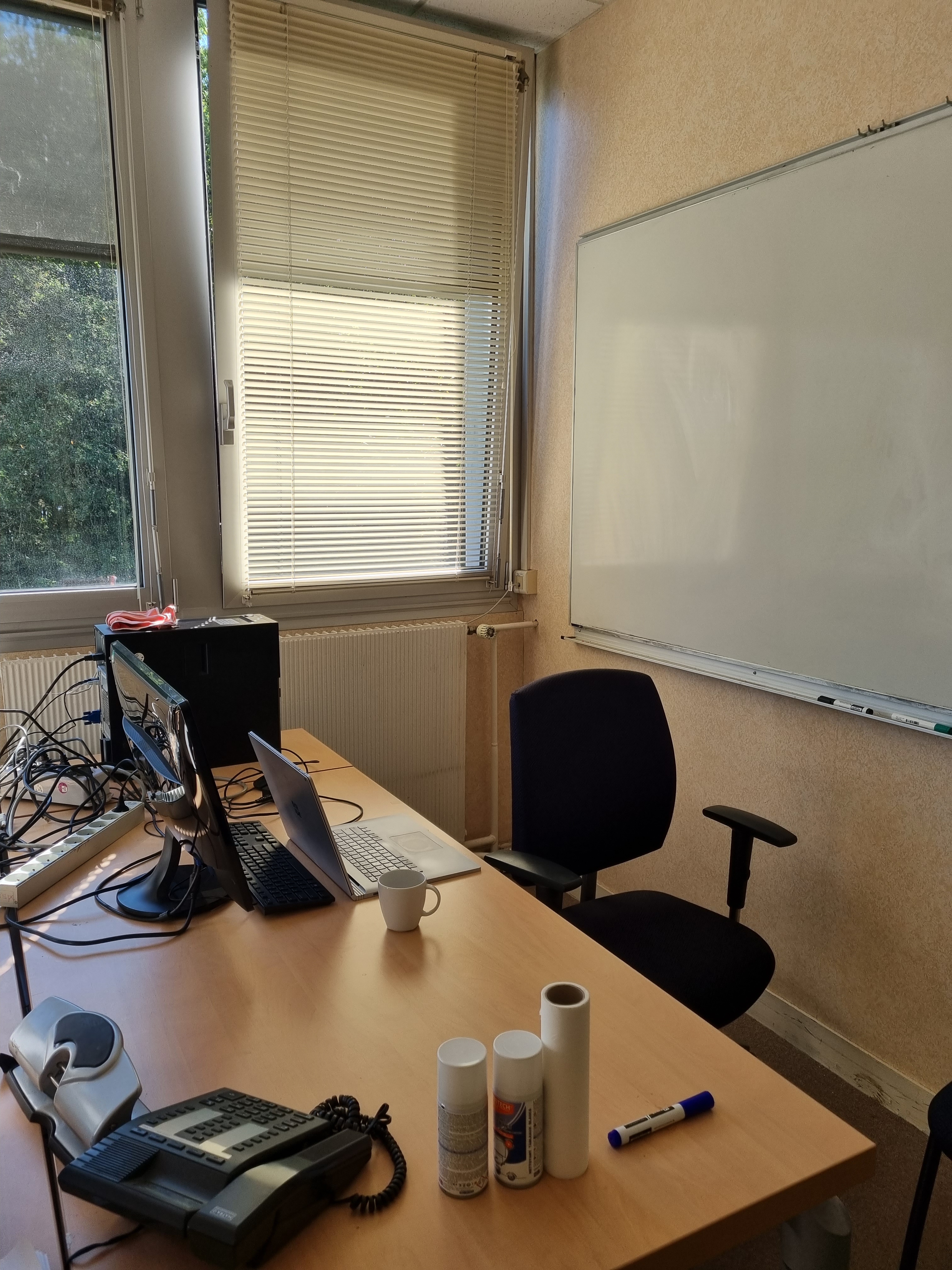
I started work this week in my new position, as a permanent researcher at the Institute for Theoretical Physics of CEA Paris-Saclay. I’m still settling in, figuring out how to get access to the online system and food at the canteen and healthcare. Things are slowly getting into shape, with a lot of running around involved. Until then, I don’t have a ton of time to write (and am dedicating most of it to writing grants!) But I thought, mirroring a post I made almost a decade ago, that I’d at least give you a view of my new office.

Cosmology and the Laws of Physics

Suppose you were an unusual sort of person: one who wanted, above all else, to know the laws of physics. Not content with the rules governing just one sort of thing, a star or an atom or a galaxy, you want to know the fundamental rules behind everything in the universe.

A good reductionist, you know that smaller things are more fundamental: the rules of the parts of things determine the rules of the whole. Knowing about quantum mechanics, you know that the more precisely you want to pin down something’s position, the more uncertain its momentum will be. And aware of special relativity, you know that terms like “small thing” or “high momentum” are relative: things can look bigger or smaller, faster or slower, depending on how they move relative to you. If you want to find the most fundamental things then, you end up needing not just small things or high momenta, but a lot of energy packed into a very small space.

You can get this in a particle collider, and that’s why they’re built. By colliding protons or electrons, you can cram a lot of energy into a very small space, and the rules governing that collision will be some of the most fundamental rules you have access to. By comparing your measurements of those collisions with your predictions, you can test your theories and learn more about the laws of physics.

If you really just wanted to know the laws of physics, then you might thing cosmology would be less useful. Cosmology is the science of the universe as a whole, how all of the stars and galaxies and the space-time around them move and change over the whole history of the universe. Dealing with very large distances, cosmology seems like it should take you quite far away from universal reductionist physical law.

If you thought that, you’d be missing one essential ingredient: the Big Bang. In the past, the universe was (as the song goes) in a hot dense state. The further back in time you look, the hotter and denser it gets. Go far enough back, and you find much higher energies, crammed into much smaller spaces, than we can make in any collider here on Earth. That means the Big Bang was governed by laws much more fundamental than the laws we can test here on Earth. And since the Big Bang resulted in the behavior of the universe as a whole, by observing that behavior we can learn more about those laws.

So a cosmologist can, in principle, learn quite a lot about fundamental physics. But cosmology is in many ways a lot harder than working with colliders. In a collider, we can clash protons together many times a second, with measurement devices right next to the collision. In cosmology, we have in a sense only one experiment, the universe we live in. We have to detect the evidence much later than the Big Bang itself, when the cosmic microwave background has cooled down and the structure of the universe has been warped by all the complexities of star and galaxy formation. Because we have only one experiment, all we can do is compare different sections of the sky, but there is only so much sky we can see, and as a consequence there are real limits on how much we can know.

Still, it’s worth finding out what we can know.m Cosmology is the only way at the moment we can learn about physics at very high energies, and thus learn the most fundamental laws. So if you’re someone who cares a lot about that sort of thing, it’s worth paying attention to!