Monthly Archives: May 2023

Enfin, Permanent

My blog began, almost eleven years ago, with the title “Four Gravitons and a Grad Student”. Since then, I finished my PhD. The “Grad Student” dropped from the title, and the mysterious word “postdoc” showed up on a few pages. For three years I worked as a postdoc at the Perimeter Institute in Canada, before hopping the pond and starting another three-year postdoc job in Denmark. With a grant from the EU, three years became four. More funding got me to five (with a fancier title), and now nearing on six. Each step, my contract has been temporary: at first three years at a time, then one-year extensions. Each year I applied, all over the world, looking for a permanent job: for a chance to settle down somewhere, to build my own research group without worrying about having to move the next year.

This year, things have finally worked out. In the Fall I will be moving to France, starting a junior permanent position with L’Institut de Physique Théorique (or IPhT) at CEA Paris-Saclay.
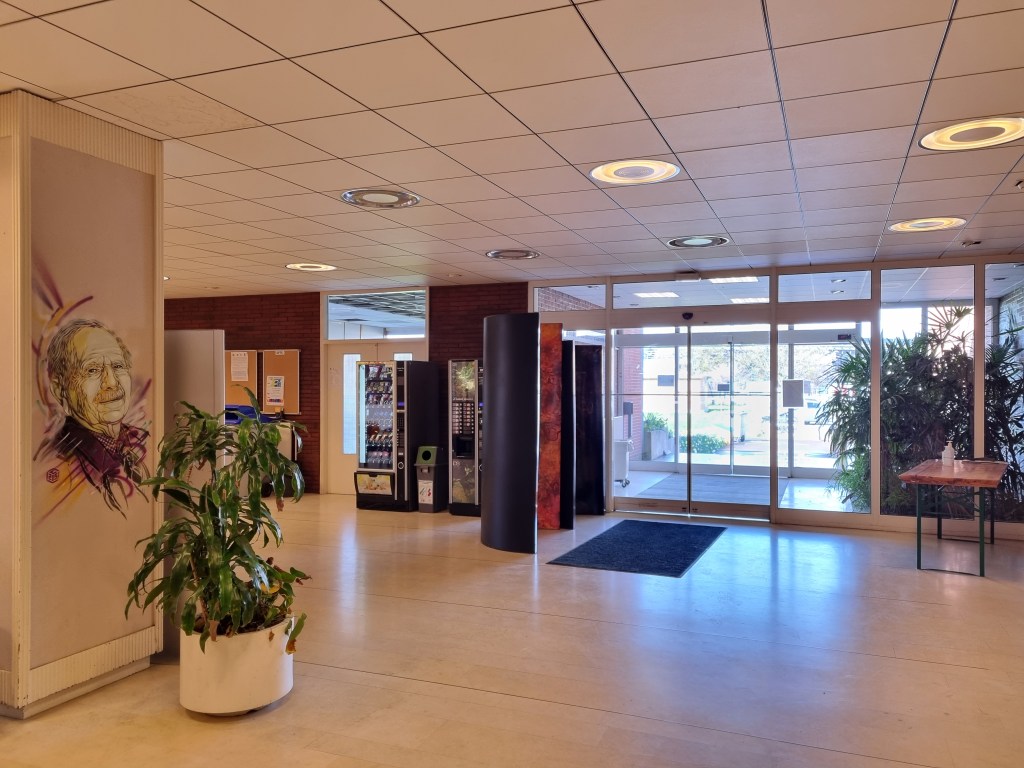
A photo of the entryway to the Institute, taken when I interviewed

It’s been a long journey to get here, with a lot of soul-searching. This year in particular has been a year of reassessment: of digging deep and figuring out what matters to me, what I hope to accomplish and what clues I have to guide the way. Sometimes I feel like I’ve matured more as a physicist in the last year than in the last three put together.

The CEA (originally Commissariat à l’énergie atomique, now Commissariat à l’énergie atomique et aux énergies alternatives, or Alternative Energies and Atomic Energy Commission, and yes that means they’re using the “A” for two things at the same time), is roughly a parallel organization to the USA’s Department of Energy. Both organizations began as a way to manage their nation’s nuclear program, but both branched out, both into other forms of energy and into scientific research. Both run a nationwide network of laboratories, lightly linked but independent from their nations’ universities, both with notable facilities for particle physics. The CEA’s flagship site is in Saclay, on the outskirts of Paris, and it’s their Institute for Theoretical Physics where I’ll be working.

My new position is genuinely permanent: unlike a tenure-track position in the US, I don’t go up for review after a fixed span of time, with the expectation that if I don’t get promoted I lose the job altogether. It’s also not a university, which in particular means I’m not required to teach. I’ll have the option of teaching, working with nearby universities. In the long run, I think I’ll pursue that option. I’ve found teaching helpful the past couple years: it’s helped me think about physics, and think about how to communicate physics. But it’s good not to have to rush into preparing a new course when I arrive, as new professors often do.

It’s also a really great group, with a lot of people who work on things I care about. IPhT has a long track record of research in scattering amplitudes, with many leading figures. They’ve played a key role in topics that frequent readers will have seen show up on this blog: on applying techniques from particle physics to gravitational waves, to the way Calabi-Yau manifolds show up in Feynman diagrams, and even recently to the relationship of machine learning to inference in particle physics.

Working temporary positions year after year, not knowing where I’ll be the next year, has been stressful. Others have had it worse, though. Some of you might have seen a recent post by Bret Deveraux, a military historian with a much more popular blog who has been in a series of adjunct positions. Deveraux describes the job market for the humanities in the US quite well. I’m in theoretical physics in Europe, so while my situation hasn’t been easy, it has been substantially better.

First, there’s the physics component. Physics has “adjunctified” much less than other fields. I don’t think I know a single physicist who has taken an adjunct teaching position, the kind of thing where you’re paid per course and only to teach. I know many who have left physics for other kinds of work, for Wall Street or Silicon Valley or to do data science for a bank or to teach high school. On the other side, I know people in other fields who do work as adjuncts, particularly in mathematics.

Deveraux blames the culture of his field, but I think funding also must have an important role. Physicists, and scientists in many other areas, rarely get professor positions right after their PhDs, but that doesn’t mean they leave the field entirely because most can find postdoc positions. Those postdocs are focused on research, and are often paid for by government grants: in my field in the US, that usually means the Department of Energy. People can go through two or sometimes even three such positions before finding something permanent, if they don’t leave the field before that. Without something like the Department of Energy or National Institutes of Health providing funding, I don’t know if the humanities could imitate that structure even if they wanted to.

Europe, in turn, has a different situation than the US. Most European countries don’t have a tenure-track: just permanent positions and fixed-term positions. Funding also works quite differently. Department of Energy funding in the US is spread widely and lightly: grants are shared by groups of theorists at a given university, each getting funding for a few postdocs and PhDs across the group. In Europe, a lot of the funding is much more concentrated: big grants from the European Research Council going to individual professors, with various national and private grants supplementing or mirroring that structure. That kind of funding, and the rarity of tenure, in turn leads to a different kind of temporary position: one not hired to teach a course but hired for research as long as the funding lasts. The Danish word for my current title is Adjunkt, but that’s as one says in France a faux ami: the official English translation is Assistant Professor, and it’s nothing like a US adjunct. I know people in a variety of forms of that kind of position in a variety of countries, people who landed a five-year grant where they could act like a professor, hire people and so on, but who in the end were expected to move when the grant was over. It’s a stressful situation, but at least it lets us further our research and make progress, unlike a US adjunct in the humanities or math who needs to spend much of their time on teaching.

I do hope Deveraux finds a permanent position, he’s got a great blog. And to return to the theme of the post, I am extremely grateful and happy that I have managed to find a permanent position. I’m looking forward to joining the group at Saclay: to learning more about physics from them, but also, to having a place where I can start to build something, and make a lasting impact on the world around me.
Traveling This Week

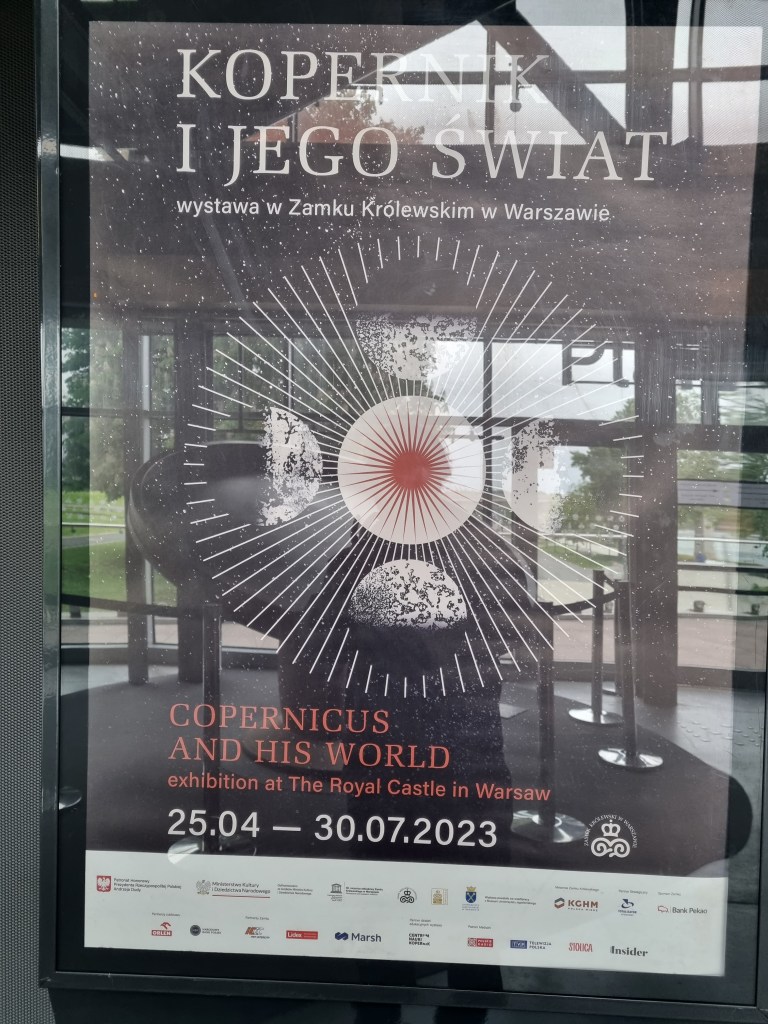
I’m traveling this week, so this will just be a short post. This isn’t a scientific trip exactly: I’m in Poland, at an event connected to the 550th anniversary of the birth of Copernicus.

Not this one, but they do have nice posters!

Part of this event involved visiting the Copernicus Science Center, the local children’s science museum. The place was sold out completely. For any tired science communicators, I recommend going to a sold-out science museum: the sheer enthusiasm you’ll find there is balm for the most jaded soul.

Extrapolated Knowledge

Scientists have famously bad work-life balance. You’ve probably heard stories of scientists working long into the night, taking work with them on weekends or vacation, or falling behind during maternity or paternity leave.

Some of this is culture. Certain fields have a very cutthroat attitude, with many groups competing to get ahead and careers on the line if they fail. Not every field is like that though: there are sub-fields that are more collaborative than competitive, that understand work-life balance and try to work together to a shared goal. I’m in a sub-field like that, so I know they exist.

Put aside the culture, and you’ve still got passion. Science is fun, it’s puzzle after puzzle, topics chosen because we find them fascinating. Even in the healthiest workplace you’d still have scientists pondering in the shower and scribbling notes on the plane, mixing business with pleasure because the work is genuinely both.

But there’s one more reason scientists are workaholics. I suspect, ultimately, it’s the most powerful reason. It’s that every scientist is, in some sense, irreplaceable.

In most jobs, if you go on vacation, someone can fill in when you’re gone. The replacement may not be perfect (think about how many times you watched movies in school with a substitute teacher), but they can cover for you, making some progress on your tasks until you get back. That works because you and they have a shared training, a common core that means they can step in and get what needs to be done done.

Scientists have shared training too, of course. Some of our tasks work the same way, the kind of thing that any appropriate expert can do, that just need someone to spend the time to do them.

But our training has a capstone, the PhD thesis. And the thing about a PhD thesis is that it is, always and without exception, original research. Each PhD thesis is an entirely new result, something no-one else had known before, discovered by the PhD candidate. Each PhD thesis is unique.

That, in turn, means that each scientist is unique. Each of us has our own knowledge, our own background, our own training, built up not just during the PhD but through our whole career. And sometimes, the work we do requires that unique background. It’s why we collaborate, why we reach out to different people around the world, looking for the unique few people who know how to do what we need.

Over time, we become a kind of embodiment of our accumulated knowledge. We build a perspective shaped by our experience, goals for the field and curiosity just a bit different from everyone else’s. We act as agents of that perspective, each the one person who can further our particular vision of where science is going. When we enter a collaboration, when we walk into the room at a conference, we are carrying with us all we picked up along the way, each a story just different enough to matter. We extrapolate from what we know, and try to do everything that knowledge can do.

So we can, and should, take vacations, yes, and we can, and should, try to maintain a work-life balance. We need to to survive, to stay sane. But we do have to accept that when we do, certain things won’t get done as fast. Our own personal vision, our extrapolated knowledge…will just have to wait.

Bottlenecks, Known and Unknown

Scientists want to know everything, and we’ve been trying to get there since the dawn of science. So why aren’t we there yet? Why are there things we still don’t know?

Sometimes, the reason is obvious: we can’t do the experiments yet. Victorian London had neither the technology nor the wealth to build a machine like Fermilab, so they couldn’t discover the top quark. Even if Newton had the idea for General Relativity, the telescopes of the era wouldn’t have let astronomers see its effect on the motion of Mercury. As we grow (in technology, in resources, in knowledge, in raw number of human beings), we can test more things and learn more about the world.

But I’m a theoretical physicist, not an experimental physicist. I still want to understand the world, but what I contribute aren’t new experiments, but new ideas and new calculations. This brings back the question in a new form: why are there calculations we haven’t done yet? Why are there ideas we haven’t had yet?

Sometimes, we can track the reason down to bottlenecks. A bottleneck is a step in a calculation that, for some reason, is harder than the rest. As you try to push a calculation to new heights, the bottleneck is the first thing that slows you down, like the way liquid bubbles through the neck of a literal bottle. If you can clear the bottleneck, you can speed up your calculation and accomplish more.

In the clearest cases, we can see how these bottlenecks could be solved with more technology. As computers get faster and more powerful, calculations become possible that weren’t possible before, in the same way new experiments become possible with new equipment. This is essentially what has happened recently with machine learning, where relatively old ideas are finally feasible to apply on a massive scale.

In physics, a subtlety is that we rarely have access to the most powerful computers available. Some types of physics are done on genuine supercomputers, but for more speculative or lower-priority research we have to use small computer clusters, or even our laptops. Something can be a bottleneck not because it can’t be done on any computer, but because it can’t be done on the computers we can afford.

Most of the time, bottlenecks aren’t quite so obvious. That’s because in theoretical physics, often, we don’t know what we want to calculate. If we want to know why something happens, and not merely that it happens, then we need a calculation that we can interpret, that “makes sense” and that thus, hopefully, we can generalize. We might have some ideas for how that calculation could work: some property a mathematical theory might have that we already know how to understand. Some of those ideas are easy to check, so we check, and make progress. Others are harder, and we have to decide: is the calculation worth it, if we don’t know if it will give us the explanation we need?

Those decisions provide new bottlenecks, often hidden ones. As we get better at calculation, the threshold for an “easy” check gets easier and easier to meet. We put aside fewer possibilities, so we notice more things, which inspire yet more ideas. We make more progress, not because the old calculations were impossible, but because they weren’t easy enough, and now they are. Progress fuels progress, a virtuous cycle that gets us closer and closer to understanding everything we want to understand (which is everything).